
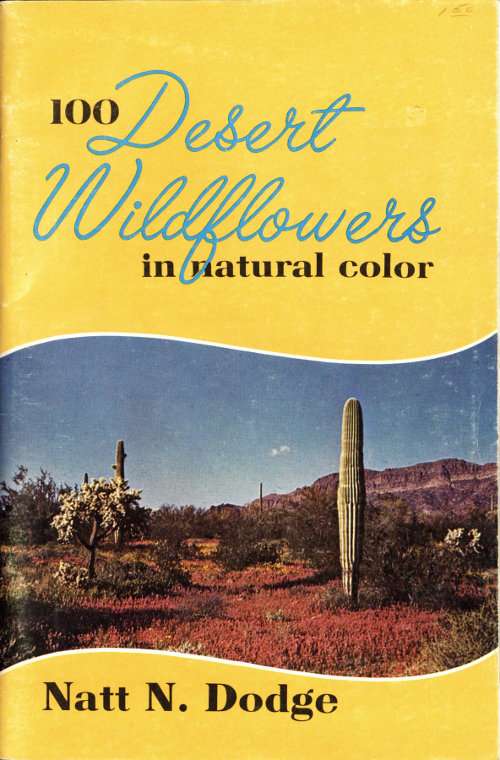
The Project Gutenberg eBook of 100 Desert Wildflowers in Natural Color
Title: 100 Desert Wildflowers in Natural Color
Author: Natt N. Dodge
Release date: April 29, 2017 [eBook #54631]
Most recently updated: October 23, 2024
Language: English
Credits: Produced by Stephen Hutcheson and the Online Distributed
Proofreading Team at http://www.pgdp.net
100 Desert Wildflowers
in natural color
Photography & Text
Natt N. Dodge
SOUTHWESTERN MONUMENTS ASSOCIATION
Copyright 1963 by the Southwestern Monuments Association. All rights reserved. No part of this book may be reproduced in any form without permission in writing from the publisher, except by a reviewer who may quote brief passages in a review to be printed in a magazine or newspaper.
Library of Congress Catalog Card Number: 63-13471
First Printing, 1963—20,000
Second Printing, 1965—20,000
Third Printing, (revised) 1967—20,000
Printed in the United States of America
W. A. Krueger Co., Tyler Div. · Phoenix, Arizona
Contents
- Hints for Flower Photographers 1
- Introduction 1
- The Desert 1
- Why and When Do Deserts Bloom? 1
- Identifying Desert Wildflowers 3
- Spring gives an Evening Party 4
- 1. Longleaf ephedra 5
- 2. Common reed 5
- 3. Prairie spiderwort 6
- 4. Desertlily 6
- 5. Mariposa 7
- 6. Golden mariposa 7
- 7. Desert mariposa 8
- 8. Soaptree yucca 8
- 9. Joshua-tree 9
- 10. Torrey yucca 9
- 11. Giant yucca 10
- 12. Sacahuista 10
- 13. Sotol 11
- 14. Agave 11
- 15. Parry agave 12
- 16. Lechuguilla 12
- 17. Canaigre 13
- 18. Trailing-four-o’clock 13
- 19. Sand-verbena 14
- 20. Mexican goldpoppy 14
- 21. Pricklepoppy 15
- 22. Evening-primrose 15
- 23. Spectaclepod 16
- 24. Bladderpod 16
- 25. Western-wallflower 17
- 26. False-mesquite 17
- 27. Catclaw-acacia 18
- 28. Mescat-acacia 18
- 29. Honey mesquite 19
- 30. Senna 19
- 31. Blue palo-verde 20
- 32. Bird-of-Paradise-flower 20
- 33. Lupine 21
- 34. Adonis lupine 21
- 35. Smoke-thorn 22
- 36. Dalea 22
- 37. Tesota 23
- 38. Woolly loco 23
- 39. Heron-bill 24
- 40. Creosotebush 24
- 41. Arizona-poppy 25
- 42. Desert-mallow 25
- 43. Five-stamen tamarisk 26
- 44. Yellow mentzelia 26
- 45. Rock-nettle 27
- 46. Night-blooming cereus 27
- 47. Saguaro 28
- 48. Organpipe cactus 28
- 49. Claretcup echinocereus 29
- 50. Strawberry echinocereus 29
- 51. Rainbow echinocereus 30
- 52. Yellow pitaya echinocereus 30
- 53. Barrel cactus 31
- 54. Fishhook cactus 31
- 55. Beavertail cactus 32
- 56. Engelmann pricklypear 32
- 57. Jumping cholla 33
- 58. Pencil cholla 33
- 59. Whipple cholla 34
- 60. Walkingstick cholla 34
- 61. Evening-primrose 35
- 62. Ocotillo 35
- 63. Field bind-weed 36
- 64. Santa Fe phlox 36
- 65. Starflower 37
- 66. Phacelia 37
- 67. Nama 38
- 68. Buffalobur 38
- 69. Silverleaf nightshade 39
- 70. Sacred datura 39
- 71. Tree tobacco 40
- 72. Ceniza 40
- 73. Desert beardtongue 41
- 74. Palmer penstemon 41
- 75. Paintbrush 42
- 76. Owl-clover 42
- 77. Desert-willow 43
- 78. Trumpet-bush 43
- 79. Louisiana broomrape 44
- 80. Coyote-melon 44
- 81. Snake-weed 45
- 82. Desertstar 45
- 83. Mohave aster 46
- 84. Fleabane 46
- 85. Broom baccharis 47
- 86. Desert zinnia 47
- 87. Brittle-bush 48
- 88. Silverleaf enceliopsis 48
- 89. Crown-beard 49
- 90. Douglas coreopsis 49
- 91. Paperflower 50
- 92. Desert baileya 50
- 93. Goldfields 51
- 94. Chaenactis 51
- 95. Douglas groundsel 52
- 96. New Mexico thistle 52
- 97. Desert dandelion 53
- 98. Malacothryx 53
- 99. White cupfruit 54
- 100. Prickly sowthistle 54
- Suggestions for Additional Reading 56
- Index 58
Hints for Flower Photographers
If your interest in desert flowers includes a desire to obtain beautiful photographs of them, the following “tips” may be helpful.
MOTION is a major hazard in still photography, and flowers, especially those on long, slender stems, seem to be constantly in motion stimulated by the ever-present desert breeze. The practical solution to this problem is to take your photographing jaunts, if possible, in the early morning when the air is most likely to be motionless. A flower picture blurred by motion is a complete flop!
Except for motion, nothing will irritate you more often than the abrupt, frequent, and marked CHANGES IN LIGHTING due to small clouds passing over the sun. Again, early morning has an advantage in normally cloudless desert skies. Clouds may be expected after 10 o’clock on many days.
DEPTH OF FIELD is highly important in flower photography, and you will be gratified with the results if you take pains to have all parts of the picture, except the background, in sharp focus. This desirable objective has become less difficult to attain with the advent of “faster” films which enable you to use the required small diaphragm “stop” without too greatly reducing the shutter speed, and still obtain adequate exposures.
Too many flower photographers fail to get really CLOSE UP PICTURES. A single blossom or a small cluster of blossoms provides a much more attractive and significant picture than an entire plant. One blossom with, perhaps, a bud, one fruit, and a trace of foliage, if well composed, is tops among flower pictures. This objective requires camera equipment with the ability to focus on objects close to the lens. Also it complicates the goal of getting all parts of the picture into sharp focus.
UNCLUTTERED BACKGROUNDS are a “must” in flower pictures. You might consider joining the flower photographers who carry with them plain gray or variously tinted background cards or light-weight boards. Such a card or board of contrasting color, when placed behind the blossom, will accomplish wonders in giving prominence to the flower. One method of obtaining a dark background is to ask someone (if you are a contortionist you can do it yourself) to stand in such a position as to cast a shadow on the ground or foliage behind the subject. The sky makes an excellent background, and you will find it useful whenever you can set your camera below the level of the subject.
With the foregoing points in mind, study the pictures in this booklet with the aim of trying to surpass them in quality. By exercising care and patience, you should be able to do so.
Introduction
The Desert
When Webster defined a desert as a “dry, barren region, largely treeless and sandy” he was not thinking of the 50,000 square mile Great American Desert of the southwestern United States and northern Mexico. Most of it is usually dry and parts may be sandy, but as a whole, it is far from barren and treeless. Heavily vegetated with gray-green shrubs, small but robust trees, pygmy forests of grotesque cactuses and stiff-leaved yuccas, and myriads of herbaceous plants, the desert, following rainy periods, covers itself with a blanket of delicate, fragrant wildflowers. Edmund C. Jaegar, author of several books on deserts, reports that the California deserts alone support more than 700 species of flowering plants.
The late Dr. Forrest Shreve, for many years Director of the Desert Laboratory of the Carnegie Institution near Tucson, Arizona, defined a desert as “a region of deficient and uncertain rainfall.” He divided the Great American Desert into four major sections: (1) Chihuahuan (chee-WAH-wahn), including the Mexican States of Chihuahua and Coahuila (coa-WHEE-lah), southwestern Texas, and south-central New Mexico; (2) Sonoran, including Baja California, southwestern Arizona, and northwestern Sonora; (3) Mojave (moh-HAH-vee), Colorado, including south-eastern California and extreme southern Nevada; (4) Great Basin, including Nevada, Utah, southwestern Idaho and southeastern Oregon.
Since the steppes and mesas of the Great Basin Desert have generally lower temperatures, higher elevations, and greater precipitation than the other three sections, we are not including its flowers in this work.
Why and When Do Deserts Bloom?
The Great American Desert produces, when conditions are favorable, a gorgeous exhibition of wildflowers. Trees, shrubs, and herbs all contribute to the splendor of the display. Soil composition, slope and exposure, suitable temperatures, and adequate moisture are essential to plant growth and flower production.
Moisture is the uncertain factor, and years may pass without enough rainfall to stimulate plant growth. Rain of less than 0.15 inch is wasted as far as desert plants are concerned, for the moisture evaporates before penetrating the soil. Some annuals produce seeds having water-soluble germination inhibitors in their coverings, hence fail to sprout, even after rain, unless the moisture totals at least half an inch.
When soil moisture from December and January rainfall is enough to support potential plants it dissolves the seed coats, and the desert floor is soon carpeted with eager green seedlings. When winter rains are scant, as is so often the case, the dormant seed population fails to germinate and the spring flower display doesn’t appear. There is no sure way to forecast a spectacular blossom year, for a sudden cold wave or period of drying winds may literally nip in the bud a potential season of brilliant bloom. A great flower year may occur only once in a decade.
Perennials are more dependable than annuals, since some of them, particularly cactuses and other succulents, have water storage tissues in their stems or roots. These perennials may be counted on to blossom each year, but with much less abandon than after winters of above normal precipitation. Many perennials have surprisingly extensive root systems. Fascinating are the ways by which plants manage to thrive under severe conditions of desert heat and drought. As we have seen, most annuals lie dormant as seeds until suitable moisture and temperature occur. Then they grow very rapidly, to bloom and mature seeds while the soil still has moisture. Winter rains produce spring-blooming ephemerals, and summer showers produce summer “quickies.”
Another group of plants, including the ocotillo (oh-koh-TEE-yoh), slows down life processes to become dormant during dry periods, even to dropping all leaves. When rains come they put on new leaves, several times a year if necessary.
Cactuses and other succulents gorge themselves with water when the soil is wet, releasing moisture very sparingly from storage tissues during the “long dry.” Some have discarded or reduced foliage, or have covered leaf surfaces with varnish or wax, to decrease to a minimum the loss of vital moisture through transpiration.
Identifying Desert Wildflowers
Unless you are a botanist, identification of flowers by measuring and counting their various parts, as described in technical keys, is generally too complicated to be practical. Several years ago, recognizing this problem, I authored a book, Flowers of the Southwest Deserts, illustrated by Jeanne R. Janish and published by the Southwestern Monuments Association, designed to aid the wildflower fancier in plant identification by color-grouping the flowers. With Mrs. Janish’s superb illustrations pointing out each plant’s most obvious characteristics, it has proved an excellent field guide. However, the demand for natural color flower portraits could not go unheeded, and this book is the result. The two books complement each other, although each fills a need in its own right. Used together, they make you more positive of some identifications.
Probably the best way to become acquainted with a flower is to be introduced to it by someone. But there is one catch to this method—one plant may be known by many aliases.
When the Spaniards came into the Southwest over 400 years ago they found Indians had names for some flowers in their own languages. The Spaniards added their names, and later the Americans added English names. Some of these names were of similar-appearing but quite different flowers they had known “back East.” Later, scientists studied the desert plants, and gave them all Latin names.
To assist in standardizing names of desert flowers, this booklet gives preference in its headings to scientific and common names found in Arizona Flora, by Kearney and Peebles, Second Edition, 1960. Common names found in Texas Plants, A Checklist and Ecological Summary, 1962, by F. W. Gould, also have been used. In addition, placed within the text, are some of the more widely used common names that we have encountered. Tree names, both common and scientific, follow the Checklist of Native and Naturalized Trees of the United States, by Elbert L. Little, Jr., 1953.
There are many desert flowers, some quite common, for which there was not space in this booklet. If you wish to broaden your acquaintance to include more, we recommend, for added reading publications listed in the back.
The author wishes to express here sincere thanks to Mrs. Pauline M. Patraw, Santa Fe botanist, for assistance in identifying many of the flowers pictured here. For assistance in checking identifications, the author is indebted to Miss Barbara Lund, Park Naturalist, National Park Service; to Dr. Charles T. Mason, Jr., Curator of the Herbarium, University of Arizona Tucson; and to Dr. W. B. McDougall, Curator of Botany, Museum of Northern Arizona, Flagstaff.
Spring gives an Evening Party
When Paloverde trims her golden gown,
And Deerhorn dons her filaments of white;
When tall Saguaro fits his fragrant crown
In preparation for the party night;
When bats across the ruby sunset dance,
When Ocotillo lights his candle’s flame,
When verdure carpets Desert’s wide expanse,
Then Spring is in the Southwest once again.
The linnets in their scarlet vests and caps
Are first to answer Spring’s insistent call,
While white-crowned sparrows scan their travel maps,
Discussing details of the coming ball.
Then thrashers practice every morn and eve
The songs they’ll sing upon that night of nights,
While phainopeplas, in their haste to leave,
Dash back and forth in short, impatient flights.
The desert halls glow bright as time draws near.
Each cactus wears her frilled and perfumed dress.
Ground squirrels, for this joyous time of year,
Sport their best furs. The rabbits do no less.
From far and near the desert folk have come
To wait their hostess, Spring, who, very soon,
Will lift stars o’er the skyline, one by one,
And then turn on the glorious, golden moon.
1. Longleaf ephedra
Commonly called “Mormon tea,” there are many species of ephedra (ef-FED-rah) growing throughout the Southwest. This yellow-green, stringy-stemmed shrub with tiny, scale-like leaves, is usually 3 to 4 feet tall, but sometimes reaches a height of 12 feet. Its small, fragrant, springtime flowers grow in dense clusters that attract insects. Some species provide winter forage for cattle and are said to be browsed by bighorn sheep. Pioneers brewed a palatable drink from the dried stems. Certain Indian tribes considered the brew a tonic, beneficial for treatment of syphilis and other diseases. The drug, ephedrine, comes from a Chinese member of this genus.
Ephedra trifurca Jointfir Family
LONGLEAF EPHEDRA
2. Common reed
Somewhat resembling bamboo, carrizo grows in dense thickets in marshes, along river banks, and in other wet locations. Largest of the grasses, it sometimes attains a height of 12 feet. The large, tassel-like flower heads appear from July to October and create a spectacular mass display. The horizontal rootstalks interlock, crowding out other plants. A single rootstalk may extend 30 feet. The straight, hollow stems served Indians as arrowshafts, pipestems, and loom rods. Along the Mexican border the leaves are woven into mats and the long, sturdy stems are used as screens and in roofing native houses.
Phragmites communis Grass Family
COMMON REED
3. Prairie spiderwort
Because of its slender, drooping leaves, this delicate blue-to-violet, three-petaled flower might easily be mistaken for a lily. Plants grow from 8 to 18 inches high. A perennial, the spiderwort’s thick, succulent roots enable it to produce blossoms from April to September. Not abundant, it is usually found in moist locations in desert mountain ranges at elevations above 2,500 feet. Flowers form in clusters at the tip of a plant’s stem, and are pollenized by bumblebees that eat the pollen.
Tradescantia occidentalis Spiderwort Family
PRAIRIE SPIDERWORT
4. Desertlily
Limited in its range to the desertlands of southern California and southwestern Arizona, the desertlily or ajo (AH-hoe) resembles a small easter lily. During dry seasons the plants do not bloom, but following wet winters each deeply-buried bulb sends up a vigorous shoot which may be from 6 inches to 2 feet tall, with a bud cluster at its tip. The delicately fragrant flowers may appear in late February, with some tardy bloomers still in evidence in early May. Bulbs were dug and eaten by Indians and, because of their flavor, were called ajo (garlic) by the Spanish pioneers. The town of Ajo and a nearby valley and mountain range in southwestern Arizona were named for this plant.
Hesperocallis undulata Lily Family
DESERTLILY
5. Mariposa
Similar in appearance to the segolily, State flower of Utah, weakstem mariposa, sometimes called “straggling butterfly lily,” varies in color from white to pale purple. The slender stem is not erect, like other mariposas, of which there are many species, but wanders over the ground or makes its twisting way among the branches of low shrubs. It grows at elevations up to 4,000 feet on slopes and benches of mountains of the Mojave-Colorado Desert, in the Death Valley area, and in the desert mountains of southern Arizona, blossoming during April and May. Indians and pioneers ate the bulbs.
Calochortus flexuosus Lily Family
MARIPOSA
6. Golden mariposa
Considered by some botanists as a distinct species, this mariposa or “butterfly tulip” is found in the higher mountains of the eastern Mojave-Colorado Desert and also in the vicinity of the Painted Desert of northern Arizona. Common in Petrified Forest National Park from May to July, the bright yellow flowers make an eye-catching display among the colorful pieces of petrified wood covering the ground. The bulbs can withstand severe cold, but suffer during winters when there is frequent freezing and thawing.
Calochortus nuttalii aureus Lily Family
GOLDEN MARIPOSA
7. Desert mariposa
Brightest of the mariposas, the short-stemmed, flame-like flowers usually appear singly, but may occur in patches, producing in April a spectacular display visible from a long distance. Plants growing under bushes elongate their stems to elevate their blossoms into the sunlight. Occasional in the Mojave-Colorado Desert, this species is abundant in the foothills of some of southern Arizona’s mountain ranges, exceeding even the goldpoppy in the neon-like brilliance of display. Mariposa is Spanish for butterfly, and the genus name calochortus is Greek for beautiful grass.
Calochortus kennedyi Lily Family
DESERT MARIPOSA
8. Soaptree yucca
Common throughout the Southwest, the many species of yuccas (YUH-kuhs) are of two major groups, the narrow-leaf and the wide-leaf. Called “soaptree” because of its height (maximum 30 feet) and the fact that its roots contain saponin, soaptree yucca or palmilla (pahm-EE-yah—“little palm”) belongs in the narrow-leaf group. From southwestern Arizona across southern New Mexico, and from west Texas southward into the Mexican states of Chihuahua and Sonora, this spectacular plant blossoms in May and June on desert grasslands from 2,000 to 6,000 foot elevations. Cattle eat the young flower stalks, and Indians used the leaf fibers for making fabrics, basketry, and other items. The yucca is the State flower of New Mexico.
Yucca elata Lily Family
SOAPTREE YUCCA
9. Joshua-tree
Another of the narrow-leaf yuccas and largest of the genus, the joshua-tree is restricted in its range to the Mojave-Colorado Desert, of which it is the principal indicator. Blossoms, which do not open as wide as those of other species, grow in tight clusters at the tips of the branches, appearing in March and April. Joshuas do not blossom every year, the interval between flowerings depending upon rainfall and temperature. A small night lizard is dependent upon the joshua-tree, at least 25 {species of birds find nesting sites in it, and numerous insects, spiders, and scorpions live in its dried leaves and fallen branches.}
Yucca brevifolia Lily Family
JOSHUA-TREE
10. Torrey yucca
Unlike the narrow-leaf soaptrees which produce dry, capsular fruits, the wide-leaf yuccas bear fleshy fruits which Indians cooked and ate. Indians also used the leaf fibers in weaving fabrics. Roots contain saponin and the Indians still cut them up and use the pieces for soap, especially as a shampoo. The stiff, fleshy leaves with needle-sharp tips give the plant the name “Spanish bayonet.” Torrey yucca blooms in April in southeastern New Mexico and west Texas, with similar plants, Yucca schottii in southern Arizona, and Yucca schidigera in the Mojave-Colorado Desert.
Yucca torreyi Lily Family
TORREY YUCCA
11. Giant yucca
Massive and thick-stemmed, the locally-named “giant dagger” is supposedly limited in its native range in the United States to Brewster County, Texas. A colony (Yucca faxoniana) resembling this species has been reported recently in McKittrick Canyon in the Guadalupe Mountains. An extensive forest of these spectacular plants has given the name Dagger Flat to a broad valley in the Sierra del Carmen of Big Bend National Park. Usually blossoming in April, the massive, white flower clusters gracing the crowns of thousands of these majestic yuccas create a never-to-be-forgotten spectacle. A small night-flying moth is the yuccas’ pollenizing agent and, in return for this essential service, lays her eggs in the plants’ ovaries where the young feed on the developing seeds.
Yucca carnerosana Lily Family
GIANT YUCCA
12. Sacahuista
Sometimes confused with the yuccas, the several species of “beargrass” or “basketgrass” have pliant, grasslike leaves, small flowers, and papery fruits. The plumelike blossom panicles open in May and June. The plants favor rocky hillsides, and rarely occur on valley floors. Indians roasted the tender bud stalks for food, and cattle browse the leaves when other vegetation is lacking. Mexicans, in weaving basketry, use the entire leaves, which are especially desirable for fashioning basket handles.
Nolina microcarpa Lily Family
SACAHUISTA
13. Sotol
Also likely to be confused with the yuccas, sotol has a basal cluster of pliant, ribbonlike leaves edged with hooked thorns, and a tall flower stalk bearing at its upper end a dense panicle of small, creamy (sometimes brown) flowers. Blossoming in May and June, the maturing flower clusters remain attractive throughout the summer. Mexicans split the succulent basal crowns and allow the sap to ferment, producing the fiery alcoholic beverage, sotol (SOH-tole). Desert-dwelling bighorn sheep are said to browse the tough leaves. The stiff leaf bases, when pulled from the cluster, form the “desert spoons” sold in some curio stores.
Dasylirion wheeleri Lily Family
SOTOL
14. Agave
Many species of agaves (ah-GAH-vees) or “century plants” attract attention on desert hillsides when they send up their tall blossom stalks in June and July. The thick, fleshy, sharp-tipped leaves form a basal rosette. Some of the larger species may require 10 to 20 years to store enough plant food to produce the sturdy, fast-growing flower stalk. After blossoming, the exhausted plant dies. Agave scabra, one of the spectacular forms, is limited in its range to the Chisos Mountains of Big Bend National Park, Texas.
Agave scabra Amaryllis Family
AGAVE
15. Parry agave
Another of the large “century plants,” Parry agave blooms from June to August, producing spectacular displays on hillsides in northern Mexico, southern New Mexico, and southern Arizona. Some of the larger agaves are called mescal (mess-KAHL) because of a potent alcoholic beverage of that name distilled from the fermented sap derived from the bud stalks. Tequila (tee-KEEL-ah), the famous native drink of Mexico, also is distilled from fermented agave juices, and the beerlike pulque (pool-KAY) has a similar derivation. Indians roasted the bud stalks in stone-lined pits covered with hot rocks. Some of these pits may still be seen.
Agave parryi Amaryllis Family
PARRY AGAVE
16. Lechuguilla
One of the common plants of the Chihauhuan Desert and considered the principal indicator of that region, lechuguilla (lay-chu-GHE-ah) covers the ground so densely in some places that it is impossible to walk through it. The stiff, erect, needle-tipped, banana-shaped leaves are a hazard to man and beast. The flowering stalk, which blossoms in May and June, is unbranched and flexible, bending gracefully in the desert breeze. Deer and cattle nip off the tender buds. Mexicans weave the tough leaf fibers into coarse fabrics; and the roots, called amole, produce suds when rubbed in water.
Agave lechuguilla Amaryllis Family
LECHUGUILLA
17. Canaigre
This coarse, herbacious perennial is one of the early spring flowers of the desert, sometimes blooming along road shoulders and in sandy washes in late February and March. Commonly called wild rhubarb, its sap and roots are high in tannin content, and its delicately pink fruits are more attractive than the blossoms. Indians and Mexicans use the leaves for greens. Papago Indians of Arizona roast the leaves and use the roots for treating colds and sore throat. This plant is a close relative of European dock, several species of which have become naturalized in North America.
Rumex hymenosepalus Buckwheat Family
CANAIGRE
18. Trailing-four-o’clock
Blossoming from April to October, trailing allionia, known in some places as “trailing four o’clock” or “windmills,” is a spreading annual with small but colorful blossoms on long, trailing stems. The prostrate branches are sticky, so are often covered with grains of sand and flecks of mica. What appears to be one blossom is actually three flowers, giving it the name “pink three-flower.” It is found on dry, sandy benches throughout desert regions of the Southwest. Fruits are winged.
Allionia incarnata Four o’clock Family
TRAILING-FOUR-O’CLOCK
19. Sand-verbena
One of the early spring flowers, sand-verbena creates spectacular mass displays, sometimes alone, usually intermingling with other colorful early bloomers such as bladderpod and sundrops, which grow on road shoulders and sandy flats. The flowers are delicately fragrant, especially at night. Semi-prostrate in habit, sand-verbena leaves are covered with a dense growth of short, soft hairs which retard the loss of moisture so essential to desert plants. This annual is common from southern California and southern Arizona into Sonora.