
The Project Gutenberg eBook of A Bible Hand-Book
Title: A Bible Hand-Book
Author: F. C. Holliday
Release date: June 3, 2016 [eBook #52232]
Most recently updated: October 23, 2024
Language: English
Credits: Produced by Richard Hulse, Chris Pinfield and the Online
Distributed Proofreading Team at http://www.pgdp.net
Transcriber's Note.
Apparent typographical errors have been corrected. The author's use of hyphens has been retained. Scriptural references have been reproduced as printed. The source is not stated but is most probably the King James version.
The work is divided into books, chapters, and sections. Some sections are divided further: most of the headings of these divisions are not listed in the Table of Contents.
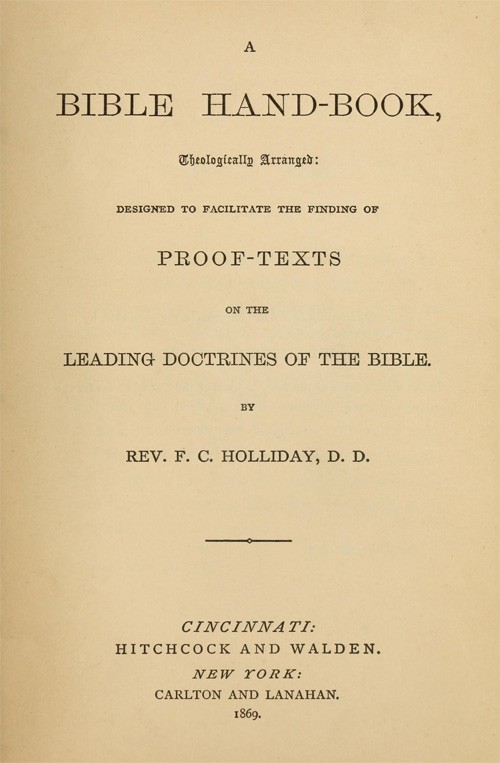
A
BIBLE HAND-BOOK,
Theologically Arranged:
DESIGNED TO FACILITATE THE FINDING OF
PROOF-TEXTS
ON THE
LEADING DOCTRINES OF THE BIBLE.
BY
REV. F. C. HOLLIDAY, D. D.
CINCINNATI:
HITCHCOCK AND WALDEN.
NEW YORK:
CARLTON AND LANAHAN.
1869.
Entered, according to Act of Congress, in the year 1869, by
HITCHCOCK & WALDEN,
In the Clerk's Office of the District Court of the United States for the Southern District of Ohio.
PREFACE.
This work has engaged the author's attention, at intervals, for several years; and is the result of the labor of such leisure moments as could be snatched from the more pressing duties of an active pastorate.
It will be found a time saver to all students of the Bible, and a convenient help to young ministers and Sunday-School teachers. Trusting that the Divine blessing will rest upon this humble effort to make the Bible its own expositor on the topics herein presented, the author submits it to the public.
CONTENTS.
| page. | ||
| BOOK I. | ||
| Doctrines Relating to God | 21 | |
| CHAPTER I. | ||
| 1. | Existence | 26 |
| 2. | God Self-Existent | 26 |
| CHAPTER II. | ||
| ATTRIBUTES. | ||
| 1. | Unity | 27 |
| 2. | Spirituality | 28 |
| 3. | Eternity | 28 |
| 4. | Immutability | 29 |
| 5. | Omnipotence | 29 |
| (1.) Shown by the Fact of Creation, 29. (2.) By the Vastness and Variety of His Works, 30. (3.) The Ease with which He is said to Create and Uphold All Things, 30. (4.) Terrible Descriptions of Divine Power, 31. (5.) By the Universality of His Dominion, as well over Intelligent Beings as over the Material Universe, 32. (6.) Direct Scriptures, 33. | ||
| 6. | Omnipresence | 34 |
| 7. | Omniscience | 34 |
| 8. | Wisdom | 36 |
| 9. | Goodness | 36 |
| 10. | Holiness | 38 |
| 11. | Justice and Truth | 39 |
| 12. | Majesty and Glory | 40 |
| CHAPTER III. | ||
| PERSONS OF THE GODHEAD. | ||
| 1. | Trinity | 44 |
| 2. | Three Persons, and three only, are spoken of under Divine Titles | 44 |
| 3. | Baptism is in the Name of Three Divine Persons | 45 |
| 4. | The Apostolic Benediction is in the Name of Three Divine Persons | 45 |
| CHAPTER IV. | ||
| DIVINITY OF CHRIST PROVEN. | ||
| 1. | By His Pre-Existence | 45 |
| 2. | He was the Jehovah of the Old Testament | 46 |
| 3. | Divine Titles ascribed to Christ | 48 |
| (1.) He is called God, 48. (2.) He is called Lord, 48. (3.) He is called the Son of God, 50. (4.) Christ, as the Son of God, calls God Father, 51. (5.) Christ, as the Son of God, is distinguished from Created Beings by the Phrase, "Begotten, Only Begotten," etc. (6.) Christ is One with the Father, 52. (7.) The Same Things are spoken of God the Father and of Christ, 52. (8.) Equal with God, 53. (9.) Styled God's Fellow, 53. (10.) Called Word of God, 53. | ||
| 4. | Divine Attributes Possessed by Him | 53 |
| (1.) Eternity, 53. (2.) Omniscience, 54. (3.) Omnipotence, 54. | ||
| 5. | Divine Acts are attributed to Him | 54 |
| (1.) Creation, 54. (2.) Preservation, 55. (3.) The Final Destruction of the Material Universe is attributed to Christ, 55. (4.) Christ claimed to perform the Works of His Father, and to possess Original Miraculous Power, 55. (5.) He promised to send the Holy Ghost, 56. (6.) He gave the Holy Ghost, 56. (7.) He forgave Sins, 56. | ||
| 6. | Divine Worship paid to Him | 57 |
| (1.) Before His Ascension, 57. (2.) After His Ascension, 57. (3.) Adored by Angels, 58. (4.) Doxologies to Christ, 58. (5.) But to Worship any Being or Thing but God is Idolatry, 58. | ||
| CHAPTER V. | ||
| THE PERSON OF CHRIST. | ||
| 1. | His Humanity | 59 |
| 2. | The Union of Two Natures in One Hypostasis | 59 |
| CHAPTER VI. | ||
| THE HOLY GHOST. | ||
| 1. | Proceeds from the Father and Son | 60 |
| 2. | His Personality | 60 |
| 3. | His Deity | 62 |
| (1.) The Subject of Blasphemy, 62. (2.) Divine Titles ascribed to Him, 62. (3.) Possessed of Divine Attributes, 62. a. Eternity, 62. b. Omnipresence, 62. c. Omniscience, 62. d. Holiness—He is styled the Holy Ghost, 63. e. Goodness, 63. f. Grace, 63. g. Truth, 63. | ||
| 4. | He is the Source of Inspiration | 63 |
| 5. | He is the Source of Life | 63 |
| 6. | He is the Author of the New Creation—Regeneration | 63 |
| 7. | He is the Source of Religious Comfort | 63 |
| BOOK II. | ||
| DOCTRINES RELATING TO MAN. | ||
| CHAPTER I. | ||
| MAN'S PRIMEVAL STATE. | ||
| 1. | Made Under Law | 71 |
| 2. | Created in the Image of God | 71 |
| (1.) Dominion, 71. (2.) Spirituality, 72. (3.) Immortality, 72. (4.) Intellectual Powers—Knowledge, 73. (5.) Moral Image of God—Holiness, 74. | ||
| CHAPTER II. | ||
| THE FALL OF MAN. | ||
| 1. | The Temptation—The Serpent the Instrument—The Devil the Real Tempter | 74 |
| 2. | The Transgression | 75 |
| 3. | The Results of the Fall—Physical Evil | 75 |
| (1.) The Ground Cursed for Man's Sake, 75. (2.) Man Doomed to Labor, 75. (3.) Physical Suffering caused by the Fall, 75. (4.) Temporal Death the Result of Sin, 76. | ||
| 4. | Results of the Fall—Moral Evil | 77 |
| (1.) Spiritual Death—Loss of the Divine Image, 77. | ||
| 5. | Man's Moral Nature Corrupted by the Fall | 78 |
| 6. | Depravity Hereditary | 79 |
| 7. | The Extent of Depravity is Total or Universal | 80 |
| (1.) The Will is Depraved, 80. (2.) The Understanding Darkened, 81. (3.) The Affections Corrupt, 82. (4.) The Imagination Vitiated, 82. (5.) Man's Moral Powers Paralyzed, 83. (6.) Man's Utter Helplessness, 83. | ||
| BOOK III. | ||
| Atonement or Redemption | 87 | |
| CHAPTER I. | ||
| REDEMPTION. | ||
| 1. | Necessity for an Atonement | 90 |
| 2. | Redemption by the Death of Christ | 92 |
| 3. | The Death of Christ a Sufficient Atonement for the Sins of the Whole World | 94 |
| 4. | The Death of Christ the Procuring Cause of Man's Salvation | 95 |
| 5. | Benefits of the Death of Christ | 96 |
| (1.) Justification, 96. (2.) Regeneration, 97. (3.) Reconciliation, 98. (4.) Adoption, 98. (5.) Peace, 99. (6.) Witness of the Spirit, 100. (7.) Sanctification, 101. | ||
| CHAPTER II. | ||
| BENEFITS OF THE DEATH OF CHRIST—CONDITIONS OF SALVATION. | ||
| 1. | Repentance—Faith the Instrumental Cause of Man's Salvation | 104 |
| 2. | The Holy Spirit the Efficient Cause of Man's Salvation | 107 |
| CHAPTER III. | ||
| FURTHER BENEFITS OF THE DEATH OF CHRIST. | ||
| 1. | The Right to Pray | 108 |
| 2. | The Power of Prayer | 110 |
| 3. | Divine Providence—General and Special | 112 |
| 4. | Victory over Death | 113 |
| 5. | The Immediate Reception of the Souls of the Pious into a State of Blessedness | 114 |
| 6. | The Resurrection of the Body | 114 |
| CHAPTER IV. | ||
| ELECTION, DECREES, AND FREE-WILL. | ||
| 1. | Election | 117 |
| (1.) The Election of Individuals to perform some Particular Service, 117. (2.) Collective or National Election, 117. (3.) Personal Election, or the Choosing of Individuals to be the Heirs of Eternal Life, 119. | ||
| 2. | Scripture Doctrine of Divine Decrees | 120 |
| 3. | Freedom of the Human Will | 121 |
| CHAPTER V. | ||
| THE DOCTRINE OF A GENERAL JUDGMENT. | ||
| 1. | The Certainty of the Judgment | 123 |
| 2. | The Judgment Subsequent to Death | 124 |
| 3. | The Judgment Subsequent to the Resurrection | 124 |
| 4. | Christ will be the Judge | 126 |
| 5. | The Decisions of the Judgment will be Final and Equitable | 128 |
| 6. | The Award to the Righteous | 129 |
| 7. | The Doom of the Wicked | 131 |
| 8. | Heaven a Place of Eternal Happiness | 133 |
| 9. | Hell a Place of Endless Misery | 136 |
| BOOK IV. | ||
| THE MORAL LAW. | ||
| CHAPTER I. | ||
| THE FIRST COMMANDMENT. | ||
| 1. | Idolatry Forbidden | 146 |
| 2. | God to be Worshiped | 146 |
| 3. | Threatenings against Idolatry | 147 |
| 4. | The Judgments of God inflicted upon the Violators of this Commandment | 147 |
| 5. | Instances of God's Judgments upon Particular Transgressors of this Commandment | 148 |
| 6. | Idolatry Punished with Death | 152 |
| 7. | Idols are but Vanity | 153 |
| 8. | Against Inquiring Concerning Future Events of False Gods and of those professing to have Familiar Spirits | 153 |
| 9. | This Command requires us to have a God, and is therefore against Atheism | 154 |
| 10. | This Command requires Supreme Love to God | 155 |
| CHAPTER II. | ||
| THE SECOND COMMANDMENT. | ||
| 1. | The Use of Images is Forbidden | 156 |
| 2. | Images are not Representations of God | 157 |
| 3. | The Judgments of God upon the Violators of this Command | 157 |
| 4. | Images used by Apostates as Outward Symbols in the Worship of the True God | 159 |
| 5. | Images not to be Worshiped, though enjoined by Human Authority | 160 |
| 6. | Threatenings against Idolatry | 160 |
| 7. | The Following Crimes, as partaking of the Nature of Idolatry, are Prohibited | 161 |
| (1.) Magic, 161. (2.) Sorcery, 163. (3.) Enchantments, 164. (4.) Soothsaying, 164. (5.) Observing of Times, 164. (6.) Witchcraft, 164. (7.) Divination, 166. (8.) Consulting Familiar Spirits, 166. | ||
| 8. | Idolatry is Debasing | 167 |
| CHAPTER III. | ||
| THE THIRD COMMANDMENT. | ||
| 1. | Profane Swearing is Forbidden | 168 |
| 2. | False Swearing is Forbidden | 169 |
| 3. | Swearing by Creatures is Forbidden | 171 |
| 4. | Instances of Swearing to commit Sin or to encourage it | 172 |
| 5. | Civil Oaths Lawful | 173 |
| 6. | Articles of Peace and Private Contracts ratified by an Oath | 174 |
| CHAPTER IV. | ||
| THE FOURTH COMMANDMENT. | ||
| 1. | The Sabbath must be observed as a Day of Rest from Secular Work | 178 |
| 2. | The Sabbath a Day for Religious Worship | 181 |
| 3. | Works of Necessity and Mercy may be done on the Sabbath Day | 182 |
| 4. | The First Day of the Week is the Christian Sabbath | 183 |
| CHAPTER V. | ||
| THE FIFTH COMMANDMENT. | ||
| 1. | This Command requires Reverence and Obedience on the Part of Children | 185 |
| 2. | It requires Reverence to the Aged, whether they are our Parents or not | 186 |
| 3. | God's Judgments against Disobedient Children | 186 |
| 4. | It requires Reverence and Submission to Civil Rulers | 187 |
| CHAPTER VI. | ||
| THE SIXTH COMMANDMENT. | ||
| 1. | Murder is Prohibited | 188 |
| 2. | Threatenings against Murderers | 189 |
| 3. | Cases where Killing a Man is not to be punished with Death | 190 |
| 4. | Human Life authorized to be taken by the Civil Government | 190 |
| 5. | Hatred Forbidden | 191 |
| 6. | Malice Forbidden | 191 |
| 7. | Anger Forbidden | 191 |
| 8. | Wrath Forbidden | 192 |
| 9. | Contention Forbidden | 192 |
| CHAPTER VII. | ||
| THE SEVENTH COMMANDMENT. | ||
| 1. | Statement of the Law | 193 |
| 2. | Threatenings against Fornication and Adultery | 193 |
| 3. | Impure Thoughts Condemned | 197 |
| 4. | Polygamy Forbidden | 197 |
| 5. | Against Divorce | 198 |
| CHAPTER VIII. | ||
| THE EIGHTH COMMANDMENT. | ||
| 1. | Theft Forbidden | 199 |
| 2. | Threatenings against Theft | 199 |
| 3. | Threatenings against Robbery | 200 |
| 4. | Fraud and Cheating Forbidden | 200 |
| 5. | Precepts Concerning Landed Property | 201 |
| 6. | Precepts Concerning Things Found, Loaned, or Intrusted to Others | 201 |
| 7. | Restitution to be made to the Injured | 202 |
| 8. | Threatenings against Oppressors | 202 |
| CHAPTER IX. | ||
| THE NINTH COMMANDMENT. | ||
| 1. | False Swearing is Condemned | 203 |
| 2. | Lying is Forbidden | 204 |
| 3. | Evil Speaking is Condemned | 205 |
| 4. | Slander is Condemned | 206 |
| 5. | Tale-Bearing and Backbiting are Condemned | 206 |
| 6. | Reviling and Railing Condemned | 206 |
| 7. | Unprofitable Conversation Forbidden | 207 |
| 8. | Flattery Forbidden | 207 |
| CHAPTER X. | ||
| THE TENTH COMMANDMENT. | ||
| 1. | Covetousness Condemned | 208 |
| 2. | Unjust Means of Acquiring Property Condemned | 209 |
| 3. | The Folly of Trusting in Riches | 210 |
| BOOK V. | ||
| INSTITUTIONS OF CHRISTIANITY. | ||
| CHAPTER I. | ||
| THE CHURCH. | ||
| 1. | The Church a Divine Institution | 217 |
| 2. | The Unity of the Church under all Dispensations | 218 |
| 3. | God's Dwelling-Place the Church | 220 |
| 4. | The Stability of the Church | 220 |
| 5. | The Church's Prosperity Dependent upon the Divine Blessing | 221 |
| 6. | The Ultimate Universal Triumph of the Church | 221 |
| 7. | The Blessedness of Church Fellowship | 223 |
| 8. | The Duty of Christians toward Each Other | 225 |
| 9. | The Duty of Union with the Church | 226 |
| 10. | Heretics and Disorderly Persons to be Excluded | 227 |
| 11. | Prayers for the Church's Prosperity | 228 |
| 12. | Limits of Christian Fellowship | 229 |
| 13. | The Church Missionary in its Constitution | 230 |
| CHAPTER II. | ||
| THE MINISTRY. | ||
| 1. | Ministers are called of God | 231 |
| 2. | The Preaching of the Gospel the Great Instrument of Human Salvation | 233 |
| 3. | Ministers to be Supported | 236 |
| 4. | Different Orders in the Ministry | 237 |
| 5. | Ministers to be Examples to the Church | 238 |
| CHAPTER III. | ||
| CHRISTIAN BAPTISM. | ||
| 1. | Baptism a Christian Duty | 243 |
| 2. | The Design of Baptism | 244 |
| 3. | Examples of Baptism | 244 |
| 4. | Baptism of Households | 245 |
| 5. | The Spiritual Import and Scriptural Mode of Baptism | 246 |
| CHAPTER IV. | ||
| THE LORD'S SUPPER. | ||
| 1. | Its Institution | 250 |
| 2. | The Obligation upon Christians to Observe It | 251 |
| 3. | The Elements to be Used | 252 |
| BOOK VI. | ||
| CHRISTIAN DUTIES AND PRIVILEGES. | ||
| CHAPTER I. | ||
| PRAYER. | ||
| 1. | Prayer a Duty | 255 |
| 2. | Vocal and Audible | 256 |
| 3. | With Faith and Submission to the Will of God | 257 |
| 4. | With the Spirit of Forgiveness | 258 |
| 5. | Should be Importunate | 258 |
| 6. | Should be in the Name of Christ | 259 |
| 7. | The Posture of the Body in Prayer | 260 |
| 8. | Secret Prayer | 260 |
| 9. | Public and Social Prayer | 261 |
| 10. | Prayer for Temporal Blessings | 262 |
| 11. | Examples of Answers to Prayer | 263 |
| CHAPTER II. | ||
| PRAISE TO GOD. | ||
| 1. | Praise is a Christian Duty | 265 |
| 2. | Praise should be Earnest | 266 |
| CHAPTER III. | ||
| FRUITS OF THE SPIRIT. | ||
| 1. | Love | 267 |
| (1.) Love to God, 267. (2.) The Love of God, 268. (3.) Love to the Brethren, 270. (4.) Love to all Men, 271. | ||
| 2. | Joy | 272 |
| (1.) Rejoice in God, 272. (2.) Rejoice Always, 274. | ||
| 3. | Peace | 275 |
| (1.) Peace with God, 275. (2.) Peace of Mind—Tranquillity, 277. (3.) Disposed to Promote Peace, 278. | ||
| 4. | Long-Suffering | 279 |
| (1.) Patience under Provocation, 279. (2.) Submission to the Will of God, 280. | ||
| 5. | Gentleness | 282 |
| (1.) Must be Kind, 282. (2.) Not Contentious, 283. (3.) Should Help the Feeble, 284. | ||
| 6. | Goodness | 285 |
| (1.) The Right State of the Heart—Be Good, 285. (2.) Doing Good—Beneficence, 286. | ||
| 7. | Meekness | 289 |
| (1.) Christian Lowliness, 289. (2.) Humility, 290. | ||
| 8. | Temperance | 291 |
| (1.) Self-Denial, 291. (2.) Christian Moderation, 292. (3.) Self-Government, 294. | ||
| 9. | Faith | 294 |
| (1.) Belief in God's Word, 294. (2.) Trust in God, 296. (3.) Faith Exemplified, 298. | ||
| CHAPTER IV. | ||
| RELATIVE DUTIES OF CHRISTIANS TOWARD EACH OTHER. | ||
| 1. | To Love One Another | 302 |
| 2. | To Live in Peace | 303 |
| 3. | Christian Forbearance | 303 |
| 4. | Duty to Forgive One Another | 304 |
| 5. | True Friendship | 304 |
| 6. | To be Benevolent | 305 |
| 7. | Liberality Rewarded | 305 |
| 8. | Encouragements to Liberality | 307 |
| CHAPTER V. | ||
| DOMESTIC DUTIES. | ||
| 1. | The Marriage Relation Instituted and Recommended | 308 |
| 2. | Cautions against Improper Marriages | 308 |
| 3. | Mutual Duties of Husbands and Wives | 308 |
| 4. | Duty of Parents to their Children | 309 |
| (1.) To Provide for them, 309. (2.) To Administer Needful Correction, 309. (3.) Encouragements to Parental Faithfulness, 309. | ||
| 5. | Duty of Children to their Parents | 310 |
| 6. | Disobedient Children Punished | 310 |
| 7. | Divorce | 310 |
| 8. | Polygamy | 311 |
| BOOK VII. | ||
| Christian Experience | 315 | |
| CHAPTER I. | ||
| CHRISTIAN EXPERIENCE. | ||
| 1. | Conviction for Sin | 317 |
| 2. | Sinners called upon to Repent | 318 |
| 3. | God Expostulates | 320 |
| 4. | Repentance Demanded | 321 |
| 5. | Repentance includes Sorrow for Sin and Confession | 321 |
| 6. | Genuine Repentance Acceptable to God | 323 |
| 7. | Repentance includes Reformation | 324 |
| 8. | Conversion, including Pardon and Regeneration | 325 |
| CHAPTER II. | ||
| 1. | Evidences of Regeneration | 327 |
| 2. | Christian Holiness | 329 |