
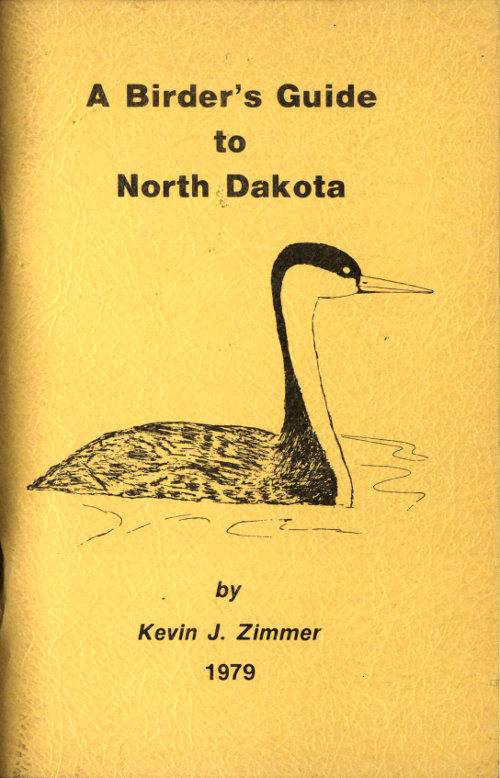
The Project Gutenberg eBook of A Birder's Guide to North Dakota
Title: A Birder's Guide to North Dakota
Author: Kevin J. Zimmer
Release date: October 18, 2016 [eBook #53307]
Most recently updated: October 23, 2024
Language: English
Credits: Produced by Stephen Hutcheson, Dave Morgan and the Online
Distributed Proofreading Team at http://www.pgdp.net
Price $5.00
A Birder’s Guide
to
North Dakota
by
Kevin J. Zimmer
1979
Distributed by
L & P Press
Box 21604
Denver, CO 80221
This book is dedicated to my parents, Bernard and Mary Zimmer, who presented me with all the opportunities that made this book possible.
PREFACE
The area covered by this guide is so large that I could not possibly have written it up without the help of many people.
I particularly wish to thank Bob Randall and Frank Kelley, who provided much of the information used for the Bismarck-Mandan and Grand Forks areas, respectively; my brother and almost constant field companion Barry Zimmer, who helped with many suggestions; Kelly Stonecypher, who provided inspiration and the best kind of moral support; and most importantly, Jim Lane, whose advice, help, and encouragement made this book possible.
Many others helped in some way, either with advice and information, or as field companions. I want to thank the following, and after this has gone to press I will probably think of others: Milan Alby, Steve Allen, Beth Anderson, David L. Bartling, William Buresh, Gary A. Eslinger, Palmer Forness, Ralph Fries, Ann and Bob Gammell, David Goeke, Harold Holt, Harold Kantrud, Art Lies, Donald E. Lindberg, Jon M. Malcolm, Rebecca Quanrud, Robert Rollings, Alan K. Trout, Robert Walkin, Dr. Nathaniel Whitney, Hugh Willoughby, Jim Zimmer, and Bernard and Mary Zimmer.
I would appreciate any suggestions or information for future editions of this book. All such correspondence should be addressed to: Kevin J. Zimmer, L & P Press, Box 21604, Denver, Colorado 80221.
TABLE OF CONTENTS
- Page
- Preface 3
- Introduction 7
- Southeastern North Dakota 15
- Cass, Richland, Sargent, Ransom, Barnes, Stutsman, Kidder, and Logan Counties
- Southwestern North Dakota 33
- Burleigh, Morton, Dunn, Bowman, Slope, and Billings Counties
- Northwestern North Dakota 50
- Dunn, McKenzie, McLean, Burke, Mountrail, Ward, and Divide Counties
- Northeastern North Dakota 62
- McHenry, Bottineau, Rolette, Cavalier, Pembina, Walsh, Grand Forks, Nelson, Benson, and Ramsey Counties
- Specialties of North Dakota 80
- Birds of North Dakota 100
- Index 111
NORTH DAKOTA (Quarters are shown bounded by County Lines, Highways, or Rivers)
INTRODUCTION
North Dakota is a fairly large state (17th among the states in total land area) but a sparsely populated one (45th). Most of the people live in rural areas, because there are few cities of any size; even these are, for the most part, widely scattered. The largest urban area (the tri-city area of Fargo, West Fargo, and Moorhead, Minnesota) has a combined population of under 120,000.
Most people visit North Dakota on their way to someplace else. They rush through because of the lack of big cities and scenic areas. Although it is true that much of the state is anything but scenic, there is great beauty awaiting those who explore the prairie, the rolling, wooded hills of the Turtle Mountains, or the rugged badlands along the Little Missouri River.
Over the years some of the greatest names in ornithology have visited North Dakota on birding expeditions. At the head of the list is John James Audubon, who made one of his last painting-and-collecting expeditions here in 1843. The most celebrated birder ever to visit the state, though, has to be our twenty-sixth president, Theodore Roosevelt.
Roosevelt established a large cattle-ranching enterprise in the Little Missouri badlands in 1883. In doing so he established two ranches: the Maltese Cross Ranch (about seven miles south of Medora) and the Elkhorn Ranch (about thirty-five miles north of Medora). Although not an ornithologist in the strictest sense of the word, Roosevelt kept written records of his bird sightings in the badlands. These records represent some of his most colorful and interesting writings.
HABITATS AND TOPOGRAPHIC FEATURES
Much of the topography of North Dakota can be traced to the effects of Wisconsin-age glaciation, particularly in the north and east. Large portions of these glaciated areas are peppered by countless ponds and lakes. A frightening number have been drained; nevertheless, these wetlands constitute one of the most important waterfowl production areas in the country.
Although North Dakota cannot boast of large mountain ranges like the states farther west, it is anything but a flat, monotonous state. Much of the state is characterized by gently rolling prairie. More noticeable hills and escarpments may be found in the Turtle Mountains, Pembina Hills, on the south side of Devils Lake, and along stretches of several rivers (notably the Missouri). Further, beach lines and sandhills left over from the last ice age provide a somewhat local variation to the level topography of some areas. The most rugged terrain occurs in the Little Missouri badlands, which are characterized by numerous steep slopes, severely eroded buttes, and arroyos.
A large percentage of the state is occupied by agricultural land. This category includes not only actively farmed land, but also retired croplands, domestic hayfields, fence rows, wood lots (referred to as tree claims), shelterbelts, orchards, and farmyards. While many of these areas are almost devoid of wildlife, others provide suitable habitat for a number of species.
Mixed-grass prairie is the predominant natural habitat, and it supports the largest numbers of many of the prairie specialties which nest in the state. Both tall-grass prairie and short-grass prairie also exist locally.
A prairie habitat which is quite limited in the state is the sage-prairie found in the southwest corner (primarily in the western portions of Bowman and Slope Counties). Xeric in character, it is composed mostly of buffalo and blue grama grasses peppered with sage flats and clumps of prickly pear cactus.
Many prairie areas are punctuated by woody thickets, which host a number of species that are characteristic of woodland-edge habitats. These thickets are composed mostly of large shrubs (wolfberry and silverberry are commonly found) in combination with a few small trees.
Wetlands occupy a major position on the list of habitats. Several types, ranging from seasonal ponds and prairie marshes to permanent wood-bordered lakes, are found here. Prairie wetlands are scattered throughout the state, but are concentrated most densely in a broad belt through the central and east-central portions. Permanent wood-bordered ponds and lakes are mostly restricted to the Turtle Mountains.
Often associated with prairie wetlands are extensive wet meadows. These are of primary interest to the birder because they support large numbers of desired species such as Yellow Rail, Willow Flycatcher, Sedge Wren, and Le Conte’s and Sharp-tailed Sparrows.
There are also several large alkaline lakes. Because of the high salinity of the water and the adjacent salt flats, no emergent plants are found, so they are not characterized by large numbers of breeding birds. They do serve as excellent attractions to migrant shorebirds.
Very little of North Dakota is occupied by forest habitat, although it is locally well-represented. Much of it is found in the form of floodplain forests along the Red, James, Sheyenne, Souris, Missouri, and Little Missouri Rivers and their tributaries. In the west the floodplain forests are dominated, for the most part, by cottonwoods (as is true along large portions of the Missouri and Little Missouri Rivers) and have a more open canopy and understory than those of the eastern streams.
In the east bottomland forests are represented by a more diverse plant community. Among the more common trees are American elm, bur oak, green ash, basswood, and box elder.
Tracts of upland deciduous forest can be found locally throughout the state. In the southern and western portions, these are largely restricted to buttes and bluffs overlooking various rivers. Bur oak, green ash, and quaking aspen are usually the most representative trees. (A good example can be found at Little Missouri State Park in Dunn County.)
Upland deciduous forests also occur in the northeast. The best examples are in the Pembina Hills of Pembina and Cavalier Counties. Smaller tracts can be found on hills and bluffs overlooking many of the larger lakes such as those around the shores of Devils Lake and Stump Lake. Predominant trees include bur oak, American elm, quaking aspen, green ash, box elder, and birch. The well-forested Turtle Mountains are dominated for the most part by quaking aspen.
Small groves of evergreen forests dot the slopes and draws of the Little Missouri badlands. These are represented by various species of junipers and by ponderosa pine.
In addition to the natural habitats there are several artificial ones. Agricultural areas, the largest group, have already been mentioned. Others are urban areas—landscaped yards, gardens, golf courses, city parks, cemeteries, and the almost-sterile downtown streets. Stock ponds, reservoirs, and drainage ditches also constitute artificial environments. An interesting man-made habitat (at least from the birder’s view) is the municipal sewage ponds. These often attract an incredible array of waterfowl and shorebirds and make excellent birding spots for anyone who can put up with the smell.
BACKGROUND ON THE BIRDS
A few years ago the American Birding Association surveyed its members to determine the 50 “most-wanted” species in North America. Of these, 9 are to be expected in North Dakota. In decreasing order of priority they are: Yellow Rail, Snowy Owl, Connecticut Warbler, Bohemian Waxwing, Baird’s Sparrow, Northern Goshawk, Sprague’s Pipit, Hoary Redpoll, and Smith’s Longspur. An additional 6 are on the current state list but are very rare and seldom seen: Boreal Owl, Great Gray Owl, Gyrfalcon, Hawk Owl, Black-backed Three-toed Woodpecker, and Eurasian Wigeon.
For the most part, North Dakota has an eastern avifauna which blends almost imperceptibly into a more western one in the extreme western part of the state. The blend zone is most apparent in the vicinity of Bismarck in the south-central part of the state. Here the ranges of Indigo and Lazuli Buntings and Rose-breasted and Black-headed Grosbeaks overlap, and the birder may see some interesting hybrids.
With few exceptions, the birds of the eastern half (especially along the Red, James, and Sheyenne Rivers) are the same species found in similar habitats throughout eastern North America. East begins to give way to West biologically in the central part. Here, the birder begins to notice the western species such as Ferruginous and Swainson’s Hawks, Yellow-headed Blackbird, Lark Bunting, and Chestnut-collared Longspur.
By the time one reaches the badlands on the western edge, it is the eastern birds which are unusual. Here, there is an abundance of western species, including Golden Eagle, Prairie Falcon, Sage Grouse, Burrowing Owl, the red-shafted race of the Common Flicker, Say’s Phoebe, Black-billed Magpie, Rock Wren, Mountain Bluebird, Lazuli Bunting, Black-headed Grosbeak, the spotted race of the Rufous-sided Towhee, Brewer’s Sparrow, and McCown’s Longspur.
Although the breeding birds may vary considerably from one part of the state to the next, winter species are fairly uniform throughout. Comparatively few birds stick out the North Dakota winters. Extremely cold temperatures, little cover, and little open water combine to make this a somewhat poor state for winter birding. The following species can usually be found: Rough-legged Hawk; Golden Eagle; Sharp-tailed Grouse; Ringnecked Pheasant; Gray Partridge; Great Horned, Snowy, and Short-eared Owls; Mourning Dove; Common Flicker; Hairy and Downy Woodpeckers; Horned Lark; Black-billed Magpie; American Crow; Blue Jay; Black-capped Chickadee; White-breasted and Red-breasted Nuthatches; American Robin; Bohemian and Cedar Waxwings; Northern Shrike; European Starling; House Sparrow; Western Meadowlark; Red-winged and Rusty Blackbirds; Evening and Pine Grosbeaks; Purple Finch; Hoary and Common Redpolls; Pine Siskin; American Goldfinch; Red Crossbill; Northern Junco (slate-colored race); Lapland Longspur; and Snow Bunting.
WHEN TO COME
The seasons are defined by the following dates: Spring—April 1 to May 31, Summer—June 1 to August 15, Fall—August 16 to November 20, and Winter—November 21 to March 31.
Most birders will be interested in breeding populations of marsh and prairie species. For these it would be best to come in June, preferably during the first three weeks.
For migration, the timing depends on specifics. Warblers generally peak about the third week of May and again in mid-September. For waterfowl April and October are probably best. Shorebirds are usually good anytime from late April to late October, but the first two weeks of May and the months of August and September are the most consistent. Shorebirding can be the most productive kind of birding in July and August.
Few people come to North Dakota in winter for the purpose of birding, but perhaps more should. Although not abundant, many of the regular winter birds make good additions to the list. Several northern species that are uncommon over the rest of the United States are often relatively easy to find here. This is also the time when the birder can add the most to our knowledge of North Dakota’s birds. There are relatively few good birders in the state, and many do not get out in winter as often as they should. Who knows? You may turn up something extra good, such as a Gyrfalcon or a Boreal Owl. For the northern owls come after January, when the birds have been pushed south by the colder weather.
WEATHER
North Dakota is a state of extremes when it comes to weather. To say that the winters are cold would be a gross understatement. Wind-chill factors commonly reach 50° below zero. (It is not wise to wander far from your car in such weather. Remember, also, never to sit for any period of time in your parked car with the heater on and the engine idling. Carbon monoxide poisoning takes many lives each year in the upper Midwest.) The winters are long in this part of the country, and just when you think one is over, along comes another March or April blizzard. As a rule the weather in spring and fall is pleasant, but be prepared for cold temperatures at all times. Summer is an altogether different story. Summer temperatures are often in the 80’s and 90’s, and it doesn’t cool off very much at night. Summer days and nights are often rather humid. Combined with the high temperatures, the high humidity can make you feel very uncomfortable.
At times the wind never seems to quit blowing (especially in the winter), and summer storms can come up fast. Remember, North Dakota is one of the states occupying the tornado belt. If violent weather hits, head for shelter immediately. Do not let all of this scare you off; most Dakotans have been easily surviving such weather for years.
WHAT TO BRING
Dress is informal in this rural state. Levis are the rule rather than the exception. When birding in spring and fall, carry a warm jacket because the temperature can drop in a hurry. As for winter dress, there is not much to say other than “get the warmest clothes and foot-gear possible.” It is next to impossible to overdress for Dakota winters. Other things that could come in handy in winter are: 1) a shovel (especially if you intend to drive the back roads), 2) studded tires, 3) booster cables, and 4) a lighter-weight motor oil for better cold-weather starts. Make sure to winterize your radiator to at least -30°, and keep more anti-freeze on hand; you may need it.
As a final suggestion, if you own a spotting scope by all means bring it. There are certainly few activities more frustrating than trying to identify shorebirds on a distant mud-flat with nothing more than binoculars. A scope can also come in handy for viewing some of the more elusive prairie sparrows.
PESTS
There are plenty of biting insects around, and the mosquitoes can be downright obnoxious at times (especially if you are sleeping outside). Carry some kind of insect repellent (except in winter). Liquid repellents seem to last longer than sprays.
Watch for ticks in brushy areas. No matter how hard you try you will probably get some anyway. Never pull one off. The proboscis usually breaks, whereupon infection may occur. They are best removed by applying rubbing alcohol (Some of the more obnoxious ticks seem to get “bombed” and then hang on for dear life.) or a hot instrument such as a recently burnt match.
Rattlesnakes do occur in the western part (particularly in the badlands), although you would be doing well to see one.
WHERE TO STAY
The larger towns have many motels, especially along the interstates. There should be no problem in Bismarck-Mandan, Dickinson, Devils Lake, Fargo, Grand Forks, Jamestown, Minot, Valley City, and Williston. These towns are distributed rather evenly over the state. Most of the smaller towns have at least one motel, but try to arrive early. Motels fill quickly in summer.
Campers will find plenty of spots. In addition to the commercial campgrounds, most of the state parks offer camp sites, and some are free. Both units of the Roosevelt Memorial have good campgrounds.
Following is a list of the state parks:
- Fort Lincoln—all facilities, birding fair
- Lake Metigoshe—all facilities, birding excellent
- Lake Sakakawea—all facilities, little birding
- Turtle River—all facilities, birding good
- Beaver Lake—all facilities, birding fair
- Butte View—all facilities, little birding
- Fort Stevenson—all facilities, little birding
- Icelandic—all facilities, birding good
- Doyle Memorial—fireplaces, tables, water, little birding
- Little Missouri Bay—fireplaces, tables, water, birding good
- Streeter Memorial—fireplaces, tables, water, little birding
- Sully’s Creek—fireplaces, tables, water, birding good
SOME RECOMMENDED MATERIALS
- 1. Checklist of Birds in North Dakota—free—Northern Prairie Wildlife Research Center, Box 1747, Jamestown, ND 58401. (The center has a wealth of other material.)
- 2. North Dakota Outdoors—official publication of the State Game and Fish Department, 2121 Lovett Avenue, Bismarck, ND 58505. Monthly, $2.00 per year. Single copies can be found on newstands at 25¢.
- 3. Breeding Birds of North Dakota (Stewart, 1975) ($18.50 plus postage)—Tri-College Center for Environmental Studies, North Dakota State University, Fargo, ND 58102. An exhaustive treatise; good section on habitats.
- 4. County maps—North Dakota State Highway Department, Capital Grounds, Bismarck, ND 58501. Expensive but very detailed.
- 5. Refuge checklists, brochures, and maps—free—contact each refuge.
- Arrowwood National Wildlife Refuge—Edmunds, ND 58476
- Audubon National Wildlife Refuge—Coleharbor, ND 58531
- Des Lacs National Wildlife Refuge—Kenmare, ND 58746
- J. Clark Salyer National Wildlife Refuge—Upham, ND 58789
- Long Lake National Wildlife Refuge—Moffit, ND 58560
- Lostwood National Wildlife Refuge—Lostwood, ND 58754
- Tewaukon National Wildlife Refuge—Cayuga, ND 58013
- Upper Souris National Wildlife Refuge—Foxholm, ND 58738
FORMAT
The main purpose of this guide is to direct the out-of-state birder to the better spots, although it is hoped that the book will be of use to resident birders as well. An effort is made to list several good areas in different parts of the state, if possible, for each of the more sought-after species. The best spots are shown in bold-faced type. If you are in a hurry, stop only at these places.
Because of the large area, the state is split into four regions—Southeast, Southwest, Northwest, and Northeast. The regions are of approximately equal size and are divided, for the most part, along county lines without regard for habitat. A minimal time of 2 weeks is suggested to cover the entire state. Even then you will leave knowing that you have missed a lot.
In North Dakota the best shorebird spot is often not one mentioned, but rather a flooded field, which will be great one week and dry the next. In addition many species change their locations from year to year because of inconsistent water levels. It would be wise to check with refuge managers and local birders for up-to-the-minute information on desired species. The names and addresses of local birders can be obtained by checking the Christmas Bird Count for the local compiler or by consulting the American Birding Association Directory ($5.00—ABA Sales, Box 4335, Austin, TX 78765).
NOMENCLATURE
In 1973 the American Ornithologists Union (A.O.U.) published a supplement to its Checklist of North American Birds. This changed the current names and taxonomic status of many species. A number of birders have been in an uproar ever since, because many former species are dropped to sub-specific rank. The A.O.U. has further revised the checklist, with the promise of even more changes in the future. In addition, the American Birding Association published its own A.B.A. Checklist (Birds of Continental United States and Canada) in 1975. This follows the taxonomic order used by the A.O.U. but incorporates some entirely different names. Because the A.B.A. is the official “listing” organization, its nomenclature is followed in this book. However, some of the field guides currently in use do not yet reflect these name changes. The old names affecting North Dakota birds are included parenthetically below to avoid confusion for the beginner.
- American White Pelican (White Pelican)
- Great Egret (Common Egret)
- Greater White-fronted Goose (White-fronted)
- Snow Goose (both Snow and Blue)
- American Black Duck (Black Duck)
- Common Pintail (Pintail)
- Eurasian Wigeon (European)
- American Wigeon (Widgeon)
- Northern Shoveler (Shoveler)
- Black Scoter (Common Scoter)
- Red-tailed Hawk (includes Harlan’s Hawk)
- Northern Harrier (Marsh Hawk)
- Merlin (Pigeon Hawk)
- American Kestrel (Sparrow Hawk)
- Lesser Golden Plover (American Golden Plover)
- Upland Sandpiper (Upland Plover)
- Red Knot (Knot)
- Little Tern (Least Tern)
- Common Screech-Owl (Screech Owl)
- Common Flicker (combines Gilded, Yellow-shafted, and Red-shafted)
- Willow Flycatcher (Traill’s, FITZ-bew race)
- Alder Flycatcher (Traill’s, fee-BEE-o-race)
- Eastern Pewee (Eastern Wood Pewee)
- Western Pewee (Western Wood Pewee)
- American Crow (Common Crow)
- Marsh Wren (Long-billed Marsh Wren)
- Sedge Wren (Short-billed Marsh Wren)
- Gray Catbird (Catbird)
- American Robin (Robin)
- European Starling (Starling)
- Northern Parula (Parula Warbler)
- Yellow-rumped Warbler (combines Audubon’s and Myrtle)
- Common Yellowthroat (Yellowthroat)
- Northern Oriole (combines Baltimore and Bullock’s)
- Northern Cardinal (Cardinal)
- Northern Junco (combines Oregon, Slate-colored, and White-winged)
- American Tree Sparrow (Tree Sparrow)
SOUTHEASTERN NORTH DAKOTA
Ruddy Ducks
The southeast sector is probably the least glamorous as far as birders are concerned. It cannot offer the western specialties of the southwest nor the northern species of the northeast, and it does not have the reputation of the northwest for prairie species. Despite these deficits, the southeast quarter offers some of the best birding in the state.
Contained within its boundaries is some of the finest prairie-pothole habitat in the country. This is the breeding ground for thousands of ducks and other marsh species. Adjacent to the countless seasonal and permanent ponds are broad expanses of mixed-grass prairie, which support large numbers of Upland Sandpipers, Sprague’s Pipits, Baird’s Sparrows, Chestnut-collared Longspurs, and other prairie specialities of great interest to the birder.
This quarter also offers excellent bottomland habitat along portions of the Red, James, and Sheyenne Rivers. These floodplain forests support an avifauna typical of eastern deciduous forests, thus making it attractive to western birders. Large numbers of eastern warblers pass through during migration, and on good days one may find as many as twenty species (possibly more).
Marshlands in the southeast corner attract southern species, such as the Little Blue Heron and King Rail. All in all, the southeast sector offers a very diverse avifauna, and it should not be ignored by the visiting birder.
a) Cass County
FARGO
The city of Fargo (population 53,000—largest in North Dakota) lies in the highly agricultural Red River Valley and is separated from Minnesota only by the river. Birds found here are basically eastern in nature.
The Red River and its adjacent woodlands act as a funnel for migrating passerines and provide food and cover in winter for the few species which decide to stick out the long period of cold weather. Because of this, wooded areas along the river are the most productive spots.
Probably the best place along the river is Lindenwood Park, which can be reached in several ways. Coming from the east, take Interstate 94 west from Moorhead, Minnesota. Turn right on the first exit after crossing into North Dakota. This leads onto South University Drive. Stay in the far right lane and turn right at the first signal light onto 18th Avenue South. Go one block to the park entrance.
Beyond the entrance, the road forks. The right leads through the park. The left (South Lindenwood Drive) follows the river for 0.8 mile and is usually better for birding, because it is less crowded and has a greater edge effect. South Lindenwood Drive is bordered in part on the left by a large grassy triangle and on the right by a good variety of trees and shrubs along the river.
Close to 175 species have been recorded here in the past ten years. Most of the birds are characteristic of the eastern deciduous forest. Exceptions include the Western Kingbird, Bobolink, Clay-colored Sparrow, and Savannah Sparrow. All of these can often be seen from May to July in the grassy triangle. In July the vegetation is cut, and the birds leave.
In migration the park is a mecca for flycatchers, thrushes, vireos, warblers, and sparrows. All of the eastern Empidonax flycatchers (except the Acadian) can be found regularly, as can the Olive-sided Flycatcher and Eastern Phoebe. All of the spot-breasted thrushes except the Wood Thrush may be seen in good numbers every spring, and even it manages to put in an appearance each year. Five species of vireos can be seen in spring, the best of which is the Philadelphia Vireo. Also occurring with regularity are twenty species of warblers, including Orange-crowned, Cape May, Bay-breasted, and Connecticut.
Of all the fringillids using the park in migration, the most sought-after is the Harris’ Sparrow. Fargo lies in its relatively narrow migratory range. It may be seen (both spring and fall) in good numbers at all parks in the area.
The following breeding species are shared with most other parks and wooded habitats in the area: Wood Duck; Black-billed Cuckoo; Mourning Dove; Great Horned Owl; Common Flicker; Red-headed, Hairy, and Downy Woodpeckers; Great Crested and Least Flycatchers; Eastern Pewee; American Crow; Blue Jay; Black-capped Chickadee; White-breasted Nuthatch; House Wren; Gray Catbird; Brown Thrasher; Cedar Waxwing; Yellow-throated, Red-eyed, and Warbling Vireos; Yellow Warbler; Northern Oriole; Rose-breasted Grosbeak; Indigo Bunting; and Chipping and Song Sparrows.
In winter check for owls, waxwings (Bohemian is common some winters), grosbeaks (mainly Evening but some Pine), siskins, and crossbills (both species).
Another productive location is the Riverside Cemetery. To get there from Lindenwood Park turn left back onto 5th Street South. Go south for about three blocks to the cemetery on the left. Although it attracts nowhere near the number of birds that Lindenwood does, you are never bothered by crowds of people, and it can be good in migration for warblers and thrushes. Things are usually pretty dead in summer, but in winters when there is an eruption of northern finches the cemetery is good for Red Crossbills, Pine Siskins, and Pine Grosbeaks.
Oak Grove Park has essentially the same avifauna as Lindenwood Park. To reach it from Lindenwood, turn right (north) on 5th Street South and right on 13th Avenue South at the water treatment plant. Turn left on 4th Street South and go several blocks until you come to the YMCA, on the left. Turn right at the signal light, and follow the road as it bends around the river. Continue under the railroad tracks and past the civic center on Second Street North. Take the first right after the Shakey’s Pizza House (left side). There should be a sign pointing the way to Oak Grove High School. After a few blocks the street becomes South Terrace, which leads to the park just beyond the school gymnasium.
Most of the birds will be the same as those seen at Lindenwood, although three species—the Common Screech-Owl, Pileated Woodpecker, and Northern Cardinal—are more easily found here. The owl (seldom seen) is most often heard calling on summer evenings from the trees across the river from the athletic field. The woodpecker, which ranges widely along the river in winter, has nested in the immediate vicinity in recent years. The Northern Cardinal can be seen almost anywhere along the river in winter (usually at feeding stations), but it is seen here more than anywhere else during spring and summer. The Wood Duck and Spotted Sandpiper seem to prefer this undisturbed stretch of the river.
Another good spot is not far from Oak Grove. From the park backtrack on South Terrace and turn right on the first street beyond Fossom Hall, or, if you wish, on the alley just behind it. Turn left on North Terrace, and, when the street forks, go right on North River Road, which ends at Mickelson Field. Most of this area has been converted into ball diamonds, but there is still a strip of trees following the river which can be productive on early mornings in migration. Walking is easy on the bike trail, so a good stretch of the river can be readily covered. In the early evening listen for the Common Screech-Owl, and keep an eye out for Common Nighthawks and Chimney Swifts cruising over the ball diamonds. Along the open stretch of the river, look for both Eastern and Western Kingbirds. Check the banks closely for Wood Duck broods and Spotted Sandpipers. Dead snags hanging over the water are favorite perches of Belted Kingfishers and flycatchers.
Try walking north along the river to the dam. There is always some open water which attracts over-wintering waterfowl, including an occasional Common Goldeneye. Winter birds here are typical of the ones found along the Red River in the Fargo area—Great Horned Owl; Pileated, Hairy, and Downy Woodpeckers; Common Flicker; American Crow; Blue Jay; Black-capped Chickadee; White-breasted and Red-breasted Nuthatches; Brown Creeper; Cedar and Bohemian Waxwings; Northern Cardinal; Evening and Pine Grosbeaks; Purple Finch; American Goldfinch; Pine Siskin; Red and White-winged Crossbills; Northern Junco; and White-throated Sparrow.
Keep in mind that although some birds are often easy to find in winter, their abundance varies drastically from year to year. The resident birds are fairly stable, but winter visitors, such as the waxwings and finches, may be everywhere one year and nowhere the next. Keep an eye out for feeders, which are often the best places to find the northern finches. If you have time for only one spot in spring, summer, or fall, your best bet is Lindenwood Park. Under similar conditions in winter try the Riverside Cemetery.
If you still have not found a Bohemian Waxwing, try driving through the residential areas, keeping your eyes trained on the tops of bare trees and on the ground near berry bushes. (It might also be wise to watch the road from time to time.) The waxwings are especially fond of crab-apples and highbush cranberries. This bird is very erratic, but in years when it is common it can be found almost anywhere. Your first look may be of a group of 20 or more perched high in a tree.
There should be no problem in separating this species from the Cedar Waxwing, which is smaller and yellower in color. A good field mark for the Bohemian is the reddish under-tail coverts. In flight the waxwings give a Starling-like appearance.
If you are here in winter and need a respite from the cold, hop into your car and try some open-country birding. Some good birds may be found without leaving the warmth of the car. Using this technique, you will really have to explore on your own. Take any of the main roads out of Fargo, and go wherever the habitat and the plowed roads lead you. One area in general that is usually pretty good can be reached by going south on I-29 for about 6.0 miles from I-94. Then go about three miles west to the town of Horace, and work your way south and west from there.
A word of caution should be heeded before setting out on back roads. Snow and mud, which may prevail from December through early April, can make these roads unfit for travel, especially for a large vehicle such as a motor home. Many roads are little traveled, and help may be a long time in coming. Being stranded in a North Dakota snowstorm is no joke.
Birding country roads can be productive from September through April. At the right time in fall, hawks may be everywhere. On some days in late September, every other post seems to have a hawk on it. Most will be Red-tails and Northern Harriers, but watch for Swainson’s and Ferruginous. If you are really living right, you may even turn up a Peregrine Falcon. In September and October the fence lines, ditches, and sloughs may hold a variety of sparrows, such as Savannah, Vesper, Field, American Tree, Lincoln’s, White-throated, and Harris’. In October and November, and again in March and April, watch for longspurs, which occur by the thousands in some fields (look especially around marshy areas in fall). Check carefully for a Smith’s or a Chestnut-collared, although the vast majority will be Laplands. Two other birds to look for in October and November are the Rough-legged Hawk and Short-eared Owl. A few of each usually winter, but most occur only as late migrants. The owl is somewhat diurnal and is often seen cruising over the fields like a large, tawny moth.
Few species are found in the open areas in winter, but the ones present are pretty choice. Large flocks of Snow Buntings will usually be the most conspicuous birds. Buntings and Horned Larks often feed right along the road. American Goldfinches and Common Redpolls are often abundant in weed-filled ditches or in sunflower fields. Check redpoll flocks closely for a Hoary, which is uncommon, but in good years not especially hard to find.
Color in redpolls varies, so a light-colored bird does not always signify a Hoary. The best field mark is the unstreaked, white rump. Fortunately, this species has a habit of holding the wings in such a way that the rump can be clearly seen.
Gray Partridge are often found in small flocks in the fields. At a distance they look like large clumps of dirt against the white snow. Rusty Blackbirds are sometimes encountered around farms. Watch also for Northern Shrikes, which are usually perched in some conspicuous spot. This species seems to prefer the sloughs, where there is an abundance of the mice, voles, and shrews upon which it feeds.
Probably the most sought-after of the winter species is the Snowy Owl. This bird may be seen right along I-29 on poles and signs. In some years it is almost common, but hard to see if it is out in the middle of a snow-covered field, where it can look amazingly like another lump of snow-covered sod. Occasionally, it may linger until early April. When some of the snow has melted, it is easier to see.
In April and May, flooded fields often make for good shorebirding with several species present, including large numbers of Lesser Golden and Black-bellied Plovers and such rarities as the Buff-breasted Sandpiper.
SEWAGE LAGOONS
For shorebirding, one area stands out—the North Fargo Sewage Lagoons. Start at the Beef and Bun Drive-In on the corner of 19th Avenue and North University Drive in Fargo. Turn right on Cass County Road #31 and go past the airport.
At County Road #20 jog left for 0.3 mile, and continue right again on County Road #31 (gravel surface). Drive 2.5 miles and stop on the right at the home of Art Lies. Ask for the key to the gate at the lagoons. Make sure to explain that you are a birder, because illegal shooting has occurred in the past. Art is a birder and will be able to tip you off to any rare visitors at the lagoons.
From the house go a mile straight down the road, watching and listening for Western Kingbirds, Dickcissels, and Clay-colored and Savannah Sparrows. When the road winds to the right, continue straight at the yield sign. The dikes on your left can be driven, so continue to the gate, drive through, and make sure to reclose the lock.