
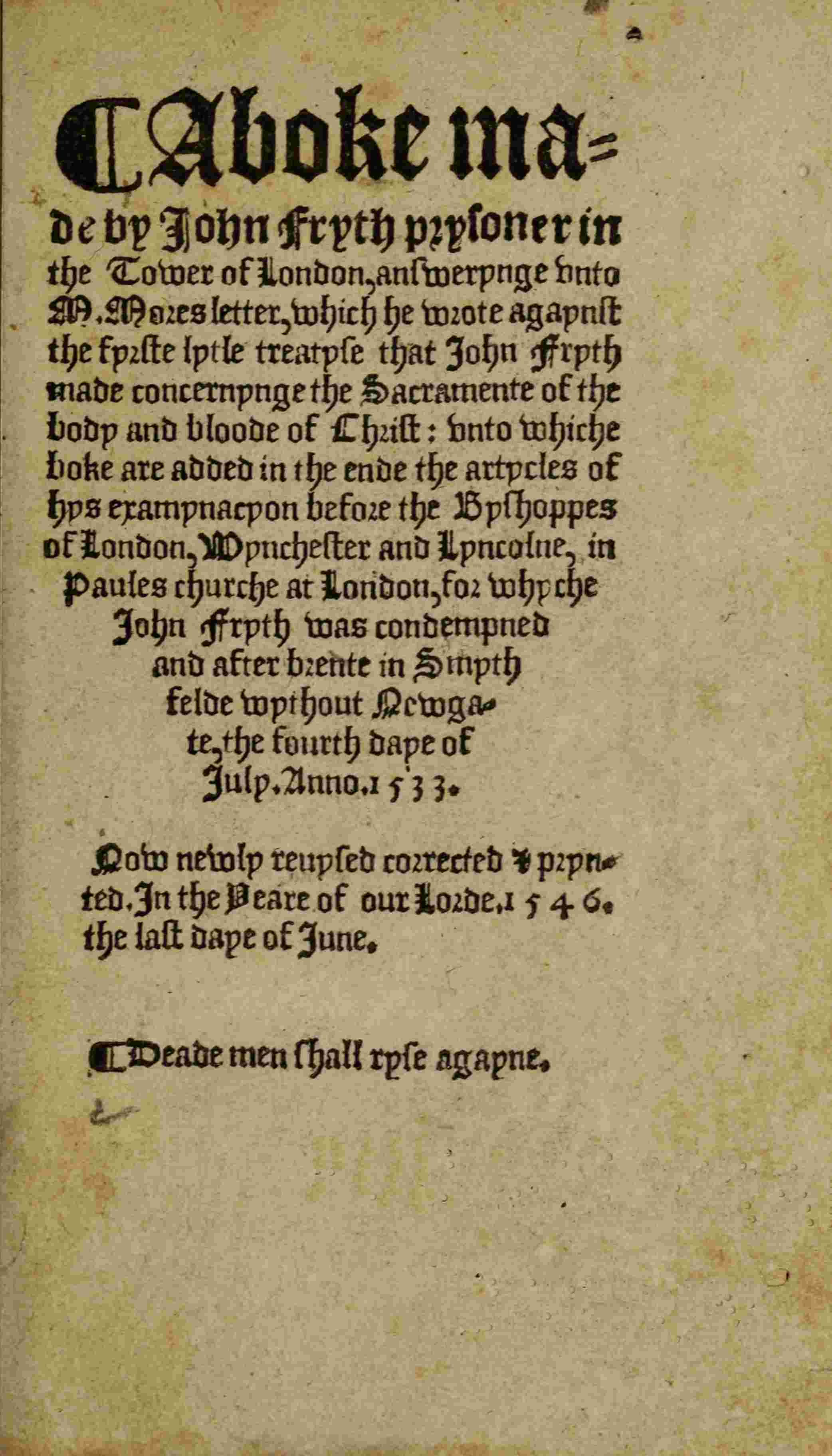
Here begynneth the preface of Master Mores boke.
|Master. More.| In my moste hartye wyse I recommende me vn to you, & sende you by thys brynger the wrytynge agayne whyche I receyued from you. Wherof I haue bene offered a cople of copyes mo, in the meane whyle, as late as ye wote well yt was.
|Fryth.| ¶ Deare bretherne consyder these wordes & prepare you fo the crosse that Christe shall laye vpon you, as ye haue ofte bene counselled. For even as whan the wolue |1. Pet. 2.| howleth the shepe hadde neade to gather |Luc. 22.| them selues to their shepharde, to be delyuered from the assaulte of the blodye beaste, lykewyse hadde you neade to flye vnto the shepharde of your soules Christe Iesus, and to sell your cootes and bye hys spirituall sworde |Ephe. 6.| (whiche is the worde of God) to defende and delyuer you in thys present necessyte. For now is the tyme that Christ tolde vs of, |Mat. 10.| Math. 10. that he was come (by hys worde) to sette varyaunce betwene the sonne and hys father, betwene the doughter and her mother, betwene the doughter in lawe & her mother in lawe, |Mich. 3.| and that a mans owne housholde shalbe hys enemyes. But be not dysmayed nor thynke it no wonder, for Christ chose .12. and one of them betrayed hys master. |Ioan. 6.| And we that are hys dyscyples may loke for no better than he hadde hym selfe: |Mat. 10.| For the scoler is not a boue hys master.
Saynt Paul protesteth that he was in |2. Cor. 11.| parell amonge the false bretherne, and surely I suppose that we are in no lesse Ieopardye. For yf it be so that hys mastershype receyved one copye and hadde acople of copyes mo offered in the meanewhyle, then may ye be sure that there are many false bretherne which pretende to haue knowlege, and in dede be but pyke thākes, prouydynge for their belye. Prepare ye therfore clokes, for the wether wexeth clowdye, and rayne is lyke to folowe. I meane not false excuses and forswerynge of your selfes: but that ye loke substancyally vpon Goddes worde, that you may be able to answere their sotle obectyons. And rather chose māfully to dye for Christe and hys worde, than cowardly to denye hym, for this vayne and transytory lyfe, consyderyng that they haue no further power but ouer this corruptible bodye, which yf they put it not to deathe, muste yet at the length peryshe of yt selfe. |2. Cor. 10.| But I truste the Lorde shall not suffer you to be tēpted a boue that you may beare, but accordynge to the spirite that he shall poure vpon you, shall he also sende you the scourge, ād make hym that hath receyued more of the spyryte, to suffer more, ād hym that receyueth lesse therof, to suffer accordynge to hys talent. I thought it necessarye fyrst to admonyshe you of thys matter, and now I wyll recyte more of master Mores boke.
|More.| ❧ Whereby men may see how greadely these newe named bretherne wryte it out, and secretely spreade it a brode.
|Fryth.| ¶ The name is of great antiquite, althoughe you lyste to iest. For they were called bretherne before our Byshoppes were called Lordes, ād had the name gyuē thē by Christe sayenge, Mat. xxiij. All ye are bretherne. And Luc. xxij. Cōfyrme thy bretherne. And the name was cōtynued by the Apostles, & is a name that norysheth loue ād amyte. And very gladde I am to heare of their greadye affectyon in wrytynge out the worde of God, for by that I do perceyue the prophesye of Amos |Amos. | to haue place, which sayth in the person of God. I wyll sende hōger ād thurste in to the earth, not honger for meate nor thurste for drynke. But for to heare the worde of God. Now begynneth the kyngdome of heuē to suffer vyolēce: |Mat. 11.| Now rōne the poore Publicanes whiche knowelege them selfes synners, to the worde of God, puttynge both goodes and bodye in |Luc. 18.| Ieoperdye for the soule health. And though our Byshopes do calle it heresye, and all them heretyques that honger after yt, yet do we knowe that it is the Gospell of the leuynge God, for the health and saluacyon of all that beleue. |Rom. 1.| And as for the name doth nothynge offende vs, though they call it heresy a thousande tymes.|Act. 24.| For saynte Paule testyfyeth that the Pharysees and Prestes whyche were counted the very churche in hys tyme, ded so call it, and therfore it forseth not though they, rulyng in their rowmes, vse the same names.
|More.| ❧ Which yonge man I here say hathe latelye made dyuers other thynges that yet ronne in hoker moker so close amonge the bretherne that there cometh no copyes abrode.
|Fryth.| ¶ I answere, that surely I can not spynne, and I thynke no man more hateth to be ydle than I do. Wherfor in suche thynges as I am able to do, I shalbe dylygent as longe as God lendeth me my lyfe. And if ye thynke I be to busye, you may rydde me the sooner, for euen as the shepe is in the bochers hādes ready bounde & loketh but euen for the grace of the bocher when he shall shedde hys blode: Euen so am I bounde at the Byshoppes pleasures, euer lokynge for the day of my deathe. In so moche that playne worde was sent me, that the chaunceloure of London sayde, it shulde coste me the best bloode in my body, which I wolde gladly were shedde tomorowe, yf so be it myght open the Kynges graces eyes.
And verely I maruell that any thynge can ronne in hoker moker or be hydde frō you. For seynge you myght haue suche store of copyes, concernynge the thynge which I moste desyred to haue bene kepte secrete, how shuld you than lacke a copye of those thynges wich I moste wolde haue publyshed? And hereof ye maye be sure, I care not though you and all the Byshoppes within England loke vpon all that euer I wrote, but rather wolde be gladde that ye so ded. For yf there be any sparcle of grace in your breastes, I trust it shulde be an occasyon somwhat to kyndle it, that you may consyder and know your selfes, which is the first poynte of wysdome.
❧ And wolde God for hys mercye |More.| (sayeth M. More) that syth there can nothynge refrayne their studye, from devyse and compassynge of euill ād vngracyous wrytynge, that they wolde ād coulde keape it so secretely that neuer man shulde see it. But suche as are so farre corrupted, as neuer wolde be cured of their canker.
|Fryth.| ¶ It is not possyble for hym that hath hys eyes and seeth hys brother which lacketh syght in Ieoperdye of peryshynge at a perellous pytte, but that he muste come to hym ād guyde hym, tyll he be past that Ieoperdye, and at the least wyse, yf he can not come to hym, yet wyll he call and crye vnto hym to cause hym chose the better waye, excepte hys harte be cankered with the contagyon of suche hatred that he can reioyse in hys neyghbours dystructyon. And euē so is it not possyble for vs which haue receyued the knowelege of Goddes worde, but that we muste crye and call to other, that they leaue the perellous patthes of their owne folyshe fantasyes. |Deut. 12.| And do that onely to the Lorde, that he commaundeth them, neyther addynge any thynge nor dymynyshynge. And therfor vntyll we see some meanes founde, by the which a reasonable reformacyon may be had on the one partye, and suffycyent instructyon for the poore cōmons, I insure you, I neyther wyll nor can cease to speake. For the worde of God boyleth in my bodye, lyke a fervente fyre, & wyll neades haue an yssue and breake out, whā occasyon is geuē.
But this hath bene offered you, is offered, and shall be offered. Graunte that the worde of God, I meane the texte of scrypture, maye go abrode in oure Englyshe tonge, as other nacyons haue it in their tōges, and my brother Wyllyā Tyndall ād I haue done, & wyll promyse you to wryte no more. Yf you wyll not graunte this condycyō, then wyll we be doynge whyle we haue breathe, and shewe in fewe wordes that the scripture doth in many: and so at the least saue some.
|More.| ❧ But a lacke this wyll not be. For as S. Paule sayeth, the contagyō of heresye creapeth ou lyke a cāker. For as the cāker corrupteth the bodye forthere and forther, & tourneth the hole partes in to the same deadly sycknes, so doth these heresyes crepe forth amonge good symple soules, tyll at the laste it be almost past remedye.
|Fryth.| ¶ Thys is a very true sayēge ād maketh well agaynst hys owne purpose. For in dede thys contagyō begā to sprynge euē in S. Paules tyme. In so moche that the Galathyans were in a maner wholy seduced from hys doctryne. And he sayde to the Thessalonyans, |1. The. 2.| the mystery of iniquyte euen now begynneth to worke. |1. Ioā. 4.| And saynt Iohn testyfyeth that there were all readye many Antichrystes rysen in hys dayes. And also Paule prophesyed what shulde folowe after hys tyme. |Act. 20.| Actes. xx. sayenge: Take ye hede to your selues and to all the flocke, ouer whyche the holye Gost hath put you overseers, to feade the congregacyon of God whyche he purchased wyth hys owne bloode. For I knowe thys well, that after my departynge shall enter in greuouse wolues amonge you, which shall not spare the flocke. And euen of your selues shall aryse men, speakynge perverse thynges, to drawe dyscyples after them, and therfore watche, & ce. Thys canker then began to sprede in the congregacyon, and ded full sore noye the bodye, in so moche that within .iiij. C. yeare there were very many sectes scatered in euerye coste. Notwithstandynge there were faythfull fathers that dylygently subdued thē wyth the swerde of Goddes worde. |Siluest.| But surely sens Siluester receyued suche possessyons, hath the canker so crepte in the churche, that it hath almoste lefte neuer a founde member. And as Cistercensis wryteth in the .viij. boke, that day that he receyued revennues, was a voyce harde in the ayre cryeng ouer the courte which sayde, Thys daye is venome shed in to the churche of God. Before that tyme there was no Byshope greadye to take a cure. For it was no honoure & profytte as it is now, but onely a carefull charge which was lyke to cost hym his lyfe at one tyme or other. And therfore no man wolde take it, but he that bare suche a loue and zele to God and his flocke, that he coulde be content to shedde hys bloode for them. But after that it was made so honorable and profytable, they that were worste bothe in lernynge and leuynge, moste laboured for it. For they that ware vertuous wolde |Mat. 7.| not entangle them selues with the vayne pryde of thys worlde, ād weare .iij. |Mar. 15.| Crownes of golde, where Christe ded weare one of thorne. |Ioā. 19.| And in conclusyon it came so farre, that who so euer wolde geue moste money for it or beste coulde flatter the Prynce (which he knewe well all good mē to abhorre) had the prehemynence and gotte the best Byshopryke, and then in steade of Goddes worde, they publyshed their owne commaundemētes, and made lawes to haue all vnder them, and made men beleue they coulde not erre what so euer they ded or sayde, ād euē as in the rowines ād stede of Moses, Aarō, Eliazer, Iosue, Calib, and other faythfull folke, came Herode, Annas, Caiphas, Pylate and Iudas, which put Christ to death: So now in the steade of Christe, Peter, Paule, Iames, ād Iohn, and the faythfull folowers of Christe, we haue the Pope, Cardynalles, Archebyshoppes, Byshoppes, and proude prelates, with their proctoure the malycyous mynyster of their master the Deuyll, which not withstondynge transforme thē selues in to a lykenes, |1. Cor. 11.| as though they were the mynysters of ryghtuousnes, whose ende shalbe acordyng to their workes. So that the bodye is cākered longe agone, ād now are lefte but certayne small mēbres, which God of hys puyssante power hath reserued vncorrupted. And because they see that they can not be cankered as their owne fleshe is, for pure anger they burne them, leaste yf they cōtynued there myght seame some deformyte in their owne cankered carcase, by the comparynge of these whole membres to their scabbed body.
|More.| ¶ Techeth in a fewe leaues shortely all the poyson that Wyclefe, Ecolāpadius, Tyndall, & Zwynglius haue taught in all their bokes before, cōcernynge the blessed Sacramente of the aulter: not onelye affyrmynge it to be verye breade styll (as Luther doth) but also (as these other beastes do) sayeth it is nothynge els. And after the same syr Thomas More sayeth. These dregges hath he dronken of Wyclefe, Ecolāpadius, Tyndall, and Zwynglius, and so hath he all that he argueth here besyde, whych .iiij. what maner folke they be, is metely well perceyued and knowen, and God hath in parte, wyth hys open vengeaunce declared.
|Fryth.| ¶ Luther is not the prycke that I ronne at, but the scrypture of God. I do neyther affyrme nor denye any thynge, because Luther so sayeth but be cause the scrypture of God doth so conclude and determe. I take not Luther for soche an autoure that I thynke he cānot erre, but I thynke verely that he both may erre and doth erre in certayne poyntes, although not in suche as concerne saluacyon and dampnacyō. For in thē (blessed be God) all these whome ye call heretykes do agre ryght well. And lykewyse I do not alowe thys thynge because Wyclefe, Decolampadius, Tyndall, and Zwinglius so saye, but because I see them in that place more purely expounde the scrypture, and that the processe of the texte doth more fauoure their sentence.
And where you saye that I affyrme yt to be breade styll as Luther doth, the same I saye agayne, not be cause Luther so sayeth, but because I can proue my wordes true by scrypture, reason of nature, and doctours. Paule calleth it breade saynge: |1. Cor. 10.| The breade which we breake, is it not the felowshyppe of the bodye of Christe: For we though we be manye, are yet one bodye and one breade: as manye as are pertakers of one breade. And agayne he sayeth. |1. Cor. 11.| As often as ye eate of this breade, or drynke of this cuppe, you shall shewe the Lordes death vntyll he come. Also Luke calleth it breade in the actes sayenge: |Act. 2.| they contynued in the felowshyp of the Apostles and in breakynge of breade, & in prayer. |Luc. 22.| Also Christe called the cuppe, the frute of vyne, sayenge. I shall not from hence forthe drynke of the frute of the vyne, vntyll I drynke that a newe in the kyngdome of my Father.
Furthermore nature doth teche you that both the breade and wyne contynue in their nature. For the breade mouldeth yf it be kepte longe, yea, and wormes breede in it. And the poore mouse wyll ronne away with it, and desyre none other meate to her dyner, whiche are euydēt ynough that there remayneth breade. Also the wyne yf it were reserued wolde wexe sower, as they confesse thē selues, and therfore they howsell the laye people but wyth one kynde onely, because the wyne can not contynue nor be reserued, to haue readye at hande when neade were. And surely as yf there remayned no breade it coulde not moulde nor wexe full of wormes: Euē so yf there remayned no wyne, it coulde not wexe sower, and therfore it is but false doctryne, that our Prelates so lōge haue publyshed. Fynallye that there remayneth breade myght be proued by the auctoryte of many doctours, which call it breade and wyne, as Christ and hys Apostles ded. And thoughe some sophysters wolde wreste their sayenges and expounde them after their fantasye, yet shall I alledge thē one doctoure (which was also Pope of Rome) that maketh so playne wyth vs that they shalbe compelled with shame to holde their tonges. For Pope Gelasius wryteth on this maner. Certe sacramenta quæ sumimus corporis et sanguinis Christi diuinæ res sunt & propterea per illa, participes facti sumus diuinæ naturæ, & tamen non desinit esse substantia uel panis & uini, sed permanēt in suæ proprietati naturæ. Et certe imago & similitudo corporis & sanguinis Christi in actione misteriorum celebrantur. That is to saye, surely the sacramentes of the bodye and bloode of Christe, are a godly thynge, and therfore through them are we made partakers of the Godly nature. And yet doth it not cease to be the substaunce, or nature of breade and wyne, but they contynue in the propertye of their owne nature. And surely the Image and symylytude of the bodye and bloode of Christe, are celebrated in the acte of the mysteryes. Thys I am sure was the olde doctryne which they cā not avoyde. And therfor wyth the scrypture, nature, ād fathers, I wyll conclude that there remayneth the substaunce, and nature, of breade and wyne.
|More.| And where ye saye that we affyrme it to be nothynge els, I dare saye that ye vntrulye reporte of vs all. And here after I wyll shewe you what it is more then breade. And where ye saye that it is meately well knowen what maner of folke they be, and that GOD hath in parte wyth hys open vengeaunce declared.
|Fryth.| ¶ I answere that Master Wyclefe was noted whyle he was lyuynge, |Wiclefe.| to be a man not onely of moste famous doctryne, but also of a very syncere lyfe and conversacyon. Neuerthelesse to declare your malycyous myndes and vengeable hartes (as men saye) xv. yeares after he was buryed, you toke hym vp and brente hym, whiche facte declared your furye, although he felte no fyre. |Mat. 10.| But blessed be GOD whiche hath geuen suche tyrauntes no further power, but over thys corruptyble bodye. For the soule ye can not bynde nor burne, |Mal. 2.| but God maye blesse where you curse, and curse where you blesse.
|Ecolampadius.| ¶ And as for Oecolampadius, that notable learned man, hys moste aduersaryes haue euer commended hys conversacyon and Godlye lyfe, which when God has appoynted hys tyme, gaue place vnto nature (as euery man muste) and dyed of a canker.
|Tyndal.| And Tyndall I truste lyueth, well contente with suche a poore Apostles lyfe, as GOD gaue hys sone Christe, and hys faythfull mynysters in thys worlde, whiche is not sure of so many mytes, as ye be yearly of poundes, although I am sure that for hys learnynge and Iudgement in scripture, he were more worthye to be promoted, then all the Byshoppes in Englande. I receyued a letter from hym, whiche was wrytten sens Chrystmas, wherin amonge other matters he wryteth thus. I calle GOD to recorde agaynst the daye we shall appere before our Lorde Iesus to geue a rekonynge of our doynges, that I neuer altered one syllable of Godes worde agaynste my conscyēce, nor wolde do this daye, yf all that is in earth, whether it be honoure, pleasure, or ryches, myght be geuen me. Morover I take GOD to recorde to my conscience, that I desyre of GOD to my selfe in this wurlde no more then that without whiche I can not keape hys lawes, & ce. Iudge Christen reader whether these wordes be not spokē of a faythfull clere innocent harte. And as for hys behauyoure is suche, that I am sure no man can reproue hym of any synne, howbeit no man is innocent before God which beholdeth the harte.
|Zwynglius.| Fynallye Zwinglius was a man of suche learnynge and grauyte (besyde eloquence) that I thynke no man in Christendome myght haue compared with hym, notwithstondynge he was slayne in battayle in defendynge hys cytye, and cōmōwelth, agaynste the assaulte of wycked enemyes, whiche cause was moste ryghtuouse.
And yf hys mastershyp meane, that that was the vēgeaunce of God, and declared hym to be an euyll parson because he was slayne: I maye say nay, and shewe euydēt examples of the contrarye. For somtyme God geueth the vyctorye agaynst them that haue moste ryghtuouse cause, as it is evydent in the boke of Iudicum, |Iudi. 20.| where all the chylderne of Israell were gathered together to punyshe the shamefull sodometrye of the trybe of Beniamyn, whyche were in nōbre but .25. thousande. And the Israelytes were .CCCC. thousāde fyghtynge men, whiche came in to Silo, and asked of God who shulde be their capytayne agaynst Beniamyn. And they beynge but .xxv. thousāde slewe of the other Israelytes .12. thousande in one day: Thē fledde the chylderne of Israell vnto the Lorde in Silo, and made greate lamentacyon before hym euen vntyll nyght. And asked hym counsell sayenge. Shall we go any more to fyght agaynste the trybe of Beniamyn oure brotherne or not? God sayde vnto them yes, go vp and fyght agaynste them. Then went they the nexte day and faught agaynste them, and there were slayne agayne of the Israelites .18. thousande men: Then came they backe agayne vnto the house of God, and sate downe and wepte before the Lorde, and fasted that daye vntyll euen, and asked hym agayne whether they shulde anye more fyght agaynste theyr bretherne or not. God sayde vnto them yes, to morow I wyll delyuer thē in to your hādes. And the nexte day was the trybe of Bēiamyn vtterly dystroyed, sauynge .600. men which hydde themselues in the wyldernes. Here yt is evydent that the chylderne of Israell loste the vyctorye twyse, and yet not withstondynge had a iuste cause, and faught at Godds commaundement. Besydes that, Iudas Machabeus, was slayne, in a ryghtuouse cause, as yt is manyfest in the fyrst boke of the Machabees. |Machabe. 9.| And therfore yt can be no evydent argument of the vēgeaunce of God, that he was slayne in battayle in a ryghtuouse cause, and therfore me thynketh that this manne ys to malaperte so bluntly to enter in to Goddes Iudgement, ād geue sentence in that matter before he be called to counsell. Thus haue I suffycyētly touched hys preface, for those poyntes that he afterwarde towched more largely haue I wyllyngly passed, because I shall towche them earnestly hereafter. Nowe lette vs see what he proueth.
|Master More.| ❧ It ys a greate wonder to see vpon how lyght and sleyght occasyons, he ys fallen vnto these abhomynable heresyes. For he denyeth not nor can not say nay, but that our sauyour sayde hym selfe, my fleshe ys verely meate and my bloode ys verely drynke. He denyeth not also that Christ hym selfe at his last souper, takynge the breade in to hys blessed handes, after that he had blessed yt sayde vnto hys discyples. Take you thys and eate yt, thys is my bodye, that shall be geuen for you. And lykewyse gaue them the chalyce after hys blessynge and consecracyon, and sayde vnto them, thys ys the chalyce of my bloode of the newe testament, whyche shalbe shedde out for manye, do ye thys in remembraunce of me.
|Fryth.| ¶ It is a greate wonder to see howe ygnoraunte their proctoure ys, in the playne textes of scrypture. For yf he had any iudgement at all he myght well perceyue that when Christe spake these wordes, my fleshe ys verely meate and my bloode ys verely drynke, he spake nothynge of the sacramēte. For yt was not instytuted vntyll hys laste souper. And these wordes were spoken to the Iewes longe before, and ment them not of the carnall eatynge or drynkynge of hys bodye or bloode, but of the spirytuall eatynge, which is done by faythe and not wyth tothe, ād bellye. Wherof Saynt Austen sayeth vpon thys Gospell of Iohan, why preparest thou other tothe or bellye? beleue and thou haste eaten hym. So that Christes wordes must here be vnderstonde spirytually. And that he calleth hys fleshe verymeate, is because that as meate by the eatynge of yt & digestynge yt in our body dothe strengthen these corruptyble membres, so lykewyse doth Christes fleshe (by the beleuynge that yt taketh our synne vpon yt selfe and suffered the death to delyuer vs) strengthen our immortall soule. And lykewyse as drynke when yt is dronken, doth comforte and quycken our frayle nature, So lykewyse both Christes bloode by the drynkynge of yt in to the bowells of our soule, that ys by the belevynge and remembrynge that yt ys shedde for our synnes, comforte and quycken our soule vnto euerlastynge lyfe. And thys is the eatynge and drynkynge that he speaketh of in that place. And that yt is so you may perceyue by the texte folowynge which sayeth. He that eateth my bodye & drynketh my bloode dwelleth in me and I in hym, which ys not possyble to be vnderstonde of the Sacrament. For it is false to saye, that he that eateth the Sacrament of hys bodye and drynketh the sacrament of hys bloode, dwelleth in Christe and Christe in hym. For some man receyueth yt vnto hys condempnacyō. And thus doth .S. Austen expounde yt sayenge. Hoc est enim Christum manducare, in illo manere, & illum manentem in se habere. Thys is the very eatynge of Christe, to dwell in hym, and to haue hym dwellynge in vs. So that who so euer dwelleth in Christ (that ys to saye) beleueth that he is sent of God to saue vs from our synnes doth verely eate ād drynke hys bodye and bloode, although he neuer receyued the sacrament. Thys ys the spirytuall eatynge necessarye for all that shalbe saued. For there ys no man that cōmeth to God without this eatynge of Christ, that is the beleuynge in hym. And so I denye not but that Christ speaketh these wordes, but surelye he ment spyrytually. As S. Austen declareth, ād as the place playnely proueth.
And as towchynge the other wordes |Mat. 26.| that Christe spake vnto hys dyscyples at hys laste souper, I denye not but that he sayde so, but that he so steshely mēt as ye falsely fayne, I vtterly denye. For I saye that hys wordes were then also spyrite and lyfe, and were spyritually to be vnderstonde. And that he called yt hys bodye, |Ioan. 6.| for a certayne propertye, euen as he called hym selfe |Ioan. 15.| a very vyne, and hys dyscyples very vyne braunches, and as he called hym selfe a dore: |Ioan. 10.| not that he was so in dede, but for certayne propertyes in the symylytudes. |Gen. 35.| As a man for some propertye sayeth of hys neyghbours horsse, this horsse is myne vp and downe, meanynge that yt is in euery thynge so lyke. |Gen. 32.| And lyke as Iacob buylded an aulter and called yt the God of Israel, and as Iacob called the place where he wrasteled with the Angell, the face of God, and as the pascall lambe was called the passynge bye of the Lorde. |Ezech. 5.| And as a broken potsherde was called Hierusalem, not for that they were so in dede, but for certayne symylytudes in the propertyes, and that the very name yt selfe myght put men in remembraunce what ys ment by the thynge, as I suffycyently declared in my fyrste treatyse.
|More.| He muste neades confesse, that they that beleue that yt ys the very bodye and hys very bloode in dede, haue the playne wordes of our sauyoure hym selfe vpon their syde, for the grounde and foundacyon of their faythe.
|Fryth.| ¶ That is very true, and so haue they the very wordes of God, whiche saye a broken potsherde ys Hierusalem, and that Christe is a stone, and that Christe is a vyne and a dore. And yet yf they shuld beleue or thynke that he were in dede any of these thynges, they were neuerthelesse deceyued. For though he so sayde, yet I saye hys wordes were spirituall ād spiritually to be vnderstonde.
|More.| ❧ And where you saye that I flye from the faythe of playne and open scryptures, and for the allegorye destroye the true sence of the letter.
|Fryth.| ¶ I answere that some textes of scripture are onelye to be vnderstonde after the letter: As when Paule sayeth, Christ |Rom. 4.| dyed for our synnes & rose agayne for ourre iustificacyō. And some textes are onely to be vnderstonde spirytually or in the way of an allegory: As whē Paule sayth, |1. Cor. x.| Christe was the stone. And when Christe sayeth hym selfe. |Johā. xv.| I am a very vyne. |Johan. x.| I ā the doore. And some must be vnderstōde both lytterallye, and spirytuallye: As when God sayde, out of Egypte called I my sonne, |Ozee. 11.| whyche although it were lytterallye fulfylled in the chylderne of Israel when he brought them out of Egypte with greate power and wōders, yet was yt also mente ād veryfyed in Christ hym selfe, |Math. 2.| hys very spyrytuall sonne, which was called out of Egygte after the death of Herode. And agayne yt is very spiritually fulfylled in vs whyche through Christes bloode are delyuered from the Egypte of synne, and from the power of Pharao the devyll. And I say that this texte of scripture, this is my bodye, ys onely spirytually to be vnderstonde, ād not lytterallye. And that doth S. Austen also confyrme, which wryteth vnto Adamantus and sayeth. These sentences of scripture, Christ was the stone, the bloode ys the soule, and thys is my bodye, are fyguratyuelye to be vnderstonde (that is to say) spiritually, or by the way of ā allegorye, & thus haue I. S. Austē whollye vpon my syde, whiche thynge shall yet hereafter more playnely appere.
|More.| ❧ Nowe hys example of hys brydgromes rynge I very well alowe. For I take the blessed sacramēt to be left with vs for a very token and a memoryall of Christe in dede. But I say that the whole substaūce of the same token & memoryall, is hys owne blessed bodye. And so I saye that Christe hathe lefte vs a better token then this man wolde haue vs take yt for. And therin he fareth lyke a mā, to whō a brydgrome had delyuered a goodly golde rynge with a ryche Rubye therin, to delyuer to hys bryde for a token. And then he wolde lyke a false shrewe, keape a waye that golden rynge and geue the bryde in steade thereof, a proper rynge of aryshe, and tell her that the brydgrome wolde sende her no better. Or els lyke one that when the brydgrome hadde geuen soche a rynge of golde to hys bryde for a tokē, wyll tell her playne, ād make her beleue, that the rynge were but coper or brasse, to mynyshe the brydgromes thanke.
|Fryth.| ¶ I am ryght gladde that ye admytte myne exāple, ād graūte that the sacramēt is lefte to be a very tokē and memoryall of Christe in dede. But where you saye, that the whole substaunce of the same token ād memoryall is hys owne blessed bodye, that is sooner sayde than proued. And where you saye that we fare lyke a false shrewe that wolde keape the golde rynge from the bryde, and geue her a rynge of a ryshe, or tell her that her golde rynge were coper or brasse, to mynyshe the brydgromes thāke. I answere that we deny not but that the ryng ys most fyne golde, and is sette wyth as ryche Rubyes as can be gotten. For that rynge (I meane the Sacrament) ys not onely a moste perfecte token and a memoryall of the brydegromes benefyttes ād vnfayned fauoure on hys partye, but yt is also on the other partye a thankes geuynge for the gracyous gyftes which she vndoubtedly knowlege her selfe to haue receyued. For as verely as that breade ys broken amōge thē, so verely was Christes bodye broken for their synnes. And as verely as they receyue that breade in to their bellye through eatynge yt, so verelye do they receyue the frute of hys death in to their soules by beleuynge in hym. And therfor they assemble to that souper, not for the valoure of the breade, wyne, or meate, that ys there eate, but for the intent to geue hym thankes commonly a monge them all, for hys inestymable goodnes. But to procede vnto our purpose, yf a man wolde come vnto the bryde, and tell her that thys goodly golde rynge were her owne brydgrome, both fleshe bloode ād bones (as you do) then I thynke yf she haue anye wytte, she myght answere hym, that he mocked, and the more he sayde yt, the lesse she myght beleue hym, and saye that yf that were her owne brydgrome, what shulde she thē neade any remēbraunce of hym, or why shulde he geue it her for a remembraunce. For a remembraunce presupposeth the thynge to be absent, and therfore yf thys be a remembraunce of hym, than can he not here be present.
|More.| ❧ I meruell therfore moche, that he is not a frayde, to affyrme that these wordes of Christe, of hys bodye and of hys bloode, muste neades be vnderstonde by waye of a symylytude or an allegorye, as the wordes be of the vyne and the doore. Nowe this he knoweth well, that though some wordes spokē by the mouthe of Christe be to be vnderstonde onely by waye of a symylytude or an allegorye, yet foloweth it not thervpon, that euery lyke worde of Christe in other places was non other but an allegorye, for suche was the shyfte and cauyllacyon that the wycked Arryans vsed which toke from Christes parson hys omnypotent Godhed.
|Fryth.| ¶ I graunte that the Arryans erred, for as Master More sayeth, though in some place a worde betakē fyguratyuely, it foloweth not therfor that in euery other place, it shulde lykewyse be takē. But one questyō muste I aske hys mastershyppe, how doth he knowe that there is any worde or texte in scripture that muste be takē fyguratyuely, that is by the waye of a symylytude, or as he calleth yt a necessarye allegory? I thynke (though some mē may assygne other good causes ād euydences) that the fyrst knowelege ys by other textes of scrypture. For yf other textes be cōferred vnto yt, and wyll not stonde with the litterall sence, then I thynke yt muste neades be taken spirytually or fyguratyuelye, as there are infynyte textes in scripture. Now when I see that .S. Thomas whiche felte Christes woundes ād put hys fynger in hys syde, called hym hys Lorde and God, and that no texte in scrypture repugneth vnto the same, but that they may well stonde together, me thynketh yt were foly to affirme that this word, God, in that texte shulde be taken fyguratyuely or by waye of an allegorye: But nowe in our matter the processe of scripture wyll not stonde with the lytterall sence, as shall here after appeare. And therfor necessyte compellethe vs to expounde yt fyguratyuelye, as doth also S. Austen and other holy doctours, as hereafter shall playnely appeare.
|More.| ❧ If euery man that can fynde out a newe fonde fantasye vpon a text of holy scrypture, may haue his owne mynd takē, and hys owne exposicyon beleued agaynste the exposycyons of the olde connynge doctours and sayntes, then may you surely see that none artycle of the Christen fayth, can stonde and endure longe. And then he alleageth .s. Hierome, which sayth, that yf the exposycion of other interpretours, and the consent of the common catholycke churche, were of no more strēgth but that euery mā myght be beleued that coulde brynge some textes of scrypture for hym, expounded as it pleaseth hym selfe, then coulde I (sayth this holy mā) brynge vpe a newe secte also, and saye by scrypture, that no man were a true Christen man, nor a membre of the churche, that keapeth two cootes. And in good fayth (sayth master More) yf that waye were alowed I were able my selfe to fynde out fyftene newe sectes in one fore none.
|Fryth.| ¶ Saynte Peter sayeth that the scripture is not expounded after the appetyte of any pryuate parson, but euē as yt was geuen by the spyrite of God, and not by mānes wyll: so muste yt be declared by the same spiryte. And therfore I wyll not that any mā shalbe beleued, by bryngynge hys owne mynde and fantasye. But yf he wyll be beleued, let hym brynge eyther an other playne texte, which shall expounde the fyrste, or els at the leaste he muste brynge suche a manyfest sentence, as wyll stonde wyth the processe of the scripture. Whye was Saynt Hierome alowed agaynst the determynacyon of the counsell of Meldeley, syth he was alone, and they a greate multytude, but onely because he brought euydent scrypture, which at the tyme of their sentence, none of them remembred ād yet when yt was brought, they coulde not auoyde yt. And lykewyse excepte I brynge euydent scripture which they all shall expounde as I do, I desyre not to be beleued. And where master More sayeth, that in good fayth he were able to fynde out fyftene newe sectes in one fore none, he may thanke GOD that he hathe suche a pregnaunte wytte: But yet I truste he shulde not fynde one (yf there were any parell of dāpnacyō therin) but that we wolde with a playne texte confute yt, which he shulde not be able to avoyde.
|More.| ❧ And ouer this, the very cyrcumstaunces of the places in the Gospell in which our sauyour speaketh of that sacramente, may well make open the defference of hys speache in this matter, and of all the other, and that as he spake all those but in an allegorye, so spake he this, playnely meanynge that he spake of hys very bodye and hys very bloode, besyde all allegoryes. For when our Lorde sayde, he was a very vyne, and when he sayd he was the dore, there was none that harde hym, that any thynge merueled therof. And whye: For because they perceyued well, that he ment not that he was a materyall vyne in dede, nor a dore neyther: But when he sayde that hys fleshe was very meate, and hys bloode very drynke, and that they shulde not be saued but yf they ded eate hys fleshe and drynke hys bloode, then were they all in suche a wonder therof, that they coulde not abyde. And wherfor, but because they perceyued well by hys wordes and hys maner of circumstaunces, that Chryste spake of hys very fleshe and hys very bloode in dede.
|Fryth.| ¶ It is openly knowen and confessed amonge all learned men, that in the |Ioan. 6.| .6. chapytre of Ioan, Christe spake not one worde concernynge the sacrament of hys bodye and bloode (which at that tyme was not yet instytuted) but all that he there spake was of the spyrytuall eatynge ād drynkynge of hys bodye, and bloode, as I haue towched before. And the circumstaunces of this place do in dede proue that they were fleshly mynded, and vnderstoode not the spirytuall wordes of our sauyoure Christ, and therfor wondered and mourmured. In so moche that Christe sayde vnto them, doth this offende you: What wyll ye say then whē ye shall see the sone of man ascendynge thyther where he was before: Thē (addeth S. Austen) you shall knowe that he ment not to geue hys fleshe to eate with your teth: for he shall ascende whole. And Christ addeth, it is the spirite that quyckeneth, the fleshe profyteth nothynge, the wordes that I speake, are spirite ād lyfe: that is to say, sayeth S. Austen, are spirytually to be vnderstonde. And where Christ sayeth, that the fleshe profyteth nothynge (meanynge of hys owne fleshe, as S. Austē sayeth) he meaneth that it profyteth not, as they vnderstoode hym, that is to saye, it profyteth not, if it were eatē. But it doth moche profyte to be slayne, that through it and the shedynge of hys blode, the wrath of God our Father is pacyfyed, ād our synnes forgeuen. And where his mastershyp sayeth that the people perceyued well what he ment, and therfor wōdered so sore ād coulde not abyde, because they perceyued well by hys wordes ād maner of cyrcumstaunces what hys meanynge was. I wyll say as I ded before, that they vnderstoode hym not. Nowe here he wyll saye vnto me, if it be but your naye and my yea, then I wolde thynke to be beleued as soone as you, and surelye that were but reason. Not withstondynge (thankes be to God) I am able to brynge in auctoryte to Iudge betwene vs bothe, whose Iudgemēt I truste hys mastershyp wyll admytte. Thys autoure is .S. Austen which sayeth. |Augusti in sermo ad infan.| Discipuli enim eius qui cum sequebantur expauerunt & exhorruerunt sermonem non intelligentes. That is to saye, his dyscyples whiche folowed hym, were a stoyned, and abhorred hys wordes, ād vnderstoode thē not. And because your mastershype shall not thynke that he over schotte hym selfe, and spake he wyste not what, we shall alledge hym sayenge the same wordes in an other place. |Aug. 54.| Cum diceret. Nisi quis manducauerit carnem .& c. Illi non intelligentes dixerunt ad inuicē. Durus est hic sermo, quis potest eum audire? That is, when Christ sayde, excepte a man eate my fleshe and drynke my bloode, he shall haue no lyfe in hym, they because they vnderstoode hym not, sayde to eche other, this is an harde sayenge, who can heare hym? Thus I truste you wyll geue place (although not to me) yet at the leaste vnto Saynte Austen, and receyue the truth whiche is so playnelye proved.
And where hys mastershyp alleageth this texte for the Sacramente, that excepte they ded eate hys fleshe and drynke hys blode they coulde not be saued, yt seameth that he is fallen in to the erroure of Pope Innocēt, which lykewyse vnderstōdynge this texte vpon the Sacrament (as master More doth) caused yonge chylderne and infantes to receyue the Sacrament, as though they had all bene dampned which dyed and had not receyued it. And of thys Carnall mynde were many mo Byshoppes a greate whyle (as are now the Bohemes, whome he after dysprayseth, and yet expoundeth the texte as they do) but afterward they loked more spirytually vpō the matter and confessed their ignoraunce, as I truste master More wyll. But now wyll I shew you .S. Austens mynde vpō this texte, which shall helpe for the exposycyon of all thys matter. |Augustinus libro 3 de doctrina christiana.| S. Austen in the thyrde boke de doctrina christiana the .16. chapytre, teachynge how we shall knowe the tropes, fygures, allegoryes, and phrases of the scrypture sayeth. Si aūt flagitium aut facinus iubere uidetur, figurata locutio est. Nisi manducaueritis (inqt) carnem filij hominis et biberitis eius sanguinē, non habebitis uitam in uobis. Facinus uel flagitium uidetur iubere. Figura est ergo precipiens passionis dominicæ esse comunicandū et suauiter atque utiliter in memoria recondendum, quod pro nobis caro eius crucifixa & uulnerata sit. That is to saye: when so euer the scrypture or Christe seameth to commaunde any fowle or wycked thynge, than muste that texte be taken fyguratyuelye, and that it is a phrase, allegorye, and maner of speakynge, ād muste be vnderstonde spyrytually and not after the letter. Excepte (sayeth Christ) ye eate the fleshe of the sonne of man and drynke hys bloode ye shall haue no lyfe in you. He seameth (sayeth S. Austen) to cōmaunde a fowle and a wycked thynge. It ys therfore a fygure, commaundyng vs to be partakers of hys passyon, and swetely ād profytablye to prynte in our mynde that hys fleshe was crucyfyed and wounded for vs. This truth (thankes be to God) doth S. Austen declare vnto vs, which thynge besyde the openyng of thys texte agaynst master Mores mynd, doth playnely shew what he thought in the holye wordes of Christes souper. For syth he called yt a fowle and wycked thynge to eate hys fleshe, than may you soone perceyue, that he thought yt ys fowle and as wycked a thynge to eate hys bodye, seynge hys bodye ys fleshe, and then consequently yt shall folowe, that eyther thys worde eate (where Christe sayde take thys and eate yt) muste be taken spirytually, or els that thys sayēge of Christe, thys is my body, muste be fyguratyuely spoken, but this worde, eate, ys taken after the letter (for they ded in dede eate the breade) therfore yt muste neades folowe, that thys sentēce (thys is my bodye) muste be fyguratyuely spoken. Or els ys .S. Austen not to be approued in thys place, which thynge our Byshoppes I thynke, wyll not saye naye.
Besydes that .S. Austen sayeth. |Augustinus in sermone ad infantes.| Quando loquebatur dominus noster Iesus Christus de corpore suo, nisi (inquit) quis manducauerit carnem meam et biberit sanguinè meum, non habebit in se uitam. Caro enim mea uere est cibus, & sanguis meus uere est potus. Intellectus spiritualis credentem saluum facit, quia littera occidit, spiritus est qui uiuificat. That is to saye: when our Lorde Iesus Christe spake of hys bodye, excepte (sayeth he) a man eate my fleshe and drynke my bloode, he shall haue no lyfe in hym selfe, for my fleshe is verye meate, and my bloode is very drynke. The spyrytuall vnderstondynge saueth hym that beleueth, for the letter kylleth, but the spirite quyckeneth. Here may you playnlye perceyue, that thys texte muste onely be taken spyrituallye. For he sayeth, that to take it after the letter it kylleth and profyteth nothynge at all, & therfor I wonder that we haue bene ledde so longe in this grosse erroure.
|Orig. in leuiti. homi .7.| This sayenge doth that famous clarke Origene, confyrme sayēg. Agnosce, figuræ sunt que in uoluminibus Domini scriptæ sunt: & ideo tanquā spirituales & non tanquam carnales, examinate & intelligite quæ dicuntur. Si enim secundum litteram sequaris hoc ipsum quod dictum est, Nisi manducaueritis carnē &c. Occidit hæc littera. That is to saye: Marke that they are fygures which are wrytē in the scrypture of God. And therfore examyne them as spyrytuall men and not as Carnall, ād vnderstonde those thynges that are spoken. For if thou folowe after the letter, this thynge that is spokē: excepte ye eate the fleshe of the sone of man and drynke hys bloode, you cā haue no lyfe in you, this letter kylleth. Alas deare bretherne why shulde any mā be offended with thys doctryne, seynge it is approued so playnelye, by suche auncyent and holy Fathers.
|Augusti sermo circa sacraferia pasche.| Agayne .S. Austē sayeth. Qui manducat carnem meā & bibit meum sanguinem in memanet & ego in illo. Hoc est ergo manducare illā escam & illū bibere potum, in Christo manere & illum manentē in se habere, ac per hoc qui non manet in Christo & in quo non manet Christus proculdubio non manducat eius carnem nec bibit sanguinē, etiā si tanterei sacramentum ad iudicium sibi manducet & bibit. That is to saye, he that eateth my fleshe and drynketh my bloode, abydeth in me, and I in hym. This is therfore the eatynge of that meate and drynkynge of that bloode, to abyde in Christe and haue hym abydynge in vs. And therfor he that abydeth not in Christe, and in whome Christe abydeth not, without doubte he eateth not Christes fleshe nor drynketh not hys bloode, although he eate and drynke that sacramēt of so greate a thynge vnto hys dampnacyon. And euē the same wordes |Idē Beda super Cor. 10.| hath Bede vpon the Corynthyās 1. Corin. 10. Thys one place is suffycyent for to proue my purpose though he sayde not one worde more. For here he doth playnelye determyne, that he whiche abydeth not in Christe: that is to saye: he that is wycked or vnfaythfull, doth not eate hys fleshe nor drynke hys bloode, although he eate and drynke the Sacramēt of so greate a thynge. And so muste it neades folowe, that the Sacramente is not the verye naturall bodye of Christ. For then the vnfaythfull shulde eate hys fleshe, seynge he eateth the Sacrament of hys bodye. But that doth S. Austen denye, wherfor it muste neades folowe, that it is but onely a token of a remembraunce, ād a sygne of hys bodye breakynge, and a representacyon of hys passyon, |Rom. 5.| that we myght keape hys facte in memorye, and geve hym thankes for hys tender loue and kyndenes, whiche when we were hys enemyes toke vpon hym to suffer moste vyle death, to reconcyle vs vnto his Father, and make vs hys frendes. Thys sayenge hath S. Austen in a nother place also, |Augusti deciuita: dei lib. 21.| where he wryteth on this maner. Qui non in me manet, & in quo ego non maneo, non se dicat aut existimet māducare corpus meum, aut bibere sanguinem meum. |capi. 25.| Non itaq; maneat in Christo qui non sunt eius membra: non sunt autem membra Christi qui se faciunt membra meritricis. That is to saye, he that abydeth not in me, and in whome I abyde not, let hym not saye or thynke that he eateth my bodye or drynketh my bloode. They abyde not in Christe which are not hys mēbers. And they are not hys membres whiche make them selues the membres of an harlote. And these are also the verye wordes of Bede. Here is it playne proued agayne by the auctoryte of S. Austen and Bede, |Beda super. 1. Cor. 6.| that the wycked and vnfaythfull (whiche are not the membres of Christe) do not eate hys bodye nor drynke hys bloode, and yet they do eate the Sacramēt as well as the other. Wherfore you muste neades, graunte, that the Sacramēt is not the naturall bodye of Christ but a fygure, tokē, or memoryall therof. Now good Christē people counte not thys new learnynge which is confyrmed by suche olde doctoures and faythfull fathers.
Now were thys ynough for a Christē man that loued no contencyon. But because there are so manye sophysters in the worlde whiche care not what they saye, so they holde not their peace, I muste neades sette some bulwarke by this holy doctoure, to helpe to defende hym, for els they wyll shortelye ouer rone hym (as they do me) ād make hym an heretyck also. Therfore I wyll alleage hys master saynt Ambrose. Saynte Ambrose sayeth |Ambrosi de sacra.| Non iste panis qui uadit in corpus a nobis tā anxie queritur, sed panis uitæ æterne que anime nostre substanciam fulscit, qui autem discordat a Christo non manducat carnem eius, nec bibit sanguinem eius, & si tante rei sacramentum iudicium sue perdicionis accipit. That is, this breade that goeth in to the bodye ys not so gredelye sought of vs, but the breade of euerlastynge lyfe which vpholdeth the substaunce of our soule. For he that dyscordeth from Christ, doth not eate hys fleshe, nor drynke hys bloode, although he receyue the sacramente of so greate a thynge vnto hys dampnacyon and destruccyon. Furthermore, the greate clarke Prosper confyrmeth the same, sayenge. |Prosper in libro sentenciarum.| Qui discordat a Christo nec carnem Christi manducat, nec sanguinem bibit, etiam si tantæ rei sacramentum ad iudicium sue presumptionis quotidie indifferenter accipiat. That is, he that dyscordeth from Christ, doth neyther eate hys fleshe, nor drynke hys bloode, although he receyueth indyfferently euery daye the sacrament of so greate a thynge vnto the condempnacyon of hys presumpcyon. And these are also the very wordes of Bede |Idē Beda super 1. Cor. 11.| vpō the xi. Chapiter of the fyrste Epystle to the Corynthyans.
Now you may see, that it ys not saynt Austens mynde onely, but also the sayēge of many mo. And therfore I truste you wyll be good vnto hym. And yf ye cōdempne not these holye Fathers, then am I wrongfullye punyshed. But, yf you condempne them, then muste poore Iohan Fryth be contente to beare the burthen wyth them.