
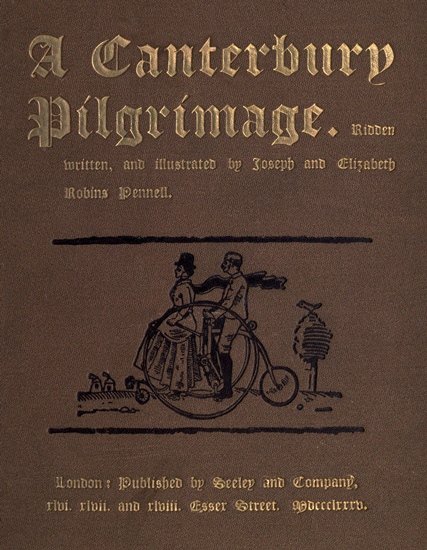
The Project Gutenberg eBook of A Canterbury Pilgrimage
Title: A Canterbury Pilgrimage
Author: Joseph Pennell
Elizabeth Robins Pennell
Release date: June 11, 2011 [eBook #36383]
Language: English
Credits: E-text prepared by the Online Distributed Proofreading Team (http://www.pgdp.net) from page images generously made available by Internet Archive (http://www.archive.org)
E-text prepared by the Online Distributed Proofreading Team
(http://www.pgdp.net)
from page images generously made available by Internet Archive
(http://www.archive.org)
| Note: | Images of the original pages are available through Internet Archive. See http://www.archive.org/details/canterburypilgri00penniala |
A Canterbury Pilgrimage
This work is Copyright in England and America.
A Canterbury
Pilgrimage.
Ridden, written, and illustrated
by Joseph and Elizabeth Robins Pennell.
London: Published by Seeley and Company,
xlvi. xlvii. xlviii. Essex Street. Mdccclxxxv.
TO
Mr. Robert Louis Stevenson,
We, who are unknown to him,
dedicate this record of one of our short
journeys on a Tricycle,
in gratitude for the happy hours we have spent
travelling with him and his Donkey.
We do not think our book needs an apology, explanation, or preface; nor does it seem to us worth while to give our route-form, since the road from London to Canterbury is almost as well known to cyclers as the Strand, or the Lancaster Pike; nor to record our time, since we were pilgrims and not scorchers. And as for non-cyclers, who as yet know nothing of time and roads, we would rather show them how pleasant it is to go on pilgrimage than weary them with cycling facts.
Joseph Pennell.
Elizabeth Robins Pennell.
36 Bedford Place,
May 14th, 1885.
First Day
Folk do go on Pilgrimage through Kent.
A
CANTERBURY PILGRIMAGE
It was towards the end of August, when a hot sun was softening the asphalt in the dusty streets of London, and ripening the hops in the pleasant land of Kent, that we went on pilgrimage to Canterbury. Ours was no ordinary journey by rail, which is the way latter-day pilgrims mostly travel. No. What we wanted was in all reverence to follow, as far as it was possible, the road taken by the famous company of bygone days, setting out from the hostelrie where these lordings lay one night and held counsel, making stations by the way at the few places they mention by name, and ending it, as they did, at the shrine of the ‘holy, blissful martyr,’ in the Canterbury Cathedral. How better could this be done than by riding over the ground made sacred by them on our tricycle?
And so it came to pass that one close, foggy morning, we strapped our bags to our machine and wheeled out of Russell Square before any one was stirring but the policeman, making his last rounds and trying door after door. Down Holborn and past Staples’ Inn, very grey and venerable in the pale light, and where the facetious driver of a donkey-cart tried to race us; past the now silent and deserted cloisters of Christ’s Hospital, and under Bow Bells in Cheapside; past the Monument of the famous fire, and over London Bridge, where the mist was heavy on the river and the barges showed spectre-like through it, and where hucksters greeted us after their fashion, one crying, ‘Go in, hind one! I bet on you. You’ll catch up if you try hard enough!’ and another, ‘How are you there, up in the second story?’ A short way up the Borough High Street, from which we had a glimpse of the old red roof and balustraded galleries of the ‘White Hart;’ and then we were at the corner where the ‘Tabard’ ought to be. This was to have been our starting-point; but how, it suddenly occurred to us for the first time, could we start from nothing? If ours had no beginning, would it be a genuine pilgrimage? This was a serious difficulty at the very outset. But our enthusiasm was fresh. We looked up at the old sign of ‘Ye Old Tabard,’ hanging from the third story of the tall brick building which has replaced Chaucer’s Inn. Here, at least, was something substantial. And we rode on with what good cheer we could.
Then we went for some distance over the Old Kent Road, which is laid with Belgian paving—invented, I think, for the confusion of cyclers, and where in one place a Hansom cab blocked the way. In endeavouring to pass around it our big wheel ran into the groove of the track, and we had to dismount and lift it out. The driver sat scowling as he looked on. If he had his way, he said, he would burn all them things. We came to Deptford, or West Greenwich, at half-past seven, the very hour when mine host and his fellows passed. So, in remembrance of them, we stopped a few minutes opposite a little street full of old two-storied houses, with tiled roofs and clustered chimney-pots and casement windows, overtopped by a distant church steeple, its outline softened in the silvery mist, for the fog was growing less as we journeyed onwards. At the corner was an Inn called the ‘Fountain,’ and as a man who talked with us while we rested there said that an old fountain had stood in the open space near by, it pleased us to think that here had been one of the Waterings of Saint Thomas where pilgrims to the shrine made short halts, and that perhaps it was at this very spot that Davy Copperfield, a modern pilgrim who travelled the same road, had come to a stop in his flight from the young man with a donkey-cart. A little way out of Deptford we came to Blackheath, where sheep were peacefully grazing, rooks cawing overhead, and two or three bicyclers racing, and where a woman stopped us to say that ‘That’s the ’ouse of Prince Harthur yander, and onst the Princess Sophia stayed in it on her way to Woolwich,’ and she pointed to the handsome brick house to our left.
The Pilgrims are Chased by Dogs.
After Blackheath the mist vanished, and the sun, gladdened by the sweet air, shone on the fields and woods, and the ugly barracks and pretty cottages by which we wheeled. Red-coated soldiers turned to look and dogs ran out to bark at us. In the meadows men and women leaned on their hoes and rakes to stare. From tiny gardens, overflowing with roses and sunflowers, children waved their delight. London was many miles behind when, at a few minutes before nine, we drew up on the bridge at Crayford.
It seemed at first a sleepy little village. The only signs of life were on the bridge. Here about a dozen men were smoking their morning pipes, and as many boys were leaning over the wall, lazily staring into the river below, or at the cool stretches of woodland and shady orchards on the hillside beyond. But presently, as we waited, the village clock struck nine, and at once the loud bell in the factory on the other side of the little river Cray began to ring. One by one the older loungers knocked the ashes from their pipes and passed through the gate. The boys lingered. But their evil genius, in the shape of an old man in a tall white cap, came out, and at his bidding they left the sunshine and the river and hurried to work. A man with a cart full of shining onions went by, and we followed him up a hilly street, where the gabled and timbered cottages seemed to be trying to climb one over the other to reach a terrace of shining white houses at the top. The first of these was but one-storied, and its tall chimney-pot threw a soft blue shadow on the higher wall of the house next to it. On a short strip of ground which stretched along the terrace patches of cabbages alternated with luxuriant crops of weeds. In one place there were stalks of pink hollyhock and poles covered with vines, and in the windows above were scarlet geraniums. About them all there was a feeling of warmth and light, more like Italy than England. J. took out his sketch-book. Several women, startled by the novelty of strangers passing by, had come out and were standing in their small gardens. When they saw the sketch-book they posed as if for a photographer—all except one old woman, who hobbled down the street, talking glibly. Perhaps it was as well we did not hear what she said, for I think she was cursing us. When she was close at our side and turned, waving her hands to the other women, she looked like a great bird of ill-omen. ‘Go in! go in!’ she croaked: ‘he’s takin’ of yere likenesses. That’s wot he’s arter!’ Her wrath still fell upon us as we wheeled out of Crayford.
There were many pilgrims on the road; a few, like us, were on machines,
but the greater number were on foot. As in Chaucer’s day, both rich and
poor go upon pilgrimage through Kent; but, whereas in his time there were
monasteries and hospitals by the way where the latter were taken in at
night, now they must find shelter under hedges or in dingles. Their lot,
however, did not seem hard. It is sweet to lie beneath the sky now as it
was when Daphnis sang. And the pilgrims whom we saw looked as if soft turf
was luxury compared to the beds they had just left, for they belonged to
the large army of hop-pickers who, every autumn, come from London to make
the Kentish roads unsafe after dark and the householder doubly watchful.
Whitechapel and other low quarters are nearly emptied at this season. It
is pleasant to know that at least once a-year these people escape from
their smoky, squalid streets, into green places where they can breathe
pure air, but their coming is not welcomed in the country. Many poor,
honest women in towns and villages thereabouts will rather lose a few
shillings than let their children go to the hop-fields during the picking
season, lest they should come away but too much wiser than they went. As
we rode further the number of tramps increased; all the morning we passed and overtook
them.
Larger Image
An Enterprising Pilgrim.
There were grey-haired, decrepit men and women, who
hobbled painfully along, and could scarcely keep pace with their more
stalwart sons and daughters; there were children by the score, some of
whom ran gaily on, forgetting fatigue for joy of the sunshine; others
lagged behind, whimpering and weary; and still others were borne in their
mothers’ arms. Almost all these people were laden with their household
goods and gods. They carried heavy bags thrown over their shoulders, or
else baskets and bundles slung on their arms, and pots and kettles and all
manner of household furniture. One man, more enterprising than the
others, had brought a push-cart; when we saw it, two babies, almost hidden
in a confused mass of clothing and pots and pans, were sleeping in it, and one clasped a kitten in her
arms.
Larger Image
An Indifferent Pilgrim.Now,
with a sharp bend in the road, we came suddenly upon a man sitting under a tree, who, though we rang our
bell right in his ear, never raised his eyes from a hole in an old silk
handkerchief he was holding; and now we came to a man and woman resting on
a pile of stones by the roadside, who sat upright at the tinkling of our
bell. I shall never forget the red and swarthy face of the woman as she
turned and looked at us, her black hair, coarse and straight as an
Indian’s, hanging about her shoulders and over her eyes: she was
unmistakably young in years but old in vice, and ignorant of all save
evil—compared to hers an idiot’s face would have been intelligent, a
brute’s refined. I could now understand why honest countrywomen kept
their children from the hop-fields. As a rule, the tramps were as
careless and jolly as Béranger’s Bohemians, and laughed and made merry as
if the world and its hardships were but jests. We, as figures in the
farce, came in for a share of their mirth. ‘That’s right! ladies fust!’
one old tattered and torn man called after us, gaily; ‘that’s the
principle on which I allus hacts!’ Which, I suppose, is a rough way of
saying ‘Place aux dames.’ A very little joke went a great way with them.
‘Clear the path!’ another man cried to the women walking with him, as we
coasted down the hill outside of Dartford: ‘ere’s a lady and gen’leman on
a happaratus a-runnin’ over us!’ ‘They’re only a ’enjoyin’ of ’emselves,’
an old hag of the party added; ‘so let luck go wi’ ’em!’ Then she laughed
loud and long, and the others joined with her, and the sound of their
laughter still reached our ears as we came into the village.
Unwelcome Pilgrims.
Dartford, from a cycler’s point of view, is a long narrow street between two hills, one of which is good to coast, the other hard to climb. The place, as we saw it, was full of hucksters and waggons, and footmen and carriages, and we passed on without stopping, save by the river that runs near a church, with a tower and an unconventional clock looking out from one side instead of from the centre, which is the proper place for clocks.
From Dartford to Gravesend the road became more pleasant every minute. Here and there were brown fields, where men were ploughing, or perhaps burning heaps of stubble, and sending pale grey clouds of smoke heavenwards; here and there were golden meadows where gleaners were busy, and then, perhaps, a row of tall, dark poplars, or a patch of brilliant cabbages. To the south, broad plains, where lazy, ease-loving cattle were grazing, stretched as far as the eye could see. To the north, every now and then, as the road turned, we saw the river, where ships were at anchor, and steamers were steaming up to London, and black barges, with dark-red sails, were floating down with the tide. The water was blue as the sky, and the hills in the distance seemed to melt into a soft purple mist hanging over them. By the road and by the river were many deep deserted quarries, whose white chalk cliffs could be seen from afar, while they brought out in strong contrast the red roofs of the cottages built at their feet. We came to one or two small villages and another church, with its tower and a clock awry, so that we wondered whether this was a fashion in Kent. And all along the hedges were white and pink with open morning-glories, and the trees threw soft shadows over the white road, and everywhere the air was sweet with the scent of clematis.
Burning Stubble near Gravesend.
Gravesend is not a very striking place as you enter it from the road. It was to us remarkable chiefly for the Rosherville Gardens, which hitherto we had known only in our Dickens. But we found a pleasant ‘ale-stake’ by the river, where we rested to ‘both drinke and biten on a cake;’ or, rather, on substantial beefsteak and vegetables. There was no one else in the coffee-room, but one or two dogs strayed in from the private bar, and seeing we were at dinner became very sociable. The maid who waited on us was friendly too, and while J. was busy putting away the tricycle she was even moved to confide in me. She was the only maid in the house, she said. There had been another, but she had gone some time ago; ‘and there’s a jolly hard lot of work for one woman to do, ma’am,’ she went on. ‘I’m not used to it, and I can’t stand it much longer. I’ve always been in a private before. It’s easy enough to go from a private to a public, but to get from a public to a private again is another thing. Onst in a public is always in a public, ma’am!’ Then some one called her. I was glad to have her go, for her way of telling her trouble had in it something of the Greek doctrine of fate, and so long as her eye was upon me I had an uncomfortable feeling, as if I were one of the instruments decreed from all time to work out her cheerless destiny. It was more agreeable to look out of the window on the little lawn in front, where two comfortable matrons were drinking beer, and a Blue-coat boy, home for the holidays, was running around, showing his orange legs to the best advantage. It was quiet on the river. Large steamers, small steam-tugs and row-boats, were lying at anchor. An old coastguard hulk was moored opposite, and an officer walked solemnly up and down the deck, every now and then halting to look through a spyglass for suspicious craft. But as we stood on the pier, after we had dined, the tide turned, and swiftly and silently all the boats turned with it. Tugs gave shrill whistles in warning of their speedy departure. Sail-boats unfurled their sails. Sailors came down the watersteps, leading from the houses built on high walls at the water’s edge, and rowed quickly to the coastguard boat, saluted the solitary officer, and disappeared below. In the large P. and O. steamer, anchored at some distance from the pier, we could see the red turbans and white tunics of Lascars moving to and fro on the decks. The river was now as lively as it had before been quiet. But it monopolised the activity of the place, for when we went back for our tricycle we met only one or two seamen and a handful of children.
By the River at Gravesend.
When we set forth again the air was warm and sleep-inspiring. This, together with the consciousness of having well dined, it must be confessed, made us return to the pedals unwillingly. Not even the fact that a whole Sunday school, off for a picnic, waited to look at us, could stimulate us into speed. A sun-dial on a church tower just outside of Gravesend seemed to take us to task for our indolence. In large black letters on its white face it said—
‘Be quick: your time’s short!’
But we knew better. Rochester was but seven miles off, and in Rochester we had made up our minds to sleep that night. The tramps had grown as lazy as we, but they did not even pretend to struggle with their laziness. All along the road we saw them lying under the hedges and in shady places. Some were asleep, others day-dreaming. Three women had roused themselves somewhat, and were making preparations for afternoon tea. They had kindled a fire by the wayside, and hung their kettle over it. A little further on, a mother and her children were just coming to the road from the deep, sweet shade of a dingle. On the hill beyond was a grey church, with a graveyard whose graves straggled down the hillside, and next to it a large farmhouse, with red roof and walls, whose colour was softened and harmonised by time. When the children saw we had stopped the machine they ran up at once to beg us to buy queer little round calico-balls, which they called pin-cushions. One had bright black eyes, and, not in the least discomfited by our refusal of the balls, danced merrily around the tricycle. Then she peered into J.’s sketch-book.
Afternoon Tea.
‘He’s drawrin!’ she called to her mother, in a loud stage whisper.
The latter bade her mind her manners. But she still continued her observations.
‘Oh, mother, it’s the church!’ was her next cry.
‘Which, I’m sure, it’s a werry decent church,’ the mother declared, as if to encourage us with her approval; and then they went their way.
Later, when, as we were coasting down a hill, we overtook the party, the same child jumped and clapped her hands, ‘It’s goin’ all by its lone self!’ she screamed; but her sister trudged stolidly on, and spake never a word.
Of the many places on the road to Canterbury, made famous by latter-day pilgrims, few are better known and loved than Gad’s Hill, where honest Jack Falstaff performed his deeds of valour, and where Charles Dickens spent the last years of his life. We had counted upon making it, too, a station by the way. But whether it was that we were just then drifting along in lotus-eaters’ fashion, our feet moving mechanically, or whether the prospect of another long coast made us forgetful of all else, certain it is that, with a glance of admiration at the dark spreading cedars, and another at the inn and its sign, adorned with the picture of Falstaff, we went by without a thought as to where we were. At the foot of the hill a baker told us that up yonder was the house where Mr. Dickens had lived. Were we already in danger of forgetting the aim of our pilgrimage? Would we sacrifice our great end for what we had intended to be but a means to it? ‘Let us,’ I said humbly, ‘try to keep our wits from wool-gathering again, lest we ride through Rochester and Canterbury without knowing it!’ We collected our thoughts in good time; for, lo! as mine host said to the monk, Rochester stands there hard by. Before many minutes we saw in the distance the town of Strood, and beyond it the broad Medway and Rochester, its castle and cathedral towering above the houses clustering about them.
We stayed all night in Rochester. The early pilgrims went to the ‘Crown.’ But the ‘Crown,’ alas! stands no longer, and so we slept at the ‘Queen’s Head,’ the C. T. C. headquarters. There is, somewhere in the city, the chapel where pious travellers of old stopped to pray, but we could not find it. The further we went the more it seemed as if we were in pursuit of a shadow. And, indeed, it was here that we discovered that even the road we had ridden over was not that along which mine host and his company had passed as they told their tales. There was no use, however, in our going back to London and starting out again, so as to take the right road; for, alas! it—that is, as far as Rochester—has gone the way of the Tabard and Crown. Only the yew-trees, planted at intervals along its course, survive to show where it once ran.
After we had had our tea, we walked out in the twilight. The town deserves the name of Dulborough, given it by Dickens; and so, indeed, our little maid at the inn thought. There was nothing to do to amuse one’s self, she said. She had been up to London for a month in the spring, and since then she couldn’t abide Rochester.
Having produced a Castle and ruined it, and a Cathedral and restored it, it has ever since rested on its laurels. We wandered a little way through the narrow twisting street, meeting only soldiers and a few young girls and men, and through the gabled gatehouse, where opium-eating Jasper lived; past the wonderful Norman doorway of the Cathedral and then to the Castle, where we rested awhile in the public garden the city has made around it. The pigeons had gone to roost, two or three women sat silently on the benches, a group of children played a singing game in the Pavilion. Away in the west, beyond the river, we could see the green and yellow fields and the poplars, radiant in the light of the afterglow; on the horizon, a dark windmill rose above the hillside like a sentinel on duty, and its long arms moved slowly around. It was even more peaceful down by the river: two men were pulling a long outrigger against the tide; a few heavy-laden barges floated up the stream with it. The figures of the men on board were silhouetted in black against the now fading western light. The red sails were furled and the masts slowly fell as the barges neared the bridge; noiselessly and swiftly they disappeared under the black arches. They seemed to carry with them all the sounds of the day; the silence of night came over the place, our voices sank lower, and we walked quietly back to the lonely street and to the Inn.
Second Day
Oh, what a Fall!
Second Day
There was a little more stir in the place the next morning, but it was because it was filled with tramps, who were wisely taking advantage of the early coolness and hurrying on their way. But when we turned off the High Street the town was as still in the glare of day as it had been in the late twilight. The high brick walls of the private gardens might have enclosed dwelling-places of the dead rather than of the living, for not a sound came over them. The little pointed houses might have been sepulchres for all the signs of life they gave. The whole town, instead of one little street, should be called Tranquil Place. It seemed very characteristic that the Cathedral should be closed, and this at the season when the tourist is abroad in the land. It was being cleaned, an old man told us. We looked through the iron railing of the door into the nave, and at the marble floor, and the tall, white, rounded arches. ‘It’s like looking down the throat of Old Time!’ Mr. Grewgious thought when he stood there. At the farther end by the chancel steps a charwoman was at work on bended knees. By her side was one small bucket. Here, truly, was a Liliputian set to do the work of Brobdignag. At that rate it is probable visitors were shut out for many months.
After we had looked at the ‘Bull,’ which still reminds the public by a sign of the good beds enjoyed by Mr. Pickwick and his friends, at the Town Hall where Pip was apprenticed, at the many-gabled, lattice-windowed house in which Rosa Bud bloomed into young ladyhood, and were standing in front of the ‘Six Poor Travellers’’ lodging-place, reading the inscription over the door, and wondering who were the proctors classed with rogues who could not rest within, a benevolent Englishman passing that way fell upon us. He was a worthy fellow-citizen of Richard Watts. Seeing we were strangers, he, without waiting to be asked, bestowed upon us the charity of information.
‘Do you know what a Proctor is, Sir?’ he asked, addressing himself to J., who meekly, as befits one receiving alms, said that he did not. ‘No! Well, then, I will tell you. It is a proc-u-ra-tor,—one who collects Peter’s pence for the Pope, Sir. Richard Watts lived in the sixteenth century, when Protestantism made people feel bitterly, Sir, and he would have no friends of the Pope beneath his roof. Proc-u-ra-tor! That’s what a Proctor is, Sir.’
He had disappeared around the curve of the street before we had finished thanking him. As the information was new to us, I, with the common belief that others must be as ignorant as myself, now imitate his benevolence, and here bestow it in alms upon whoever may be in need of it.
It was one o’clock when we mounted our tricycle and set out once more for Canterbury. The sky was still unclouded and the day warm, but a good breeze was blowing, and we were fresh for our ride. The streets of Chatham were as busy as those of Rochester were idle, and blocked with waggons, so that we had to fall in line and go at snail’s pace. Once, with a sudden halt, we were brought so near a horse just in front, that my foot knocked against his leg; but he bore the blow stoically, as if he were used to Chatham streets. An American circus was about to start out on its grand street parade, and children hung about corners and out of windows. At the foot of the hill outside the town, and marked ‘Dangerous’ by the National Cyclists’ Union, for the benefit of cyclers, two very small boys offered to ‘Push it up, Sir!’ but as it looked as if it would push them down, we declined. At the top we met a cycler on his way from Canterbury, and he gave us evil tidings of the road. It became worse with every mile, he said, and it was heavy and hilly, and the dust was enough to stifle one. To this last statement his appearance bore good testimony.
The Marshes.
But at first we found it fair enough. From Chatham to Sittingbourne our journey was one of unmixed pleasure. The wheels went easily, and the wind blew on our backs. Now we passed on our right a vast treeless expanse, divided into squares of green, and golden, and brown, all shining softly in the sunlight, with here and there a windmill; but to the left we could see far below us the white line of the river winding between the flat grey marshes, where in Pip’s day the escaped convicts prowled. Again we wheeled through small, sleepy villages, with church and tower half hidden in clumps of trees, and with red oasts, whose crooked cowls loomed up over the chimney-pots of the low cottages: for we had come to the hop country, and at every step the land of Kent grew fairer. Beyond Rainham the road lay between hop-gardens, as they are appropriately called, and cherry-orchards. In places the vines formed tall, shady hedges; in others the gardens were shut in by bare poles hung with coarse brown cloth, to defy the wind and the depredations of small boys, and other destructive animals: but the prettiest fields were those which were in no way hedged about, so that we could look down the long, narrow, green aisles, which seemed to lead to fields of light beyond. The vines twisted lovingly up the poles, which in many places bent beneath masses of green fruit, or else the topmost shoots crossed and intertwined from one pole to another, and the whole field was woven into a large arbour. Where the sunlight fell upon the green clusters it turned them to pure gold, and the leaves, blowing gently to and fro, seemed to rejoice in their great beauty. The cherry-orchards were so pretty and trim that I wondered if, like the hop-fields, they were not sometimes called gardens. The trees had been long stripped of their fruit, but their branches were well covered with cool green leaves, and their shadows met on the grass beneath. There was one in particular, before which we rested. Sheep were browsing placidly on the downy turf, and when we looked low down between the trees we could see the shining white river far in the distance. I half expected to hear a new Daphnis and Menalcas singing their pastorals in gentle rivalry.
We met few people. The tramps who come down to Kent for the hop-picking
turn off from Rochester to go to Maidstone, where the largest hop-fields
are, and where there is more chance for them to be hired; but a comparatively small number go on to
Canterbury.
Larger Image
A Kentish Pastoral.
Some cyclers were making the most of the fine day. As we sat idly between the hop-gardens three
passed us. Two rode a tandem; the third, a bicycle; but they were of the
time-making species, for whom the only beauty of a ride is that of speed.
Looking at them, and then at the sheep in a field beyond, I thought the
latter were having the best of it. A little further on we met a party of
three Frenchmen. One rode ahead on a bicycle, the two others followed on a
tandem like ours. One of the latter, when he saw us, called out to the
bicycler, ‘C’est bon d’aller comme ça!’ I suppose he thought we should
not understand him, and if we did—well, ought not a Frenchman always to
be gallant?
We rode on with light hearts. An eternity of wheeling through such perfect country and in such soft sunshine would, we thought, be the true earthly paradise. We were at peace with ourselves and with all mankind, and J. even went so far as to tell me I had never ridden so well!
It was, then, in a happy frame of mind, that we reached the inn at Sittingbourne. It was an unassuming place, but quiet and clean; the bar was on one side of the hall, the coffee-room on the other. The latter was empty, and the landlady, after laying the cloth for our bread and cheese and shandy-gaff—of all drinks the most refreshing to the cycler—left us alone to study this printed notice, which hung in a frame over the door:—
‘Call frequently,
Drink moderately,
Pay honourably,
Be good company,
Part friendly,
Go home quietly.’
We soon had the opportunity of putting into practice one clause of this advice, for the door was suddenly burst open, and a short man with a bald head, who wore the Cyclists’ Touring Club uniform, rushed in.
‘Are you the lady and gentleman that came on the tandem?’ he asked, before he was quite in the room.
We said we were.
‘I don’t like tandems, do you?’ he continued, fiercely, as if he were daring us to differ from him. He seemed to think we had come there that he might tell us his grievances; which he did, with much elaboration, while we ate our lunch. He and his wife had been down to Margate from London, and were now on their way back, he said. They had made the trip on a tandem; it was the first time he had ridden one, and it would be the last, for he didn’t like tandems—they were horrid things! Did we like tandems? To avoid repetition, I may here mention that this expression of dislike, together with the query as to our opinion, was the refrain to everything he said. It was always given with the same interest and emphasis as if it were an entirely original remark. The only variation he made was by sometimes beginning with the statement, and at others with the question. He explained the reasons for his dislike. The principal was, that the people one met on the roads always insulted riders on a tandem. Why, he had been off his machine a dozen times that morning, fighting men who had been chaffing him! I thought, with a shudder, of the crowd of hucksters J. would have had to fight by London Bridge, had he been of the same mind. Then, the next objection was, that he had to sit behind his wife—she had to steer, and he would not be surprised if he were seriously injured, or even killed, before he got back to London. Women were heedless things, and easily frightened. His wife, who had joined us a few minutes before, here grew angry, and a slight skirmish of words followed between them: she reminded him of the dangers they had escaped through her nerve and skill; he recalled the dangers into which they had run owing to her thoughtlessness and timidity. But, just at this point of the discussion J. took out his watch. At sight of it the little man forgot his anger to pounce upon it, with never as much as ‘An it please you!’ Then, looking up in triumph, he exclaimed, ‘I knew it! it’s an American watch! They know how to make watches over there, but they’re ruining our trade.’ Then he explained that he was a London watchmaker, and he pulled out of his pocket a large substantial specimen of his workmanship.
The talk now turning upon America, we told him, in answer to his inquiries, that we were Americans.
‘From Canada?’ his wife asked.
‘Oh, no!’ I answered; ‘from Philadelphia.’
‘Dear me!’ the watchmaker said; ‘then you’re real Americans! But you speak English very well!’
‘Yes,’ J. admitted, modestly. ‘But then, you know, English is sometimes spoken in our part of the world!’
All this made the fierce little cycler very friendly, and he next wanted to know where we were going.
‘To Canterbury,’ we said.
‘To Canterbury!’ he cried; and then, to give greater force to his words, he came and stood directly in front of us on the other side of the table. ‘To Canterbury! Well, then, my advice to you is, if you have no other object than pleasure, don’t go! No, don’t you go! I’ve been there, and I know what I say. It’s a rotten place. There’s nothing in it but an old cathedral and a lot of old houses and churches, and they charged me sixpence for keeping my tandem one night. I don’t like tandems-horrid things! Do you like tandems? Yes, it’s a rotten place, and if I had my way I’d raze it to the ground!’
I now understand why it is that Mr. Matthew Arnold thinks the average Briton so very terrible.
By this time we had finished our lunch, and were ready to start. The watchmaker and his wife had engaged in another battle. She did not agree with him in his opinion of Canterbury. Indeed I believe they did not agree upon any one subject, and the tandem had tried their tempers. They had both said they wanted to see us off, and to compare machines; but we, being modest people, thought we would as lieve escape without their comments and farewells. This seemed a favourable opportunity. In the heat of the argument we left the room and paid our bill, without their noticing our retreat; but just as we had mounted our tricycle, and were wheeling softly away, we heard a voice calling, ‘Oh, I say now! do come back a minute: I want to show you my machine!’ It would have been more than uncivil to have refused, so we sat patiently while the much-abused tandem was brought out. The owner, in his pride, rode out on it, pedalled by us, and then wheeled round and faced us with an abruptness that fairly took away our breath. It was the shortest turn I have ever seen, and I waited for the end with the same uncertainty with which one watches a trapeze performance. Then there was some little talk about bells and brakes, and tyres and saddles. In the meantime the landlady, with two or three of her friends, had come out, and was staring at us with a curiosity for which I could not account. But presently she said, ‘Are you going back soon?’ And then I knew she had heard we were Americans, and had come to have a look at these strange people who had sailed across the sea, apparently for no other reason than to test the cycling properties of the roads of Kent. After this exhibition was over we said good-bye very pleasantly, and rode off, followed by their wishes for our good luck, while the watchmaker called out encouragingly, ‘You Americans ride pretty well; but I don’t like tandems. Horrid things! Do you like tandems?’