
NOTES.
Note 1, page 15.
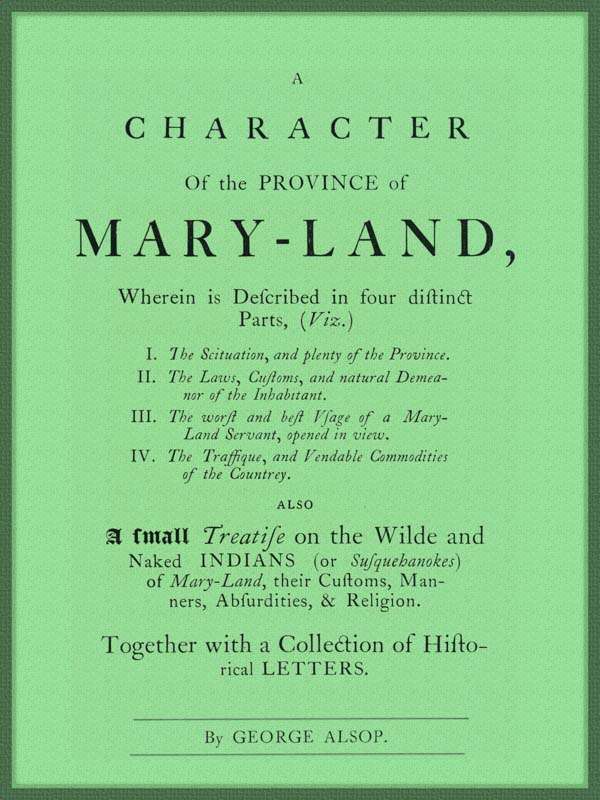
After having resolved to reprint Alsop’s early account of Maryland, as an addition to my Bibliotheca Americana, I immediately fell in with a difficulty which I had not counted on. After much inquiry and investigation, I could find no copy to print from among all my earnest book collecting acquaintances. At length some one informed me that Mr. Bancroft the historian had a copy in his library. I immediately took the liberty of calling on him and making known my wants, he generously offered to let me have the use of it for the purpose stated, I carried the book home, had it carefully copied, but unfortunately during the process I discovered the text was imperfect as well as deficient in both portrait and map. Like Sisyphus I had to begin anew, and do nearly all my labor over; I sent to London to learn if the functionaries in the British Museum would permit a tracing of the portrait and map to be made from their copy, the answer returned was, that they would or could not permit this, but I might perfect my text if I so choosed by copying from theirs. Here I was once more at sea without compass, rudder, or chart: I made known my condition to an eminent and judicious collector of old American literature in the city of New York, he very frankly informed me that he could aid me in my difficulty by letting me have the use of a copy, which would relieve me from my present dilemma. I was greatly rejoiced at this discovery as well as by the generosity of the owner. The following day the book was put into my possession, and so by the aid of it was enabled to complete the text. Here another difficulty burst into view, this copy had no portrait. That being the only defect in perfecting a copy of Alsop’s book, I now resolved to proceed and publish it without a portrait, but perhaps fortunately, making known this resolve to some of the knowing ones in book gathering, they remonstrated against this course, adding that it would ruin the book in the estimation of all who would buy such a rarity. I was inclined to listen favorably to this protest, and therefore had to commence a new effort to obtain a portrait. I then laid about me again to try and procure a copy that had one: I knew that not more than three or four collectors in the country who were likely to have such an heir-loom. To one living at a considerable distance from New York I took the liberty of addressing a letter on the subject, wherein I made known my difficulties. To my great gratification this courteous and confiding gentleman not only immediately made answer, but sent a perfect copy of this rare and much wanted book for my use. I immediately had the {110} portrait and map reproduced by the photo-lithographic process. During the time the book was in my possession, which was about ten days, so fearful was I that any harm should befall it that I took the precaution to wrap up the precious little volume in tissue paper and carry it about with me all the time in my side pocket, well knowing that if it was either injured or lost I could not replace it. I understand that a perfect copy of the original in the London market would bring fifty pounds sterling. I had the satisfaction to learn it reached the generous owner in safety.
Had I known the difficulties I had to encounter of procuring a copy of the original of Alsop’s singular performance, I most certainly would never have undertaken to reproduce it in America. Mr. Jared Sparks told me that he had a like difficulty to encounter when he undertook to write the life of Ledyard the traveler. Said he: “a copy of his journal I could find nowhere to purchase, at length I was compelled to borrow a copy on very humiliating conditions; the owner perhaps valued it too highly.” I may add that I had nearly as much difficulty in securing an editor, as I had in procuring a perfect copy. However on this point I at last was very fortunate.
115 Nassau street, March 23d, 1869.
Note 2, page 19.
Cecilius, Lord Baltimore, eldest son of George Calvert, 1st Lord Baltimore, and Anne Wynne of Hertingfordbury, England, was born in 1606. He succeeded to the title April 15, 1632, and married Anne, daughter of Lord Arundel, whose name was given to a county in Maryland. His rule over Maryland, disturbed in Cromwell’s time, but restored under Charles II, has always been extolled. He died Nov. 30, 1675, covered with age and reputation.—O’Callaghan’s N. Y. Col. Doc., II. p. 74.
Note 3, page 19.
Avalon, the territory in Newfoundland, of which the first Lord Baltimore obtained a grant in 1623, derived its name from the spot in England where, as tradition said, Christianity was first preached by Joseph of Arimathea.
Note 4, page 21.
Owen Feltham, as our author in his errata correctly gives the name, was an author who enjoyed a great reputation in his day. His Resolves appeared first about 1620, and in 1696 had reached the eleventh edition. They were once reprinted in the 18th century, and in full or in part four times in the {111} 19th, and an edition appeared in America about 1830. Hallam in spite of this popularity calls him “labored, artificial and shallow.”
Note 5, page 24.
Burning on the hand was not so much a punishment as a mark on those who, convicted of felony, pleaded the benefit of clergy, which they were allowed to do once only.
Note 6, page 25.
Literally: “Good wine needs no sign.”
Note 7, page 26.
Billingsgate is the great fish market of London, and the scurrilous tongues of the fish women have made the word synonymous with vulgar abuse.
Note 8, page 28.
Alsop though cautiously avoiding Maryland politics, omits no fling at the Puritans. Pride was a parliament colonel famous for Pride’s Purge.
Notes 9, 10, pages 31, 33.
William Bogherst, and H. W., Master of Arts, have eluded all our efforts to immortalize them.
Note 11, page 35.
Chesapeake is said to be K’tchisipik, Great Water, in Algonquin.
Note 12, page 38.
Less bombast and some details as to the botany of Maryland would have been preferable.
Note 13, page 39.
The American deer (Cariacus Virginianus) is here evidently meant. {112}
Note 14, page 39.
Whetston’s (Whetstone) park: “A dilapidated street in Lincoln’s Inn Fields, at the back of Holborn. It contains scarcely anything but old, half-tumble down houses; not a living plant of any kind adorns its nakedness, so it is presumable that as a park it never had an existence, or one so remote that even tradition has lost sight of the fact.”
Note 15, page 39.
The animals here mentioned are the black wolf (canis occidentalis), the black bear, the panther (felis concolor).
Note 16, page 40.
These animals are well known, the elk (alces Americanus), cat o’ the mountain or catamount (felis concolor), raccoon (procyon lotor), fox (vulpes fulvus), beaver (castor fiber), otter (lutra), opossum (didelphys Virginiana), hare, squirrel, musk-rat (fiber zibethicus). The monack is apparently the Maryland marmot or woodchuck (arctomys monax).
Note 17, page 40.
The domestic animals came chiefly from Virginia. As early as May 27, 1634, they got 100 swine from Accomac, with 30 cows, and they expected goats and hens (Relation of Maryland, 1634). Horses and sheep had to be imported from England, Virginia being unable to give any. Yet in 1679 Dankers and Sluyters, the Labadists, say: “Sheep they have none.”—Collections Long Island Hist. Soc., I, p. 218.
Note 18, page 41.
Alluding to the herds of swine kept by the Gadarenes, into one of which the Saviour allowed the devil named Legion to enter.
Note 19, page 42.
The abundance of these birds is mentioned in the Relations of Maryland, 1634, p. 22, and 1635, p. 23. The Labadists with whose travels the Hon. {113} H. C. Murphy has enriched our literature, found the geese in 1679–80 so plentiful and noisy as to prevent their sleeping, and the ducks filling the sky like a cloud.—Long Island Hist. Coll., I, pp. 195, 204.
Note 20, page 43.
Alsop makes no allusion to the cultivation of maize, yet the Labadists less than twenty years after describe it at length as the principal grain crop of Maryland.—Ib., p. 216.
Note 21, page 45.
Considering the facts of history, this picture is sadly overdrawn, Maryland having had its full share of civil war.
Note 22, page 46.
The fifth monarchy men were a set of religionists who arose during the Puritan rule in England. They believed in a fifth universal monarchy of which Christ was to be the head, under whom they, his saints, were to possess the earth. In 1660 they caused an outbreak in London, in which many were killed and others tried and executed. Their leader was one Venner. The Adamites, a gnostic sect, who pretended that regenerated man should go naked like Adam and Eve in their state of innocence, were revived during the Puritan rule in England; and in our time in December, 1867, we have seen the same theory held and practiced in Newark, N. J.
Note 23, page 46.
In the provisional act, passed in the first assembly, March 19, 1638, and entitled “An Act ordaining certain laws for the government of this province,” the twelfth section required that “every person planting tobacco shall plant and tend two acres of corn.” A special act was introduced the same session and read twice, but not passed. A new law was passed, however, Oct. 23, 1640, renewed Aug. 1, 1642, April 21, 1649, Oct. 20, 1654, April 12, 1662, and made perpetual in 1676. These acts imposed a fine of fifty pounds of tobacco for every half acre the offender fell short, besides fifty pounds of the same current leaf as constables’ fees. It was to this persistent enforcement of the cultivation of cereals that Maryland so soon became the granary of New England. {114}
Note 24, page 47.
The Assembly, or House of Burgesses, at first consisted of all freemen, but they gradually gave place to delegates. The influence of the proprietary, however, decided the selection. In 1650 fourteen burgesses met as delegates or representatives of the several hundreds, there being but two counties organized, St. Marys and the Isle of Kent. Ann Arundel, called at times Providence county, was erected April 29, 1650. Patuxent was erected under Cromwell in 1654.—Bacon’s Laws of Maryland, 1765.
Note 25, page 47.
Things had changed when the Sot Weed Factor appeared, as the author of that satirical poem dilates on the litigious character of the people.
Note 26, page 47.
The allusion here I have been unable to discover.
Note 27, page 48.
The colony seems to have justified some of this eulogy by its good order, which is the more remarkable, considering the height of party feeling.
Note 28, page 48.
Halberdeers; the halberd was smaller than the partisan, with a sharp pointed blade, with a point on one side like a pole-axe.
Note 29, page 49.
Newgate, Ludgate and Bridewell are the well known London prisons.
Note 30, page 50.
Our author evidently failed from this cause. {115}
Note 31, page 50.
A fling at the various Puritan schools, then active at home and abroad.
Note 32, page 50.
The first Quakers in Maryland were Elizabeth Harris, Josiah Cole, and Thomas Thurston, who visited it in 1657, but as early as July 23, 1659, the governor and council issued an order to seize any Quakers and whip them from constable to constable out of the province. Yet in spite of this they had settled meetings as early as 1661, and Peter Sharpe, the Quaker physician, appears as a landholder in 1665, the very year of Alsop’s publication.—Norris, Early Friends or Quakers in Maryland (Maryland Hist. Soc., March, 1862).
Note 33, page 50.
The Baptists centering in Rhode Island, extended across Long Island to New Jersey, and thence to New York city; but at this time had not reached the south.
Note 34, page 56.
A copy of the usual articles is given in the introduction. Alsop here refutes current charges against the Marylanders for their treatment of servants. Hammond, in his Leah and Rachel, p. 12, says: “The labour servants are put to is not so hard, nor of such continuance as husbandmen nor handecraftmen are kept at in England. . . . . The women are not (as is reported) put into the ground to worke, but occupie such domestic imployments and housewifery as in England.”
Note 35, page 59.
Laws as to the treatment of servants were passed in the Provisional act of 1638, and at many subsequent assemblies.
Notes 36, 37, pages 59, 61.
Lewknors lane or Charles street was in Drury lane, in the parish of St. Giles.—Seymour’s History of London, II, p. 767. Finsbury is still a well known quarter, in St. Luke’s parish, Middlesex. {116}
Note 38, page 65.
Nicholas Culpepper, “student in physic and astrology,” whose English Physician, published in 1652, ran through many editions, and is still a book published and sold.
Note 39, page 65.
Dogs dung, used in dressing morocco, is euphemized into album græcum, and is also called pure; those who gather it being still styled in England pure-finders.—Mayhew, London Labor and London Poor, II, p. 158.
Note 40, page 65.
He has not mentioned tobacco as a crop, but describes it fully a few pages after. In Maryland as in Virginia it was the currency. Thus in 1638 an act authorized the erection of a water-mill to supersede hand-mills for grinding grain, and the cost was limited to 20,000 lbs. of tobacco.—McSherry’s History of Maryland, p. 56. The Labadists in their Travels (p. 216) describe the cultivation at length. Tobacco at this time paid two shillings English a cask export duty in Maryland, and two-pence a pound duty on its arrival in England, besides weighing and other fees.
Note 41, page 66.
The Parson of Pancras is unknown to me: but the class he represents is certainly large.
Note 42, page 66.
The buffalo was not mentioned in the former list, and cannot be considered as synonymous with elk.
Note 43, page 67.
For satisfactory and correct information of the present commerce and condition of Maryland, the reader is referred to the Census of the United States in 4 vols., 4to, published at Washington, 1865. {117}
Note 44, page 69.
This is a curious observation as to New England trade. A century later Hutchinson represents Massachusetts as receiving Maryland flour from the Pennsylvania mills, and paying in money and bills of exchange.—Hist. of Massachusetts, p. II, 397.
Note 45, page 69.
The trade with Barbadoes, now insignificant, was in our colonial times of great importance to all the colonies. Barbadoes is densely peopled and thoroughly cultivated; its imports and exports are each about five millions of dollars annually.
Note 46, page 71.
The Susquehannas. This Relation is one of the most valuable portions of Alsop’s tract, as no other Maryland document gives as much concerning this tribe, which nevertheless figures extensively in Maryland annals. Dutch and Swedish writers speak of a tribe called Minquas (Minquosy, Machœretini in De Laet, p. 76); the French in Canada (Champlain, the Jesuit Relations, Gendron, Particularitez du Pays des Hurons, p. 7, etc.), make frequent allusion to the Gandastogués (more briefly Andastés), a tribe friendly to their allies the Hurons, and sturdy enemies of the Iroquois; later still Pennsylvania writers speak of the Conestogas, the tribe to which Logan belonged, and the tribe which perished at the hands of the Paxton boys. Although Gallatin in his map, followed by Bancroft, placed the Andastés near Lake Erie, my researches led me to correct this, and identify the Susquehannas, Minqua, Andastés or Gandastogués and Conestogas as being all the same tribe, the first name being apparently an appellation given them by the Virginia tribes; the second that given them by the Algonquins on the Delaware; while Gandastogué as the French, or Conestoga as the English wrote it, was their own tribal name, meaning cabin-pole men, Natio Perticarum, from Andasta, a cabin-pole (map in Creuxius, Historia Canadensis). I forwarded a paper on the subject to Mr. Schoolcraft, for insertion in the government work issuing under his supervision. It was inserted in the last volume without my name, and ostensibly as Mr. Schoolcraft’s. I then gave it with my name in the Historical Magazine, vol. II, p. 294. The result arrived at there has been accepted by Bancroft, in his large paper edition, by Parkman, in his Jesuits in the Wilderness, by Dr. O’Callaghan, S. F. Streeter, Esq., of the Maryland Historical Society, and students generally. {118}
From the Virginian, Dutch, Swedish and French authorities, we can thus give their history briefly.
The territory now called Canada, and most of the northern portion of the United States, from Lake Superior and the Mississippi to the mouth of the St. Lawrence and Chesapeake bay were, when discovered by Europeans, occupied by two families of tribes, the Algonquin and the Huron Iroquois. The former which included all the New England tribes, the Micmacs, Mohegans, Delawares, Illinois, Chippewas, Ottawas, Pottawatamies, Sacs, Foxes, Miamis, and many of the Maryland and Virginian tribes surrounded the more powerful and civilized tribes who have been called Huron Iroquois, from the names of the two most powerful nations of the group, the Hurons or Wyandots of Upper Canada, and the Iroquois or Five Nations of New York. Besides these the group included the Neuters on the Niagara, the Dinondadies in Upper Canada, the Eries south of the lake of that name, the Andastogués or Susquehannas on that river, the Nottaways and some other Virginian tribes, and finally the Tuscaroras in North Carolina and perhaps the Cherokees, whose language presents many striking points of similarity.
Both these groups of tribes claimed a western origin, and seem, in their progress east, to have driven out of Ohio the Quappas, called by the Algonquins, Alkansas or Allegewi, who retreated down the Ohio and Mississippi to the district which has preserved the name given them by the Algonquins.
After planting themselves on the Atlantic border, the various tribes seem to have soon divided and become embroiled in war. The Iroquois, at first inferior to the Algonquins were driven out of the valley of the St. Lawrence into the lake region of New York, where by greater cultivation, valor and union they soon became superior to the Algonquins of Canada and New York, as the Susquehannas who settled on the Susquehanna did over the tribes in New Jersey, Maryland and Virginia. (Du Ponceau’s Campanius, p. 158.) Prior to 1600 the Susquehannas and the Mohawks, the most eastern Iroquois tribe, came into collision, and the Susquehannas nearly exterminated the Mohawks in a war which lasted ten years. (Relation de la Nouv. France, 1659–60, p. 28.)
In 1608 Captain Smith, in exploring the Chesapeake and its tributaries, met a party of sixty of these Sasquesahanocks as he calls them (I, p. 120–1), and he states that they were still at war with the Massawomekes or Mohawks. (De Laet Novus Orbis, p. 79.)
DeVries, in his Voyages (Murphy’s translation, p. 41–3), found them in 1633 at war with the Armewamen and Sankiekans, Algonquin tribes on the Delaware, maintaining their supremacy by butchery. They were friendly to the Dutch. When the Swedes in 1638 settled on the Delaware, they renewed the friendly intercourse begun by the Dutch. They purchased lands of the ruling tribe and thus secured their friendship. (Hazard’s Annals, p. 48). They carried the terror of their arms southward also, and {119} in 1634 to 1644 they waged war on the Yaomacoes, the Piscataways and Patuxents (Bozman’s Maryland, II. p. 161), and were so troublesome that in 1642 Governor Calvert, by proclamation, declared them public enemies.
When the Hurons in Upper Canada in 1647 began to sink under the fearful blows dealt by the Five Nations, the Susquehannas sent an embassy to offer them aid against the common enemy. (Gendron, Quelques Particularitez du Pays des Hurons, p. 7). Nor was the offer one of little value, for the Susquehannas could put in the field 1,300 warriors (Relation de la Nouvelle France, 1647–8, p. 58) trained to the use of fire arms and European modes of war by three Swedish soldiers whom they had obtained to instruct them. (Proud’s Pennsylvania, I, p. 111; Bozman’s Maryland, II, p. 273.) Before interposing in the war, they began by negotiation, and sent an embassy to Onondaga to urge the cantons to peace. (Relation, 1648, p. 58). The Iroquois refused, and the Hurons, sunk in apathy, took no active steps to secure the aid of the friendly Susquehannas.
That tribe, however, maintained its friendly intercourse with its European neighbors, and in 1652 Sawahegeh, Auroghteregh, Scarhuhadigh, Rutchogah and Nathheldianeh, in presence of a Swedish deputy, ceded to Maryland all the territory from the Patuxent river to Palmer’s island, and from the Choptauk to the northeast branch north of Elk river. (Bozman’s Maryland, II, p. 683).
Four years later the Iroquois, grown insolent by their success in almost annihilating their kindred tribes north and south of Lake Erie, the Wyandots, Dinondadies, Neuters and Eries, provoked a war with the Susquehannas, plundering their hunters on Lake Ontario. (Relation de la Nouvelle France, 1657, pp. 11, 18).
It was at this important period in their history that Alsop knew and described them to us.
In 1661 the small-pox, that scourge of the native tribes, broke out in their town, sweeping off many and enfeebling the nation terribly. War had now begun in earnest with the Five Nations; and though the Susquehannas had some of their people killed near their town (Hazard’s Annals, 341–7), they in turn pressed the Cayugas so hard that some of them retreated across Lake Ontario to Canada (Relation de la Nouvelle France, 1661, p. 39, 1668, p. 20). They also kept the Senecas in such alarm that they no longer ventured to carry their peltries to New York, except in caravans escorted by six hundred men, who even took a most circuitous route. (Relation, 1661, p. 40). A law of Maryland passed May 1, 1661, authorized the governor to aid the Susquehannas.
Smarting under constant defeat, the Five Nations solicited French aid (Relation de la Nouvelle France, 1662–3, p. 11, 1663–4, p. 33; Charlevoix, II, p. 134), but in April, 1663, the Western cantons raised an army of eight hundred men to invest and storm the fort of the Susquehannas. They embarked on Lake Ontario, according to the French account, and then went overland to the Susquehanna. On reaching the fort, however, they found {120} it well defended on the river side, and on the land side with two bastions in European style with cannon mounted and connected by a double curtain of large trees. After some trifling skirmishes the Iroquois had recourse to stratagem. They sent in a party of twenty-five men to treat of peace and ask provisions to enable them to return. The Susquehannas admitted them, but immediately burned them all alive before the eyes of their countrymen. (Relation de la Nouvelle France, 1663, p. 10). The Pennsylvania writers, (Hazard’s Annals of Pennsylvania, p. 346) make the Iroquois force one thousand six hundred, and that of the Susquehannas only one hundred. They add that when the Iroquois retreated, the Susquehannas pursued them, killing ten and taking as many.
After this the war was carried on in small parties, and Susquehanna prisoners were from time to time burned at Oneida, Onondaga, Seneca and Cayuga (Relations de la Nouvelle France, 1668 to 1673), and their prisoners doubtless at Canoge on the Susquehanna. In the fall of 1669 the Susquehannas, after defeating the Cayugas, offered peace, but the Cayugas put their ambassador and his nephew to death, after retaining him five or six months; the Oneidas having taken nine Susquehannas and sent some to Cayuga, with forty wampum belts to maintain the war. (Relation de la Nouvelle France, 1670, p. 68.)
At this time the great war chief of the Susquehannas was one styled Hochitagete or Barefoot (Relation de la Nouvelle France, 1670, p. 47); and raving women and crafty medicine men deluded the Iroquois with promises of his capture and execution at the stake (Relation, 1670, p. 47), and a famous medicine man of Oneida appeared after death to order his body to be taken up and interred on the trail leading to the Susquehannas as the only means of saving that canton from ruin. (Relation, 1672, p. 20.)
Towards the summer of 1672 a body of forty Cayugas descended the Susquehanna in canoes, and twenty Senecas went by land to attack the Susquehannas in their fields; but a band of sixty Andasté or Susquehanna boys, the oldest not over sixteen, attacked the Senecas, and routed them, killing one brave and taking another. Flushed with victory they pushed on to attack the Cayugas, and defeated them also, killing eight and wounding with arrow, knife and hatchet, fifteen or sixteen more, losing, however, fifteen or sixteen of their gallant band. (Relation, 1672, p. 24.)
At this time the Susquehannas or Andastés were so reduced by war and pestilence that they could muster only three hundred warriors. In 1675, however, the Susquehannas were completely overthrown (Etat Present, 1675, manuscript; Relation, 1676, p. 2; Relations Inédites, II, p. 44; Colden’s Five Nations, I, p. 126), but unfortunately we have no details whatever as to the forces which effected it, or the time or manner of their utter defeat.
A party of about one hundred retreated into Maryland, and occupied some abandoned Indian forts. Accused of the murder of some settlers, apparently slain by the Senecas, they sent five of their chiefs to the Maryland and Virginia troops, under Washington and Brent, who went out in {121} pursuit. Although coming as deputies, and showing the Baltimore medal and certificate of friendship, these chiefs were cruelly put to death. The enraged Susquehannas then began a terrible border war, which was kept till their utter destruction (S. F. Streeter’s Destruction of the Susquehannas, Historical Magazine, I, p. 65). The rest of the tribe, after making overtures to Lord Baltimore, submitted to the Five Nations, and were allowed to retain their ancient grounds. When Pennsylvania was settled, they became known as Conestogas, and were always friendly to the colonists of Penn, as they had been to the Dutch and Swedes. In 1701 Canoodagtoh, their king, made a treaty with Penn, and in the document they are styled Minquas, Conestogos or Susquehannas. They appear as a tribe in a treaty in 1742, but were dwindling away. In 1763 the feeble remnant of the tribe became involved in the general suspicion entertained by the colonists against the red men, arising out of massacres on the borders. To escape danger the poor creatures took refuge in Lancaster jail, and here they were all butchered by the Paxton boys, who burst into the place. Parkman in his Conspiracy of Pontiac, p. 414, details the sad story.
The last interest of this unfortunate tribe centres in Logan, the friend of the white man, whose speech is so familiar to all, that we must regret that it has not sustained the historical scrutiny of Brantz Mayer (Tahgahjute; or, Logan and Capt. Michael Cresap, Maryland Hist. Soc., May, 1851; and 8vo, Albany, 1867). Logan was a Conestoga, in other words a Susquehanna.