
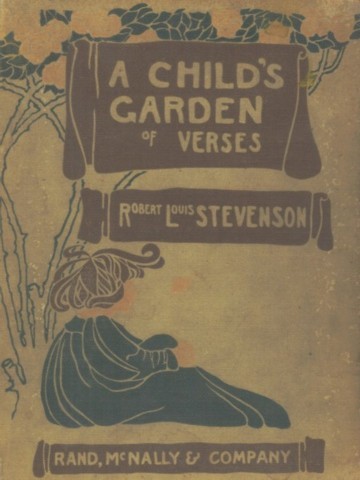
The Project Gutenberg eBook of A Child's Garden of Verses
Title: A Child's Garden of Verses
Author: Robert Louis Stevenson
Illustrator: E. Mars
Maud Hunt Squire
Release date: May 27, 2008 [eBook #25617]
Most recently updated: January 3, 2021
Language: English
Credits: Produced by Juliet Sutherland, Christine D. and the Online
Distributed Proofreading Team at https://www.pgdp.net
There are several editions of this ebook in the Project Gutenberg collection. Various characteristics of each ebook are listed to aid in selecting the preferred file.
Click on any of the filenumbers below to quickly view each ebook.
| 19722 | (Published in 1916; Black and White illustrations by M. Sheldon) |
| 25608 | (Published in 1905; Single Tone illustratons by B. C. Pease) |
| 25609 | (Published in 1905; Illustrations in Color by J. W. Smith) |
| 25610 | (Published in 1895; Black and White illustrations by C.Robins) |
| 25611 | (Publication date unknown; Black and White illustrations) |
| 25617 | (Published in 1900; Illustrations in Color by Mars and Squire) |
| 28722 | (Published in 1919; Illustrations in Color by Maria L. Kirk) |
A CHILD'S
GARDEN
of VERSES
By ROBERT
LOUIS
STEVENSON
ILLUSTRATED by
E. MARS
AND M. H. SQUIRE
RAND McNALLY &
COMPANY
CHICAGO
NEW YORK
LONDON
Copyright, 1900, by
Robert Howard Russell
Copyright, 1902, by
Rand McNally & Company
All rights reserved
Edition of 1928
BY WAY OF INTRODUCTION
Robert Lewis Balfour Stevenson, or Robert Louis Stevenson, as the world knows him, was still a boy when he published this rare volume of "A Child's Garden of Verses," although by the calendar he was thirty-five years old. You and I have sighed, no doubt, to be a boy again, but here was one who, while he outgrew his knickerbockers, never outgrew the quick sympathy, the brave heart, the fresh outlook, the confident faith and buoyant spirit of the little Scotch boy who roamed the hills 'round Edinburgh. Better than any man of any time he was able to enter into the heart of a boy, to view things with a boy's eyes, and to write of them in simple verse, touched with the warmth and color of his rich imagination. In these "Verses" he writes as a child rather than about children, and in this lies much of the charm which they possess for little readers. There is in them the surprise of reality, the beauty of a simple rhythm, and the mysterious flavor of magic that grips a boy's heart and will not let him go until the book has become a part of him. Surely this is a rare quality in schoolbooks.
The Stevensons had been famous engineers for more than a hundred years, building lighthouses along the Scottish coast, and it was natural that his father should have expected Robert Louis to follow in the family footsteps. But the slim boy with brown eyes, who at eight had written a "History of Moses," and illustrated it with his own pen; who was slow to learn from books, but quick to understand things that he saw and felt; the boy who carried a volume of history in one pocket and a notebook in another, had other plans for himself, and even his father came to see the wisdom of his son's choice of a literary life. As early as 1873, when only twenty-three years old, Stevenson was ordered south for the winter by his physician, to ward off impending consumption. For more than twenty years, or until his death in Samoa late in 1894, he was never far from this pursuing enemy. It followed him over tossing seas and through many lands as he journeyed in search of health; yet through all these years he carried a brave and happy heart, and wrote at the end this Requiem, the last three lines of which are upon his tomb on the mountain-top in Samoa;
Dig the grave and let me lie.
Glad did I live and gladly die,
And I laid me down with a will.
"This be the verse you grave for me:
Here he lies where he longed to be;
Home is the sailor, home from sea,
And the hunter home from the hill."
Robert Louis Stevenson's first book, "An Inland Voyage," was published in 1878, when he was twenty-eight years old, and is a fresh and charming account of a canoe trip up the rivers of Holland. It was during this journey that he wrote: "If we were charged so much a head for sunsets, or if God sent around a drum before the hawthorn came into flower, what a work we should make about their beauty! But these things, like good companions, stupid people early cease to observe."
The next year came his "Travels With a Donkey," which told in the same naïve style the story of his journey through the Cevennes Mountains with no other companion than a donkey, whose gait he describes as being "As much slower than a walk as a walk is slower than a run."
He first visited America in 1879, in search of health, returning in 1880 to Scotland with Mrs. Stevenson, whom he had married in California. In 1887 he came again with the hope that a dry winter in the Adirondack Mountains would stand off the hand of Death. But he was little benefited, and took up his search for health by chartering a yacht for a voyage through the South Seas. It was on this trip that he fell in love with the beauty of the scenery and the healthful climate of Samoa, and in 1890 he took up his home there, never again to leave the island except for occasional visits to Honolulu and Sydney. And when the time came for him to die, the natives, with their knives and axes cut a path up the steep mountain-side and carried him on their broad shoulders to his grave on the mountain-top.
"A Child's Garden of Verses" was first published in London in 1885, and long ago became a children's classic; yet it is now for the first time made available as a supplementary reader for the primary grades in a suitable form and at a possible price. There have been many and beautiful editions, but they have all appealed to "grown-ups" rather than to boys and girls to whom the book really belongs. To put such a book, with its simple style, its wise observations, its kindly sympathy, and fanciful humor into the hands of a boy or girl, is not only to make him happy, it is to start him on the straight path to culture.
This volume contains all the poems originally appearing under the title "A Child's Garden of Verses." The poems grouped under "The Child Alone," "Garden Days," and "Envoys" have been omitted, as many of them are too philosophical to be understood by children in the primary grades.
The illustrations in this book are used by special arrangement with Harper & Brothers of New York City, who publish the complete "Verses" in a beautiful edition suitable for the home or the library.
So with Stevenson's own words the book is yours:
Flowers in the garden, meat in the hall,
A living river by the door,
A nightingale in the sycamore."
E. O. G.
And watched for my unworthy sake:
For your most comfortable hand
That led me through the uneven land:
For all the story-books you read:
For all the pains you comforted:
For all you pitied, all you bore,
In sad and happy days of yore:—
My second Mother, my first Wife,
The angel of my infant life—
From the sick child, now well and old,
Take, nurse, the little book you hold!
May find as dear a nurse at need,
And every child who lists my rhyme,
In the bright, fireside, nursery clime,
May hear it in as kind a voice
As made my childish days rejoice!
R. L. S.
| PAGE | ||
| By Way of Introduction | 5 | |
| To Alison Cunningham | 8 | |
| Bed in Summer | 13 | |
| Young Night Thought | 15 | |
| Rain | 16 | |
| My Shadow | 17 | |
| Time To Rise | 20 | |
| At the Seaside | 21 | |
| Windy Nights | 22 | |
| Pirate Story | 24 | |
| Whole Duty of Children | 27 | |
| Foreign Lands | 28 | |
| System | 30 | |
| A Good Play | 32 | |
| The Land of Counterpane | 33 | |
| A Good Boy | 34 | |
| Looking Forward | 36 | |
| The Swing | 37 | |
| Good and Bad Children | 38 | |
| Marching Song | 40 | |
| Travel | 42 | |
| Where Go the Boats? | 46 | |
| Escape at Bedtime | 48 | |
| From a Railway Carriage | 50 | |
| The Wind | 52 | |
| Auntie's Skirts | 54 | |
| Happy Thought | 55 | |
| The Cow | 56 | |
| My Bed Is a Boat | 58 | |
| The Land of Nod | 60 | |
| Fairy Bread | 61 | |
| Keepsake Mill | 62 | |
| Winter-time | 64 | |
| Looking-glass River | 66 | |
| The Sun's Travels | 69 | |
| The Lamplighter | 70 | |
| Foreign Children | 73 | |
| The Moon | 74 | |
| The Hayloft | 77 | |
| Farewell To the Farm | 78 | |
| A Thought | 80 | |
| Singing | 81 | |
| North-west Passage | ||
| I. Good-night | 82 | |
| II. Shadow March | 84 | |
| III. In Port | 86 | |
| To My Mother | 88 | |
| Guide To Pronunciation | 89 | |
| A Word List | 90 | |
A CHILD'S
GARDEN
of
VERSES
BED IN SUMMER
And dress by yellow candle-light.
In summer, quite the other way,
I have to go to bed by day.
The birds still hopping on the tree,
Or hear the grown-up people's feet
Still going past me in the street.
When all the sky is clear and blue,
And I should like so much to play,
To have to go to bed by day?
YOUNG NIGHT THOUGHT
When my mama puts out the light
I see the people marching by,
As plain as day, before my eye.
All carrying different kinds of things,
And marching in so grand a way,
You never saw the like by day.
At the great circus on the green;
For every kind of beast and man
Is marching in that caravan.
But still the faster on they go,
And still beside them close I keep
Until we reach the Town of Sleep.
RAIN
It falls on field and tree,
It rains on the umbrellas here,
And on the ships at sea.
MY SHADOW
And what can be the use of him is more than I can see,
He is very, very like me from the heels up to the head;
And I see him jump before me, when I jump into my bed.
Not at all like proper children, which is always very slow;
For he sometimes shoots up taller like an india-rubber ball,
And he sometimes gets so little that there's none of him at all.
And can only make a fool of me in every sort of way.
He stays so close beside me, he's a coward you can see;
I'd think shame to stick to nursie as that shadow sticks to me!
I rose and found the shining dew on every buttercup;
But my lazy little shadow, like an arrant sleepy-head,
Had stayed at home behind me and was fast asleep in bed.
Time to Rise.
Hopped upon the window sill,
Cocked his shining eye and said:
'Ain't you shamed, you sleepy-head?'
At the Seaside.
A wooden spade they gave to me
To dig the sandy shore.
My holes were empty like a cup,
In every hole the sea came up.
Till it could come no more.
Windy-Nights
Whenever the wind is high,
All night long in the dark and wet,
A man goes riding by.
Late in the night when the fires are out,
Why does he gallop and gallop about?
And ships are tossed at sea,
By, on the highway, low and loud,
By at the gallop goes he.
By at the gallop he goes, and then
By he comes back at the gallop again.
PIRATE STORY
Three of us aboard in the basket on the lea.
Winds are in the air, they are blowing in the spring.
And waves are on the meadow like the waves there are at sea.
Wary of the weather and steering by a star?
Shall it be to Africa, a-steering of the boat,
To Providence, or Babylon, or off to Malabar?
Cattle on the meadow a-charging with a roar!
Quick, and we'll escape them, they're as mad as they can be.
The wicket is the harbor and the garden is the shore.
WHOLE DUTY of CHILDREN
And speak when he is spoken to,
And behave mannerly at table:
At least as far as he is able.
FOREIGN LANDS
Who should climb but little me?
I held the trunk with both my hands
And looked abroad on foreign lands.
Adorned with flowers, before my eye,
And many pleasant places more
That I had never seen before.
And be the sky's blue looking-glass;
The dusty roads go up and down
With people tramping into town,
Farther and farther I should see,
To where the grown-up river slips
Into the sea among the ships.
Lead onward into fairy land,
Where all the children dine at five,
And all the playthings come alive.
SYSTEM
And get my dinner every day;
And every day that I've been good,
I get an orange after food.
With lots of toys and things to eat,
He is a naughty child, I'm sure—
Or else his dear papa is poor.
A GOOD PLAY
All made of the back-bedroom chairs,
And filled it full of sofa pillows
To go a-sailing on the billows.
And water in the nursery pails;
And Tom said, "Let us also take
An apple and a slice of cake";—
Which was enough for Tom and me
To go a-sailing on, till tea.
And had the very best of plays;
But Tom fell out and hurt his knee,
So there was no one left but me.
THE LAND OF COUNTERPANE
I had two pillows at my head,
And all my toys beside me lay
To keep me happy all the day.
I watched my leaden soldiers go,
With different uniforms and drills,
Among the bed-clothes, through the hills.
All up and down among the sheets;
Or brought my trees and houses out,
And planted cities all about.
That sits upon the pillow-hill,
And sees before him, dale and plain,
The pleasant Land of Counterpane.
A GOOD BOY
I never said an ugly word, but smiled and stuck to play.
And I am very happy, for I know that I've been good.
And I must off to sleepsin-by, and not forget my prayer.
No ugly dream shall fright my mind, no ugly sight my eyes.
And hear the thrushes singing in the lilacs round the lawn.
LOOKING FORWARD
I shall be very proud and great,
And tell the other girls and boys
Not to meddle with my toys.
The Swing
Up in the air so blue?
Oh, I do think it the pleasantest thing
Ever a child can do!
Till I can see so wide,
Rivers and trees and cattle and all
Over the countryside—
Down on the roof so brown—
Up in the air I go flying again,
Up in the air and down!
GOOD AND BAD CHILDREN
And your bones are very brittle;
If you would grow great and stately,
You must try to walk sedately.
And content with simple diet;
And remain, through all bewild'ring,
Innocent and honest children.
Happy play in grassy places—
That was how, in ancient ages,
Children grew to kings and sages.
And the sort who eat unduly,
They must never hope for glory—
Theirs is quite a different story!
All grow up as geese and gabies,
Hated, as their age increases,
By their nephews and their nieces.