
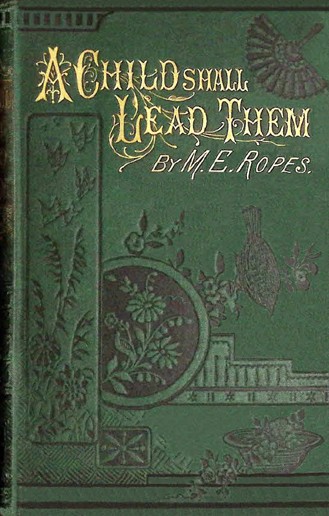
The Project Gutenberg eBook of A child shall lead them
Title: A child shall lead them
The house that Jack built; and Another Moses
Author: Mary E. Ropes
Release date: December 3, 2025 [eBook #77390]
Language: English
Original publication: London: Sunday School Union, 1882
Transcriber's note: Unusual and inconsistent spelling is as printed.
"OH! YOU LITTLE DARLING."
A
CHILD SHALL LEAD THEM:
THE HOUSE THAT JACK BUILT;
AND
ANOTHER MOSES.
BY
MARY E. ROPES
————————————
LONDON:
SUNDAY SCHOOL UNION
56, OLD BAILEY, E.C.
CONTENTS.
I. This is the House that Jack built
II. This is the Malt that lay in the House that Jack built
III. This is the Rat that ate the Malt
IV. This is the Cat that killed the Rat
V. This is the Dog that worried the Cat
VI. This is the Cow with the Crumpled Horn
VII. This is the Maiden all forlorn
VIII. This is the Man all tattered and torn
IX. This is the Priest all shaven and shorn
X. This is the Cock that crowed in the morn
————
ILLUSTRATIONS.
OH! YOU LITTLE DARLING (Frontispiece)
A CHILD SHALL LEAD THEM.
THE HOUSE THAT JACK BUILT.
————————————
CHAPTER I.
"THIS IS THE HOUSE THAT JACK BUILT."
THERE it stood, at the corner of the street, the finest public-house in the populous neighbourhood of this London suburb. There it stood, with its plate-glass windows, and grand swinging doors, and brilliant lights at night, and the air of warmth and welcome and cheer, that, like the will-o'-the-wisp of the treacherous marsh, lured many a foolish wayfarer to ruin.
The place was kept by a man called John Drinkrow, to whom it had been bequeathed by his father, who had borne the same name. For a period of thirty years, John Drinkrow, the elder, had successfully carried on the business; then he died, leaving a considerable fortune, as well as the public-house itself, to his only son. During his long life, thrifty Jack (as he had been familiarly named) had laid claim to a sort of respectability upon which he had prided himself not a little. He had always gone to church once every Sunday, had paid his way punctually, and, though so much drinking went on under his very eyes, he himself was known to be very abstemious. He put his son to a good school, and it was not until the lad was sixteen that he suffered him to return home and join him in the daily work of the "business," as he complacently termed it.
John the younger, grew up resembling his father in some things. Like him he was perfectly sober, and proud of his respectability; but the thriftiness that had characterised old Jack had turned to miserliness in the son, and the passion for hoarding had increased with every year, until at the time that our story commences, it was the ruling motive of the man's life. He had married at an early age; but after four years his wife had died, leaving two little boys, with just a year's difference between them.
The children grew up with but little care from any one; the elder, Tom, taking after his father in quietness, steadiness, and love of hoarding; the younger, Ratcliffe, turning out wild and dissipated, with many good impulses, but also with a passionate love of excitement and pleasure which led him into bad companionship and into various forms of self-indulgence. Though often absent during many hours, for which he never accounted, he was still supposed to be living at home; but his father's anger and threats had lately become more frequent, and Ratcliffe knew that, sooner or later, unless he reformed, he would have to quit the parental roof. In the fear of this, he often resolved to mend his ways; but mere resolutions with no principle to back them are weak things at best, and generally a pressing invitation from some boon companion, or a few words of ridicule, were sufficient to tempt him back to old haunts and old sins, and the resolutions would be broken.
John Drinkrow's hoarding propensities had prevented his educating his sons in a proper manner. Tom, however, had managed to pick up some knowledge by reading and study in over-hours; but poor Ratcliffe could do little more than read and write, and add up the score of the customers at the bar. Thus he was despised and sneered at by his better informed brother; and this state of feeling between the two young men added not a little to the family trouble and discord.
One evening John Drinkrow was busy with his accounts in the little back parlour. His elder son was serving the customers; the younger was out. The gaslight shone full upon the old man as he bent with passionate intentness over his work; it shone on the hard-worn face with its deep lines and furrows, on the keen watchful eye gloating over the week's gains—gains not a few, as the long column of figures plainly testified.
Suddenly the door opened and Ratcliffe entered, his face flushed, his gait somewhat unsteady. His father looked up, with no welcome but a frown on his dark countenance.
"Father," said the young man, approaching the table and laying one hand upon it as though to steady himself; "father, it's some time since you gave me anything, and I'm hard up."
John did not even glance at his son as the latter spoke; he went on adding up his figures and counting his gains.
Ratcliffe waited a moment; then he said—
"Father, did you hear what I said?"
This time the publican looked up, cold, hard, contemptuous.
"Yes, I did hear," replied he, in the unsympathetic, metallic voice which might have been borrowed from the chink of his beloved coin; "yes, I hear well enough; what of it?"
Ratcliffe's face flushed more deeply. "Why, father," he said, "it's ever so long since I came to you for tin; I think you might give me some without all this business. I'm sure you've got heaps and needn't grudge it. I wouldn't grudge a child of mine a sov. over and above his wages now and then, if I'd a strong-room and bags and bags full like you."
Now Ratcliffe was excited with drink and vexation, or he would never have dared to say all this; for if anything angered John Drinkrow, it was an allusion to his truly miserly and very unwise habit of keeping his money in coin stowed away in a strong box, in a little room expressly arranged for this purpose, and next to his own bedroom.
The words had hardly gone out of Ratcliffe's mouth before his father rose and pointed to the door. His menacing wrath was terrible to witness, and Ratcliffe, sobered by the sight, his momentary boldness gene, staggered away from the table as though struck by a sudden blow.
"Go," said the father; "you have long been a disgrace to your brother and me; and I'll bear the burden of a spendthrift no longer. Get you gone—where you will; living or dying, I'll have none of you! Get you gone!"
"But, father!" cried the young man, with a wild gesture of despair. "Father, if you only knew! Oh, 'do' hear me! Hear me out!"
John interrupted him. "No more, I'll hear no more—get you gone!"
"Only one minute, father—God knows I'm—"
The old man's face grew livid with anger; his eyes were ablaze with unholy fire. In his excitement he rose and advanced a step with his arm outstretched. The son recoiled once more, gave his father one look, half of dread, half of defiance, then opened the door and was gone; and this was the beginning of great troubles for Ratcliffe himself, and also for the master of "the house that Jack built."
CHAPTER II.
"THIS IS THE MALT THAT LAY IN THE HOUSE
THAT JACK BUILT."
A WEEK had passed since Ratcliffe had been driven from his father's home, and his name had only once been mentioned between John and his elder son. This was on that first day when Tom had asked where his brother was, and had received the brief and not unwelcome reply, "He's gone, and he'll come back no more."
A week had passed, and now it was night—deep night. The house had been closed, and the miser had come up to his strong-room to count his gold. His gold was his life now; all natural tenderness and right feeling had been consumed out of his heart by this canker. For long enough the Bible, given him years ago by his wife, had remained unopened—unopened until that morning when, as he took it up to remove it to the bookshelves, it opened of its own accord, and his eye had caught the words, "The love of money is the root of all evil."
Down went the book on to the floor. Why had this silent messenger been sent thus to touch him where he felt it most? Yet he saw no warning in the solemn words; he tried not to feel the pricking of the conscience that was not yet quite dead, but had leaped up for a moment into the light of the great and awful truth as it flashed upon the man's unwilling intelligence.
"Well," said he, suddenly recovering himself, "this is the last time that I shall ever see anything in this book."
So saying, he raised the Bible once more (for he had dropped it in the first surprise that the reading of the text had occasioned him), looked at its cover, from which the silver clasp was gone, coldly estimated its money value as simply nothing; then, opening a window, he flung the volume out on to the dust-heap below.
"There," he had said, sullenly, as he closed the window, "that's the last I shall see of you, you printed lie! Catch me ever having another Bible in the house!"
But somehow, after he had left the room, and all through the day, the words had haunted him; and now again, when the shadows of night were about him, the brief sentence rang in his ears like the death knell of all faith and hope, "The love of money is the root of all evil;" and again other words that came to him like an avenging spirit out of the long ago, "How hardly shall they that have riches enter into the kingdom of God!"
But John Drinkrow would not yield to these memories. With the resolution of a stubborn nature, he strove against them. He did not think of the time when death must overtake him, swift, and silent, and unrelenting; of a future state where he must reap as he had sown; of that eternity whither we can carry nothing, but where the poor and the rich in this world's goods will be as though they were alike.
"No one can reproach me with dishonesty or drunkenness," said John, as he lighted the one meagre candle which he allowed himself, and buttoned his coat that he might not feel the damp chill of the fireless room. "I am better than most of my neighbours; I adulterate the beer less than many men would in my position, and I've never let my place get a bad name. Now that young scamp Ratcliffe is off, the house will be more respectable than ever. Tom will never ruin himself or me. He and I are of one mind in the matter of saving, and a very good mind it is."
Thus, like the Pharisee of our Lord's parable, this hard old man prided himself upon his supposed virtues, and grew yet harder in their contemplation, forgetting that it was the poor publican—broken-hearted, humble, contrite—who went down to his house justified.
Then the miser unlocked his safe and took out his bags of gold and laid them on the table, while into one less full than the rest, he poured the week's gains from a large leathern purse that he had brought up with him. And now his cold eyes began to kindle and to glitter; the unholy passion of avarice—of greed in its meanest form—flushed his wrinkled cheeks, and nerved his hands, and he fingered and counted the yellow heaps before him, whispering, "Mine! All mine!"
And upstairs, in his own room, Tom—true son of a miser—was following his father's example. Stingy as John Drinkrow was, he was obliged to pay Tom a salary for his services, and even a small share of the profits; and Tom's only pleasure consisted in escaping to his room and drawing out of his cashbox the bank-notes and sovereigns he had earned, and to which he was steadily adding.
"Now Ratcliffe is gone," said he to himself, "if anything happens to the old man, all that he leaves will be mine. I don't believe father will ever wish to see him again, but if he should seem as if he wanted him back, I will tell him what I have lately found out; and when he hears that Ratcliffe has been married on the sly, for ever so long, to a girl with no money, or next to none, and that this is what he has been doing with himself—let alone his gay life—the old gent will never forgive him, I'll be bound. And I shall mind it the less telling him all this, because of my having had a fancy for that girl myself once upon a time, and she wouldn't have anything to say to me. Ah! She waited for something better; and now she's got a treasure, and I wish her joy of him. But I owe them both a grudge for this, and I'll pay it some day."
These thoughts, and thoughts like these, were passing through Tom's mind when a loud knock came at his door. Hastily he swept his money into the box, and hid it under the bed; then he went to the door, and, drawing aside the bolt, opened it. To his surprise and horror there stood Ratcliffe, his face pale and haggard, and softened a little with what looked like penitence.
"Oh, Tom!" he said. "I managed to get in with my latch-key because I wanted a word with you—because I felt I must speak to you to-night." Here he paused and repressed the lump in his throat.
But Tom said nothing, and Ratcliffe, mastering his emotion, went on: "Did you hear what passed between father and me, Tom, the other night? I'd been drinking—more fool I!—and emptied my pockets; and then I came to him and asked him for money, and, stupid ass that I was, I said something about the lots of tin he had got put away. I shouldn't have done it, Tom, if I'd been sober, but never was any saying truer than this, 'When the wine's in, the wit's out.' Well, he rose up like a black tempest, and he told me to go. I tried to speak, but he shut me up, and at last, seeing him like this, I did go. But that's a week ago, and I am hoping he may have softened down a bit and changed his mind; and I came to-night, Tom, to ask you whether you would say a good word for me to the governor. You're a child after his own heart (if he's got one to be after), and he'd do a deal for your asking. And think, Tom, we're brothers—you and I—and you're rich, and I'm nigh upon starving, and my poor girl at home the same. Help me a little, just this once, and to-morrow say a good word for me to the old man, and tell him you think, if he will only take me back, that I'll work and be steady. Will you do this for me, Tom, old boy?" And Ratcliffe's eyes moistened in his earnest pleading, and he laid his hand upon his brother's shoulder.
Tom shook it off; not roughly, but coldly. "Look here, Ratcliffe," said he, in that quiet voice of his, which, though so low-toned, had no sweetness or softness in it, "you must know you've brought this on yourself. Your own bad habits have done it all. Now, is it fair that you should come here and beg from me what I've saved by hard work for ever so long, when you've thrown away more than I've got to bless myself with?" And Tom's voice grew yet colder and more metallic as he hardened his heart against his brother's entreaties.
Ratcliffe made a sudden exclamation, then checked himself, and Tom went on,—
"As for speaking to father, you ought to know how little good that would do you; when he makes up his mind, he never changes, and I should only get into trouble myself if I tried to persuade him to take you back. Besides—think, Ratcliffe—it wouldn't be long before he found out about that marriage of yours, just as I did, and then you'd be as badly off as you are now. No, no; you'd better keep clear of this house—and, for the matter of that, of father and me too. Here's five shillings for your present necessities, but don't you come again."
And Tom, with a mighty effort of will, took two half-crowns out of his pocket, and laid them on the table before his brother. He did not look at him while he did this, or he would have seen the sudden change in Ratcliffe's face—a change from humble, sorrowful penitence to defiant pride and anger.
The prodigal took the two silver coins, drew himself up to his full height, and, with a passionate gesture, flung them into the farthest corner of the room.
"There!" said he, in a husky voice. "We're brothers no more. I came to you for help that one brother might well give another; but I'm not quite crushed yet, and I'd sooner starve—and so would my Nan—than take from your hand the bread that would keep body and soul together after the words you've said to me to-night. Now I'm going; but mark what I say—my mood is changed, and some day you'll repent this night's work. I came here sorry I'd done wrong, and wanting to mend my ways, but you've turned me to flint!"
Tom had risen too, and as the money rolled away against the wall, and, after spinning a moment, lay flat on the floor, he listened intently, as if fearing that the noise would be heard. Then he said, "A little more, Master Ratcliffe, and you'd have had the governor up to see what's the matter. I'm sure I hope the housekeeper hasn't heard the row. Now go, if you 'are' going, and remember that you and I cannot be friends again."
Ratcliffe needed no second injunction; he fixed one look on his brother—a gaze of defiance, resentment, and menace; then he was gone, and Tom breathed freely once more. Hastily he shot home the bolt of his door, picked up the despised half-crowns and returned to his seat—not to reproach himself, but to try to calculate his gains, and to form some idea of the advantages which would come to him from his brother being disinherited.
RATCLIFFE, THE PRODIGAL.
Alas! That the interests of two immortal souls should be sacrificed to the love of gold! Alas! That the priceless jewel of eternal life, and the joy of Christ's free and blessed service, should be bartered for the tarnishing glitter—the metallic ring—of perishable money! In this one home were two men deliberately choosing the evil and throwing away the good, shutting their hearts against all right influences—love and charity, a forgiving spirit, pity, and sympathy, and bowing down, as it were, with an idolatrous homage, like the Israelites of old at the foot of Mount Horeb, to the golden calf of their hoarded wealth. And this was the "malt that lay in the house that Jack built."
CHAPTER III.
"THIS IS THE RAT THAT ATE THE MALT."
ON leaving his brother's room, Ratcliffe groped his way out of the house by the back door that led into the yard. He carefully locked it behind him, and was about to jump over the gate into the road, when the moon came suddenly from behind a cloud and shone full upon the yard and upon him. Like a guilty thing he shrank from the light, and had already placed one hand upon the top of the gate, when his eye was arrested by a small dark object that lay on the dust-heap in a corner. He made a step forward and picked it up; it was a book. This was all he saw, for the fickle moon retreated again behind the clouds, and all was dark once more, excepting for the flickering light of the lamp farther down the street.
Lightly he sprang over the gate, and, book in hand, made his way into the main road. A sharp walk of half an hour brought him into a side street, and at length to the door of a shabby cottage. He paused here and knocked. The door was instantly opened, and he entered.
"Ah, Nan, here I am, you see!" said the young man, trying to look careless and unconcerned, as he flung himself down into a seat.
But his wife's clear eyes were searchingly, questioningly fixed upon him, and, moving uneasily beneath their gaze, he said at last, "No, my girl; no good! I got in easily enough, thanks to my key and to my knowledge of the sliding panel and inside bolt, but Tom is as hard as a millstone, and won't say a good word for me to father, or help me properly himself. There's no help for it, my poor Nan, we're adrift, sure enough; and there's father and Tom as rich as anything, and won't stretch a hand to help us."
Ratcliffe paused, and looked again at his wife. Her young fair face was turned from him now, turned towards the corner of the room where stood a small trundle bed; and, following her eyes, his own rested on the tiny golden head of his child and hers.
The sight of the little one seemed to rouse him to fresh passion, and he exclaimed,—
"Nan, I went there to-night feeling humbled and sorry. I don't mind telling you this, because you've loved me and been patient with me—but I've come back a worse man than I went, for I believe I've turned as hard as Tom himself. And now I'll go no more to ask him for anything, but I know of something that shall keep us from starving, spite of father and Tom." And the young man's face darkened with a menacing scowl that made his wife shudder as she looked at him.
"Don't go and do anything wicked, dear," she said, gently; "better starve, or go into the workhouse, than commit sin. I wish, Ratcliffe, that you hadn't the burden of me and the child, and then you'd do well enough. I wish I had not let my heart tempt me into marrying you—you'd have been better off." And Nan stole to her husband's side, and softly passed an arm round his neck, pressing her smooth cheek to his.
At another time this loving caress would have touched and soothed him, but now, in his fierce mood, he hardly noticed it. Without a word he sprang up, and crushing his old cap again over his brows, he went out.
Nan looked after him in fear and wonder; then she stooped and picked up the book which he had held mechanically, and had dropped when he rose.
"What can this be?" she said to herself. "Why, how strange! It is a Bible. Where could Ratcliffe have found it?"
Drawing a chair to the table, she opened the book, glancing over some of the pages. They were discoloured and defaced, but most of the print was still legible. On the fly-leaf were the initials E. D., and underneath was written the text, "For the Son of Man is come to seek and to save that which was lost."
As she turned the leaves, her attention was caught by many underlined passages, some of which had been favourite ones of her own, and gradually the familiar words recalled old associations, and she found herself going back in thought to the events of the last few years.
"I wonder what my old priest-uncle would say," she mused, "if he saw me reading this. How angry he was at the idea of my marrying a Protestant. And I remember it was not until I assured him that I did not think Ratcliffe had much religion of any kind that he half consented to my having him. He did not know that at heart I was more than half a Protestant long before Ratcliffe came to court me."
And then there came vividly back to Nancy's recollections, how it was that she had first begun to doubt the faith in which she had been brought up. She remembered walking along the street one Sunday afternoon, and at the corner there was an open-air service going on. As she passed, the preacher was just closing his address, and Nancy, stopping for a moment to listen, had caught the following words:—
"Dear friends, dear fellow-sinners and fellow-sufferers, ye whose hearts are aching with their burden of guilt; ye the darkness of whose souls may be felt, so deep is it; ye whose doubts are honest, and whose helpless hands are ever reaching through the night and striving to grasp at truth, here is a rest for the burdened, a light for the darkened, a solving of all doubt, truth ready to be embraced; for all these are in my text, 'Behold the Lamb of God, which taketh away the sin of the world.'"
This had set the young girl thinking, and carefully studying a Bible which she bought for the purpose; and, though she said nothing to her uncle, she began to have a new faith and a new hope. Then Ratcliffe had come, and in spite of his wild ways she could not help loving him.
"Ah," sighed she now, as she laid the book down on the table, and began to turn her wedding-ring round and round her finger, "it was not surprising that uncle disapproved of the match, for he is such a staunch Romanist, and so, he says, were my parents; and also, he did not like my marrying into a family of which he knew so little. I remember we had been married some time before Ratcliffe told me that his relatives must not know of his altered circumstances. No wonder uncle was offended then; the idea that his niece was married to a man who would not acknowledge her to his own friends hurt his feelings, and I could not be surprised that he ceased writing to us, and that a coolness sprang up between him and Ratcliffe. And yet all my husband's relations were not quite strangers, for I recollect long ago meeting Tom Drinkrow in my cousin's house near London. It seemed to me at the time as if he rather wanted to make me like him; but one look at that cold, hard face was enough for me, and I soon showed him what I thought. What an age it seems since all this happened, yet it isn't quite four years ago.
"Poor uncle! He had very little satisfaction in either of his nieces, for Sister Susie married a sailor, and left the neighbourhood soon after I came to settle here. She wrote me that he had pretended to be a Roman Catholic just to get her, knowing that uncle would never have allowed his favourite niece to marry him otherwise. He had lived among Romanists in several countries, and knew their ways and the outward forms of their religion, or he could not have deceived uncle as he did. Poor Susie! She died soon after her baby's birth, and the little one only lived a week or two longer. As for her husband—Frank, as we used to call him—I suppose he went back to sea; strange I have never heard of him since: Only four years ago, yet how much has happened since then!" And Nancy glanced round the room till her eye rested on the crib where her child was lying.
She was still living over the past when her husband returned. His passion had given place to a deep sullenness, and he did not explain why he had gone out, or answer a single question that Nan put to him.
He only said in a surly tone, wholly different from that in which he usually addressed her, "Stop chattering, Nan, and get to bed. If you're not tired, I am."
And Nancy obediently did as she was told. She did not soon fall asleep, however; long after Ratcliffe was breathing heavily at her side, she was broad awake, and thinking sadly over the troubles of which their lot was full, and trying to find a way out of them.
At last, however, she was just dropping off into sleep, the tears yet wet on her cheeks, when her husband, turning uneasily in his feverish slumber, muttered with a groan, but in the strange unconscious voice of the sleep-talker, "Hist, don't tell her! Don't tell Nan; she'd never forgive me. But there; I can't see her starve for want of the gold—gold! Oh, those bags! So heavy; dragging me lower, lower still. No, they're not; gold's never too heavy; yes, they are; curse them! I'm going down, down, down to perdition. Save, oh save me!" And the young man awoke with a start and smothered cry, to find his wife's tender face bent over him in fear and anxiety.
"Nothing but a dream, my girl; nothing in the world but a dream!" said he. "Don't be afraid; I shall sleep quieter now."
Nan saw very little of her husband during the next few days, and what she saw caused her a strange, undefined uneasiness. On the evening of the fifth day he went out, saying, as he was about to close the door behind him, "Don't sit up for me, Nan; I've a little bit of business that may keep me late. Go to bed, and I'll let myself in with the key."
"Won't you tell me where you're going?" cried Nancy. "Ratcliffe, dear, do stay one moment and answer me."
But her words did not reach her husband's ear, for he was already gone, and the door was shut between them.
There was no sleep for the wife that night; her heart was full of foreboding fear. It was about three o'clock in the morning when she heard Ratcliffe's step outside the door, and the key turned in the lock.
Springing up at once, she struck a light which flashed full in the young man's face. It was deathly pale, and full of a ghastly expression of blended mental and physical pain.
"I've been in a bit of a row, Nan," he stammered, as he sank into a chair; "and I got a blow and a fall which hurt me a little, and I think I must have broken a blood-vessel, for I've thrown up a lot of blood. Don't look so frightened, child; I'm better now. I'll keep quiet for a day or two, and then I shall be all right." And he smiled a dreadful smile, a conscious, guilty, hopeless kind of smile, which struck terror to the heart of his poor wife.
"For God's sake, my darling," she cried, "tell me where you have been, and what you have done this night! No matter what it is, do tell me." And Nan threw her arms round her husband's neck and clung to him as though her embrace must bring to her a knowledge of the truth.
But he put her away, not roughly, but decidedly, saying, "I am very tired and faint, Nan, and I haven't the strength to talk. Help me to undress and get to bed."
So Nan obeyed without another word, and then lay down herself, her heart heavier than ever, and finding no outlet for its grief save in the plaintive cry of the Psalmist of old, "O Lord, I am oppressed; undertake for me."
Ah, loving heart of God! Did ever a child of Thine cry to Thee in affliction and pain, and receive no help and comfort? Never, oh never! Blessed be Thy Holy Name!
CHAPTER IV.
"THIS IS THE CAT THAT KILLED THE RAT."
GREAT excitement and consternation were prevailing in — Street the next morning.
John Drinkrow had been absent for a couple of nights—called away to the north of England to a dying relative—and during his absence a strange event had taken place.
We might say here that attention to his relations' wishes was not John's invariable habit, but this kinsman was a rich man, and John thought that his presence at the bedside might influence the conditions of the will, and the consequent division of the property. Hence his venturing on a journey which, even by third-class in a cheap train, must have wrung the miser's heart by its expense.
But be this as it may, on the second night of his absence "the house that Jack built" was broken into by a band of practised housebreakers, and, as if guided by instinct, they took their way straight to the miser's strong-room, where, having the proper instruments for the execution of their wicked designs, they had succeeded in forcing open one box and in carrying off a small bag of gold.
They would doubtless have done more mischief, but the noise that they unavoidably made, awoke the old housekeeper, Mrs. Curr, who in her turn roused Tom.
Tom armed himself with a life-preserver, and came down from his room; but the burglars had already caught the alarm, and two of them made off; the third, more venturesome or more greedy than the rest, stayed a moment longer in the miser's room, and was met at the head of the stairs by Tom. The black-masked figure tried to slip by him, but Tom made a rush, and as the burglar tried to gain the stairs, Tom struck at him with his heavy weapon. The blow fell full on the back, between the shoulders, and the robber, what with the pain and shock of the blow, what with the blind haste with which he was trying to escape, fell half way down stairs. To this fall, however, he mainly owed his escape, for Tom, of course, followed in a somewhat less headlong manner, and meanwhile the thief had time to pick himself up and make for the back door by which he had entered. A moment later and his dark form was lost in the shadows of the night.
It would not have been wise to apply to the police, and thus to make public the private affairs of the miser; so Tom and his father—for the latter reached home that day—bore their trouble as they best might, and tried to make their possessions more secure by the fixing of an alarum, and by the addition of several modern appliances for further safety. But the loss the two men had sustained only strengthened still more their passion for hoarding, until at last John Drinkrow grudged himself even the necessaries of life; and Tom, though he grumbled at his father's meanness in the things that touched his own comfort, was almost as penurious in his way.
Poor Mrs. Curr, the housekeeper, had hard work sometimes to provide food for the little household with the meagre allowance supplied her. Since Ratcliffe had gone, John Drinkrow had reduced by one-quarter the money for the expenses, and it was harder than ever to arrange and economise.
For Ratcliffe was gone—gone for good; his father's home would be his no more; and only one of the three people whom he had left behind him at "the house that Jack built" missed him or wanted him back, and this was good Mrs. Curr, the kindest-hearted, most motherly body in the world. She had held her situation in John Drinkrow's family for some years, and had become really attached to Ratcliffe, who, with all his faults, had a warm heart, and seemed to be the only on capable of receiving or giving affection.
Mrs. Curr was not a woman of much education, but she had strong good sense and high principle. And when she found, after the quarrel between father and son, that Ratcliffe returned no more, and that no wonder or anxiety was expressed either by John or Tom, Mrs. Curr became first distressed, then indignant; and she resolved to find out why her favourite had been banished from his home, and whether he were not to come back shortly.
Accordingly, one evening, when she had carried her week's accounts to her master to look over and correct, as was his wont, she did not move away with her usual "Good night, sir," but stood in the doorway, almost filling it up with her portly figure.
John looked up. "What are you waiting for, Mrs. Curr?" said he, sharply. "You've got your money for next week; why don't you go?"
Mrs. Curr cleared her throat. Hers was a throat that required a good deal of clearing at times, and just now the process had an ominous sound.
"Please, sir," said she, at last, "I was jist a-goin' to ask you about Master Ratcliffe, and when you'll be a-expectin' of him home, for his room ought to be cleaned, and I'd be glad to know when we're to hev the pleasure of him back. I wouldn't hev him find his room other than a welcome home, which clean blinds cost but little, and is worth their weight in anything reasonable for the genteel effect they perduces. Why, sir," and Mrs. Curr again cleared that much enduring throat, "in the last situation as I lived in, my missus (which never would I have left her if so be she hadn't died)—my missis, she said to me allers, 'Curr, clean blinds is a mark of "genteelity," and folks as doesn't look after their winder drapery doesn't know what genteelity is, and—'"
"There—there," growled the miser; "hold your noise, Mrs. Curr. Who cares to hear about your mistress's sayings, or your stupid white blinds? Save yourself the trouble and me the expense of having any got up for my son's room, as he's not coming back any more; and listen, Mrs. Curr, I forbid you to mention his name to me again."
"WHY DON'T YOU GO?"
The old housekeeper drew herself up, while her cheeks turned the colour of her own cherry cap-ribbons. "Then, sir," she said, in a burst of honest indignation—"then, sir, you ought for to be ashamed of yourself; though, bein' as how I'm a sarvant, it's me that says it as shouldn't; but I can't see you turn agin' your own flesh and blood, and hold my tongue. God help us! Where should we be, I wonder, if our Father that's in heaven treated us as some fathers treat their children! Oh, master, master! I must have my say this once, and then you can send me away if you want to; but if poor Mr. Ratcliffe ain't jist the kind of lad as you wanted him to be, you oughtn't to forget he's been brought up without a mother; nor he wasn't never a child to be drove, but led, which you might have led him anywheres, if so be you'd have loved him. And though I know he's been and acted contrairy, and disobeyed God's command to obey his parents—which it's only one he's got, worse luck—there's a second command, which reads t'other way, 'Fathers, provoke not your children to anger, lest they be discouraged.' And it's discouraged he's been, poor boy, as no one knows better than old Jemima Curr."
As the brave old woman uttered these last words, she cleared her throat once more, and braced herself to meet the thunderbolt of John Drinkrow's indignation, which she thought must fall at once now upon her devoted head. But, much to her amazement, it did not come. John had been astonished at his housekeeper's vehemence, and her fearless way of speaking fairly cowed him for the moment. Besides, he knew her worth from an economical point of view, and he could not afford to quarrel with her yet.
So while she waited, expecting her notice to leave, there was silence. Then the miser looked up, and said, quietly, "If that's all, I'll wish you good night, Mrs. Curr."
"Good night, sir," said the housekeeper, in a tone that showed her amazement, and then she trotted off to her own room, where, after thinking over what had passed, she made up her mind to take the first opportunity she could get of seeking out Ratcliffe, and of showing him by every means in her power that he was not forgotten by at least one of the inmates of "the house that Jack built."