
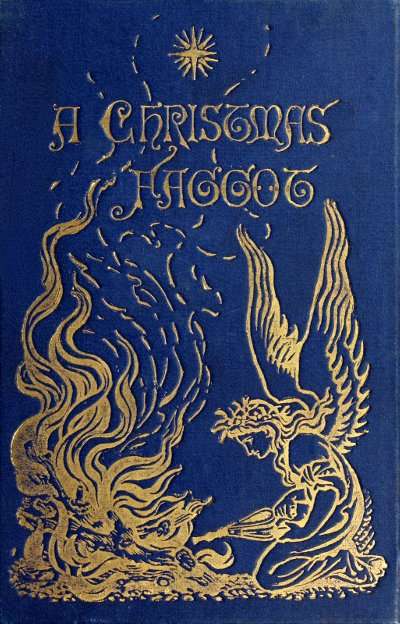
The Project Gutenberg eBook of A Christmas Faggot
Title: A Christmas Faggot
Author: Alfred Gurney
Release date: January 20, 2009 [eBook #27851]
Language: English
Credits: Produced by Bryan Ness, Louise Pattison and the Online
Distributed Proofreading Team at http://www.pgdp.net (This
file was produced from images generously made available
by The Internet Archive/American Libraries.)
A CHRISTMAS FAGGOT
TO THE GLORY OF GOD THE FATHER·
A CHRISTMAS FAGGOT
BY
ALFRED GURNEY, M.A.
VICAR OF S. BARNABAS', PIMLICO
AUTHOR OF 'THE VISION OF THE EUCHARIST AND OTHER POEMS' ETC.
And fit it is we finde a roome
To welcome Him. The nobler part
Of all the house here is the heart,
Which we will give Him, and bequeath
This hollie and this ivie wreath
To do Him honour who's our King,
The Lord of all this revelling'
Herrick, A Christmas Carol
LONDON
KEGAN PAUL, TRENCH, & CO., 1 PATERNOSTER SQUARE
1884
(The rights of translation and of reproduction are reserved)
ETHEL, ALBINIA,
CYRIL, BASIL,
BERTRAM, WILFRID,
LOUISE, HELEN,
ARTHUR.
With a gold and silver wing
Gently stirred the wave baptismal,
Heard ye not their carolling
Who of old to Eastern shepherds
Heralded their King?
Still those angel-voices tell
How God's river feeds the fountain
Opened by Emmanuel,
Yielding the baptismal waters
Of salvation's well.
Love-begotten from the dead;
Will you make a gallant promise
When my verses you have read—
'We will trace life's lovely river
To the Fountain-head'?
PREFACE.
Most of the following poems have appeared in the 'S. Barnabas' Parish Magazine.' For my godchildren and my people I have made them up into a little bundle of sticks—a Christmas faggot to feed the fires in the winter palace of our King.
It is the Incarnation that justifies all joy, and song is the expression of joy. The Gospel Songs all celebrate the Great Nativity. Birth and marriage are the occasions most sacred to mirth and music among men; and Christmas is at once the Birthday and the Marriage Festival of Humanity.
Glad and thankful shall I be if any song of mine should help to fan the flame of rejoicing love in any Christian heart at this holy and happy season.
CONTENTS.
| PAGE | |
| YULE TIDE | 1 |
| THE MADONNA DI SAN SISTO | 6 |
| BETHLEHEM GATE | 11 |
| SAINT JOSEPH | 16 |
| A CRADLE SONG | 18 |
| A CRADLED CHILD | 23 |
| AN EMPTY CRADLE | 26 |
| NEW YEAR'S EVE | 28 |
| THE VICTIM | 30 |
| THE DAYSMAN | 33 |
| THE PHYSICIAN | 36 |
| THE POET | 40 |
| THREE SISTERS | 43 |
| A CHRISTMAS PUZZLE | 46 |
| FOUR EPIPHANIES | 48 |
| THE CHILDREN'S EUCHARIST | 56 |
| THE GOSPEL SONGS: | |
| I. Benedictus | 59 |
| II. Magnificat | 63 |
| III. Nunc Dimittis | 66 |
| NOTES | 69 |
YULE TIDE.
The merry merry bells of Yule.'
Tennyson, In Memoriam.
A stricken world to bless;
And sufferers forget their pain,
And mourners their distress.
With happy tears are wet;
She is too humble to despair,
Too faithful to forget.
Her heart is brave and strong;
Her vassal, I would fain repeat
Some fragments of her song.
Its rapture to express;
My Father's son must be a king,
And share His consciousness.
That utters all His Thought;
That Word made Flesh by all is heard
Who seek as they are sought.
Our search an easy thing;
He sows good seed, and bids us take
The joys of harvesting.
And what He gives accept;
No heart can understand His Heart
That has not bled and wept.
His priceless treasures hold;
The Winter's silver all is His,
And His the Summer's gold.
The Christ within has grown
To perfect manhood, and self-will
By love is overthrown.
That makes the babe a boy;
'T is thus the seed becomes a life,
The life becomes a joy.
And swift are pilgrim-feet;
Ah! hope at length may come to be
Than memory more sweet.
With children's laughter near,
It is not hard to sing and pray,
'T is hard to doubt or fear.
To Thee my song address;
From Winter pain and toil of Spring
Grows Summer happiness.
THE MADONNA DI SAN SISTO.[1]
'The Lord Himself shall give you a sign; behold, a Virgin shall conceive and bear a Son.'
Earth's curtains part, God's veil is lifted up;
There comes a Child, forth from His Bosom sent
To rule the feast of life, His Bread and Cup,
His purpose making plain with man to sup.
Out-streams the light, accomplished is the Sign,
A Virgin-Mother clasps a Babe Divine.
Great succour bringing to a world forlorn;
On either side a man and woman share
A common rapture, welcoming the dawn
Of God's new day, the everlasting morn—
Of such a day as shall from East to West
Dispel the darkness, doing Love's behest.
Enamoured of the sight he looks upon;
She to the end of what is now begun
Downgazes, stooping, shadowed by the throne
Made by a Maiden's arms, maternal grown;
Than ivory most fair, than purest gold,
More pure, more fair, and stronger to uphold.
A spell has fallen—a prophetic dream;
Their upward-gazing and far-seeing eyes,
Like stars reflected in a tranquil stream,
To look beyond the Child and Mother seem;
A twisted thorn-branch and a cross to them
Are manifest—His throne and diadem.
Of worshippers with love-lit eyes appear,
Like stars down-gazing through a fleecy cloud,
Dimly discerned as morning draweth near
Spreading a radiant pall upon night's bier.
The blessed thing the Sign doth signify
They partly know, and are made glad thereby.
Than soaring angel or than climbing saint;
Her heart familiar grown with mysteries
Of God's own working under love's constraint,
The remedy she knows for man's complaint.
The clouds are all beneath her, and above
The light of life, the radiancy of love.
Is on her bosom borne, a blossom fair;
The pentecostal breath that lifts her veil
Has fanned His royal brow, and stirred His hair,
And kissed His lips just parted for a prayer.
That spirit-wind shall blow, that Face shall shine,
Till all His brothers know their Father's Sign.
Dresden: 1883.
BETHLEHEM GATE.
A Picture by Dante Gabriel Rossetti.[2]
Two exiles went with eyes downcast;
The Present now retrieves the Past,
God's Eden is in Bethlehem.
By Mary's arms encompassèd,
A living shrine, a 'house of bread,'
A very haven of repose.
His cradle angry tempests rage;
He needs must go on pilgrimage,
An exile, homeless and discrowned.
The unquenched Star of Bethlehem
Shines forth, a radiant diadem;
While Angels on His footsteps wait.
A triumph-song e'en now they sing,
And, wondering and worshipping,
Attend His Pilgrim-Family.
Is of a solemn countenance;
To him a rapid backward glance
Reveals a massacre begun.
The glory of the age to come,
The fruitfulness of martyrdom,
Of deaths that are nativities.
The Mother whom this canvass shows
Nor fears, nor weeps, although she knows
An anguish deeper than your fears.
For all who fare on pilgrimage;
By suffering from age to age
God seals the vassals of His Will.
And, guided by the Holy Dove,
She sees the victory of Love
Beyond the Cross and Sepulchre.
The shadow of God's Providence.
How fragrant is the frankincense
Of their uninterrupted prayer!
A new and living way they tread,
So gain they the true 'House of Bread,'
A garden for a wilderness.
It is a going forth to win
The world from Satan and from sin,
And build the New Jerusalem.
Thou art Thyself the Door, the Way;
All, all shall find one coming day
Thy Heart their everlasting goal!
Loch Leven: 1884.
S. JOSEPH.
Where Mary grew, God's perfect flower;
One, only one, discerned her grace,
And visited her bower.
To guard the Mother of the King;
No heart, save hers, had e'er a song
So sweet as his to sing.
No record of a word from him;
God's Ark he guards, a silent sage,
Pure as the Cherubim.
Recorded of the wise and good,
His silence is a music heard
On high, and understood.
Amid the carol-singing throng;
Thrice blest the meditative heart
Whose silence is a song.
Ballachulish: 1884.
A CRADLE SONG.
May the music of your song
Silence all the dark forebodings
That have plagued the world too long;
He who made your voices tuneful
Comes to right the wrong.
Lift your praises loud and high,
Merry lark, and thrush, and blackbird,
In the grove and in the sky
Make your music, shame our dumbness,
Till we make reply.
Flowing from a hidden spring,
Which, though men misdoubt its virtue,
Well is worth discovering;
Slowly dies the heart that knows not
How to laugh and sing.
Is the Heart of God Most High;
All sweet voices are the echoes
That in varied tones reply
To that Voice which through the ages
Sings earth's lullaby.
For a season frets and cries:
All at once an unseen finger
Curtains up the little eyes.
So the cradled child He nurses
God will tranquillise.
Oh, what tutelage it brings
To the little lives that ripen
'Neath the shelter of its wings;
God's delays are no denials,
As He waits He sings!
Who invalidate despair
By the lofty hopes they cherish,
By the gallant deeds they dare,
By the ceaseless aspirations
Of a life of prayer.
Loch Laggan: 1884.
A CRADLED CHILD.
(To E. A. G.)
The treasure-trove of happy homes;
Whereby the poorest hut becomes
A fairy-palace of romance.
Two lamps o'erhang it—her sweet eyes,
Whose love-light falls, Madonna-wise,
On sleeping infancy divine.
Madonna-wise, her heart discerns,
And like a fragrant censer burns,
O'ershadowed by an angel's wing.
A trembling joy her bosom stirs,
Her thoughts are white-robed worshippers,
'Magnificat' is all her song.
The waking moment she awaits,
The opening of two pearly gates,
The lifting of two silken veils.
Ah! then, what words can tell the bliss,
The rapture of the fond embrace,
When mother's lips on baby's face,
Feast and are feasted with a kiss?
And who can tell of hands and feet
The dimpled wonders, hidden charms,
The dainty curves of legs and arms,
So sweet and soft, so soft and sweet?
This is the world's possession still,
The treasure-trove of wedded hearts,
Whereby a Father's love imparts
His joy, their gladness to fulfil.
Tyntesfield: 1884.
AN EMPTY CRADLE.
A mother's falling tears the only sound;
But not of earth her thoughts, nor underground;
Up-gazing she discerns the Fountain-head
Of life; the living Voice she hears that said
'Fear not' to weeping women who had found
An empty tomb, and angels watching round,
Who asked 'Why seek the living with the dead?'
So weeps our Mother Church—her tears outshine
Sun-smitten dewdrops on a summer's morn;
God's rainbow girdles her, Hope's lovely sign,
Whereby she knows that smiles of tears are born;
Fulfilled of life herself, she would assure
Her children all of death's discomfiture.
Carlisle: 1884.
NEW YEAR'S EVE.
Our beating hearts may be
The harps that celebrate His praise
Who loves eternally!
When Love Himself draws near;
No cup can empty stand, no grief
Embitter God's New Year.
Soon emptied is his glass;
We wait for an oncoming Day
Which nevermore shall pass.
The coming months to cheer;
And phantom-fears and griefs outworn
Die with the dying year.
Our waiting hearts shall be
Harps tremulous with His dear praise
Whose is Eternity!
S. Barnabas': December 31, 1883.
THE VICTIM.
For the Feast of the Circumcision: New Year's Day.
On that great New Year's Day,
When Blood was in the cradle shed
Where Mary's Darling lay.
Was silent on the wing;
The nightingale, when day was done,
Forgot her song to sing.
And hushed was every voice,
When in the crib the Cross was found,
The Infant-Victim's choice.
The Mother's face was white;
Her eyes were stars, and every tear
Gave lustre to their light.
Upon that manger-bed,
And wove a mystic glory-crown
Around the Sleeper's head.
THE DAYSMAN.
Which memory recalls to-day,
In many moods and many ways,
My yearning heart would pray.
My feet, God's shrine was everywhere;
But this I scarcely knew as yet—
Christ is His Father's Prayer.[3]
Appeals to them; and, rightly heard,
The music of creation is
The echo of His Word.
The echo is an answer strong;
A prayer up-springing from the heart
That blossoms in a song.
His Poem and His Prophecy;
The homeward way His Feet have trod
Mankind must travel by.
Is pledged to ministry divine,
Who sees the Ruler of life's feast
Turn water into wine;
The Spirit's whispering within;
Who knows the Messenger of love
The Conqueror of sin.
Art Thou, dear Lord, whene'er we pray;
So always now, and everywhere,
My heart keeps holiday.
On the Danube: Feast of the Holy Name, 1883.
THE PHYSICIAN.
Falls a blight upon thy bliss,
Smiles no more their sunshine make,
Lips estranged withhold their kiss?
For thy consolation take
Some such song as this:—
Help our weeping eyes to see;
Never may we deem things are
What to us they seem to be;
Rise, Thou Dayspring, and afar
Bid the shadows flee!
Strong to comfort, skilled to heal;
Failure is with Thee success,
Woe the forerunner of weal;
Every stroke is a caress,
Every crust a meal.
From the grave, the bed, the bier,[4]
Souls astray, forlorn, misled,
Buffeted by doubt and fear,
Cannot but be comforted
When Thou drawest near.
Banishing all week-day cares,
Thine the gracious voice that tells
What a Father's love prepares,
Leading to salvation's wells
Up God's altar-stairs.
Tyrol: 1882.
FOOTNOTES:
[4] S. John xi. 43; S. Matt. ix. 25; S. Luke vii. 14.
THE POET.
Who with anointed eye
Discerns a sacrament of love
In earth and sea and sky,
And finds himself at love's behest
Constrained to prophesy.
Love is of life the spring,
Love is the sole interpreter
Of every lovely thing:
This is the burden of his song,
Well may the poet sing!
Because far off he hears
A whisper silencing the storm,
A laughter through the tears,
The music of eternity
Beyond the dying years.
God's loveliness, and we,
When with his insight we are blest,
Shall share his ecstasy;
Oh, come the day when all shall sing
As blithe a song as he!
Thou art the Poet true;
The men who would Thy vision share
Must learn Thy works to do,
All, all shall have the singing heart
Whose feet Thy steps pursue!
Pitz Ortler: 1882.