
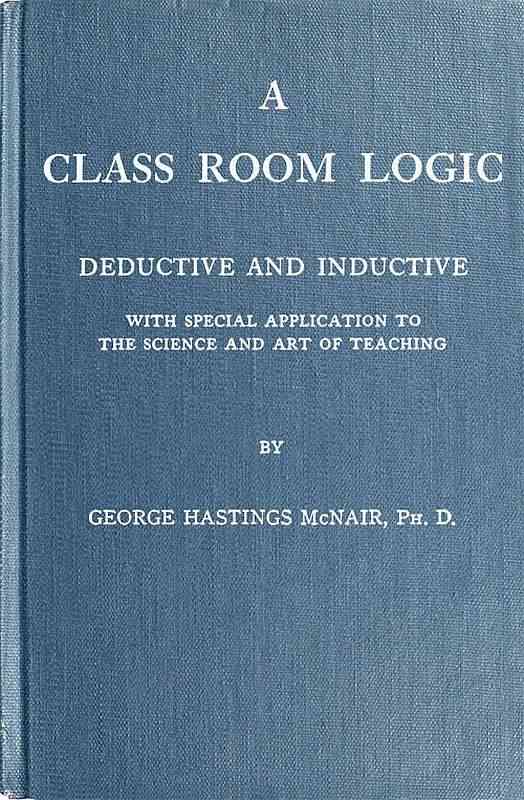
The Project Gutenberg eBook of A Class Room Logic
Title: A Class Room Logic
Author: George Hastings McNair
Release date: September 16, 2018 [eBook #57912]
Language: English
Credits: Produced by Richard Hulse and the Online Distributed
Proofreading Team at http://www.pgdp.net (This file was
produced from images generously made available by The
Internet Archive)
A CLASS ROOM LOGIC
THE SCIENCE AND ART OF TEACHING
Transcriber’s Notes
The cover image was provided by the transcriber and is placed in the public domain.
Punctuation has been standardized.
Most abbreviations have been expanded in tool-tips for screen-readers and may be seen by hovering the mouse over the abbreviation.
The under bracket in the original text has been replaced by a standard underline.
This book was written in a period when many words had not become standardized in their spelling. Words may have multiple spelling variations or inconsistent hyphenation in the text. These have been left unchanged unless indicated with a Transcriber’s Note.
Index references have not been checked for accuracy.
Footnotes are identified in the text with a superscript number and have been accumulated in a table at the end of the text.
Transcriber’s Notes are used when making corrections to the text or to provide additional information for the modern reader. These notes have been accumulated in a table at the end of the book and are identified in the text by a dotted underline and may be seen in a tool-tip by hovering the mouse over the underline.
PREFACE.
This treatise is an outgrowth of our class room work in logic.
It has been published in the hope of removing some of the difficulties which handicap the average student.
We trust that the language is simple and definite and that the illustrative exercises and diagrams may be helpful in making clear some of the more abstruse topics.
If a speedy review for examination is necessary, it is recommended that the briefer course as outlined on page 493 be followed and that the summaries closing each chapter be carefully read.
Only the fundamentals of deductive and inductive logic have received attention. Moreover emphasis has been given to those phases which appear to commend themselves because of their practical value.
Further than this we trust that the book may fulfill in some small way the larger mission of inspiring better thinking and, in consequence, of leading to a more serviceable citizenship.
Surely as civilization advances it is with the expectation of giving greater significance to the assumption “that man is a rational animal.”
I am indebted to a number of writers on logic, notably to Mill, Lotze, Keynes, Hibben, Fowler, Aikins, Hyslop, Creighton and Jevons. I am likewise under obligation to that large body of students who, by frankly revealing their difficulties, have given me a different point of view.
For constructive criticism and definite encouragement I owe a personal debt of gratitude to Prof. Charles Gray Shaw of New York University, to Prof. Frank D. Blodgett of the Oneonta Normal School and to Prin. A. C. MacLachlan of the Jamaica Training School for Teachers.
G. H. McN.
City Training School for Teachers,
Jamaica, N. Y. City.
October 3, 1914.