
The Project Gutenberg eBook of A Comparative View of the Mortality of the Human Species, at All Ages
Title: A Comparative View of the Mortality of the Human Species, at All Ages
Author: William Black
Release date: July 2, 2019 [eBook #59846]
Language: English
Credits: Produced by Susan Skinner and the Online Distributed
Proofreading Team at http://www.pgdp.net (This file was
produced from images generously made available by The
Internet Archive)
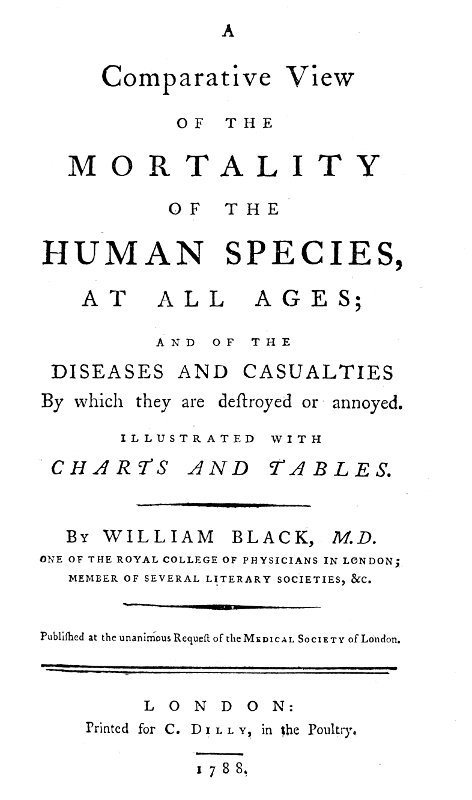
COMPARATIVE VIEW
OF THE
MORTALITY
OF THE
HUMAN SPECIES,
&c. &c.
A
Comparative View
OF THE
MORTALITY
OF THE
HUMAN SPECIES,
AT ALL AGES;
AND OF THE
DISEASES AND CASUALTIES
By which they are destroyed or annoyed.
ILLUSTRATED WITH
CHARTS AND TABLES.
By WILLIAM BLACK, M.D.
ONE OF THE ROYAL COLLEGE OF PHYSICIANS IN LONDON:
MEMBER OF SEVERAL LITERARY SOCIETIES, &C.
Published at the unanimous Request of the Medical Society of London.
LONDON:
Printed for C. Dilly, in the Poultry.
1788.
DEDICATION.
TO
HIS ROYAL HIGHNESS
George Prince of Wales.
May it please your Royal Highness,
A Young and celebrated Prince, before his first Military Expedition, interrogated one of his experienced Relations and Instructors, How he should conduct himself to be respected and obeyed by his Army?—“To know more of the Profession than any of your Soldiers,” was the sage Reply; and to the renowned Cyrus, the Conqueror of the Babylonians. This Maxim is, in some Degree, applicable and pertinent throughout all the Gradations and Scale of Society. A Prince, born to the Throne of a mighty Empire, pre-eminent in its Political Constitution, and in the universal Range of the Arts and Sciences, is urged by his Personal Dignity and Public Duty, to aspire to the intrinsick Qualifications of Human Supremacy.
In the present small Tribute of Duty and Respect, I am not submitting to your Royal Highness a dry, technical Analysis of Diseases. An enlarged Survey of Medicine is intimately interwoven with most of the sublime Objects, not only of Philosophy, but, in our original Chart and Model, of Politicks also and Legislation, both in Peace and War. It transcends the British Poet’s Limitation of Human Studies, the Knowledge of Man: it embraces a Scope of Natural Knowledge far beyond any other of the learned Professions; encompassing in its spacious Orbit most of the grand Divisions of Science. A total Ignorance in this, would leave a dreary Chasm in Literature; and, like the ancient Geography, the Map and Globe of intellectual Discoveries would be half unexplored.
In early Ages, when Medicine had not reached beyond the Merit of a few Empirical Cures, the Consultation in consecrated Temples of Medical Oracles was ingrafted with Divinity and Objects of Worship. The Rays of Majesty were not then obstructed from cherishing this tender Shoot. From the encouragement of Alexander, Aristotle’s Natural History had its Origin. From the Patronage of his Successors to the Egyptian Throne, the Ptolemys, first arose Human Anatomy, together with the magnificent Alexandrian Library. Many of the first Miracles of Christianity are a Display of Medical Omnipotence. By several of the Asiatic and Roman Emperors, their Physicians were admitted to a Familiarity, and to their Tables: their Archiaters, or Royal Physicians, held the Second Rank in the Empire; and even, so late as Constantine, were created Counts. The Arabians, Mahomet’s Successors, were unbounded in their Rewards and Encouragement of Medicine. With the Destruction of the Roman Empire, Science lay many Centuries buried in its Ashes. But on the Recovery from Feudal Anarchy, and the Revival of Literature after the Crusades, those raised to the Degree of Doctor in any of the learned Professions, contended Precedence with the most respectable then in any European State, with Military Knighthood.
In Britain, and most other Kingdoms of Europe, Italy excepted, Literature of any Sort, of Native Growth, is but a modern Plant. Medicine in this Island is an Exotic, until within the last Three Centuries; and since that Period, seems to have scrambled into Consequence and Emolument, from its own intrinsic Merit, and the public Encouragement. For Truth compels me to observe, that the Favours and Honours of Majesty have been measured out, even to the Benefactors of Science and of Mankind, in this Profession, with a parsimonious and partial Hand. I do not presume to arraign the Wisdom or Justice of your Royal Ancestors, but of their Counsellors and Ministers; in whom there seems a Sort of epidemical or entailed Infatuation and Bigotry to lavish the first Honours of the State upon the Memory of dry Laws, and the specious Accomplishments of Logick and Rhetorick.
Your Royal Highness is at present, through the bountiful Beneficence of Nature, and the variegated Acquisitions of Education, endowed with most of the preliminary Embellishments requisite in your exalted Station, and to a Summit of Celebrity and Admiration. The Rudiments, Difficulties, and Acclivities are surmounted, and leave you an uninterrupted Range through Parnassus, in the Fruition of the luxurious Feasts furnished by Apollo and the Muses. In a political View, and in their public Administration throughout all the Professions, and Medicine notoriously, there are numerous Defects and Abuses originating from the Ignorance and Inexperience of former Ages, the Corruptions and Innovations of Time, and from various other Causes. With thousands of these remediable Diseases, the most enlightened Nations are yet over-run and contaminated; and a Monarch who would emulate a Trajan or an Aurelius, will find glorious Employment as a Political Physician. He will have the divine Consolation and Reflection of circulating his Knowledge through innumerable Channels, to the Benefit, Happiness, Nurture, and Preservation of Millions of Mankind.
I have the Honour to remain,
with profound Respect and Esteem,
Your Highness’s
most humble and obedient Servant,
WILLIAM BLACK.
CONTENTS.
| Page | |
| The station and rank of our planet amongst the celestial orbs, | 1 |
| The solar system and stars, | 3 |
| The earth’s figure, magnitude, motion, | 4 |
| Of the moon, | 7 |
| The investing elements of the earth, | |
| Heat and light, | 8 |
| Atmosphere and winds, &c. | 10 |
| Rain, snow, &c. | 11 |
| Electrical emanation, | 12 |
| The earth’s division into land and water, and into continents, | 13 |
| The situation of the human species upon the earth, | 14 |
| The number of the human species, | 15 |
| The multiplication of the human species, | 19 |
| The distinction of the human species into classes, | 21 |
| Mankind diversified by civilization, | 22 |
| The inhabitants of cities, towns, and country, constitute other groups of society, | 24 |
| The human species diversified by their ages, | 25 |
| The distinction of the sexes into male and female, form two important groups, | 27 |
| The comparative produce of marriages in city and country, | 28 |
| The general proportion of births to the mortality in various kingdoms, | 30 |
| The comparative births of males and females, | 32 |
| Of public registers, of births, burials, and diseases, | 35 |
| The primary orders of medical architecture not yet established, | 37 |
| The mortality of the human race in city and country, and from birth to the extreme of existence, | 38 |
| Of longevity, | 43 |
| Comparative mortality of males and females, | 44 |
| Comparative mortality of husband and wife, | 45 |
| Comparative longevity in the married and single state, | 47 |
| Comparative mortality of the seasons, | 48 |
| A general abstract of human mortality in city and country, and throughout the globe, | 49 |
| The probabilities or expectation of life, | 51 |
| A general chart of mortality in city and country, and in different kingdoms, | 54, 55 |
| The probable prospects or expectations of life at all ages, | 55 |
| Of the mortality by different diseases, | 56 |
| Of the London bills of mortality, | 57 |
| The chart of London diseases may serve as a general scale and index of diseases and casualties to Britain and Ireland, or to the whole globe; with exceptions: a sort of medical geometry and trigonometry, | 60 |
| The number and proportion of diseases not to be estimated by the mortality of each, | 63 |
| A medical catalogue of all the diseases and casualties by which mankind are destroyed or annoyed, | 65 |
| A chart of all the diseases and casualties in London, during 75 years, | 64, 65 |
| Of diseases in general, | 70 |
| Of the fatal epidemicks in England during two centuries; and comparison of sickly years in city and country, | 72 |
| Of fevers, | 75 |
| Intermittent fevers, | 78 |
| Remittent fevers, | 84 |
| Nervous and putrid fevers, | 90 |
| Inflammatory fever, | 97 |
| Small pox, | 102 |
| Measles, | 111 |
| Scarlet fever, | 113 |
| Plague, | 115 |
| Sweating sickness, | 121 |
| Of the predisposing and occasional causes of all the preceding fevers, | 121 |
| Of general febrile prognosticks, | 127 |
| Of the local phlogistic fevers, | 133 |
| Inflammation of the brain, | 134 |
| Angina, inflammatory and putrid, | 136 |
| Pulmonic inflammation, | 142 |
| Hepatic inflammation, | 150 |
| Inflammation of the stomach, | 152 |
| Erysipelas, | 153 |
| Rheumatism, acute and chronic, | 155 |
| Gout, | 159 |
| Internal suppuration and gangrene in the thorax and abdomen, | 166 |
| Diseases of the lungs and organs of respiration, | 168 |
| Pulmonary hemorrhage, | 172 |
| Pulmonary phthisis, | 174 |
| Other species of consumption, | 177 |
| Asthma, | 183 |
| Dyspnœa and coughs, | 190 |
| Catarrh, | 192 |
| Hooping cough, | 195 |
| Croup, | 198 |
| Headach, | 200 |
| Night mare, | 202 |
| Apoplexy, | 203 |
| Lethargy, coma, and carus, | 207 |
| Vertigo, | 209 |
| Palsy, | 210 |
| Epilepsy, | 212 |
| Tetanus, | 217 |
| Spasms and cramps, | 221 |
| St. Vitus’s dance, | ibid. |
| Catalepsy and extacy, | 222 |
| Fainting and asphyxy, | 223 |
| Palpitation of the heart, | 226 |
| Polypus of the heart, internal aneurism, and ossification, | 227 |
| Hypochondriasm, | 229 |
| Insanity, | 232 |
| Diseases of the external senses, | 251 |
| Vision, | 252 |
| Hearing, | 257 |
| Smell, | 258 |
| Taste, | ibid. |
| Voice and speech, | 259 |
| Sterility of the sexes, | ibid. |
| Morbid irritability of the genitals, | 260 |
| Impediments in deglutition and manducation, | 262 |
| Diseases of the stomach and intestines, and organs of digestion, | 263 |
| Of the stomach, | 268 |
| Cholera morbus, | 272 |
| Dysentery, | 274 |
| Diarrhœa, | 275 |
| Colick, | 277 |
| Gall stones, | 282 |
| Jaundice, | 284 |
| Worms, | 286 |
| Hemorrhoides, | 288 |
| Vomiting of blood, | 291 |
| Poisons, | 293 |
| Hydrophobia, | 294 |
| P. S. Costiveness, and nasal hemorrhage, | 297 |
| Diseases of the urinary organs, | 298 |
| Inflammation, and calculi in the kidneys, | 299 |
| Inflammation, and calculi in the bladder, | 301 |
| Incontinence of urine, and diabetes, | 305 |
| Ulcers in the kidneys and bladder, and bloody urine, | 307 |
| Dropsy, | 309 |
| Of the brain and spine, | 311 |
| Thorax, | 312 |
| Abdomen, | 314 |
| Anasarca, | 317 |
| Hydrocele, | 318 |
| The predisposing and occasional causes of dropsy, | 320 |
| Tympany, | 322 |
| Excess of fat and corpulency, | 323 |
| Female diseases, | 324 |
| The proportion of menstrual obstruction and excess, and of hystericks, to other diseases, | 325 |
| Morbid and irregular menstruation, including chlorosis, obstruction, suppression, | 328 |
| Uterine relaxation, including excessive menstruation and fluor albus, | 330 |
| Final cessation of menstruation, | 334 |
| Hystericks, | 335 |
| Childbed, the proportion of mortality, | 339 |
| Abortives and twins, the proportion, | 340 |
| Conception and pregnancy, | 343 |
| Parturition, natural, laborious, preternatural, and complex, | 350 |
| The principal diseases in consequence of pregnancy, and also after parturition, | 362 |
| Abortion and uterine hemorrhage, | 366 |
| Convulsions, | 370 |
| Irregularity of the lochia, comprehending excess, obstruction, and suppression, | 371 |
| Inflammation of the womb, | 373 |
| Puerperal fever, | 375 |
| After-pains, weed, milk fever, inflammation of the breasts, | 378 |
| Infant diseases, | 380 |
| The general causes of infant diseases, | 383 |
| Convulsions and inward spasms, | 385 |
| Dentition, | 387 |
| Rickets, | 389 |
| Thrush, | 391 |
| N. B. Their other diseases are before described, | 392 |
| Venereal disease, | 393 |
| Scurvy, | 398 |
| Scrofula, | 403 |
| Leprosy, | 406 |
| To the Reader: an apology for breaking off abruptly, | 407 |
| Executed, | 408 |
| Of the London bills of mortality; their defects; easy and important improvements recommended, | 414 |