
The Project Gutenberg eBook of A Course of Mechanical, Magnetical, Optical, Hydrostatical and Pneumatical Experiments
Title: A Course of Mechanical, Magnetical, Optical, Hydrostatical and Pneumatical Experiments
Author: William Whiston
Francis Hauksbee
Release date: October 23, 2013 [eBook #44019]
Most recently updated: October 23, 2024
Language: English
Credits: Produced by Enrico Segre and the Distributed Proofreading
team at DP-test Italia, http://dp-test.dm.unipi.it
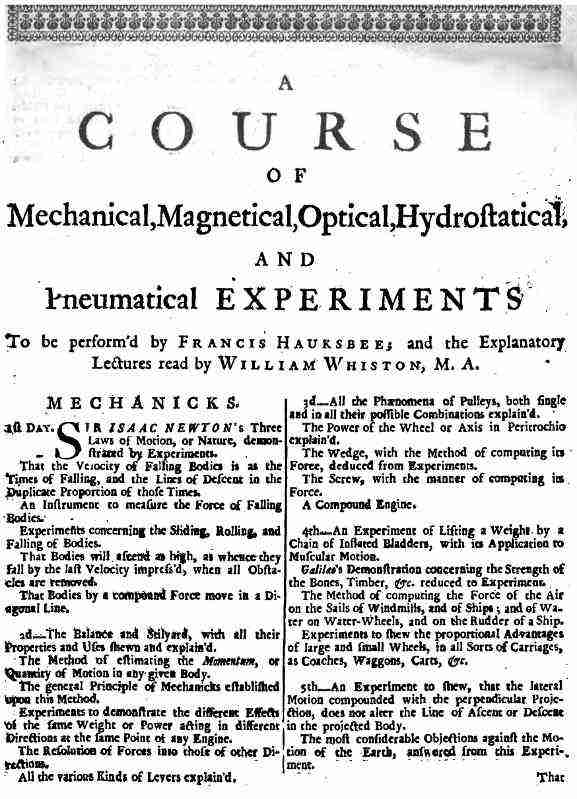
A
COURSE
OF
Mechanical, Magnetical, Optical, Hydrostatical,
AND
Pneumatical EXPERIMENTS.
To be perform'd by Francis Hauksbee; and the Explanatory Lectures read by William Whiston, M. A.
MECHANICKS.
1st Day. Sir Isaac Newton's Three Laws of Motion, or Nature, demonstrated by Experiments.
That the Velocity of Falling Bodies is as the Times of Falling, and the Lines of Descent in the Duplicate Proportion of those Times.
An Instrument to measure the Force of Falling Bodies.
Experiments concerning the Sliding, Rolling, and Falling of Bodies.
That Bodies will ascend as high, as whence they fall by the last Velocity impress'd, when all Obstacles are removed.
That Bodies by a compound Force move in a Diagonal Line.
2d—The Balance and Stilyard, with all their Properties and Uses shewn and explain'd.
The Method of estimating the Momentum, or Quantity of Motion in any given Body.
The general Principle of Mechanicks established upon this Method.
Experiments to demonstrate the different Effects of the same Weight of Power acting in different Directions at the same Point of any Engine.
The Resolution of Forces into those of other Directions.
All the various Kinds of Levers explain'd.
3d—All the Phænomena of Pulleys, both single and in all their possible Combinations explain'd.
The Power of the Wheel or Axis in Peritrochio explain'd.
The Wedge, with the Method of comparing its Force, deduced from Experiments.
The Screw, with the manner of computing its Force.
A Compound Engine.
4th—An Experiment of Lifting a Weight by a Chain of Inflated Bladders, with its Application to Muscular Motion.
Galilæo's Demonstration concerning the Strength of the Bones, Timber, &c. reduced to Experiment.
The Method of computing the Force of the Air on the Sails of Windmills, and of Ships; and of Water on Water-Wheels, and on the Rudder of a Ship.
Experiments to shew the proportional Advantages of large and small Wheels, in all Sorts of Carriages, as Couches, Waggons, Carts, &c.
5th—An Experiment to shew, that the lateral Motion compounded with the perpendicular Projection, does not alter the Line of Ascent or Descent in the projected Body.
The most considerable Objections against the Motion of the Earth, answered from this Experiment.
That the Line described by a Projectile is a Parabola.
The Experiments upon which the Art of Gunnery does depend, most exactly perform'd.
6th—Experiments concerning Pendulums.
The Description and chief Properties of the Cycloid, and the Application of Cycloidal Cheeks for regulating the Vibrations of Pendulums.
An Experiment to shew the Analogy between the Swings of a Pendulum and the Waves of the Sea.
Experiments concerning the Expansion of Metals by Heat.
7th—The Laws of Motion in the Collision of Hard and Elastick Bodies.
Experiments concerning the Centrifugal and Centripetal Forces of Solid and Fluid Bodies in Motion.
Experiments in order to estimate the Centrifugal Forces of Solid Bodies.
MAGNETICKS.
8th Day. Attractive and Directive Powers of Loadstones.
The Form or Position of Filings of Iron at the Poles and Equator of a Loadstone.
Magnetick Power acts thro' all Bodies but Iron.
The Attraction of different, and Repulse of corresponding Poles.
The manner of touching and untouching of Needles.
The Law of Magnetick Attraction discover'd.
9th—The Phænomena of Terrella, or Spherical Loadstones.
The Direction of Magnetick Needles on the Surfaces of Terrella nearly towards the Poles.
Their Variation East and West.
The Inclinatory or Dipping-Needle, with the Law of the Alteration of that Inclination on the Surface of a Terrella.
The Terrestrial Magnetism consider'd.
The Application of the Dipping-Needle to the Discovery of the Longitude and Latitude of Places by Land and Sea.
OPTICKS.
10th Day. Experiments to demonstrate, that in the Rays of Light the Angle of Incidence is equal to the Angle of Reflection in all Sorts of Surfaces.
The Method of tracing the reflected Rays of Light from Plain, Convex, Concave, and Cylindrical Superficies, with all their wonderful Properties and Uses, shew'd and explain'd.
11th—Sir Is. Newton's Reflecting Telescope exhibited, and its Construction explained; together with some Specimens of its Uses in observing the Planets and Fixed Stars.
12th—Experiments to shew the Manner of Refraction.
The Sines of the Angles of Incidence and Refraction, shewn to be (at all Degrees of Incidence) in a constant Proportion to each other.
An Instrument to measure the Refraction of Fluids.
The Method of tracing the Refracted Rays of Light thro' Plain, Convex, and Concave Superficies.
13th—An artificial Eye, in which all the Coats and Humours are curiously represented.
The Dissection of the Eye.
The Explication of Vision by the naked Eye, deduced from Experiments.
14th—All the Effects, Properties, and Uses of Plain, Convex, and Concave Glasses, both single and combin'd in Telescopes and Microscopes, shew'd and explain'd.
Several Kinds of Microscopes and Telescopes, with the Manner of applying them to their respective Objects; together with a Specimen of the Uses of such Microscopes and Telescopes.
A Multiplying Glass.
The Magick Lanthorn.
15th—A particular Apparatus to manifest and measure the Refraction of Air.
The Camera Obscura.
The Theory of Light and Colours, as delivered by Sir Isaac Newton, demonstrated by several of his principal Experiments.
The Archbishop of Spalato's Experiment, which discovered the Cause of the Rainbow.
Monsieur Hugen's Experiments, which discover the Causes of Halo's, of the Mock Suns and Moons, and of inverted Rainbows.
Experiments concerning the blending and Production of Colours by Motion.
HYDROSTATICKS.
16th Day. That Fluids gravitate in proprio loco, the upper Parts continually pressing upon the lower: That this Pressure is not only propagated Downwards, but even Upwards, and Sideways, according to all possible Directions; That a lighter Fluid may gravitate upon a heavier, and an heavier upon a lighter; That a Fluid may sustain a Body heavier in Specie than it self, and even raise it up; That a Fluid may detain a Body lighter in Specie than it self, and even depress it. A general Experiment to prove, that a competent Pressure of a Fluid may produce the remarkable Phænomena of the Torricellian Tube, the Pump, Syringe, Syphon, polished Plates, and other Effects of the like Nature.
17th—That Fluids press according to their perpendicular Altitudes, whatever be their Quantities, or however the containing Vessels be figured. The exact Estimate of all manner of Pressures. That the Velocity and Quantity of Fluids running out at a given Hole, is in the subduplicate Proportion of their perpendicular Altitudes. Several Sorts of Pumps. Of the sinking and floating of Bodies immers'd in Fluids; their relative Gravities and Levities; their Situations and Positions. The Phænomena of Glass Bubbles and Images accounted for.
18th—An Instrument to find out the Specifick Gravity of all Liquors. The Hydrostatical Balance explain'd, with the Methods of determining the Specifick Gravities of all Sorts of Bodies, whether Solid or Fluid, thereby. The Praxis of the Hydrostatical Balance, whereby the Specifick Gravities of several particular Bodies are actually found out. Some Account of the various Uses of such Enquiries.
PNEUMATICKS illustrated by Experiments for the most part Tubular, being such as were wont to be made before the Air-Pump was invented.
19th Day. The several Phænomena of the Torricellian Experiment exhibited and explained. Other Experiments of the like Nature, with Fluids variously combin'd. Several Sorts of Barometers, Thermometers, and Hygroscopes. The Pressure of the Air shewn by Experiment to be different at different Altitudes from the Surface of the Earth.
20th—The Density and Spring of the Air proved by several ways to be as the Force which compresses it, and reciprocally as the Spaces into which it is compress'd. From hence an Enquiry is made into the Limits and State of the Atmosphere.
21st—The Effects of the Weight and Spring of the Air in Syringes, Pumps, Siphons, polished Plates, Cupping-Glasses, Suction: Respiration explained by artificial Lungs; That the Air may be so disorder'd by a violent Impulse, as to require Time to recover its Strength and Elasticity again.
The more known Properties of the Air established by the Air-Pump, and other Engines.
22d Day. The Air-Pump; the Instruments for Condensing and Transferring of Air; their Fabrick, Operation, and Gages explained.
23d—A Parcel of Air weighed in the Balance; its Specifick Gravity to that of Water determined thereby; an artificial Storm, shewing that high Winds may make the Barometer sink much and suddenly.
24th—The Weight, Pressure, and Spring of the Air prov'd several ways; by the Sense of Feeling; by breaking Glass Vials; the Phænomena of Bladders, Glass-bubbles, Fountains; the Gardiner's Watering-Pot; the Diving-Bell, &c.
25th—The Torricellian Tube in Vacuo; Quicksilver raised to the usual Height of the Weather-Glass, by the bare Spring of a little included Air; Otto Gerick's Hemispheres; and that dense Air has the same Advantage over common Air, as that has over a Vacuum.
The Ebullition of Liquors in Vacuo; the Quantity of Air contain'd in them; the Sustentation of Fumes and Vapours; the Descent of Bodies in Vacuo.
The more hidden Properties of the Air consider'd by the help of the like Engines.
26th Day. The Influence of the Air examin'd as to the Causes of Magnetism; the Elasticity of Springs; the Cohæsion of the Parts of Matter; the Sphericity of the Drops of Fluids; the Ascent of Liquors in capillary Tubes, and between Glass-Planes in the Curve of the Hyperbola, both by the Attractive and Repulsive Power of the Glass.
27th—The Influence of the Air, as to Sounds, Fire, and Flame; the Consumption of Fuel; the firing of Gunpowder; the Effects of rarified, condensed, and burnt Air upon the Life of Animals.
28th—A Piece of Phosphorus in Vacuo; new Experiments concerning the Mercurial Phosphori; Experiments concerning the Electricity of Bodies.
Every SUBSCRIBER is to pay Three Guineas; One Guinea at the Time of Subscription, and the Remainder, the First Day of the Course.
SUBSCRIPTIONS are taken in at Mr. Whiston's, in Great Russel-Street; and at Mr. Hauksbee's, in Crane-Court in Fleetstreet; where the Course is to be perform'd.
Advertisement.
Air-Pumps, or Engines for Exhausting the Air from proper Vessels, with all their Appurtenances; whereby the various Properties and Uses of that Fluid are discover'd and demonstrated by undeniable Experiments. Engines for the Compression of the Air: Fountains, in which the Water, or other Liquor, is made to ascend by the Force of the Air's Spring. Syringes and Blow-Pipes, with Valves for Anatomical Injections. Hydrostatical Balances, for determining the Specifick Gravity of Fluids and Solids. The Engine and Glasses for the New Way of Cupping without Fire. Scarificators, which at once make either 10, 13, or 16 Incisions. Weather-Glasses of all Sorts, as Barometers, Thermometers, &c. Reflecting Telescopes, by which in so short a Length as Six Feet, all that has hitherto been discovered in the Heavens (by the longest Telescopes of the common Construction) may be observed.
All the above-mention'd Instruments, according to their Latest and Best Improvements, are made and sold by Francis Hauksbee, in Crane-Court in Fleetstreet, London.
1
MECHANICKS.
An Explication of the First Plate.
Figure. 1. This belongs to Galilæo's famous Demonstration of the Velocities and Times of Bodies descending by an uniform Force, such is that of Gravity here below: And shews that they will ever fall in equal Times, 1, 2, 3, 4, &c. according to the odd Numbers, 1, 3, 5, 7, &c. or the Trapezia B C D E, D E F G, F G H I, &c. and by consequence, that their Velocity will increase uniformly in Proportion to the Lines B C, D E, F G, H I, &c. or to the Times of Descent. And that the entire Lines of their Descent will be as the Triangles A B C, A D E, A F G, A H I, &c. or as the Squares of those Times, 1, 4, 9, 16, &c.
Fig. 2. This is a strong Balance for an Experiment to prove the former Proposition, by shewing that any Bullet or Ball, when it falls from four Times the Height, has twice, from nine Times the Height has thrice its former Velocity or Force; and will accordingly raise a double or triple Weight in the opposite Scale, to the same Height, and no more; and so for ever.
Fig. 3. This shews how Bodies upon an inclin'd Plane will slide, if the Perpendicular through the Center of their Gravity falls within; and will rowl, if that Perpendicular fall without their common Section.
Fig. 4. This shews that an oblique Body will stand, if the Perpendicular through its Center of Gravity cut the Base; and that it will fall, if it cut not the Base: As accordingly we stand when the Perpendicular through the Center of Gravity of our Bodies falls within the Base of our Feet; and we are ready to tumble when it falls without the same.
Fig. 5. This is a Conick Rhombus, or two right Cones, with a common Base, rowling upwards to Appearance, or from E towards F and G: Which Points are set higher by Screws than the Point E. But so that the Declivity from C towards A and B is greater than the Aclivity from E towards F and G. Whence it is plain, that the Axis and Center of Gravity do really descend all the Way.
Fig. 6. Is a Balance, in an horizontal Posture, with weights at Distances from the Center reciprocally proportional to themselves; and thereby in Æquilibrio.
Fig. 7. and 8. Are two other Balances in an horizontal Posture, with several Weights on each Side, so adjusted, that the Sum of the Motion on one Side, made by multiplying each Weight by its Velocity, or Distance from the Center, and so added together, is equal to that on the other: And so all still in Æquilibrio.
Fig. 9. Belongs to the Laws of Motion, in the Collision of Bodies to be tried with Pendulums, or otherwise, both as to Elastical Bodies, and to those which are not Elastical.
Fig. 10. Belongs to that Famous and Fundamental Law of Motion, that if a Body be impell'd by two distinct Forces in an Proportion, it will in the same Time move along the Diagonal of that Parallelogram, whose Sides would have been describ'd by those distinct Forces; and that accordingly all Lines, in which Bodies move, be consider'd as Diagonals of Parallelograms; and so may be resolved into those two Forces, which would have been necessary for the distinct Motions along their two Sides respectively: Which grand Law includes the Composition and Resolution of all Motions whatsoever, and is of the greatest Use in Mechanical and Natural Philosophy.
Fig. 11. Are two polite Plains inclined to one another, to shew that the Descent down one Plain will elevate a Ball almost to an equal Height on the other.
MECHANICKS. 2
An Explication of the Second Plate.
Figure 1. Is the deceitful Balance; which yet is in Æquilibrio because the Weights 23 and 24 are reciprocally proportional to their Distances from the Center of Motion. Now this Cheat is easily discover'd by changing the Position of the Weights, and putting each of them into the other Scale, which will then be very unequal, or nearly as 11 to 12.
Fig. 2. Is that sort of Balance which is called a Stiliard, and of frequent Use among us. It is only a Common Balance, with Weights at Distances from the Center of Motion reciprocally Proportionable to themselves: Only here the Length of Part of the Beam is compensated by a large Ball or Weight B, fixed to the shorter Beam; and one Weight as w removed along equal Divisions is made use of to weigh several others, as 6 w. &c.
Fig. 3. Is design'd to shew how any Force is diminish'd by its Obliquity; and that a Weight hung obliquely at 3, 2, 1, in the Circumference of a Circle or Wheel, is of no more Efficacy, as to the turning of the Wheel round, than if it were hung perpendicularly at the corresponding Points 3, 2, 1, in the Semidiameter of the same Circle.
Fig. 4. Is the Demonstration of the former Case, by shewing that in those Circumstances the Force P B is resolved into two B F and B G, of which B F pulls directly from the Center, and is of no Use to the turning the Wheel round: And so all the remaining Force is represented by the perpendicular Force B G, which is wholly spent in turning it round. So that as B P is to B G, so is the whole oblique Force, to the real or direct Force: Or so, in the similar Triangle B E C, is B C the whole oblique Radius, to C E the Perpendicular: Or so in the foregoing Figure is O 1, O 2, O 3, the common Hypotenuse or entire Radius, to O 1, O 2, O 3, the Bases or shorter Radij, where the String cuts the entire Radius perpendicularly.
Fig. 5. Is the first Sort of Lever, where C the Prop is between the Resistance to be overcome, or Weight to be moved 5 w, and w 1 the Power or Weight to move the other by: And is so like the Case of the Balance or Stiliard, that it needs no particular Explication. A Crow of Iron is of this Sort.
Fig. 6. Is the second Sort of Lever, where the Resistance to be overcome, or Weight to be moved w 3, is between the Prop C and the Point A, to which by the means of the Pulley P, the Power or Weight to move the other by, is applied. Bakers Knives for cutting Bread are commonly of this Sort.
Fig. 7. Is the third Sort of Lever, where the Resistance to be overcome, or Weight to be moved, w 2 is at one End, the Prop at the other, and the Power or Weight w 3 between them. A Ladder lifted up by the Middle, in order to be rear'd, where one End is fixed, is of this Sort. Only the Force being in this Case nearer the Prop than the Resistance to be overcome, or Weight to be moved, this Sort of Lever diminishes Force instead of increasing it, and is therefore of little Use.
Fig. 8. Is a common Lever of the first Sort, with its Prop and equal Divisions, fit to be used as the Stiliard.
Fig. 9. Is a compound Lever of the first Sort, as long as the single one just above it, where a Weight at G, by being doubled three several Times, will raise eight Times its own Weight at A, as well as the other does it at once. This last is therefore of the same Force as the former, and no more; and by being compounded, is less considerable than the other.
N. B. Had the Proportion in the Compound Lever, Fig. 9. been otherwise, as suppose the Part B C on one Side of the Prop B three Times the Length of A B on the other Side, and the same in the other two Levers C E and E G; then the Weight G being but the 27th Part of the Weight at A, will be in Æquilibrio with it.
Fig. 10. Is a bended Lever of the first Sort, where C the Prop is at an Angle, and the Force is increas'd with C H, the Distance of the Weight w 1, which by the means of the Pulley P, is applied to the longer Part of the Lever; and in this Lever, the Power is to the Resistance reciprocally as their Distances. An Hammer drawing out a Nail is such a bended Lever.
Fig. 11, 12. Shew that Levers or Balances that are even when horizontal, may be uneven in other Positions; that is, too light when the Center of Gravity of one Weight is fix'd to the Lever or Balance above, and it is elevated; or below, and depress'd: Because the Perpendicular cuts the horizontal Line too near the Center in these Cases.
MECHANICKS. 3
An Explication of the Third Plate.
Figure 1. Is a Sort of Compound Lever of the second Kind, where the Weight H 6 is unequally born by the Weights F 4 and G 2, which are reciprocally proportional to the Distances C B and C A; and are accordingly in Æquilibrio. Whence we see how two Men may bear unequal Parts of the same Weight, in Proportion to their Nearness thereto.
Fig. 2. Is another Engine of the same Nature with the former; where the Lines D C, A E, B F, and the Lever A B, are parallel to the Horizon; but the Lines on which the Weights hang D w 7, E w 5, F w 2, are perpendicular thereto; and here a Force or Weight pulling at the Point C sustains the unequal Weights w 5 and w 2 in Æquilibrio: Provided the Distances C B and C A be reciprocally proportional to those Weights. Whence we learn, how Horses of unequal Strength may be duly fitted to preserve equally in their Labour; viz. by taking care that the Beam by which they both draw a Weight or Waggon, may be divided at the Point of Traction as C, in reciprocal Proportion to such their Strength.
Fig. 3. A B is an upper Pulley, of no direct Advantage, but for Readiness of the Motion, as increasing not the Power at all; equal Weights being ever required to raise others.
Fig. 4. Is an upper and an under Pulley connected together; where the upper being of no Efficacy, the lower does however double the Force, as is ever the Case in such Pulleys.
Fig. 5. Is a Compound Pulley of three upper and three under Pulleys, all communicating together; where therefore the whole Weight is divided among 6 Strings; and so 1 Pound balances 6 Pound. The last String B M 1, as passing beyond the last upper Pulley, not being here to be reckon'd of any Consequence.
Fig. 6. and 7. These are Boxes of the same Number of upper and under Pulleys with the former; only in other Positions, and depend on the same Principle entirely.
MECHANICKS. 4
An Explication of the Fourth Plate.
Figure 1. Is a System of Pulleys connected together, whereby the Force is increased by Addition in Proportion to the Number of Cords; so that one Pound, w 1, sustains five Pounds, w 5, as must happen from the Equality of the stretching of the whole Cord, and the consequent Division of the whole Weight into five equal Parts, as equally supported by them all.
Fig. 2. Is a System of Pulleys not connected together, whereby the Force is increas'd, for every lower Pulley; according to the Numbers, 2, 4, 8, in a double Proportion; because every lower Pulley doubles the Force of the former; as is evident at the first Sight; since the Velocity of Ascent or Descent of the greater Weight is every Time but half so great as before.
Fig. 3. Is the Axis in Peritrochio; or Wheel, with its Axel; where any Weight or Force applied round E F, or C D, or A B, has just so much greater Power to move the Wheel, or entire Machine about the Axis, as the Velocity or Distance from the Geometrical Axis it self is greater. Nor is there any farther Difficulty in this plain Engine.
Fig. 4. This is only a Train of Wheel-work; which by Composition of Wheels vastly increases the Force. Thus suppose the Diameter of the Barrel E F, be ten times the Diameter of the Pinion G: And the Diameter, or Number of equal Teeth in G, be one tenth of the Diameter, or Number of equal Teeth in H I: And the Diameter and Velocity of the Teeth in H I, be ten times the Diameter and Velocity of the Pinion K; and the Diameter or Number of equal Teeth in K, be one tenth of the Diameter, or Number of equal Teeth in L M; And that the Barrel N O, be of the same Diameter with the Wheel L M. Then a Weight on the Barrel E F will balance a Weight one hundred times as heavy upon the Barrel N O; which is done by its moving an hundred Times as swift as the other. For the Velocity in the first Barrel E F, to that of its Pinion G, is as ten to one; and that in the Wheel H I, to that in its Pinion K, is also as ten to one. While the Velocities at each Wheel, and its corresponding Pinion in the other Wheel, as well as at the Wheel L M, and its Barrel N O, are equal.
Fig. 5. Is a compound Engine, to prove that in a Wedge, as E M G, depress'd by a Weight w, or by its own Weight, or by a Stroke, the Force is diminished in Proportion to the Sine of its Aperture, compar'd with the Line of its Depth: So that when the former Sine is double or triple, &c. the Force is diminished one half, or one third, &c. This is here prov'd by the Wedges separating two Cylinders, which are drawn together by other Weights, in the Scales R and S beneath, when its Sides are screw'd nearer or farther off, to adjust their Distance to those Weights perpetually.
Fig. 6. Is a Wedge by it self, where the Force is increas'd in the Proportion of the Sines of the Angles of Aperture, D F and D E, to the Radius D B; or is resolv'd into two Forces, the one perpendicular, and the other parallel to the Plain of the Tree or Timber it is to reeve: And this because the Velocity downward is ever to the Velocity side-ways in the Proportion of D B to D F and D E, or to 2 D F. i. e. by the Similitude of Triangles, as A B or C B to A C.
Fig. 7. Is a Paper Wedge, H F G coil'd round a Cylinder, and so representing a Screw; and shews that its Force must be increas'd in Proportion to the Progress along its Cylinder, when it is compar'd with the Circumferences on the same Cylindrical Surface, or as H F to H G.
Fig. 8. Is a compound Engine to explain and measure the Power of the Screw: from whence it appears, that the Force of Screws is reciprocally proportional to the Distance of the Helix's or Threads which compose them.
MECHANICKS. 5
An Explication of the Fifth Plate.
Figure 1. Is a Compound Engine in which all the several Mechanical Powers are combin'd: as the Wheel and Axle G H: The Balance or Lever I K: the Screw F; which includes the Wedge: and the Pulley L M. The entire Force of this Engine is to be computed by compounding the separate Forces together.
Fig. 2. Is a Windmill; whose Force is here represented, by its raising a Weight on a Barrel. The Wind is supposed to blow parallel to the Axis, from E towards D; its several Sails have their Plains nearly 45 Degrees oblique to the Plain through the middle of those Sails: Two of them inclining, and two reclining. By this Means the Wind falling at about 45 Degrees obliquity on the Plain of each Sail; the Breadth of each Sail is a Diagonal of a square, one of whose Sides is parallel to the Direction of the circular Motion, and has its full Force; and the other is perpendicular thereto, and so has no Effect as to that circular Motion at all. And as much as the Side of a Square is lesser than the Diagonal, so much of the whole Quantity of the Wind is lost on every single Sail. But then each Pair along the same Line, by the different Situation of those Sails, agreeing in the same Motion, the whole united Quantity is more than the single Quantity upon one equal Sail directly expos'd to the same Wind, as much as two Sides of a Square are greater than the Diagonal. But this without the Consideration of the weakning of the Force of the Wind by the Obliquity of Incidence; which alters the former Proportion: for this also diminishing the Force in the same Proportion with the former Diminution of the Quantity of the Wind, the whole Diminution will ever be as the Squares of that Quantity; or as the Squares of the Sines of the Angles of Incidence: wherefore in this Case of Four oblique Sails of 45 Degrees will be equivalent to Two direct ones.
Fig. 3. Is the elastical spiral Spring of a Watch, out of its Box, and unwinding it self more weakly, as it is less restrained.
Fig. 4. Is the same Spring in its Barrel A B join'd by a Chain to its Fusee C D, or spiral Line about a Cone, which Cone has the Semidiameter or Distance from its Axis in the very same Proportion, greater as the Spring is weaker, and lesser as the Spring is stronger: that so the absolute Force on the Wheels of the Watch may be ever the same, for the exact Equality of their Motion in all Cases.
Fig. 5. Is an Imitation of a Waggon or Coach, with its fore Wheels E F, either equal (as here,) or else lesser, or greater, than the hinder G H; to be drawn by a Weight w in the Scale, either upon an Horizontal, or upon an Inclined Plain A B, and to get over any Obstacle as C D: The Quadrant M, and Bullet N, are to shew the Quantity of the Elevation of that Plain, for the Tryal of Experiments relating to all such Sort of Vehicles.
Fig. 6. Is a strong Machine, with a Wheel O P, and its Winch R, and String O P L K, its lesser Barrel K L, circular Table A B, Scale with a Weight w, suspended by a String that comes through the hollow Axis C D, and oblique Tube G C, in which Mercury or a Bullet is included; its Screw H; its Balls I and B, and their Strings; To shew that Motion once begun always continues, till some other Cause stops it: That absolute and respective Motion are entirely different: And to shew withal the Endeavour of Bodies that move circularly to recede from the Center of their Motion, on inclined, as well as horizontal Plains, and that in the same Circle in a duplicate Proportion to their Velocity.
MECHANICKS. 6
An Explication of the Sixth Plate.
Figure 1. Is an Instrument to shew the various Parabola's that are made by Projectils, and particularly the Truth of the several Rules in the Art of Gunnery. Wherein A B is a Tunnel full of Quicksilver, D K is a Glass Tube, let into a Groove or Frame of Wood for its Support, and at K is a fine Stem, accommodated to the Arch of a Quadrant L M, and turning upon its Center, to direct the projected Quicksilver to any Angle; while the Tube's perpendicular Altitude, or the Force that produces the Projection, is either the same, or altered by a different Inclination at Pleasure, according to the Nature of the several Experiments.
Fig. 2. Is a Cycloid with its equal Sides A B, A C, and pendulous Body E, oscillating therein. And, Note, That by the Make of the Figure, the Line B C is equal to the Circumference of the Circle D G F, by which it was describ'd; that the Length of the Cycloid it self is four times that Circle's Diameter; that every Part of it from F the Vertex is still double to the Chord of the Correspondent circular Arch G F; that its included Area B D C F, is Three times the Area of the former Circle; that the Force upon the Pendulum at any Point E, is exactly proportional to the Distance along the Cycloid of the Point from the Vertex, as E F; and that therefore the Time of every Oscillation, in all Angles whatsoever, is always equal.
Fig. 3. A C B is a Syphon with Quicksilver from A to C, and a Pendulum of half that Length; to shew here also that the Force is as the Line to be describ'd, and that by Consequence the Vibrations in the Syphon are all equal: as also to shew that they are equal to those of a Pendulum, of half the same Length: As is plain from the former Case of the Cycloid, where the Length of the Pendulum is half that of the Cycloid in which the Body moves.
Fig. 4. A B are two Spheres, to denote the several Laws of Motion in the Collision of Bodies, whether Elastical or not Elastical, to be tried in the Cycloid, or in a Circle, with proper Corrections: Which Experiments yet are most of them too difficult for such a Course as this is.
Fig. 5. Is an Instrument to explain muscular Motion; supposing the Muscles to be some way like a String of Bladders; by shewing that a smaller Quantity of an elastical Fluid may equally raise equal Weights with a larger; and to shew exactly what Quantity is necessary for any particular Effect. For thus will the lesser Quantity of Air, (measured in both Cases by the Gage C A K, as condens'd by the Syringe H A) equally raise an equal Weight to the same Height by the lesser three Bladders, that the greater Quantity raises the same by the one larger Bladder.
Fig. 6. Are several Pendulums of several Sorts of Matter, heavy and light; where the Centers of Suspension and Oscillation are equally distant, and the Times of those Oscillations are all equal. This also hints the other remarkable Phænomena of Pendulums; viz. that the Semicircular and Cycloidal Times of Oscillation are to each other as 34 to 29: That in both the Length of the Strings of Pendulums are in a duplicate Proportion to their Times of Oscillation; and that the Heights of Roofs, &c. may be found from the Times of the Oscillations of Pendulous Bodies fixed to them, on the known Hypothesis that a Pendulum of 39.2 Inches vibrates in one Second of Time.
Fig. 7. Is a Fountain running on Wheels, and made by Air condens'd on the Surface of Quicksilver, and so forcing the Quicksilver to ascend through the Pipe G: And is to shew that the Lines of Projectils, or other Bodies, are not alter'd by the common Motion of the whole Instrument or Floor on which they are plac'd; and that all Motions on the Earth, if it move, will be the same as if it stand still.
Fig. 8. Is a Parabola with the several Lines belonging to it, in order to demonstrate the Doctrine of Projectils; and particularly the Art of Gunnery.
Fig. 9. Is an Engine moving on Wheels, that lets a Ball fall down from a Groove through a Hole, as it is in Motion; to shew that it will then fall on the same Point of the Frame that it falls upon when it is at rest; as does a Stone let fall from the Top of the Mast of a Ship under Sail: and that all respective Motions on the Earth must be the very same, while it self moves as if it were at rest.
Fig. 10. Is a Cylindrical Iron A B, swinging on a Pin E F, in the very same time that a pendulous Body D of two thirds of its Length C D does; to shew that two thirds is the Center of Oscillation or Percussion in all such prismatick or cylindrical Bodies.
7
OPTICKS.
An Explication of the First Plate.
Figure 1. Represents the Foundation of Vision, and of all Opticks whatsoever, by exhibiting to the Eye a Specimen how the Rays of Light do as well originally, as after Reflection or Refraction, spread themselves in right Lines from each Point in every visible Object, as P, to each other Point, as R, R, R, R, R, every way, to be receiv'd by the Eye in any direct Position whatsoever.
Fig. 2. Represents the known Law of Reflection; that the Angle of Incidence C P D, is equal to that of Reflection C P E, or that the Angle of Inclination D P A is equal to the other E P B.
Fig. 3. Shews the Reason why a plain Looking-Glass, as A E F B, exhibits the Object C D by the Image c d, which is equal to C D, and equidistant from the Glass A c = A C: And in an erect Posture; all depending only on the Equality of the Triangles, whose Vertices are C c : D d, and have their common Bases below E and above F, which Glass by forming the same Image c d, so to the Eye, as if the real Object C D was at c d, must needs shew that Picture in the Place assign'd, without any Inequality of Distance or Magnitude, or any Inversion.
Fig. 4. Shews the Reason why the same or equal Object, as A B, C D, E F, appears larger when it is nearer, and smaller when farther off: viz. on account of the Inequality of the Angles A G B, or M G N, and C G D, or K G L, and E G F or H G I, and the consequent Inequality of the Pictures made by the Rays at the Bottom of the Eye.
Fig. 5. Shews the Reason why a Convex Looking-Glass, as A E F B, exhibits Object C D by the Image c d, both nearer to the Glass, and lesser than it self; but still in an erect Posture. All depending only on the different Bend of the Circle between E and its lower Point, between F and its upper Point; which cannot make the Angles of Reflection or Inclination equal, as they must needs be in all such Reflections, without making the Vertices of the Angles, as c and d, nearer the Glass than C and D: And so the apparent Picture or Diameter c d lesser than that of the Object C D, though without any Inversion.
Fig. 6. Shews the Reason why a Concave Glass, as A E F B, exhibits an Object plac'd nearer the Glass than the Center, as C D by the Image c d, remoter from the Glass, and larger than it self, viz. for Reasons just contrary to those under the fifth Figure foregoing.
Fig. 7. Shews the Reason why a Concave Glass, as C D E F, exhibits an Object, if it be plac'd remoter than the Center, as A B, inverted, and at different Distances between the Eye and the Glass; according to the Length or Shortness of its own Distance, as B C or A D, viz. Because the Rays from the same Point still cross one another, as at G and H, before they fall upon the Eye; and so by forming an inverted Image make it impossible for the Eye to see the Object in any other Position than that the Image has; which Image indeed it self is the only proper Object of the Eye, in all such Cases whatsoever.
Fig. 8. Is a Picture in Confusion; but rectified by a Convex Cylinder, and thereby brought into exact Order again.
Fig. 9. Represents an Image in a Cylindrical Concave Surface, when the Eye is in a Plain perpendicular to its Axis; so that lengthways it is as a Plain, and breadthways as a Concave Speculum: Which therefore makes the Picture longer, but not wider. The contrary will happen in a Convex Speculum, which will make it shorter but not narrower, for the like Reason.