
New Books Published by JOHN CAMDEN HOTTEN, 151B, PICCADILLY.
Now ready, Second Edition, beautifully printed, Fcap. 8vo, pp. 316, cloth extra, 4s. 6d.,
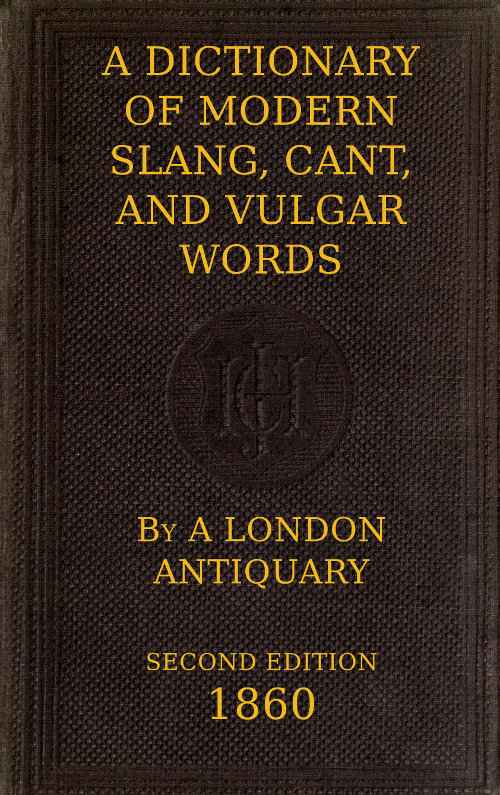
A Dictionary of Modern Slang, Cant, and VULGAR WORDS, used at the present day in the Streets of London; the Universities of Oxford and Cambridge; the Houses of Parliament; the Dens of St. Giles; and the Palaces of St. James: preceded by a History of Cant and Vulgar Language from the time of Henry VIII., showing its connection with the Gipsey Tongue; with Glossaries of Two Secret Languages, spoken by the Wandering Tribes of London, the Costermongers, and the Patterers. By a London Antiquary. Fcp. 8vo. extra cloth. With a curious Woodcut, “A Cadger’s Map of a Beggar’s District,” and Explanation of the Hieroglyphics used by Vagabonds.
“Rabble-charming words, which carry so much wild-fire wrapt up in them.”—South.
☞ The Second Edition, entirely rewritten, with more than TWO THOUSAND additional words, and a mass of fresh information not included in the first issue.
This interesting work is an important contribution to popular philology, as it chronicles for the first time nearly Five Thousand Words used by persons of every denomination in common conversation, most of which are contained in no English Dictionary whatever. The origin of many cant and slang words is also traced.
OPINIONS OF THE PRESS.
“The author has spared no pains to make his little volume perfect, both by collecting original and unused material from costermongers, vagabonds, and tramps, and by consulting nearly all writers who have gone before. * * * The author divides Slang into historical, fashionable, parliamentary, military and dandy, university, religious, legal, literary, theatrical, civic, money, shopkeepers’ and workmen’s slang,—the slang apologies for oaths, and the slang of drunkenness. The Freemasonry of tramps and beggars, and the hieroglyphics they use, is an interesting part of vagabond history that requires, if possible, further investigation. * * * His work is carefully and honestly performed, and we hope that the writer will read our remarks [five full columns] in a proper spirit, and, in the latest slang of the present hour, will “TAKE THEM ON HIS HEAD LIKE A BIRD.”—Athenæum.
“Extremely interesting. This little volume is evidently the result of a great deal of labour, as all works must be that are, in the chief part, collected directly by the observation and care of the author: and this we believe is the case in the present instance. The author we suspect to be identical with the publisher, and if so, he has had great opportunity by his possession of a large amount of scarce tracts, ballads, and street publications, of informing himself of the language of the vagabond portion of our population.”—Leader.
“There is a certain amount of interest in preserving the origin of slang words as a record of existing manners, and of those strange popular sayings which have a rapid and almost universal popularity, and then fade away as rapidly. The combinations of language in cant are often curious. The London Antiquary informs us that the cant for a public house at the present day is suck cassa,—pure Saxon and pure Spanish.”—Saturday Review.
“This is by far the most complete work upon a curious subject which has yet been compiled—a dictionary of more than three thousand words in current use in our streets and alleys, lanes and by-ways, from which the learned lexicographers have turned aside with contempt.”—Critic.
“This new Dictionary of our English cant and slang is full, and may be received as an amusing and suggestive little book of common knowledge into any household. Indecency has been omitted from its pages.”—Examiner.
“The ‘London Antiquary’ has certainly taken up a very curious and interesting branch of linguistic research.”—Notes and Queries.
“An instructive as well as amusing work. The author may be congratulated upon the successful issue of his labours in the field of vagabond and unrecognised speech.”—Titan in an article of ten pages.
“An amusing work, and a most useful and valuable contribution to the study of words. It is absolutely necessary to all those who in fast life would “mind their P’s and Q’s,” as well as to the readers of our newspaper and periodical literature.”—Montrose Review.
“We do not wonder that of so quaint and entertaining a compilation a new edition should so soon have been demanded.”—Globe.
“Contains a good deal of curious historical and anecdotical information, and is altogether a well got up, well edited, and amusing little volume.”—Shipping Gazette.
“Evinces a great amount of industry.”—Morning Star.
Beautifully printed, 12mo., cloth, 3s. 6d., THE CHOICEST HUMOROUS POETRY OF THE AGE.
The Biglow Papers. By James Russell LOWELL. (Alluded to by John Bright in the House of Commons.) WITH AN ILLUSTRATION BY GEORGE CRUIKSHANK.
⁂ This Edition has been Edited with additional Notes explanatory of the persons and subjects mentioned therein.
“The rhymes are as startling and felicitous as any in ‘Hudibras.’ ‘Sam Slick’ is a mere pretender in comparison.”—Blackwood’s Magazine.
“The fun of the ‘Biglow Papers’ is quite equal to the fun of the ‘Ingoldsby Legends.’ This is the real doggerel, the Rabelaiesque of poetry.”—Fraser.
☞ There is an edition of this work extant, hastily got up after my own was announced, edited by Mr. Hughes, the author of Tom Brown’s School Days. It gives an introduction, long and occasionally amusing, but of not the least value in explaining to the English reader the peculiarities of the work. The Globe pointed out this sad defect in reviewing the present edition:—“The copy beside us,” remarks the writer, “is apparently edited and published by Mr. Hotten, who gives a preface—which has the rare merit of explaining exactly what the ordinary English reader requires to know of satirical political poems, written in the Yankee dialect, touching the Mexican war, and the extension of the slave states—and of attempting to explain nothing else.”—Globe, Dec. 8, 1859.
Now ready, Second Edition, fcap. 8vo, neatly printed, price 1s.,
Macaulay; the Historian, Statesman, and ESSAYIST: Anecdotes of his Life and Literary Labours, with some Account of his Early and Unknown Writings.
⁂ Also, a fine paper Edition, cloth, neat, with a Photographic Portrait (the only one known to have been taken) by Maull and Polyblank, price 2s. 6d.
☞ Includes Anecdotes of Sydney Smith, Moore, Rogers, and Lord Jeffrey; and gives numerous examples of Lord Macaulay’s extraordinary memory and great powers of conversation.
“A brilliant sketch of the great historian, containing particulars of his youthful compositions, which are new and deeply interesting.”—Herald.
“We regard the little work before us as a very opportune publication. The author has brought together such a mass of facts, sketches, and anecdotes, illustrative of the character and mind of Lord Macaulay, that the book is very valuable as supplying, in a small compass, a faithful and vivid account of the great historian.”—Bradford Review.
“An interesting account of a man who was an ornament to our nation. Of the extraordinary capacity and availability of his memory many wonderful stories are told.”—Evangelical Repository.
“This work is well timed. Here we really have all that is known concerning the great man. The little book brings together with much dexterity and success very various and very scattered materials. We have been peculiarly interested in the details of the late illustrious Baron’s youthful productions. Never before has Wordsworth’s famous couplet, “The boy is father of the man,” received so vivid illustration. It is earnestly to be hoped that the whole of these early papers, and his inedited speeches and addresses written and spoken in the flush of his powers, and with all the wealth of illustration that so distinguished him, shall be collected. Why not at once by the writer of the present brilliant sketch? We know not who he is, but he is a man of no common powers. He has evidently, too, put his heart into his book. It thrills and throbs with reverent love towards the man. We like exceedingly his fresh, generous, glowing style; and not less his genial, gossipy way of telling the many anecdotes with which his pages sparkle.”—Advertiser.
“Valuable from the original matter and anecdotes it gives concerning Macaulay’s youthful productions.”—Leader.
“We hear Mr. Hotten’s little book on Macaulay is a success. Ten thousand copies sold within a few days!”—Critic.
Now ready, New and Popular Edition, neatly printed, fcap. 8vo, pp. 336, price 2s. 6d.,
Anecdotes of the Green Room and STAGE; or Leaves from an Actor’s Note-Book, at Home and Abroad, by GEORGE VANDENHOFF.
☞ Mr. Vandenhoff, who earned for himself, both in the Old and New Worlds, the title of The Classic Actor, has retired from the Stage. His reminiscences are extremely interesting, and include Original Anecdotes of the Keans (father and son), the two Kembles, Macready, Cooke, Liston, Farren, Elliston, Braham and his Sons, Phelps, Buckstone, Webster, Chas. Mathews: Siddons, Vestris, Helen Faucit, Mrs. Nisbett, Miss Cushman, Miss O’Neil, Mrs. Glover, Mrs. Chas. Kean, Rachel, Ristori, and many other dramatic celebrities.
Now ready, post 8vo, cloth, 3s. 6d.,
Rubbing the Gilt Off: a West End Book for All Readers. By JOHN HOLLINGSHEAD, Author of “Under Bow Bells, a City Book for All Readers.”
WITH A HUMOROUS ILLUSTRATION.
Contents.
- The Humiliation of Fogmoor.
- A Pet of the Law.
- Navy Dry Rot.
- How to Make a Madman.
- Nine Kings.
- An Official Scarecrow.
- A Model Theatre.
- The Suffering Sinecurist.
- A National Christmas Bill.
- The Social Reformer.
- Mudfog on Colonies.
- Diplomatic World.
- The Man behind my Chair.
- Wanted, a Court Guide.
“Clever and sagacious writing.”—Athenæum.
“As a collection of papers which, through all their whimsical fancies, develope a political system with an earnestness and a consistency that are rare, we can cordially recommend Mr. Hollingshead’s book.”—Leader and Saturday Analyst.
“Mr. Hollingshead has lost nothing of his dramatic power.”—Critic.
“The stories are no less interesting and amusing than instructive.”—Morning Star.
“Mr. Hollingshead has considerably widened his range of humorous illustration, still keeping, however, to the field of political economy.”—Daily News.
Now ready, fcap. 8vo, cloth, price 3s. 6d., beautifully printed,
Gog and Magog; or, the History of the Guildhall Giants. With Some Account of the Giants which Guard English and Continental Cities. By F. W. FAIRHOLT, F.S.A.
WITH ILLUSTRATIONS ON WOOD BY THE AUTHOR, COLOURED AND PLAIN.
⁂ The critiques which have appeared upon this amusing little work have been uniformly favourable. The Athenæum pronounces it a perfect model of successful antiquarian exposition, readable from the first line to the last. The Art Journal devotes a considerable space to the little work, and congratulates the author upon his success. The Leader contributes two full columns of eulogy. The Builder directs its readers to purchase it. The Critic says, in a long article, that it thoroughly explains who these old Giants were, the position they occupied in popular mythology, the origin of their names, and a score of other matters, all of much interest in throwing a light upon fabulous portions of our history.
Now ready, in 8vo, 4s., blue cloth and gold,
Photographic Pleasures: Popularly pourtrayed with Pen and Pencil. By CUTHBERT BEDE, B.A., Author of “Verdant Green,” &c.
WITH SEVENTY HUMOROUS DESIGNS BY THE AUTHOR.
“The ludicrous side of Photography is fair game for the caricaturist. With much cleverness Mr. Bede has seized the salient points of the new art.”—Athenæum.
“The work is full of illustrations, radiant with the raciness of Cruikshank, the broad and round humour of Rowlandson, knowledge of the world of Doyle, and quick apprehension of Leech.”—Herald.
NEW WORK BY THE LATE DOUGLAS JERROLD.
Nearly ready, in Two Vols. 8vo, cloth, extra,
Old Wine in New Bottles: Tales and Sketches of Life and Character, by DOUGLAS JERROLD, edited, with an Introduction, by his son, Blanchard Jerrold. With Illustrations by John Leech.
⁂ This work will contain some of the most characteristic pieces from the pen of the master wit—tales hitherto unknown and untold. Amongst others may be enumerated:—
- Some Account of a Stage Devil.
- Baron von Botts, a Tale of Blood.
- A Chapter on Black Dogs.
- The Actress at the Duke’s.
- Papers of a Gentleman-at-Arms.
- Bully Bottom’s Babes.
- The Rocking Horse.
- My Husband’s Winnings: a Household Incident.
- The Lamp-post: a Household Narrative.
- Midnight at Madame T.’s.
- The Old Boatman.
- Solomon’s Ape.
- Patty Larkspur’s Watch.
- The Tutor Fiend and his Three Pupils.
- Lizzy’s Back Hair.
- Christopher Snub, who was Born’d to be Hang’d.
- Recollections of Guy Fawkes, &c. &c.
Nearly ready, in fcap. 8vo, cloth extra,
A Pedlar’s Wallet: Filled from Household Words, by DUDLEY COSTELLO.
This work will comprise some of the best papers contributed to Charles Dickens’ famous periodical.
Nearly ready, beautifully printed, fcap. 8vo, price 3s. 6d.
The Choicest Jests of English Wits; from the Rude Jokes of the Ancient Jesters, to the refined and impromptu Witticisms of Theodore Hook and Douglas Jerrold. Including the Cream of Joe Miller: comprising the best Sayings, Facetious and Merry, which have contributed to give to our country the name of Merry England.
Nearly ready, beautifully printed, on fine paper, fcap. 8vo, pp. 350, price 5s.,
The History of Playing Cards, and the VARIOUS GAMES connected with them, from the Earliest Ages; with some Account of Card Conjuring, and Old-Fashioned Tricks.
ILLUSTRATED WITH FORTY CURIOUS WOODCUTS ON TINTED PAPER.
This most amusing work, introducing the reader to a curious chapter of our social history, gives an interesting account, replete with anecdotes, of the most popular and widely known pastime which has ever been invented by man for his amusement. A more instructive and entertaining book could not be taken in hand for a pleasant hour’s reading.
Two Vols. royal 8vo, handsomely printed, £2 8s.
Ancient Songs, Ballads, and Dance TUNES of the Olden Time, illustrative of the National Music of England, with Introductions to the different Reigns, and Notices of the Airs from Writers of the Sixteenth Century; also a Short Account of the Minstrels, by W. CHAPPELL, F.S.A.
This interesting work forms the largest and most complete collection of Ancient British Ballads and Songs ever published. The words are from the original old copies, and the addition of the Old Tunes to which they were formerly sung is an interesting and most curious feature. Several facsimiles adorn the work.
Preparing for publication, fcap. 8vo, beautifully printed,
Old English Ballads, relating to New England, the Plantations, and other Parts of North America; with Ancient Poetical Squibs on the Puritans and the Quakers who emigrated there; now first collected from the original excessively rare Broadsides sold in the streets at the time, and edited with Explanatory Notes. Illustrated with facsimiles of the very singular woodcuts which adorn the original Songs and Ballads.
Preparing for publication, beautifully printed, post 8vo, half morocco, Roxburghe style,
Garland of Pepysian Ballads, Historical, ROMANTIC, and HUMOROUS, some illustrating Shakespere, edited by EDWARD F. RIMBAULT, Esq., LL.D.
It is well known that the unfortunate regulation imposed by Pepys, the celebrated diarist, that his Manuscripts and Books should never be examined save in the presence of a Fellow of the College at Cambridge where they are preserved, has hitherto alone prevented the collecting and publishing some of the more interesting of these world-renowned Ballads and Songs. The difficulty, however, has been surmounted by Dr. Rimbault, aided by the authorities of Magdalene College; and the lovers of our charming old popular poetry will be glad to know that a Garland of these Balladian ditties is in course of publication. The work will be preceded by an Introduction on Ballad Lore, Ballad Writers, and Ballad Printers, giving some new and interesting particulars gathered from “old bookes,” and other sources, hitherto unexplored. The publisher would state that the work will be beautifully printed by Whittingham, and that it will be adorned by a curious woodcut facsimile frontispiece.
Nearly ready, in small 4to, half morocco, very neat,
An hitherto unknown Poem, written by John Bunyan, whilst confined in
Bedford Jail, for the Support of his Family, entitled,
Profitable Meditations, Fitted to Man’s DIFFERENT CONDITION; in a Conference between Christ and a Sinner. By JOHN BUNYAN, Servant to the Lord Jesus Christ.
London: Printed for Francis Smith at the Sign of the Elephant and Castle without Temple Bar, 1661
This very interesting, though melancholy literary memorial of the Author of the celebrated Pilgrim’s Progress, will be choicely reprinted by Whittingham, from the only known copy lately discovered by the publisher. It will be edited, with an Introduction by George Offor, Esq. The impression will be limited.
Now ready, price 5s.
Magna Charta. An Exact Facsimile of the Original Document, preserved in the British Museum, very carefully drawn, and printed on fine plate paper, nearly 3 feet long by 2 feet wide, with the Arms and Seals of the Barons elaborately emblazoned in gold and colours.
A.D. 1215
COPIED BY EXPRESS PERMISSION, and the only correct drawing of the Great Charter ever taken. This important memorial of the liberties and rights of Englishmen is admirably adapted for framing, and would hang with propriety from the walls of every house in the country. As a guarantee to the purchaser that the facsimile is exact, the publisher need only state that Sir Frederick Madden has permitted copies to hang for public inspection upon the walls of the Manuscript Department in the British Museum. It was executed by Mr. Harrison, under whose auspices the splendid work on the Knights of the Garter was produced some years ago.
A LITERARY AND PHILOLOGICAL CURIOSITY.
Shortly will be published, in square 12mo, beautifully printed, price 3s. 6d.,
The Book of Vagabonds and Beggars, (Liber Vagatorum: Der Betler Orden), with a Vocabulary of their Language (Rotwelsche Sprach); edited, with Preface, by MARTIN LUTHER, in the year 1528. Now first Translated into English, with Notes, by JOHN CAMDEN HOTTEN.
⁂ This very singular work is comparatively unknown in this country. The first edition appears to have been printed at Augsburg, by Erhard Öglin, or Ocellus, as early as 1514—a small quarto of twelve leaves. It was frequently reprinted at other places in Germany; and in 1528 there appeared an edition at Wittemberg, with a Preface by Martin Luther, from which the present translation has been made. The work is divided into three parts or sections; the first gives a special account of the several orders of the “Fraternity of Vagabonds;” the second, sundry notabilia relating to the different classes of beggars previously described; and the third consists of a Canting Dictionary. It is singular that more than three centuries ago Martin Luther should have declared that the cant language of beggars comes from the Hebrews, and that in our own time a similar statement should be made by Mayhew in his London Labour. Mayhew says that many of the most expressive street terms in every day use by London and provincial vagabonds are derived from the Jew Fences.
Now ready, fcap. 8vo, beautifully printed by Whittingham, price 2s.,
Letters of the Marchioness Broglio Solari, one of the Maids of Honour to the Princess Lamballe, &c.; with a Sketch of her Life, and Recollections of Celebrated Characters (intended to have been sold at 5s.)
The Marchioness Broglio Solari was the natural grand-daughter of Lord Hyde Clarendon, and consequently one of the collateral branches of the Queens Mary and Ann, and their grand-father, the great Chancellor of England. She played an important part in the French Revolution; was the friend of Emperors and Princes; was intimately acquainted with George the Fourth, Burke, Sheridan, Madame de Stael, the Duke of Wellington, Sir Robert Peel, Sir H. Davy, Paganini, &c., of most of whom she gives characteristic anecdotes. The Marchioness endured many troubles, was robbed of her fortune, and for some time obtained her living as an actress at the theatres of London and Dublin. This work was published by an intimate friend, and the entire impression (with the exception of a few copies) passed into the hands of the family. It is believed that only 150 copies were printed. The book (by those who know of its existence) has always been considered as a suppressed work.
[In preparation.]
The History of English Popular Literature, with some Account of Cheap or Chap-Books, Penny and Sixpenny Histories, Old Romances, Fairy Tales, Books of Wonder, Garlands and Penny Collections of Ballads, Books of Recipes and Instruction, Jest Books, &c.; also the History of the Rise of Cheap Serial Literature. 8vo.
This very important work will range with Nisard’s History of French Popular Literature, 2 vols., Paris, 1854. It will be illustrated with numerous exceedingly curious woodcuts, many by Fairholt, and several from the original blocks used by the old London Bridge and Aldermary Church Yard publishers.
Printed by Taylor & Greening, Graystoke-place, Fetter-lane, London, E.C.
Transcriber’s Notes
Variant spelling and hyphenation have been preserved as printed; simple typographical errors have been corrected.
The transcriber added text to the book’s original plain cover. The cover has been placed in the public domain.
The following changes were also made (all changes are noted in the source code: search TN:):
- Page 24:
ROME BOUSE [rum booze], [TN: added comma] - Page 25:
and what schoolboys term “freeing.”] [TN: added closing bracket] - Page 32:
through the caprices of fashion. [TN: deleted extraneous quotation mark] - Page 35:
“Houg dog youg dog?” [TN: added closing quotation mark] - Page 67:
a “GRACIOUS child,” [TN: added closing quotation mark] - Page 91:
singular enough now, but common forty years ago. [TN: deleted extraneous quotation mark] - Page 95:
“oh, BETTER ’n a mile.” [TN: added closing quotation mark] - Page 95:
talk BIG,” i.e. [TN: was "ie."] - Page 96:
Blood-red [TN: added hyphen] - Page 98:
“O du blühende [TN: was "bülhende"] - Page 103:
having been at first plastered [TN: was "filastered"] - Page 127:
“tip us your DADDLES,” [TN: added closing quotation mark] - Page 133:
“what does he intend to imply?” [TN: added opening quotation mark] - Page 135:
DUNAKER, a stealer of cows or calves. [TN: added period] - Page 138:
“cut up FAT,” [TN: added opening quotation mark] - Page 142:
FLUMMUXED, stopped, used up. [TN: added period] - Page 148:
GO, a GO of gin, [TN: added comma] - Page 152:
for his customers to visit him. [TN: was a comma] - Page 154:
ST. BEE’S.—University. [TN: added period] - Page 156:
feigning sickness or other means. [TN: added period] - Page 164:
KIMBO, or A-KIMBO [TN: was "A KIMBO"] - Page 167:
“landsman.”—See LOAFER [TN: added opening quotation mark] - Page 174:
“gay women.” [TN: added opening quotation mark] - Page 177:
MUMMER, a performer at a travelling theatre. [TN: added period] - Page 178:
“he picked up a bit of MUSLIN.” [TN: added closing quotation mark] - Page 180:
NESTS, varieties.—Old. [TN: added period] - Page 182:
NYMPH OF THE PAVE (French, PAVÉ [TN: was "PAVÈ"] - Page 190:
“PIPE one’s eye.” [TN: added closing quotation mark] - Page 191:
“he’s a rare PLUCKED-’UN,” i.e. [TN: added period] - Page 194:
PRIG, a thief. [TN: added period] - Page 194:
PUB, or PUBLIC, a public-house. [TN: added period] - Page 196:
“M.B.” coats worn by Tractarian curates.— [TN: deleted extraneous quotation mark] - Page 199:
“Lord Strut was not very flush in READY.” [TN: added closing quotation mark] - Page 199:
RIBROAST, to beat till the ribs are sore. [TN: was a comma] - Page 200:
“Rip! well, he was an old RIP, and no mistake.” [TN: added closing quotation mark] - Page 202:
“Roughing it in the Bush” [TN: added opening quotation mark] - Page 204:
or SALOP, a greasy [TN: deleted extraneous comma] - Page 204:
NOVE SOLDI. [TN: added period] - Page 218:
is supposed to be analogous [TN: was "analagous"] - Page 220:
Tops are out; SMUGGING about.” [TN: single quote changed to double] - Page 227:
“a rum START,” [TN: added opening quotation mark] - Page 227:
“to get the START of a person,” to anticipate [TN: deleted extraneous comma] - Page 234:
“to TAKE THE FIELD,” [TN: added closing quotation mark] - Page 236:
swim in twentie of their boats over the river UPON TICKET.” [TN: added closing quotation mark] - Page 241:
TWIST, appetite; “Will’s got a capital TWIST. [TN: was a comma] - Page 242:
TWOPENNY, the head; “tuck in your TWOPENNY, [TN: was a period] - Page 242:
hornpipes in fetters, à la Jack Sheppard, [TN: was a period] - Page 244:
WALK-THE-BARBER, [TN: added comma] - Page 244:
WALL-FLOWER, [TN: added comma] - Page 244:
this word from an ancestor of the Earl of Portsmouth, [TN: added comma] - Page 245:
Generally used to express anything dishonestly taken. [TN: added period] - Page 247:
“Jack made a DOOGHENO HIT this morning,” [TN: added opening quotation mark] - Page 277:
BAILEY’S (Nath.) Etymological English Dictionary, 2 vols, 8vo. [TN: added period] - Page 283:
Classical Dictionary of the Vulgar Tongue, 8vo. 178— [TN: final number missing; em dash added] - Page 284:
(prefixed to Holinshed’s Chronicle) [TN: added closing parenthesis] - Page 293:
—South. [TN: added em dash] - Page 294:
‘Sam Slick’ [TN: added closing quotation mark] - Page 295:
many wonderful stories are told.” [TN: added closing quotation mark] - Page 299:
other sources, hitherto unexplored. [TN: added period] - Page 300:
one of the Maids of Honour to the Princess Lamballe, &c. [TN: added period] - Page 300:
The Marchioness Broglio [TN: was "Broglia"]