
The Project Gutenberg eBook of A Dictionary of the First or Oldest Words in the English Language
Title: A Dictionary of the First or Oldest Words in the English Language
Author: Herbert Coleridge
Release date: February 2, 2013 [eBook #41975]
Most recently updated: October 23, 2024
Language: English
Credits: Produced by The Online Distributed Proofreading Team at
http://www.pgdp.net (This file was produced from images
generously made available by The Internet Archive.)
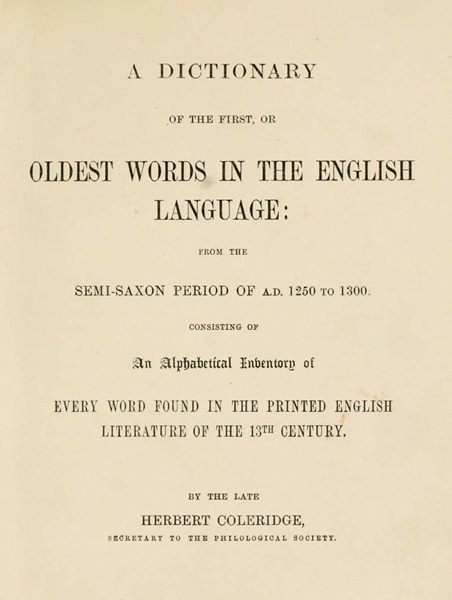
A DICTIONARY OF THE FIRST, OR
OLDEST WORDS IN THE ENGLISH LANGUAGE
A DICTIONARY
OF THE FIRST, OR
OLDEST WORDS IN THE ENGLISH
LANGUAGE:
FROM THE
SEMI-SAXON PERIOD OF A.D. 1250 TO 1300.
CONSISTING OF
An Alphabetical Inventory of
EVERY WORD FOUND IN THE PRINTED ENGLISH
LITERATURE OF THE 13TH CENTURY.
BY THE LATE
HERBERT COLERIDGE,
SECRETARY TO THE PHILOLOGICAL SOCIETY.
LONDON:
JOHN CAMDEN HOTTEN, PICCADILLY.
M DCCC LXII.
PREFACE.
The present publication may be considered as the foundation-stone of the Historical and Literary portion of the Philological Society’s proposed English Dictionary. Its appearance in a separate form has been necessitated by the nature of the scheme, on which that work is being constructed. Without entering into details, which will be found in the Society’s published Prospectus,[1] it will be sufficient for the present purpose to mention, that the raw material of the Dictionary, the words and authorities, are being brought together by a number of independent collectors, for whom it is consequently necessary to provide some common standard of comparison, whereby each may ascertain what he is to extract, and what to reject, from the author, or work, he has undertaken. This standard for works of earlier date than 1526 is furnished by the following pages, which contain an alphabetical inventory of every word found in the printed English literature of the 13th century. As, however, a mere index verborum would but inadequately fulfil its object, a certain amount of explanatory and etymological matter has been added, which it is hoped may render the work more generally interesting and useful than could otherwise have been the case. It is only proper to add that English literature, as distinguished from Semi-Saxon, is assumed to commence about the middle of the 13th century.
[1] London, Trübner and Co., Paternoster Row, price 6d.
All words are arranged under their modern forms, where such exist, but the older forms, except where utterly unimportant, are always noticed. The more remarkable of these older forms are also entered in the Glossary in their alphabetical order, with cross references to that under which the word is discussed. Thus under ‘Hymn’ and ‘Isle’ will be found the forms ‘ympne’ and ‘ydle;’ but ‘ympne’ and ‘ydle’ appear also in their proper places in the Glossary. Obsolete words are of course entered as they are spelt in the passage whence they are taken, a rule which applies as much to different forms of the same word, as to different words. As to the etymological matter, nothing further as a general rule has been attempted than to indicate the nearest cognate, or cognates, of the particular word; but it has not been thought necessary, or desirable, to load the Glossary with illustrations of this nature in very simple cases. I have to thank Hensleigh Wedgwood, Esq., for many kind and valuable suggestions in this part of my work.
My best thanks are also due to the Rev. J. Eastwood, the Rev. W. H. Herford, to my colleague Mr F. J. Furnivall, and to Messrs M’Ewan and Harrison, for their valuable assistance in the formation of separate indexes to several of the works comprised in this Glossary. Their respective shares in the work are pointed out in the List of Books and Editions, which will be found in page v.
And I cannot terminate this brief preface without expressing my deep sense of the obligations I am under to Sir F. Madden, not merely for the help of his invaluable editions of Laȝamon and Havelok, without which this work would have been far less complete than it now is, but also for much kind personal advice and assistance, which probably few, if any, living philologists beside himself would have been competent to bestow. It only remains for me to add that, although no pains have been spared to render the book as complete as possible, I cannot but expect that some omissions and errors will be discovered, more especially as the largest and most laborious portion of the work was carried on during a long period of ill health. I shall feel very grateful to those who discover any addenda, if they will kindly communicate them to me for insertion hereafter in the Dictionary itself.
HERBERT COLERIDGE.
10, Chester Place, Regent’s Park,
June 13th, 1859
LIST OF BOOKS AND EDITIONS REFERRED TO.
⁂ All the following pieces are cited by the number of the verse, except where the contrary is expressly mentioned.
Havelok the Dane. Edited by Sir F. Madden, for the Roxburgh Club. (By Mr H. Coleridge.)
Geste of Kyng Horn. Edited by M. Michel, for the Bannatyne Club. (By Mr H. Coleridge.)
(N.B. The text of this poem in the second vol. of Ritson’s Metrical Romances is taken from a later MS., and differs considerably from the Bannatyne text.)
Kyng Alysaunder. In Weber’s Metrical Romances, vol. I. (By Mr H. Coleridge.)
The Land of Cokaygne. In Hickes’s Thesaurus, vol. I. p. 231. (By Mr Furnivall.)
| The Life of St Margaret (cited by stanzas), | } | in Hickes’s Thesaurus, vol. I. pp. 224, 233. (By Mr Furnivall.) |
| Metrical Version of the Athanasian Creed, |
The Owl and Nightingale. Edited by Mr Wright for the Percy Society. (By Mr Furnivall and Mr H. Coleridge.)
Fragment on Popular Science, from the Early English Metrical Lives of Saints, in Mr Wright’s ‘Popular Treatises on Science.’ (By Mr H. Coleridge.)
Specimens of Lyric Poetry, temp. Edw. I. Edited by Mr Wright, for the Percy Society. (By Mr M’Ewan.)
Various Pieces in the Reliquiæ Antiquæ (cited by volume and page). (By Mr H. Coleridge.)
Political Songs, temp. Hen. III. and Edw. I. Edited by Mr Wright, for the Camden Society. (By the Rev. W. H. Herford.)
Ritson’s Ancient Songs, Class I. Most of these songs, however, are contained in the Specimens of Lyric Poetry, temp. Ed. I., and are quoted from that collection. (By Mr Harrison.)
Religious Songs, printed at the end of the Percy Society’s edition of the Owl and Nightingale. (By Mr H. Coleridge.)
Dialogue between the Soul and Body. In the Appendix to Mapes’s Poems, edited by Mr Wright, for the Camden Society, p. 334. (By the Rev. J. Eastwood.)
The Early English Psalter. Edited by the Rev. J. Stevenson, for the Surtees’ Society. Cited by the psalm and verse. (By Mr H. Coleridge.)
Robert of Gloucester’s Chronicle. Ed. Hearne (2nd ed., 1810). Cited by the page. (By Mr. H. Coleridge.)
The Legend of St Brandan. Edited by Mr Wright, for the Percy Society. (By the Rev. J. Eastwood.)
The Life and Martyrdom of Thomas Beket. Edited by Mr Black, for the Percy Society. (By the Rev. J. Eastwood.)
(Owing to the gross inaccuracy of the marginal numbering in the printed edition of this poem, it has been found necessary to go over the whole afresh, and to cite according to the amended reckoning. The following data will assist the reader:—The first error occurs in page 64, where the line numbered 1280 should be 1282. The second occurs in page 100, where ten lines are dropped, and 1961 is printed for 1973, the true number. The third will be found in page 110, where 2049 is made to succeed 2139, and after this, of course, the confusion is hopeless. The exact number of lines in the poem is 2515, while the printed numbers give only 2398. Readers are therefore requested to renumber their copies from page 64 onwards, before attempting to verify the references in the Glossary.)
The following pieces will be printed in the second part of the Philological Society’s Transactions for 1858, and are therefore included in the Glossary. I am indebted to the kindness of my friend and colleague, Mr Furnivall, for the loan of his transcripts.
A Moral Ode. MS. Egerton, 613. Cited by stanzas.
(Hickes printed Extracts from this Ode, in his Thesaurus, vol. I. p. 222, from one of the Digby MSS.; but his text is somewhat different from that of the Egerton MS., and omits nine stanzas contained in the latter.)
| A Sermon (cited by stanzas), | } | MS. Harl. 913. |
| Signa Ante Judicium, | ||
| A Fragment on the Seven Sins, | ||
| The Ten Commandments, | ||
| Christ on the Cross, | ||
| A Poem on Miracles, containing a Tale of an Oxford Student, | ||
| The Fall and Passion, |
| The Legends of | ||
| St Dunstan, | } | from MS. Harl. 2277. |
| St Katherine, | ||
| St Andrew, | ||
| St Lucy, | ||
| St Swithin, | ||
| St Edward, | ||
| Pilate, | ||
| Judas Iscariot, |
A few references will also be found to the Manuel des Pecches of Robert Brunne, now being edited by Mr Furnivall, for the Roxburgh Club, but the proof-sheets came into my hands too late to allow of anything like a complete analysis of the language of the poem.
OTHER WORKS REFERRED TO IN THE GLOSSARY.
Burguy’s Grammaire de la Langue d’Oïl. 3 vols. 8vo. Berlin, 1856. The third volume contains an excellent Glossary.
Cotgrave’s French and English Dictionary, by Howell. 1650.
Egilsson’s Lexicon Poeticum Antiquæ Linguæ Septemtrionalis. Hafniæ, 1854-1859. One part is still wanting to complete the work.
Halliwell’s Provincial and Archaic Dictionary. 2 vols. 8vo. 1855.
Kilian’s Lexicon Teutonicum. Ed. Hasselt. 2 vols. 4to. 1777.
Laȝamon’s Brut. Ed. Sir F. Madden. 3 vols. 8vo. 1847. (Cited by volume and page.)
The Ormulum. Ed. White. 2 vols. 8vo. 1852.
The Philological Society’s Transactions, from 1842-1856. 9 vols. 8vo.
Roquefort’s Glossaire de la Langue Romane. 2 vols. 8vo. 1808.
A Volume of Vocabularies, forming vol. I. of a Library of National Antiquities. Edited by Wright. 1857. (Privately printed.)
Warton’s History of English Poetry. 3 vols. 8vo. Ed. 1840.
LIST OF ABBREVIATIONS MADE USE OF IN THE GLOSSARY.
| Alys. | Kyng Alysaunder. | |
| AS. | Anglo-Saxon. | |
| B. | The Life of Beket. | |
| β | The Legend of St Brandan. | |
| comp. | comparative. | |
| Cok. | The Land of Cokaygne. | |
| Cotgr. | Cotgrave. | |
| Dut. | Dutch. | |
| Fall and P. | The Poem on the Fall and Passion. | |
| Fr. Sci. | The Fragment on Popular Science in the Lives of Saints. | |
| Fr. | French. | |
| Hall. | Halliwell. | |
| HD. | Havelok the Dane. | |
| Kil. | Kilian. | |
| Laȝ. | Laȝamon. | |
| L. P. | Specimens of Lyric Poetry, ed. Wright. | |
| lit. | literally. | |
| Marg. | The Life of St Margaret. | |
| M. G. | Mæso-Gothic. | |
| M. Ode. | The Moral Ode. | |
| N. and Q. | Notes and Queries. | |
| O. and N. | Owl and Nightingale. | |
| ON. | Old Norse. | |
| O. H. G. | Old High German. | |
| Orm. | Ormulum. | |
| part. | participle. | |
| Pol. S. | Political Songs. | |
| pret. | præterite. | |
| Ps. | Psalm. | |
| Rel. S. | Religious Songs. | |
| RG. | Robert of Gloucester. | |
| Ritson’s AS. | Ritson’s Ancient Songs. | |
| Roq. | Roquefort. | |
| S. S. | Semi-Saxon. | |
| sb. | substantive. | |
| sup. | superlative. | |
| v. a. | verb active. | |
| v. n. | verb neuter. | |
| W. | Welsh. | |
| Warton, H. E. P. | Warton’s History of English Poetry. |
GLOSSARIAL INDEX.
A
A, indef. art. RG. 367
—— == on. O. and N. 20
—— == he. Alys. 7809
—— == and. HD. 359
—— == one. Ps. liv. 14
Aback, adv. RG. 131
Abash, v. a. Alys. 224
Abate, v. a. == put an end to, make to cease. RG. 54. Fr. abattre
—— v. n. == cease from doing a thing. RG. 447
Abay, v. a. == drive to bay. Alys. 3882
Abbess, sb. RG. 370
Abbey, sb. RG. 369
Abbot, sb. RG. 376, 447
Abece, == ABC. RG. 266
Abed, adv. RG. 547
Abelde, v. n. == become bold. Alys. 2442
Abenche, == on a bench. St. Kath. 91
Abide, v. n. == remain, tarry. RG. 382. AS. bidan
—— v. a. == wait for, hence receive. RG. 265, and 302, pret. ‘abade.’ Ps. xxxix. 2
Abie, v. a. == pay for, pay the penalty for. [abigge] 1624. B. pret. ‘abouȝte.’ 58 B. ‘abid.’ O. and N. 1775. AS. a-bicgan. See Phil. Soc. Proc. vol. v. p. 33
Abite, v. a. == bite. Alys. 7096
Ablende, v. a. == make blind. RG. 208
Aboht, part. == bought. Wright’s L. P. p. 103
About, adv. == round about (of locality). RG. 369; ‘ȝeode aboute’ 76 B.
—— ‘about to,’ with a verb, as a future part. 1593 B.
—— == nearly. RG. 247
—— prep. == around, circum. RG. 467; [obout]. Ps. lxxvii. 28
—— == near (of time), ‘aboute noon.’ Wright’s L. P. p. 34
Above, adv. 266 B.
—— prep. O. and N. 1492
Abow, v. a. == make to bend. RG. 46. pret. ‘abuyde.’ RG. 476
—— v. n. == bow, 3s pres. ‘abueth.’ RG. 193. part. ‘abouynde.’ RG. 302
Abowes, sb. == patron saints. RG. 475. Fr. avoués
Abraid, v. a. == open. O. and N. 1042. AS. abredan
Abroad, adv. RG. 542
Abrode, adv. == breeding, lit. ‘on brood.’ O. and N. 518. Fragm. on Seven Sins, v. 34
Abusse, v. a. == ambush, conceal. 1382 B.
Abuten, prep. == without (sine). M. Ode, st. 43
Ac, conj. == and, but. RG. 367
Acast, part. == disappointed. Pol. S. 149
Accord, v. a. == reconcile. RG. 388
—— v. n. == agree. RG. 388
—— sb. == agreement. RG. 388, 447
Account, v. n. == render an account or reckoning. Pilate 86
—— sb. == reckoning. 164 B. Sermon, st. 24
Accurse, v. a. RG. 296, 474
Accuse, v. a. RG. 523. part. ‘acoysing,’ == accusing or accusation. Alys. 3973
Acele, v. a. == seal. RG. 510. See Asele
Ache, sb. == smallage or water-parsley. Wright’s L. P. p. 26. Fr. ache
Ache, v. n. RG. 240 pret. ‘ok.’ RG. 208
Acoled, == cooled. O. and N. 215
Acomber, v. a. == encumber. Alys. 8025
Acopede, == accused. See Aculp
Acore, v. a. == make sorry, grieve. RG. 75. part. ‘acorye,’ == chastened, punished. RG. 390
Acost, adv. == at the side. Alys. 2443, 3547
Acquaint, v. a. RG. 15, 465
Acquit, v. a. RG. 565
Acton, sb. == a leathern jacket worn under the armour. Alys. 2153. Fr. acoton. See Burguy s. v.
Acue, adv. == on his rump. Fr. au cul. Marg. 67
Aculp, v. a. == accuse. RG. 544. pret. ‘acopede.’ 773 B.
Adaunt, v. a. RG. 61, 372
Aday, adv. == by day. O. and N. 219
—— == of the day, ‘aȝen eve aday,’ ‘on the evening of the day.’ RG. 289
Adder, sb. Alys. 5262
Addle, adj. == rotten. O. and N. 133
Adiȝte, v. a. == adapt, prepare. O. and N. 326
Admiral, sb. [amyrayl.] RG. 409. [admirald.] K. Horn 95
Admonishment, sb. [amonestement]. Alys. 6974
Adown, prep. [adun]. O. and N. 1452
—— adv. RG. 376.
Adownward, adv. RG. 362. Fragm. Sci. 321
Adraw, v. a. == draw (as a sword). RG. 361, pret. ‘adrou.’ == drew. RG. 400
Adread, v. n. == fear, be in dread. O. and N. 1264
—— adj. == in fear. Rel. S. iv. 2. part. ‘adrad.’ 44 B.
Adrench, v. a. == to drown, pret. ‘adrentte.’ RG. 384
—— v. n. == be drowned, pret. ‘adrent.’ RG. 401. part. ‘adrencte.’ RG. 437. ‘adronke.’ RG. 430
Adriȝe, v. a. == endure. K. Horn, 1068. AS. a-dreogan
Adun, v. a. == stun. O. and N. 337
Adun, adv. == adown, q. v.
Advance, v. a. == set forward, promote. RG. 503; to advance a girl in marriage. RG. 431
Advancement, sb. Alys. 2570
Advent, sb. == the season of Advent. 1849 B.
Advice, sb. 101 B.
Advowson, sb. [vowson]. RG. 471
Adwole, adv. == in error. O. and N. 177. AS. dwelian, dwola
Ae, adv. for ‘aȝe,’ == against. 1456 B.
Afaitment, sb. == address, skill. Alys. 661
Afare, part. == gone away. St Kath. 176
Afaytye, v. a. == manage, reduce to subjection. RG. 177
—— 3 s pret. ‘afighteth.’ Alys. 6583. Fr. afaiter
Afar, adv. 1226 B.
Afaunce, == affiance? Weber. Gl. ad Alys. 732
Afear, v. a. == frighten. RG. 504, 22
Afeard, adj. RG. 388
Afell, v. a. == fell, cut down. Alys. 5240
Afeng, v. a. == take up, receive, pret. afong. RG. 368
Aferd, part. == affaired, i.e. charged with an affair to be executed. Alys. 1813
Affair, sb. Alys. 410
Affie, v. a. == give confidence to a person. Alys. 4753
Affirm, v. a. Alys. 7356
Afighteth. See Afaytye
Afiled, == defiled. Alys. 1064
Afind, v. a. == find. O. and N. 527
Afingred, part. == hungered. 416 β. Cf. ‘fyrst’ for ‘thirst,’ ‘frefownd’ for ‘greyhound;’ and see Wright’s Vocab. pp. 250, 259, note
Afire, adv. RG. 380, 541, 546
Afoled, part. == befooled, made a fool of. O. and N. 206
Afoot, adv. RG. 378
Aforce, v. a. == force, compel. RG. 121. Alys. 789
Aforeward, adv. == foremost, foreward. 492 B.; first of all. RG. 567
Aforth, adv. == forwards. O. and N. 822
Afretie, v. a. == devour. Pol. S. 237, 240. AS. fretan
Afte, sb. == folly? Pol. S. 210
After, prep. == in expectation of, ‘after betere wynde hii moste þere at stonde.’ RG. 367
—— == of time, ‘after Mydsomer.’ RG. 407
—— == like. Alys. 5418
—— == in; ‘after eche strete.’ M. Ode, st. 117
—— == ‘behind,’ of place. RG. 398
Afterblismed, == pregnant. Ps. lxxvii. 70. AS. blósma == a bud
Afterward, adv. == in the after part (of a book). RG. 6
—— == next in order, afterwards. Wright’s L. P. p. 24
Aftertale, sb. == postscript. 627 B.
Afterwending, sb. == following. Alys. 7280
Again, adv. == iterum, a second time. RG. 36
—— == back again [aȝé]. 147 B.
Againbuy, v. a. == redeem, pret. ‘agaynboghte.’ Ps. lxxiii. 2
Againbuying, sb. == redemption. Ps. xlviii. 9
Againcall, v. a. Ps. ci. 25
Againlook, v. a. == look back upon. Ps. xxxiv. 3
Againres, sb. == meeting. Ps. lviii. 6. [ogain raas]. Ps. xviii. 7
Againsaw, sb. == contradiction. Ps. lxxx. 8
Againsaying, sb. == contradiction. Ps. cv. 32
Against, prep. == contra, [aȝe]. 54 B. [aȝen]. RG. 367. [ogaines] Ps. lxxxii. 4
—— == opposite to, of place, [aȝeyn]. RG. 6
—— == by the time that. Wright’s L. P. p. 23
—— == in comparison with, [aȝeynes]. Wright’s L. P. p. 68
Againstand, v. n. Ps. lxxv. 8
Againturn, v. n. == return. Ps. lxxvii. 39
Againward, adv. Ps. lxxvii. 57
Againwend, v. n. == retreat, part, ‘aȝenwendand.’ Ps. lxxvii. 9
Agast, v. a. == frighten. RG. 387
—— adj. == frightened. RG. 402. Alys. 3912. MG. us-gaisjan.
Age, sb. == sæculum. RG. 9
Agesse, vb. == calculate on, expect. K. Horn, 1219
Agin, v. n. == begin. O. and N. 1287
Ago, v. n. == go. O. and N. 1451. part. ‘agonne.’ == proceeded. RG. 561
Ago, == gone, neglected. Pol. S. 197
Agrame, v. a. == make angry. Alys. 3309
Agrief, v. a. Alys. 3785
Agrill, v. a. == annoy. [a-grulle]. O. and N. 1108. AS. grillan
Agrise, v. a. == terrify. RG. 463. pret. ‘agros.’ RG. 549. part. ‘agrise,’ == frightened. RG. 539. ‘To agrise him,’ == become furious. K. Horn, 895. AS. agrýsan
Aground, or ‘alaground,’ == on the ground. RG. 378
Ahen, adj. == own. O. and N. 1284. AS. ágen
Aheve, v. a. == lit. lift up; hence, bring up, educate. Marg. 5. AS. a-hefan
Ahte, sb. == property, goods. Wright’s L. P. p. 46. AS. æht
Ahwene, v. a. == vex, trouble. O. and N. 1562. AS. a-hwænan
Ainoȝe, adj. == anew. RG. 397
Air, sb. 697 β
—— == airs, pride, vaunting. RG. 51, 397
Aither, == either. 434 β
Aiware—Aihwar, == everywhere. O. and N. 216. Moral Ode, st. 42, ed. Hickes, but the Egerton MS. reads the verse “eiðer he mai him finde”
Akelde, vb. a. pret. == cooled. The other reading is ‘acoled,’ q. v. RG. 442
Aken, v. a. == reconnoitre. Alys. 3468
Aknee, adv. == on the knee’s. 993 B. [aknawe]. Alys. 3540
Alaboute, adv. 2258 B. Many other compounds of ‘all’ are thus written as one word, where they are now generally disjoined, thus—‘alaground.’ RG. 378
Alamed, part. == lamed. O. and N. 1602
Alas! interj. RG. 443
Alast, adv. == at last. Pol. S. 216
Alb, sb. == clothing, lit. a white robe. RG. 347. AS. albe
Albidene, adv. == by and by. HD. 730. Wright’s L. P. p. 61
Albysi, adv. == about, scarcely. RG. 81. The V. L. gives ‘unnethe’
Alday, adv. == all the day. RG. 197
—— == continually. RG. 92
Aldeman, sb. == elder. Ps. civ. 22
Aldest, == oldest. RG. 232
Alderelde, sb. == extreme old age. Ps. lxx. 18
Ale, sb. HD. 14
Alegge, v. a. == to lay down, put down. 1928 B. part, ‘aleyd.’ == quelled, subdued. Wright’s L. P. p. 105
—— (of laws) == to annul. RG. 422. part. ‘aleyd.’ RG. 144 == ‘to confute.’ O. and N. 394. AS. a-lecgan
Alesen, v. a. == loose. Marg. 24
Alight, v. a. == descend, alight. 1897 B. RG. 468. part, ‘alight.’ RG. 433. AS. a-lihtan
Alighting, sb. RG. 430
Alisaundre, sb. == the herb alexander, or horse-parsley. Wright’s L. P. p. 26. See the Prompt. Parv. s. v.
Alive, adv. 67 B. See Gloss. Rem. to Laȝamon, p. 442
Alike, adj. [iliche]. 1894 B.
—— adv. 714 β
Alinlaz. See Anlace
All, adj. RG. 373, == the whole
—— RG. 371, == every one of a number gen. s. ‘alles,’ used adverbially, == very, entirely. RG. 17; 73 B. gen. pl. ‘alre,’ 1332 B. ‘aller,’ RG. 135
All, adv. RG. 367, et passim
Allerfurst, == first of all. Alys. 1569
Allermost, adv. RG. 44
Alliance, sb. RG. 89, 295; [enlyance]. RG. 12
Allong, == during the whole of; ‘al longe day.’ 403 B. ‘allonge niȝt.’ 595 β
Allout, adv. == entirely. 1940 B.
Ally, v. a. RG. 65
Allyng, adv. == entirely. RG. 48. AS. eallunga
Almatour, sb. == almoner. Alys. 3042
Almesse, sb. == alms. RG. 330
Almightand, == almighty. Creed. 33
Almighty, adj. 1041 B.
Almost, adv. RG. 389. Ps. cxviii. 87
Almsdeed, sb. Rel. S. iv. 39
Almsful, adj. 1676. B.
Almshede, sb. RG. 498
Alnil, == and only? Pol. S. 201
Alond, adv. == on the land. RG. 389
Alone, adj. 59 B.
Along, adv. == straight on, ‘to go along.’ Alys. 3410
—— == lengthwise [o lonke]. Pol. S. 156
Alothe, v. n. == become loathsome. O. and N. 1275
Alour, sb. == corridor. Alys. 7210. pl. ‘alurs.’ RG. 192. Fr. aller
Alout, v. n. == bow. RG. 476
Alre, gen. pl. of ‘all,’ forms numerous compounds with adjj. in the superlative degree,—thus ‘alre-hecst,’ == highest of all. O. and N. 687; ‘alre-mest,’ ib. 684; ‘alre-necst,’ ib. 685; ‘alre-wrste,’ ib. 121; &c. &c.
Als, == as. HD. 306, == as if. HD. 508
Alsauf, adv. == without fail. RG. 391
Also, == besides. RG. 369
—— == as. RG. 561. HD. 1872
—— == as if. HD. 468
Alswa, adv. == also, in like manner. O. and N. 237
—— == as if. O. and N. 146
Altar, sb. 2215 B.
Altherbest, == best of all. HD. 182
Alto, adv. 99 B.
Alumere, adj. == bright. Wright’s L. P. p. 68
Alȝare, adv. == already. 917 B.
Am, == them. Ps. v. 12
Am, vb. == 1s pret. of ‘be.’ 337 RG.
Amad, part. == amaied or dismayed. Alys. 1749. K. Horn. 586
—— == mad. Pol. S. 156
Amaistre, v. a. == reduce to subjection. Pilate 60
Amanse, v. a. == curse. RG. 474. AS. amánsumian, lit. to disjoin, hence to excommunicate
Amar, v. a. Rel. Ant. ii. p. 211
Amarstle, v. a. == to stuff full? Wright’s L. P. p. 111. AS. amæstan
Ambesas, sb. == two aces, the lowest throw on the dice. Hence ‘to caste an ambesas,’ == to have bad luck, to fail in a thing. 492 β. 450 B. See Roq. s. v. Ambezas
Amblant, part. == ambling, Alys. 3462
Ambush, sb. RG. 51
—— v. a. [abusse] 1382 B.
Amen, interj. Wright’s L. P. p. 51
Amend, v. a. RG. 449, 391
Amending, sb. == amendment. Alys. 7502
Amendment, sb. RG. 404, 472
Amere, adv. == bitterly, wrathfully. Alys. 4427. Fr. ameir, Lat. amarus
Amet, sb. == emmet, ant. RG. 296; ‘amete hulle’ == an anthill. RG. 296
Amethyst, sb. Cok. 91
Ameye, sb. == a mistress. Alys. 520. Fr. amie
Amid, prep. == in the midst of. 1139 B.
—— == with, 90 B. for ‘mid.’
Amidward, adv. Alys. 690
Amiral. See Admiral.
Amiss, adj. == wrong. RG. 451
Amiture, sb. == friendship. Alys. 3975
Amone, v. a. == remember. Sign. 147. AS. gemunan
Among, prep. == inter. 6 B.
—— adv. == at intervals, O. and N. 6
Amorrow, [amorwe] adv. == on the morrow. 49 B.
Amount, v. n. RG. 497 == ‘vor it ne ssolde amounti noȝt,’ == because it would amount to or avail nought. So the prep. is omitted in Alys. 6020
‘That amounted fyve hundred thousand
Knyghtis to armes, so Y fynde’
Amour, sb. == lover. Alys. 951
—— == love. Alys. 4573
Amty, == empty, RG. 17
Amye, sb. == friend. Alys. 1834. Fr. ami.
An, indef. art. == before a cons. RG. 537, ‘an stounde.’ So also RG. 261
—— == and. q. v.
—— == on, ‘an urthe’ 174 B. ‘an honde’ == on hand. 71 B. This last phrase seems to have dropped the meaning of ‘soon,’ ‘now,’ which it bears in Semi-Saxon. See Gloss. Rem. to Laȝamon, vol. iii. p. 474. ‘an hei’ == on high. RG. 537. ‘an hoker’ == with scorn. 710 B. ‘an aunter’ == on adventure, i. e. in peril. RG. 311, an oniwar == at unawares
—— == one, in acc. ‘anne.’ RG. 223.
An, v. a. == grant, allow, consent. O. and N. 1738. AS. unnan
Analing, == annihilating? Alys. 2166. Sic. Weber in Gloss. Hall s. v. suggests ‘avaling’ as the true reading == pulling down from their horses, which is probably correct
Anarrow, v. a. == confine, cramp up; hence, dishearten? Alys. 3346
Ancestor, sb. 428 B.
Anchor, sb. HD. 521
Ancre, sb. == nun. RG. 380
And, conj. RG. 368; [an]. O. and N. 31. RG. 264
Aneli, adj. == lonely. Ps. xxiv. 16
Anente, prep. == opposite to, over against. Fragm. Sci. 241
Anethered, part. == lowered, conquered. RG. 217
Angel, sb. RG. 254, 255, 441
Angrom, sb. == anguish. Ps. cxviii. 143. AS. ange
Anguish, sb. RG. 172, 442
Anguishous, adj. == full of anguish, RG. 157, 222
Anhang, v. a. == hang up, 3 s. pres. ‘an-hoð,’ O. and N. 1644. pret. ‘an-hung.’ RG. 509. AS. an-hòn
Anhit, v. a. == hit, strike. RG. 185
Anight, adv. == during the night. 681 B.
Anilepi, adj. == one, single. HD. 2107. AS. ‘æn-lipig’. Cf. ‘lepi ane.’ Ps. xiii. 1; lii. 2, 4
Anise, sb. Wright’s L. P. p. 26
Annoy, v. a. RG. 420, 487; part. annuid. RG. 550
—— sb. [anuy]. 1618 B.
Anness, sb. == solitude. Ps. ci. 7; [anes]. Ps. liv. 8
Anlace, [alinlaz] == a long knife worn at the girdle. HD. 2554
Anleth, sb. == countenance. Ps. xxvi. 9. AS. andwlita
Anon, adv. RG 373.
Anoniwar, adv. == at unawares. RG. 511
Anonrightes, adv. == immediately. Alys. 824
Another, adj. RG. 379, 444
Anoven, adv. == above. K. Horn, 638
Anoward, adv. upon. RG. 419
Anstond, v. a. == stand. RG. 267
Answer, vb. a. RG. 431
—— sb. RG. 500
Anthem, [anteyn] sb. St Dunstan, 185
Antre, sb. == adventure. RG. 35
—— v. a. == risk. Alys. 4265
Any, adj. == ‘any thing.’ 410 B.
—— == any one [eny]. RG. 376
Apair, v. a. == impair. St. Kath. 152
Apayed, == pleased. RG. 117, 1642 B. Fr. apaier, paier
Ape, sb. Alys. 4344
Apertly, adv. == openly. RG. 375
Apeyre, v. a. == impair. RG. 279
Apliȝt, adv. == immediately, at once. RG. 511
—— == faithfully? Pol. S. 218
Apoison, v. a. == to poison. RG. 122
Apostle, sb. RG. 70
Appeal, sb. 602 B.
Apple, sb. RG. 283
Aprikie, v. a. == prick. RG. 553
April, sb. Wright’s L. P. p. 27
Aquell, v. a. == quell or kill. Pol. S. 192. AS. a-cwellan
Aquench, v. a. Rel. S. i. 10. part. ‘a-queynt’ == quenched. Frag. Sci. 162. AS. acwencan
Ar, sb. == oar. HD. 1776. AS. ár
Ar, adv. == ere, before than. O. and N. 862. compar. ‘erur.’ O. and N. 1736. AS. ǽr, ǽror
Arape, adv. == in haste. Alys. 4239. Fr. araper. Lat. arripere.
Arbalast, sb. RG. 377, 536
Arbalaster, sb. Alys. 2613
Arch, sb. RG. 415
Archbishop, sb. RG. 367
Archbishopric, sb. RG. 417
Archdeacon, sb. RG. 468
Archer, sb. RG. 199
Architemple, == chief church. RG. 74
Are, adj. == former. HD. 27
Are, vb. [aren], Wright’s L. P. p. 34. See Be
Arear, v. a. == raise up; hence ‘build,’ of a church. 320 B.; to ‘stir up,’ as war. RG. 436; or dust. Alys. 4077
Areason, v. a. == talk to. Alys. 6751
Areche, v. a. == explain. K. Horn, 1258. AS. arecan
Areche, v. n. == extend, reach onwards to a thing. Rel. Ant. i. 110; reach, St Andrew, 92. AS. arǽcan
Aredde, v. a. == rid of. O. and N. 1569
Arehwe, sb. == fear. O. and N. 1714
Arenk, adv. == in a rank or row. 273 β
Areu, sb. == fear. O. and N. 1496. See Areȝ
Arewe, adv. == in a row. RG. 252
Arewe, v. a. == to rue. Pol. S. 188
Areȝ, adj. == afraid. O. and N. 407. AS. earh
Areȝthe, sb. == fear. O. and N. 404
Arge, adj. == slow. M. Ode, st. 10. AS. earh
Aright, adv. O. and N. 400
Arise, v. n. RG. 369, 379. 3 s. pret. ‘aros.’ RG. 560. ‘arist.’ Alys. 5760
Ark, sb. Ps. cxxxi. 8
Arm, adj. [areme] == poor, miserable. O. and N. 1160. AS. earm
Arm, sb. == a limb. 2136 B.
Arm, v. a. RG. 63, 511. part. ‘y-armed.’ RG. 386
Armour, sb. RG. 397
Arms, sb. 2087 B.
Arn, v. n. == run, pret. ‘arnde.’ RG. 397. ‘orn,’ 2158 B. See Urne
Arnement, sb. == ink? Alys. 6418. Lat. atramentum. Fr. attrament. Cotgr. This is Weber’s conjecture, who refers to the Sevyn Sages, v. 2776, ‘as blak as ani arnement,’ in confirmation. And see Rel. Ant. i. p. 302
Arning, == destroying. Alys. 2165. Fr. arner == to enfeeble. Cotgr.
Aroom, adv. == aside, out of the way. Alys. 1637
Arost, part. == roasted. Pol. S. 151
Around, [aroun] adv. == in circumference. Alys. 6603
Arrive, v. n. RG. 371
Arrow, sb. RG. 394, 398
Arson, sb. == saddle. Alys. 4251. It is properly the bow of the saddle, from Fr. ars == arc, or bow
Arst, == erst, first. RG. 389, 393
Art, vb. O. and N. 642
Art, sb. [ars]. Alys. 74, 737
Arwe, adj. == arrant. Alys. 3340
Aryhed, == laboured. Ps. cxviii. 27. AS. erian, pres. erige
As, == ut. RG. 368
—— == where. RG. 555. St. Andrew, 16
Asad, adj. == sad. Pol. S. 212
Ascape, v. n. == escape. Pol. S. 190
—— v. a. == avoid. Alys. 3775
Aschewele, v. a. == frighten. O. and N. 1611. A ‘shewel,’ or ‘shawel,’ was a scarecrow. See O. and N. 1646
Aschend, v. a. == injure. 1356 B.
Ascoff, adv. == scoffingly. Alys. 874
Aseen, part. == seen. Alys. 847
Asele, v. a. == seal. RG. 510. [acele.] RG. 496
Asely, == to absolve. RG. 360. See ‘assoil’
Asenk, v. a. == drown, make to sink, pret. ‘asentte.’ RG. 416; ‘asencte.’ ib. 489. Laȝamon, iii. 19, has ‘aseingde.’ AS. sencan
Aseven, adv. == in 7 parts. RG. 405
Ashes, sb. [aske]. RG. 536. [axen]. Pol. S. 203
Ash-wednesday. RG. 542
Ashunche, v. a. == shun, detest. Wright’s L. P. p. 38. AS. ascunian
Asiwe, v. a. == follow. Alys. 2494
Ask, v. a. RG. 89. pret. ‘ascode.’ RG. 550. ‘askede’
Aske, == ashes, q. v.
Asking, sb. == prayer. Ps. xix. 7
Aslawe, part. == slain. RG. 317
Asleep, adv. RG. 417, 547
Asoke, vb. a. == forsook. K. Horn. 69
Asluppe, vb. == slip away from. Wright’s L. P. p. 38
Asperant, adj. == bold. Alys. 4871
Aspide, sb. == asp. Ps. xc. 13
Aspill, v. a. == spill. 356 B.
Aspy, v. a. part. ‘aspie,’ == aspied. RG. 553
—— v. n. RG. 549
—— sb. == spy. RG. 557
Ass, sb. RG. 404
Assail, v. a. [asayly]. RG. 394; part. ‘asayled.’ RG. 387
Assault, v. a. [asayly]. RG. 177
Assault, sb. [asayt]. RG. 380. [asaut]. RG. 409
Assay, v. a. == essay, try. RG. 34. [a-syghe]. Alys. 3879
Assemble, v. a. Pol. S. 188
Assent, v. n. RG. 96
—— sb. Alys. 1480
Asshreynt, part. == caught, deceived. Alys. 4819. AS. ascrencan
Assign, v. a. RG. 502. 347 B.
Assize, sb. == judicial inquest. RG. 429
—— sb. == commodities, goods. Alys. 7074
Assoign, vb. a. == excuse, hence as a legal term ‘to put in a plea for delay and non-appearance.’ RG. 539. Fr. essoiner
—— sb. == a plea for non-appearance at a trial. [asoyne, a sothne]. RG. 539
Assoil, v. a. == absolve. RG. 464, 501
Assoiling, sb. RG. 501
Assuage, v. a. 1454 B.
Assumption, sb. (Feast of the). RG. 570
Astand, v. n. == stand still, delay. [astonde] 1920 B. 3 pl. pret. ‘astunte’ RG. 546. ‘astynte’ RG. 128
Asteynte, part. == attainted. Alys. 880
Astiune, sb. == a precious stone. Cok. 88. Probably the ‘astios’ of Plin. H. N. xxxvii. 48
Astoned, == astonished. RG. 396
Astore, v. a. == store (a place). RG. 375, 385, 395
—— adv. == plentifully. Alys. 2110, 5002
Astrangle, v. a. == to strangle. RG 342
Astrengthy, v. a. == strengthen. RG. 342
Astride, adv. Alys. 4445
Astromyen, sb. == astronomer. Alys. 136
Astronomy, sb. Alys. 137
Astye, v. n. == move, or stir. RG. 317 AS. astígan
Asunde. See Aswunde
Aswink, v. a. == swink for, earn by labour. 1665 B.
Aswunde, part. == worn out, decayed. O. and N. 1478. ‘asunde.’ O. and N. 534. AS. aswindan
At, adv. == but. RG. 256, 372
—— with inf. == to. Ps. lxxvi. 16; lxxii. 23. ON. at
—— prep. == of time, ‘at Alle Halwyn tide.’ RG. 416
—— == of place, ‘at Westmynstre.’ 227 B.
Atake, part. == taken. 1963 B.
Atblenche, v. a. == shrink from, escape. Rel. S. v. 8
Atbroide, part. == seduced? O. and N. 1378. AS. æt-bredan
Ate. See Eat.
Atell, v. a. == reckon up. RG. 171
Ateliche, adj. == hateful, foul. O. and N. 1123. AS. átelic
Atfall, v. n. == fall. Rel. S. vii. 24
Atfly, v. n. == fly away. O. and N. 37
Atgo, v. n. == go away. Wright’s L. P. pp. 48, 74
Athel, sb. == nobleman? Wright’s L. P. p. 33. AS. æþel
—— adj. == noble. O. and N. 632
Atheling, sb. == nobleman. Rel. S. vi. 11. AS. æþeling
Athold, v. a. == retain. RG. 124; restrain. O. and N. 392
—— v. n. == hold still, remain faithful to. 2 s. pres. ‘athalst.’ RG. 193
Athrang, adv. == in a throng. Alys. 3409
Athree, adv. == in 3 parts. RG. 437
Atour, adv. == round about. Alys. 4511
Atprenche, v. a. == deceive. O. and N. 249, 812. ON. pretta, to deceive
Atraht, for ‘at-raft.’ == reaved or snatched away. Wright’s L. P. p. 37
Atrute, v. a. == make a noise or disturbance. RG. 428. O. and N. 1166. See Route
Atscape, v. a. == escape. Wright’s L. P. p. 75
Atschet, vb. a. == burst? O. and N. 44. AS. sceðan
Atschote, vb. a. part. == shot, destroyed by a shot. O. and N. 1621. AS. sceotan
Atsit, v. a. == withstand, oppose. RG. 174
Atstand, v. a. == withstand. RG. 44
—— v. n. == stand, remain. 2375 B. pret. ‘atstode.’ RG. 355
Attan, == at the, for ‘at than.’ 81 B.
Atte, == at the. RG. 285
Attercop, sb. == spider. O. and N. 600. Lit. ‘poison-cup.’ AS. attor-coppa
Attire, v. a. RG. 547
—— sb. Alys. 173
Attorn, v. n. == return. RG. 419, 539
Atwende, v. a. == put away, remove. O. and N. 1425
Atwit, v. a. == twit. RG. 33. pret. ‘atwiste,’ ibid. AS. edwitan
Atwo, adv. RG. 375
Atyl, sb. == array, dress. RG. 51. Fr. teile, toile
—— v. a. == array. RG. 191, 525
Aunt, sb. RG. 571. Fr. ante, tante. Lat. amita
Autors, sb. == ancestors. Alys. 4519
Avail, v. a. == bring down, lower. O. and N. 1683. Fr. avaler
Avail, v. n. == help, be of avail. Body and S. 188. Fr. valoir
Avenant, adj. == graceful. Alys. 6333. Fr. avenant
Avetrol, sb. == bastard. Alys. 2693. Fr. avoistre
Aveysé, adj. == wary. Alys. 5261
Avile, v. a. == render vile, with ‘to.’ RG. 495
Aviroun, adv. == round about. Alys. 2672. Fr. environ
Avise, v. a. == advise, inform. RG. 547
Avision, sb. == warning. RG. 255
—— == vision. 1101 B.
Avoi, adv. == away. 2061 B.
Avoirdupois. Rel. Ant. ii. p. 175
Avoth, == takes in, hear, from ‘a-fón.’ O. and N. 841
Avoué, sb. == protector. Alys. 3160. See ‘Abowes’
Avowerie, sb. == help, patronage. Pol. S. 189
Await, v. a. == wait for. Pilate 17
—— == attend upon, observe. RG. 49
Awake, v. n. == pret. ‘awok.’ RG. 15. Alys. 356
Awaking, sb. RG. 557
Awaped, == amazed, angered. Alys. 899. AS. wafian
Aware, adj. == [iwar]. O. and N. 147
Awarie, v. a. == curse. Marg. 18. part. ‘awariede.’ Rel. S. v. 137. AS. awarian
Awarp, v. a. == cast away, render worthless. Rel. Ant. ii. p. 210. AS. awerpan
Away, adv. RG. 398
Awaybear, v. a. Ps. xlv. 10
Awayput, v. a. Ps. lxxxviii. 39; lxxxvii. 15
Awayward, adv. RG. 151
Awaywerp, v. a. == reject. Ps. lxxvii. 60
Awe, sb. [agh]. Ps. lxxxviii. 31
Awe, v. a. == own, possess. HD. 1291. AS. ágan
Awede, v. n. == go mad. O. and N. 1382. pret. ‘awedde.’ RG. 162. part. ‘awed,’ == mad. 1488 B. AS. awédan
Awend, v. n. == go. part. ‘awend,’ 1240 B. AS. awendan
Awene, v. a. == make to think or prompt? O. and N. 1256. part. ‘awene.’ O. and N. 239. AS. wenan
Awful, [aghful]. Ps. xlvi. 3
Awfully, [aghfulli]. adv. Ps. cxxxviii. 14
Awfulness, [aghfulness.] sb. Ps. cxliv. 6
Awhile, adv. 1243 B.
Awille, adv. == pleasingly, ex voto. O. and N. 1720
Awl, sb. == RG. 48. [owel]. O. and N. 80. AS. æl
Awlate, v. a. == disgust. RG. 485. AS. wlætian
Awonder, v. a. == cause to wonder. Alys. 1408, 5513
Awreke, v. a. == avenge. RG. 391. pret. ‘awrete.’ ib. 135
Awrothe, v. n. == become wroth, or evil. O. and N. 1276
Awuste, v. a. pret. == knew. M. Ode, 9
Axe, sb. RG. 490, 540
Ay, sb. == egg. Alys. 568. pl. ‘ayren,’ Alys. 4719. See Ey
Ayschelle, sb. == egg-shell. Alys. 577
Aye, adv. == ever. 884 B.
Ayke, v. a. == increase. Ps. civ. 24. AS. écan
Aysil, sb. == vinegar. Ps. lxviii. 22. AS. eisile. Germ. essig
Azure, adj. Ritson’s AS. viii. 37
Aȝt, adj. == noble. RG. 377, 183, 459. AS. æht
Aȝte, vb. == ought. RG. 357