
The Project Gutenberg eBook of A Diplomat in Japan
Title: A Diplomat in Japan
Author: Ernest Mason Satow
Release date: August 23, 2013 [eBook #43541]
Most recently updated: October 23, 2024
Language: English
Credits: Produced by sp1nd, Ernest Schaal, and the Online Distributed
Proofreading Team at http://www.pgdp.net (This file was
produced from images generously made available by The
Internet Archive)
A DIPLOMAT IN JAPAN
NEW & RECENT BOOKS
A Diplomat in Japan.
The Inner History of the Critical Year in the Evolution of Japan when the Ports were Opened & the Monarchy Restored, Recorded by a Diplomatist who took an active part in the events of the time. By The Right Hon. Sir Ernest Satow, G.C.M.G., British Minister, Peking, 1900-5; Formerly Secretary to the British Legation at Tokio. With Illustrations. Demy 8vo. 32s. net.
In Farthest Burma.
The Record of an Arduous Journey of Exploration & Research through the Unknown Frontier Territory of Burma & Tibet. By Captain F. Kingdon Ward, B.A., F.R.G.S. With Illustrations & Maps.
The Life and Explorations of
Frederick Stanley Arnot.
The Authorised Biography of a Zealous Missionary, Intrepid Explorer & Self-denying Benefactor amongst the Natives of the Dark Continent. By Ernest Baker. With many Illustrations & a Map. Demy 8vo.
In Unknown China.
A Record of the Observations, Adventures & Experiences of a Pioneer Missionary during a prolonged sojourn amongst the wild & unknown Nosu tribe of Western China. By S. Pollard, Author of "In Tight Corners in China," &c. &c. Many Illustrations. Two Maps. Demy 8vo.
Among the Ibos of Nigeria.
An Account of the Curious & Interesting Habits, Customs & Beliefs of a Little Known African People by one who has for many years lived amongst them on close & intimate terms. By G. T. Basden, M.A., F.R.G.S. With 37 Illustrations & a Map. Demy 8vo. 25s. net.
Second Edition.
Unexplored New Guinea.
A Record of the Travels, Adventures & Experiences of a Resident Magistrate amongst the Head-Hunting Savages & Cannibals of the Unexplored Interior of New Guinea. By Wilfred N. Beaver, with an Introduction by A. C. Haddon, M.A., Sc.D., F.R.S. With 24 Illustrations & 4 Maps. Demy 8vo. 25s. net.
Modern Whaling and Bear-Hunting.
A Record of Present-day Whaling with Up-to-date Appliances in many Parts of the World, & of Bear & Seal Hunting in the Arctic Regions. By W. G. Burn Murdoch, F.R.S.G.S. With 110 Illustrations.
Third Edition
Prehistoric Man & His Story.
A Sketch of the History of Mankind from the Earliest Times. By Prof. G.F. Scott Elliot, M.A. (Cantab), B.Sc.(Edin.), F.R.S.E., F.L.S., F.R.G.S. With 56 Illustrations.
SEELEY, SERVICE & CO. LTD.
PRINTED IN GREAT BRITAIN BY
THE DUNEDIN PRESS LIMITED, EDINBURGH
PREFACE
The first portion of this book was written at intervals between 1885 and 1887, during my tenure of the post of Her Majesty's minister at Bangkok. I had but recently left Japan after a residence extending, with two seasons of home leave, from September 1862 to the last days of December 1882, and my recollection of what had occurred during any part of those twenty years was still quite fresh. A diary kept almost uninterruptedly from the day I quitted home in November 1861 constituted the foundation, while my memory enabled me to supply additional details. It had never been my purpose to relate my diplomatic experiences in different parts of the world, which came finally to be spread over a period of altogether forty-five years, and I therefore confined myself to one of the most interesting episodes in which I have been concerned. This comprised the series of events that culminated in the restoration of the direct rule of the ancient line of sovereigns of Japan which had remained in abeyance for over six hundred years. Such a change involved the substitution of the comparatively modern city of Yedo, under the name of Tôkiô, for the more ancient Kiôto, which had already become the capital long before Japan was heard of in the western world.
When I departed from Siam in 1887 I laid the unfinished manuscript aside, and did not look at it again until September 1919, when some of my younger relations, to whom I had shown it, suggested that it ought to be completed. This second portion is largely a transcript of my journals, supplemented from papers drawn up by me which were included in the Confidential Print of the time and by letters to my chief Sir Harry Parkes which have been published elsewhere. Letters to my mother have furnished some particulars that were omitted from the diaries.
Part of the volume may read like a repetition of a few pages from my friend the late Lord Redesdale's "Memories," for when he was engaged on that work he borrowed some of my journals of the time we had spent together in Japan. But I have not referred to his volumes while writing my own.
Ottery St Mary,
January 1921.
Note.—In pronouncing Japanese words the consonants are to be taken as in English, the vowels more or less as in Italian. G, except at the beginning of a word, when it is hard, represents ng.
CONTENTS
CHAPTER I PAGE
Appointment as Student Interpreter at Yedo 17
CHAPTER II
Yokohama Society, Official and Unofficial 22
CHAPTER III
Political Conditions in Japan 33
CHAPTER IV
Treaties—Anti-Foreign Spirit—Murder of Foreigners 42
CHAPTER V
Richardson's Murder—Japanese Studies 50
CHAPTER VI
Official Visit to Yedo 61
CHAPTER VII
Demands for Reparation—Japanese Proposals to Close the Ports—Payment of the Indemnity 72
CHAPTER VIII
Bombardment of Kagoshima 84
CHAPTER IX
Shimonoseki: Preliminary Measures 95
CHAPTER X
Shimonoseki—Naval Operations 102
CHAPTER XI
Shimonoseki—Peace concluded with Chôshiû 116
CHAPTER XII
The Murder of Bird and Baldwin 134
CHAPTER XIII
Ratification of the Treaties by the Mikado 141
CHAPTER XIV
Great Fire at Yokohama 156
CHAPTER XV
Visit to Kagoshima and Uwajima 167
CHAPTER XVI
First Visit to Ozaka 185
CHAPTER XVII
Reception of Foreign Ministers by the Tycoon 194
CHAPTER XVIII
Overland from Ozaka to Yedo 204
CHAPTER XIX
Social Intercourse with Japanese Officials—Visit to Niigata, Sado Gold Mines, and Nanao 228
CHAPTER XX
Nanao to Ozaka Overland 239
CHAPTER XXI
Ozaka and Tokushima 252
CHAPTER XXII
Tosa and Nagasaki 265
CHAPTER XXIII
Downfall of the Shogunate 281
CHAPTER XXIV
Outbreak of Civil War (1868) 295
CHAPTER XXV
Hostilities begun at Yedo and Fushimi 310
CHAPTER XXVI
The Bizen Affair 319
CHAPTER XXVII
First Visit to Kioto 332
CHAPTER XXVIII
Harakiri—Negotiations for Audience of the Mikado at Kioto 343
CHAPTER XXIX
Massacre of French Sailors at Sakai 351
CHAPTER XXX.
Kioto—Audience of the Mikado 356
CHAPTER XXXI
Return to Yedo and Presentation of the Minister's New Credentials at Ozaka 364
CHAPTER XXXII
Miscellaneous Incidents—Mito Politics 373
CHAPTER XXXIII
Capture of Wakamatsu and Entry of the Mikado into Yedo 386
CHAPTER XXXIV
Enomoto with the Runaway Tokugawa Ships Seizes Yezo 395
CHAPTER XXXV
1869—Audience of the Mikado at Yedo 400
CHAPTER XXXVI
Last Days in Tokio and Departure for Home 409
LIST OF ILLUSTRATIONS
PAGE
The Last of the Shoguns Frontispiece
Sir Ernest Satow—1869 56
Sir Ernest Satow—1903 56
Payment of the Indemnity for the Murder of Richardson 80
Kagoshima Harbour: Bombardment 90-91
The Straits of Shimonoseki 106-107
Interior of a Japanese Battery after the Landing of the Allied Naval Forces 112
Daimio of Cho-shiu and His Heir 184
Cho-shiu Councillors 184
Group Photographed during a Visit to Ozaka 192
Niiro Giobu, a Satsuma Councillor 272
Katsu Awa no Kami 272
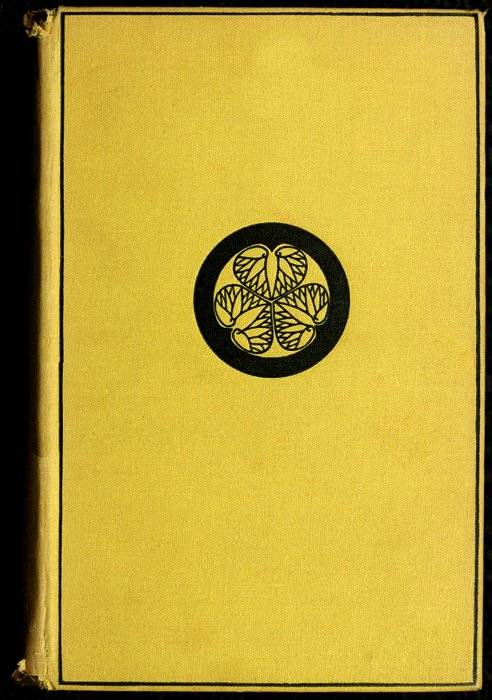
The Design on the Cover of this Book is the Family Crest of
the Tokugawa Shôguns.
A DIPLOMAT IN JAPAN
A DIPLOMAT IN JAPAN
CHAPTER I
APPOINTMENT AS STUDENT INTERPRETER AT YEDO (1861)
My thoughts were first drawn to Japan by a mere accident. In my eighteenth year an elder brother brought home from Mudie's Library the interesting account of Lord Elgin's Mission to China and Japan by Lawrence Oliphant, and the book having fallen to me in turn, inflamed my imagination with pictures verbal and coloured of a country where the sky was always blue, where the sun shone perpetually, and where the whole duty of man seemed to consist in lying on a matted floor with the windows open to the ground towards a miniature rockwork garden, in the company of rosy-lipped black-eyed and attentive damsels—in short, a realised fairyland. But that I should ever have a chance of seeing these Isles of the Blest was beyond my wildest dreams. An account of Commodore Perry's expedition, which had preceded Lord Elgin's Mission, came in my way shortly afterwards, and though much more sober in its outward appearance and literary style, only served to confirm the previous impression. I thought of nothing else from that time onwards. One day, on entering the library of University College, London, where I was then studying, I found lying on the table a notice that three nominations to student-interpreterships in China and Japan had been placed at the disposition of the Dean. Here was the chance for which I had been longing. Permission to enter myself for the competition was obtained, not without difficulty, from my parents, and having gained the first place in the public examination, I chose Japan. To China I never wished or intended to go. My age was sufficient by a few hours to enable me to compete. I was formally appointed in August 1861, and quitted England full of joyful anticipation in November of that year.
Owing to the prevalence of a belief among those who then had the direction of our affairs in Japan that a knowledge of Chinese was a necessary preliminary to the study of Japanese, my fellow-student, R. A. Jamieson, and myself were at first stationed for a few months at Peking, where we were joined early in 1862 by Russell Robertson, who also belonged to the Japan establishment. I pass over our sojourn there, which, though not without its own interest, was not long enough for me to gain any useful knowledge of China. But I learnt a few hundred Chinese characters which were of great help to me afterwards, and I even began the study of Manchu.
Our stay at the Chinese capital was suddenly cut short by the arrival of a despatch from Yedo, containing the original text of a Note from the Japanese Ministers, which it was found no Chinaman could decipher, much less understand. This was decisive of the question whether the short cut to Japanese lay through the Chinese language. I thought then, and still think, that though an acquaintance with Chinese characters may be found useful by the student of Japanese, it is no more indispensable than that of Latin is to a person who wishes to acquire Italian or Spanish. We were consequently bundled off to Japan with the least possible delay.
Of the eight students belonging to the China establishment then at Peking, three only are still (1885) in the service—H. J. Allen, C. T. Gardner, and W. G. Stronach, each of whom attained the rank of consul in 1877. They had all passed the examination at the same time as myself. The man who came out second was "allowed to resign" in 1867, three are dead, and one, the best man of the whole set, and who oddly enough was last or last but one in the examination list, passed in 1872 into the Chinese Customs Service, in which he now holds one of the highest appointments. So unequal are the results obtained by even limited competitive examination. When the competition was afterwards thrown open to the public, the results became even more uncertain, as later experience has shown, at least in Japan, and perhaps elsewhere.
The great fault of the system is that it takes no account of moral qualities. Whether a candidate has the manners or feelings of a gentleman cannot be ascertained from the way in which he will reproduce a proposition of Euclid or translate a passage from a Greek author. It does not test the intellectual powers, for a stupid young man who has been properly coached will almost always beat the real student who has not got the right "tips." Nowadays, every candidate for a public examination goes to a crammer, who trains him in a few months for the contest, and enables him to bring forth forced fruit for a moment. Show me a successful examinee, and I will show you a well-coached candidate. In the majority of cases the process disgusts the man who has undergone it, and takes away any inclination he may previously have had for study. And without serious study it is not possible to acquire such languages as Chinese, Siamese or Japanese. The scheme of examination is no test of the linguistic capabilities of the men, and sometimes sends into the service those who can no more learn to speak a foreign language than they can fly. My own success in the examination was due to my having left school more recently than any of the other competitors.
While I was at Peking the whole body of students was invited to dine one evening with the Bishop of Victoria, who was stopping at the Legation in the absence of Mr. Bruce, the Minister. The conversation fell upon the effects of Chinese studies on the intellectual powers, and the Bishop inquired of us whether we did not find that the mind was weakened by close application to such a dry, unproductive form of learning. At least, his own experience had been to that effect. This was a curious admission to make, but the matter of his conversation certainly corroborated it. I do not think any of us was candid enough to confess to a similar result in his own case.
I should like to dwell longer on our life in Peking—the rides in the early morning over the plain on the north of the city, excursions to the ruins of the Summer Palace, beautiful still in its desolation, the monasteries among the blue mountains west of the city, the magnificent temples inside and outside the walls, the dirt and dust of the streets in wet or fine weather, the pink lotus blossoms on the lake of the marble bridge, the beggars with their cry of K'olien, k'olien, shang i-ko ta, the bazaar outside the Ch'ien Men Gate, with its attractive shops, the Temple of Heaven, the view of yellow, brown and green-tiled roofs embosomed in trees as one saw them from the city wall, the carts bumping over the stone pavements worn into deep ruts, the strange Eastern life that surrounded a band of boys fresh from school or college or their mothers' apron-strings, and the splendour of the newly restored buildings of the Liang Kung Fu, occupied by the British Legation—which will never be effaced from my memory: but there is no time. Mr, afterwards Sir Frederick, Bruce was then our Minister there, a tall man of about fifty, with a noble forehead and brown eyes, grey beard, whiskers and moustache; altogether a beautiful appearance. The Chinese Secretary was Mr, afterwards Sir Thomas, Wade, a great Chinese scholar, to whom we looked up with awe, and who was said to be of an irascible temper. A story was told of his visiting the Chinese Ministers with the chief, and waxing very warm in argument. The president of the Ts'ung-li Ya-mên remarked: "But, Mr. Wade, I do not observe that Mr. Bruce is so angry." "D'ye hear that, Mr. Bruce, they say you're not angry." Whereupon Mr. Bruce, with a benevolent smile and with the most good-tempered expression in the world, replied: "Oh, tell them I'm in a deuce of a rage."
We, that is to say Jamieson, Robertson and myself, got away early on the morning of August 6, arriving that evening at Ho-si-wu, a town on the way, and reached Tientsin next day. Thence we took boat to Taku, where we passed some days under the hospitable roof of the Vice-Consul Gibson. He was later on transferred to a post in Formosa, where he got into difficulties with the Chinese officials and called on the commander of a gunboat to bombard the Custom House, for which he was smartly reprimanded by the Foreign Office. Shortly afterwards he died, it was said, of a broken heart. This happened in the days when the so-called "gun-boat" policy was no longer in favour, and poor Gibson fell a victim to his excess of zeal.
At Shanghai Jamieson left us, to start a newspaper on terms which promised him a better future than the Consular service could offer. Robertson and I embarked in the steamer Lancefield, and started for Japan on September 2. The first land we sighted after leaving the coast of China was Iwô Shima, a volcanic island to the south of Kiû-shiû, and on the 7th we found ourselves close to Cape Idzu in a fog. Luckily it lifted for a moment, and the captain, who was new to the coast, ordered the ship to be put about, and we ran down among the islands. Next morning early we were steaming over the blue waves east of Vries Island, passed the serrated wooded range of Nokogiri yama on our right and the tiny inlet of Uraga to our left, and stood across the broad bay towards Yokohama. It was one of those brilliant days that are so characteristic of Japan, and as we made our way up the bay of Yedo, I thought no scenery in the world could surpass it. Irregular-shaped hills, covered with dark-green trees, lined the whole southern coast, and above them rose into the air for 12,000 feet and more the magnificent cone of Fuji, with scarcely a patch of snow visible. The noble ranges of Oyama and others bounded the plain on its western side, while by way of contrast, a low-lying sandy coast trended rapidly away on our right, and speedily sank below the horizon in the direction of the capital.
Curious duck-shaped boats of pure unpainted wood, carrying a large four-square sail formed of narrow strips of canvas loosely tacked together, crowded the surface of the sparkling waters. Now and then we passed near enough to note the sunburnt, copper-coloured skins of the fishermen, naked, with the exception of a white cloth round the loins, and sometimes a blue rag tied across the nose, so that you could just see his eyes and chin. At last the white cliffs of Mississippi Bay became closer and more distinct: we rounded Treaty Point and dropped anchor on the outer edge of the shipping. After the lapse of more than a year I had at last attained my cherished object.
CHAPTER II
YOKOHAMA SOCIETY, OFFICIAL AND UNOFFICIAL (1862)
Three years had now elapsed since the opening of the country to foreign trade in consequence of the Treaties of 1858, and a considerable number of merchants had settled at the ports of Nagasaki and Yokohama. Hakodaté, however, offered then, as now, few attractions to mercantile enterprise, and being far removed from the political centre, shared very slightly in the uneasy feeling which prevailed elsewhere. At Nagasaki most of the territorial nobles of Western Japan had establishments whither they sent for sale the rice and other produce received in payment of tribute from the peasants, and their retainers came into frequent contact with foreigners, whose houses they visited for the purchase of arms, gunpowder and steamers. Some sort of friendly feeling thus sprang up, which was increased by the American missionaries who gave instruction in English to younger members of this class, and imparted to them liberal ideas which had no small influence on the subsequent course of events. At Yokohama, however, the foreign merchants had chiefly to do with a class of adventurers, destitute of capital and ignorant of commerce. Broken contracts and fraud were by no means uncommon. Foreigners made large advances to men of straw for the purchase of merchandise which was never delivered, or ordered manufactures from home on the account of men who, if the market fell, refused to accept the goods that would now bring them in only a loss. Raw silk was adulterated with sand or fastened with heavy paper ties, and every separate skein had to be carefully inspected before payment, while the tea could not be trusted to be as good as the sample. Now and then a Japanese dealer would get paid out in kind, but the balance of wrong-doing was greatly against the native, and the conviction that Japanese was a synonym for dishonest trader became so firmly seated in the minds of foreigners that it was impossible for any friendly feeling to exist.
The Custom House officials were in the highest degree corrupt, and demanded ever-increasing bribes from the foreigners who sought to elude the import duties. One of the worst abuses was the importation of large quantities of wines, beer, spirits and stores, for which exemption from the payment of duty was claimed as goods intended for "personal use."
The local administration was carried on by a large staff of officials established at the Custom House. There were two Bugiô, or Governors; two Kumi-gashira, or Vice-Governors; two Metsuké, whose function was that of keeping an eye on the doings of the others; a number of Shirabé-yaku, or Directors; and Jô-yaku, or chief clerks, besides a host of scribes, interpreters, tidewaiters and policemen, in black or green robes. Dutch was the common medium of communication both orally and in writing, for English was as yet scarcely studied by the natives, and the foreigners who could speak Japanese might be counted on the fingers of one hand. Yet all knew a little. A sort of bastard language had been invented for the uses of trade, in which the Malay words peggi and sarampan played a great part, and with the addition of anata and arimasu every one fancied himself competent to settle the terms of a complicated transaction. In this new tongue all the rich variety of Japanese speech, by which the relative social position of the speakers is indicated, and the intricate inflexion of the verbs, were conspicuous by their absence. Outside the settlements it was of course not understood, and its use by Europeans must have contributed not a little to the contempt for the "barbarian" which was characteristic of the native attitude towards foreigners.
By virtue of the treaties Kanagawa had been at first fixed upon for the residence of Europeans, but, lying on the Tôkaidô, or principal highway between Yedo and Kiôto, it was only too well calculated to afford occasion for collision between the armed followers of the Japanese nobles and the foreign settlers. Early in the day the Tycoon's government sought to avoid this difficulty by erecting a Custom House and rows of wooden bungalows at the fishing village of Yokohama, across the shallow bay to the south. Some of the foreign representatives, more intent upon enforcing Treaty provisions than desirous of meeting the convenience of the native officials and the European merchants, strongly opposed this arrangement, but the practical advantages of proximity to the anchorage and personal security won the favour of the merchants, and Yokohama became recognised as the port. Long after, and perhaps to this day, the foreign consuls continued to date their official reports from Kanagawa, though they were safely ensconced at the rival site, where a town of 100,000 inhabitants now exists, and curious stories are told of the difference in freight that used to be earned on goods shipped from Europe to Yokohama or Kanagawa as the case might be.
The foreign settlement, for greater security, was surrounded on the land side by wide canals, across which bridges were thrown, while ingress and egress were controlled by strong guards of soldiers placed there with the double object of excluding dangerous characters and levying a tax on the supplies introduced from the surrounding country. At first land was given away freely to all applicants, some of whom were employés of the different consulates. These latter afterwards sold their lots to new arrivals bent upon commercial pursuits, and thus pocketed gains to which they had no shadow of a right. When further additions were afterwards made to the "settlement," precautions were taken which effectually prevented any one, whether merchant or official, from obtaining land without paying an adequate price. Later on, title-deeds were made out, by which the ground was conveyed to the holders, their heirs, administrators, executors and assigns, thus creating a form of property new to English experience, which purported to be at once real and personal. Streets were laid out with but little thought of the general convenience, and slight provision for the future. The day of wheeled carriages had not dawned upon Japan. It was sufficient if space were left for handcarts, and the most important Japanese commercial town of the future was thus condemned in perpetuity to inconveniences of traffic, the like of which can be best appreciated by those who knew the central parts of business London fifty years ago, or the successive capitals of the Italian kingdom when they were raised to that rank. Architectural ambition at first was contented with simple wooden bungalows, and in the latter part of 1862 there were not more than half a dozen two-storied buildings in the foreign portion of the town.
Behind the settlement lay a newly filled-in tract of ground known as the "swamp," still unoccupied except by a racecourse track, and in the rear of this again, across a foul marsh, were conspicuous the flimsy buildings of the Yoshiwara, euphemistically described by a noble Duke from his place in Parliament as an "establishment for the education of young ladies," and where a colonial bishop, to the intense amusement of the younger and more irreverent of the foreign community, had innocently left his visiting-card upon the elderly female who presided over the pleasures of the place. But in those days all the residents were young.
Two churches, however, had already been erected, by Catholics and Protestants respectively, and a foreign cemetery had been set apart on the outside of the settlement. The health enjoyed by the European and American inhabitants was such that the only occupants of the burial-ground were some Russian officers and two Dutch merchant captains, who had fallen victims to the deadly and mistaken patriotism of Japanese samurai (two-sworded men). No one had yet succumbed to disease in that beautiful sunny climate.
The foreign community of Yokohama of that day was somewhat extravagantly described by an English diplomat as "the scum of Europe." No doubt there was a fair sprinkling of men who, suddenly relieved from the restraints which social opinion places upon their class at home, and exposed to the temptations of Eastern life, did not conduct themselves with the strict propriety of students at a theological college. That they were really worse than their co-equals elsewhere is unlikely. But in a small community, where the actions of everyone are semi-public and concealment is not regarded as an object of first-rate importance, the vices that elsewhere pass unnoticed become prominent to the eyes of those who are not exposed to the same temptations. There were also not a few who came there without much capital to make a livelihood, or, if possible, something more, and hastened to the attainment of their object without being troubled with much scruple. And the difficulty which soon presented itself of obtaining a sufficiency of native coin in exchange for the silver dollar of Eastern commerce was the cause of extravagant demands being presented to the Japanese Treasury. But the compromise eventually arrived at, by which the merchant had to buy his ichibus in the open market, while the official obtained the equivalent of his salary, and often much more, in native coin nearly weight for weight of his "Mexicans," was to the minds of all unprejudiced persons a far greater scandal. Detractors said that the advantages thus given to Ministers, Consuls, sailors and soldiers was a bribe to induce their compliance with violation of treaty stipulations to the prejudice of their non-official countrymen; but this is unfair. It was the result of false theories as to the nature and function of money, and personal interest worked against a conversion to views more in accordance with the principles of political economy.
The fact, however, remains, that in September 1862 the current rate of exchange was 214 ichibus for 100 dollars, though the latter were really exchangeable for 311 ichibus according to the Treaty. Each diplomatic or consular establishment was allowed to exchange monthly a certain number of dollars, supposed to represent the total salaries of the staff, and other government charges, thirteen ichibus per $100 being deducted for coinage. An official whose salary was $100 received 298 ichibus, the surplus of which over his bazaar expenses he proceeded to change back into dollars; but practically he received $139.25, or a profit of nearly 40 per cent. The gains of a Minister whose salary was £3000 a year it may easily be seen were very large. This was not all. The balance of the monthly quota of ichibus was then reconverted into dollars, the amount due to the official chest was deducted, and the profit then divided among the staff in proportion to their salaries. On a nominally small income it was consequently possible to live well, keep a pony and drink champagne. As time went on, the number of ichibus thus put into circulation increased, and the rate of exchange eventually declined to par. Then and only then the system was abandoned. Where the money came from that was thus transferred to the pockets of officials can be best explained by those who are versed in economical questions. For my own part, I cannot look back on that period without shame, and my only excuse, which is perhaps of little worth in the court of history, is that I was at the bottom of the ladder, and received the proportion paid to me by those who were in charge of the business.
A few words may be devoted to describing the Yokohama society of those days. There were few ladies in the settlement. Japan was a long way from Europe, with no regular steam communication, and the lives of foreigners were supposed to be not very safe at the hands of the arm-bearing classes. The two great China firms of Jardine, Matheson & Co. and Dent & Co. were of course represented. The latter came down with a crash a year or two after my arrival. Fletcher & Co., another important Shanghai firm, had a branch, and so had Barnet & Co., both now long forgotten. Most of the remainder were Japan firms, amongst whom Aspinall, Cornes & Co., Macpherson, Marshall & Co., were the foremost English, and Walsh, Hall & Co., the leading American firms. Germans, French and Dutch were considered of "no account." Money was abundant, or seemed to be, every one kept a pony or two, and champagne flowed freely at frequent convivial entertainments. Races were held in the spring and autumn, and "real" horses competed in some of the events. A favourite Sunday's excursion was the ride along the Tôkaidô to Kawasaki for tiffin, and back again toward evening. Longer outings were to Kanazawa, Kamakura and Enoshima; but anyone who had ventured as far as Hachiôji or Hakoné, which were beyond the Treaty limits, was regarded as a bold, adventurous spirit. The privilege of travelling beyond a distance of 25 miles from Yokohama was reserved to the diplomatic representatives of foreign powers, and Yedo could be visited only in the disguise of a member of one of the legations, with the permission of its head. Such favours were regarded with extreme jealousy by those who were debarred by circumstances from obtaining them, and loud murmurs were heard that it was the Minister's duty to invite his countrymen to the capital, and give them board and lodging, irrespective of the shape which their private relations with him might have assumed. Then, and perhaps even yet, there existed a theory that public servants were practically the servants of the extremely small section of the public that inhabited Yokohama, and when the servants failed to comply with the wishes of their employers they were naturally and rightly abused—behind their backs.
So strong was the hostility excited in the breasts of the English-Scotch-Irish portion of the community by the unlucky phrase, "scum of Europe," that no member of either legation or consulate of their country was allowed admittance into the Yokohama Club, composed chiefly of British merchants; and this feeling lasted until the year 1865 brought about a permanent change in the representation of Great Britain. The excuse for such relations between the British residents and one who ought to have been the leader of the small society, is to be found in the comparative youthfulness and ignorance of the world which characterised the former. The experience of men and manners which saves the dwellers in Little Peddlington from believing that others are deliberately plotting to inflict insults on them is seldom attained before middle life, especially when Little Peddlington happens to be located in an Eastern land where the mind's growth comes to a standstill, and a man's age is virtually to be reckoned by the years actually spent in the mother country. For all purposes of mental and moral development the time passed on the opposite side of the world must be left out of the calculation.
It was agreed in the Treaties that Yedo should be the residence of the foreign diplomatic representatives, and four Buddhist monasteries had, in accordance with Japanese custom, been assigned to the representatives of the four chief powers—Great Britain, France, Holland and the United States. Sir R. Alcock [1] occupied Tô-zen-ji, in the suburb of Takanawa; M. de Graef van Polsbrock lived in Chô-ô-ji, a little nearer the city; then came Sai-kai-ji, the residence of M. Duchesne de Bellecourt; and Mr. Harris had settled down at Zem-puku-ji in Azabu. But a series of alarming occurrences had caused the European portion of the diplomatic body to transfer their quarters to Yokohama, and the American Minister alone held out, declaring his confidence in the good faith of the Japanese Government and their ability to protect him. In September of 1862 he had already been replaced by General Pruyn, who followed the example of his predecessor, until eventually driven out of the capital by a fire which destroyed his house, whether purely accidental or maliciously contrived. The English legation in 1861 had been the object of a murderous attack in which the Secretary, Mr. Laurence Oliphant, and Mr. G. C. Morrison were wounded. The assailants were principally retainers of the Daimiô of Mito, but others belonging to various clans were concerned in the affair, and some of these are still living. Sir R. Alcock had consequently removed to Yokohama, where the strong guard placed by the Japanese government at the entrances to the town and the foreign men-of-war in the harbour offered sufficient guarantees for safety. On his quitting Japan for a term of leave early in 1862, his locum-tenens, Colonel Neale, not believing in a danger of which he had no experience, brought the legation back to Tô-zen-ji. But he had no sooner installed himself there than an event occurred which led him to change his opinion. This was nothing less than the murder of the sentry who stood at his bedroom door and of a corporal on his rounds, at the hands of one of the Japanese guard, in revenge for an insult offered to him, it is said, by the youngest member of the staff, a heedless boy of fifteen or sixteen. So the British Legation packed up their archives and hastened back to Yokohama, where they installed themselves in a house that stood on the site of the present Grand Hotel. This building belonged to an Englishman named Hoey, who was murdered in his bed in 1870, apparently from motives of private revenge. The foreign consuls were all stationed at Yokohama with the exception of the American consul, Colonel Fisher, who remained at Kanagawa. Mr. Harris, it is said, would never admit that Yokohama could be rightfully substituted for Kanagawa, the town mentioned in the Treaty, and would not permit his consul to reside there. He even carried his opposition so far as to declare that he never would countenance the change of settlement, and carried out his vow by leaving Japan without having set foot in Yokohama.