
WeRead Powered by ReaderPub
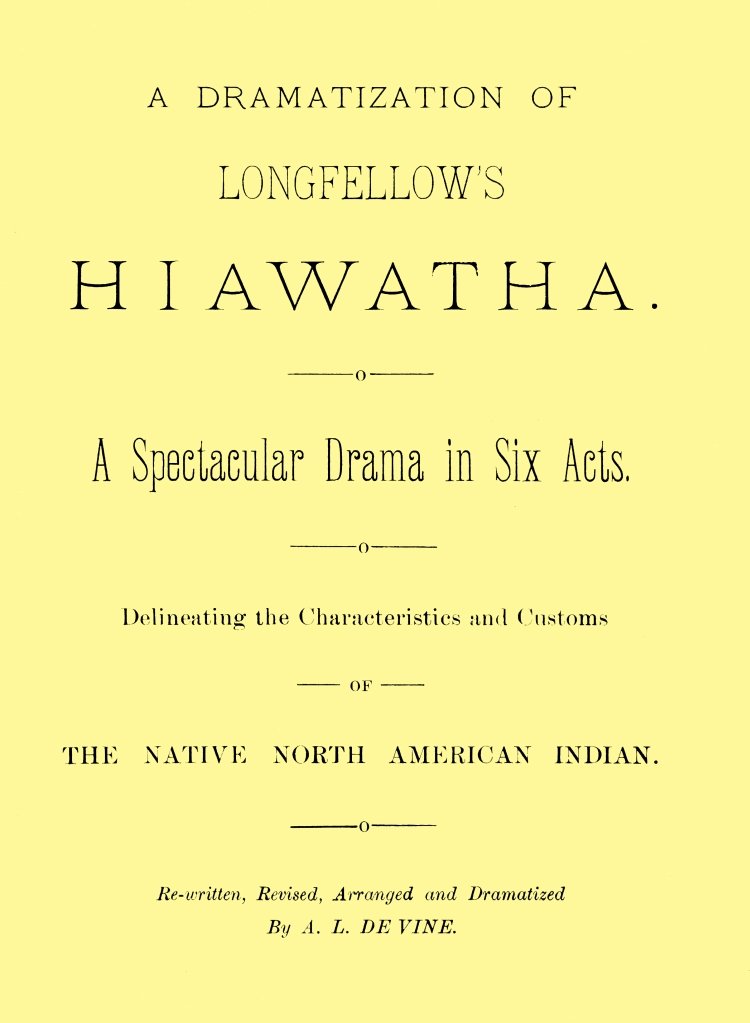
A dramatization of Longfellow's Hiawatha: A spectacular drama in six acts cover

A dramatization of Longfellow's Hiawatha: A spectacular drama in six acts

Chapter 10: ACT IV. HIAWATHA’S WEDDING FEAST.
Open in WeRead

About This Book

The dramatization stages a six-act adaptation of an Indigenous epic, opening with the Great Spirit calling for peace and creating a ceremonial peace pipe. It traces the protagonist from cradle to manhood, including courtship, a wedding feast, and communal celebrations, then depicts winter famine and disease leading to the bride's death and elaborate mourning rites. Scenes showcase dances, games, hunting, and rites of passage, concluding with a transcendent reunion and the hero's departure. The play foregrounds ritual life, relationships with nature, and the aspiration for harmony among neighboring peoples.

ACT IV.
HIAWATHA’S WEDDING FEAST.

Scenery:

Scene first; same as Act III. Lake shore with forest, with the Tepee of Old Nokomis on the shore of the lake. Many Indians grouped here and there with NOKOMIS waiting and watching for the arrival of HIAWATHA and MINNEHAHA who are seen approaching from a distance, NOKOMIS and the Indians coming joyously forward to welcome them. In this scene are introduced an imitation of, or, better still, a Genuine Indian Feast; Indian Music; Indian Songs; Sports and Pastimes, and Indian Dances in Native Costumes by Native Indians—if possible.

Description:

Sumptuous was the feast Nokomis
Made at Hiawatha’s wedding;
All the bowls were made of bass-wood,
White and polished very smoothly.
All the spoons of horn of bison,
Black and polished very smoothly.
She had sent through all the village
And the wedding guests assembled,
Clad in all their richest raiment,
Robes of fur and belts of wampum,
Splendid with their paint and plumage,
Beautiful with beads and tassels.

Act, Nokomis, (seeing Hiawatha and Bride approaching):

With a shout and song of triumph,
On the shore stood old Nokomis,

Nokomis:

We bid you welcome Hiawatha,
We have waited long your coming,
Welcome to your home and people.

Hiawatha, (leading forward Minnehaha):

Dear Old Nokomis,
A daughter have I brought to you
From the land of the Dacotahs,
Minnehaha, Laughing Water,
Who shall run upon your errands,
Be the sunlight of my people.

Nokomis, to Minnehaha:

The Objibways welcome the Dacotah maiden,
You shall be my starlight, moonlight, firelight;
You shall be the sunlight of our people.

Indians:

Honor be to Hiawatha.

Act, Indians:

And the people of the village
Welcomed them with songs and dances,
Made a joyous feast, and shouted:

Description of Feast:

First they ate the sturgeon, Nahma,
And the pike, the Maskenoza,
Caught and cooked by old Nokomis;
Then on pemmican they feasted,
Pemmican and buffalo marrow,
Haunch of deer and hump of bison,
Yellow cakes of the Mondamin,
And the wild rice of the river.

Act, Hiawatha, Minnehaha and Nokomis:

But the gracious Hiawatha,
And the lovely Laughing Water,
And the careful old Nokomis,
Tasted not the food before them,
Only waited on the others,
Only served their guests in silence.

Act, Nokomis:

And when all the guests had finished,
Old Nokomis, brisk and busy,
From an ample pouch of otter,
Filled the red stone pipes for smoking
With tobacco from the South-land,
Then she said to Chibiabos,
To the friend of Hiawatha,
To the sweetest of all singers,
To the best of all musicians.

Nokomis:

Sing to us, O Chibiabos!
Songs of love and songs of longing,
That the feast may be more joyous,
That the time may pass more gayly,
And our guests be more contented!

Act, Chibiabos:

And the gentle Chibiabos
Sang in accents sweet and tender,
Sang in tones of deep emotion,
Songs of love and songs of longing;
Looking still at Hiawatha,
Looking at fair Laughing Water,
Sang he softly, sang in this wise:

Chibiabos Song:

Onaway! Awake, beloved!
Thou the wild-flower of the forest!
Thou the wild-bird of the prairie!
Thou with eyes so soft and fawn-like!
If thou only lookest at me,
I am happy, I am happy,
As the lilies of the prairie,
When they feel the dew upon them!
Sweet thy breath is as the fragrance
Of the wild-flowers in the morning,
As their fragrance is at evening,
In the Moon when leaves are falling.
Does not all the blood within me
Leap to meet thee, leap to meet thee,
As the springs to meet the sunshine,
In the Moon when nights are brightest?
Onaway! my heart sings to thee,
Sings with joy when thou art near me,
As the sighing, singing branches
In the pleasant Moon of Strawberries.
When thou art not pleased, beloved,
Then my heart is sad and darkened,
As the shining river darkens,
When the clouds drop shadows on it!
When thou smilest, my beloved,
Then my troubled heart is brightened,
As in sunshine gleam the ripples
That the cold wind makes in rivers.
Smiles the earth, and smiles the waters,
Smile the cloudless skies above us,
But I lose the way of smiling
When thou art no longer near me!
I myself, myself, behold me!
Blood of my beating heart, behold me!
O awake, awake, beloved!
Onaway! awake, beloved!

Nokomis, to Pau-Puk-Keewis:

O Pau-Puk-Keewis,
Dance for us your merry dances,
Dance the Beggar’s Dance to please us,
That the feast may be more joyous,
That the time may pass more gayly,
And our guests be more contented!

Act, Pau-Puk-Keewis:

Then the handsome Pau-Puk-Keewis,
He the Idle Yenadizze,
He the merry mischief-maker,
Whom the people called the Storm-Fool,
Rose among the guests assembled.
Skilled was he in sports and pastimes,
In the game of quoits and ball play,
In all games of skill and hazard.
He was dressed in shirt of doe-skin,
White and soft, and fringed with ermine,
All inwrought with beads of wampum;
He was dressed in deer-skin leggings,
Fringed with hedgehog quills and ermine,
And in moccasins of buckskin,
Thick with quills and beads embroidered.
On his head were plumes of swan’s down,
On his heels were tails of foxes,
In one hand a fan of feathers,
And a pipe was in the other.
Barred with streaks of red and yellow,
Streaks of blue and bright vermilion,
Shone the face of Pau-Puk-Keewis.
From his forehead fell his tresses,
Smooth, and parted like a woman’s.
Shining bright with oil, and plaited,
Hung with braids of scented grasses,
As among the guests assembled,
To the sound of flutes and singing,
To the sound of drums and voices,
Rose the handsome Pau-Puk-Keewis,
And began his mystic dances

Dance, Pau-Puk-Keewis:

First he danced a solemn measure,
Very slow in step and gesture,
In and out among the pine-trees,
Through the shadows and the sunshine,
Treading softly like a panther.
Then more swiftly and still swifter,
Whirling, spinning round in circles,
Leaping o’er the guests assembled,
Eddying round and round the wigwam,
Till the leaves went whirling with him,
Till the dust and wind together
Swept in eddies round about him.
Then along the sandy margin
Of the lake, the Big-Sea-Water,
On he sped with frenzied gestures.
Stamped upon the sand, and tossed it
Wildly in the air around him;
Till the wind became a whirlwind,
Till the sand was blown and sifted
Like great snowdrifts o’er the landscape,
Sand Hills of the Nagow Wudjoo!
Thus the merry Pau-Puk-Keewis
Danced his Beggar’s Dance to please them,
And, returning, sat down laughing
There among the guests assembled,
Sat and fanned himself serenely
With his fan of turkey-feathers.

Act, Chibiabos:

Then again sang Chibiabos,
Sang a song of love and longing,
In those accents sweet and tender,
In those tones of pensive sadness,
Sang a maiden’s lamentation
For her lover, her Algonquin.

Song:

The original of this song may be found in Oneata, p. 15.

When I think of my beloved,
Ah me! think of my beloved,
When my heart is thinking of him,
O my sweetheart, my Algonquin!
“Ah me! when I parted from him,
Round my neck he hung the wampum,
As a pledge, the snow-white wampum,
O my sweetheart, my Algonquin!
“I will go with you he whispered,
Ah me! to your native country;
Let me go with you, he whispered,
O my sweetheart, my Algonquin!
“Far away, away, I answered,
Very far away, I answered,
Ah me! is my native country,
O my sweetheart, my Algonquin!
“When I looked back to behold him,
Where we parted, to behold him,
After me he still was gazing,
O my sweetheart, my Algonquin!
“By the tree he still was standing,
By the fallen tree was standing,
That had dropped into the water,
O my sweetheart, my Algonquin!
“When I think of my beloved,
Ah me! think of my beloved,
When my heart is thinking of him,
O my sweetheart, my Algonquin!”

Indian pastimes, games, dances and specialties should be here introduced. If possible a national Indian dance by a number of Indians. The Harvest Dance, Ghost Dance or a War Dance, with colored lights thrown upon the scene and soft music behind scenes, forming tableaux during dances and before the curtain falls.

CURTAIN.