
WeRead Powered by ReaderPub
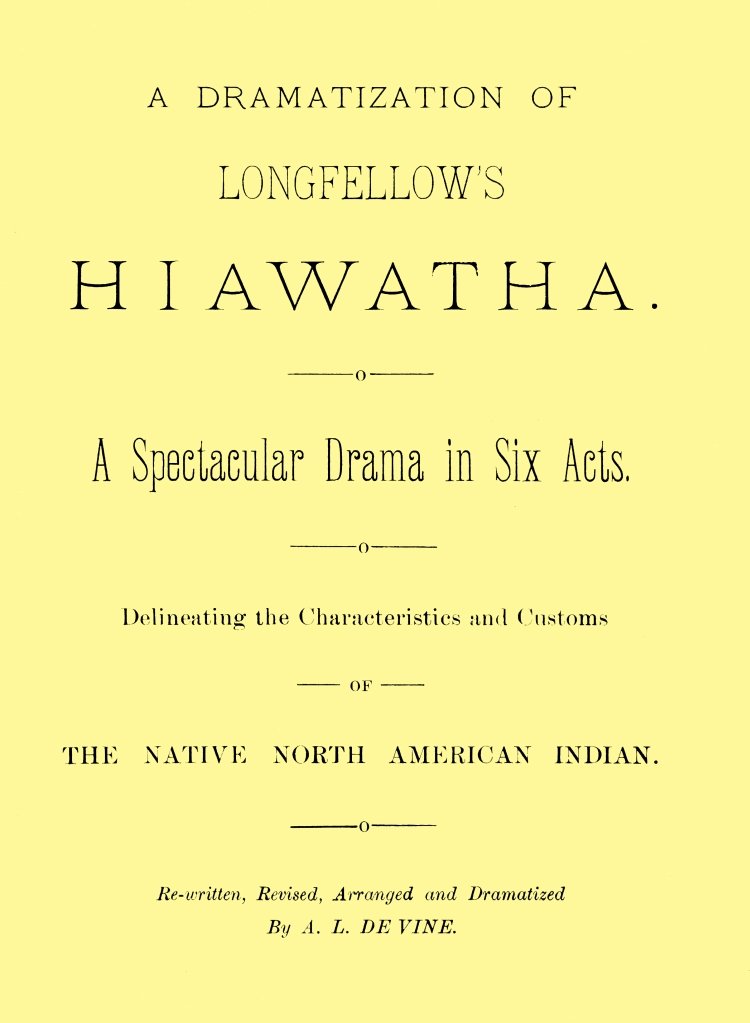
A dramatization of Longfellow's Hiawatha: A spectacular drama in six acts cover

A dramatization of Longfellow's Hiawatha: A spectacular drama in six acts

Chapter 12: ACT VI. HIAWATHA’S DEPARTURE.
Open in WeRead

About This Book

The dramatization stages a six-act adaptation of an Indigenous epic, opening with the Great Spirit calling for peace and creating a ceremonial peace pipe. It traces the protagonist from cradle to manhood, including courtship, a wedding feast, and communal celebrations, then depicts winter famine and disease leading to the bride's death and elaborate mourning rites. Scenes showcase dances, games, hunting, and rites of passage, concluding with a transcendent reunion and the hero's departure. The play foregrounds ritual life, relationships with nature, and the aspiration for harmony among neighboring peoples.

ACT VI.
HIAWATHA’S DEPARTURE.

Scenery:

Shore of the lake with a forest on its margin. A peaceful quiet summer scene. In the distance Indian tents, and nearer the tepee of Nokomis. Indians scattered here and there, some making a birch bark canoe in true Ojibway fashion, others shooting at target and indulging in Indian pastimes. Hiawatha standing on the lake shore. Here can be given a transformation and spectacular scene and tableaux, showing Minnehaha in the distance as an angel and hovering o’er them. Or, the following spectacular—Suddenly in the distance soft low sweet music is heard (by stringed instruments behind the scenes), and across the lake through a rift in the sky is seen a bright heavenly light, growing brighter and brighter, then an object is seen growing more and more distinct as the music grows louder, the object draws nearer and the light brighter, and as the object comes into view it is discovered to be a birch bark canoe gliding toward them. In the canoe is Minnehaha dressed as an angel and using paddle. The soft sweet music grows nearer and louder, and the halo of light surrounding her brighter as the canoe approaches. The Indians stop their various pursuits and stand in attitudes of astonishment watching the canoe approach. Hiawatha, stepping forward to the margin of the lake when Minnehaha is first seen, stands shading his eyes, expectantly watching and waiting. Nokomis also comes forth from her tepee. Minnehaha beckons to Hiawatha. As she approaches them Hiawatha recognizing her, steps forward, close to the waters edge, and with hands extended and a smile of joy and triumph, and a look of exultation waits. As the boat stops close to shore and Minnehaha again beckons to him, he apparently hesitates between her and leaving his people, then again turns to her, with exultation, hope, joy and deep feeling.

Hiawatha:

Oh, my angel, Minnehaha,
Long have I been waiting for you!
Youth is lovely, age is lonely,
Youth is fiery, age is frosty;
You bring back the days departed,
You bring back my youth of passion,
O my beautiful Laughing Water
My lovely wife, my Minnehaha.

Hiawatha turns first to Nokomis and then to his people, as though loth to leave them. Then, again looking at Minnehaha, who motions to him smilingly:

Act, Minnehaha:

O’er the water, flying,
Through the shining mist of morning,
Comes a birch canoe with paddles,
Rising, sinking on the water,
Dripping, flashing in the sunshine;
O’er the water floating, flying,
Something in the hazy distance,
Something in the mists of morning,
Loomed and lifted from the water,
Now seemed floating, now seemed flying,
Coming nearer, nearer, nearer.

Act, Hiawatha:

From the brow of Hiawatha
Gone was every trace of sorrow.
As the fog from off the water,
As the mist from off the meadow.
With a smile of joy and triumph,
With a look of exultation,
As of one who in a vision
Sees what is to be, but is not,
Stood and waited Hiawatha.
And the noble Hiawatha,
With his hands aloft extended,
Held aloft in sign of welcome,
Waited, full of exultation.

Hiawatha, to Nokomis, tenderly:

I am going, O Nokomis,
On a long and distant journey,
To the portals of the Sunset,
To the regions of the home-wind,
Of the Northwest wind, Keewaydin.

Motioning to his people.

In your watch and ward I leave them,
See that never harm comes near them,
See that never fear molests them,
Never danger nor suspicion,
Never want of food nor shelter,
In the lodge of Hiawatha.

Nokomis, sobbing.

Farewell, O Hiawatha!
Farewell, my child, my noble Hiawatha.

Hiawatha, turning to Indians:

Gitche Manitou, the Mighty,
Showed me in my vision,
All the secrets of the future,
Of the distant days that shall be.
I beheld the westward marches
Of the unknown crowded nations.
All the land was full of people,
Restless, struggling, toiling, striving,
Speaking many tongues, yet feeling
But one heart-beat in their bosoms.
In our woodlands rang their axes,
Smoked their towns in all our valleys,
Over all the lakes and rivers
Rushed their great canoes of thunder.
Then a darker, drearier vision
Passed before me, vague and cloud-like:
I beheld our nation scattered,
All forgetful of my counsels.
There are great men, I have known such,
Whom their own people understand not,
Whom they even make a jest of.

Stepping into canoe and drifting away.

I am going, O my people,
On a long and distant journey;
Many moons and many winters
Will have come and will have vanished,
Ere again I meet you.

Indian Chiefs:

We have listened to your message,
We have heard your words of wisdom,
We will think on what you tell us.
Farewell, O Hiawatha!

All Indians, sorrowfully, watching and waving adieu.

Farewell, Hiawatha, the beloved!
Farewell, forever! Farewell, O Hiawatha.

Canoe is seen disappearing in the distance.

CURTAIN.

Transcriber’s Notes:


Typographical and punctuation errors have been silently corrected.