
WeRead Powered by ReaderPub
A drunk man looks at the thistle cover

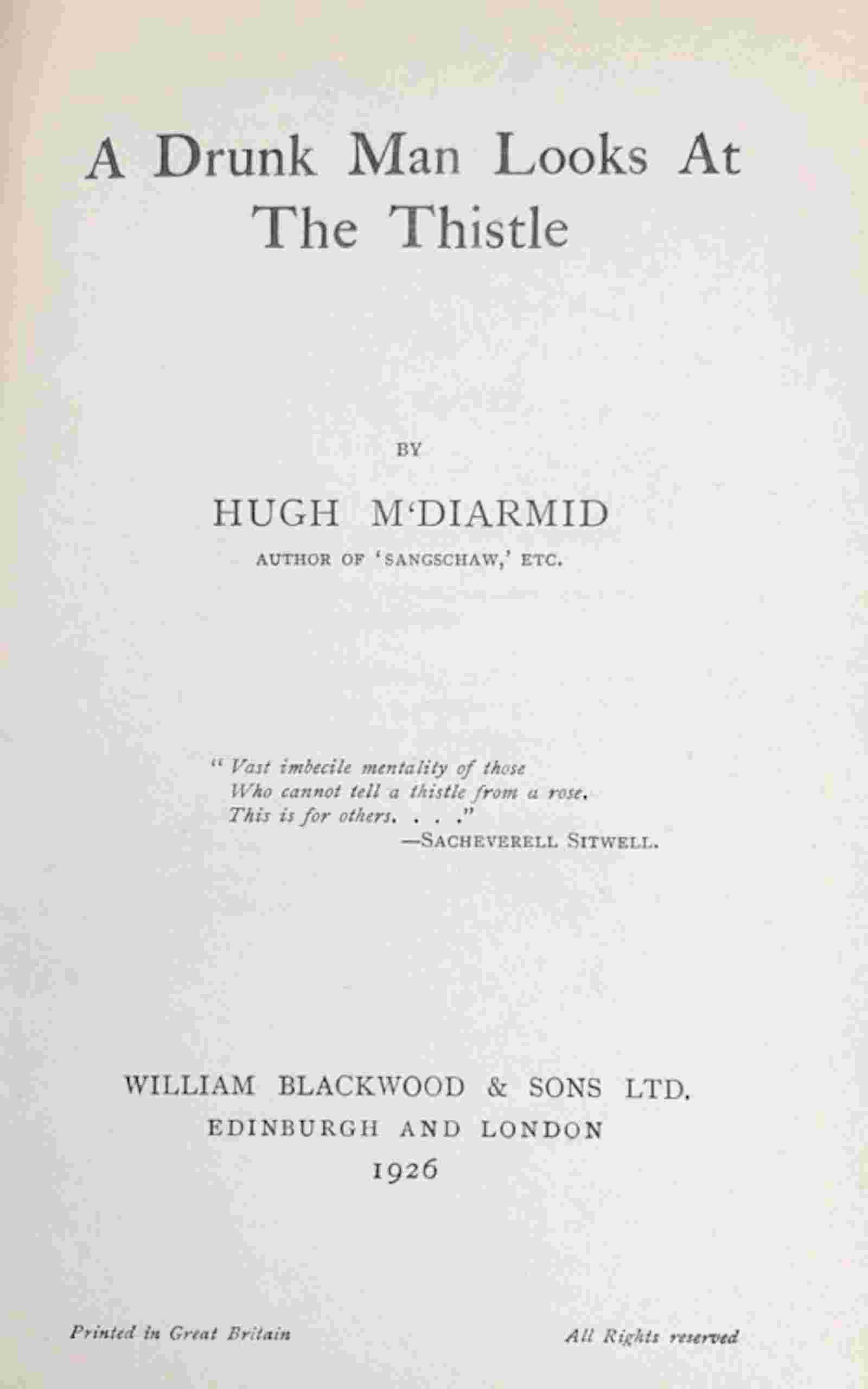
A drunk man looks at the thistle

Chapter 5: FOOTNOTES
Open in WeRead

Explore more books like this:

About This Book

A long, free-ranging dramatic monologue in a Scots-inflected voice in which an inebriated speaker alternates between self-reflection and sharp cultural critique. Through digressions on language, song, literary icons, public ritual, and personal memory the speaker interrogates commercialization of tradition, the limits of rationality, artistic sincerity, and the tension between private feeling and public spectacle. The poem mixes colloquial register, ironic satire, lyric meditation, and philosophical speculation, shifting between comic invective and serious moral questioning while experimenting with form and voice to explore how history, identity, and art are remembered, commodified, and transformed.

THE END.

FOOTNOTES

[1] From the Russian of Alexander Blok.

[2] Freely adapted from the Russian of Alexander Blok.

[3] From the Belgian poet, George Ramaekers.

[4] Adapted from the Russian of Zinaida Hippius.

[5] Suggested by the German of Else Lasker-Schüler.

[6] Suggested by the French of Edmond Rocher.

[7] Tragical crack (Dostoevski’s term).

[8] The line which precedes these in Mallarmé’s poem is “Aimai-je un rêve?” and Wilfrid Thorley translates the passage thus:—

“Loved I Love’s counterfeit?
My doubts, begotten of the long night’s heat,
Dislimn the woodland till my triumph shows
As the flawed shadow of a frustrate rose.”

[9] The General Strike (May 1926).

[10] God-bearers.

[11] The All-Man or Pan-Human.

[12] Hermann Melville.

[13] Dostoevski.

[14] Quoted from Robert Buchanan.

[15] Dostoevski.

[16] Wicksteed’s translation of Dante’s Italian (Paradiso, canto xxxiii. 85-90) is as follows: “Within its depths I saw ingathered, bound by love in one volume, the scattered leaves of all the universe; substance and accidents and their relations, as though together fused, after such fashion that what I tell of is one simple flame.”