
The Project Gutenberg eBook of A General History of the Sabbatarian Churches
Title: A General History of the Sabbatarian Churches
Author: Tamar Davis
Release date: September 11, 2021 [eBook #66265]
Most recently updated: October 18, 2024
Language: English
Original publication: United States: Lindsay and Blakiston, 1851
Credits: Brian Wilson, Chris Pinfield, and the Online Distributed Proofreading Team at https://www.pgdp.net (This file was produced from images generously made available by The Internet Archive/American Libraries.)
Transcriber's Note:
Obvious printer errors have been corrected. Hyphenation has been rationalised.
In Chapter I, Section III (A Sketch Of The History Of The Abyssinian Church) "Hinglar" and "Kinglar" may refer to the same individual.
A HISTORY
OF THE
SABBATARIAN CHURCHES.
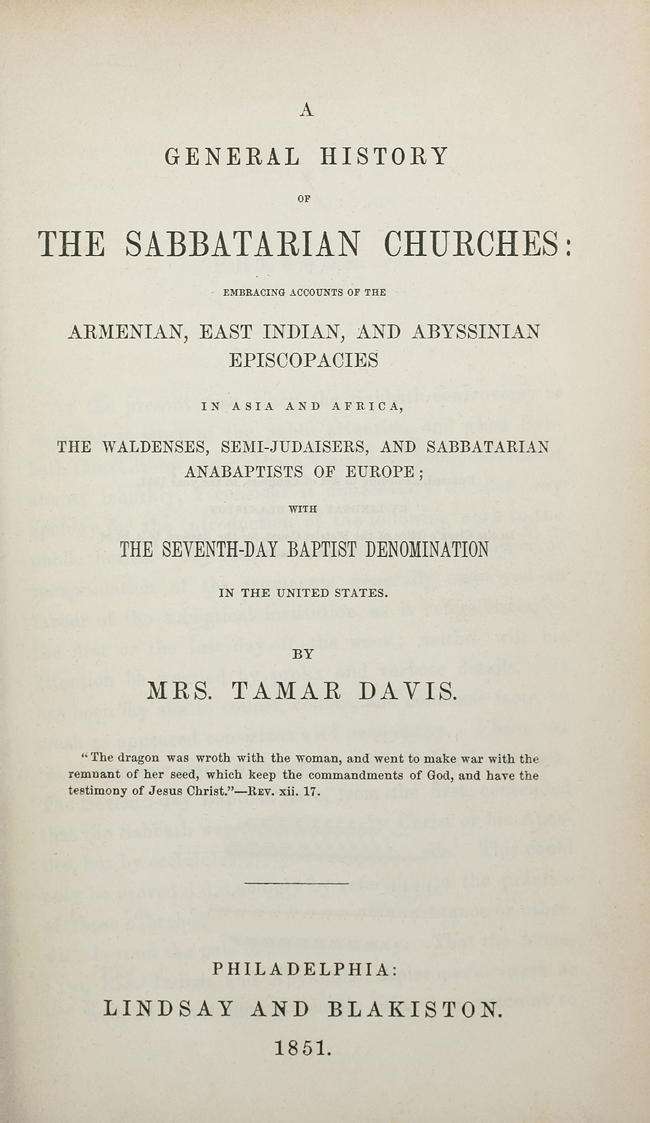
A GENERAL HISTORY OF
THE SABBATARIAN CHURCHES:
EMBRACING ACCOUNTS OF THE
ARMENIAN, EAST INDIAN, AND ABYSSINIAN EPISCOPACIES
IN ASIA AND AFRICA,
THE WALDENSES, SEMI-JUDAISERS, AND SABBATARIAN ANABAPTISTS
OF EUROPE;
WITH THE
SEVENTH-DAY BAPTIST DENOMINATION
IN THE UNITED STATES.
BY
MRS. TAMAR DAVIS.
"The dragon was wroth with the woman, and went to make war with the remnant of her seed, which keep the commandments of God, and have the testimony of Jesus Christ."—Rev. xii. 17.
PHILADELPHIA:
LINDSAY AND BLAKISTON.
1851.
Entered, according to Act of Congress, in the year 1851,
BY LINDSAY AND BLAKISTON,
In the Clerk's Office of the District Court, for the Eastern District of Pennsylvania.
C. SHERMAN, PRINTER.
PREFACE.
At the present time, when the Sabbath controversy is engaging so much of the public attention, and when Sabbath Conventions and Sabbath Unions are being chronicled almost monthly, I consider it unnecessary to offer any apology for the introduction of the following work to the public notice. My reader need not fear a repetition or recapitulation of the arguments generally employed in favour of the sabbatical institution, as it refers either to the first or the last day of the week; neither will his attention be wearied by prolix and verbose details. It has been my aim to collect, collate, and condense facts, as much as appeared consistent with perspicuity. I have not taken any new stand with regard to the Sabbath question. The Seventh-day Baptists have, from the first, contended that the Sabbath was changed, not by Christ or his Apostles, but by ecclesiastical synods and councils. This could only be proved convincingly by reference to the practice of those churches who were removed by distance or otherwise beyond the pale of such authority. That the Armenian, East Indian, and Abyssinian Episcopacies were so removed, and that they absolutely refused to succumb to the authority of the Latin or Greek prelates, sustaining in consequence the most cruel and desolating wars, is an undeniable historical fact; no less so the truth that during all this time they have been living witnesses against Anti-Christ, as the observers of the ancient Sabbath, which practice they learned from the Apostles, or their immediate successors.
With respect to the History of the Seventh-day Baptist denomination, I am not unaware of the imperfections that may be detected in it. But I must excuse my own defects by a just complaint of the blindness and insufficiency of my guides; and may also observe that, with reference to nearly every portion of the work, I have been the pioneer in the field of research.
TABLE OF CONTENTS.
| PAGE | |
| Preliminary Observations, | 13 |
| CHAPTER I. | |
| SABBATARIAN CHURCHES IN ASIA AND AFRICA. | |
| The Armenian Church, | 18 |
| Sabbatarianism of this Church, | 30 |
| Ancient Christians of India, | 33 |
| Their Sabbatarian Character, | 39 |
| The Ethiopic Church, | 40 |
| Its Sabbatarian Character, | 54 |
| CHAPTER II. | |
| SEVENTH-DAY BAPTISTS IN EUROPE. | |
| Waldenses, Albigenses, etc., | 62 |
| Their Doctrinal Sentiments, | 69 |
| Testimonies to their Sabbatarian Character, | 70 |
| Their Persecutions, | 84 |
| Further Accounts of their Sabbatarianism, | 88 |
| Semi-Judaisers—their Origin, | 95 |
| Their Sabbatarianism, | 97 |
| Their Churches in Russia, Poland, | 99 |
| Sabbatarians of Holland, | 103 |
| Sabbatarians of England, | 107 |
| The Natton Church, | 114 |
| The Cripplegate Church, | 118 |
| The Mill-Yard Church, | 122 |
| CHAPTER III. | |
| SEVENTH-DAY BAPTISTS IN THE UNITED STATES. | |
| General History, | 130 |
| Churches in Rhode Island, | 145 |
| Churches in Connecticut, | 162 |
| Churches in New Jersey, | 166 |
| Central Association, | 174 |
| Western Association, | 190 |
| Southwestern Association, | 198 |
| Northwestern Association, | 202 |
| CHAPTER IV. | |
| SEVENTH-DAY BAPTISTS IN THE UNITED STATES, CONTINUED. | |
| Keithian Seventh-day Baptists, | 211 |
| German Seventh-day Baptists,—General History, | 215 |
| German Seventh-day Baptists,—Particular History, | 233 |