
The Project Gutenberg eBook of A Gray Eye or So. In Three Volumes—Volume I
Title: A Gray Eye or So. In Three Volumes—Volume I
Author: Frank Frankfort Moore
Release date: May 2, 2016 [eBook #51944]
Most recently updated: October 23, 2024
Language: English
Credits: Produced by David Widger from page images generously
provided by the Internet Archive
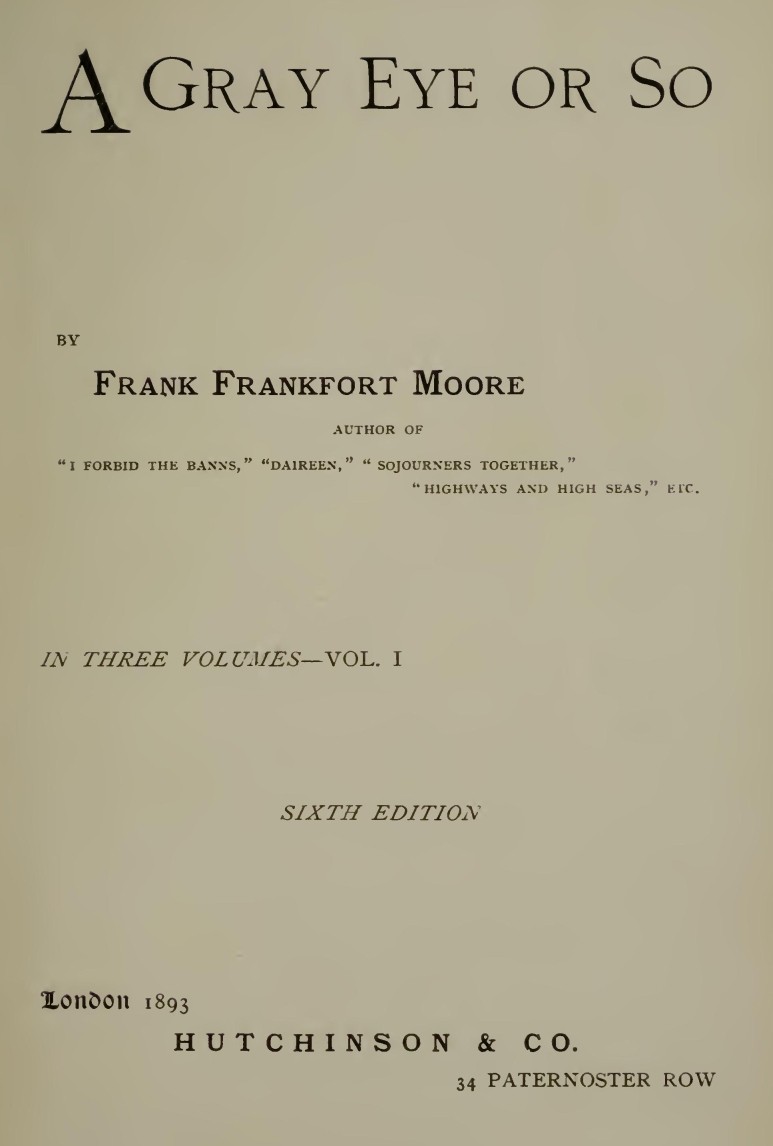
A GRAY EYE OR SO
By Frank Frankfort Moore
Author of “I Forbid The Banns,” “Dalreen,” “Sojourners Together,” “Highways And High Seas,” Etc.
In Three Volumes—Volume I
Sixth Edition
London: Hutchinson & Co., 34 Paternoster Row
1893
CONTENTS
CHAPTER I.—ON CERTAIN ABSTRACTIONS.
CHAPTER III.—ON HONESTY AND THE WORKING MAN.
CHAPTER V.—ON A PERILOUS CAUSEWAY.
CHAPTER VI.—ON THE INFLUENCE OF AN OCEAN.
CHAPTER VII.—ON THE ADVANTAGES OF A FULL MOON.
CHAPTER VIII.—ON THE ZIG-ZAG TRACK.
CHAPTER IX.—ON THE HELPLESSNESS OF WOMAN.
CHAPTER X.—ON SCIENCE AND ART.
CHAPTER XI.—ON HEAVEN AND THE LORD CHANCELLOR.
CHAPTER XII.—ON THE MYSTERY OF MAN.
CHAPTER XIII.—ON THE ART OF COLOURING.
CHAPTER XIV.—ON AN IRISH DANCE.
CHAPTER XVI.—ON THE VALUE OF A BAD CHARACTER.
CHAPTER XVII.—ON PROVIDENCE AS A MATCH-MAKER.
CHAPTER XVIII.—ON THE PROFESSIONAL MORALIST.
CHAPTER XIX.—ON MODERN SOCIETY.
A GRAY EYE OR SO
CHAPTER I.—ON CERTAIN ABSTRACTIONS.
I WAS talking about woman in the abstract,” said Harold.
The other, whose name was Edmund—his worst enemies had never abbreviated it—smiled, lifted his eyes unto the hills as if in search of something, frowned as if he failed to find it, smiled a cat’s-paw of a smile—a momentary crinkle in the region of the eyes—twice his lips parted as if he were about to speak; then he gave a laugh—the laugh of a man who finds that for which he has been searching.
“Woman in the abstract?” said he. “Woman in the abstract? My dear Harold, there is no such thing as woman in the abstract. When you talk about Woman enthusiastically, you are talking about the woman you love; when you talk about Woman cynically, you are talking about the woman who won’t love you.”
“Maybe your honours never heard tell of Larry O’Leary?” said the Third—for there was a Third, and his name was Brian; his duty was to row the boat, and this duty he interpreted by making now and again an elaborate pretence of rowing, which deceived no one.
“That sounds well,” said Harold; “but do you want it to be applied? Do you want a test case of the operation of your epigram—if it is an epigram?”
“A test case?”
“Yes; I have heard you talk cynically about woman upon occasions. Does that mean that you have been unloved by many?”
Again the man called Edmund looked inquiringly up the purple slope of the hill.
“You’re a wonderful clever gentleman,” said Brian, as if communing with himself, “a wonderful gentleman entirely! Isn’t he after casting his eyes at the very spot where old Larry kept his still?”
“No,” said Edmund; “I have never spoken cynically of women. To do so would be to speak against my convictions. I have great hope of Woman.”
“Yes; our mothers and sisters are women,” said Harold. “That makes us hopeful of women. Now we are back in the wholesome regions of the abstract once more, so that we have talked in a circle and are precisely where we started, only that I have heard for the first time that you are hopeful of Woman.”
“That’s enough for one day,” said Edmund.
“Quite,” said Harold.
“You must know that in the old days the Excise police looked after the potheen—the Royal Irish does it now,” said the Third. “Well, as I say, in the old days there was a reward of five pounds given by the Excisemen for the discovery of a private still. Now Larry had been a regular hero at transforming the innocent smiling pratie into the drink that’s the curse of the country, God bless it! But he was too wary a lad for the police, and he rolled keg after keg down the side of Slieve Gorm. At last the worm of his still got worn out—they do wear out after a dozen years or so of stiff work—and people noticed that Larry was wearing out too, just through thinking of where he’d get the three pound ten to buy the new machinery. They tried to cheer him up, and the decent boys was so anxious to give him heart that there wasn’t such a thing as a sober man to be found in all the country side. But though the brave fellows did what they could for him, it was no use. He never got within three pound five of the three pound ten that he needed. But just as things was at their worst, they mended. Larry was his old self again, and the word went round that the boys might get sober by degrees.
“Now what did our friend Larry do, if you please, but take his old worn-out still and hide it among the heather of the hill fornenst us—Slieve Glas is its name—and then he goes the same night to the Excise officer, in the queer secret way.
“‘I’m in a bad way for money, or it’s not me that would be after turning informer,’ says he, when he had told the officer that he knew where the still was concealed.
“‘That’s the worst of you all,’ says the officer. ‘You’ll not inform on principle, but only because you’re in need of money.’
“‘More’s the pity, sir,’ says Larry.
“‘Where’s the still?’ says the officer.
“‘If I bring you to it,’ says Larry, ‘it must be kept a dead secret, for the owner is the best friend I have in the world.’
“‘You’re a nice chap to inform on your best friend,’ says the officer.
“‘I’ll never be able to look at him straight in the face after, and that’s the truth,’ says Larry.
“Well, your honours, didn’t Larry lead the officer and a couple of the Excisemen up the hill in the dark of the early morning, and sure enough they came upon the old still, hid among the heather. It was captured, and Larry got the five pound reward, and was able to buy a brand-new still with the money, besides having thirty shillings to the good in his pocket. After that, was it any wonder that he became one of the greatest informers in the country? By the Powers, he made a neat thing out of the business of leading the officers to his own stills and pocketing the reward. He was thirty shillings to the good every time. Ah, Larry was a boy!”
“So I judge,” said the man called Edmund, with an unaffected laugh—he had studied the art of being unaffected. “But you see, it was not of the Man but of the Woman we were talking.”
“That’s why I thought that the change would be good for your honours,” remarked Brian. “When gentlemen that I’ve out in this boat with me, begin to talk together in a way that has got no sense in it at all, I know that they’re talking about a woman, and I tell them the story of Larry O’Leary.”
Neither the man called Edmund, nor the man called Harold, talked any more that day upon Woman as a topic.
CHAPTER II.—ON A GREAT HOPE.
I THINK you remarked that you had great hope of Woman,” said Harold, the next day. The boat had drifted once again into the centre of the same scene, and there seemed to be a likelihood of at least two of the boat’s company drifting back to the topic of the previous afternoon.
“Yes, you certainly admitted that you had great hope of Woman.”
“And so I have. Woman felt, long ago; she is beginning to feel again.”
“You don’t think that feeling is being educated out of her? I certainly have occasional suspicions that this process is going on. Why, just think of the Stafford girl. She can tell you at a moment’s notice the exact difference between an atheist, an infidel, an agnostic, a freethinker, and the Honest Doubter.”
“She has been reading modern fiction—that’s all. No, I don’t think that what is called education makes much difference to a woman. After all, what does this thing called education mean? It simply means that a girl can read all the objectionable passages of the ancient poets without the need of a translation. I have hope of Woman because she is frequently so intensely feminine.”
“Maybe you never heard tell of how the Widdy MacDermott’s cabin came to be a ruin,” said the Third.
“Feeling and femininity will, shall I say, transform woman into our ideal?” said Harold.
“Transform is too strong a word,” said Edmund. “And as for our ideal, well, every woman is the ideal of some man for a time.”
“And that truth shows not only how lowly is the ideal of some men, but also how unwise it is to attempt to speak of woman in the abstract. I begin to think that what you said yesterday had a grain of truth in it, though it was an epigram.”
“The Widdy MacDermott—oh, the Widdy Mac-Dermott,” said the Third, as though repeating the burden of a ballad. “They made a pome about her in Irish, that was near as full of nonsense as if it had been in the English. You see when Tim, her husband, went to glory he left the cow behind him, taking thought for the need of his widdy, though she hadn’t been a widdy when he was acquainted with her. Well, your honours, the byre was a trifle too near the edge of the bog hole, so that when one end fell out, there wasn’t much of the mud walls that stood. Then one blessed morning the childer came running into the cabin to tell their mother that the cow was sitting among the ruins of its home.”
“A Marius of the farmyard,” remarked Edmund.
“Likely enough, sir. Anyhow, there she sat as melancholy as if she was a Christian. Of course, as the winter was well for’ard it wouldn’t do to risk her life by leaving her to wander about the bogs, so they drove her into the cabin—it was a tight fit for her, passing through the door—she could just get in and nothing to spare; but when she was inside it was warm and comfortable that the same cow made the cabin, and the childer were wondering at the end of a month how they could have been such fools as to shiver through the winter while the cow was outside.
“In another month some fine spring days came, and the cabin was a bit close and stuffy with the cow inside, and the widdy herself turned the animal’s head to the door and went to drive her out for exercise and ventilation. But the way the beast had been fed and petted told upon her, and by the Powers, if she didn’t stick fast in the doorway.
“They leathered her in the cabin and they coaxed her from outside, but it was all of no use. The craythur stood jammed in the door, while the childer crawled in and out of the cabin among her hind legs—the fore legs was half a cow’s length outside. That was the situation in the middle of the day, and all the neighbours was standing round giving advice, and calling in to the widdy herself—who, of course, was a prisoner in the cabin—not to lose heart.
“‘It’s not heart I’m afeard of losing—it’s the cow,’ says she.
“Well, your honours, the evening was coming on, but no change in the situation of affairs took place, and the people of the country-side was getting used to the appearance of the half cow projecting beyond the door of the cabin, and to think that maybe, after all, it was nothing outside the ordinary course of events, when Barney M’Bratney, who does the carpentering at the Castle, came up the road.
“He took in the situation with the glance of the perfessional man, and says he, ‘By the Powers, its a case of the cow or the cabin. Which would ye rather be after losing, Widdy?’
“‘The cabin by all means,’ says she.
“‘You’re right, my good woman,’ says he. ‘Come outside with you.’
“Well, your honours, the kindly neighbours hauled the widdy outside over the back of the cow, and then with a crowbar Barney attacked the walls on both sides of the door. In ten minutes the cow was free, but the cabin was a wreck.
“Of course his lardship built it up again stronger than it ever was, but as he wouldn’t make the door wide enough to accommodate the cow—he offered to build a byre for her, but that wasn’t the same—he has never been so respected as he was before in the neighbourhood of Ballyboreen.”
“That’s all very well as a story,” said Edmund; “but you see we were talking on the subject of the advantages of the higher education of woman.”
“True for you, sir,” said Brian. “And if the Widdy MacDermott had been born with eddication would she have let her childer to sleep with the cow?”
“Harold,” said Edmund, “there are many side lights upon the general question of the advantages of culture in women.”
“And the story of the Widdy MacDermott is one of them?” said Harold.
“When I notice that gentlemen that come out in the boat with me begin to talk on contentious topics, I tell them the story of how the Widdy MacDermott’s cabin was wrecked,” said Brian.
CHAPTER III.—ON HONESTY AND THE WORKING MAN.
DON’T you think,” remarked Edmund, the next day, as the boat drifted under the great cliffs, and Brian was discharging with great ability his normal duty of resting on his oars. “Don’t you think that you should come to business without further delay?”
“Come to business?” said Harold.
“Yes. Two days ago you lured me out in this coracle to make a communication to me that I judged would have some bearing upon your future course of life. You began talking of Woman with a touch of fervour in your voice. You assured me that you were referring only to woman in the abstract, and when I convinced you—I trust I convinced you—that woman in the abstract has no existence, you got frightened—as frightened as a child would be, if the thing that it has always regarded as a doll were to wink suddenly, suggesting that it had an individuality, if not a distinction of its own—that it should no longer be included among the vague generalities of rags and bran. Yesterday you began rather more boldly. The effects of education upon the development of woman, the probability that feeling would survive an intimate acquaintance with Plato in the original. Why not take another onward step today? In short, who is she?”
Harold laughed—perhaps uneasily.
“I’m not without ambition,” said he.
“I know that. What form does your ambition take? A colonial judgeship, after ten years of idleness at the bar? A success in literature that shall compensate you for the favourable criticisms of double that period? The ownership of the Derby winner? An American heiress, moving in the best society in Monte Carlo? A co-respondency in brackets with a Countess? All these are the legitimate aspirations of the modern man.”
“Co-respondency as a career has, no doubt, much to recommend it to some tastes,” said Harold. “It appears to me, however, that it would be easy for an indiscreet advocate to over-estimate its practical value.”
“You haven’t been thinking about it?”
“You see, I haven’t yet met the countess.”
“What, then, in heaven’s name do you hope for?”
“Well, I would say Parliament, if I could be sure that that came within the rather narrow restrictions which you assigned to my reply. You said ‘in heaven’s name.’”
“Parliament! Parliament! Great Powers! is it so bad as that with you?”
“I don’t say that it is. I may be able to get over this ambition as I’ve got over others—the stroke oar in the Eight, for instance, the soul of Sarasate, the heart of Miss Polly Floss of the Music Halls. Up to the present, however, I have shown no sign of parting with the surviving ambition of many ambitions.”
“I don’t say that you’re a fool,” said the man called Edmund. He did not speak until the long pause, filled up by the great moan of the Atlantic in the distance and the hollow fitful plunge of the waters upon the rocks of the Irish shore, had become awkwardly long. “I can’t say that you’re a fool.”
“That’s very good of you, old chap.”
“No; I can’t conscientiously say that you’re a fool.”
“Again? This is becoming cloying. If I don’t mistake, you yourself do a little in the line I suggest.”
“What would be wisdom—comparative wisdom—on my part, might be idiotcy—”
“Comparative idiotcy?”
“Sheer idiotcy, on yours. I have several thousands a year, and I can almost—not quite—but I affirm, almost, afford to talk honestly to the Working man. No candidate for Parliament can quite afford to be honest to the Working man.”
“And the Working man returns the compliment, only he works it off on the general public,” said Harold.
The other man smiled pityingly upon him—the smile of the professor of anatomy upon the student who identifies a thigh bone—the smile which the savant allows himself when brought in contact with a discerner of the obvious.
“No woman is quite frank in her prayers—no politician is quite honest with the Working man.”
“Well. I am prepared to be not quite honest with him too.”
“You may believe yourself equal even to that; but it’s not so easy as it sounds. There is an art in not being quite honest. However, that’s a detail.”
“I humbly venture so to judge it.”
“The main thing is to get returned.”
“The main thing is, as you say, to get the money.”
“The money?”
“Perhaps I should have said the woman.”
“The woman? the money? Ah, that brings us round again in the same circle that we traversed yesterday, and the day before. I begin to perceive.”
“I had hope that you would—in time.”
“I shouldn’t wonder if we heard the Banshee after dark,” said the Third.
“You are facing things boldly, my dear Harold,” said Edmund.
“What’s the use of doing anything else?” inquired Harold. “You know how I am situated.”
“I know your father.”
“That is enough. He writes to me that he finds it impossible to continue my allowance on its present scale. His expenses are daily increasing, he says. I believe him.”
“Too many people believe in him,” said Edmund. “I have never been among them.”
“But you can easily believe that his expenses are daily increasing.”
“Oh, yes, I am easily credulous on that point. Does he go the length of assigning any reason for the increase?”
“It’s perfectly preposterous—he has no notion of the responsibilities of fatherhood—of the propriety of its limitations so far as an exchange of confidences is concerned. Why, if it were the other way—if I were to write to tell him that I was in love, I would feel a trifle awkward—I would think it almost indecent to quote poetry—Swinburne—something about crimson mouths.”
“I dare say; but your father—”
“He writes to tell me that he is in love.”
“In love?”
“Yes, with some—well, some woman.”
“Some woman? I wonder if I know her husband.” There was a considerable pause.
Brian pointed a ridiculous, hooked forefinger toward a hollow that from beneath resembled a cave, half-way up the precipitous wall of cliffs.
“That’s where she comes on certain nights of the year. She stands at the entrance to that cave, and cries for her lover as she cried that night when she came only to find his dead body,” said Brian, neutralizing the suggested tragedy in his narrative by keeping exhibited that comical crook in his index finger. “Ay, your honours, it’s a quare story of pity.” Both his auditors looked first at his face, then at the crook in his finger, and laughed. They declined to believe in the pity of it.
“It is preposterous,” said Harold. “He writes to me that he never quite knew before what it was to love. He knows it now, he says, and as it’s more expensive than he ever imagined it could be, he’s reluctantly compelled to cut down my allowance. Then it is that he begins to talk of the crimson mouth—I fancy it’s followed by something about the passion of the fervid South—so like my father, but like no other man in the world. He adds that perhaps one day I may also know ‘what’tis to love.’”
“At present, however, he insists on your looking at that form of happiness through another man’s eyes? Your father loves, and you are to learn—approximately—what it costs, and pay the expenses.”
“That’s the situation of the present hour. What am I to do?”
“Marry Helen Craven.”
“That’s brutally frank, at any rate.”
“You see, you’re not a working man with a vote. I can afford to be frank with you. Of course, that question which you have asked me is the one that was on your mind two days ago, when you began to talk about what you called ‘woman in the abstract.’”
“I dare say it was. We have had two stories from Brian in the meantime.”
“My dear Harold, your case is far from being unique. Some of its elements may present new features, but, taken as a whole, it is commonplace. You have ambition, but you have also a father.”
“So far I am in line with the commonplace.”
“You cannot hope to realize your aims without money, and the only way by which a man can acquire a large amount of money suddenly, is by a deal on the Stock Exchange or at Monte Carlo, or by matrimony. The last is the safest.”
“There’s no doubt about that. But—”
“Yes, I know what’s in your mind. I’ve read the scene between Captain Absolute and his father in ‘The Rivals’—I read countless fictions up to the point where the writers artlessly introduce the same scene, then I throw away the books. With the examples we have all had of the success of the mariage de convenance and of the failure of the mariage d’amour it is absurd to find fault with the Johnsonian dictum about marriages made by the Lord Chancellor.”
“I suppose not,” said Harold. “Only I don’t quite see why, if Dr. Johnson didn’t believe that marriages were made in heaven, there was any necessity for him to run off to the other extreme.”
“He merely said, I fancy, that a marriage arranged by the Lord Chancellor was as likely to turn out happily as one that was—well, made in heaven, if you insist on the phrase. Heaven, as a match-maker, has much to learn.”
“Then it’s settled,” said Harold, with an affectation of cynicism that amused his friend and puzzled Brian, who had ears. “I’ll have to sacrifice one ambition in order to secure the other.”
“I think that you’re right,” said Edmund. “You’re not in love just now—so much is certain.”
“Nothing could be more certain,” acquiesced Harold, with a laugh. “And now I suppose it is equally certain that I never shall be.”
“Nothing of the sort. That cynicism which delights to suggest that marriage is fatal to love, is as false as it is pointless. Let any man keep his eyes open and he will see that marriage is the surest guarantee that exists of the permanence of love.”
“Just as an I O U is a guarantee—it’s a legal form. The money can be legally demanded.”
“You are a trifle obscure in your parallel,” remarked Edmund.
“I merely suggested that the marriage ceremony is an I O U for the debt which is love. Oh, this sort of beating about a question and making it the subject of phrases can lead nowhere. Never mind. I believe that, on the whole, the grain of advice which I have acquired out of your bushel of talk, is good, and is destined to bear good fruit. I’ll have my career in the world, that my father may learn ‘what’tis to love.’ My mind is made up. Come, Brian, to the shore!”
“Not till I tell your honour the story of the lovely young Princess Fither,” said the boatman, assuming a sentimental expression that was extremely comical.
“Brian, Prince of Storytellers, let it be brief,” said Edmund.
“It’s to his honour I’m telling this story, not to your honour, Mr. Airey,” said Brian. “You’ve a way of wrinkling up your eyes, I notice, when you speak that word ‘love,’ and if you don’t put your tongue in your cheek when anyone else comes across that word accidental-like, you put your tongue in your cheek when you’re alone, and when you think over what has been said.”
“Why, you’re a student of men as well as an observer of nature, O Prince,” laughed Edmund.
“No, I’ve only eyes and ears,” said Brian, in a deprecating tone.
“And a certain skill in narrative,” said Harold. “What about the beauteous Princess Fither? What dynasty did she belong to?”
“She belonged to Cashelderg,” replied Brian. “A few stones of the ruin may still be seen, if you’ve any imagination, on the brink of the cliff that’s called Carrigorm—you can just perceive its shape above the cove where his lordship’s boathouse is built.”
“Yes; I see the cliff—just where a castle might at one time have been built. And that’s the dynasty that she belonged to?” said Harold.
“The same, sir. And on our side you may still see—always supposing that you have the imagination—”
“Of course, nothing imaginary can be seen without the aid of the imagination.”
“You may see the ruins of what might have been Cashel-na-Mara, where the Macnamara held his court—Mac na Mara means Son of the Waves, you must know.”
“It’s a matter of notoriety,” said Edmund.
“The Macnamaras and the Casheldergs were the deadliest of enemies, and hardly a day passed for years—maybe centuries—without some one of the clan getting the better of the other. Maybe that was how the surplus population was kept down in these parts. Anyhow there was no talk, so far as I’ve heard, of congested districts in them days. Well, sir, it so happened that the Prince of the Macnamaras was a fine, handsome, and brave young fellow, and the Princess Fither of Cashelderg was the most beautiful of Irish women, and that’s saying a good deal. As luck would have it, the young people came together. Her boat was lost in a fog one night and drifting upon the sharp rocks beyond the headland. The cries of the poor girl were heard on both sides of the Lough—the blessed Lough where we’re now floating—but no one was brave enough to put out to the rescue of the Princess—no one, did I say? Who is it that makes a quick leap off the cliffs into the rolling waters beneath? He fights his way, strong swimmer that he is! through the surge, and, unseen by any eye by reason of the fog, he reaches the Princess’s boat. Her cries cease. And a keen arises along the cliffs of Carrigorm, for her friends think that she has been swallowed up in the cruel waves. The keen goes on, but it’s sudden changed into a shout of joy; for a noble young figure appears as if by magic on the cliff head, and places the precious burden of her lovely daughter in the arms of her weeping mother, and then vanishes.”
“And so the feud was healed, and if they didn’t live happy, we may,” said Edmund.
“That’s all you know about the spirit of an ancient Irish family quarrel,” said Brian pityingly. “No, sir. The brave deed of the young Prince only made the quarrel the bitterer. But the young people had fallen in love with each other, and they met in secret in that cave that you see there just above us—the Banshee’s Cave, it’s called to this day. The lovely Princess put off in her boat night after night, and climbed the cliff face—there was no path in them days—to where her lover was waiting for her in the cave. But at last some wretch unworthy of the name of a man got to learn the secret and told it to the Princess’s father. With half-a-dozen of the clan he lay in wait for the young Prince in the cave, and they stabbed him in twelve places with their daggers. And even while they were doing the murder, the song of the Princess was heard, telling her lover that she was coming. She climbed the face of the cliff and with a laugh ran into the trysting-place. She stumbled over the body of her lover. Her father stole out of the darkness of the cave and grasped her by the wrist. Then there rang out over the waters the cry, which still sounds on some nights from a cave—the cry of the girl when she learned the truth—the cry of the girl as, with a superhuman effort, she released herself from her father’s iron grasp, and sprang from the head of the cliff you see there above, into the depths of the waters where we’re now floating.”
There was a pause before Edmund remarked, “Your story of the Montague-Macnamaras and the Capulet-Casheldergs is a sad one, Brian. And you have heard the cry of the young Princess with your own ears, I dare say?”
“That I have, your honour. And it’s the story of the young Princess Fither and her lover that I tell to gentlemen that put their tongues in their cheeks when they’re alone, and thinking of the way the less knowing ones talk of love and the heart of a woman.”
Both Edmund and Harold began to think that perhaps the Irish boatman was a shrewder and a more careful listener than they had given him.
CHAPTER IV.—ON FABLES.
VERY amusing indeed was Edmund’s parody of the boatman’s wildly-romantic story. The travesty was composed for the benefit of Miss Craven, and the time of its communication was between the courses of the very excellent dinner which Lord Innisfail had provided for his numerous guests at his picturesque Castle overlooking Lough Suangorm—that magnificent fjord on the West Coast of Ireland. Lord Innisfail was a true Irishman. When he was away from Ireland he was ever longing to be back in it, and when he was in Ireland he was ever trying to get away from it. The result of his patriotism was a residence of a month in Connaught in the autumn, and the rest of the year in Connaught Square or Monte Carlo. He was accustomed to declare—in England—that Ireland and the Irish were magnificent. If this was his conviction, his self-abnegation, displayed by carefully avoiding both, except during a month every year, was all the greater.
And yet no one ever gave him credit for possessing the virtue of self-abnegation.
He declared—in England—that the Irish race was the finest on the face of the earth, and he invariably filled his Castle with Englishmen.
He was idolized by his Irish tenantry, and they occasionally left a few birds for his guests to shoot on his moors during the latter days of August.
Lord Innisfail was a man of about fifty years of age. His wife was forty and looked twenty-five: their daughter was eighteen and looked twenty-four.
Edmund Airey, who was trying to amuse Miss Craven by burlesquing the romance of the Princess Fither, was the representative in Parlament of an English constituency. His father had been in business—some people said on the Stock Exchange, which would be just the opposite. He had, however, died leaving his son a considerable fortune extremely well invested—a fact which tended strongly against the Stock Exchange theory. His son showed no desire to go on the turf or to live within reach to the European gaming-table. If there was any truth in the Stock Exchange theory, this fact tended to weaken the doctrine of heredity.
He had never blustered on the subject of his independence of thought or action. He had attached himself unobtrusively to the Government party on entering Parlament, and he had never occasioned the Whips a moment’s anxiety during the three years that had elapsed since the date of his return. He was always found in the Government Lobby in a division, and he was thus regarded by the Ministers as an extremely conscientious man. This is only another way of saying that he was regarded by the Opposition as an extremely unscrupulous man.
His speeches were brief, but each of them contained a phrase which told against the Opposition. He was wise enough to refrain from introducing into any speech so doubtful an auxiliary as argument, in his attempts to convince the Opposition that they were in the wrong. He had the good sense to perceive early in his career that argument goes for nothing in the House of Commons, but that trusted Governments have been turned out of office by a phrase. This power of perception induced him to cultivate the art of phrase-making. His dexterity in this direction had now and again made the Opposition feel uncomfortable; and as making the Opposition feel uncomfortable embodies the whole science of successful party-government in England, it was generally assumed that, if the Opposition could only be kept out of power after the General Election, Edmund Airey would be rewarded by an Under-Secretaryship.
He was a year or two under forty, tall, slender, and so distinguished-looking that some people—they were not his friends—were accustomed to say that it was impossible that he could ever attain to political distinction.
He assured Miss Craven that, sitting in the stern sheets of the boat, idly rocking on the smooth swell that rolled through the Lough from the Atlantic, was by far the most profitable way of spending two hours of the afternoon. Miss Craven doubted if this was a fact. “Where did the profit come in except to the boatman?” she inquired.
Mr. Airey, who knew that Miss Craven was anxious to know if Harold had been of the profitable boating-party, had no idea of allowing his powers of travesty to be concealed by the account, for which the young woman was longing, of Harold and the topics upon which he had conversed. He assured her that it was eminently profitable for anyone interested in comparative mythology, to be made acquainted with the Irish equivalent to the Mantuan fable.
“Fable!” almost shrieked Miss Craven. “Mantuan fable! Do you mean to suggest that there never was a Romeo and Juliet?”
“On the contrary, I mean to say that there have been several,” said Mr. Airey. “They exist in all languages. I have come unexpectedly upon them in India, then in Japan, afterwards they turned up, with some delicate Maori variations, in New Zealand when I was there. I might have been prepared for them at such a place as this You know how the modern melodramas are made, Miss Craven?”
“I have read somewhere, but I forget. And you sat alone in the boat smoking, while the boatman droned out his stories?” remarked the young woman, refusing a cold entrée.
“I will tell you how the melodramas are made,” said Mr. Airey, refusing to be led up to Harold as a topic. “The artist paints several effective pictures of scenery and then one of the collaborateurs—the man who can’t write, for want of the grammar, but who knows how far to go with the public—invents the situation to work in with the scenery. Last of all, the man who has grammar—some grammar—fills in the details of the story.”
“Really! How interesting! And that’s how Shakespeare wrote ‘Romeo and Juliet’? What a fund of knowledge you have, Mr. Airey!”
Mr. Airey, by the method of his disclaimer, laid claim to a much larger fund than any that Miss Craven had attributed to him.
“I only meant to suggest that traditional romance is evolved on the same lines,” said he, when his deprecatory head-shakes had ceased. “Given the scenic effects of ‘Romeo and Juliet,’ the romance on the lines of ‘Romeo and Juliet’ will be forthcoming, if you only wait long enough. When you pay a visit to any romantic glen with a torrent—an amateurish copy of an unknown Salvator Rosa—ask for the ‘Lover’s Leap’ and it will be shown to you.”
“I’ll try to remember.”
“Given, as scenic details, the ruin of a Castle on one side of the Lough, the ruin of a Castle on the other, and the names of the hereditary enemies, the story comes naturally—quite as naturally—not to say overmuch about it—as the story of the melodrama follows the sketch of the scenic effects in the theatre. The transition from Montague to Macnamara—from Capulet to Cashelderg is easy, and there you are.”
“And here we are,” laughed Miss Craven. “How delightful it is to be able to work out a legend in that way, is it not, Mr. Durdan?” and she turned to a man sitting at her left.
“It’s quite delightful, I’m sure,” said Mr. Durdan. “But Airey is only adapting the creed of his party to matters of everyday life. What people say about his party is that they make a phrase first and then look out for a policy to hang upon it. Government by phrase is what the country is compelled to submit to.”
Mr. Durdan was a prominent member of the Opposition.