
The Project Gutenberg eBook of A Guide to the Mount's Bay and the Land's End
Title: A Guide to the Mount's Bay and the Land's End
Author: John Ayrton Paris
Release date: January 30, 2015 [eBook #48116]
Most recently updated: October 24, 2024
Language: English
Credits: Produced by Chris Curnow, Moti Ben-Ari and the Online
Distributed Proofreading Team at http://www.pgdp.net (This
file was produced from images generously made available
by The Internet Archive)
Drawn by F. Tonkin.
A GVIDE to MOVNTS BAY and LANDS END.
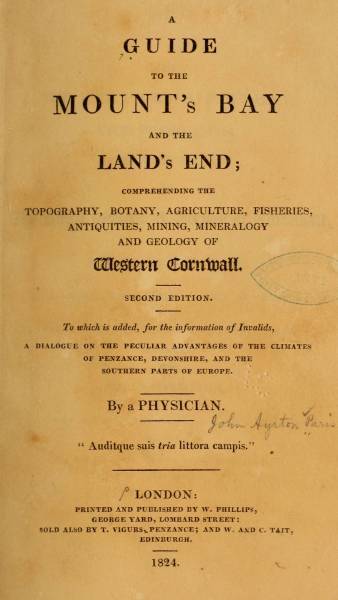
A
GUIDE
TO THE
MOUNT's BAY
AND THE
LAND's END;
TOPOGRAPHY, BOTANY, AGRICULTURE, FISHERIES,
ANTIQUITIES, MINING, MINERALOGY
AND GEOLOGY OF
Western Cornwall.
A DIALOGUE ON THE PECULIAR ADVANTAGES OF THE CLIMATES
OF PENZANCE, DEVONSHIRE, AND THE
SOUTHERN PARTS OF EUROPE.
PRINTED AND PUBLISHED BY W. PHILLIPS,
GEORGE YARD, LOMBARD STREET:
SOLD ALSO BY T. VIGURS, PENZANCE; AND W. AND C. TAIT,
EDINBURGH.
THE VICE PATRONS, PRESIDENT,
VICE PRESIDENTS,
AND MEMBERS
OF
The Royal Geological Society of Cornwall,
THIS WORK IS INSCRIBED,
AS A HUMBLE, YET SINCERE TRIBUTE OF RESPECT,
FOR THE ZEAL AND LIBERALITY WITH WHICH THEY CONTINUE
TO UPHOLD
AN INSTITUTION
"WHICH HAS RENDERED THEIR HOME THE SCHOOL OF
SCIENCE,
AND THEIR NATIVE RICHES INCREASING SOURCES
OF PROSPERITY."
TO THE READER.
This little volume has been republished, at the earnest solicitation of numerous friends and applicants, and with such additions and improvements as the present extended state of information appeared to render necessary. In obeying this call, the author trusts that he may, in some degree, remove the prejudice to which the carelessness of his provincial compositor must, on the former occasion, have exposed the work.
Since the publication of the first Edition, Penzance, and the District of the Mount's Bay, have become objects of greatly increased interest; the successful establishment of the Geological Society,—the erection of commodious Sea Baths,—the growing confidence of the Public, and of the medical profession, in the superior mildness of the climate,—and the general amelioration of every thing connected with the wants and comforts of a winter residence, have powerfully operated in augmenting the influx of strangers and invalids, into this formerly obscure, and comparatively neglected district. Such considerations, it will be acknowledged, were quite sufficient to sanction the propriety and expediency of the present undertaking, but the author must in candour allow, that they would scarcely have prevailed, had not another powerful motive been in silent but effectual co-operation—the "Antiquæ vestigia Flammæ,"—a secret lingering after the pursuits of Geology have, for once at least, seduced him from a resolution he had formed on quitting Cornwall,—that of abandoning a science which can never be pursued except with enthusiasm; but which, from its direction and tendency, is wholly incompatible with the duties of an anxious and laborious profession.
As the work is calculated for the guidance of those who may seek the shores of the Mount's Bay, for its genial atmosphere, the introduction of some general observations upon the subject of Climate, appeared essentially necessary. For this purpose, the form of a Dialogue has been preferred to that of a Didactic essay; by which much circumlocution is avoided, while the only interesting parts of the question are thus made to appear in a more prominent and popular point of view.
The Cornish Dialogue, introduced in the Appendix, for the sake of illustrating the provincial Dialect, has been composed after the model of the well known "Tim Bobbin," which was written for the accomplishment of the same object, with reference to Lancashire. From the direction in which it came into the hands of the author, he is inclined to consider it as an hitherto unpublished production of the celebrated Dr. Walcott.——Valete.
CONTENTS.
The Mount's Bay—Its Topography and Scenery, 1.—Northern Shores, their aspect cheerless but interesting, 3.—Minerals and Antiquities, 4.—The Climate of Mount's Bay, 5.—Meteorological Records, 5.—Vegetation, 6.—Tender Exotics flourish in the open air, 7.—Proofs of superior mildness from the animal kingdom, 9.—Coolness of the Summer, 10.—Rain; Storms, 11.—Hurricane of 1817, 14.—Encroachments of the Sea, 16.—The Bay formerly a woodland, 17.—Causes of the Sea's inundation, 18.—Rapid decomposition of the Cornish hills, 19.—Penzance—an eligible residence, 22.—Its situation most beautiful.—Extraordinary fertility of the neighbouring lands, 23.—Corporation—Pier—Chapel—Meeting Houses, 24.—Penzance a Coinage Town, 25.—Public Dispensary, 25.—Royal Geological Society of Cornwall, 26.—Its Cabinet of Minerals, 27.—Laboratory, 29.—Accidents from explosion in Mines prevented by the scientific efforts of the Society, 30.—Mineralogical Collection of Joseph Carne, Esq. 31.—Penwith Agricultural Society, 32.—Penzance Market, 33.—Wild fowl and fish abundant and cheap,—Newlyn Fish-women remarkable for their beauty, 33.—Public Hot and Cold Sea Baths, 34.—Beautiful prospect from the waiting room, 35.—Packet to Scilly, 35.—Ancient Customs—Festivities at Midsummer, 36.—Penzance remarkable in history from having been burnt by the Spaniards, 38.—Tobacco first smoked in this town, 39.—The birth place of Sir Humphry Davy, 40.—List of Indigenous Plants of Western Cornwall, 41, &c.
An object of the very first interest—Excursion by water—By land, 45.—The Eastern Green celebrated as the habitat of some rare plants, 46.—Marazion, or Market Jew, 47.—Its origin and Charter, 47.—Chapel Rock, 48.—Arrival at Saint Michael's Mount, 49.—Conical form of the hill—Its dimensions—Town at its base—The Pier—Interesting as a geological object, 50.—Why—Its scenery most magnificent—Geological structure, 51.—Militates against the Wernerian doctrines—De Luc's improbable explanation, 51.—Dr. Berger's gratuitous assumption, 52.—Plutonian views, 52.—Western base of the Mount—Beds of Granite, 53.—Quartz veins—Interesting contents of the veins, 55.—Pinite discovered in this spot, 55.—Other minerals, 56.—Lodes of Tin and Copper—Remains of a Tin Mine—Veins of Mica, 57.—The Tamarisk, 57.—Ascent to the Castle, 57.—Ancient Fortifications—The Chevychace room, 58.—The Chapel, 59.—Mysterious discovery in the Chapel, 59.—More Discoveries—Ascent to the top of the tower—Prospect hence of the grandest description, 60.—Saint Michael's Chair—Its origin and supposed mystic powers—A remnant of Monkish fable, 61.—The modern Apartments, 62.—The Natural History of the Hill—Formerly cloathed with wood—Its old Cornish appellation, 62.—Once at a distance from the sea, 63.—Ecclesiastical History—Monkish Legends of the vision of Saint Michael, 63.—Saint Keyne's Pilgrimage to the Mount in the fifth century, 64.—The Confessor's Endowment, 65.—Ancient instrument A.D. 1070 found amongst its registers, 65.—Annexed to a Norman Priory at the Conquest, 66.—The Nunnery—Its establishment broken up—The connection of the Priory with Normandy destroyed, 67.—Granted by Henry the Sixth to King's College Cambridge, 67.—Transferred by Edward IV. to the Nunnery of Sion in Middlesex, 68.—Bestowed upon Lord Arundel at the Reformation, 68.—Its Private History continued, 69.—Military History.—Pomeroy's Treachery—Monks expelled—Monks restored, 70.—The Mount is again reduced by the Earl of Oxford, 71.—who in his turn is compelled to surrender to the forces of Edward the Fourth, 71.—The Lady Catherine Gordon, wife of Perkin Warbeck, flies to the Mount for safety, 71.—Besieged by the Cornish rebels in the reign of Edward VI., 71.—Reduced by Colonel Hammond during the Civil war of Charles the First, 72.—The Mount supposed by Sir Christopher Hawkins and Dr. Maton to be the Ictis of Diodorus Siculus, 73.
Intermediate objects worthy of notice, 74.—Castle Horneck, 75.—Rose Hill—Trereiffe, 76.—The country wild but susceptible of cultivation, 77.—Furze—Boulders of Granite, 77.—Capable of numerous applications in rural œconomy, 78.—Cornish Granite, (provincially, Growan), when in a state of decomposition is used as a manure, 79.—Theory of its operation, 79.—Form of the Felspar crystals, 79.—State of Agriculture—The Farm of John Scobell, Esq. at Leha, 80.—Arish Mows, 81.—Ancient Stone Crosses, 81.—Druidical Circle at Boscawen Un, 81.—Opinions concerning the origin of such circles, 82.—Chapel Euny, and its mystic well, 82.—Caerbran Round, 83.—Other Hill Castles, 84.—Chapel Carn Bre—Its origin, 84.—Commands a very extensive view, 85.—Sennan Church-town—The First and Last Inn in England, 85.—The Village of Mayon or Mean, 85.—Table Mean the vague tradition concerning, 86.—The Land's End, 86.—A Spot of great geological interest, 87.—Grotesque appearance of its granitic rocks, 87.—The Armed Knight, Irish Lady, and Dr. Johnson's Head, 88.—Cape Cornwall, and Whitsand Bay, 88.—Historical recollections, 88.—The Long-Ships Light-house, 89.—Tradition of the Lioness, 91.—The Wolf rock, 91.—The Scilly Islands, 92.—Ancient Accounts—Six of the Islets only inhabited, 92.—Saint Agnes, 93.—The Light-house, 93.—Civil Government of the Islands, 93.—Present inhabitants all new comers, 94.—A robust and healthy race, 94.—Their employment, 96.—Experience great distress, 96.—Curious fact with respect to the migration of the Woodcock, 98.—Climate and Geology, 99.—Return to the Land's End—Fine rock Scenery at the Cape near the Signal Station, 101.—Tol Pedn Penwith, 102.—Cornish Chough—A Cliff Castle, 102.—Castle Treryn—Stupendous Rock Scenery—The Logan Rock, 103.—Its weight, 103.—How and whence it came, 104.—A natural production, 104.—Its appearance easily reconciled with the known laws of decomposition, 105.—Used probably by the Druids as an engine of superstition, 105.—Plants—Geological phenomena, 106.—Rare Shells to be found in Treryn Cove, 107.—Saint Buryan, once the seat of a College of Augustine Canons, 108.—Church Tower commands a very extensive prospect—Remarkable ancient Monument in the church, 109.—Ancient Crosses, 110.—The Deanery, 111.—The supposed Sanctuary, 111.—Return to Penzance by a circuitous route, through the parish of Saint Paul, 111.—Boskenna, the romantic seat of John Paynter, Esq., 112.—A Druidical circle, called the Merry Maidens, 112.—Sepulchral Stones called the Pipers, 113.—Carn Boscawen, Pensile Stone at, 113.—Trove or Trewoof, the remains of a triple entrenchment at, 113.—The romantic valley of Lemorna, 113.—Kerris, supposed Druidical monument at, 114.—Paul Church, 114.—Epitaph of Dolly Pentreath, 115.—Mousehole and Newlyn, Colonies of Fishermen, 116.—Geological phenomena, 117.
Plan of the excursion, 119.—Nancealverne, the seat of John Scobell, Esq.—Poltair, of Edward Scobell, Esq.—and Trengwainton, of Sir Rose Price, Bart. 119.—Original Paintings by Opie, 120.—Village of Madron, 120.—Madron Well and Baptistry; Ancient Superstitions attached to it, 121.—Lanyon Cromlech (represented in the title page of this work) known by the name of the Giant's Quoit, 122.—Its supposed origin, 123.—Men-an-Tol, 124.—Men Skryfa, or the Inscribed Stone, 125.—Chun Castle, 126.—Stamping Mills, Burning Houses, or Roasting Furnaces, 127.—Cavern at Pendeen, 126.—Pendeen Cove, 128.—Geological phenomena, 128.—The Gurnard's head, 129.—Minerals to be found in this district, 130.—Axinite at Trewellard—Prehnite—Stilbite—Mesotype, 131.—The Crown Engine of Botallack—Extraordinary Scenery of the spot, 132.—Descent to the Engine, 133.—The workings of the Mine extend under the bed of the Atlantic ocean, 133.—Mineralogical observations, 134.—Cape Cornwall, 136.—Little Bounds Mine, 136.—Its workings under the sea, 137.—Curious Stalactites found there, 138.—Caraglose Head, a spot well worthy the stranger's notice, 138.—Portnanvon Cove, 139.—Saint Just Church Town, 139.—Ancient Amphitheatre, where Tournaments are held at this very day, 140.—Botallack circles, 140.—Antiquarian speculations, 141.
Embowered Village of Gulval—Kenegie the seat of J. A. Harris Arundel, Esq.—Rosmorran, the retired cottage of George John, Esq., 143.—Ascent to the great Granite ridge, 143.—Castle an Dinas, 144.—Atmospheric Phenomenon, 144.—Saint Ives, 145.—The Pilchard Fishery—Confusion and bustle which are occasioned on the appearance of a shoal, 146.—Natural History of the Pilchard, 147.—Period of its appearance, 148.—How discovered by the Huer, 149.—Necessary outfit for the fishery, 149.—The Great Net, or Stop Seine—How shot, 150.—The quantity of fish usually secured—Tucking, a beautiful sight, 152.—Driving Nets, 153.—Fish brought to the cellars and cured—lying in bulk, 153.—Packed in hogsheads, headed up, and exported, 154.—The great importance of this fishery to the county, 155.—Refuse fish used as manure, 155.—Their fertilizing powers increased by lime, 156.—The Herring Fishery, 156.—Tregenna Castle, the seat of Samuel Stephens, Esq.—Knill's Mausoleum, 157.—Quinquennial Games instituted, 158.—Hayle Sands—The Port of Hayle, 159.—Desolate appearance of the district, 161.—Sand-flood, 162.—Recent Formation of Sandstone, 163.—Investigation of the causes which have operated in consolidating the sand, 166.—Huel Alfred Copper-mine, 169.—The Herland Mines, 170.—Saint Erth—Trevethoe, 171.—Tin Smelting, 173.—Ludgvan Church—The tomb of the venerable and learned Dr. Borlase, 174.
The country uninteresting to the traveller in search of the picturesque, but affording a rich and instructive field of Mineralogical inquiry, 176.—Antiquity of the Cornish Tin Trade, 177.—Stannary Courts—Copper Ore of comparatively modern discovery, 178.—Lead, Cobalt, and Silver ores, 180.—Average width of the metalliferous veins—Depth of the principal mines, 181.—North and South veins, or Cross Courses, 181.—Heaves of the Lodes—A remarkable instance in Huel Peever, 182.—Costeening, the meaning of the term—Method of Working the Cornish Mines, 183.—Blasting the rock with gunpowder, 186.—Descent into a Mine, 186.—Interior of a Mine, 187.—Temperature of Mines, 189.—Mines considered as property, 190.—Various processes by which the ore is rendered marketable, 191.—Spalling, 191.—Stamping, 192.—Dressing, 193.—Vanning, 194.—Burning, 194.—The Standard Barrow, 195.—Names of Mines, whence derived, 196.—Number of Mines, 196.—Stream Works, 197.—Gold found there, 197.—Clowance, the seat of Sir John St. Aubyn—Pendarves, the seat of E. W. W. Pendarves, Esq.—Tehidy Park, the mansion of Lord de Dunstanville, 198.—Dolcoath Copper Mine, 198.—Cook's Kitchen, 199.—Redruth—The Great Steam Engine at Chacewater, 200.—The Consolidated Mines—Huel Unity—Poldice, 202.—Hints to the Collectors of Cornish Minerals, 202.—Mineralogical Cabinets—That in the possession of Mr. Rashleigh, 203.—Of Mr. Williams's Collection, 206.—Saint Agnes, 208.—Carn-breh Hill—The supposed grand centre of Druidical worship, 209.—Imaginary monuments of the Druids—Their true nature developed, 209.—Cleavelandite found in the porphyritic granite on the summit of the hill, 212.—Carn-breh Castle, 213.