
The Project Gutenberg eBook of A History of Banks for Savings in Great Britain and Ireland
Title: A History of Banks for Savings in Great Britain and Ireland
Author: William Lewins
Release date: April 22, 2013 [eBook #42583]
Most recently updated: October 23, 2024
Language: English
Credits: E-text prepared by Adrian Mastronardi, Carol Brown, The Philatelic Digital Library Project
The Project Gutenberg eBook, A History of Banks for Savings in Great Britain and Ireland, by William Lewins
E-text prepared by Adrian Mastronardi, Carol Brown,
The Philatelic Digital Library Project
(http://www.tpdlp.net)
and the Online Distributed Proofreading Team
(http://www.pgdp.net)
HISTORY OF SAVINGS BANKS.
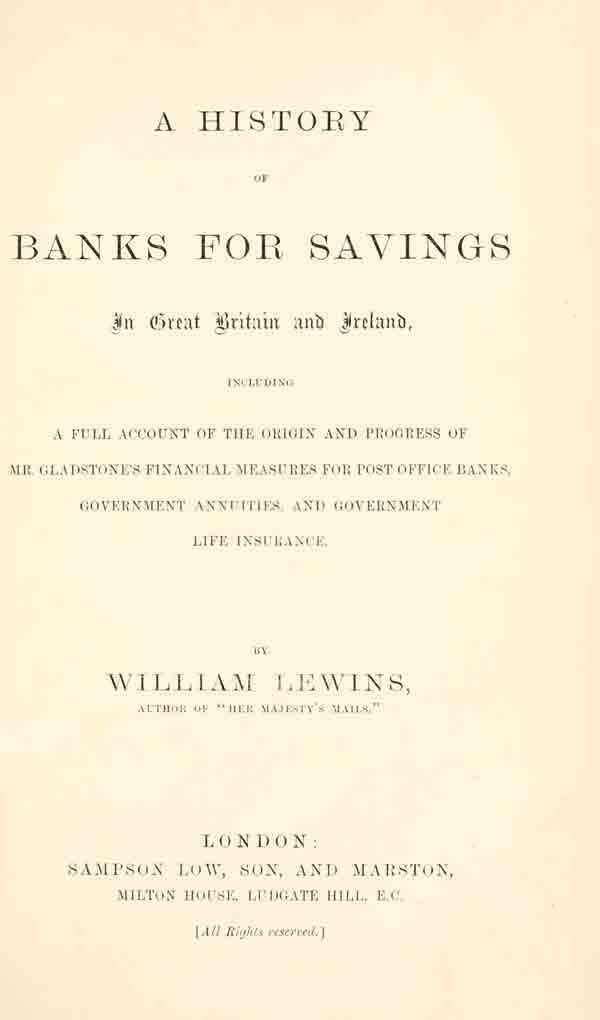
A HISTORY
OF
BANKS FOR SAVINGS
In Great Britain and Ireland,
INCLUDING
A FULL ACCOUNT OF THE ORIGIN AND PROGRESS OF
MR. GLADSTONE'S FINANCIAL MEASURES FOR POST OFFICE BANKS,
GOVERNMENT ANNUITIES, AND GOVERNMENT
LIFE INSURANCE.
BY
WILLIAM LEWINS,
AUTHOR OF “HER MAJESTY'S MAILS.”
LONDON:
SAMPSON LOW, SON, AND MARSTON,
MILTON HOUSE, LUDGATE HILL, E.C.
[All Rights reserved]
LONDON:
PRINTED BY R. CLAY, SON, AND TAYLOR,
BREAD STREET HILL.
TO
THE RIGHT HONOURABLE
WILLIAM EWART GLADSTONE, M.P.
CHANCELLOR OF THE EXCHEQUER,
&c. &c. &c.
THE GREATEST LIVING AUTHORITY ON ALL MATTERS OF FINANCE,
WHOSE NAME IS NOW INTIMATELY AND DESERVEDLY
CONNECTED WITH ALL THAT RELATES TO
THE SUBJECT OF THESE PAGES,
This Work
IS BY PERMISSION
MOST RESPECTFULLY DEDICATED.
PREFACE.
The present volume is offered as a contribution to the history of a number of provident schemes, which, though quietly working in the country for many years, and affecting to no small extent the social condition of great masses of the people, can scarcely be said to have found an annalist. I think I may fairly consider that the ground covered by this work has not previously been occupied. In saying so much, I do not forget the only book which has hitherto emanated from the British press on Savings Banks. Mr. Scratchley's Practical Treatise on Savings Banks deals, however, with the question technically, and is meant avowedly as a text-book for actuaries and those employed about Savings Banks. The present volume, on the contrary, while it may be supposed to possess some interest even for this limited circle, is not meant to take the place of the above, but seeks its public amongst general readers, and amongst those who, either from inclination in that direction, or through connexion with them as employers, take an interest in the progress of the industrial classes of our country.
Treating as this volume does of useful practical schemes and matter-of-fact topics, I have sought to avoid all matters of speculation, to speak in very plain terms and without waste of words, and, whilst noticing in their proper order all the different proposals having to do with the subject, to refrain from venturing upon any myself. My aim has been to give a full and accurate account of the early history of Savings Banks; and as subsequently to their origin the discussions in Parliament with regard to them and kindred subjects were no incorrect reflex of the feeling in the country at different periods, I have also dealt fully with the parliamentary history of these institutions. In this way Savings Bank reformers, both in and out of Parliament, and their measures of reform—many of them ending in the establishment of different kinds of supplementary banks—are made to pass under review; and the names of those who framed the original schemes, as well as of those who tried to improve upon them, are rescued, for a brief space at any rate, from a state of obscurity, if not of oblivion.
With respect to the latest modification of the Savings Bank principle, as exhibited in the measures brought about within the past few years by Mr. Gladstone, great efforts have been made—as great efforts have been needed—to treat all the questions involved fully and impartially, and to accord these important and far-reaching measures their due place amongst the other wonderful provident schemes of the present century.
Great pains have also been taken to ensure perfect accuracy, both as to facts and figures, and my acknowledgments are due to many gentlemen who are acquainted with the subject in all its bearings, who sent me information, or answered my inquiries, with great readiness and cordiality. It is less necessary to mention any of these gentlemen in this place, inasmuch as reference is frequently made to their assistance at the proper place in the body of this work; but it would be wrong to omit to state that, with regard to Mr. Gladstone's recent measures, I have had every facility granted me by the Post Office authorities for obtaining the necessary and the most recent information respecting these schemes, and that this assistance has been rendered in a manner which calls for my heartiest thanks, as the only sufficient or fitting acknowledgment.
Dealing as I have done with what Mr. Carlyle will allow to be one of the “side sources” of history, I venture to hope that some of the facts now gathered together may not be without their interest to the student of human progress in some of its highest aspects; while to all those who are directly concerned in such schemes, and to masters of workmen, to whom the concluding parts especially are more particularly addressed, this volume is offered, with some confidence that they will find much new and original matter in it, and some old matter put in a new light.
An Appendix is added, giving the Acts, or clear abstracts of Acts, at present in force for all the different descriptions of Banks for Savings, together with some of the latest statistical information which may be thought of value.
W. L.
London, May 24, 1886.
* * * * *
*** Two questions connected more or less with my subject have been brought into prominence by the action of Parliament since the present work was completed, and to these questions it may not unreasonably be expected that I should in some way refer. The first, or the Savings Bank qualification in the new Reform Bill, concerns Savings Banks and Savings Bank depositors very intimately; the second question, or the proposal of Mr. Gladstone to employ a portion of the money of Savings Banks in reducing the National Debt, can scarcely be said to have an immediate bearing upon either.
With regard to the Savings Bank qualification, I may, perhaps, be permitted to say that, though received with hostility in some quarters and indifference in others, the balance appears to me to be in favour of the proposal. In most respects, if not in all, the qualification may be defended on the same grounds as the Forty Shilling Freeholds; the investment is about the same; the one is open to much the same objections as the other, and there are similar merits in each. Votes may be manufactured under the one equally as under the other, and it is not easy to understand why those who support the one “Bye Franchise” should oppose the other. Little trouble will accrue to Savings Banks under the Act; and the money forming the qualification may oftentimes be allowed to remain in the bank, whereas under other circumstances it might be squandered in unnecessary or unprofitable expenditure. The distinction may be hard on others quite as worthy of the franchise, but who may be in some way unfortunately circumstanced; and it may seem arbitrary to those who have an equal amount invested in some other shape: but these are the sort of arguments which may be brought against Fancy Franchises of any kind with quite as much reason as against this particular one. Working men who may claim the Franchise on the Savings Bank qualification will not be able to keep the fact secret that they are depositors, and that up to a certain amount; and they must submit, on misfortune overtaking them, to be deprived of a privilege which they may have learnt to prize: but, notwithstanding all these and some other minor considerations, I cannot help regarding the Clause as, on the whole, a fair and reasonable acknowledgment of the merits and claims of many of the best portions of the community, who were not influenced by the consideration of this electoral qualification when they originally commenced the practice of provident habits, and also of the claims of others who may not be unduly influenced by the prospect of citizenship which the Clause may henceforth hold out to them.
Mr. Gladstone's recent proposal to convert the 24,000,000l. of Consols, invested by the nation in Savings Banks, into Terminable Annuities concerns the Nation itself much more than Savings Banks. So far, indeed, as the matter affects the trustees of Savings Banks, or depositors in them, it was settled some years ago when the money was made a book debt, and the Government became the banker, as it were, for the sum in question. What the Government now does with the money is no concern of Savings Banks. This is put so plainly by Mr. Gladstone in his Budget speech, and is at the same time so indubitable, that to quote his words is to say all that can be said on this point. “They (the trustees) have nothing to do with the money; that is a mere question of investing it with which we are alone concerned. If we lost every farthing of it, we should have to pay it to them; and if we made a profitable investment of it, it would be entirely our own affair.” In one respect only is Mr. Gladstone's proposal specially satisfactory to Savings Bank officials and all who take an interest in Savings Banks. Under the operations described by the Chancellor of the Exchequer in his Financial Statement, and now familiar to every reader, the Balance estimated to be deficient, of over three millions sterling—a deficiency which has long been a bugbear in all considerations of the subject—will disappear as a separate item in the National Accounts in the process of redemption proposed. The entire scheme shows, especially and prominently, Mr. Gladstone's anxiety to reduce our enormous burden of debt. He here voluntarily proposes to cripple himself in no small degree in the matter of his resources. Should his proposals become law—and it is sincerely to be hoped they will—the process must go on, even when he or his successors may require to raise money at an obvious disadvantage; but if he be satisfied to throw the burden equally on years of prosperity and adversity, surely this is a matter on which the public generally should feel no fear.
CONTENTS.
PAGE
CHAPTER I.
INTRODUCTORY CHAPTER 1
CHAPTER II.
ON THE ORIGIN OF SAVINGS BANKS 18
CHAPTER III.
EARLY LEGISLATION OF SAVINGS BANKS—1817 TO 1844 45
CHAPTER IV.
ON THE PROGRESS OF SAVINGS BANKS UP TO THE YEAR 1844 80
CHAPTER V.
LEGISLATION ON SAVINGS BANKS FROM 1844 TO THE PRESENT TIME 122
CHAPTER VI.
A CHAPTER ON SAVINGS BANK FRAUDS 183
CHAPTER VII.
ON THE DEFICIENCIES OF THE EXISTING SYSTEM, AND THE ESTABLISHMENT OF SUPPLEMENTARY SAVINGS BANKS 226
CHAPTER VIII.
ON PROPOSALS FOR GOVERNMENT SAVINGS BANKS 269
CHAPTER IX.
ON THE DEVELOPMENT OF THE POST OFFICE SAVINGS BANK SYSTEM 311
CHAPTER X.
ON GOVERNMENT INSURANCE AND GOVERNMENT LIFE ANNUITIES 345
CHAPTER XI.
CONCLUDING CHAPTER 377
APPENDIX 395
INDEX 437
HISTORY
OF
SAVINGS BANKS.
CHAPTER I.
INTRODUCTORY CHAPTER.
“Archimedes was wont to say that he would remove the world out of its place, if he had elsewhere to set his foot, and truly I believe so far that otherwise he could not do it. I am sure that so much is evident in the architecture of fortunes, in the raising of which the best art or endeavour is able to do nothing, if it have not where to lay the first stone.”—Sir Henry Wotton.
The habit of laying something by in a prosperous season for the wants of an adverse one is one of the very oldest customs in the world. All our laws, Divine and human, enjoin the exercise of providence and frugality as a social, and as a personal duty. These habits which are inculcated in Scripture as positive duties, and which find ample illustrations in many of the arrangements of nature and Providence, have been common in one form or other to all people in every country and in every age. In England, in almost everything relating to the social advancement of the industrial population, there has been a great and manifest improvement since the commencement of the present century. In nothing is this more true than in the incentives and appliances provided for the growth of provident habits amongst them. An old stocking, a hole in the floor, or a crevice in the wall, was formerly a sufficient bank for such of the poor as cared to save anything; but were that mode of investment unsatisfactory to some few, it was not possible to obtain better. The change which fifty years have wrought in the means for saving and investing small sums of money is remarkable. Not only have these savings assumed in consequence a variety of different forms, but they represent a sum which in the aggregate must be well calculated to astonish anyone who can remember anything of the last century. Before dealing, however, with this as our special subject, a few words may not be spent in vain in endeavouring to trace the gradual advancement made among the poorer classes, the causes that have led to the improvement in their condition, and the means by which the difficulties in their position have been encountered. After this it will not be inappropriate to refer to what still remains to be done.
“The nineteenth century,” as Mr. Gladstone, in addressing the working men of Glasgow, has just said, “whatever else it is, is undoubtedly in a new and peculiar sense the century of the working man.” “It is the century which has seen his position raised, his circumstances improved, new means organised for his benefit, new prospects opened for the future, and he has before him—I mean not the individual but the class—a prospect which, I trust, nothing can mar—of increased weight, increased consideration, increased usefulness, increased happiness in the generations to come.” The Chancellor of the Exchequer might with justice have said that the second quarter of the present century has seen this great improvement inaugurated and carried on. Beginning with 1830, and letting the period of the removal of political and fiscal burdens mark the commencement of the better order of things, the progress of political economy, of social knowledge, and the favouring circumstances of the times achieved the rest. In the first quarter of the century the working population, left pretty much to themselves, or given over to the tender mercies of political demagogues, were either stolidly indifferent to any improvement, or were kept in a constant turmoil of excitement and confusion. The Reform Bill bringing political power to the better class of artisans, gave a decided stimulus to the intelligence of the people, and an impulse to the then existing means of education. This political power brought its responsibilities, and it may be fairly assumed that increased political knowledge was the result. Whether so much will be granted or no, it is certain that schools and educational establishments now began to multiply in a manner unknown to any previous decade. It was now that there came demands for knowledge, and that the demand brought forth supplies of the most practical kind. The story of the popular literary ventures of 1832—the very first of their kind—need not be repeated here, though a volume might well be written on the subject, and showing the influence which they, and other ventures to which they gave rise, have had on the intellectual progress of the people. On the demand for knowledge there followed in quick succession the removal of many barriers that stood in the way; and more important still, the remissions of, to the poor man, enormous fiscal burdens which pressed with great weight upon his energies.[1] It would scarcely be too much to say that every year for the last thirty years the working man has found himself better able to cope with the disadvantages of his position, and, if he should so choose, to place himself to a very great extent beyond the reach of absolute want.
We have alluded to the necessity which began to be felt for the mental improvement of the adult population; still more important were the steps taken from time to time to educate the children who are the old people and the adults of the present day. The present century, among many wonderful changes which it has witnessed, has seen a complete revolution in the means of education for the masses. Many generations since, Milton, with that clear mental vision which was in him like a kind of second sight, foretold that a time would come when the bulk of the people would get a better education “in extent and comprehension far more large, and yet of time far shorter, and of attainment far more certain, than hath yet been in practice;” and although we may not have exactly reached the point prefigured by the poet-seer, some marvellous strides have been taken during the present century. A dramatist of Milton's own period makes a man of substance reply, in answer to the query, “Can you read and write then?” “As most of you gentlemen do, my bond has been taken with my mark at it.”[2] At the beginning of the present century little had been done for the education of the masses. Grammar schools for the children of the middle classes, and Free schools, as they were called, for an infinitesimal fraction of the poor of our towns had been long established, and, so far as they went, with certain enough results; but, if we except the establishment of Sunday schools by Mr. Raikes of Gloucester in 1783, nothing had been done for the educational wants of the general poor. Malthus in his “Essay on Population,” published twenty years after this date, says, “It is surely a great national disgrace that the education of the lower classes should be left merely to a few Sunday schools supported by subscriptions from individuals,” adding at the same time, that the country “lavished immense sums on the poor which we have every reason to think have constantly tended to aggravate their misery.” “In their education,” he goes on to say, “and in the circulation of those important political truths that most nearly concern them, which are perhaps the only means in our power of really raising their condition, and of making them happier men and more peaceable subjects, we have been miserably deficient.” What the state neglected, private enterprise took up; earnest men like Raikes and Pounds, the working shoemaker, not only set an admirable example in their own spheres of labour, but roused to action other men who applied to the work greater powers of mind and the benefits of greater system. Dr. Bell and Mr. Lancaster were two of these, who nearly at the same time expounded their views of a general scheme for educating the people; and who were strengthened in their opinion, as one of them tells us, of its necessity, by the clamour of many who held that the stability of our institutions was only sure so long as the people were kept in ignorance. Mr. Whitbread, a statesman whose name was very prominent about this time for efforts to promote the interests of the bulk of the people, tried to induce Parliament at this stage to take the subject into its consideration, by proposing a plan for the establishment of parochial schools “for the exaltation of the character of the labourer,” and it would have been well if he had met with more success. As it was, the sage legislators of the day, led on by Mr. Windham, considered that such a plan would be very liable to give an education to these classes much above their condition, and Mr. Whitbread's scheme, like many other of his wise proposals to which we shall have subsequently to allude, was set aside. The work, however, had begun and could not be stopped by the attitude of the government. Dr. Bell commenced his system by the establishment of National schools; Mr. Lancaster, supported by Nonconformists principally, set up Lancasterian schools. Although there was for some time much hostility displayed between the rival factions, both organizations struck deep into the dense masses of ignorance in our towns and villages. Then came Government assistance, and gradually that system of Government education and supervision which, in spite of many objections to it, has been an untold blessing to the land.
Within the last thirty years the wise legislation of the Government has had a direct influence on the progress of the people in education, and in their social well-being. No more powerful aid, for example, was given towards the triumph of enlightenment than the passing, in 1839, of the penny postage measure, when thousands of the poorer classes became emulous of each other in learning the rudiments of education, so as to be enabled to possess themselves of the untold advantages of this wonderfully successful scheme. Mr. Laing, the celebrated traveller, after visiting the Continent, declared that the system of penny postage was far more likely to cause the spread of education among the masses than the Prussian system of education, if it came to be adopted in this country. Only second to the repeal of the taxes on correspondence was that of the reduction of the newspaper stamp duty, and, still more recently, the abolition of the paper duty. The relinquishment of these taxes redounds to the honour of those who took part in the agitation for their abolition, and who held that no artificial impediment, such as a paltry consideration of revenue, ought to stand between the people and the free circulation of thought. Lord Brougham said on one occasion that, “if newspapers, instead of being sold for sixpence, could be sold for a penny, there would immediately follow the greatest possible improvement in the tone and temper of the political information of the people.” Lord Campbell once expressed a hope that newspapers would be sold for a halfpenny. Much of this has been realized, and the result has been powerful for good. On this point no one can speak with anything like the authority of Mr. Gladstone. Speaking of the repeal of the paper duty, this eloquent statesman has said within the present year, “I did to the best of my ability fight a hard battle for its repeal. And I find now that not only in its repeal was there involved the liberation of a great branch of trade, but there was involved a seed of social and moral good that has sprung up with rapidity, producing a harvest such as, I confess, I had hardly been sanguine enough to anticipate.”[3] The cheap press now finds its way into the homes of the poorest, keeps them informed of the current public events, and makes them interested and anxious in all that concerns their country and its institutions; and, inasmuch as the press of the present day is, under proper conduct, well qualified to enlarge the minds of those whom it must instruct, it is a “seed of social and moral good” from which a constantly-increasing harvest of good fruit may be obtained.
In view of such facts it cannot be said that, during the last quarter of a century, the industrial classes have been entirely thrown on their own resources for the means of their enjoyment and improvement. Over and above the tendency of the legislation of the past thirty years, the upper classes have felt it their duty, as it is unquestionably their interest, to attend to the wants and requirements of those at the bottom of the social scale. They are the safest when the vast mass of our working population are the happiest. Dr. Chalmers must have felt this when he wrote, “I would like to see a king upon the throne, not like an unsupported may-pole among a level population, but a king surrounded by a noble aristocracy and gradations below them, shelving downwards to the lowest basis of the people.” Society has been very often and very truly likened to a pyramid, at the apex of which is the throne; gradually descending, we have substantial strata of the ruling, the upper, and the middle classes, the rough and strong material at the base not inappropriately said to represent the unpolished millions of our industrial population. How far it may be considered true that the foundations of English society are laid in this great class, and how much of the social superstructure they bear on their broad shoulders, we will not attempt to decide. We will content ourselves with saying that the well or ill-being of every man forming this great social pyramid must have a direct or reflex influence on every other man. Homo sum, humani nihil a me alienum.
Of the hundreds of charitable and benevolent agencies set on foot to improve the condition of the English artisan we can only speak in the aggregate. We have the clearest evidence of our senses, that many of them have not been established in vain. Some of them, indeed, have been born and carried on under serious misapprehensions, fatal to their existence, and so have perished without doing half the good which the expenditure of money and time would have warranted. But this is the exception and not the rule. Under the influence of properly organised and properly conducted societies of this nature, which have been quietly working for years, there is a sensible improvement in public morals among the masses of the people. Within the memory of the present generation lewdness, profanity, and vulgarity polluted the atmosphere of most large workshops, and the effect of all this on the minds of the younger portions of the workers must have been utterly demoralizing. Then their hours of idleness were hours of mischief; in them the old proverb of “an idle brain” being “the devil's workshop” was fully exemplified; bull-baiting, cock-fighting, low drinking, and gambling were their amusements; Sunday nor weekday did their children frequent any school, nor they themselves any place of worship; they made no provision for want, sickness, or death, and in times of enforced idleness they were a terror and reproach to the country, only kept in order by the strong arm of the law. To say that all this is changed would be idle, but that much of it is changed is beyond doubt. Even humble society now quickly lays its ban upon those who would think “to rule the roast” by proficiency in vulgarity and profanity; in our large workshops we are assured that acquirements of this nature get less and less appreciation, nor do their exhibition often escape rebuke. Under better and happier influences, many of the rules and social regulations among large congregations of workmen, such as fines and footings, which have always offered great encouragement to idleness and intemperance, have either been done away with or altered for good;[4] masters not only see it to be their interest to encourage their men where they can in habits of sobriety and prudence, but they are now often enabled to enforce regulations tending to this end which before they were almost powerless to effect.[5]
The good results of such habits to the industrial classes themselves and to all portions of society are neither few nor doubtful. The pursuit of economy and thrift will beget, as a matter of course, self-dependence; and as soon as men become socially independent they also become self-relying and self-supplying. “Few men come to the parish who have ever saved money,” said one large employer of labour before a Committee of the House of Commons on Poor Laws. Another never knew a man who had saved a pound out of his earnings who had in the end become a pauper. But the good work does not stop here. “In proportion as our men save money,” said another large employer, “their morals are improved; then they come to see that they have a stake in the country, and behave better.” Or, as Vegetius, describing the Roman soldier, puts it, “knowing that his property is deposited with the standards in the public chest, he never thinks of desertion, becomes attached to his standards, and in battle fights more bravely for them; according to the nature of man, who has always his heart where his treasure is.” Arrived at this stage of the upward journey, the provident man feels the need of education, and must have it; he must also take a part in exerting an influence among his fellows, and even in the government of the country, and if his reading takes a rigid-turn, higher principles of duty are superadded; he will do his work, whatever it is, in every sense better. “I would rather have,” said another well-known gentleman, to the Committee just referred to, “a hundred men in my employ who save money than two hundred who spend every shilling they get; the sober, saving man is always to be depended upon, and the one lot in the long run will almost do as much work as the other.”
The improvement of which we have been speaking must not blind us, however, to the darker side of the picture. Notwithstanding the improvement which has been made, and the inestimable good which flows from the practice and pursuit of frugality and economy, it is still the exception and not the rule among the bulk of our labouring population. For the hundreds who look to the exigencies of their life, there are thousands who are utterly careless of such considerations, and who, in the coarse enjoyment of the present, bury alike all thought of the past and all expectation of and hope for the future. The stigma of improvidence has long attached, and we fear must yet long attach, itself to the generality of English artisans. But for this stigma there would be no operatives in the world equal to the English operative either in wealth, intelligence, or influence. No one with any experience in the case, and with any care as to accuracy, would venture to say that the English workman, sui generis, is not industrious at his work,[6] but too many can say that he is not provident in his home.[7] The English artisan has been said to be at once the hardest worker and the hardest spender in the world. He works like a horse and spends like an ass. So foolishly, indeed, is much of this hard-earned money spent, or misspent, that it were a charity to withhold it, or if it could be done, to throw it into the sea. The consequences attending this riot of expenditure is as natural and as inevitable as any of the laws of God's government. As one who knows them well, and one who has done much for the intellectual culture of the better portion of the artisan class tells us: “In a time of prosperity they feast; in a time of adversity they clem.” Any depression of trade, be it even of the most transient nature, finds them totally unprepared for it; those who have been accustomed to the best wages invariably suffer the most; for, accustomed to the greatest amount of indulgences, they can do worst without it. It is such classes as these that must be reached by some means. In the improvement brought about in the social habits of the people of late years we have a happy augury of the future.[8]
It is time that we brought these introductory remarks to a close. We have to enter upon the consideration of helps and accessories to the spread of prudential habits among the working classes. We have to direct attention to the history and working of some of those schemes which, since the commencement of the present century, have been started to teach men self-reliance and self-dependence, and how they might best help themselves. Anxious not to over-estimate the importance of the subject, we still think it not too much to say that on our industrial classes depends very much the continued and onward progress of the world. Let them but be thoughtful and sober, and these classes, which are the direct agents in our wondrous and manifold British industry, will, not only under circumstances of huge toil and no inconsiderable danger, continue to provide all classes with the necessaries or comforts of life, but they will yet strike out new paths; they will become, in the future, as they have been in the past, the skilful inventors of new instruments and new modes. No fact is more capable of proof than that almost all the successful inventions that have been given to the world to economize the strength of the human hand have been either the productions of thoughtful and industrious workmen, or of those who have risen from that class. “Deduct all,” says Mr. Helps, “that men of the humbler classes have done for England in the way of inventions only, and see where she would have been but for them.” Nor is this all. The list would be a long one of those who have risen by their own industry and perseverance from the lowest ranks to fill the highest positions in every department of life. “It is notorious,” says Mr. Smiles, “that many of our most successful employers, and some of our largest capitalists, have sprung directly from the working classes, and to use the ordinary phrase, have been 'the architects of their own fortunes;' whilst many more have risen from a rank scarcely a degree above them. It was the prudent thrift and careful accumulations of working-men that laid the foundations of the vast capital of the middle class; and it is this capital, combined with the skilled and energetic industry of all ranks, which renders England, in the quantity and quality of her work, superior to any other nation in the world.”[9] And what the humbler classes have done for England in past times they may do, and indeed must do in the future, if we would keep our country in the proud position she now occupies in the world. It requires no prophetic vision to foresee that labour must yet undergo many transformations; and it is of paramount importance that the labourers themselves be not only intelligent but sober and frugal, in order that they may always compete on at least equal terms with the skilled workmen of any other nation.
It is far more difficult to point out what course of action will tend most successfully to secure the fair results of sobriety and frugality than it is to show how necessary it is that these virtues should be cultivated. “The difficulty of doing good,” as one writer expresses it, “is at least equal to its luxury.” The task we have undertaken is far from easy, and beset with perils, but we will endeavour to avoid all occasion of dispute. The pointing out of safe and profitable investments for the hard-earned savings of the frugal and industrious need not and should not be regarded as an invidious task. It seems to us that, as Savings Banks have to do primarily with the foundation of the habit of saving money, and indeed scarcely ever can be considered as competing with any of the numerous schemes for the investing of money, the subject should never be regarded with any jealous feeling. The principle upon which these institutions are founded “interferes,” to use the words of one who has written most ably on such subjects, “with no individual action, saps no individual self-reliance.” “It prolongs childhood by no proffered leading-string; it valitudinarises energy by no hedges or walls of defence, no fetters of well-meant paternal restriction. It encourages virtue and forethought by no artificial excitements, but simply by providing that they shall not be debarred from full fructification, nor defrauded of their natural reward. It does not attempt to foster the infant habit of saving by the unnatural addition of a penny to every penny laid by; it contents itself with endeavouring to secure to the poor and inexperienced that safe investment and that reasonable return for their small economies which is their just and scanty due.”[10] Strengthened by such testimony, we will proceed at once to sketch the history, and, as far as we are able, to show the benefits to be derived from the various kinds of banks for savings established from time to time amongst us.
[1] The following table taken from the Statistical Returns, presented by the Board of Trade, shows in a clear light how much of the position of the working classes must have been improved by the removal of fiscal burdens. Almost all the impositions of taxation between 1850 and 1864 have fallen upon the wealthier classes:—
| Repealed or Reduced. | Imposed. | Diminution or Addition. | ||
|---|---|---|---|---|
| £ | £ | £ | ||
| Customs | 12,208,604 | 3,291,820 | D. | 8,916,784 |
| Excise | 5,607,000 | 6,380,000 | A. | 773,000 |
| Property and Income Tax | 16,265,000 | 14,764,000 | D. | 1,501,000 |
| Other taxes | 2,608,800 | 600,000 | D. | 2,008,800 |
| Stamps (including succession duty) | 1,428,000 | 2,411,200 | A. | 983,000 |
| Total | £38,117,404 | 27,447,020 | D. | 10,670,384 |
[2] In 1846, according to the Report of the Registrar General for that year, out of the persons married in that year, one man out of three, and one woman in two, signed the register with marks. What was being done for the children of that year may be gathered from the return for 1864, where it is shown that only eighteen in 100 of those marrying in that year were unable to write their names.
[3] Speech at Newton-le-willows, July 22, 1865.
[4] By way of giving an example of our meaning, we would adduce the case of the workmen employed in the large brass works of Messrs. Guest and Chrimes, Rotherham. When one of their number, for instance, gets married, instead of the accustomed hard-drinking, the men and their wives drink tea together, and a piece of furniture of substantial value is presented to the newly-married pair, paid for out of the subscriptions by the men. On one of these occasions it is related, that the head of the firm was asked to present articles which had been bought for two newly-married couples, and Mr. Guest complied and introduced the business as follows: “The custom you have adopted deserves the warmest commendation and support, and is well worthy of superseding those footings, fines, treats, &c., which, until recently, had become a source of the most cruel, heartless, and unjust robbery to which workmen could possibly be exposed by each other. Thank God that wicked system is fast passing away.”
[5] In 1851-2 a large and well-known engineering firm in Leeds had a serious struggle with their workmen on account of the masters having determined to pay the men according to their merit and the character of the work turned out. A determined strike was the result, which, though the original difference was only with eight men, threw eventually more than 600 out of employment. Fresh hands were obtained with the usual difficulty, and these were subjected to great annoyance and even danger; in eighteen months, however, the works were again all going and were efficiently manned. The masters henceforth made it a condition of employment under them that no member of a trades' union should be engaged, and the sequel was a better behaved and superior class of men. Not only so, but the masters are now enabled to make their own regulations for the benefit of those employed under them, which before, owing to the interference of the trades society, they could not make. They have instituted a sick and funeral fund to which the men contribute by working ten minutes additional time when necessary, an arrangement which we recommend to other large employers of labour and large bodies of workmen. That the masters should be acquitted of any selfish motive, they allow the funds to be managed and applied by a committee of workmen appointed by themselves from their own number.
[6] “No labourer,” says Mr. Smiles in his Workman's Earnings, &c., “is better worthy of his hire than the English one. It is not merely that he works harder than the labourer of any other country, but he generally produces a better quality of workmanship. He possesses a power of throwing himself bodily into his occupation, which has always been a marvel to foreigners;” and he then recurs to the well-known example of the surprise created among the French peasantry when gangs of English navvies proceeded with the works of the Rouen railway, and worked amidst constant exclamations, of “Voilà! voilà ces Anglais! comme ils travaillent!”
[7] We put the matter quite mildly here, though it is customarily and very properly spoken of much more severely. For example, Mr. Norris, one of the Government inspectors of schools, in speaking of the well-paid miners and iron workers of Staffordshire—who doubtless are little worse than the same classes throughout the country—says in one of his able reports: “Improvidence is too tame a word for it—it is recklessness; here young and old, married and single, are uniformly and almost avowedly self-indulgent spendthrifts. One sees this reckless character marring and vitiating the nobler traits of their nature. Their gallantry in the face of danger is akin to foolhardiness; their power of intense labour is seldom exerted except to compensate for time lost in idleness and revelry; their readiness to make ”gatherings“ for their sick and married comrades seems only to obviate the necessity of previous savings,” &c.
[8] Much of what we have said in the foregoing pages is admirably summed up in a sentence or two in an article on “Savings Banks,” which we would not be far wrong in attributing to Dr. Wynter, and which we had not seen before these pages were written: “Contemporaneously with the growth of savings banks, we have seen a growth of civilization among the poorer classes. Thrift has not effected all that amelioration of morals which contrasts so happily the mid years of the century with its younger ones; but it has been no mean confluent to the tide of progress, the softening of manners, the spread of education, the humanising of popular sports and pastimes, the wakening up of the natural dignity and self-reliance of the people,—the broad and indispensable basis of every other virtue.”—London Review.
[9] Quarterly Review, 1859.
[10] Mr. W. R. Greg in the Edinburgh Review, 1853, p. 406.
CHAPTER II.
ON THE ORIGIN OF SAVINGS BANKS.
“It would be difficult, we fear, to convince either the people or their rulers that the spread of Savings Banks is of far more importance, and far more likely to increase the happiness and even the greatness of the nation, than the most brilliant success of its arms, or the most stupendous improvements of its trade or its agriculture. And yet we are persuaded that it is so.”—Edinburgh Review, 1818.
Great Britain can with justice, we think, lay claim to the original establishment of the system of Savings Banks. One well-known writer[11] on this and cognate subjects has traced them to Switzerland, if not to Hamburg, at a time prior to any experiments with them in this country; but from the best investigation we have been able to make, the institutions in question were something very different from Savings Banks as English people understand them, dealing, as they did, in business more like the sale of deferred annuities. The institution at Hamburg, which is said to have been founded in the year 1778,—and which is interesting to readers of history as being one of those whose coffers the First Napoleon swept of their funds, thus giving it its death blow,—simply took the spare cash of domestic servants and handicraftsmen, and granted annuities on the members arriving at a certain age. No withdrawal of money was allowed. In this country the first proposals for a bank for savings were made in 1798 or 1799, according to the judgment of the reader as to which of the two original schemes best deserves the name of Savings Bank, or whether either of them is entitled to the honour. The two persons whose names it is customary to speak of in connexion with the earliest people's banks are those of the well-known Priscilla Wakefield, and the Rev. Joseph Smith of Wendover. In the mind of each of these estimable persons we think the question of becoming the bankers for the poor around them was at first only a subordinate measure, and quite auxiliary to other matters deemed of greater importance. Mrs. Wakefield's scheme arose out of a well-meant anxiety to better the condition of the weaker and more defenceless portions of the community, an object to which she devoted much of her literary ability, and was first started in 1799, for the benefit of women and children in her own village of Tottenham, and under her immediate superintendence. Members paying according to their age certain sums per month became entitled to a pension after sixty years of age; in case of sickness, four shillings a week; in case of extraordinary misfortune a certain amount could be withdrawn; in case of death a sum of money was allowed for the funeral. Honorary members paid subscriptions, which went to meet deficiencies and current expenses. In 1801 there was added, first, a fund from which loans were made to those who had been members for six months; and second, a regular bank for savings. The interest given in the latter case was the same as that charged in the former, or five per cent. The clauses relating to children were such as almost to entitle the founders to the honour of being the originators of Penny Banks, if nothing else; juveniles were encouraged to deposit their penny per month, which was kept for them, along with interest, until such a time as the accumulation was needed for apprentice fee, clothes, or such like object. The management of this Parent Institution, as it may well be called, was equitably divided amongst the honorary and the “benefited” members. In 1804 the Tottenham Bank was more regularly organized, and Mr. Eardley Wilmot, M.P. and Mr. Spurling, were appointed Trustees.[12]
The Wendover institution, which was really started a year before that at Tottenham, partook at first so largely of the nature of a charity as to make it almost of the character of a private undertaking between a rich and benevolent rector and his poor parishioners. Still, there was here the germ of that of which we are in search. Mr. Smith, and two of his richer parishioners, who joined him in the work, circulated proposals in the summer of 1798 to receive any surplus money which any of the working population round them felt they could spare—provided it were not less in amount than twopence; to keep a strict account of every deposit made in this way; and then to repay the money during the winter season, or generally about Christmas, with the addition of one third of the whole, which would be allowed as interest on their deposits—or to speak, perhaps, more correctly, as a bounty for their economy. Any depositor might receive his money before Christmas on demand; and it was further stipulated that, in case of sickness or loss of employment, these fruits of his savings should not preclude him from parish relief, if otherwise he could obtain it. A Christmas dinner was the comfortable addition to the good round sum which, generally, was garnered at this time, the dinner, too, being provided by the three directors. It is rather curious that the time chosen to receive deposits was limited to Sunday evenings; but we suppose this would be justified by the scriptural text, not generally applied in this fashion, which they chose for their motto, “Upon the first day of the week, let every one of you lay by him in store, as God hath prospered him.” For several years these benevolent gentlemen carried on their operations, and had generally about sixty subscribers, who deposited from five to ten pounds every season.
In February, 1807, Mr. Whitbread introduced his Poor Laws Amendment Bill into the House of Commons, and went over the whole ground of the condition and the wants and requirements of the working population in an eloquent manner. That speech—which must have been of several hours' duration—dealt with the past legislation on the subject, and commented on the various steps which ought to be taken, over and above the mere collection of poor-rates, to alleviate the condition of the poor. After dwelling on the subject of national education, and hinting at a mode such as was eventually brought into operation many years afterwards, Mr. Whitbread went on to describe the want felt by the poor of some safe and profitable investment for their earnings; “that so few are found to make any saving may in a great degree be accounted for by the difficulty of putting out the little they can raise at a time.” He described the action of Friendly Societies, and showed that at that early period they were open to the same objections that are now being continually raised against them. “Mr. Malthus,”[13] said Mr. Whitbread, “had just proposed the establishment of county banks, but he would go farther than Mr. Malthus, and extend his principle.” It seemed to him that there would be less trouble in his proposals than in the less extensive proposals of Mr. Malthus.
Mr. Whitbread then went into the matter of his proposals under this head, and we give his own words:[14] “I beg gentlemen not to start at what I am about to suggest, which to many who hear me may be quite new, but to afford it their cool and deliberate consideration. I would propose the establishment of one great national institution, in the nature of a bank, for the use and advantage of the labouring classes alone; that it should be placed in the metropolis, and be under the control and management of proper persons; that every man who shall be certified by one Justice of the Peace to subsist on the wages of his own labour shall be at liberty to remit to the Accountant of the Poor's Fund (as I would designate it) any sum from 20s. upwards, but not exceeding 20l. in any one year, and not more than 200l. in the whole.” He then proceeded to show how the money might be invested in Government Stock, in the name of commissioners to be appointed, and by this means interest would be allowed to depositors at the highest rate possible. “The plan,” added Mr. Whitbread, “will be more amply detailed in the Bill itself, and such regulations are provided as will, with the intervention of the Post-office, give ample facilities to its execution. Gentlemen need not to be told that the perfection attained in the management of that great machine is such as to give the most easy and rapid means of communication with the metropolis, much greater, indeed, than usually subsists between the remote parts of any county and its capital town.” Mr. Whitbread then went on to say, that in addition to this form of investment, the same machinery might be employed to give those who might wish it an opportunity of purchasing annuities by the payment of stated regular sums up to a certain age; and even to insure their lives. So strong, indeed, was this feeling, that he eventually proposed, as an addition to his bill, that under the same management there should be an Insurance-office for the poor, with properly-calculated tables and modes of payment. We need not here dwell upon the miscellaneous items which he fully went into in his admirable speech. He finally begged the patient attention of the House and the country to the consideration of the general outline of the plan which he had proposed, in order to encourage the labourer to acquire property, and to secure to them the certain and profitable possession of it when acquired. He had the greatest hope of a happy effect from its being put in practice. “If the poor,” said he, “should be found to avail themselves of it to any extent, the advantage to them and the country would be incalculable, and the expense attending it would speedily be covered.” This Bill went through several necessary stages; there was little objection manifested to Mr. Whitbread's plans for securing the savings of the poor, but there was also little anxiety to forward the measure. Mr. Whitbread in this, as in many others of his wise proposals, was far ahead of his time, and he suffered the matter to drop towards the end of the session.[15]
One at least of the important organs of public opinion frowned upon Mr. Whitbread, and laughed at his scheme; an organ whose frown and whose laugh was no joke at that date. It has not unfrequently been a subject of remark how persistently the Quarterly Review stood in the way of progress, clogging the wheels of all kinds of reform. In matters of this kind, however, it generally showed a most enlightened policy, and was not unfrequently in the van of improvement instead of obstruction. It was not so always with its more powerful rival, the Edinburgh Review. It commented upon Mr. Whitbread's “strange project” of uniting the savings banks throughout the kingdom in one national establishment, and his minor proposals under that head, and very warmly ridiculed all. “Neither from theory nor from experience,” it concludes an article, “are we able to discover any kind or degree of good as likely to result from so vast a project; though it is easy to see that it might be productive of infinite confusion, trouble, and expense. In fact, every savings bank is perfectly competent in itself to transact the whole of its affairs, and can have no great difficulty to provide the requisite facilities or securities without either disturbing its neighbours, or withdrawing the attention of Government or the Legislature from their proper concerns.”
Before we come to the plans and exertions of Mr., afterwards Dr. Henry Duncan, of Ruthwell, we ought to speak of the original foundation of the savings bank at Bath. The idea of establishing a bank for taking the wages of industrious domestic servants only, and granting them interest for their money, originated with Lady Isabella Douglas in 1808. The managers consisted of four ladies and four gentlemen. No servant could deposit more than 50l., and the entire amount of the funds in the bank could never exceed 2,000l. A servant might deposit up to 50l., withdraw the money and place it in safety, and deposit again in the servants' bank. Interest was allowed at four per cent., and the money could be withdrawn at will. This scheme, so far as it proceeded, was very successful; so much so, that an endeavour was made in 1813 to convert it into a general savings bank, which should know no limit, either in the amount of the deposits or in the class of people from whom the deposits could be taken. For this purpose a committee, “highly respectable for their rank, ability, and benevolence,” met frequently at Bath; but only to find, “after much deliberation,” that these conditions “were utterly impracticable.”[16] In 1815, the Provident Institution of Bath was projected, on very different conditions; and this time, through the exertions of Dr. Haygarth and the Marquis of Lansdowne, who was president, the bank was successfully floated. This bank was essentially the first of its kind in this country, and upon its basis have been formed almost all subsequent banks of any note. The sums deposited were invested in the public Funds, and each man's interest at this early period varied according to the price of the Funds on the day when the investment was made for him.
In November, 1815, the Provident Institution of Southampton was established, principally through the exertions of the Right Hon. George Rose, who was appointed president, and who soon afterwards wrote an account of the undertaking.[17] The exertions of Mr. Rose on behalf of savings banks will frequently require to be spoken of in subsequent pages. The Southampton Bank was an improvement on the Bath institution, having copied several of the details of the bank at Edinburgh. The average rate of interest given was four per cent. Notice had to be given for withdrawing deposits. One regulation, new at that period, which was a suggestion of Mr. Rose, empowered the officiating clergyman or other responsible person, in adjacent parishes, to receive sums “on account of the institution,” and remit them to the treasurer at Southampton. It was stipulated, however—and this had an ill effect upon the public, though the proviso was by no means unreasonable in itself—that the institution should not be answerable for the money until it absolutely reached the office. We will here refer to two other original English savings banks, quite equal in importance to those of Bath or Southampton. The Exeter Savings Bank, since better known as the Exeter and Devon Bank, was established in 1816, principally through the exertions of Sir John Acland, one of the county members. The rules of this bank limited the amount which could be deposited to 50l. in the first and second years, and 25l. in any succeeding year. The distinguishing feature about the Exeter bank was the application, attended with much greater success, of the Southampton plan of rural or branch banks. In 1817, there were sixty of these branch banks, all contributing sums to the parent bank through village clergymen, who acted as the agents. The plan only entailed a trifling expense for printing, postage, &c., and even these expenses were paid out of a fund raised by voluntary contributions. At the date of the first enactment relating to savings banks, this bank had 946 depositors, who had paid in 14,525l. in 1,380 deposits. The interest given was at the rate of four per cent. Within the two years of which we have spoken, only 984l., or about a fifteenth-part of the deposits, were paid as withdrawals.
The original Hertford Savings Bank was a charitable concern, after the fashion of Mr. Smith's at Wendover. “The Sunday Bank,” as it was called, was established about the year 1808, by the vicar of the place, the Rev. Thomas Lloyd. Sums of from sixpence to two shillings were received by the benevolent pastor from his poorer parishioners after morning service on Sundays, and in this way about 300l. a year was invested between 1808 and 1816. The money did not accumulate from year to year, but was repaid on New Year's day, with the addition of ten per cent. interest, which the vicar was able to give by the help of some charitable funds at his disposal.
We must now, without referring to other early banks, such as the important institution in St. Martin's Place, London, and other societies, turn to Dr. Duncan, whose exertions on behalf of savings banks were much greater than those of any other person, and which exertions, more than any original suggestions which he may have made with regard to them, entitle him to the foremost place in any history of savings banks. Dr. Duncan's claim to be considered the founder of savings banks rests on the ground of his having originated and organized the first self-sustaining bank, and in having succeeded in so arranging his scheme as to make it applicable not to one locality only, but to the country generally.[18] It remains to be seen whether the bank established by Dr. Duncan in his own village answers the description here given of the distinctive character attaching to the banks of his proposing. It is very true that all the banks established up to 1810 partook very much of the character of eleemosynary institutions, supported in great part by the benevolence of the rich, and therefore very unsuitable to some localities, where the benevolent rich did not preponderate. Dr. Duncan's great merit—merit for which he has received neither enough credit nor praise, but which should entitle him to a high place in the ranks of those who have sought to do their fellow-men good service—seems to us to lie in having deeply studied the nature and wants of the industrial classes; in having modified existing proposals in order to make them suitable to the general requirements; and, finally, in having laboured with unremitting energy to make his plans known around him, and to secure their general adoption. A writer in the Quarterly Review of October, 1816, incidentally referring to Dr. Duncan and his proposals for parish banks, says, “It is our belief, founded on no slight investigation, that but for this Scotch clergyman, there would at this time have been found only a few insulated establishments for the savings of industry, of which the intelligent and wealthy would have had little knowledge, and from which the lower classes in general would have derived no advantage.”
Henry Duncan, who was the son of a Dumfriesshire clergyman, was born at Lochrutton manse, in that county, in the year 1774. At the age of twenty-five he too was ordained a clergyman, and appointed to the charge of the parish of Ruthwell, a remote locality in the same county. When very young, it is said, he showed remarkable powers of mind; and it appears he early exercised them in writing for the young, with whom he was an especial favourite. Before he was thirty he had made great progress in geology, and a book he published on the subject when he was about that age gained him the friendship of Dr. Buckland and Mr. Sedgwick. Perhaps, however, he showed most zeal during all the periods of his life in the prosecution of schemes for the benefit of the poor and distressed around him; and his manse in this way, lonely as it was, and far from the busy haunts of men, soon became a place of resort to much of the young and remarkable talent to be found in that part of Scotland. David Brewster, and James Grahame, the Sabbath bard, Dr. Chalmers, and Dr. Andrew Johnson, were frequent visitors beneath his roof; Robert Owen, then an amiable enthusiast in the walks of philanthropy; Thomas Carlyle, a young man who had not then emerged to fame; Robert McCheyne, and many others who subsequently rose to eminence, were friends of the village pastor, and frequently met to talk over with him different schemes of practical benevolence. “Few, indeed,” says his biographer, “whose lot has been cast in a retired spot like that of Ruthwell, have been more fortunate in attaching the affection and good-will of so many of the best class of their fellow men,” and the boast is neither an idle nor a vain one. Mr. Duncan must have been no ordinary man to have brought round him such a circle of friends. His literary abilities were of no mean order, but gave a charm to all he wrote. Delighting in humble usefulness, he edited, in 1809 and 1810, a number of Tracts for the instruction and moral improvement of “the lower orders,” to use the vulgar term then in constant use. The greater part of the work seems to have been the production of his own pen. One series of these Tracts, called “The Cottage Fireside; or, The Parish Schoolmaster,” was afterwards published separately with Duncan's name attached, and had a very large sale at the time. “In point of genuine humour and pathos,” says a high authority of that period,[19] “we are inclined to think it fairly merits a place by the side of 'The Cottagers of Glenburnie;' while the knowledge it displays of Scottish manners and character is more correct and more profound.” Whether the plans which he laid for the benefit of the poor, and which occupied so much of his after life, came up at any of the réunions at his house, we have no means of knowing. However it was, we have Mr. Duncan's own statements to show that they were originated in his mind by the frequent discussion at that time of the question of poor-rates, and the endeavours on the part of many of his friends to prevent their introduction into Scotland. It is also clear, that though Mr. Whitbread's name is never mentioned, the parish minister had heard of his scheme, and had been much struck with it. The result of Mr. Duncan's reflections on the subject were given in the Dumfries Courier, with which paper he seems to have had some literary connexion. A discussion ensued in the columns of this paper, in the course of which some books and pamphlets on cognate subjects were forwarded to Mr. Duncan by Mr. Erskine, afterwards Earl of Mar. Among the pamphlets he found a very curious and ingenious paper by John Bone, the originator of a charitable institution in London, the plan of which was there sketched. The Society was called by the whimsical title of “Tranquillity, or an institution for encouraging and enabling industrious and prudent individuals to provide for themselves, and thus effecting the gradual abolition of the Poor's Rate.” This pamphlet, which we have carefully examined, contains, among much matter of a visionary and impractical kind, many proposals for the safe keeping of the savings of the poor similar to those acted upon in the case of the charitable bank at Tottenham. These subordinate provisions attracted the notice of Mr. Duncan, as he himself admits, and he thought that if he could in any way reduce them to a regular scheme, the result would be beneficial to the working classes, wherever they might be adopted. He resolved to form some such scheme and give it a fair trial in his own parish, when, if successful, he would endeavour to get it introduced elsewhere. With this object he published a paper, as a sequel to the discussion he had commenced in its pages, in the Dumfries Courier, in which paper he directly proposed to the gentlemen of the county the establishment of a Bank for Savings in all the different parishes of the district. “The only way,” said Mr. Duncan in making these proposals, “it appears to me, by which the higher ranks can give aid to the lower in their temporal concerns, without running the risk of aiding them to their ruin, is by affording every possible encouragement to industry and virtue; by inducing them to provide for their own support and comfort; by cherishing in them that spirit of independence which is the parent of so many virtues; and by judiciously rewarding extraordinary efforts of economy, and extraordinary instances of good conduct. Friendly Societies, excellent as they are in their way, do not in every respect appear to be calculated for this intended effect; advantages are held out which cannot always be realized, but in simple Parish Banks there can be no objection of this sort.” Mr. Duncan met with little response to his appeals from the gentlemen of the neighbourhood, but he resolved to make the attempt single-handed. The fact that an institution of the kind contemplated could possibly be carried out by a single individual, however benevolently disposed, is evidence enough of that person's sagacity and perseverance; but the ordinary difficulties were greatly increased by the circumstances in which this particular parish where Mr. Duncan was located was placed. Few parishes, we are told, presented so many and such unusual obstacles to the progress of a scheme of this kind. Almost every adult member of the parish belonged to some Friendly society, and many of these found it extremely difficult to fulfil their engagements to the established societies. Again, there were few, if any, resident heritors or proprietors of the land to whom Mr. Duncan could look in any difficulty that might arise, or to whom he could look for any assistance of a pecuniary kind. Nevertheless, he resolved to commence. He had arrived at that experience of human kind which made him understand that, in even the poorest family, “there are odds and ends of income which are only too likely to get frittered away in thoughtless extravagance.” Could he but induce the mass of the people to comprehend the value of the savings which might by a reasonable economy be gathered from this source alone, and could he succeed in supplying the means of investing these savings securely, affording them at the same time the prospect of a fair rate of interest, not from charity, but from the resources of trade, he was confident the hopes he cherished would be realized.[20] The scheme was started in May, 1810, and savings to the amount of 151l. were deposited under the stipulated conditions during the first year. In the two succeeding years they rose to 176l. 241l. and in 1814 to 922l.