
| PAGE | |
| Walpole retains his position, | 966 |
| Increase of the Civil List, | 966 |
| Influence of the Queen, | 967 |
| Character of Walpole's ministry, | 967 |
| Character of the Opposition, | 967 |
| Strength of the Government, | 969 |
| Depression of the Jacobites, | 969 |
| European complications, | 970 |
| 1729 Congress at Soissons, | 970 |
| Treaty of Seville, | 971 |
| Disappointment of the Emperor, | 971 |
| 1731 Second Treaty of Vienna, | 971 |
| Complete supremacy of Walpole, | 972 |
| 1730 Rejection of the Pension Bill, | 972 |
| 1731 Retirement of Townshend, | 972 |
| Walpole's home government, | 973 |
| 1733 His financial measures, | 973 |
| His pacific foreign policy, | 975 |
| 1734 Refuses to join in the new European war, | 975 |
| 1738 Definitive Peace of Vienna, | 976 |
| 1734 Increasing opposition to Walpole, | 976 |
| Wyndham's speech against him, | 977 |
| 1735 Prince of Wales head of the Opposition, | 978 |
| 1737 Quarrel of George with his son, | 979 |
| Death of the Queen, | 980 |
| Walpole retains his influence with the King, | 980 |
| 1738 The Opposition attacks his pacific policy, | 980 |
| George desires war, | 981 |
| 1739 Negotiations with Spain, | 982 |
| Walpole declares war rather than resign, | 982 |
| 1740 Increased vigour of the Opposition, | 983 |
| Ill success of the war, | 984 |
| 1742 Walpole resigns, | 985 |
| Review of Walpole's ministry, | 985 |
| The new ministry under Wilmington, | 987 |
| 1743 Pelham succeeds Wilmington, | 988 |
| The question of the Austrian succession, | 989 |
| Ambition of Prussia, | 989 |
| Position of Maria Theresa, | 990 |
| England supports Austria, | 991 |
| The English army in Flanders, | 991 |
| Battle of Dettingen, | 992 |
| Effect of the victory, | 994 |
| Negotiations for peace, | 994 |
| Treaty of Worms, | 995 |
| 1744 League of Frankfort, | 995 |
| Threatened invasion of England, | 995 |
| Progress of the war, | 996 |
| Changes in the ministry, | 996 |
| 1745 German subsidies granted, | 997 |
| Campaign in Flanders, | 998 |
| Battle of Fontenoy, | 998 |
| Charles Edward lands in Scotland, | 999 |
| Cope marches against him, | 1001 |
| Charles avoids him, and gains Edinburgh, | 1001 |
| Battle of Prestonpans, | 1002 |
| Indifference of England, | 1002 |
| Charles marches to Derby, | 1003 |
| He retreats to the relief of Government, | 1004 |
| 1746 Charles besieges Stirling, | 1005 |
| Battle of Falkirk, | 1005 |
| Cumberland takes command of the army, | 1006 |
| He defeats Charles at Culloden, | 1007 |
| He cruelly suppresses the rebellion, | 1008 |
| Charles escapes to France, | 1008 |
| Ministerial crisis, | 1009 |
| 1747 Effect of the rebellion on the continental war, | 1010 |
| 1748 Treaty of Aix-la-Chapelle, | 1011 |
| Results of the war, | 1011 |
| Pelham's conciliatory government, | 1012 |
| 1750 His financial measures, | 1012 |
| Increase of wealth and of trade, | 1013 |
| 1751 Reform of the Calendar, | 1014 |
| 1753 Lord Hardwicke's Marriage Act, | 1015 |
| Decay of the Church, | 1015 |
| 1730 Rise of the Wesleyans, | 1016 |
| 1754 Pelham's death gives the Government to Newcastle, | 1018 |
| Approaching danger from India and America, | 1018 |
| Newcastle tries to confine the war to the colonies,; | 1019 |
| George's anxiety for Hanover, | 1020 |
| 1755 His subsidiary treaties against Prussia, | 1020 |
| 1756 The French capture Minorca, | 1021 |
| Newcastle resigns, | 1021 |
| 1757 Pitt's vigorous government, | 1022 |
| 1754 Europe prepares for war, | 1023 |
| 1756 The Seven Years' War begins, | 1023 |
| Alliance between England and Prussia, | 1023 |
| Frederick's first campaign, | 1023 |
| Foreign policy of the various parties in England, | 1024 |
| 1757 Disasters of the year, | 1025 |
| 1758 Change of generals, | 1026 |
| Success in America, | 1026 |
| Victory of Creveld, | 1027 |
| Expeditions to Cherbourg and St. Malo, | 1027 |
| 1759 Naval victories of Lagos and Quiberon, | 1028 |
| Capture of Quebec, | 1029 |
| Victory of Minden, | 1031 |
| 1760 Frederick's campaign, | 1032 |
| Battle of Torgau, | 1033 |
| Pre-eminence of Pitt, | 1033 |
| Death of the King, | 1033 |
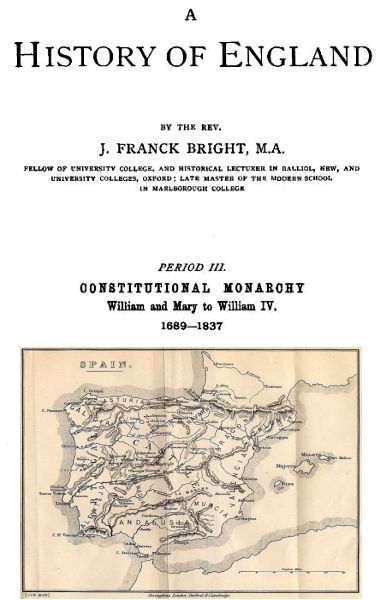
A History of England, Period III. Constitutional Monarchy
Explore more books like this:
About This Book
A chronological survey of England's political evolution from the Revolution at the end of the seventeenth century through early nineteenth-century developments, detailing the shift toward a constitutional monarchy. It traces the establishment of parliamentary supremacy and party-government, the impact of recurring European wars and imperial expansion on policy and finance, and reforms in revenue, banking, and administration that underpinned state power. Organized by successive administrations and episodes, the narrative situates legal and ecclesiastical settlements, popular and elite politics, and diplomatic and military crises within a framework of institutional change, supported by maps and recommended authorities.