
The Project Gutenberg eBook of A history of the Zulu Rebellion, 1906, and of Dinuzulu's arrest, trial, and expatriation
Title: A history of the Zulu Rebellion, 1906, and of Dinuzulu's arrest, trial, and expatriation
Author: James Stuart
Release date: June 6, 2022 [eBook #68255]
Most recently updated: October 18, 2024
Language: English
Original publication: United Kingdom: MacMillan and Co., Limited, 1913
Credits: Charlene Taylor, Graeme Mackreth and the Online Distributed Proofreading Team at https://www.pgdp.net (This file was produced from images generously made available by The Internet Archive/American Libraries.)
A HISTORY OF THE ZULU REBELLION, 1906
MACMILLAN AND CO., Limited
LONDON · BOMBAY · CALCUTTA
MELBOURNE
THE MACMILLAN COMPANY
NEW YORK · BOSTON · CHICAGO
DALLAS · SAN FRANCISCO
THE MACMILLAN CO. OF CANADA, Ltd.
TORONTO
COLONEL SIR HENRY E. McCALLUM, R.E., G.C.M.G.,
(Governor of Natal, 1901-1907).
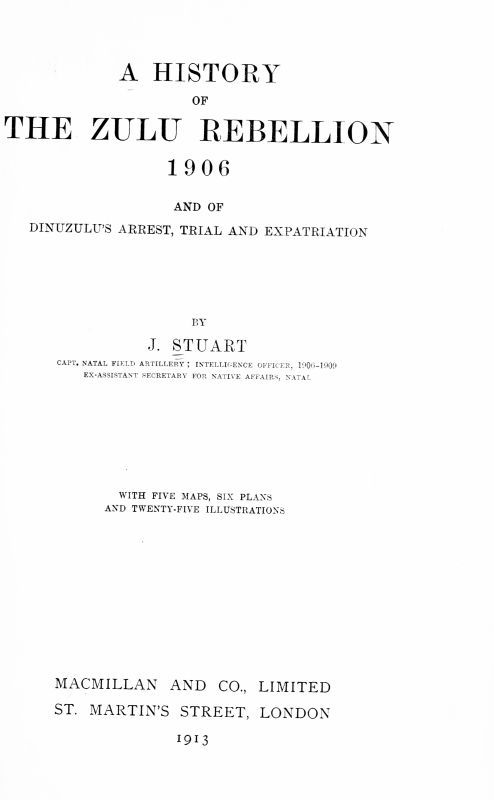
A HISTORY
OF
THE ZULU REBELLION
1906
AND OF
DINUZULU'S ARREST, TRIAL AND EXPATRIATION
BY
J. STUART
CAPT. NATAL FIELD ARTILLERY; INTELLIGENCE OFFICER, 1906-1909
EX-ASSISTANT SECRETARY FOR NATIVE AFFAIRS, NATAL
WITH FIVE MAPS, SIX PLANS
AND TWENTY-FIVE ILLUSTRATIONS
MACMILLAN AND CO., LIMITED
ST. MARTIN'S STREET, LONDON
1913
COPYRIGHT
Dedicated,
BY PERMISSION,
TO
HIS EXCELLENCY,
COLONEL SIR HENRY EDWARD McCALLUM.
R.E., G.C.M.G., AIDE-DE-CAMP TO HIS MAJESTY THE KING, ETC., ETC.
GOVERNOR OF NATAL (1901-1907),
WHOSE FIRM AND CAPABLE ADMINISTRATION
OF THE GOVERNMENT OF THE COLONY,
IN A TIME OF PUBLIC DANGER,
WILL LONG BE REMEMBERED WITH GRATITUDE
BY EVERY NATALIAN.
PREFACE.
Although the object of this book is stated in the opening paragraph, it is, perhaps, proper that the circumstances under which it came to be written should also be set briefly before the reader.
Towards the end of the campaign, probably the first to be conducted by a British colony without the assistance of the Mother Country,[1] the Government of Natal decided that a history of the military operations should be compiled. On being asked, I consented to undertake the task. But, though promptly entered upon, the greatest difficulty was experienced in carrying it to a conclusion. This arose from my being a civil servant and being obliged to continue discharging certain special as well as ordinary official duties. As, when the Union of South Africa was established, the work had not been completed, the attention of the Minister of Defence was drawn to the matter. General Smuts intimated that the new Government was unable to ratify the original instructions, and that if the book was ever to be published (which he personally hoped would be the case) it would have to be on my own responsibility and at my own expense. In these circumstances, particularly as an opportunity occurred of severing my twenty-four years' connection with the Civil Service, I resolved to go on with it and appeal for support to those who had taken part in the campaign. This appeal was made to a somewhat limited extent in 1912, and it is owing very largely to the guarantee then obtained that the heavy costs of publication have been incurred.
But, although the volume can no longer claim to be an official publication, it is in the unique position of being based as much on official information as, perhaps, any exclusively official history could have been, for I am pleased to say that considerable assistance has been given by the Government, especially by all records, e.g. commanding and other officers' reports, statistics, maps, etc., being placed freely at my disposal. The reader will, however, soon perceive that the subject has been treated with a fulness and freedom that could hardly have been expected in a more formal production. Owing, for instance, to having for years specialized in Zulu history, habits, and customs, I have not hesitated to incorporate information, germane to the subject, which I felt the reader might wish to have, especially as some of it is not procurable elsewhere. Moreover, instead of being limited, as at first intended, to the events of 1906, the narrative includes a detailed account of the Dinuzulu Expedition, and other topics incidental to that important sequel of the Rebellion.
Although I had the privilege of serving as intelligence officer throughout the campaign, as well as during the Expedition, and therefore was an eye-witness of many of the operations, it became necessary, as it was desired that the history should be comprehensive, to obtain exact information regarding several actions, operations, etc., at which I was not present. A party, which included a first-class surveyor and professional photographer, was accordingly organized by direction of the Commandant, as early as November, 1906, for the purpose of visiting the battle-fields. The members were selected for their personal knowledge of what had occurred at the places in question. Quantities of accurate information, not previously available, were thereupon collected by me at each spot, the surveyor at the same time preparing the maps and plans included herein.
So abundant is the material accumulated then, as well as on various other occasions, that it would have been easy to compile a much larger work than the present one. That the book is as full as it is, is due to the fact that no general account exists of an occurrence that must for long loom large in the history of the Native races of South Africa. To some extent, owing to my recent intimate connection with the Native Affairs Department, the book may even claim to be an introduction to and a study of some of the more fundamental aspects of the Native Question—no doubt the greatest problem with which South African statesmen will ever be called on to deal.
The main object throughout has been to ensure accuracy. Working, as I have had to do, practically alone, the task has proved long and difficult. This is the sole reason why the time originally fixed for publication has, I regret to say, been exceeded by a few months.
I cannot conclude without acknowledging my indebtedness and expressing my thanks to the many officers, non-commissioned officers and men, and others not in the military service, who, from time to time, have given valuable information and helpful suggestions or advice. To name but a few of these would be invidious. I can only say that the uniform readiness and unfailing courtesy of all to whom I was obliged to appeal have been greatly appreciated, and have gone a long way towards rendering the undertaking less arduous than it otherwise would have been. To say that the greatest assistance has come from the Government, especially the Militia and Police Departments in Natal and the Volunteer Department in the Transvaal, is but to state what will be patent to everyone.
The despatches from the Governors, Sir Henry McCallum and Sir Matthew Nathan, to the Secretary of State for the Colonies in various blue-books have been invaluable. Captain W. Bosman's and Mr. W.J. Powell's well-known books have, of course, also been consulted; the help derived from them, especially the former, is very gratefully acknowledged.
My thanks are also due to J. Windham, Esq., and my mother for reading several of the chapters and suggesting various improvements.
The index is the work of Miss M. Marsh, of the Encyclopædia Britannica staff; no pains have been spared in rendering it as complete and accurate as possible.
J. STUART.
London, June, 1913.
FOOTNOTES:
[1] But see p. 63.
CONTENTS.
| CHAPTER | PAGE | |
| I. | Introduction | 1 |
| II. | System of Native Administration in Natal | 18 |
| III. | State of Military Organization on the Outbreak of Rebellion | 38 |
| IV. | Zulu Military System and Connected Customs (with a Note on the Rebel Organization1906) | 67 |
| V. | Events and Conditions antecedent to Outbreak of Hostilities.—Murder of Hunt and Armstrong | 92 |
| VI. | Mobilization and Demonstrations in Force (a) in the South-west, (b) at Mapumulo.—Executions at Richmond | 127 |
| VII. | Outbreak at Mpanza | 155 |
| VIII. | Flight of Bambata to Nkandhla Forests.—First Steps taken to cope with the Situation.—Zulu Customs | 178 |
| IX. | The Nkandhla Forests.—Sigananda and his Tribe.—Dinuzulu's Attitude.—Early Operations at Nkandhla.—Murder of H.M. Stainbank | 204 |
| X. | Mobilization of Zululand Field Force.—Mansel Engages the Enemy at Bobe | 222 |
| XI. | Converging Movement on Cetshwayo's Grave.—Negotiations for Sigananda's Surrender.—Further Operations, Nkandhla.—Tate Gorge | 237 |
| XII. | Operations by (a) Umvoti Field Force, (b) Mackay's Column.—Battle of Mpukunyoni | 257 |
| XIII. | Further Operations by Zululand Field Force.—Action at Manzipambana.—Enemy decides to move in Force to Mome | 280 |
| XIV. | Action at Mome Gorge | 299 |
| XV. | State of Affairs at Umsinga.—Operations by Murray-Smith's Column.—Further Operations by Umvoti Field Force and Mackay's Column | 318 |
| XVI. | Concluding Operations, Nkandhla.—Visit of Dinuzulu's Indunas to Pietermaritzburg.—Position at Mapumulo.—Actions at Otimati and Peyana (Hlonono) | 333 |
| XVII. | General Concentration at Thring's Post.—Actions at Macrae's Store, Insuze and Ponjwana.—Converging Movement on Meseni's Ward | 359 |
| XVIII. | Action at Izinsimba.—Concluding Operations.—Disbandment. —Courts-martial.—Cost of the Rebellion | 386 |
| XIX. | Some Lessons of the Rebellion | 407 |
| XX. | Native Affairs Commission.—Visit of Dinuzulu to Pietermaritzburg.—Murders of Loyalists.—Escape of Bambata's Wife and Children from Usutu.—Remobilization of Militia to arrest Dinuzulu | 424 |
| XXI. | Dinuzulu Expedition.—Surrender of Dinuzulu.—Calling in of Firearms.—Searching for Outstanding Rebels | 443 |
| XXII. | Preliminary Examination and Trial of Dinuzulu.—Withholding of his Salary.—His Settlement in the Transvaal | 460 |
| XXIII. | Review of Policy followed in Connection with Dinuzulu.—His Status.—His Attitude during, and subsequent to, the Rebellion | 477 |
| XXIV. | Conclusion | 504 |
| APPENDICES. | ||
| I. | Casualties, (a) Killed, (b) Wounded | 540 |
| II. | Honours | 543 |
| III. | Strength of Forces, 7th May, 1906 | 546 |
| IV. | Disposition of Forces, 7th May, 1906 | 547 |
| V. | State of Transport, 7th May, 1906 | 548 |
| VI. | Strength of Active Militia called out, December, 1907 | 549 |
| VII. | Strength of Reserves in the Field, December, 1907 | 549 |
| VIII. | Expenditure, Rebellion and Dinuzulu Expedition | 550 |
| IX. | Zulu Songs sung at Usutu | 551 |
| X. | Causes, Superstitions, etc., Matabele Rebellion, 1896 | 551 |
| XI. | Native Corps | 557 |
| Index | 563 | |
LIST OF ILLUSTRATIONS.
(a) ILLUSTRATIONS.
Colonel Sir Henry E. McCallum, R.E., G.C.M.G., Frontispiece
Hon. C.J. Smythe,
Hon. Sir Thomas Watt, K.C.M.G.,
Hon. T.F. Carter, K.C.,
Hon. H.D. Winter,
Colonel H.T. Bru-de-Wold, C.M.G., D.S.O.,,
Major-General Sir J.G. Dartneli, K.C.B., C.M.G.,,
Colonel G. Leuchars, C.M.G., D.S.O.,,
Sir Abe Bailey, K.C.M.G.,,
Mr. H.M. Stainbank,
Mr. Oliver E. Veal,
Sub-Inspector S.H.K. Hunt,
Trooper G. Armstrong,
Bambata,
Cakijana,
Sigananda,
Mangati,
Brigadier-General Sir D. McKenzie, K.C.M.G., C.B.,
Mveli,
Sitshitshili,
Sibindi,
Mankulumana,
Bambata's Wife,
Usutu Kraal,
Group: Dinuzulu, Hon. W.P. Schreiner, K.C., AND OTHERS,
(b) MAPS AND PLANS.
Key Map, and Area of Operations, End of Index
Mpanza,
Bobe,
Mpukunyoni,
Manzipambana,
Mome, showing Tate Gorge,
Otimati,
Peyana (Hlonono),
Insuze,
Ponjwana (Sikota's Kraal),
Izinsimba and Macrae's Store,
ABBREVIATIONS.
| B.M.R. | Border Mounted Rifles. |
| Cd. | Command, i.e. "Presented by 'Command' of His Majesty to both Houses of Parliament." |
| C.M.R. | Cape Mounted Rifles. |
| C.N.A. | Commissioner for Native Affairs. |
| D.C.M. | Distinguished Conduct Medal. |
| D.L.I. | Durban Light Infantry. |
| H.F.F. | Helpmakaar Field Force. |
| I.L.H. | Imperial Light Horse. |
| J.M.R. | Johannesburg Mounted Rifles. |
| L. and Y. | Lancaster and York. |
| M.C.R. | Militia Composite Regiment. |
| N.C. | Natal Carbineers. |
| N.D.M.R. | Northern District Mounted Rifles. |
| N.F.A. | Natal Field Artillery. |
| N.M.C. | Natal Medical Corps. |
| N.M.R. | Natal Mounted Rifles. |
| N.N.C. | Natal Naval Corps. |
| N.N.H. | Natal Native Horse. |
| N.P. | Natal Police. |
| N.R. | Natal Rangers. |
| N.R.R. | Natal Royal Regiment. |
| N.S.C. | Natal Service Corps. |
| N.T.C. | Natal Telegraph Corps. |
| N.V.C. | Natal Veterinary Corps. |
| O.C. | Officer Commanding. |
| R.H. | Royston's Horse. |
| S.A.L.H. | South African Light Horse. |
| Sc.H. | Scottish Horse. |
| S.N.A. | Secretary for Native Affairs. |
| T.M.R. | Transvaal Mounted Rifles. |
| Transport | Natal Transport Corps. |
| U.D.R. | Umvoti District Reserves. |
| U.F.F. | Umvoti Field Force. |
| U.M.R. | Umvoti Mounted Rifles. |
| U.S.N.A. | Under Secretary for Native Affairs. |
| V.D. | Volunteer Decoration. |
| Z.F.F. | Zululand Field Force. |
| Z.M.R. | Zululand Mounted Rifles. |
| Z.N.P. | Zululand Native Police (Nongqai). |
GLOSSARY.
| Commando | A Boer military force, usually one recruited from a particular district. |
| Division (District) | The magisterial areas in Natal are usually spoken of as 'divisions,' in Zululand as 'districts.' |
| Donga | A channel or hollow worn in the earth by a current of water; a gully; the bank of a river, etc. |
| Impi | A force,—military, hostile, etc. |
| Indaba | A story, affair, public inquiry, etc. |
| Induna | An officer. The word, however, connotes in one context, military, and in another, civil, functions. In the case of Dinuzulu it may also be taken to mean 'political adviser.' |
| Isibalo | Corvée or compulsory labour. |
| Ka | A preposition, signifying son or daughter of, e.g. Matshana ka Mondise. |
| Kloof | A ravine or gorge. |
| Kop | A peak. |
| Kopje | A small hill or peak. |
| Krantz | A precipice or cliff. |
| Lagers | Enclosures of various kinds erected to serve as temporary or permanent fortifications. |
| Loopers | Large shot, or irregularly-shaped pieces of metal used instead of shot. |
| Nkomondala | Name of Dinuzulu's bodyguard; formed about 1901. |
| Nongqai | Policeman. Members of Z.N.P. Corps. The word, which really means 'watching,' is probably derived from uGqainyanga, a moon-gazer, i.e. night-watchman. |
| Outspan | v. To unyoke or unharness; n. Place where unyoking or harnessing occurs. |
| Spoor | A recently-formed track. |
| Supreme Chief | Title assumed by Governor in his capacity as head of the Native population. |
| Thorn country, the thorns | Country, usually low-lying, covered with stunted trees of Mimosa (thorn) species. |
| Trek | Travelling by waggon, especially when drawn by oxen. |
| Tshokobezi, properly umtshokobezi | Bushy portion of ox or cow-tail, usually white, worn about the head or neck by adherents of the Usutu faction among the Zulus; the wearer of such badge. |
| Umkumbi | The close, circular formation in which an impi is drawn up to be doctored, to receive instructions, etc. |
| Usutu | (1) Name of the tribe or faction recently presided over by Dinuzulu. (2) The war-cry used by members of Dinuzulu's tribe, as well as by those who espoused his or Bambata's cause. |
| Veld | Open, unenclosed country. |
| Viyo | A company of warriors, usually varying from fifty to eighty or more in number. |
| Voorlooper | A person, generally a small Native boy, who leads a span of oxen. |
| Voortrekker | A pioneer. |
I.
INTRODUCTION.
The main object of this book is to describe the military operations of the Rebellion of 1906-08, a rebellion in which a considerable section of the Zulus of Natal and Zululand took up arms against the Government of Natal. Such conflict was, of course, between a race of savages on the one hand, and a number of Europeans or representatives of Western Civilization on the other. An account of the campaign that ensued might, indeed, succeed in holding the reader's attention and even afford information of practical value. However that may be, whenever great and sudden outbursts of hostility occur in human society, no one is quite satisfied unless he can, at the same time, learn something of the inner or underlying circumstances under which they came to take place. Particularly is this the case when, as in the present instance, the hostilities were planned by people with whom the British race had been in close contact and on terms of amity for upwards of eighty years. This aspect of the matter will, therefore, be kept carefully in view, in the hope that some of that fuller information, which, it is assumed, every reader naturally desires to have, may be afforded. In order that this better understanding may be obtained, it is necessary to begin with the first coming into contact of the colonists with the Zulu people.
It was in May, 1824, that the first group of European settlers arrived in Natal by sea from the Cape Colony.[2] They found large tracts of country about Port Natal almost uninhabited.[3] Learning that the King of that important section of the Bantu family, the great and terrible Tshaka, then residing in what is now called Zululand, claimed the territory as his, they immediately repaired to the royal headquarters, Bulawayo,[4] obtained from the despot permission to take up their abode at the Port and enter into commercial dealings with his people. Notwithstanding the ease with which a footing was obtained, their position was, for many years, one of very considerable insecurity, which, indeed, was inevitable under the prevailing mode of government.
The circumstances might have been different had the Zulu dynasty been long in power. As it was, for barely a decade had any kingdom existed in those parts, its existence having been brought about by Tshaka himself by means of a newly-created and remarkable military system, to be described in a later chapter, under which practically every man and youth capable of bearing arms was bound to serve. As, through the King's aggressive tactics, the borders of the country were being rapidly expanded, it can be seen his forces were constantly being augmented in proportion.
Owing, then, to the existence, on the north side of the Tugela, of this large, efficient and highly-organized army of warlike barbarians, an army whose movements were dependent on the caprice of as absolute an autocrat as it is possible to conceive—an army prepared and able, upon emergency, as was proved upon various occasions, to mobilize 40,000 to 50,000 men (inhabiting roadless, mountainous regions) within a week—it became a matter of vital importance for such state of affairs to be borne perpetually in mind; for these early colonists, it must be remembered, were, from 1824 to 1837, but a handful of strangers in a strange land. It became their first duty to maintain a strictly friendly disposition towards the Zulu monarch, and to avoid, by all means in their power, a conflict which must have severely crippled them, if it did not result in the complete annihilation of themselves, their families and dependants.
There were, however, not a few influences at work, feeble though these were, in the direction of placating the Zulu monarch, and securing, as far as possible, his continual friendly co-operation and goodwill. Among these, practical services of various kinds were rendered by the pioneers from time to time, in a collective as well as individual capacity. For instance, they were occasionally called on to assist in military expeditions; when not so engaged, they established and developed a commerce in sundry commodities, notably blankets, cloth, bangles and beads of different colours and sizes, in exchange for ivory, cattle, goats, corn, maize, etc., which proved as beneficial to the aborigines as it was lucrative for the settlers. Then again, men like Henry F. Fynn, the first European to settle permanently in Natal, ministered unceasingly to the numerous sick, indigent and wounded people, including the King and his relations, whom he found about him on every side during his journeys of exploration. In these and other ways, the foundations of a warm friendship (soon extended to every member of the party, and, later on, to all other Europeans that came to Natal) were gradually and successfully built up. Alive to the material advantages arising out of having the British settlers so close at hand—for were they not the makers of firearms?—not to refer to the intense interest undoubtedly aroused through his coming into contact with a strange, exceedingly capable and amicably-disposed race, apparently so situated at Port Natal as not to be a source of domestic or political annoyance, Tshaka, on being appealed to, readily agreed to cede to them, "their heirs and executors," a tract of country stretching some thirty-five miles along the coast, north and south of Port Natal, and running "about one hundred miles backward from the sea-shore,"[5] and there, in 1835, at the Port, was laid off the now beautiful town of Durban.
Thus, the earliest provisions consisted in nought else than the establishment and consolidation of a bond of friendship between the little band of adventurers and the rulers of the land, and, so long as that bond was faithfully observed, so long was there peace between the parties, whatever else might have been the position in respect of the adjoining states.
From 1824 to 23rd September, 1828 (the date of Tshaka's assassination), the British settlers averaged about twenty-five souls in number. Between the latter date and 1834 they fell to a smaller figure. But, from then on to 19th October, 1837,[6] when a party of Boers under Piet Retief arrived at Durban from the Cape Colony, the numbers, through the coming of traders and missionaries, and their families, were considerably increased.
The policy of the pioneers, indeed, could be no other than, for the time being, to place themselves wholly and unreservedly under the protection of the Zulu sovereign, first Tshaka, their declared and, as it proved, real and constant friend, and subsequently, Dingana, perfidious autocrat as he soon revealed himself to be. The kindly feelings entertained by Tshaka towards his Europeans (abelungu), as he always called them, and the invaluable services and substantial concessions extended to them up to the day of his assassination, are not borne in mind in these days as much as they deserve to be. This disposition carried with it, as a matter of course, an unqualified attitude of amity and respect on the part of the entire Zulu nation, only too eager to render immediate obedience to their tyrant.
With his successor and brother Dingana, the position became greatly altered. So far from cherishing a friendly disposition towards the immigrants, he regarded them as sources of peculiar inconvenience, if not as an insidious and growing menace to his very throne and person. He resented their harbouring refugees from his country at Port Natal, notwithstanding that Tshaka had always refrained from troubling himself with such escapades, on the ground that, in quitting Zululand for the abelungu at Isibubulungu (as the Zulus called Port Natal), they had but gone to his friends, and were, therefore, within reach whenever required. So uneasy and hostile did Dingana eventually become that, in 1834, he dispatched a strong raiding-party to massacre every soul, white as well as black, settled in the neighbourhood of the Port, and this vindictive order would have been carried out to the letter, had they not fled precipitately either towards the Cape Colony, or concealed themselves in the numerous bushes round about. As it was, a party, headed by Fynn, consisting of a considerable number of his Native adherents, was overtaken by the raiders south of Umzimkulu, and exterminated almost to a man, Fynn himself escaping. Nor was this the only occasion on which this King betrayed his hatred of the British settlers.[7]
With the arrival overland from the Cape Colony of the Boer voortrekkers, however, a great change came over the scene. Momentous events followed one another in quick succession. Here was a well-armed, mounted and efficient force, extremely small in numbers as compared with the Zulus, and very desirous of occupying the land they found vacant in the northern portions of Natal. Although in no way intending to be aggressors, the entirely amicable and co-operative spirit in which they entered upon negotiations with Dingana being evidence of this fact, they were undoubtedly regarded ab initio in that light by the Zulus. The Boers, however, had arrived in these practically unexplored regions prepared for all contingencies, war included; Dingana saw this, and war they were compelled to enter upon forthwith. The treacherous and brutal massacre of Piet Retief, along with some sixty followers and forty Hottentot and Native servants, at the principal royal kraal, Mgungundhlovu, on the 6th February, 1838, followed almost immediately by the cold-blooded murders of 281 Boer men, women and children, together with 250 of their coloured servants, at Bushman's and Blauwkrantz Rivers in Natal, were the initial acts of that wholly unprovoked war. The valiant manner in which 460 voortrekkers subsequently went forth to oppose an army outnumbering them by at least 40 to 1; the readiness with which they moved about the roadless country with cumbersome transport, notwithstanding the traps occasionally laid by a crafty foe; their crushing victory over some 9,500 Zulus at Blood River on 16th December, 1838; and their further expedition of January-February, 1840, when, as the result of a battle between Dingana and their ally Mpande, the former's power was finally shattered, will always stand to their credit, and be a lesson as to how operations can be conducted with success against a race of barbarians.
Subsequently to the death of Dingana, probably from poisoning, in January, 1840, his brother, Mpande, who, towards the end of 1839, had crossed over into Natal with a vast concourse of adherents to seek the protection of the Boers, was later on formally installed by the latter as Paramount Chief of the Zulus.
Between 1840 and 1843, the relations between the English settlers on the coast and the Boers, who had taken up their residence further inland,[8] unhappily became so strained that open hostilities broke out between them in the winter of 1843, the former having been strengthened by a regiment sent overland to Durban in 1842. This regrettable conflict resulted in the formal annexation of Natal by the British Government, the majority of the Boers falling back to establish themselves in territory across the Vaal, then already partly occupied by their own countrymen, and now known as the Transvaal.
After being invested by the Boers, as already stated, Mpande maintained and even elaborated the Zulu military system. This system continued to exist, not only to the end of his reign in 1872, but throughout that of his son Cetshwayo, that is, until the Zulu War of 1879.
During this long period, notwithstanding that numerous immigrants arrived in Natal, nothing in the shape of regular military organization took place among the white settlers, beyond the formation, from time to time, of volunteer corps[9] (this, however, does not apply to the Boers who, between 1837 and 1843, were well organized). Lagers[10] were erected in various parts of the Colony, as well as a few magazines for arms and ammunition. Where magazines existed, rifle associations soon began to be formed.
If it was never possible to determine how long it might be before trouble arose, the Government was aware that a general rising could originate only in Zululand. From the time the first colonists arrived in Natal, up to the end of the Zulu War, August, 1879, the principal arbiter of savage warfare in South Africa was the Zulu sovereign. It was to him that the whole of the tribes of Zululand—the real storm-centre of South Africa—looked, including those of Natal, who were without any hereditary King. The latter were, indeed, only too glad to place themselves under the protection of the British Government, and even actively assist against their former King in the campaign of 1879. The majority of the Natives of Natal then, and the same is still the case, consisted of people who, at various times, had fled from Zululand, fearing lest they should be put to death on some bogus charge of practising witchcraft, of infringing the very stringent and remarkable marriage regulations, or of neglecting to conform to a hundred and one instructions or directions. Ever since the days of Dingana, the King became exceedingly incensed on hearing of any of his subjects breaking away to place himself under the notoriously milder European rule south of the Tugela. Any neglect to conform to his pleasure, where, in former days, similar desires would have been carried out with alacrity and without the least demur, appeared to be no less than outrageous defiance, and, as such, punishable with the utmost rigour. The tendency of fleeing to Natal from the despotic laws, which became even more arbitrary as the possibility of infringing any of them with impunity appeared greater, grew to such formidable proportions, that special regulations were introduced in Natal to cope with the situation. Refugees, for instance, were required to indenture themselves as labourers to European house-holders, farmers, etc., for a period of three years. But, by the time Cetshwayo, long the de facto ruler of Zululand, actually began to reign (October, 1872), the prestige of the Imperial Government had become so firmly established in Natal, and to such numbers had the farmers and other Europeans grown, backed up by an Imperial garrison at Fort Napier, Pietermaritzburg, that the King perceived that any attack was not only destined to fail, but must result in the prompt dispatch of irresistible forces to bring an end to his rule. The fact, however, remained that the relations between Cetshwayo and the representatives of Imperial authority in Natal became more and more strained, and the outbreak of war between the two races sooner or later inevitable.
No one appreciated better the position than did the Natives in Natal. Because, in most cases, their having come to the Colony was tantamount to flagrant defiance of the royal will, so, no one knew better than they, that, in having placed themselves under alien protection, they had thereby burnt their boats behind them and incurred the unappeasable wrath of the Zulu dynasty. It is for this reason that Natal Natives were, formerly, at all times only too eager to co-operate with their protectors in the direct or indirect destruction of the Zulu power.
In these circumstances, as actual warfare between the colonists and the Zulus was never imminent, notwithstanding sharp differences in civilization, manners and customs, till shortly before 1879, it was unnecessary to promote systematic enrolment and organization of the local forces.
There was, however, an important factor in the situation to which reference should be made. Natal became a British Colony in 1843, and remained such, though at first, for a few years, annexed to the Cape Colony, until the grant of responsible government in 1893; thus, during the long critical period preceding and succeeding the Zulu War, it devolved on the Imperial Government to provide continually for the protection of its recently-acquired possession. A regiment was stationed at Fort Napier. With the existence of this organized and well-armed force, capable of quelling any local disorder of limited proportions, there was still less necessity for organizing the Colony's fighting material. For all ordinary purposes, the Volunteers and the Natal Mounted Police, commanded for many years by Major (now Major-General Sir John) Dartnell—the first to organize the Volunteers into a military body—were sufficient, with the Imperial troops behind them, to preserve order. After responsible government was granted, however, it became imperative for Natal to consider how to defend herself by means of her own resources against an internal or external foe.
Although there was no regular Native war in Natal proper between 1824 and 1906, there were periodical disturbances, limited, however, to particular districts. Among these may be named: the Fodo Revolt (Unkomanzi River), 1846; the Sidoyi Expedition (Ixopo division), April, 1857; the Matshana Expedition (Umsinga division), March, 1858; and the Langalibalele Rebellion (Estcourt division), November, 1873.
The most important occurrences outside, though near, the borders of Natal were: the conquest of Zululand by the Boers, assisted to some extent by British colonists, 1838-9; a raid by a Boer commando from Natal on Ncapayi, (Pondoland), 1841; battle between Cetshwayo and Mbuyazi, sons of Mpande and rival claimants to the Zulu throne, near the mouth of the Tugela (Ndondakusuka), December, 1856; the Bushman Expedition, 1866; the Sikukuni Rebellion, 1878-9; the Zulu War, 1879; and the Zululand disturbances, 1883-8.
Other battles or campaigns, in which, however, the Natives were only indirectly concerned, were: Battle of Congella, 1843; the Boer War, 1881; and the Boer War, 1899-1902.
Of the foregoing campaigns, etc., it is proposed to refer specially to two only, the Langalibalele Rebellion and the Zulu War.
The Langalibalele Rebellion, the only internal warfare of any importance prior to that of 1906, and for that reason worthy of notice here, occurred in 1873. It was directly connected with the Kimberley diamond fields, which began to be developed in the year 1870. Contractors recruited labourers in Natal for the mines. Many of these Natives received guns in lieu of wages and returned with them to Natal. The Government, objecting to unregistered arms being held, proceeded to call them in for registration, or confiscation, where any owner was regarded as unfit to possess a firearm. Langalibalele, Chief of the Hlubi tribe, living near Estcourt, refused, in the name of those of his tribe concerned, to comply with the order, although aware of instructions issued by the Government prohibiting the introduction and holding of guns, except under the usual conditions. It was believed most of the unlawfully-held weapons were in possession of this particular tribe. A force, accompanied by the Lieutenant-Governor and consisting of 200 regular troops, 300 colonial volunteers, and some 6,000 Natives, marched on 30th October to enforce obedience. Langalibalele, with a large following, fled at once into Basutoland. Many of his cattle, etc., as well as those of a Chief, Putili, who was associated with him, were seized. In attempting to hold a difficult pass in the Drakensberg Mountains,[11] by which it was correctly supposed the fugitives would travel, Major A.W. Durnford[12] and his men[13] who had been directed "not to fire the first shot," were attacked by about 200 rebels on the 4th November—three Natal Carbineers and two Natives being killed. It was found necessary to proclaim martial law on the 11th of the same month over the disaffected area, but only, as it happened, for a period of fourteen days. During the operations, some 200 rebels were killed. Langalibalele himself was followed up in December by a force under Capt. A.B. Allison, one of the Magistrates of the Colony. Finding himself opposed by Natal forces, Cape Colony troops (which had been specially sent to co-operate), as well as by the Basutos, Langalibalele, after offering some resistance, surrendered. Of the 7,000 cattle captured from him in Basutoland (besides 200-300 horses), 2,000 were awarded to the Basutos, Allison conveying the remainder, with the Chief and a number of other prisoners, back over the mountains to Natal. The Chief, with some of his sons and followers, were afterwards tried at Pietermaritzburg. He was deposed and banished to Robben Island, Cape Town, and his tribe broken up. After some years, however, he was permitted to return to Natal, where he subsequently died a natural death.
With regard to the Zulu War, the fundamental causes were disputes with Transvaal Boers over land matters, notably territory lying between the Buffalo River—then part of the eastern border of Natal—to as far down as where the Blood River enters it, and the Pongolo River. Another cause was, violation of Natal territory in July, 1878, by three sons and a brother of Sirayo, a Zulu. One of these sons was Mehlokazulu, of whom more will be heard when the Rebellion itself is being dealt with.
The land matters were investigated by a Commission. Whilst the award to be made was under consideration, various incidents occurred, thereby complicating still further an already strained position. An ultimatum was sent, by direction of the High Commissioner (Sir Bartle Frere), to the Zulu King, Cetshwayo. This, inter alia, required that certain promises, alleged to have been made by Cetshwayo at his coronation in respect of governing his people should be observed, e.g. that his army should be disbanded; that the military system should be discontinued, except on certain specified lines; that, on arriving at man's estate, Zulus should be free to marry, without waiting to receive special royal sanction; that a British resident, whose duty it would be to see that these and other stipulations were observed, should henceforth reside in Zululand.
The King failed to meet the demands, whereupon his country was invaded by three columns. During the campaign, which lasted just under eight months, several severe engagements were fought. Among these were Inyezane, Isandhlwana, Rorke's Drift, Hlobane, Kambula, Gingindhlovu and Ulundi.[14]
The last battle, Ulundi, when the Zulu power was broken up, was fought on the 4th July, but it was not until 28th August that the King was captured.
On the conclusion of the War, the country was divided into thirteen districts, over which as many Chiefs, with very extensive powers, were appointed by Sir Garnet (later Viscount) Wolseley. The arrangement soon proved calamitous and unsatisfactory, notwithstanding that a British resident was stationed in the country to supervise internal and external affairs.
After his arrest, Cetshwayo was imprisoned for a time at Cape Town. In 1882, he was allowed to visit England, where he had an audience of Her Majesty, Queen Victoria. He was subsequently repatriated, but, owing to the refusal of two or three of the thirteen appointed Chiefs to recognize him as head of the district assigned him, his position became untenable. He attacked one of these Chiefs, Zibebu, who, retaliating, forced the ex-King to take refuge in reserved territory south of the Mhlatuze River, first at Nkandhla, then at Eshowe. Cetshwayo died at the latter place on the 8th February, 1884. His body was conveyed by his people to the vicinity of the Nkandhla forests and there interred. Of this grave and forests a good deal will be heard later.
The disturbances that had broken out between Zibebu and the royal family continued down to the middle of 1888, by which time Dinuzulu, eldest son of Cetshwayo and bearer of his father's tattered mantle, had reached his majority.[15]
As the part played by Dinuzulu both before and during the Rebellion was of the greatest importance, it would be as well to include here, by way of introduction to what has to follow, a somewhat fuller notice of his antecedents. He was born about the year 1868. As Zulus are nothing if not expressive in the selection of names, so, in devising one for his eldest son, Cetshwayo gave evidence of the well-known national characteristic. Dinuzulu means "one who is a source of worry to the Zulus."
Under Sir Garnet Wolseley's settlement, Ndabuko, Dinuzulu's uncle, and, next to Cetshwayo, the man of greatest rank and influence in Zululand, was placed under one of the thirteen "kinglets," Zibebu, a blood relation of the King. During Cetshwayo's imprisonment, Ndabuko became Dinuzulu's guardian. As the result of endeavours by this prince to secure the return of Cetshwayo, friction arose between him and Zibebu. It was not long before civil war broke out between the royalist party and that of Zibebu. Ndabuko's cause became the cause of Dinuzulu. The British Government had, in the meantime, definitely refused to take over the government of the country.
In 1883, when, at Ulundi, Cetshwayo was surprised and defeated by Zibebu, Dinuzulu was saved by a faithful adherent Sitshitshili, who will be referred to later.
On the death of Cetshwayo, the heads of the nation nominated Dinuzulu as successor.[16] The claim of his younger brother, Manzolwandhle,[17] to the heirship has, however, always been regarded by the majority of Zulus as superior to his own.
Dinuzulu soon found it necessary to seek the assistance of the Boers against Zibebu and Hamu (another of the "kinglets" and an uncle of Dinuzulu). The latter (Dinuzulu) called in the support of Boers of the Transvaal, who, on the 21st May, 1884, went through the farce of "crowning" the prince "King of the Zulus," thereby recalling the occasion on which, forty years before, they had installed his grandfather as Paramount Chief. On the 5th June following, Dinuzulu's adherents, aided by 600 Boers, attacked and completely routed Zibebu and his followers at Tshanini.[18] The Boers, for their moral assistance—hardly more than moral—induced the young "King" to sign a document ceding them a large tract of north-eastern Zululand, extending down to the sea at St. Lucia Bay. This they cut up into farms and created the "New Republic," afterwards the Vryheid district of the Transvaal. In Sir A. Havelock's settlement with the Boers, this Republic was recognized by Britain, its limitations were defined, and a large portion of country alleged to have been ceded was recovered for the Zulus, including all the coast land round St. Lucia Bay.
In May, 1887, the Imperial Government assumed full control of the affairs of Zululand, the Governor's proclamation of formal annexation being read at Eshowe in the presence of some 15,000 Zulus.
Other disturbances arose between Dinuzulu and Zibebu in 1887-8, but as the country had been formally annexed by the Imperial Government, and as it appeared Dinuzulu and his two uncles, Ndabuko and Tshingana, had deliberately contravened the law, of whose provisions they were fully aware, they were arrested on a charge of public violence. Their trial took place at Eshowe before a specially-constituted court, when all three were convicted and sentenced to ten, fifteen and twelve years' imprisonment, respectively. Early in 1889, they were deported to St. Helena. There they remained until the end of 1897, when they were taken back to Zululand. Their return followed immediately upon the annexation of Zululand to Natal, when, of course, the Imperial Government ceased to directly control the affairs of the former territory. The terms of Dinuzulu's repatriation will call for particular notice in a later chapter.
In the Act of Annexation[19] it was provided that "until other provisions shall have been made ... with the approval of Her Majesty, no grants or alienation of Crown Lands ... shall be made, nor till then shall the Natives be disturbed in the use and occupation of any lands occupied or used by them at the time of the taking effect of this Act." In 1902, a Commission was appointed for the purpose of delimiting tracts of country to be reserved for occupation of the Natives, on the one hand, and those for immediate and future European occupation, on the other. About seven-twelfths of the country (whose total acreage is 6,695,000), or approximately 3,887,000 acres, divided into twenty-one separate locations, were reserved for the exclusive occupation of the Natives, whose numbers, at that time, fell just short of 200,000. Much of this land, however, was and still is unsuitable for human habitation, either because of its being too arid and stony for cultivation, of malarial fever being prevalent therein, or of its being infested with the tsetse fly. The total area set apart for European occupation was 2,808,000 acres. The recommendations of the Commission received the approval of the Imperial Government, whereupon the blocks set apart for Europeans were surveyed into farms not exceeding 500 acres apiece, mainly on the coast belt south of the Mhlatuze River, and disposed of to sugar planters. Similarly reserved lands in other parts were not so readily taken up. This opening of the door on a large scale to European settlers undoubtedly went a long way towards unsettling the people.
HON. C.J. SMYTHE,
Prime Minister and Colonial Secretary.
HON. SIR THOMAS WATT, K.C.M.G.,
Minister of Justice and Defence.
HON. T.F. CARTER, K.C.,
Attorney General, 1907-10.
HON. H.D. WINTER,
Minister for Native Affairs.