
The Project Gutenberg eBook of A Journal of the Disasters in Affghanistan, 1841-2
Title: A Journal of the Disasters in Affghanistan, 1841-2
Author: Florentia Wynch Sale
Release date: October 15, 2015 [eBook #50219]
Most recently updated: October 22, 2024
Language: English
Credits: Produced by MWS, Chris Pinfield and the Online Distributed
Proofreading Team at http://www.pgdp.net (This file was
produced from images generously made available by The
Internet Archive)
Transcriber's Note:
Apparent typographical errors have been corrected and hyphenation rationalised. Inconsistent accents have been retained.
The first of two maps precedes the Introduction. It lacks a caption but probably depicts the Kabul or Khood Cabul Pass. "Boot Khak" named on the map is probably the "Bhoodkhak" of the Journal.
The second map follows the Appendix. It depicts the British cantonments at Cabul.A
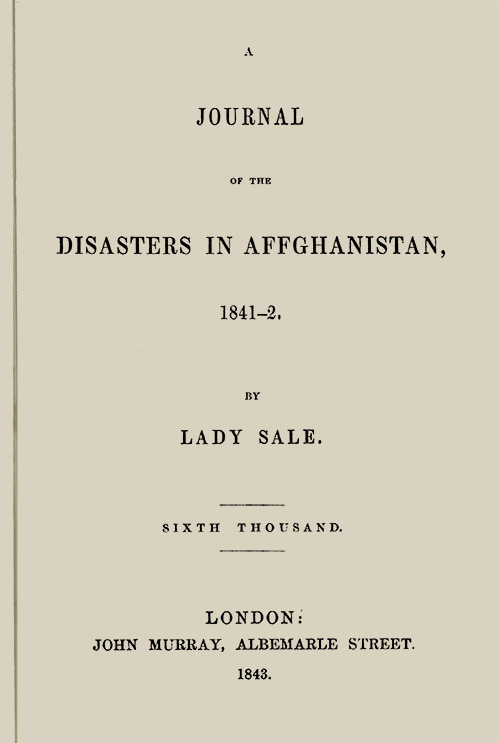
JOURNAL
OF THE
DISASTERS IN AFFGHANISTAN,
1841-2.
BY
LADY SALE.
SIXTH THOUSAND.
LONDON:
JOHN MURRAY, ALBEMARLE STREET.
1843.
London:
Printed by A. Spottiswoode,
New-Street-Square.
NOTICE.
The absence of the Author from England, and the consequent impossibility of consulting her during the progress of this work through the press, may have caused some errors to creep in,—especially in the spelling of the oriental words. The greatest care, however, has been taken to adhere exactly to the original manuscript.
CONTENTS.
| Vocabulary | Page ix |
| Introduction | 1 |
| CABUL. | |
| The Zoormut Expedition | 6 |
| Revolt of Tézeen and Bhoodkhak | 8 |
| Departure of Gen. Sale's Brigade from Cabul | 10 |
| Losses at the Khood Cabul pass | 11 |
| Terms made with the Chiefs | 21 |
| Outbreak in Cabul | 31 |
| Captain Johnson's Treasury plundered | 35 |
| Supineness of the British Chiefs | 38 |
| Capt. Campbell's regiment repulsed | 39 |
| State of the cantonments | 42 |
| Return of the 37th N. I. | 43 |
| Attack on the Commissariat fort | 50 |
| Loss of Mackenzie's fort | 54 |
| Outbreak in the Kohistan | 56 |
| Want of provisions | 58 |
| Loss of the Commissariat fort | 59 |
| Disastrous attempt to recapture the small fort | 62 |
| Shah Zeman declared King | 66 |
| Recall of Gen. Sale | 69 |
| Position of the cantonments | 70 |
| Arrival of Brig. Shelton in cantonments | 83 |
| Losses at the Rikabashees' fort | 87 |
| Death of Col. Mackrell | 89 |
| Losses at Kandahar | 95 |
| Action on the Western Heights | 97 |
| Affairs in the Kohistan | 103 |
| Accounts from Jellalabad | 108 |
| Dissensions in the British councils | 120 |
| Action on the hills above Behmaru | 121 |
| Terms proposed by the enemy | 135 |
| Reply of the Envoy | 142 |
| Difficulty of obtaining supplies | 149 |
| Attack on the captured fort | 152 |
| Disgraceful loss of the fort | 157 |
| The General urges the necessity of negotiating | 168 |
| Terms made with the enemy | 173 |
| Hostages demanded by them | 176 |
| The forts given up to them | 181 |
| The seizure of the Envoy by Mahommed Akbar Khan | 194 |
| News received of the Envoy's death | 197 |
| Negotiations resumed | 201 |
| Preparations for evacuating cantonments | 208 |
| Departure postponed | 215 |
| RETREAT FROM CABUL. | |
| Cantonments evacuated | 221 |
| Difficulties encountered by the rear guard | 227 |
| Loss of the guns and ammunition | 231 |
| Terms made with Mahommed Akbar | 235 |
| Losses in the Khoord Cabul pass | 236 |
| Akbar demands possession of the ladies and children | 244 |
| Destruction of the rear column | 254 |
| Attempt of the remnant of the army to reach Jugdaluk | 259 |
| Gen. Elphinstone and Brig. Shelton go to Mahommed Akbar | 264 |
| Deliberations of the Chiefs | 267 |
| Attack at Jugdaluk | 273 |
| The final struggle at Gundamuk | 278 |
| THE CAPTIVITY. | |
| March of the prisoners towards the Lughman valley | 279 |
| Accommodation at Buddeabad | 284 |
| Accounts from Jellalabad | 288 |
| Severe earthquake | 297 |
| Adventures of Capt. Bygrave | 300 |
| Accounts from the garrison at Ghuznee | 305 |
| Ferocity and cruelty of Mahommed Akbar | 307 |
| Change of jailors | 309 |
| Offers for ransoming the Prisoners | 311 |
| Report of the murder of Shah Shoojah | 317 |
| March for Tézeen | 321 |
| Major Pottinger expostulates with the Sirdar | 328 |
| Death of Gen. Elphinstone | 332 |
| Insults offered to his corpse on its way to Jellalabad | 334 |
| Akbar acknowledges that he slew the Envoy | 337 |
| Treachery of Shumshudeen at Ghuznee | 340 |
| Visit to the ladies of Mahommed Shah's family | 345 |
| Accounts from Jellalabad | 351 |
| Proceedings at Cabul | 351 |
| March to Khoord Cabul | 352 |
| Offers for exchange of Prisoners | 357 |
| Reports from Cabul | 365 |
| The Bala Hissar is surrendered to Akbar | 367 |
| Sufferings of Col. Stoddart and Capt. A. Conolly in Bokhara | 376 |
| Friendly conduct of the Nawaub, Zeman Shah Khan | 381 |
| Gen. Pollock offers to treat with the Sirdar | 384 |
| Gloomy prospects | 386 |
| Policy of Mahommed Akbar Khan | 386 |
| Death of Capt. John Conolly | 392 |
| Accounts of the Kandahar force | 397 |
| Newspaper controversy | 399 |
| Review of Akbar's conduct | 400 |
| His treatment of the Prisoners | 403 |
| Futteh Jung challenges Akbar to battle | 409 |
| Removal of the Prisoners to the Loghur country | 410 |
| Proposed plan for their release | 415 |
| March to Bamean | 421 |
| Terms made by the Prisoners with their jailor | 425 |
| He hoists the flag of defiance on the fort | 426 |
| The Prisoners are joined by several native Chiefs | 427 |
| They commence their March | 430 |
| Arrival of Sir Richmond Shakespear | 432 |
| Rescue by Gen. Sale | 436 |
| ADDENDA | 439 |
| APPENDIX | 449 |
VOCABULARY
OF
PERSIAN, HINDOSTANI, AND OTHER ORIENTAL WORDS
EMPLOYED IN THIS VOLUME.
- Akukzye. The name of one of the great Affghan tribes.
- Aloo-baloo. The wild sour cherry.
- Aman. The cry for mercy—quarter.
- Ameer. Commander or chief.
- Ana. A small coin; sixteen of which make a rupee. Its value is about three halfpence.
- Ashurpee. A mohur—a gold coin. Its value is about thirty shillings English.
- Ayah. A female attendant—a nurse.
- Bahadur. A bravo—a boaster or braggadocio; also a brave man—a hero.
- Bahadur (verb). To boast or brag.
- Bala Hissar. Upper citadel—royal palace.
- Barats. Legal documents—assignments—promissory notes.
- Barukzye. The name of one of the five great Dooranee tribes.
- Bash or bosh. Nothing—humbug.
- Bashee. A head-man.
- Bédanas. A sort of mulberry.
- Behmaru. The name of a village near Cabul. The word signifies "the husbandless."
- Bhanghys. Baggage.—Boxes. They are boxes hung at each end of a pole and carried on a man's shoulder.
- Bheestees. Water-carriers.
- Bhoosa or Boussa. Chopped straw—chaff. Hindostani.
- Bhoodkhees. Presents.
- Bildars. Excavators—sappers.
- Bourj or Burj. A fortified hill or tower.
- Bukshees. Gifts—presents—douceurs.
- Bukhraeed. A Mahommedan feast. The festival of the goat; held to commemorate the history of Abraham and Ishmael (Isaac).
- Bunneah. A trader—a corn-merchant or dealer in grain, flour, &c .
- Cafila. A caravan—a convoy.
- Cass. A kind of furze.
- Caupoochees. Porters. Chaoney. An encampment—cantonments.
- Charpoys. A bed on four poles, with ropes crossed over them.
- Chattak. A measure for grain, &c . The 16th part of a seer, or about 2 ounces English.
- Chebootras. Small thick mats, on which slaves usually sit or squat.
- Chillum. The part of the hookah, or pipe, containing the lighted tobacco—hence used for the pipe itself.
- Chillumchee. A washand-basin.
- Chiragh. A lamp.
- Chogah. A sort of cloak.
- Chokey. A police station.
- Chouk. A bazaar—a street. Also the portion of the taxes excused to the native Chiefs for keeping the passes open, and for keeping the tribes in check.
- Chowdry. The chief man or head of a bazaar.
- Chuddah. A sheet or veil.
- Chupao. A night attack—a surprise—a foray.
- Chupao (verb). To attack by night—to surprise by stealth.
- Chupatties. Unleavened cakes, made of ottah.
- Chuprassy. A messenger—a servant bearing a badge or brass plate.
- Chuttah or chatta. An umbrella or parasol.
- Compound. An enclosed space—the ground round a house.
- Cossid. A courier—an express—a foot messenger.
- Crore. Ten lakhs of rupees, or one million pounds sterling.
- Dāk. Letter post.
- Dallies. Baskets for fruits, &c .—panniers.
- Dewan. A steward.
- Dhal. A kind of split pea—pulse.
- Dhooley. A palanquin for the sick.
- Dhye. Sour curds.
- Dooranee. The general name of the five great tribes; the Populzye—Barukzye—Nurzye—Barmizye and Abkhuzye.
- Durbar. Levee.
- Duffodar. A non-commissioned officer of cavalry.
- Elchee. An ambassador—an agent.
- Eusofzyes. An Affghan tribe north of Peshawer.
- Fakirs. Devotees—mendicants.
- Fatcha. The prayer for the reigning monarch—a part of the Mahommedan service; the reading of which is equivalent to doing homage.
- Feringhees. Europeans—Franks—foreigners.
- Fernez. Sweet curds.
- Fouj. An army.
- Ghee. Clarified butter.
- Ghuzee or Ghazeea. A champion of religion—a fanatic.
- Gilzye. The name of a great Affghan tribe.
- Gobrowed. Dumbfounded—at a non-plus.
- Godowns. Storehouses—granaries.
- Golees. Balls—bullets.
- Golundaz. Artillerymen—literally, throwers of balls.
- Goor. Coarse brown sugar or molasses.
- Goorkha. A native of Nepaul; literally "Cowherd."
- Gulas. Cherries.
- Hamaum. A hot bath—baths; commonly written Hummums.
- Haut. A measure equal to half a yard—a cubit.
- Havildar. A serjeant in the native troops.
- Hazir-Bashes. The king's body guard. The words imply "Ever ready."
- Hookm. An order—permission—the word of command.
- Hoosseinee-Angoor. A peculiarly fine sort of grape, of immense size, called "the bull's eye."
- Huft Kohtul. The seven passes.
- Hurkaru. A messenger.
- Janbaz. The Affghan cavalry.
- Jee. Life—spirit—"with right goodwill."
- Jeerga. An assembly or council—a diet.
- Jemadar. A native officer holding the rank of lieutenant.
- Jhala. A raft.
- Jingals. Wall pieces, carrying a ball of about a quarter of a pound.
- Jorabs. Boots.
- Jung. The fight or battle.
- Juwans. Young men.
- Juzail. The long rifle of the Affghans.
- Juzailchees. Riflemen.
- Kaffirs. Infidels.
- Kaloss. Safe—free. Finished.
- Kazanchez. A treasurer—a treasury.
- Keshmish. Raisins—grapes.
- Khan. A nobleman. In Cabul the title is assumed by every one.
- Khelluts. Dresses of honour.
- Khootba. The prayer for the king.
- Kirkee. A wicket or window.
- Kos. A measure of distance, equal to about two English miles.
- Kote. A fort.
- Kotilla Taj-i. The name of a pass—literally, the crown of the mountains.
- Kotilla Murdee. The dead men's pass.
- Kujavas. Camel-panniers.
- Kulassy. A tent pitcher—a baggage servant.
- Kulma. The Mahommedan creed.
- Kuneh. A private dwelling.
- Kurtoot. The name of a village—literally, the donkey's mulberry.
- Kurwar, or Khurwah. A measure; equal to 700 lbs. English.
- Kuzzilbashes. Persians; or persons of Persian descent, residing in Cabul.
- Kyde. Prison. The root of the vulgar English "quod"—to put in quod.
- Kysee. The white apricot.
- Lakh. One hundred thousand.
- Lakh of Rupees. Ten thousand pounds sterling.
- Larye. A battle—an engagement.
- Lascar. An attendant on guns, magazines, &c .
- Loonghee. The cloth of a turban.
- Loot. Plunder.
- Loot (verb). To sack—to plunder.
- Mast. Curds.
- Maund. A measure of grain; about 80 lbs. English.
- Maush. A sort of grain.
- Meerza. A secretary—a Mahommedan writer.
- Meer Wyse. A teacher—the high priest.
- Mehmandar. A cicerone—a man of all work—a factotum.
- Mehter. A class of camp-followers—a sweeper.
- Mohur. A coin, generally gold; its value is about thirty shillings English.
- Moollah. A priest.
- Moong. Pulse.
- Moonshee. A secretary or interpreter.
- Muezzin. The call of the Faithful to prayers.
- Mushk. A leathern bag for holding water—a goat's skin.
- Musjid. A temple or place of worship.
- Nagura. A set of drums which the natives beat to announce the presence of the king or any great chief.
- Naib. A deputy or lieutenant.
- Naich. A corporal in the native troops.
- Nal. A horse-shoe.
- Nalbunds. Farriers.
- Nalkee. A palanquin.
- Nans. Cakes of bread. (? Latin, Annona.)
- Nawaub. A prince. Nabob.
- Nazir. A master of the household.
- Neemchees. A kind of spencer made of sheep-skins.
- Neencha. A coat.
- No-roz. The Vernal Equinox. The Mohammedan New Year's Day.
- Nullah. The bed of a river; also used for a river.
- Numdas. Coarse felt carpets.
- Ooloos. The tribes or clans. To summon the Ooloos, answers to our "calling out the militia."
- Oorsees. Open-work lattices.
- Ottah or Attah. Ground wheat—flour, or rather what is called pollard.
- Palkee. A palanquin.
- Pall. A kind of tent.
- Pesh Khedmuts. Attendants.
- Pillau. A dish of meat and rice.
- Posha Khana. An armoury.
- Poshteen. A sheep-skin; also a fur-pelisse.
- Pushtoo. The language of the natives of Affghanistan.
- Pyjania. Loose trowsers.
- Raj. A government—a province.
- Rajah. A prince.
- Ressalah. A troop of horse.
- Rezai or Resaiz. A counterpane—a quilt.
- Rui-band. A veil.
- Rupee. A silver coin; its value is about two shillings English.
- Saces. A groom.
- Sahib. Sir—master.
- Salaam. Salutation. To make salaam—to pay one's respects.
- Seer. A measure; about equal to two lbs. English.
- Shah Bagh. The king's garden.
- Shah Guzees or Shahghasses. The household troops—the "yeomen of the guard." Officers of the court.
- Shah-zada. A king's son—a prince.
- Shalu. Red cotton cloth from Turkey.
- Shikar. Field sports.
- Shikargurs. Hunting grounds—preserves.
- Shoke. A hobby—a mania.
- Shroffs. Native bankers—money changers.
- Shubkoon. A surprise at night.
- Shytan. The devil.
- Siah Sung. The black rock.
- Siahs. A large sect of the Mahommedans; opposed to the Soonees.
- Sipahees. The native Hindostanee troops. Sepoys.
- Sir-i-chusm. The name of a village—the words signify "the head of the spring."
- Sirdar. A general. The title assumed by Mahomed Akbar Khan.
- Sirdar-i-Sirdan. The chief of the generals. Generalissimo.
- Soonees. A large sect of the Mahommedans.
- Subadar. A native officer, holding the rank of captain.
- Sugs. Dogs. A term of contempt.
- Sungah. Breast work. Fortifications.
- Surda. A species of melon. The cold melon.
- Surwans or Surwons. Camel drivers—grooms.
- Setringees. A kind of small carpet.
- Suwars. Horsemen—troopers.
- Syud. The title of a chief of the Ooloos.
- Syud. A holy man—a saint.
- Syuds. A sect of the Mahommedans; claiming to be the descendants of the prophet; and who therefore wear the green turban.
- Tattoes. Ponies.
- Topes. Tombs—mounds—barrows. There are several in Affghanistan, built in the time of Alexander.
- Topshee Bashee. The commander of the artillery. "The master-general of the ordnance."
- Turnasook. The red plum.
- Tykhana. A cellar.
- Usufzyes. An Affghan tribe north of Peshawer.
- Vakeel. A deputy—a commissioner—one who acts or negotiates for another.
- Wuzeer. Vizier.
- Wuzeerat. The office of vizier.
- Xummuls. Coarse blankets.
- Yaboos. Affghan ponies.
- Yaghi. Rebellious—in a state of rebellion—or of independence.
- Zenana. A harem.
- Zerdaloos. Apricots.
- Zilzilla. An earthquake.
- Zubberdust. Overbearing—"with the strong arm."
- Zuna. A dwelling.
J & C. Walker, lith. 9. Castle Street.
JOURNAL
OF
LADY SALE.
INTRODUCTION.
* * * * I have not only daily noted down events as they occurred, but often have done so hourly. I have also given the reports of the day, the only information we possessed; also such news as was telegraphed from the Bala Hissar, or sent in by the King or by Capt. Conolly to the Envoy; and many other reports brought by Affghan gentlemen of Capt. Sturt's[1] acquaintance, and by others of lower degree, who having had dealings with him in the engineer department and public works, and having received kindness from him, gave him such intelligence and warning as was in their power: all of which he communicated [to his superior officers] at different times; but the warnings were not attended to; and as when he gave his advice it was seldom adhered to, he became disgusted, and contented himself with zealously performing his duties and making himself generally useful, acting the part of an artillery officer as well as that of an engineer. Had poor Sturt's life been spared, it was his intention to have worked up my Rough Notes, and to have added much valuable information: he was too much overworked to afford leisure to give me assistance at the time. His plans, drawings, &c ., with his public and private papers, were lost, except a note or two that were, just a few days before we left Cabul, put with my Journal. I believe several people kept an account of these proceedings, but all except myself lost all they had written; and had recourse to memory afterwards. I lost every thing except the clothes I wore; and therefore it may appear strange that I should have saved these papers. The mystery is, however, easily solved. After every thing was packed on the night before we left Cabul, I sat up to add a few lines to the events of the day, and the next morning I put them in a small bag and tied them round my waist. I am indebted to Capt. Souter, of H. M. 44th Regiment, for a plan, from recollection, of the cantonment and forts. The inaccuracies, if any, are but trifling; and it is sufficiently clear to indicate the positions of the principal places alluded to.
A much better narrative of past events might have been written, even by myself; but I have preferred keeping my Journal as originally written, when events were fresh, and men's minds were biassed by the reports of the day, and even hour.
It is easy to argue on the wisdom or folly of conduct after the catastrophe has taken place. With regard therefore to our chiefs, I shall only say that the Envoy has deeply paid for his attempt to out diplomatize the Affghans. Gen. Elphinstone, conscious that his powers of mind had become enfeebled with those of his body, finding there was no hope of Gen. Nott's arrival to assume the command, called in another officer to his aid, who had but one object in view (to get back, at all hazards, to Hindostan). He averred that a retreat to the Bala Hissar was impossible, as we should have to fight our way (for one mile and a half)! If we could not accomplish that, how were we to get through a week's march to Jellalabad? Once in the Bala Hissar, which would have been easily defended by one thousand men, we should have had plenty of troops for foraging purposes; and the village of Ben-i-shehr, just under the Bala Hissar, would have given us a twelvemonth's provisions if we had only made the demonstration of a night march, to have the appearance of taking them by force. Sallies from thence might also have been made into the town, where there was always a party, particularly the Kuzzilbashes, who would have covertly assisted us, until our returning fortunes permitted them to do so openly.
Independent of ——'s determination to return to India, he often refused to give any opinion when asked for it by the General, a cautious measure whereby he probably hoped to escape the obloquy that he expected would attach to the council of war, composed of Gen. Elphinstone, Brig. Shelton, Brig. Anquetil, and Col. Chambers. I might say nominally composed; numerically it was much more extended. Capt. Grant, with cold caution, obstructed every enterprise, and threw all possible difficulties in the way; Capt. Bellew was full of doubts and suggestions, all tending to hamper and retard operations; and numbers of young men gave much gratuitous advice; in fact, the greater part of the night was spent in confusing the General's ideas, instead of allowing a sick man time by rest to invigorate his powers. Brig. Shelton was in the habit of taking his rezai with him, and lying on the floor during these discussions, when sleep, whether real or feigned, was a resource against replying to disagreeable questions. Major Thain, a sincere friend and good adviser of the General's, withdrew in disgust from the council: and Sturt, who was ever ready to do any thing or give his opinion when asked, from the same feeling no longer proffered it.
As a proof that Sir William Macnaghten's confidence in Shah Shoojah was latterly much shaken, he wrote to the Governor of India, proposing that, if it really should be proved that His Majesty was acting treacherously against us, the Dost should be restored to his country. But it is very doubtful whether this despatch ever reached the Governor-General.
I shall not refer back to many small insurrections that took place, but only allude to the events that immediately preceded the grand insurrection at Cabul.
I believe I have indifferently written the name of a village as Dehmaru and Behmaru; it is called both, but Behmaru is the correct name, signifying the husbandless: Dehmaru would be the Husband's Village. It takes its name from a romantic legend of a girl of rank betrothed to a chief who was said to have been slain in combat, and she consequently pined away and died also; but the lover recovered from his wounds, and placed a stone, said to be one of those white ones that look like women in Bourkhor, over her grave on the Behmaru hill; and when he died he was buried beside her, with a similar stone to mark the spot.
[1] Lady Sale's son-in-law.
CABUL.
September, 1841.—Sir William Macnaghten obtained a force to be sent out to the Zoormut country. A chief, contemptuously designated as a robber, was said to have gone into the town of Zaho beyond Gurdez. The information given to Capt. Hay, commanding one of the Shah's corps, represented the place as contemptible. He went there with some few troops supported by guns, found that the place was much stronger than he had supposed, and that he could not do any thing against it, and that he was fired at from six forts. On this intelligence reaching Cabul, a large force was sent out on the 28th of September, under Col. Oliver of the 5th, consisting of half of Capt. Abbott's battery, two iron nine-pounder guns, a wing of the 44th Queen's, the 5th N. I., Capt. Warburton's guns, Capt. Backhouse's mountain train, Anderson's horse, the Kohistan corps, and two others of the Shah's, with the King's sappers and miners and the Hindostanee sappers and miners under Capt. Sturt, as sole engineer.
The first day's march was through the city, with narrow streets and sharp turnings, very unfavorable for guns, as was also a bad road afterwards, a nullah, and a steep ascent; all which circumstances kept them from getting into camp until late in the evening; after that the road was good, with the exception of the Al-Timor pass, which was very steep. It rises 9600 feet above the level of the sea. The crest was represented as being as much as a man on horseback could surmount, and the artillery would never have been got over it had not the natives given their assistance: 800 of them dragged the guns up. The great difficulty (as far as I could learn) lay, not so much in the acclivity, as in the roughness of the road, which was perfectly filled with huge blocks of stone. Here it was dreadfully cold, and snow fell. Beyond this pass the people of the country fled, abandoning their property, and consequently their suffering must be very great in the approaching winter.
The chiefs declared that they were ready to submit, but the orders were peremptory to destroy the forts that had fired on the Shah's troops. Lieut. John Conolly and Lieut. Burnet (54th) chupao'd[2] Akram Khan, riding sixty miles at night with 300 horsemen. They surprised the chief, his wives, and families; it was however done through the treachery of the chief's son-in-law, who disclosed his retreat. The Shah has ordered Akram Khan's execution. Whilst these events were going on, disturbances had broken out near Cabul, where much had occurred to incite the chiefs to rise. In former times, under the feudal system, when the sovereign of Cabul required troops, each bold chieftain came forward with his retainers; but these vassals had been taken from them, and were embodied in corps commanded by British officers, to whom they owed no affection, and only paid a forced obedience, whilst their hearts were with their national religion; their chief's power was now greatly limited, and the chouk guaranteed to them was withheld on the plea that the Company had commanded retrenchments. But the saving required by Government was a curtailment of those expences which were defrayed by its own rupees, whereas the 40,000 rupees now the subject of dispute were, in fact, no saving at all to us, as that money was never paid by the Company, but was the chouk or money excused to the chiefs out of the revenue or dues owing to the King, on condition of their enforcing the submission of the petty chiefs and the payment of their rents. This sum whether paid to Shah Shoojah or not, would never have replenished the Hon. Company's coffers; and by upholding the Shah in such an act of aggression we compromised our faith, and caused a pretty general insurrection, said to be headed by Meer Musjude.
The Kohistanee chiefs are urged on by the Dooranee Chiefs in Cabul, and all the country about Tézeen and Bhoodkhak is in a state of revolt. It is only wonderful this did not take place sooner.
The Indian government have for some time been constantly writing regarding the enormous expenditure in Affghanistan, every dāk has reiterated retrench; but instead of lessening the political expences and making deductions in that department, they commenced by cutting off these 40,000 rupees from the chiefs.
Affairs having assumed this gloomy appearance, the Envoy sent in all haste for the force under Col. Oliver to return as quickly as possible, leaving it to Capt. Macgregor's diplomatic ability to patch up the Zaho business as best he might, and come to the rescue with his advice regarding the Tézeenites, with whose customs, &c . he had much familiarity. Macgregor strongly advised the not stirring up a hornet's nest, and wished to try what he could do by diplomacy. Valour, however, was the order of the day; and various were the suggestions of the politicals. One plan was, that Gen. Sale's brigade, on its way down to the provinces, should make a detour viâ Nigerow. The troops were not to fight but only by their presence to overawe the Nigerowians, whilst some neighbouring tribes, who had a blood feud with them, should make the attack. Plans of the country were sent in, with imaginary roads drawn on them from various points, whilst supervening obstacles to the march of an army, such as hills and passes, were omitted. The scheme was not considered feasible, in consequence of the advanced state of the season, it being now October, and from the apprehension that the cold would destroy the camels requisite to carry the tents and provisions.
9th October.—The 35th N. I., commanded by Col. Monteath, C. B., with two six-pounder guns under Lieut. Dawes, were suddenly sent at a day's notice to Bhoodkhak, partly as being the first march towards the provinces (they forming a part of Sale's, or the 1st brigade), and partly in consequence of the disturbances.
11th.—The 13th light infantry, commanded by Lieut.-Col. Dennie, C. B., were also sent at a few hours' notice to Bhoodkhak; but as they were not to proceed on their march until the arrival of Capt. Abbott with his guns, I remained at Cabul with my daughter, Mrs. Sturt, who had been staying with us during her husband's absence with Col. Oliver's force; and Sale took his departure from Cabul, fully expecting me to follow him in three days at the latest.
12th.—The 13th and 35th, with the two guns under Dawes, moved forward, the whole under Sale, them object being to go through the Khoord Cabul pass, and place the 35th N. I. in an advanced position at Khoord Cabul, after which the 13th were to fall back again on Bhoodkhak. This movement was effected, but with considerable loss. The Khoord Cabul is a narrow defile, enclosed by high and rugged rocks; it is said that the number of the enemy did not exceed 60 men, but they possessed considerable advantage over our troops in their knowledge of the country and in the positions they took up; for until they commenced firing, not a man was known to be there. They were concealed behind rocks and stones, and by a stone breastwork that they had hastily thrown up, behind which, on our troops entering the pass, they laid in wait, and appeared to pick off the officers in particular. The number of the enemy were, however, underrated, as I am assured there were fully 200 of them. The 35th lost, in killed and wounded, about 40 men; and Capt. Younghusband, of the same corps, was badly wounded in the foot. The 13th had 8 men killed and 19 wounded. Gen. Sale was wounded in the left leg; the ball entered near the ankle, shivered the small bone, and was taken out from the skin on the other side where it had lodged. Lieut. Mein of the 13th, while leading his company up to the breastwork, was severely and dangerously wounded in the head; the skull was fractured by the ball, which entered it. Lieut. Oakes, of the same regiment, had also a very narrow escape, being wounded in the head also. It rained very heavily that night, and the 13th had the full benefit of it, for they were out all night, having two alertes; one of the sentries was mortally wounded, being shot on his post. Exertions were made to discover the persons who fired on our sentries: three men were seized who had in their possession the soldier's belt, which was a tolerable evidence of criminality; but the Envoy wrote to say, that the people about the King said that those men were good men and true, and they were to be released without any punishment!
13th.—Two companies of the 37th N. I. and two guns under Mr. Waller, were sent to reinforce the 13th at Bhoodkhak, leaving only the remainder of the 37th in cantonments, and no guns. Should there be a rising in Cabul, we should be entirely without the means of defence. The Shah's troops have moved from their camp behind, to Siah Sung, for protection, as, from the force which has gone with Col. Oliver, they have not guards enough to protect their camp, or the stores left there: their sentries are fired on constantly. Lieut. Mayne, of the Shah's service was reported to have been shot when going his rounds last night, but it was a mistake; the suwar who accompanied him was the sufferer.
A poor woman, a Mrs. Smith, the wife of a conductor, was travelling up the Bolan pass to Kandahar, with a few suwars as a guard. She was attacked by the Belooches; the suwars fled, Mrs. Smith got out of her palkee and ran a short distance, but was soon overtaken and killed; the body was not plundered, and her rings were found on her fingers, and her earrings in her ears; not that they committed the act from hatred to the Feringhees and disdain of plunder, but that, according to the superstition of these tribes, it is a most unlucky circumstance to kill a woman; and finding their victim of the gentle sex, they fled, and left her as she fell.
17th.—Col. Oliver's force returned; Capt. Abbott's guns have had their carriages much damaged; the spokes of sundry wheels are absent, thanks to the acclivities and declivities of the Al-Timor pass, so that he requires a few days to put all to rights before he can go to join Sale with the 37th: when they do so, the brigade will move on Tézeen.
18th.—The enemy came down (a chupao or night attack), 400 strong, on Khoord Cabul, where an action was fought with great loss on both sides; Lieut. Jenkins of the 30th was mortally wounded, and lingered in great agony, having been shot through the spine. Col. Monteath sent to Sale for reinforcements, who despatched to him the two companies of the 37th that had lately arrived at Bhoodkhak.
19th.—The remainder of the 37th marched from Cabul to Bhoodkhak; also Capt. Abbott and his guns, and the Shah's sappers and miners under Capt. Broadfoot. Sale and Sturt have agreed that I am to remain with him and my daughter at Cabul, and to come on with the Envoy, who is anxious to go to his government at Bombay, and Gen. Elphinstone, who returns to the provinces in consequence of ill health.
Sale's brigade is to move on to Khoord Cabul to-morrow. Seventy-seven of the wounded men from thence and Bhoodkhak have come in to cantonments, as also Lieut. Mein, of the 13th. It appears that the Hazir Bash, the escort sent by the King with Capt. Trevor to Capt. Macgregor (political agent), were the people who let the Ghilzyes into the 35th's camp; they were partly of the same tribe, and whilst the rest were fighting, these ever-ready gentlemen did a little work of their own, cutting down surwans and hamstringing camels. Whilst they were thus employed Capt. Wyndham came up with a company of the 35th, and fired into the midst, putting them to rout. Col. Monteath turned these people out of his camp as unsafe to be trusted; the Envoy has ordered them to be sent back to Cabul, and to be kindly treated, and will not believe them to be in fault. The Hazir Bash, as their name imports, are "aye ready for the field," but I fear that just now—