
PREFACE TO VOLUME XIII
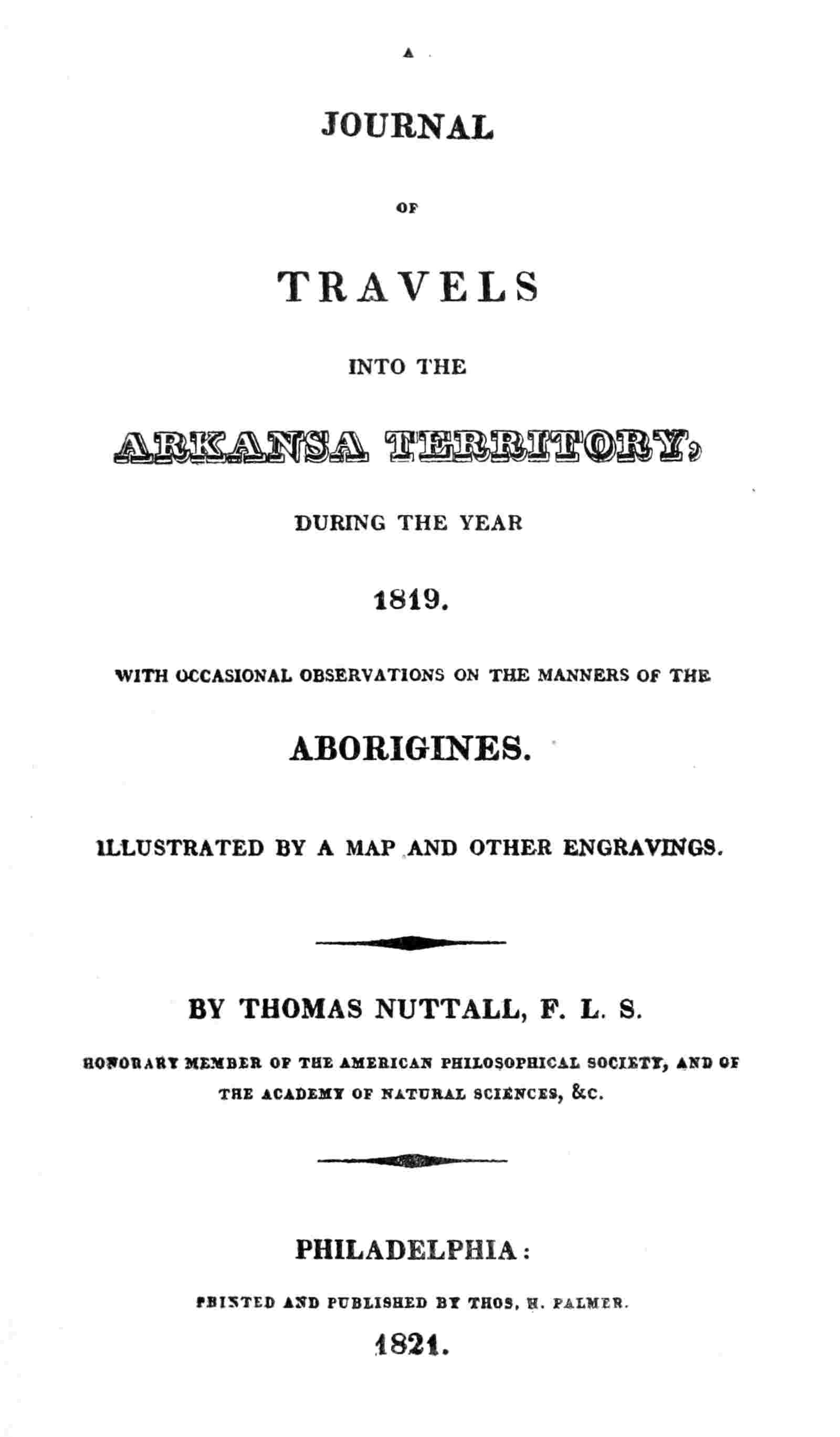
The present volume of our series is devoted to a reprint of Thomas Nuttall’s Journal of Travels into the Arkansa Territory, during the year 1819, with Occasional Observations on the Manners of the Aborigines, originally published at Philadelphia in 1821.
Nuttall was born in the market town of Settle, West Riding, Yorkshire, in 1786.[1] His parents being in humble circumstances, at an early age he was apprenticed to a printer, probably an uncle who was a member of that craft, in Liverpool. After a few years, becoming dissatisfied with his employer, he journeyed to London, where his pecuniary condition approached so near to destitution that he emigrated to the United States, arriving at Philadelphia in 1808, aged twenty-two.
In spite of the disadvantages which had beset him in his early years, a natural love for books and a faculty for application had by this time given him some knowledge of history, Greek, and Latin, and much of natural science, already his favorite study. Soon after his arrival in Philadelphia, he was seeking information relative to a plant which interested him, when he met Dr. Benjamin Smith Barton; the interview stimulated him to the botanical studies on which his fame as a scientist chiefly rests, and he soon began to make excursions, especially along the seacoast as far south as North Carolina. In 1810, he accompanied John Bradbury (whose Travels comprise volume v of our series), on the latter’s scientific expedition into the Missouri country, described in volume v of our series.
Nuttall returned to Philadelphia early in 1811, and during the succeeding eight years spent his summers in excursions within the area east of the Mississippi, his winters being passed in studying the collections thus acquired. The fruits of these studies appeared in The Genera of North American Plants and a Catalogue of the Species to 1817 (Philadelphia, 2 vols., 1818), for which he personally set most of the type. Just before the appearance of this work, Nuttall, who was already a member of the Linnæan Society of London, was elected to membership both in the American Philosophical Society and the Academy of Natural Sciences, at Philadelphia. To the journal published by the Academy he became a frequent contributor.
Being well acquainted with the cis-Mississippi region, and having already visited the Northwest, he now turned his thoughts to the Southwest. He had long desired to visit the Arkansas country, which still offered a practically virgin field for the scientific investigator.[2] Accordingly, assisted by a number of friends who were likewise interested in science,[3] he prepared for the journey which is herein recorded, and set out from Philadelphia on the second of October, 1818. Crossing southern Pennsylvania to Pittsburg, and descending the Ohio and Mississippi by boat, he arrived at Arkansas Post on January 22, 1819. Thence ascending the Arkansas River, he reached the recently-founded Fort Smith on April 24. Here he remained for three weeks, studying the flora of the vicinity. On May 16, he set out from the post with the commandant, Major Bradford, and a company of soldiers; and crossed the wilderness to Red River, following the Poteau and Kiamichi. Near the mouth of the latter, while loitering to collect some curious plants, he became separated from his companions and was compelled to spend three weeks with the squatters, awaiting the departure of a party for Fort Smith, where he finally arrived after an absence of five weeks.
On July 6, Nuttall again left Fort Smith in the boat of a trader whose establishment was situated at the mouth of Verdigris River. Reaching this point on the fourteenth, nearly a month was spent in making short trips to study the plant-life and geology of the neighborhood, and in observing the habits of the Osage Indians.
On August 11, accompanied by a hunter for guide, he began the final stage of his journey, having as its objective the river now called Cimarron. At this season the streams were stagnant, and the intense heat, foul water, poor food, and night dews soon brought on a fever, which came near terminating our traveller’s career. The Indians, moreover, were an almost constant source of annoyance and danger. Nuttall rejected the guide’s suggestion of a return to the Verdigris, and finally it became impracticable; so the two pushed on until the Cimarron was reached. By this time his fever had somewhat abated, and an effort was made to ascend that river. The loss of one of the two horses, however, compelled the abandonment of the project, and a canoe was built, in which the guide essayed to return by water while his chief rode the remaining horse. Setting forth in this fashion, still beset by Indians, who pilfered from them on every pretext, they soon found that the horse could not keep pace with the boat. The two travellers thereupon agreed to separate, and Nuttall completed the journey to the Verdigris alone, arriving, more dead than alive, on September 15. For a week he was unable to proceed farther; at Fort Smith another long halt was necessary, but on October 16 he began the descent of the Arkansas, and reached New Orleans on February 18, 1820, without further mishap.
Two years later, Nuttall was appointed curator of the botanical garden of Harvard College. He spent several years at Cambridge cultivating rare plants, pursuing his studies, and delivering occasional lectures. These years were fruitful in contributions to Silliman’s Journal, the Journal of the Academy of Natural Sciences, the Transactions of the American Philosophical Society, and the American Journal of the Medical Sciences.[4] A little later appeared his Introduction to Systematic and Physiological Botany, and at about the same time he produced the Manual of the Ornithology of the United States and Canada (Part I, Land Birds, Cambridge, 1832; Part II, Water Birds, Boston, 1834). The life at Cambridge was, however, distasteful to him; he declared that he was, like his plants, only vegetating. His instincts and habits drew him to the wilderness, that he might unravel its secrets. About the beginning of 1833, he had received a collection of plants gathered by Captain Nathaniel Jarvis Wyeth during a journey overland to Oregon. With interest in the far Northwest thus quickened, Nuttall joined Wyeth when he set out on a second expedition,[5] resigning his position at Harvard when the college authorities refused to grant a leave of absence. He was accompanied by John K. Townsend, as representative of the Philosophical Society and the Academy of Natural Sciences. The party rendezvoused at Independence, Missouri, and began the long march on April 28, 1834. Nuttall and Townsend passed the autumn exploring the environs of Fort Vancouver; but as winter drew near, they embarked on a Boston brig bound for the Sandwich Islands, where they arrived January 5, 1835. Two months later, leaving Townsend, Nuttall sailed to the California coast, where he passed the summer, returning thence to the Sandwich Islands and embarking for Boston by way of Cape Horn, on board the vessel whose cruise has been made famous by Dana’s Two Years before the Mast.
Upon reaching the United States, Nuttall resumed his abode in Philadelphia. In 1840, the results of the Pacific journey were published in the Transactions of the Philosophical Society, in the form of two long essays, entitled: “Descriptions of new species and genera of plants in the natural order Compositæ, collected in a tour across the continent to the Pacific, a residence in Oregon, and a visit to the Sandwich Islands and California, in the years 1834 and 1835;” and “Description and notices of new and rare plants of the natural orders Lobeliaceæ, Campanulaceæ, Vacciniceæ and Ericaceæ, collected in a journey across the continent of North America, and during a visit to the Sandwich Islands and Upper California.”
Nuttall’s last work, The North American Sylva; or a Description of the Forest-Trees of the United States, Canada and Nova Scotia, not described in the work of François André Michaux (Philadelphia, 3 vols., 1842–49), was, as the title indicates, undertaken as a supplement to the earlier work of Michaux.[6] It was completed on the eve of his departure from the United States, and entrusted to a friend for publication. Part one of the first volume appeared in 1842, and the second part the following year. The remaining volumes were delayed by various causes, not being printed until 1846 and 1849, respectively.
In 1841, by the bequest of an uncle, Nuttall received the estate of Nutgrove, near Liverpool, with the accompanying condition that during the remainder of his life he reside in England at least nine months of each year. Reluctantly leaving the land of his adoption and the field of his labors, impelled, it is said,[7] by regard for the needs of his sisters’ families, he retired to the ancestral estate, which he largely devoted to the cultivation of rare plants. He revisited America in 1847–48; by taking three months at the end of the first year and three at the beginning of the next, he was able to spend six consecutive months outside of England without infraction of the terms of his relative’s will. After seventeen years of the simple farm life which both his disposition and circumstances required, his death came, September 10, 1859, as the result of overstraining in his eagerness at unpacking a case of plants which had been sent to him from Asia.
Nuttall’s natural shyness was enhanced by the character of his studies, so largely pursued in the solitude of the field or forest. Both in Cambridge and Philadelphia, his circle of acquaintance was quite small; even his intimates in Philadelphia declaring that they knew not the place of his residence—his intercourse with them was largely in their homes. Of a contemplative mind, his manner was often abstracted, yet with those of like interests he was companionable and communicative. His head was large and bald, his forehead broad, his features small; he was fair of feature, and often pale from application to his work; and stout and slightly stooped of frame, but above middle height. The story of his explorations proves him to have been of an active temperament. A persistent worker, his enthusiasm was unlimited. “To me,” he said, “hardships and privations are cheaply purchased, if I may but roam over the wild domain of primeval nature.... My chief converse has been in the wilderness with the spontaneous productions of nature; and the study of these subjects and their contemplation have been to me a source of constant delight.” Several anecdotes are related, which illustrate his ardor. On one of his early excursions to the Carolina coast, he was badly bitten by mosquitoes; but, absorbed in his investigations, was unconscious of the presence of the insects until, upon approaching a dwelling, he was thought to be afflicted with small-pox, and well-nigh driven away. When rounding Cape Horn, with the vessel beset by wind and icebergs, he vainly pleaded with the captain to be set on shore if only for a few hours, that he might examine the vegetation of that little-known coast.[8]
Nuttall will chiefly be remembered as a man of science. His work was painstaking, and he made solid contributions to the knowledge of his generation. Nor was he in his own lifetime denied his meed of praise, especially for his botanical work. Contemporary reviews of his books were usually appreciative; a fellow-member[9] of the American Philosophical Society left this testimony: “No other explorer of the botany of North America has, personally, made more discoveries; no writer on American plants, except perhaps Professor Asa Gray, has described more new genera and species. His name will live as long as our Flora remains an object of study.”
The journal of the Arkansas journey, reprinted in the present volume, while primarily interesting to the scientist is not without value for the historian. The author was fairly well acquainted with the principal printed accounts of Spanish and French exploration in the region, as well as with the reports of the previous American visitors. But Nuttall’s historical statements are not invariably accurate; the value of the work lies in the record of his personal observations, from which we obtain often graphic descriptions of the settled portions of the Arkansas country and the state of civilization prevalent there in 1819. Neither does our author neglect the Indians, in whom he was much interested. His book ranks high as a source of information regarding the native tribes of that region, especially the Quapaw; although such of his information as was obtained second hand needs the corrective of critical study.
In the preparation of this volume for the press, the Editor has had the assistance of Homer C. Hockett, fellow in American history in the University of Wisconsin.
R. G. T.
Madison, Wis., February, 1905.
FOOTNOTES:
[1] The chief source of information concerning Nuttall’s life is a “Biographical Notice” prepared upon his death by Elias Durand, for the American Philosophical Society, and published in their Proceedings for 1859–60 (volume viii, p. 297). Other details are given in his writings, especially the Journal, and in Bradbury and Townsend, who were his associates on other expeditions (see volumes v and xxi of our series).
[2] The expeditions of William Dunbar and Dr. George Hunter, who explored the Ouachita as far as Hot Springs in 1804, under a commission from President Jefferson, and of Lieutenant James B. Wilkinson, who descended the Arkansas River under General Z. M. Pike’s orders in 1806, were primarily geographical and topographical reconnaissances.
[3] This fact, and the names of Nuttall’s patrons, appear in the dedication.
[4] For full titles of the numerous essays, see the sketch of his life, referred to in note 1, ante.
[5] Wyeth’s expedition was dispatched for the purpose of establishing trading posts for the Columbia Fishing and Trading Company.
[6] Histoire des arbres forestiers de l’Amérique du Nord (Paris (?), 4 vols., 1810–13); translation by Augustus L. Hillhouse, North American Sylva, or a description of the forest trees of the United States, Canada and Nova Scotia (Paris, 3 vols., 1819).
[7] See the Durand Memorial.
[8] Dana, Two Years Before the Mast, quoted by Durand.
[9] Elias Durand, in sketch already cited.