
CHAPTER XXVI.
ADVENTURES AMONG THE SHILLOOK NEGROES.
Morning—Magnificence of the Island Scenery—Birds and Hippopotami—Flight of the Natives—The Island of Aba—Signs of Population—A Band of Warriors—The Shekh and the Sultan—A Treaty of Peace—The Robe of Honor—Suspicions—We walk to the Village—Appearance of the Shillooks—The Village—The Sultan gives Audience—Women and Children—Ornaments of the Natives—My Watch—A Jar of Honey—Suspicion and Alarm—The Shillook and the Sultan’s Black Wife—Character of the Shillooks—The Land of the Lotus—Population of the Shillook Kingdom—The Turning Point—A View from the Mast-Head.
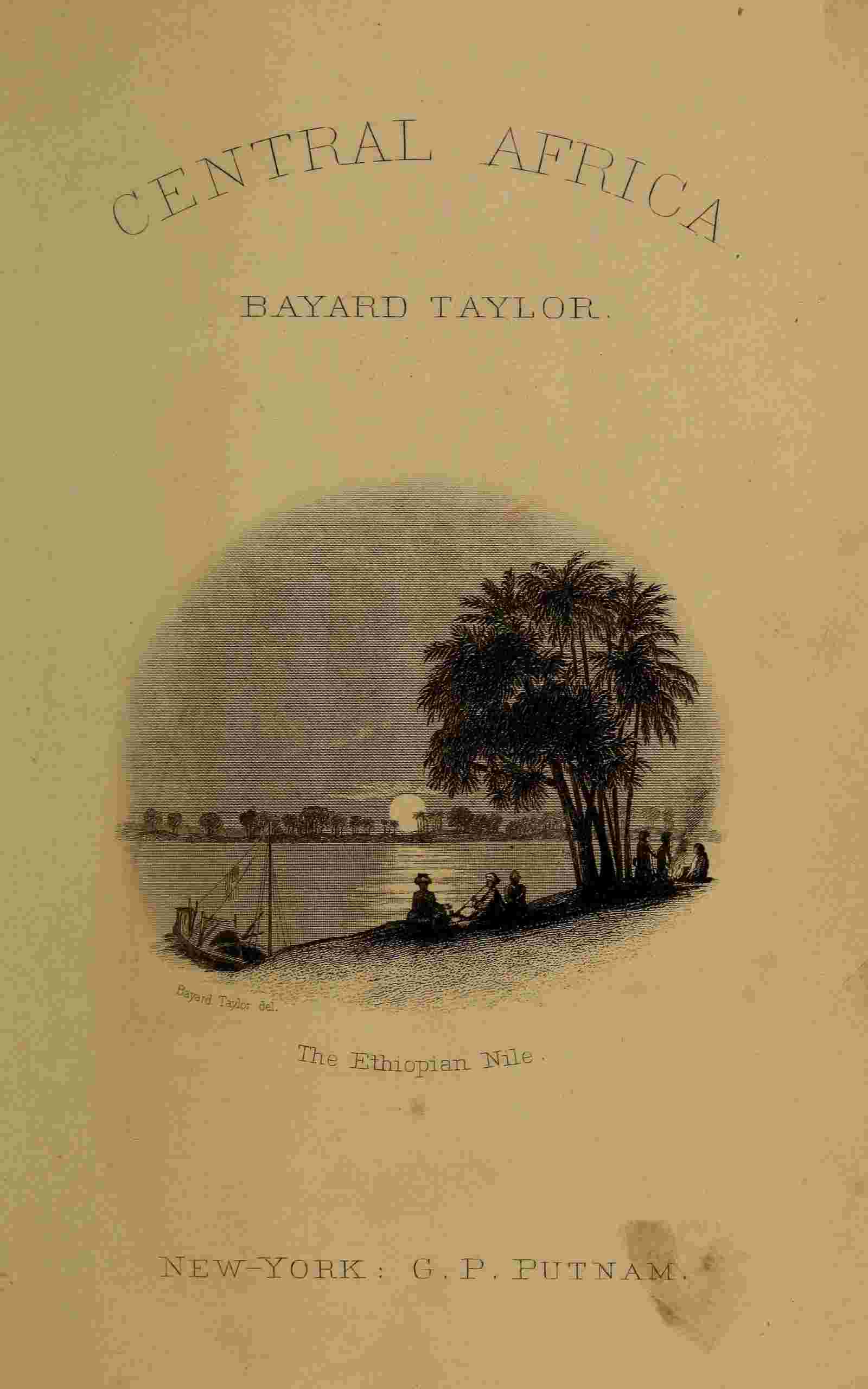
We sailed nearly all night with a steady north-wind, which towards morning became so strong that the men were obliged to take in sail and let us scud under bare poles. When I rose, in the gray of early dawn, they were about hoisting the little stern-sheet, which alone sufficed to carry us along at the rate of four miles an hour. We had passed the frontier of Egyptian Soudân soon after sunset, and were then deep in the negro kingdom of the Shillooks. The scenery had changed considerably since the evening. The forests were taller and more dense, and the river more thickly studded with islands, the soil of which was entirely concealed by the luxuriant girdle of shrubs and water-plants, in which they lay imbedded. The ambak, a species of aquatic shrub, with leaves resembling the sensitive plant and winged, bean-like blossoms of a rich yellow hue, grew on the edge of the shore, with its roots in the water and its long arms floating on the surface. It formed impenetrable ramparts around the islands and shores, except where the hippopotamus and crocodile had trodden paths into the forests, or the lion and leopard had come down to the river’s margin to drink. Behind this floating hem of foliage and blossoms appeared other and larger shrubs, completely matted together with climbing vines, which covered them like a mantle and hung from their branches dangling streamers of white and purple and yellow blossoms. They even stretched to the boughs of the large mimosa, or sont trees, which grew in the centre of the islands, thus binding all together in rounded masses. Some of the smaller islands resembled floating hills of vegetation, and their slopes and summits of impervious foliage, rolling in the wind, appeared to keep time with the rocking of the waves that upheld them. The profusion of vegetable life reminded me of the Chagres River. If not so rich and gorgeous, it was on a far grander scale. The river had still a breadth of a mile and a half, where his current was free, but where island crowded on island in a vast archipelago of leafy shores, he took a much wider sweep. The waves danced and glistened in the cool northern wind, as we glided around his majestic curves, and I stood on deck watching the wonderful panorama unfold on either side, with a feeling of exultation to which I gave free vent. In no other river have I seen landscapes of larger or more imposing character.
All the rich animal world of this region was awake and stirring before the sun. The wild fowls left their roosts; the zikzaks flew twittering over the waves, calling up their mates, the sleepy crocodiles; the herons stretched their wings against the wind; the monkeys leaped and chattered in the woods, and at last whole herds of hippopotami, sporting near the shore, came up spouting water from their nostrils, in a manner precisely similar to the grampus. I counted six together, soon after sunrise, near the end of an island. They floundered about in the shallows popping up their heads every few minutes to look at us, and at last walked out through the reeds and stood upon the shore. Soon afterwards five more appeared on the other side of the river, and thenceforth we saw them almost constantly, and sometimes within fifty yards. I noticed one which must have been four feet in breadth across the ears, and with a head nearly five feet long. He opened his mouth wide enough to show two round, blunt tusks, or rather grinders, one on each side. They exhibited a great deal of curiosity, and frequently turned about after we had passed, and followed for some time in our wake.
Soon after sunrise the raïs observed some Shillooks in the distance, who were sinking their canoes in the river, after which they hastily retreated into the woods. We ran along beside the embowering shores, till we reached the place. The canoes were carefully concealed and some pieces of drift wood thrown over the spot, as if left there by the river. The raïs climbed to the mast-head and called to the people, assuring them that there was no danger, but, though we peered sharply into the thickets, we could find no signs of any human being. The river here turned to the south, disclosing other and richer groups of islands, stretching beyond one another far into the distance. Directly on our left was the northern point of the island of Aba, our destination. As the island is six or eight miles in length, I determined to make the most of my bargain, and so told the raïs that he must take me to its further end, and to the villages of the Shillooks, whom I had come to see. Abou-Hammed was small in body, but had a stout heart. The Consul and fat Abou-Balta had given him special instructions to keep me out of danger, yet he could not refuse my demands. We sailed two or three miles along the shore of Aba, looking into the depths of its ambak forests for traces of the Shillooks, who, according to the raïs, had a village on the island. On our right extended a chain of smaller islands—bowery masses of leaves and blossoms—and beyond them the wild forests of the western bank. Glorious above description was that world of waves and foliage—of wood, water and sky.
At last, on rounding one of the coves of Aba, we came upon a flock of sheep, feeding along the shore. A light thread of smoke arose from among some dead, fallen trees, a few paces in the forest, but no person was to be seen. The boat was run to the shore, and we landed and examined the spot. The natives had evidently just left, for the brands were burning, and we saw the prints of their long feet in the ashes. The raïs and sailors walked on tiptoe through the woods, looking for the hidden inhabitants. The mimosas, which here grow to the height of fifty feet, met above our heads and made a roof, against the sun. Some large gray apes, startled by our visit, leaped with wonderful dexterity from tree to tree. I found several abandoned fire-places during my walk, and near the shore saw many footprints in the soft soil. The forest was quite clear of underwood, but the ground was cumbered with the trunks of dead trees. There were but few flowering plants, and I was too much interested in the search for the Shillooks to examine them.
The raïs finally descried the huts of the village at a distance, near the extremity of the island. We returned to the vessel, and were about putting off in order to proceed thither, when a large body of men, armed with spears, appeared in the forest, coming towards us at a quick pace. The raïs, who had already had some intercourse with these people and knew something of their habits, advanced alone to meet them. I could see, through the trees, that a consultation was held, and shortly, though with some signs of doubt and hesitation, about a dozen of the savages advanced to within a short distance of the vessel, while the others sat down on the ground, still holding the spears in their hands. The raïs now returned to the water’s edge, and said that the Shillooks had come with the intention of fighting, but he had informed them that this was a visit from the Sultan’s son, who came to see them as a friend, and would then return to his father’s country. Thereupon they consented to speak with me, and I might venture to go on shore. I landed again, with Achmet, and walked up with the raïs to the spot where the men were seated. The shekh of the island, a tall, handsome man, rose to greet me, by touching the palm of his right hand to mine and then raising it to his forehead. I made a like salutation, after which he sat down. The vizier (as he called himself), an old man excessively black in complexion, then advanced, and the other warriors in succession, till all had saluted me. The conversation was carried on in the Arabic jargon of Soudân, which the shekh and some of his men spoke tolerably well, so that I could understand the most of what was said. “Why don’t you bring the Sultan’s carpet that he may rest?” said the shekh to one of my sailors. The carpet and pillows were immediately brought, and I stretched myself out in front of the shekh and vizier, who sat upon a fallen tree, while the others squatted upon the ground. The shekh at first took no part in the conversation, but sat looking at me steadily, from under his heavy eyebrows. Our negotiations were conducted in genuine diplomatic style. Whenever His Majesty of the Shillooks had any thing to say, he mentioned it to his vizier, who addressed Achmet, my vizier, who communicated it to me, the Sultan. The spectators observed the most profound silence, and nothing could surpass the gravity and solemnity of the scene.
In the mean time the other warriors had come up and taken their seats around us, each one greeting me before he sat down, with “ow-wow-wobba!” (probably a corruption of the Arabic “mar-habba?” “how d’ye do?”) The vizier, addressing me through Achmet, said: “Tell us what you want; if you come to fight, we are ready for you.” I assured the shekh through him that I came as a friend, and had no intention of molesting them, but he was not satisfied, and repeated three or four times, drawing a mark between us on the ground: “if you are really friends, we will be friends with you; but if you are not, we are ready to fight you.” Achmet at last swore by the Prophet Mohammed, and by the wisdom of Allah, that we had come in peace; that the Sultan wished to pay him a visit, and would then return home. At the request of the raïs we had come on shore unarmed, but it had not the anticipated effect. “Why have you no arms?” said the shekh; “are you afraid of us?” I told him that it was in order to show that I had no hostile intentions, but the people seemed to consider it as mark of either treachery or fear. I brought some tobacco with me; which I gave to the shekh, but he received it coldly, and said: “Where is the dress which the Sultan has brought for me?” This reminded me that I had entirely neglected to provide myself in Khartoum with muslin and calico, for presents. I remedied the deficiency, however, by going on board and taking one of my shirts and a silk handkerchief, as well as some beads and ear-rings for the wives of the two dignitaries. Achmet added a shirt and a pair of Turkish drawers, and brought a fresh supply of tobacco for the warriors. The shekh took the presents with evident gratification, and then came the work of clothing him. He was entirely at a loss how to put on the garments, but Achmet and the raïs unwound the cotton cloth from his loins, stuck his legs into the drawers, his arms into the shirt-sleeves, and tied the handkerchief about his head. Once clothed, he gave no more attention to his garments, but wore them with as much nonchalance as if he had never possessed a scantier costume. The vizier, who had shown manifest ill-humor at being passed by, was quieted by the present of a shirt, which was put upon his shoulders in like manner. He gave me his name as Adjeb-Seedoo (“He pleases his Master”), a most appropriate name for a vizier. The shekh’s name, Abd-en-noor (“the Slave of Light”), was hardly so befitting, for he was remarkably dark. I was much amused at my servant Ali, who had shown great terror on the first appearance of the savages. He had already become so familiar, that when the shekh did not seem to understand the use of the beads and ear-rings, Ali pinched his ears very significantly, and took hold of his neck to show how they must be worn.
By this time coffee had been prepared and was brought to them. But they had been so accustomed to inhumanity and deception on the part of the Turks, that they still mistrusted us and no one would drink, for fear that it contained poison. To quiet them, therefore, I drank a cup first, after which they took it readily, but many of them, who then tasted coffee for the first time, did not seem to relish it. A drove of sheep happening to pass by, the shekh ordered one of the rams to be caught and put on board the vessel, for the Sultan’s dinner. The men soon began to demand tobacco, clothes, and various other things, and grew so importunate that Achmet became alarmed, and even the raïs, who was a man of some courage, seemed a little uneasy. I thought it time to give a change to affairs, and therefore rose and told the shekh I was ready to visit his village. We had intended returning on board and sailing to the place, which was at the southern extremity of the island, about a mile distant, but reflecting that this might occasion mistrust, and that the best way of avoiding danger is to appear unconscious of it, I called Achmet and the raïs to accompany me on foot. While these things were transpiring, a number of other Shillooks had arrived, so that there were now upwards of fifty. All were armed—the most of them with iron-pointed spears, some with clubs, and some with long poles, having knobs of hard wood on the end. They were all tall, strong, stately people, not more than two or three under six feet in height, while the most of them were three or four inches over that standard. Some had a piece of rough cotton cloth tied around the waist or thrown over the shoulders, but the most of them were entirely naked. Their figures were large and muscular, but not symmetrical, nor was there the least grace in their movements. Their faces resembled a cross between the Negro of Guinea and the North American Indian, having the high cheek-bones, the narrow forehead and pointed head of the latter, with the flat nose and projecting lips of the former. Their teeth were so long as to appear like tusks, and in most of them one or two front teeth were wanting, which gave their faces a wolfish expression. Their eyes were small and had an inflamed look, which might have been occasioned by the damp exhalations of the soil on which they slept. Every one wore an armlet above the elbow, either a segment of an elephant’s tusk, or a thick ring of plaited hippopotamus hide. The most of them had a string of glass beads around the neck, and the shekh wore a necklace of the large white variety, called “pigeon eggs” by the traders on the White Nile. They had no beards, and their hair was seared or plucked out on the forehead and temples, leaving only a circular crown of crisp wool on the top of the head. Some had rubbed their faces and heads with red ashes, which imparted a livid, ghastly effect to their black skins.
The shekh marched ahead, in his white garments and fluttering head-dress, followed by the warriors, each carrying his long spear erect in his hand. We walked in the midst of them, and I was so careful to avoid all appearance of fear that I never once looked behind, to see whether the vessel was following us. A violent dispute arose among some of the men in front, and from their frequent glances towards us, it was evident that we were in some way connected with the conversation. I did not feel quite at ease till the matter was referred to the shekh, who decided it in a way that silenced the men, if it did not satisfy them. As we approached the village, good-humor was restored, and their demeanor towards us was thenceforth more friendly. They looked at me with curiosity, but without ill-will, and I could see that my dress interested them much more than my person. Finally we reached the village, which contained about one hundred tokuls of straw, built in a circular form, with conical roofs. They were arranged so as to inclose a space in the centre, which was evidently intended as a fold for their sheep, as it was further protected by a fence of thorns. Guards were stationed at intervals of about twenty yards, along the side fronting the river, each leaning back against his spear, with one of his legs drawn up, so that the foot rested against the opposite knee. At the principal entrance of the village, opposite which I counted twenty-seven canoes drawn up against the shore, we made halt, and the shekh ordered a seat to be brought. An angareb, the frame of which was covered with a net-work of hippopotamus thongs, was placed in the shade of a majestic mimosa tree, and the shekh and I took our seats. Another angareb was brought and placed behind us, for our respective viziers. The warriors all laid aside their spears and sat on the ground, forming a semicircle in front of us. A swarm of naked boys, from eight to twelve years of age, crept dodging behind the trees till they reached a convenient place in the rear, where they watched me curiously, but drew back in alarm whenever I turned my head. The village was entirely deserted of its inhabitants, every one having come to behold the strange Sultan. The females kept at a distance at first, but gradually a few were so far overcome by their curiosity that they approached near enough for me to observe them closely. They were nude, except a small piece of sheepskin around the loins, and in their forms were not very easy to distinguish from the men, having flat, masculine breasts and narrow hips. They were from five feet eight inches to six feet in height. The raïs informed me that the Shillooks frequently sell their women and children, and that a boy or girl can be bought for about twenty measures of dourra.
After undergoing their inspection half an hour, I began to get tired of sitting in state, and had my pipe brought from the boat. I saw by an occasional sidelong glance that the shekh watched me, but I smoked carelessly until the tobacco was finished. Some of the men were already regaling themselves with that which I had given them. They had pipes with immense globular bowls of clay, short, thick stems of reed, and mouth-pieces made of a variety of wild gourd, with a long, pointed neck. A handful of tobacco was placed in the bowl and two or three coals laid upon it, after which the orifice was closed with clay. The vizier, Adjeb-Seedoo, who had something of the Yankee in his angular features and the shrewd wrinkles about the corners of the eyes, chewed the tobacco and squirted out the saliva between his teeth in the true Down-East style. I bargained for his pipe at two piastres, and one of the ivory arm-rings at five, but as I had no small silver money (the only coin current among them), did not succeed in getting the former article. I obtained, however, two of the arm-rings of hippopotamus hide. While these things were going on, the shekh who had been observing me closely, saw the chain of my watch, which he seized. I took out the watch and held it to his ear. He started back in surprise, and told the men what he had heard, imitating its sound in a most amusing manner. They all crowded around to listen, and from their looks and signs seemed to think the case contained some bird or insect. I therefore opened it, and showed them the motion of the balance-wheel and of the hand on the smaller dial of the face. Their astonishment was now changed to awe and they looked at it silently, without daring to touch it.
I profited by this impression to make a move for starting, before their greed for presents should grow into a resolve to rob us by force. I had asked the shekh two or three times to have a cup of water brought for me, but he seemed to pay no attention to the request. Soon, however, one of the men brought a large earthen jar, stopped with clay, and placed it at my feet. Thereupon the shekh turned to me, saying: “There is plenty of water in the river, and here I give you honey to mix with it.” The jar was taken on board, and contained, in fact, nearly a gallon of wild honey, which had a rich, aromatic taste, like the odor of the mimosa flowers. The trading-vessels on the White Nile purchase this honey, but as the natives, in their hatred of the Turks, frequently mix with it the juice of poisonous plants, they are obliged to taste it themselves before they can sell it. I did not require this proof at their hands, preferring to trust them unreservedly, at least in my demeanor. Trust always begets a kindred trust, and I am quite sure that my safety among those savages was owing to my having adopted this course of conduct.
I went on board to get the money for the arm-rings, and after Achmet had paid the men, directed him and the raïs to return. Several of the Shillooks followed, offering articles for sale, and the vizier, who had waded out, holding up his new shirt so that it might not be wet, climbed upon the gunwale of the boat and peered into the cabin. I changed my position so as to stand between him and the door, gave him two onions which he saw on deck and had an appetite for, and hurried him away. The shekh and all the warriors had come down to the shore, but without their spears, and were seated on the ground, holding a consultation. By this time, however, the raïs was at the helm, and the sailors had begun to shove the bow of my boat into the stream. I called out: “O Shekh Abd-en-noor!” in a familiar way, and waved my hand as a token of parting. He rose, returned the salute, made a gesture to his men, and they all went slowly back to the village. As we were leaving, the sailors informed me that one of the Shillooks, who had come down to the boat while I was seated with the shekh on shore, took a fancy to the fat black slave who cooks for them, and expressed his determination to take her. They told him she was one of the Sultan’s wives, and that as His Majesty was now the shekh’s friend, he dare not touch her. “Oh,” said the Shillook, “if she is the Sultan’s wife, that is enough;” and he immediately returned to the shore. I forgave the impertinence of the sailors in passing off such a hideous creature as one of my wives, in consideration of the adroitness with which they avoided what might have been a serious difficulty.
The Shillooks have not the appearance of men who are naturally malicious. The selfish impudence with which they demand presents, is common to all savage tribes. But the Turks and even the European merchants who take part in the annual trading expeditions up the river, have dealt with them in such a shameful manner that they are now mistrustful of all strangers, and hence it is unsafe to venture among them. I attribute the friendly character of my interview with them as much to good luck as to good management. The raïs afterwards informed me that if the shekh had not been satisfied with the dress I gave him, he would certainly have attempted to plunder the vessel. He stated that the Shillooks are in the habit of going down the river as far as the country of the Hassaniyehs, sinking their boats and concealing themselves in the woods in the day-time, while by night they venture into the villages and rob the people of their dourra, for which they have a great fondness. They cultivate nothing themselves, and their only employment is the chase of the elephant, hippopotamus and other wild beasts. All the region east of the river abounds with herds of elephants and giraffes, but I was not fortunate enough to get sight of them.
Here is the true land of the lotus, and the Shillooks, if not the lotophagoi of the Greeks, are, with the exception of the Chinese, the only modern eaters of the plant. I was too late to see it in blossom, and there were but few specimens of it among these islands; but not far beyond Aba it appears in great profusion, and both the seeds and roots are eaten by the natives. Dr. Knoblecher, who ate it frequently during his voyage, informed me that the root resembles the potato in consistence and taste, with a strong flavor of celery. These islands are inhabited only by the hunters and fishers of the tribe, who abandon them in summer, when they are completely covered by the inundation. At lat. 12°, or about thirty miles south of Aba, both banks of the river are cultivated, and thence, for upwards of two hundred miles, the villages are crowded so close to each other all along the shores, that they almost form two continuous towns, fronting each other. This part of the White Nile is the most thickly populated region in Africa, and perhaps in the world, China alone excepted. The number of the Shillooks is estimated at between two and three millions, or equal to the population of all Egypt.
As we weighed anchor, I found that the men had taken down both sails and shipped the oars for our return to Khartoum. We had reached the southern point of the island, in about lat. 12° 30′ north, and the north-wind was still blowing strongly. The rounded tops of the mimosa forests bent southward as they tossed; the flowery arms of the ambak-trees waved to the south, trailing against the current, and my heart sank within me at the thought of retracing my steps. We had sailed two hundred and fifty miles in forty-eight hours; the gateway to the unknown South was open, and it seemed a treason against Fortune to turn my face towards the Mediterranean. “Achmet!” said I, “tell the men to set the trinkeet again. We will sail to the Bahr el-Ghazàl.” The Theban’s face became ghastly at the bare idea. “O Master!” he exclaimed, “are you not satisfied with your good fortune? We are now nearly at the end of the earth, and if we go further, it will be impossible to return.” Raïs Abou-Hammed declared that he had kept his word, and that he should now return, as it had been agreed, before we left Khartoum. I knew there was certain danger in going further, and that I had no right to violate my agreement and peril others as well as myself; but there lay the great river, holding in his lap, to tempt me on, isles of brighter bloom and spreading out shores of yet richer foliage. I was in the centre of the Continent. Beyond me all was strange and unknown, and the Gulf of Guinea was less distant than the Mediterranean, which I left not three months before. Why not push on and attempt to grasp the Central African secret? The fact that stronger, braver and bolder men had failed, was one lure the more. Happily for me, perhaps, my object on commencing the voyage had been rest and recreation, not exploration. Had I been provided with the necessary means and scientific appliances for making such an attempt useful, it would have been impossible to turn back at that point.
I climbed to the mast-head and looked to the south, where the forest archipelago, divided by glittering reaches of water, wove its labyrinth in the distance. I thought I saw—but it may have been fancy—beyond the leafy crown of the farthest isles, the faint blue horizon of that sea of water and grass, where the palm again appears and the lotus fringes the shores. A few hours of the strong north-wind, now blowing in our faces, would have taken me there, but I gave myself up to Fate and a pipe, which latter immediately suggested to me that though I was leaving the gorgeous heart of Africa, I was going back to Civilization and Home.