
The Project Gutenberg eBook of A Letter to the Right Honourable the Earl of Derby
Title: A Letter to the Right Honourable the Earl of Derby
Author: Benjamin Parsons
Release date: May 22, 2020 [eBook #62197]
Language: English
Credits: Transcribed from the 1853 John Snow edition by David Price
Transcribed from the 1853 John Snow edition by David Price, email ccx074@pglaf.org
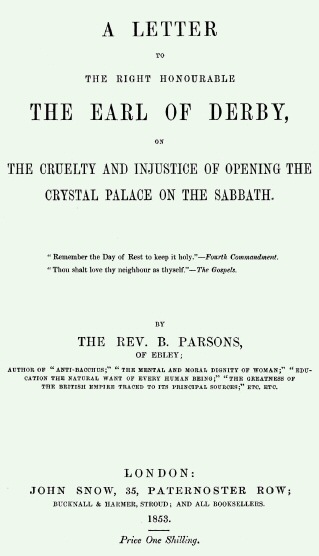
A LETTER
TO
THE RIGHT HONOURABLE
THE EARL OF DERBY,
ON
THE CRUELTY AND INJUSTICE OF OPENING THE
CRYSTAL PALACE ON THE SABBATH.
“Remember the Day of Rest to keep it holy.”—Fourth Commandment.
“Thou shalt love thy neighbour as thyself.”—The Gospels.
BY
THE REV. B. PARSONS,
OF EBLEY;
AUTHOR OF
“ANTI-BACCHUS;” “THE MENTAL AND MORAL DIGNITY
OF WOMAN;” “EDU-
CATION THE NATURAL WANT OF EVERY HUMAN
BEING;” “THE GREATNESS OF
THE BRITISH EMPIRE TRACED TO ITS PRINCIPAL
SOURCES;” ETC. ETC.
LONDON:
JOHN SNOW, 35, PATERNOSTER ROW;
BUCKNALL & HARMER, STROUD; AND ALL
BOOKSELLERS.
1853.
Price One Shilling.
A LETTER, &c. &c.
My Lord,
Divided as the country is in its political and religious sentiments, there is one subject on which there is a very great unanimity: and I may add also that this union of opinion exists among the most moral of your countrymen; the most loyal supporters of the throne and the constitution; the most enlightened members of the community; and the most benevolent and philanthropic individuals in the empire. I need not say that the point on which all these persons are agreed is “The observance of Sabbath.” Here, my Lord, you have thousands or rather millions of citizens who never trouble the realm in any way by their vices or disorderly conduct; who are never brought before magistrates or judges for their offences; and who require no soldiers or police to watch over them and keep them from disturbing the commonwealth.
It is a matter of surprise to all sober and reflecting minds that you, my Lord, should wish to set yourself in an attitude of antagonism towards all these peaceful and religious men and women; and especially that you should do this most gratuitously and in defiance of your own creed.
In proposing to have the Pleasure Grounds of the new Crystal Palace thrown open during one half of the Lord’s-day, you involved yourself in a responsibility which no one called upon you to incur, except a small body of railway speculators, and a few theoretic and practical rejectors of the commandments of the Most High. Your coadjutors and instigators are those who never allow a word of Scripture to stand in the way of their views, their pleasures, their prejudices, or their love of gain. It has become popular of late years for prime ministers “to do evil that good may come.” The Maynooth grant was asked for by few. The Catholics themselves did not want it. There has rarely been a measure which met with such unanimous opposition; but still it was carried—most tyrannically carried—in defiance of the voice of the nation: and, how has it worked? The believers in Roman Catholicism knew that it was intended as a bribe, and therefore an insult; and have resolved that they will not be converted into spiritual chattels, or have their zeal quenched or consciences silenced by Government pay. The money was taken from our pockets to purchase state patronage for the premier and his partisans, but the artifice has proved a perfect failure, for the followers of Pio Nono have shown that they are not to be bought. Your measure, my Lord, concerning the Sabbath is as perfectly gratuitous as the Maynooth scheme.
I. In wishing to grant a charter for the violation of the Lord’s-day, you, my Lord, tried to play the same game as your predecessors. The profit of a small company of railway kings was the chief thing sought; and to obtain their smile, you were willing to risk the favour of the King of Kings, to endanger the morals of the country, and consequently the Throne, the Constitution, and the Church; and you were also setting yourself in an attitude of defiance against the best and most patriotic of your countrymen. There might, my Lord, have been boldness in this effort of yours to undermine the Sabbath and trample upon the consciences of the majority of the nation, but the infatuation was equal to the courage. You have long been ambitious of power. The deep and settled opinion in your own mind for a long time has been, that both as a profoundly wise and apostolically religious man, you, my Lord, and you alone, were the only person in the realm qualified to guide the affairs of this great empire. Your Lordship has for some years put yourself forward as the bulwark of the Church and of pure Christianity. All persons who differed from you have been viewed as heretics and sinners exceedingly; and you are, according to your own showing, a model saint, the moral hero and spiritual Wellington of religion and the Bible; and yet, after all these high pretensions, no sooner were you in power than your first effort on behalf of Christianity was to announce to the country that you were about to set the authority of your royal mistress against the command of the King of Heaven; and, in doing so, you alienated from yourself and your administration the minds of the majority of the religious people whom you promised to serve if you could only obtain the reins of government.
By many of the most devout members of your Church, your premiership was hailed as the advent of another Luther or Wickliffe, and you covered all these with chagrin and shame by your gratuitous violation of the law of the Most High. There never was a specimen of greater infatuation in a statesman who aimed at popularity and almost vaunted of preeminence in religious zeal. You, my Lord, great as your power may have been, were hardly high enough to despise the favour or indignation of the Ruler of the Universe. Read history, my Lord, and you cannot find a single Sabbath breaking nation but has paid dearly for its ungodliness. The Lord’s-day, scripturally observed, would have saved France from the convulsions and bloodshed which have made it a warning to the world. Sabbath breaking sent the Jews to Babylon, and gave them seventy years of captivity that “the land might enjoy her Sabbath,” and that all ages might learn that the Almighty will not have His commands set at nought with impunity.
But supposing you had possessed such power that you could have said, “I fear not God,” yet sound policy might have suggested that it would be well to have some “regard to man.” You really were not quite secure in your post as prime minister. A few votes of the senate deprived you in an instant of all your authority; and you fell because you rendered yourself unpopular in the estimation of the nation. You ought also to know that religion is a sacred thing in the eyes of all, whether Pagans, Jews, Mahommedans, or Christians. To touch the ark has brought destruction upon many an “Uzzah” without any special intervention of heaven; and you, my Lord, are not too high for their doom. The majority which sustained you in office was very small and doubtful; and nothing sunk you so low in the estimation of thousands as this Sabbath desecration, which you proposed to establish by a royal charter!! By many you were looked upon as the bulwark of the Church and religion; and by your own speeches you wished to make the country believe that you were a very godly man; and yet without the least substantial reason you blasted all their hopes, and, in their estimation, you have denied the faith, and become worse than an infidel—because an unbeliever has no reverence, and can have no reverence for the Word of God; but you profess to believe in its divine origin, and to be guided by its sacred injunctions, and thus sinned with your eyes open: you have therefore foolishly, most gratuitously, alienated your friends, and hastened your own downfal, and all to please the avarice and fill the coffers of a small clique of gentlemen who prefer “gain to godliness.”
II. You have not only been guilty of the most gratuitous presumption and rashness, but you have also acted in defiance of your own creed. You, my Lord, according to your own showing, are a very religious, indeed, an apostolically religious, man—a believer in the Church Catechism, and in the doctrine of confirmation. Doubtless your Lordship has been confirmed; and I may presume that you go to church as often as the majority of your order; and, when there, you listen very attentively to the reading of the decalogue, and after each precept you most devoutly and sincerely repeat the prayer, “Lord have mercy upon us, and incline our hearts to keep this law!” At the end of the tenth command you vary the words, and say, “Lord have mercy upon us, AND WRITE ALL THESE THY LAWS IN OUR HEARTS, WE BESEECH THEE.”
In the Communion Service of the Prayer Book, I read the following words:—“Then shall the priest, turning to the people, rehearse distinctly ALL THE TEN commandments; and the people, still kneeling, shall after every commandment ask mercy for their transgression thereof, and grace to keep the same for time to come.” In accordance with this direction the clergyman in a solemn voice commences with Exodus xx. 1: “God spake these words and said;” and thus wishes to impress upon the devout and kneeling audience before him, that the laws which he is about to rehearse are the identical laws which were once proclaimed by Jehovah himself, and that they have now all the majesty and authority of the Divine Legislator which they have ever had. When he comes to the fourth, he reads, “Remember that thou keep holy the Sabbath-day. Six days shalt thou labour, and do all that thou hast to do; but the seventh day is the Sabbath of the Lord thy God. In it thou shalt do no manner of work, thou, and thy son, and thy daughter, thy man servant, and thy maid servant, thy cattle, and the stranger that is within thy gates. For in six days the Lord made heaven and earth, the sea, and all that in them is, and rested the seventh day: wherefore the Lord blessed the seventh day, and hallowed it.” No sooner are these words ended, than you, my Lord, and all true Churchmen, all newspaper editors and railway directors, who go to church on Sunday mornings, repeat the solemn prayer given above. In the sentence, “Lord have mercy upon us,” you confess that you have broken the commandment, and pray the God of Heaven to grant you “mercy” for the past; and in the following words, “Incline our hearts to keep this law,” you entreat Jehovah to renew your hearts, and give you an inclination to obey the “Fourth Commandment” in future. Are you, my Lord, sincere in this prayer and supplication? Are your Church friends among the nobility, railway companies, and newspaper editors, who use this form of devotion, sincere? The Son of God tests our love by our obedience. “If ye love me, keep my commandments,” are his sacred injunctions, plainly teaching us that if we violate his commands we give a public demonstration that we do not love him. Now, to keep the Sabbath one half of the day and violate it the other, is to furnish but a very poor proof that we feel any deference for the Fourth Commandment.
My Lord, would you be satisfied that your commands to your servants should be half broken and half kept? Are you pleased with your coachman if he drives you half way to church on the Sabbath when your command is to be driven all the way? Do you like to have your will in any other particular but half done? Would you be pleased to have your hunters and racehorses but half fed and half groomed, or your food but half cooked? Yet we may ask, Who is the Earl of Derby, that his commands should be perfectly obeyed to the very letter, while the God of Heaven, at the instance of this same Earl of Derby, is to be satisfied with only a moiety of that obedience which he has enjoined in the Scripture?
What, my Lord, if you comprehended all your own wishes in “Ten Commands,” and summoned all your servants into your presence once a week and directed your chief steward to read in their ears your injunctions, commencing with the sentence, “The Earl of Derby spake these words and said”; and what if all your attendants fell on their knees before you, and, in the most pitiful language, confessed that they had rebelled against your precepts; implored mercy for their transgressions; earnestly entreated you to assist them in their future efforts to do your pleasure; and, having satisfied themselves that you had pardoned them, immediately rose from the ground and resolved in future to be more guilty than ever by neglecting your commands altogether, or by only attending to half their import! Could you put up, my Lord, with this farce week after week and year after year? Would it require fifty-two repetitions of such insolence to exhaust your patience? Would the Earl of Derby allow himself to be thus insulted even a second time? Would you not denounce these impudent menials as a set of mocking hypocrites? But is it a matter of more importance that the Earl of Derby should not be mocked than that the God of Heaven should be worshipped in sincerity and in truth? Let me then entreat your Lordship, as you value your present consistency and future happiness, either to reverence the Fourth Commandment, or else cease to use the prayer attached to it in the Liturgy.
But perhaps you may say, “that you neither disobey it, nor teach others to do so.” I need not tell your Lordship, as a learned man, and the Chancellor of one of the great seats of learning, that the day mentioned by Moses, and which you pray the Almighty to give you grace to observe, is TWENTY-FOUR HOURS LONG; that during these twenty-four hours we are commanded to abstain from all manner of work; that we are “to keep the day holy to Jehovah,” and consequently to observe it religiously by not “doing our own ways, finding our own pleasure, or speaking our own words.” Such is the command of the King of Kings. How then can the half observance of the Lord’s-day be reconciled with the divine command to keep the whole? If the railway to Sydenham is to be worked on the Sabbath, and the pleasure grounds thrown open, you will of necessity doom a large number of clerks, stokers, drivers, porters, waiters and others to labour on that day on which Jehovah has commanded that no work shall be done. The God of Heaven says, “Thou shalt do no manner of work”; but the Earl of Derby tells the people that they may work on the Sabbath! You thus set yourself in a position of antagonism against the Creator of the Universe. The Scriptures assert that “The Son of Man is the Lord of the Sabbath”; but you, my Lord, intimate that the Earl of Derby is the Lord of the Sabbath!! When “God spake,” he solemnly commanded that the whole day should be observed; but when the Earl of Derby spoke, he said “Let half the day be kept,” thus making himself not only equal but superior to the Almighty!
It is no use, my Lord, to plead that only a few hands comparatively will be employed, because you have no right to doom even one man to lose his day of rest and sin against God, for the gain and gratification of others. One soul is of more value than the whole world; and I query whether your Lordship will be willing to stand at the bar of the Eternal in the stead of the poor labourers whom you condemned to toil on the seventh day, and thus converted into Sabbath breakers. And it would not be one, two, or ten, who would be robbed of the rest of the Sabbath, but the opening the grounds at Sydenham on Sunday would be the condemnation of hundreds of our countrymen to this seventh-day slavery. Why should railway companies be permitted to exact Sunday labour from their servants, and yet grocers, drapers, tradesmen, and manufacturers be prohibited from similar gains? The age is passing away for legislative favouritism; and if one company may have royal authority to work, oppress and destroy their vassals, why should not all the shops be thrown open: why should not the anvil, the saw and the spade be used, and all apprentices and labourers be called upon to be Sunday slaves? Such labour will minister to the pleasure and profit of many. It is rather remarkable, that almost the same day in which your good lady was announced, in connection with the Duchess of Sutherland and others, as an opponent to American slavery, you, my Lord, proclaimed yourself as the patron of English slavery! and might have founded your arguments on the same principles as the Transatlantic planters. Uncle Tom was enslaved for the profit and pleasure of his masters; and clerks, drivers, stokers, &c., &c., are to be enslaved on the Sabbath to enrich their employers, and to minister to the gratification of the irreligious portion of the community who “are lovers of pleasure more than lovers of God.” Indeed, the American slave in many instances is allowed his full day of rest on the Sabbath; but the white slave of the railway and of Sydenham is to know nothing of the repose of that day which Jehovah has set apart for the benefit not only of the sons and daughters of toil, but also of animals, for it was one of God’s commands to the Jews that “the ox and the ass should rest.”
Of course, my Lord, if you persevere now you are out of office, in this wish to have the Sabbath desecrated, you will also, in accordance with your public DISSENT from the Church of England, demand that the Prayer Book shall be altered. You will for consistency sake request the Convocation, to which you are said to be very favourable, to immediately set about the re-formation of the Liturgy as their very first work. By all means let the Fourth Commandment be omitted from the Catechism; let all reference to it be erased from the Baptismal Service; let sponsors no longer be called upon “to promise and vow” that their godchildren shall “keep God’s holy will and commandments and walk in the same all the days of their life”; and, in the service of Confirmation, let the candidates be duly taught that in taking their vows upon them, they are, on the authority of the Earl of Derby, freed from the observance of the Sabbath; let the priests of the Church also be informed that to read the Fourth Commandment is an absurdity now it is abolished; and above all, never again let heaven be mocked, piety outraged, and common sense insulted by the repetition of the prayer, “Lord have mercy upon us, and incline our hearts to keep this law.” Why should not a second book of sports be read from the pulpits of the Establishment, and the people be duly apprised that the words of the Eternal respecting the seventh day, “In it thou shalt do no manner of work, thou, nor thy son, nor thy daughter, thy man servant, thy maid servant, thy cattle, and the stranger within thy gates,” are now of no force, for the Earl of Derby has proclaimed that railway speculators may compel their servants to work on the seventh day, and as a consequence that all other persons may “go and do likewise”?
You have, my Lord, by your changing, often surprised your countrymen; but this wish to trample the Prayer Book in the dust, to set Baptism, Catechism, Confirmation, the Communion Service, and the Word of God at defiance, is a revolution which none of your friends or foes were prepared to expect, and should you succeed will be attended with greater evils to the masses and greater calamities to the nation than have ever yet occurred. England owes all to her Bible and her Sabbaths; and I may add, that the Scriptures would have been of little good without her Sabbaths. Abolish, my Lord, the rest of the seventh day, and you may write “Ichabod” on our walls. The Bible has been but partially studied by those nations who reject the Lord’s-day, and their history and present condition show that they have paid very dearly for this neglect.
But, my Lord, if you have power, supposing you were prime minister, to annul the Fourth Commandment, then you have power to abolish all the rest. If you can command that the Sabbath shall be half kept and can give men a charter to break the other half, you certainly have power to allow them to break it altogether; and if you can grant a royal commission to violate one precept of the decalogue, you can license the people to break the whole. And, my Lord, you must not stop, for there are persons to whom the Sixth, the Seventh and Eighth Commandments are as great an obstruction to their profit or pleasure as the Fourth Command is to the Sydenham gentlemen. How many thieves could enrich themselves but for the Eighth Command; and how many might relieve themselves of the burden of dependents or jump into rich inheritances, by trampling the Sixth in the dust! Yea, my Lord, were they only allowed by a royal charter to violate one half of these commandments, by half starving, half killing and half robbing their fellow creatures, no one can tell the property that might be saved or gained. Here would be a “MAGNA CHARTA” with a vengeance, and one, my Lord, which would immortalize your name to all eternity. The dead, by the million, would proclaim your fame or your infamy. And there can be no just reason given why, if you granted a charter to railway speculators to enable them to rob their servants of the Sabbath, you should not give other worshippers of Mammon equal power to plunder and oppress; for I shall presently have to show that to deprive the physical frame of rest once in seven days is both robbery and murder, and therefore if you begin to charter these outrages, you will find it difficult to stop. It will be only for any company to make out a case and prove that pleasure and profit will be the result of oppression, robbery and death, and you, to be consistent, must advocate their cause.
The change in The Prayer Book too must be greater than at first was contemplated. Instead of praying “Lord have mercy upon us, and write ALL these THY commandments in our hearts, we beseech thee”; or, when the fourth is abolished, “Lord have mercy upon us, and write NINE of these THY commandments in our hearts, we beseech thee,” you will have to obliterate them from the Liturgy altogether. And indeed wherever in the prayers, thanksgivings, or collects there is any reference to the commandments of Jehovah, the words must be omitted in the re-formed Prayer Book. Of course, my Lord, after this great and stupendous change, we shall hear no more of the heresy of Nonconformists, and the wonder of modern times will be, not, “Is Saul among the prophets?” but, “Is the Earl of Derby among dissenters?”
Other Prayer Book reforms, my Lord, will have to follow. To preserve your consistency it will be needful to omit the Lord’s Prayer. Five times in the full morning service of your Church the petition is offered, “Lead us not into temptation,” and yet when your devotions are ended you wish to proclaim by royal charter that the people shall be tempted to break the Sabbath. I need not tell your Lordship as a learned divine, that “temptation,” in the prayer alluded to, means, temptation “to sin,” and that “to sin” is to violate the commandments of Jehovah. When therefore you pray not to be led “into temptation,” you intimate that your nature is weak, and entreat our heavenly Father to prevent your being placed in any position in which your pious principles would be likely to give way. How strange then that you, who are so sensitive of your own frailty, notwithstanding the robustness of your piety, should propose to have the young, the morally feeble and undecided, tempted every seventh day to trample the commandment of heaven in the dust! Surely, my Lord, if it is of so much importance that yourself and all the railway directors and pious newspaper editors who go to church, should be kept from temptation, that you pray five times in the morning service for divine protection, then it is also necessary that the poor vulgar herd of sinners, who have so little of your apostolical godliness, should also be preserved from temptation. It seems inexplicably marvellous that you should exhibit so much care of your own piety and morality, and yet be so reckless about the virtue of your poorer neighbours as actually to propose that other persons, by royal charter, should be led into that very temptation to sin from which you five times on the Sabbath morning entreat the Almighty to enable you to escape. Either, my Lord, invite the Convocation to obliterate the Lord’s Prayer as well as the ten commandments from the Liturgy, or else cease to instigate the nation to rebel against the Word of God. In fact, if you continue to advocate Sabbath breaking, you ought to leave the Church and reject the Liturgy, or to have the words “command” and “commandments” expunged from every prayer and collect in the Prayer Book.
Need I remind your Lordship, that the words “Thy kingdom come, thy will be done in earth as it is in heaven,” refer to the ten commandments? The kingdom of God will come when his commands are obeyed, just as the kingdom of our Queen extends wherever her laws are observed. Where the laws of England are trampled in the dust, there the sceptre of Victoria is set at nought; and just in the same manner, so long as the laws of the decalogue are disregarded, the kingdom of God cannot come. “The will of God” will “be done in earth as it is in heaven,” when his laws are obeyed, because his will is embodied in his commandments. But if you propose to grant the nation or a few of your favourites a royal charter to break the divine commands, doubtless you will also have the petitions “Thy kingdom come, thy will be done in earth as it is in heaven,” “deliver us from evil,” &c., &c., erased from the Lord’s Prayer and from the Prayer Book. Indeed so few of the words of the Saviour will remain, when all reference to obedience to the laws of God is obliterated, that for very shame the mutilated part must be abandoned.
I cannot imagine that after proposing this charter for Sabbath breaking, you will ever repeat the words, “God be merciful unto us and bless us, and show us the light of his countenance and be merciful unto us. That thy way may be known upon earth, thy saving health among all nations.” God’s “way” is his commandments, and there is no “saving health” except in obeying them. But to give a royal charter to set at nought the Fourth or any other Command, is to do what you can to prevent God’s “way” from being “known upon the earth,” and therefore of course you will have this Psalm expunged from evening service, or else never unite in repeating or chanting it. Your conduct, my Lord, for the sake of consistency, must demand the most sweeping alterations in the Prayer Book.
I have thus shown, my Lord, that you cannot be a true Churchman, nor a devout worshipper according to the forms of the Liturgy, if you advocate Sabbath desecration; and hence your desire to make such an irreligious use of your power has not only been gratuitous, unwise, and impolitic, but also a most glaring contradiction of your own professed principles. James speaks of “the superfluity of naughtiness,” and you, my Lord, have given to the nation a public commentary on the words, and to do so have deeply reflected on your own consistency.
III. Truth and humanity tell us, my Lord, that your proposition is not only inconsistent with your creed, but also that it is very CRUEL to a large number of your fellow citizens. The Redeemer has said that “The Sabbath was made for man.” Now man is a compound being, consisting of a frail body and an immortal soul. His body requires periodical rest; his soul stands in need of religious instruction; and the Fourth Command contains two parts exactly corresponding with these two exigencies of our race. It demands “rest” from labour for the body; it enjoins “holiness to the Lord” for the soul. “Remember the Sabbath-day to keep it holy: six days shalt thou labour and do all that thou hast to do,” &c., &c., are words which embrace these two principles. Holiness is the work of the soul. You cannot make a body holy; because holiness, or religion, is an intellectual and spiritual business. It is true you may employ the body in a holy or unholy manner, but then the moral principle, which sins or obeys, is in the soul, and the bodily members are only the instruments with which the heart accomplishes its good or wicked desires. When therefore the Scriptures command us to hallow or consecrate one day in seven, they enjoin a duty which can only be performed by an intelligent and voluntary being; and consequently one with which human legislation has nothing to do, except to see that no one shall be robbed of the liberty or power of attending to it. There is no government, prince, monarch, or emperor in the world that has a right to dictate to mankind respecting the religious observance of the Lord’s-day. Here men must be left to persuasion, exhortation, and the power of conscience. And therefore, my Lord, you are not called upon to legislate on the worship of the Sabbath. You must leave to others the same right which you claim for yourself. Doubtless you, my Lord, go to church, or not, according to your inclination; the rest of the nobility act in like manner; some of them are said to be Homœopaths in Sabbath worship; and you really must permit your countrymen and countrywomen to enjoy the same freedom. The business of legislation is with man’s mortal and corporeal nature, with his property and liberties. You have to guard that he be robbed of no right, that he receive no personal injury, that his life be safe, and his property secure; and it is on these principles of physical, civil, and social legislation that we demand that one day in seven shall be the possession of every British subject.
The Fourth Commandment enjoins a day of rest for man’s body. Jehovah, who “knoweth our frame,” who made us, and fully understands the capabilities of our brain, nerves and muscles, and who may with the profoundest reverence be termed, The Great Physiologist, has set apart one day in seven for bodily rest from labour. The body of Adam was stronger than ours. It knew no infirmity, was enfeebled by no disease; the labour of Paradise was comparatively light; and yet to Adam was given the rest of the seventh day. And to enforce this duty on our first parents, our merciful Creator not only sanctified the day, or made it a holy and sanctifying day for them, but rested himself as our example. There is no doubt that antediluvian believers kept the Sabbath, and they were as strong as we. We read of the observance of the Sabbath in the wilderness before the law was given on Sinai, and Jehovah worked especial miracles on the manna to enable the children of Israel to rest on this holy day; for on the sixth he rained twice as much food from heaven as on any other morning, and on the seventh he preserved it from putrefaction, which always occurred on any other day, except the Sabbath, if the manna was kept until the morrow. God also said to these Israelites in the wilderness, before the law was given on Sinai, that the law of the Sabbath was to be observed “as a SIGN between himself” and his worshippers. We have reason to believe that these children of Abraham were quite as strong in nerve and muscle as we are, and we know that their labour was not very hard, for they had during their wanderings in the wilderness but few occupations, and yet they were commanded to rest on the seventh day.
Some persons ask, Why did they rest on the seventh day, and not on the sixth, the eighth, or the tenth? Our only answer to this question is, that God, “who knoweth our frame,” judged it to be best and ordained that it should be so. A man may ask me why the earth moves on her axis from the west to the east, and I confess that I cannot give any better answer than that it is the will of the all-wise Creator. I cannot give a reason why the centipede has so many feet. If any person asked whether eighty, or one hundred and one would not have been as well, I must leave the matter in the hands of God. I say, “it is the will of God,” and “God is merciful.” Ten thousand questions in physics might be put to me which I could only answer by saying, “God is wise,” “God is powerful,” “God is love,” “God is merciful, and has made the world and our corporeal frame what they are.”
But I may add one word respecting the rest of the seventh day. The most distinguished physiologists assure us that both men and cattle require to be relieved from toil at the end of every six days. Gentlemen who have had much to do with horses have assured me that it was always a dead loss to rob those animals of the physical rest of the Sabbath, and that horses which are so worked invariably become diseased and die before their time. Before observation and physiology brought out these facts, the great and merciful Creator gave the command to Moses that “the ox and the ass should rest” on the seventh day. In the evidence on “Sabbath Observance” which was given before the “Parliamentary Committee,” and which, as a Government document, your Lordship has doubtless read, it is stated by several eminent physiologists, that man’s corporeal frame requires the rest of the Sabbath, and that to rob him of this is to injure his health and shorten his days. Yea, they show that tea gardens and other places of excitement produce baneful effects upon the brain and nerves, and eventually lead to premature decay and dissolution. Hence, my Lord, physiology teaches that our merciful Father, the maker of our frame, was right and kind and compassionate in ordaining one day in seven as a rest from toil. The refreshment of sleep teaches us that the body needs repose from continuous labour, and the Sabbath was intended to be still more invigorating.
I must here remind your Lordship that rest is the meaning of the word Sabbath. A sage reviewer in one of our “Quarterlies,” who has been pompously quoted by a literary brother of the “DAILY” press, has told us with much learned naïveté, that the word “Sabbath” means “seven”!! Doubtless we shall soon hear from the same philosophical philologer that the moon is made out of gossamer. The one will be as true and as scientific as the other. But we may leave these critics to the lexicons. You, my Lord, are distinguished as a scholar, and therefore know full well that our term “Sabbath” is the very identical Hebrew word for “Rest,” and that a literal translation of the first words of the Fourth Commandment would be, “Remember the Day of Rest to keep it holy.” “Rest” from labour, then, is the exact meaning of the word “Sabbath.” History and physiology show that man’s corporeal frame requires rest from toil every seventh day; and the Bible teaches that our heavenly Father, who made us thus frail, has, in pure love and mercy, commanded that one day in seven for the repose and consequent reinvigoration of the body shall be reserved from worldly occupations. Physical laws, as well as revealed laws, are the laws of God; and in the law of the Sabbath we have both combined to preserve the health and life of man. We have here a sacred bulwark of philanthropy, proving that the Sabbath, or Rest-day, was made for man. The labourer, therefore, has a Divine right to one day in seven as his own property. The charter or title deeds which give him a claim to the full enjoyment of the Sabbath for twenty-four hours, were signed by the King of Kings and Lord of Lords. The great seal of heaven is upon them. They are inscribed on the bones, muscles, nerves, brain, heart, lungs, and digestive organs of the human constitution, and were solemnly proclaimed by Jehovah himself amidst the thunders of Sinai. No work, except what can be shown to be absolutely necessary, must be done on the seventh day: and he who deprives the servant, operative, or labourer of this sacred claim to rest from toil, is both a robber and murderer, and will be treated as such at the great day.
You, my Lord, must enter eternity as a child of Adam, and not as a nobleman; and you will be acquitted or condemned accordingly as you observed or violated the ten commandments. As a sinner you may trust in the merits of Christ, but at the bar of God your faith will be tested by your observance of the decalogue. “Faith without works is dead,” and cannot justify the soul. You will there have no ancestry to plead, no titles to wear, and no wealth or influence to bribe. Death, as to all these advantages or disadvantages of your earthly existence, will leave you as bare and naked as Lazarus. Nor will forms and ceremonies be admitted as a substitute for the “weightier matters of the law.” Baptismal regeneration, sacramental grace, the repetition of forms of prayer, going to church once a day, the half observance of the Sabbath, and zeal for tithes and offerings, will not stand in the place of obedience to the law uttered on Mount Sinai. You must obey, or be excluded from Paradise. Your obedience also must proceed from faith and love; not a deed must be done to merit the kingdom of heaven, but every act of piety and devotion must proceed from pure gratitude to Him who died to procure eternal life for all who believe with a practical faith.
You know, my Lord, who has said, “Whosoever therefore shall break one of these least commandments, and shall teach men so, the same shall be called least in the kingdom of heaven; but whosoever shall do and teach them, shall be called great in the kingdom of heaven.” I need not say that the precepts here referred to are the ten commandments; because Christ came to abolish the ceremonial law; but to fulfil and establish the laws of the decalogue. Of these “one jot or tittle was not to be abolished”; for “on them hang all the law and the prophets.” The period also in which they were to be observed and kept is the Gospel dispensation, here emphatically called “the kingdom of Heaven.” The kingdom of Victoria is the kingdom where her laws are to be observed, and “the kingdom of Heaven,” or “kingdom of God,” is the Gospel kingdom in which the laws of God are to be carefully taught and devoutly obeyed. Your Lordship will hardly assert that the divine law of the Sabbath is one of “the least of the commandments”; because an injunction which is intended to preserve human life, and give the soul leisure to prepare for a better world, can scarcely be called little, and certainly not the “least”; but if it was “the least,” yet even then the Earl of Derby, if he broke it, or taught men to break it, or gave them a royal charter to do so, would incur the wrath of “The Lord of the Sabbath.”
It would be easy to show that the Fourth Commandment, far from being the “least” is one of the very “greatest” of the laws of the decalogue; for without it the other precepts would be to a great extent unheeded; man’s life would be shortened, and his soul lost. Many have separated the ten commandments into two classes—the first four referring to Jehovah, and the remaining six to our fellow man. The Lord Jesus evidently sums up the whole under the two ideas of “Love to God,” and “Love to our neighbour.” We have therefore the authority of the Divine Lawgiver himself for this twofold division; and a very little reflection will show us that the Fourth Command is the bond or vinculum which unites the two tables of the law together. “Remember the day of rest to keep it holy,” refers to the worship of God, and consequently to the first table. “In it thou shalt do no manner of work, thou, nor thy son, thy daughter, thy man servant, thy maid servant, thy cattle, nor the stranger that is within thy gates, or jurisdiction,” embraces our neighbour or universal man as far as our influence or legislative power may extend; for your Lordship knows very well that the words, “within thy gates,” include political and magisterial dominion. The Fourth Commandment, then, is a Janus—it has two faces and looks both ways: it regards what is due to our heavenly Father, and what is due to our brethren and sisters. It teaches the worship which must be paid to the former, and the rest from labour which is needed by the latter. Abolish this command, and you do away with the public worship of Jehovah; and at the same time rob the physical frame of your brother of that repose, and his mind of that edification, which are absolutely necessary to his corporeal, moral, and eternal well being.
Instead, then, of saying that the precept concerning the Sabbath is a ritual, ceremonial, or positive law which is abolished, we are fully warranted in asserting that it is one of the very “greatest” of the MORAL commandments. For if the worship of Jehovah is a moral duty of all ages, times, and dispensations—if to regard the health, life, rights, and universal welfare of our neighbour is also a moral obligation founded in nature, and therefore immutable as eternal justice—then the observance of the Sabbath, like the prohibition of idolatry, murder, and theft, is based in the natural and everlasting laws of rectitude, which remain unchanged from age to age. If we “love God with all our heart, mind, soul, and strength,” we shall hail the opportunity of ceasing from worldly pursuits one day in seven, that we may meditate upon him, worship him, and study his word “without distraction”; and if we “love our neighbour as we love ourselves,” we shall neither rob him of his day of rest, nor hurry him to the grave by continuous labour. You might, my Lord, as well strive to stay the planets in their flight, as endeavour to be a Christian while you encourage Sabbath labour. The sum and substance of all law, all justice, all mercy, all worship, is love. The Apostle says, “Love is the fulfilling (πλήρωμα, the fulfilment, the completion) of law,”—of law, καr’ ἐξοχῆν—the fulfilling of all good, sound, healthy, equitable law. In connection with the words just quoted from Rom. xiii., the inspired writer, after mentioning the prohibition of “adultery, murder, theft, false witness, and avarice,” adds, “and if there be any other law, it is briefly comprehended in this saying, ‘Thou shalt love thy neighbour as thyself.’” Now the Fourth Commandment is especially comprehended in this love to our fellow man.
You, my Lord, would not like to be robbed of the comforts of home on a Sabbath; to have your health broken up by incessant labour; and, if a Christian, nothing would be more painful to you than to be deprived of the rest and spiritual enjoyments of the Lord’s-day: then how can you wish stokers, porters, clerks, and waiters to be thus injured? You must, my Lord, you must “love your neighbour as yourself,” or you cannot be a Christian; and therefore you cannot be a Christian if you encourage Sabbath labour. And the railway speculators who wanted you by royal charter to sacrifice the liberties, comforts, health, and lives of your fellow citizens, at once deprived themselves of all claim to Christian, humane, or equitable principle. To enrich themselves, they were willing to barter away all the dearest rights of their brethren and sisters by robbing them of the rest of the Sabbath; and what is worse still, they tried to cover over all this wickedness with the pretence of having a regard to the happiness of the working classes. Judas of old professed to have very great sympathy for the poor; but we are told that his seemingly pious considerations arose rather from avarice than benevolence. “This he said, not that he cared for the poor, but because he was a thief and had the bag, and bare what was put therein.” If the Sydenham philanthropists feel so much for the comforts of the poor, let them become clerks, drivers, and waiters themselves, and carry the people for nothing: or let them devote a week-day to the gratuitous conveyance of the masses to the Crystal Palace, and not a voice, even in obedience to the sophistry of pseudo philanthropists, will be raised to have the building open on the Sabbath.
Sabbath labour, then, my Lord, is a gross violation of the law, “Thou shalt love thy neighbour as thyself”; and I am persuaded that even the misled Spitalfields weavers, and others, when they understand the bearing of the whole subject, have too much humanity and justice about them to wish that workmen employed on the railway should be enslaved on the Sabbath to minister to their pleasure. The operatives of our country generally demand, “Justice for all, and favour to none,” and therefore will hardly desire that one portion of their brethren should be deprived of the rest and comforts of home on the Sunday to enable another portion to indulge in various amusements. This would be to imitate the slave owners, oppressors, and tyrants whom they so loudly denounce, and would prove that, were they in power, they would wield the iron rod of the despot as cruelly as any Pharaoh, Nero, or Russian Czar. The stoker, the clerk, and the porter have bodies and souls. Six days’ toil on a railway, over the same ground and subject to the same monotony of duties, is as fatiguing to them as driving the shuttle or superintending the spindle. There is generally no very great variety of scenery for the clerk who gives out the tickets or the porters who traverse the platform. I have known the poor railway clerk doomed to be at his post from eight in the morning until eleven at night during all the seven days of the week, and all this for a very paltry remuneration. While waiting for a train, some time ago, I had the following dialogue with a young man who filled the office of clerk and porter, and attended to the telegraph:—
Myself. Are you the only person employed here?
Clerk. Yes, Sir.
Myself. Are you here many hours?
Clerk. I come before seven in the morning and leave about nine at night.
Myself. Then you have fourteen hours a day?
Clerk. I have two hours to spare in the middle of the day, when I go home to dinner.
Myself. Have you to be here the same time on Sundays as weekdays?
Clerk. Just the same.
Myself. Can you ever go to a place of worship?
Clerk. Never, Sir.
Myself. How long have you been on the line?
Clerk. Upwards of five years; and have not had an opportunity of going to a place of worship all that time.
Myself. Did you ever attend church or chapel?
Clerk. I was brought up in a Sunday School, my parents are members of a Christian Church, and I always attended myself until I was occupied on the railway.
Myself. What wages do you obtain?
Clerk. I am paid eighteen shillings a week.
Here, my Lord, are some facts worthy of your consideration. You have heard a great deal about Millocracy and the cruelties practised in the manufacturing districts. I live among factories and we have “A Ten Hours Bill,” and our operatives leave work at four, some at two, o’clock on Saturday, and have the whole Sabbath to themselves. The wages on an average are quite equal to those of this railway clerk. And yet we are told that these masters are tyrants, oppressors, and care nothing for their workpeople. But if so, what shall we say of the “Railocracy” which is springing up among us? The poor railway operative in a great number of cases has no Saturday afternoon to himself, no Good Friday, no Christmas-day, no Sunday, no holiday throughout the year. He must never attend a place of worship, and in some instances he is prohibited from reading during the hours that he is on the line. Such a monotonous life, though spent on Parnassus, or in the pleasant vale of Tempe, would prove fatal to all physical, intellectual, and moral health. And when we consider that some of the buildings and localities in which these poor fellows are imprisoned are almost as comfortless as an Irish cabin, and far worse than many gaols, we must blush for the system which thus violates all the dictates of humanity and religion. We spend some thousands a year to send missionaries to the heathen, to teach barbarians to keep the Sabbath, but how little do those simple hearted savages dream that, at home, we doom our own Christian brethren to break the Sabbath and become pagans in a land of Bibles and Gospel light, or that we have Lords who wish for royal charters to sanction this cruelty and wickedness!
At the time that our peeresses and other ladies are bestirring themselves to move the heart of woman in America to feel for her coloured brethren and sisters in bondage, we, who boast of being quite free from all the prejudices of colour, wish to doom our own fellow countrymen to the slavery of the rail and Crystal Palace, and then “thank God that we are not as other men are,” nor even as those vile Americans!! Is it any wonder that Brother Jonathan laughs at our philanthropy, or tauntingly retorts, “Physician, heal thyself!” The most complete specimen of religious grimace and morbid sentimentalism is to see an Englishman or Englishwoman alternately shedding tears, or burning with indignation over the fetters of a negro on the other side of the Atlantic, and yet, at the same moment, condemning his own free born brethren and fellow citizens to the murderous slavery of the rail, because it will add to the pelf of some and minister to the pleasure of others! Talk, indeed, of Judas being dead; why, Mr. Mayhew, kissing the mob in order that he may induce them first to doom their brethren and then themselves to all the fatal consequences of Sabbath labour and Sabbath dissipation, is a sufficient proof that the spirit of the arch traitor is still living among us!
We have of late been very fond of commissions and commissioners. It has been quite a money speculation. We first create an evil and then employ men to inquire into the extent of the mischief. We have sent into the factories, the mines, and the agricultural districts, and children have been expected to answer questions in religion which would have puzzled not a few of our Lords temporal and spiritual; but let our present Sabbath railway system continue, let the Sydenham grounds be open, and other modes of Sabbath slavery be adopted, and we shall soon want a Committee of the House of Commons, and a host of commissioners to inquire into the disease, insanity, crime, ignorance, premature deaths, and frequent accidents connected with railways. It is well known that the late catastrophe on the North-Western line near Oxford, by which six lives were sacrificed, was mainly owing to the immoral character of the driver. This man, with several other drivers and firemen, was drinking and carousing the night before. His wife, the Daily News tells us, had only the day preceding the fatal collision been obliged to flee and take refuge in a neighbour’s house from his violence; and when he mounted the engine, with which he hurried himself so recklessly into destruction, and involved others in his ruin, he had just come from a pothouse, and was under the maddening influence of liquor. It has been my lot, when waiting for night trains, to have to stay for a considerable time in station houses and elsewhere, and there listen to the conversation of drivers, firemen, porters, and others; and the profanity and obscenity would hardly have been surpassed by pagans. And is it any wonder, seeing Sabbath breaking, in many cases, must be an essential trait in the character of the servants of our different railway companies?
No man who reverences and worships God will break his commandments by working on the Sabbath, and therefore in a very little time no truly religious person will have anything to do with railways; and hence it will come to this, that the lives and property of millions of Her Majesty’s subjects will be entrusted to Sabbath breakers who neither “fear God nor regard man.” Formerly we were taught that Sabbath desecration led to every vice; but now, forsooth, all kinds of good are to flow from the transgression of the command of the King of Kings, and the whole community is to be placed, to a great extent, at the mercy of those who are prohibited by their masters from having any mercy on themselves.
Volumes upon volumes of facts, my Lord, might be written to show that without a Sabbath you cannot have a healthy or moral population. And surely I need not spend any time to prove that health and morality are essential to national prosperity and greatness. People destitute of health cannot be strong and enterprising; and citizens without good morals will bring themselves to ruin by their own vices. Hence the Sabbath was divinely instituted to preserve both. The rest was intended for the invigoration of the body; and the leisure for religious tuition, study, and worship was ordained for the moral edification of the soul; and therefore if you grant royal charters for Sabbath labour, you will shorten the days of the workpeople, and at the same time deprive their minds of the means of religious improvement. On God’s own day you lock up or chain the man from the sanctuary, and then on the week-day you lock the sanctuary from the man! For the sake of Mammon and the Moloch of pleasure, you slay men’s bodies and ruin their souls. Whole hecatombs of human victims are to be immolated for the purpose of increasing the dividends of railway speculators, and gratifying those who delight in Sabbath desecration and in trampling the laws of God under their feet. Wealth is of course valuable, and pleasure desirable, but no one has a right to obtain either of these blessings at the expense of his brother man. Money gained at the risk of the health or life of but a single servant or operative is the price of blood; and that cup of pleasure will end in the bitterest sorrow which was procured by violating the divine injunction, “Thou shalt love thy neighbour as thyself.”
You are therefore, my Lord, on the plain principles of humanity, called upon to use your influence that the grounds of the Crystal Palace shall not be opened on the Sabbath. Though you rejected revelation; though you supposed the moral law abolished; though you believed that human senators are prohibited from legislating on any subject on which Jehovah has given a law; yet it would then be your duty to exert yourself to prevent Sunday trading and labour. All persons admit that life and property are proper objects for political laws. Hence you have various sanitary regulations. There are laws respecting public nuisances, drainage, and common sewers: you have statutes prohibiting the keeping of pigs and other animals in cities and towns: you have enactments concerning public houses, gin palaces, putrescent fish and vegetables: you have penalties to protect persons from dangerous footpaths, machinery, and poisonous gases; murder and theft are punishable by law; and neither parents, masters, nor mistresses are allowed to maltreat their children, servants, or dependents. If I mistake not, I was in the House of Commons, when I heard your Lordship advocate the Factory Act; and you have the Ten Hours Bill and laws respecting the labour of women and children in mines and factories: the sale of intoxicating liquors in the Crystal Palace was forbidden; and ale houses are closed until noon on the Lord’s-day; and we have reason to believe that your Lordship approves of all these enactments. And we presume that you do so because all of them, either directly or indirectly, involve the preservation of the health, lives or property of Her Majesty’s subjects. And now, my Lord, upon the very same grounds and reasons we call upon you to interfere in the case of the Sydenham Palace. We know, and you, my Lord, know full well, that higher motives might be urged; but we now pass these by, and simply plead, that the opening of the said pleasure gardens on the Lord’s-day, in consequence of the Sabbath labour that would be attended therewith, would be an infraction of the natural rights of many of your neighbours and fellow citizens, and therefore ought to be prohibited by law.
It is now demonstrated beyond all controversy that man’s body wants rest at the end of every six days. History and physiology, independent of religion, assure us of this fact. If you deny to the horse, the ox, the ass, or the man the rest of the Sabbath, you kill him before his time; and consequently on the same principle of humanity on which you passed “The Ten Hours Bill,” and uphold laws against murder, we call on you to defend the clerks, porters, drivers, and other servants of the Sydenham speculators from the evils of Sabbath occupation. It is said by some that we are a godless age; and by others that we are a most enlightened and religious generation; and somehow or other both these classes coalesce to crush the poor labourer and shorten his life by robbing him of his Sunday. The godless people beg us not to be so fanatical as to make any law on any subject on which Jehovah has legislated; and the enlightened and hyper-religious entreat us not to sanction any statute respecting the right of the labourer to rest from toil on the seventh day, because it is a religious question!! You may make a “Ten Hours Bill” because it is not mentioned in the Bible; you may even enact a law against murder and theft, although both are mentioned in the Word of God; but alas! alas! to make a law to save the poor tired, worn out, weary, oppressed operative or clerk from being injured by Sabbath labour, would be to un-Protestant yourself and prove that you do not understand religious liberty!! As if religious liberty consisted in the liberty to kill our brethren and sisters by continuous labour!! If there had been no Fourth Commandment, given by God himself, we should have heard nothing about this matter. There was no Fourth Command about the “Ten Hours Bill” and therefore it passed; but now our poor operatives and peasants are to be robbed of their rights and burdened with over work, because their heavenly Father has said, “Remember the rest-day to keep it holy. Six days shalt thou labour and do all thy work; but the seventh is the Sabbath of the Lord thy God: in it thou shalt do no manner of work,” &c. Therefore, as Jehovah has said we shall do “no manner of work,” you, my Lord, propose that a royal charter shall be given to railway directors to enable them to exact labour from their servants on the “Lord’s-day.” Who can after this doubt our piety, our enlightenment, our staunch Protestantism, or our love to religious liberty?
These are some of the blessings which we are told belong to Christian freedom, and the Gospel dispensation! If our overworked mechanics, operatives, and labourers lived under the darkness and bondage of the Mosaic law, then, poor souls! they might have a good week’s wages for six days’ work, and have one day in seven to rest, recruit their strength, enjoy their homes, bless their families, and improve their minds and morals; but seeing they live in an age of Gospel light, they are to be blessed with seven days’ hard work, no rest from toil, no leisure day to taste the sweetness of home and train themselves and their families for this world and that to come! It will require no common sophistry to persuade the simple minds of the masses that it is an overwhelming privilege, to work seven days instead of six, and often without any increase of wages! Many of them will wish they were Jews, and that the law of Moses was still in force, that they might rest one day in seven, and enjoy the sweets of home and the blessings of religious worship and instruction.
Then how absurd to suppose that we must not legislate concerning the Sabbath, because Jehovah has legislated on it! And yet we legislate on murder, theft, &c., although both these crimes are forbidden in the decalogue. Is this because there are no Sydenham speculators in the way of observing these commands? But if we legislate concerning the right of the labourer to rest on the Sabbath, we shall prevent certain gentlemen from robbing the poor to enrich themselves, and from shortening the lives of one body of citizens to increase the profits of another. Of course it would be vastly inconvenient to give every one license to rob, steal, and take away life; but forsooth, the case is much changed when, instead of licensing all to plunder and destroy, you make a monopoly of the business, and grant to Crystal Palace adventurers the privilege of defrauding their servants of one day in seven, of corrupting the morals of their fellow citizens, and shortening their days by oppressive toil. There is a tribunal before which Lords and Commons, employers and employed must appear, and before which a director has lately been suddenly summoned. There, my Lord, the highwayman who robbed with the pistol, and the noble or squire who more genteelly, with an Act of Parliament, or royal charter, plundered the labourer of one day in seven, will be placed in the same company and indicted for the same offence; and where also those who destroyed their brethren more speedily by prussic acid; and those who did it more slowly, but not less cruelly, by hard and continuous labour, will be ranked with Cain and his fraternity. Nor will it be any mitigation of their crime to plead that they would have granted “A Seventh Day Bill” as well as “A Ten Hours Bill,” if it had not been that the Bible forbad Sabbath labour. But as the Universal Father out of pure love to his children commanded that labour should not be exacted on the seventh day, therefore it behoved human legislators to countenance Sunday occupations, lest by following the dictates of heaven, of justice and humanity, they should violate the principles of religious liberty!!!
How many persons will be employed every Sabbath on the Sydenham Railway and in the gardens we cannot tell, nor need we trouble to inquire, because it is too much to sacrifice the liberties, rights, health and life of but ONE INDIVIDUAL. Were the French, the Russians, or the Turks wantonly to kill but one Englishman, we should demand satisfaction. And shall we allow ourselves to plunder and destroy our poor brethren because we hope to enrich a few speculators thereby? Granted that the pleasure of a thousand, or of a hundred thousand may be obtained by such cruelty, yet the amusement and recreation of millions is but as the small dust of the balance when weighed against the rights and the life of but ONE labourer or operative. But, my Lord, the mischief will not be confined to one, or two. We are told that the working of the Sunday train from Edinburgh to Glasgow compels at least one hundred persons to break the Sabbath. Probably quite as many will be required for the Sydenham business; and therefore the sacrifice of human comfort, rights, health and life will be very great.
And it must be remembered that but few of the men and women employed will have time to enter a place of worship on the former part of the Lord’s-day. Granted that the visitors to the grounds may very devoutly go to church and pay their devotions to the Eternal before they hasten to break his Sabbath!! yet firemen, porters, waiters, &c., will hardly have time to repair to the sanctuary before they put the engines, &c., in readiness for their masters’ customers; so that the majority of these railway servants will be deprived of the opportunity of worshipping God and learning their duty. Here then, my Lord, will be robbery and cruelty of the worst kind, and therefore we call on you as a man to interfere between the oppressor and the oppressed. If you never went to church, and prayed that God would have mercy upon you and “incline your heart to keep the Fourth Commandment”; if you disbelieved revelation altogether; if you were a Jew, Turk, infidel, or the most ultra dissenter, yet then we would appeal to your humanity and entreat you to interpose the shield of the law and protect the servants of the Sydenham directors, and indeed all labourers, from being robbed and destroyed by Sabbath occupations.
The question then, my Lord, is a physical one, and just as much within the range of parliamentary prohibition as any other which involves the property and lives of Her Majesty’s subjects. There is not a law in the statute book more just or humane than the enactments against Sabbath labour. The poor man has as equitable a claim to rest for twenty-four hours, every seventh day, as he has to sleep, to food, or protection from the thief and the assassin. Sunday is his own property, and no other day can now be substituted in its place. His physical frame demands it, and must be injured if deprived of its refreshing repose; and his family and home must be rendered desolate if robbed of the presence and smile of its husband, father, instructor and companion. We pity the orphan and the widow, but Sunday labour deprives the mother and her children of their best friend for months and years in succession. It is true he may come home every night, but then it is generally when his little ones are in bed, and he leaves in the morning before they are up; and should he visit his house during the day, in many cases they are at work, or at school. You cannot, my Lord, give another day that will be a compensation for the loss of the Sunday. Should our railway directors resolve to grant their servants a day every week as a substitute for the Sabbath, still the exchange would not be an equivalent. On the Sunday the whole family rests from labour; all the members are at home; the house is nicely cleaned; wife and children are dressed in their best, and all their resources of domestic happiness are at hand. These blessings cannot be had on the Monday, Tuesday, or any other day of the week. On the Sabbath the labourer is as free from toil and care as the nobleman, the prince, or the monarch; and this weekly leisure and independence are enjoyed by all his family. The whole community also has an opportunity of participating in these comforts, so that the people sympathize with each other in their rest from work, and the endearments of home which are thus elicited and cherished. Very great also are the intellectual, moral, and religious privileges of the Sabbath. But these physical, social and spiritual advantages and pleasures cannot be shared on any other day. All sorts of occupations will call the various members of the family from home; instead of the neat and quiet Sabbath appearance of the house, wife, children, neighbours and friends, all will be bustle and confusion, and everything will wear the aspect of business, labour and toil. No one will sympathize with the week-day rest of the railway operative. His wife is in her every day garb, and perhaps obliged to leave home to follow her calling. Did he rest on the ordinary Sabbath, he would enjoy it along with others; but by the unjust arrangement which makes his Sunday a week-day, and his week-day a Sunday, he has to work when others are free from toil; and when he has a period of repose, others are at work; and the noise and labour with which he is surrounded prevent him from having that rest and social enjoyment which he might share with his friends and relatives on the general Sabbath. And then most of the sanctuaries are closed, and thus he is as much shut up from the means of salvation as if he were transported to some heathen land.
You are therefore, my Lord, about to inflict incalculable evils and injuries upon a large portion of the most valuable of your fellow citizens. The working classes are very important members of the commonwealth. We cannot all be kings and queens; and trade, commerce, agriculture, manufactures, railways and domestic life, would be in a very pitiable condition if all were lords, squires, great capitalists, and Crystal Palace speculators. Our clerks, operatives, peasants, hard handed fustain jackets, smock frocks, &c., make the wealth and the comforts of the nation.
“Princes and peers may flourish or may fade—
A breath can make them, as a breath has made;
But a bold peasantry, their country’s pride,
If once destroyed, can never be supplied.”
Thanks to our Sabbaths, Sabbath Schools, Bibles, and Gospel Ministry, we have in this favoured land of ours, the most industrious, upright, contented, and moral population under heaven. It may suit speculators in State Education to malign the working classes, and to exaggerate the ignorance and vice that may exist among us, but still after making every just allowance for our intellectual and moral defects, we are prepared to prove, that there is no country on the globe which can boast of a race of operatives and peasants equal to the English. And are these the men and women who are to be robbed of their Sabbaths and the comforts of home? Is this the return which lords and gentlemen are about to make for their large revenues and peaceful mansions? It is no use, my Lord, to say that you only propose to injure, corrupt, and destroy a few, for the benefit of the many, because the country may have all necessary amusement without Sabbath desecration and without inflicting an evil on anyone; but if it could not, you have no right to rob even ONE man of his day of rest, his health and his home, to increase the wealth or minister to the recreation of others; and therefore, instead of sanctioning this injustice, it is the solemn duty of the Government to enact such laws as shall secure to the labourer full exemption from toil on every seventh day. Works of absolute necessity and deeds of charity and mercy may be attended to. All requisite domestic duties may be performed: the sick and the young may be nursed: the ox and the ass may be led away to watering: or if either fall into a pit, it may be helped out; but then these occupations and occurrences will interfere very little with the rest of the Sabbath, and therefore can bear no comparison with continuous employment on that sacred day during the whole year.
Should your Lordship, or any of my readers, be doubtful respecting the physical evils arising from Sabbath labour, I may again refer to the Blue Book, containing the Parliamentary Evidence respecting Sabbath occupations. The testimony of the medical men and especially of Dr. Farr on this point is particularly worthy of notice. I may also quote the following words of another well known London Physician of long experience and great practice. The venerable Dr. Conquest of Finsbury Square, in a letter to the churchwardens of St. Luke’s, says,
“I regret my inability to be at the vestry this evening. Had it been in my power to be there, I should have endeavoured to prove, as a medical man, that it is absolutely necessary for the human constitution to have one day in seven for rest, because without it, its powers become enfeebled and impaired.—Daily exertion and excitement and fatigue during the week, without this one day’s rest, prematurely break down the strength and vigour of the animal system, shorten life, and deprive old age of that energy and cheerfulness which usually attend it in those who have rested from mental and bodily toil on the Lord’s-day.”
There is not a physiologist or medical man in the country who understands the physical and metaphysical nature of man, but would subscribe to these sentiments. Here then you are shown that health, corporeal, mental and moral energy, and longevity, depend upon the rest of the Sabbath, and consequently that disease and premature death will arise from Sunday labour, and yet we are told that we must not legislate on this subject because it is a religious question. We grant that it is a religious question, but then it is a physical and social question also. Are not legislative enactments on murder, theft, on the cholera, factory labour and poisons, physical and religious questions at the same time? Yea, are they not religious because they are physical? Is it not a social, a physical, and a religious duty to preserve life and protect the rights of the labourer from the injustice of the oppressor? No one has a greater dread of over legislation, or legislation where conscience is concerned, than the writer of this Letter, but then who would say that legislating against murder and robbery must be shunned out of deference to the consciences of murderers and thieves; or because the duty to avoid these crimes is a religious duty; and therefore in making any laws respecting them we should violate the great principles of Religious Liberty, as though it was a part of Religious Liberty to grant to all sorts of assassins, plunderers, and speculators, the liberty to defraud and slay their brethren and dependents? Dr. Conquest, Dr. Farr, and many other skilful and experienced physiologists have proved, and are prepared to prove, that Sabbath labour shortens life, and this fact alone renders legislation on the subject the solemn duty of every humane government, whether that government consists of pagans, Jews, Turks, infidels, or Christians.