
CHAPTER IV
ROMANCE (1848)
Whitman was nearly twenty-nine, and had not, so far as I can discover, wandered beyond the limits of his own State,[94] nor had he experienced, to our knowledge, any serious affair of the heart. The only trace of strong personal emotion in his writing hitherto is that which we found in the Tribune poems, dictated by the passion of human solidarity. “Blood Money” is probably the only thing which he had yet produced from the deeper regions of consciousness; it is the only piece of real self-revelation which he had yet confided to the world. Now we come suddenly upon a time of wandering, over which he himself has drawn a veil—a veil which covers, we cannot for a moment doubt, one of the most important incidents of his life. But it is a veil which we are unable to raise.[95]
Walking in the lobby of the old Broadway Theatre, between the acts, one February night,[96] Whitman was introduced to a Southern gentleman. A quarter of an hour later he had engaged to go South, to assist in starting the Crescent, a daily paper in New Orleans. On the eleventh of the month he set out.[97] The South was as unknown to him as it still remains to the majority of Northerners; and the South must have been as strange and fascinating to the son of Mannahatta as are the shores of the Mediterranean to a Londoner. An air of romance seems to breathe from his every reference to this period, and it may well be that the passionate attraction which afterwards drew his memory to the “magnet-south” had some personal incarnation.
Bidding a hasty good-bye to his family and friends, he left New York and made his way[98] through populous Pennsylvania, and over the Alleghanies to Wheeling on the Ohio river, where he found a small steamer, and in it descended leisurely, with many stops by the way, through the recently settled lands of Ohio, Indiana, Kentucky, and Illinois, into the Mississippi, the Father of Waters, thenceforward pursuing his voyage for more than a thousand miles along that greatest of American highways, to the borders of the Mexican Gulf.
For the first time his eyes saw how vast was his country: he realised the South, and he understood the significance of the political struggle for the control of the new West. He was almost afraid as he journeyed, not so much at the immensity of the prospect, as because he felt himself upon the verge of the Unknown and its mysteries: and his feelings found utterance in some verses written on the voyage and subsequently published—surely, with a smile at the critics—in his Collected Prose. As they illustrate his mood at the time, and afford the best example of his skill as a maker of conventional verses, I may quote from them here.
After describing the fantastic forms which line the margins of the forest-bordered river, he proceeds:—
The lines are not of the best, but they are suggestive. They seem to express the lurking fear of one hardily bred in the North, when first he feels upon his face the breath of the seductive South. His strenuous self-sufficiency is imperilled. A strange world of sensations surrounds him, awakening in himself a world of emotions as strange. It is suggested to him that he is not quite the man that he supposed, that there is another side to his character, and he resents the suggestion. For who will willingly begin over again the task of self-discovery? The conservative organising active Ego fears the awakening of the adventurous, receptive Ego. I think Whitman was startled as he realised how little as yet he understood himself, or was willing to accept his whole soul if it should rise up and face him.
NEW ORLEANS ABOUT THE TIME OF WHITMAN’S VISIT, FROM A PRINT
The New Orleans of ’48 must have been the most romantic and perhaps the most prosperous city in the Union. It was the centre of Western commerce, as well as of Mexican filibustering: its great hotels, the St. Charles and the St. Louis, were the rendezvous of planters and merchants, politicians and adventurers, and of the proudest aristocracy in the States.[100] It was a gay city, with its Creole women and Spanish men, its dancing and its play, its masks and dominoes, its duels and carnivals; gay as only an old city can be gay, with the contrast between age and youth.
About the Catholic cathedral was a mass of irregular red-tiled roofs and a net-work of shady alleys, on to which opened great galleries and courtyards full of vines. Scent of roses and the caressing sound of Creole singing stole upon the languorous breaths of the warm humid air, breaths which lazily stirred the golden-rod that overgrew the dormer windows, the old venetian blinds, the geraniums and the clothes hanging in the sun. Along the alleys went the priests in their black skirts. Through the doorways one saw red floors sanded and clean, and quaint carved furniture, heirlooms of generations; or caught a glimpse of some old garden with its fountains and lilies, its violets and jonquils, myrtle and jessamine. Everywhere flowers and singing birds, and the soft quaint Creole phrases falling with the charm that only Southern lips confer.
Such was the old French quarter. Along the river-side was another; the lawless world of Mississippi flat-boatmen, a vagrant population drawn from many States, who with the soldiers discharged after the Mexican war frequented the low saloons and gaming-houses; passionate men, capable of any crime or adventure.
Again, there were the Bohemians of the city, the artists, journalists and actors of a centre of fashion. Opera had found its first American home at New Orleans, and was presented at the famous Orleans Theatre four times a week. Whitman, the opera-goer, must often have been there. Perhaps he met among the Bohemians a juvenile member of their group, Dolores Adios Fuertes, a young dancer, to be known hereafter in London and in Paris as Adah Isaacs Menken, actress, and authoress of a pathetic volume of irregular metres, who now lies buried at Mont Parnasse.
During the three months of his stay, Whitman saw New Orleans thoroughly.[101] Often on Sunday mornings he would go to the cathedral; he idled much in the old French quarters, and sauntered and loafed along the levees, making acquaintances and friends among the boatmen and stevedores. He frequented the huge bar-rooms of the two hotels, where most of the business of the city seems at that time to have been transacted; but temperate and simple himself, he preferred to their liqueurs and dainties his morning coffee and biscuit at the stall of a stout mulatto woman, who stood with her shining copper kettle in the French market. There all the races of the world seemed to be gathered to idle or to bargain. He went also to the theatres, where he talked with the soldiers back from the Mexican war; among the rest, with General Taylor, soon to be President, a jovial, genial, laughter-loving old man, one of the plainest who ever went to the White House, where he died soon after his inauguration in 1849.
Whitman appears to have been thoroughly enjoying himself, when suddenly about the end of May, he made up his mind to return to the North. His brother Jeff, a lad of fifteen, who had accompanied him and was working in the printing office, was homesick and out of health; the climate with its malarial tendencies did not suit him. Walt was always devoted to this young brother, who had been his companion on many a Long Island holiday, tramping or sailing,[102] and becoming alarmed at his condition, hurried him away. There were other reasons which, he says, made him wish to leave the city, but as he does not specify[103] them himself, we can only follow the indications in guessing at their nature. We know they were not connected with his work: it is probable that they were private and personal.[104]
When asked in later years why he had never married, he would say either that it was impossible to give a satisfactory explanation,[105] although such an explanation might perhaps exist, or he would declare that, with an instinct for self-preservation, he had always avoided or escaped from entanglements which threatened his freedom.[106] These replies he made with an obvious reticence and reservation. He who professed to make so clean a breast of his own shortcomings, and who in his last years required that records of himself should err in being somewhat over personal, deliberately concealed certain important incidents in his life. There can, I think, be only one interpretation of this singular state of affairs: that these incidents concerned others equally with himself, and that those others were unwilling to have them published. If they had been his, and his alone, he would have communicated them, but they were not.
Whatever Whitman’s duty in this matter, it behoves his biographer to present as full a picture as possible of his life, and to let no fact go by without notice; while the knowledge that Whitman himself could not disclose the whole truth, should only make us the more careful in our reading of the scanty facts which are known.
It seems that about this time Walt formed an intimate relationship with some woman of higher social rank than his own—a lady of the South where social rank is of the first consideration—that she became the mother of his child, perhaps, in after years, of his children; and that he was prevented by some obstacle, presumably of family prejudice, from marriage or the acknowledgment of his paternity.
The main facts can now hardly be disputed. Whitman put some of them on record in a letter to Addington Symonds during the last year of his life, designing to leave a fuller statement in the care of his executors. But this, through access of weakness, was never accomplished. Remarks which he let fall from time to time in private conversation seem to admit of no other interpretation than that I have put upon them.
In one of his poems[107] he vividly describes how once in a populous city he chanced to meet with a woman who cast her love upon him, and how they remained together till at last he tore himself away, to remember nothing of that city save her and her love. In spite of Whitman’s express desire that the poem should be regarded merely in its universal application—a desire which in itself seems to betoken a consciousness of self-betrayal—we cannot but recognise its autobiographical suggestion. And in the stress laid upon the part of the woman, we may see a cause for Whitman’s reticence. If it was she who had pressed the relationship, it behoved him the more, for her sake, to keep silence, and to leave the determination of the relationship to her.
But perhaps the most important evidence upon this obscure passage of his story is to be found in the psychological development which we can, as I believe, trace in his character. It was but a short time after his Southern visit,[108] perhaps in the same year, that he began to sketch out some of the poems which afterwards took the form familiar to us in Leaves of Grass. Now these differ from his earlier writings in many ways, but fundamentally in their subjectivity. In them he sets out to put himself on record in a way he heretofore had not attempted, and this enterprise must, I take it, have had its cause in some quickening of emotional self-consciousness. That process may well have culminated a few years later in what has been described as “cosmic consciousness”; but before that culmination, Whitman’s experience must have contained elements which do not seem to have been present in the Whitman of Franklin Evans, or of the verses written upon the Mississippi. These elements, I believe, he acquired or began to acquire in the South.
Hitherto we have seen him as a young man of vigorous independence, eagerly observant of life, and delighting in his contact with it. Henceforward he enters into it in a new sense; some barrier has been broken down; he begins to identify himself with it. Strong before in his self-control, he is stronger still now that he has won the power of self-abandonment. Unconsciously he had always been holding himself back; at last he has let himself go. And to let oneself go is to discover oneself. Some men can never face that discovery; they are not ready for emancipation. Whitman was.
But who emancipated him? May we not suppose it was a passionate and noble woman who opened the gates for him and showed him himself in the divine mirror of her love? Had Whitman been an egoist such a vision would have enslaved and not liberated his soul.
But if this woman loved him to the uttermost, why did he leave her? Why did he allow the foulest of reproaches to blacken that whitest of all reputations, a Southern lady’s virtue? Nowhere in the world could such a reproach have seemed more vile, more cruel. The only answer we can make is that it was, in some almost inexplicable way, her choice. And that somehow, perhaps by a fictitious marriage, this reproach was doubtless avoided; the woman’s family being readier to invent some subterfuge than to take a Northern journalist and artisan into their sacred circle. There is a poem which remained till recently in manuscript—a poem[109] of bitter sarcasm and marked power of expression—in which Whitman holds an aristocrat up to scorn. He never printed it himself, and this fact adds to the possibility that it may gain some of its force from personal suffering.
Whether Whitman met his lady again we do not know. There is no record of a second visit to the South, though there is no evidence to disprove such a visit; rather indeed, to the contrary, for Whitman speaks in one of his letters[110] of “times South” as periods in which his life lay open to criticism; and refers, elsewhere,[111] to his having lived a good deal in the Southern States. As he was in no position to reply to criticism upon this matter, he was careful not to arouse it.
Whatever lay behind his departure, Whitman left New Orleans on the 25th of May, 1848,[112] ascending the Mississippi in a river steamer between the monotonous flat banks. Jeff picked up at once.[113] They spent a few hours in St. Louis where the westward flowing streams of northern and of southern pioneers met and mingled.[114] Changing boats, and passing the mouth of the great yellow Missouri, they made their way up the Illinois river for some two hundred miles, arriving after forty-eight hours at La Salle, whence a canal boat carried them to Chicago. Through the rich agricultural lands of Illinois they passed at a speed not exceeding three miles an hour.
They spent a day in the still very young metropolis of the North-west, travelling thence by way of the Great Lakes to Buffalo. The voyage occupied five glorious summer days. Whitman went on shore at every stopping place intensely interested in everything. He was so delighted with the State of Wisconsin, which was about this time admitted to the Union, that he dreamed of settling in one of its new clean townships; and he carried away with him definite impressions of the towns of Milwaukee, Mackinaw, Detroit, Windsor, Cleveland, and Buffalo.
A week from La Salle he passed under the Falls of Niagara and saw the whirlpool; but coming at the end of so much wonder, the stupendous spectacle does not seem to have greatly impressed him. Twenty-four hours of continuous travel through the thickly settled country districts of New York State brought him to the old Dutch capital of Albany, whence descending the beautiful Hudson with its wooded high-walled mountain banks, he reached New York on the evening of 15th June.
He had been away from home four months, had travelled as many thousand miles, and had made acquaintance with seventeen of the States of the Union. In New Orleans he had learnt the meaning of the South, from St. Louis he had looked into the new West, while in Illinois, Indiana, Wisconsin, Michigan, and the coasts of Ontario, he had seen the rich corn-lands of the North-west under their first tillage. And he had felt the meaning of the Mississippi, that great river whose tributaries, from the Alleghanies to the Rockies, drain and fertilise half the arable land of America.
Besides the discovery in himself of a new world, a new hemisphere, Whitman came home filled with the sense of his American citizenship. A patriot from his childhood, from henceforward “these States,” as he loved to call them, became the object of his passionate devotion. Not in their individuality alone—though this he recognised more than ever, regarding each in some degree as a nation—but above all in their Union. Thus he came back to Brooklyn to take up his old vocation and his old acquaintances with a sense of enlargement: latent powers had been awakened within him and a new ideal which may once have been a childish dream, began to dominate his manhood, hitherto lacking in a clear purpose.
In the old days,[115] when his mother read the Bible to him and taught him something of its meaning, it had seemed to the child that the highest of all the achievements of manhood must be to make such another book as that. It had been written thousands of years ago by inspired men, to be completed some day by others as truly inspired as they. For he believed in the Quaker doctrine of the continuity of revelation, which is not strange to a child.
Such fancies in a child’s mind are apt to grow into a purpose: to dream, is to dream of something one will presently do. If the dream is wholly beyond the range of possible accomplishment, a cloud of disillusionment descending on the face of youth will blot it out; but if it is not, it may become an ideal which will shape the whole of manhood as sternly as any fate.
To be an American prophet-poet, to make the American people a book which should be like the Bible in spiritual appeal and moral fervour, but a book of the New World and of the new spirit—such seems to have been the first and the last of Whitman’s day-dreams. It must have come to him as a vague longing when he was still very young, and he was never so old as to lose it. Now on his return from this long journey, his mind full of America and full of profound and mystical thoughts concerning love and the soul and the soul’s relation to the world, the dream began to struggle in him for utterance. It was seven years before it found itself a body of words, but henceforward it took possession of his life.
FOOTNOTES:
[94] Descriptions of Virginia in Franklin Evans being probably derived from hearsay.
[95] Camden, xxxv.
[96] Comp. Prose, 14, 188, 522.
[97] MSS. Harned.
[98] Burroughs, 82.
[99] Comp. Prose, 374; see also Rejected Passages in Camden.
[100] Historical Sketch Book and Guide to N. O., 1885.
[101] Comp. Prose, 251, 439-443; Bucke, 24.
[102] Comp. Prose, 514.
[103] Ib., 441.
[104] See Appendix B.
[105] In re, 323.
[106] Bucke, 60.
[107] L. of G., 94.
[108] In re, 116; L. of G., 434; Bucke, 135; cf. infra, 89, 103.
[109] Camden, iii., 261, 262.
[110] Letter to A. J. Symonds, see infra, Appendix B.
[111] Comp. Prose, 522.
[112] Camden, xxxiv.
[113] Comp. Prose, 441-43.
[114] Cf. Winston Churchill, The Crisis.
[115] Cf. L. of G., 434.
CHAPTER V
ILLUMINATION
Whitman returned to Brooklyn about the time that Free-soil Democrats and Liberty men were uniting at Buffalo on the ticket and platform which I have already described. He established a small book-store and printing office on Myrtle Avenue,[116] and commenced the publication of the Freeman, a weekly first, but afterwards a daily paper.
The venture continued for about a year but eventually proved unsuccessful. Its failure may have been due to the comparatively small circle of readers which the Free-soil party in Brooklyn could provide, or it may have resulted from the same lack of regularity which killed the Long Islander. It is not improbable that Whitman wearied of the continuous mechanical production demanded by the ownership and management of a daily paper. He was not methodical; and his mind was struggling with ideas which made him restless in harness, ideas so large and fundamental that much of the merely ephemeral detail of journalism must have become irritating and irksome. When the Freeman collapsed it was a bondage broken, and its owner and editor became a freeman himself.
His father was some sixty years of age and failing in health, and for lack of anything more suited to his state of mind, Walt joined him, taking up his business and becoming a master carpenter, building small frame-houses in Brooklyn and selling them upon completion as his father had been doing these thirty years.
Brooklyn was growing fast, and the Whitmans prospered. Walt lived at home and spent little; he was soon on the way to become rich. What was more important, he was now the master of his own time; and carpentering left his mind free to work entirely in its own way. He was no longer being “pushed for copy”. When the mood was urgent he could idle; that is to say, he could give himself up to his thoughts. He could dream, but the saw in his hand and the crisp timber kept him close to reality. He was out of doors, too, and among things rather than thoughts, so that his ideas were but rarely bookish.
Yet though he was the opposite of bookish he was not ill-read. He always carried a volume or part of a magazine in his knapsack with his mid-day dinner;[117] and every week for years he had visited Coney Island beach to bathe there and to read. He watched the English and American reviews, bought second-hand copies whenever they contained matter of interest to him, tore out his prize and devoured it with his sandwich. He loved especially to read a book in its native elements: the Inferno[118] in an ancient wood, Homer in a hollow of the rocks with the Atlantic surf on either hand, while he saw all the stage-plays of Shakespeare upon the boards.
He had always remained faithful to Scott, and especially to the Border ballads of his collection, with their innumerable and repaying notes. He studied the Bible systematically and deliberately, weighing it well and measuring it by the standards of outdoor America in the nineteenth century. In the same way and spirit he had read and re-read Shakespeare’s plays before seeing them, until he could recite extended passages; and he had come to very definite conclusions about their feudal and aristocratic atmosphere and influence.
He read Æschylus and Sophocles in translations, and felt himself nearer to the Greeks than to Shakespeare or the Middle Ages. It is interesting to note that he barely mentions Euripides, most modern of the Hellenes, the poet of women, and was evidently little acquainted with Plato. Surely if he had read The Republic or The Symposium there could be no uncertainty upon the matter.
But about another poet, as opposed to Plato as any in the category, there is no shade of doubt. Whitman, like Goethe and Napoleon, was a lover of that shadowy being whom Macpherson exploited with such success—Ossian the Celt.[119] Ossian is dead, and for good reasons—we can do much better than read Ossian to-day; but with all his mouthings and in spite of the pother of his smoke, he is not without a flavour of those Irish epics which are among the perfect things of pure imagination. And when one thinks of the eighteenth century with its town wit, one cannot wonder at the welcome Macpherson’s Ossian won. Great billowy sea-mists engulf its reader; and through them he perceives phantom-forms, which, though they are but the shadows of men, are pointed out to him for gods. But at least the sea is there, and the wind and an outdoor world. Whitman was not blind to the indefinite and misty in Ossian.[120] He himself clung to the concrete, and though he could rant he preferred upon the whole to use familiar phrases. But he loved Ossian for better, for worse. And we may add as a corollary he disliked Milton.[121]
In the case of the foreign classics I have mentioned, and of others like Don Quixote, Rousseau, and the stories of the Nibelungen,[122] he fell back upon translations, and in works of classical verse, often upon prose. He declaimed the Iliad in Pope’s heroics, but he studied it according to Buckley.[123]
As a journalist and writer for the magazines, he had become more or less acquainted with contemporary literature, but, with few exceptions only, it seems to have affected him negatively. He knew something of Wordsworth, Byron and Keats;[124] the first he said was too much of a recluse and too little of a lover of his kind; Byron was a pessimist, and in the last of the three he seemed only to find one of the over-sensitive products of civilisation and gentility. Tennyson—whose “Ulysses” (1842) was a special favourite—interested him from the beginning, though Whitman always resented what he called his “feudal” atmosphere.[125] It is doubtful whether he had yet read anything of Carlyle’s, though he would be acquainted with the ideas of Heroes and Hero-Worship.
Among Americans, he was apparently most familiar with Bryant and with Fenimore Cooper. When he first studied Emerson is uncertain; he seems to have known him as a lecturer, and could not have been ignorant of the general tendencies of his teaching.[126] Longfellow’s “Evangeline,” Lowell’s “Biglow Papers” and Whittier’s “Voices of Freedom” were the talk of the time. He had met Poe; and his tragic death at Baltimore in 1849 may have set him to re-read the brilliant but disappointing verses, and profounder criticism, of that ill-starred genius.[127]
But it was from the pages of the Bible, of Homer and of Shakespeare, of Ossian and of Scott that he derived most. Ballads he loved when they came from the folk; but Blake and Shelley, the purely lyrical writers of the new era, do not seem to have touched him; perhaps they were hardly virile enough, for when he came to know and appreciate Burns, it was as a lyrist who was at once the poet of the people and a full-blooded man. From all of which it may be deduced that it was the elemental and the virile, rather than the subtle qualities of imagination which appealed to him; he responded to breadth and strength of movement and of passion, rather than to any kind of formal or static beauty. For him, poetry was a passionate movement, the rhythm of progress, the march of humanity, the procession of Freedom. It was more; it was an abandonment to world-emotions. Where he felt this abandonment to inspiration, he recognised poetry, and only there. In American literature he did not feel it at all.
When he read poetry, the sea was his favourite companion. The rhythm of the waves satisfied the rhythmical needs of his mind. Everything that belonged to the sea exercised a spell over him. The first vision that made him desire the gift of words was that of a full-rigged ship;[128] and the love of ships and shipping remained a passion with him to the end; so that when he sought to describe his own very soul it was as a ship he figured it. For the embrace of the sea itself, for the swimmer’s joy,[129] he had the lover’s passion of a Swinburne or a Meredith.
His reading was not, of course, confined to pure literature, but we have no list of the books which he read in other departments. We know that he was deeply interested in the problems of philosophy and the discoveries of science.
Though never what is called a serious student of their works, he had a good understanding of the attitude both of the metaphysicians and of the physicists of his time; and he had no quarrel with either. In his simple and direct way he came indeed very near to them both; for he loved and reverenced concrete fact as he reverenced the concept of the cosmos. Individual facts were significant to him because they were all details of a Whole, but he loved facts too for their own sake. And to the Whole, the cosmos, his soul responded as ardently as to the detailed parts. The deeper his knowledge of detail—the closer his grasp upon facts—the more intense must be his consciousness of the Whole. This consciousness of the Whole illuminated him more fully about this date, in a way I will soon recount; it must for some time previously have been exercising an influence upon his thought.
Regarding poetry as the rhythmical utterance of emotions which are produced in the soul by its relation to the world, he doubtless regarded science as the means by which that world becomes concrete, diverse and real to the soul, as it becomes one and comprehensible to it through philosophy. Science and philosophy seemed alike essential, not hostile, to poetry. Poetry is the utterance of an inspired emotion; but an emotion inspired by what? By the discovery that the Other and the Self are so akin that joy and passion arise from their contact.
In order to conceive of science or philosophy as hostile to poetry, we must think of them as building up some barrier between us and the world. But in this respect modern science does not threaten poetry, for it recognises the homogeneity of a material self with a material world; neither does idealism threaten the source of this emotion, regarding the self and the world as both essentially ideal.
The aim of modern thought has been, not to isolate the soul, but rather to give it back to the world of relations. It seems to me that, in so far as Religion has attempted to separate between the Self and things, between God and Man, between the soul and the flesh, Religion has cut at the roots of poetry; but the Religion which attempted this is not, I believe, the religion of the modern world.
Whitman then accepted modern science and philosophy with equanimity, in so far as he understood them, and in their own spheres. Apparent antagonisms between them did not trouble him. They were for him different functions of the one soul. He was too sensible of his own identity and unity in himself to share in the perplexity of those who lose this sense through the exclusive exercise of one or other of their functions. His joint exercise of these proved them to be harmonious. He was unconscious of any quarrel in himself between the scientific and the poetic, the religious and the philosophic faculties.
Definitions in such large matters must generally seem absurd and almost useless, yet here they may be suggestive. If Whitman had formulated his thought he might, perhaps, have said: “Science is the Self probing into the details of the Not-self; Philosophy is the Self describing the Not-self as a Whole; Religion is the attitude of the Self toward the Not-self; and Poetry springs from the passionate realisation of the homogeneity of the Self with the Not-self”.
In such rough and confessedly crude definitions we may suggest, at any rate, a theory for his attitude toward the thought of his day. That thought, it seems unnecessary to add, was impregnated by the positive spirit of science. Names like those of Leibnitz, Lamarck, Goethe, Hegel and Comte remind us that the idea of evolution was becoming more and more suggestive in every field—soon to be enforced anew, and more definitely, by Darwin, Wallace and Spencer. The idea of an indwelling and unfolding principle or energy is the special characteristic of nineteenth century thought; and it has been accompanied by a new reverence for all that participates in the process of becoming. Every form of life has its secret, and is worthy of study, for that secret is a part of the World’s Secret, the Eternal Purpose which affects every soul. We are each a part of that progressive purpose which we call the universe. But we are each absolutely and utterly distinct and individual. Every one has his own secret, his own purpose; in the old phrase, it is to his own master that each one standeth or falleth.
Ideas such as these, the affirmations of a new age, were driving the remnants of the old faiths and the dogmas of the school of Paley into the limbo of the incredible; but they were also casting out the futile atheisms and scepticisms of the dead century. The era of Mazzini, Browning, Ruskin, Emerson, was an era of affirmations, not an era of doubt. And Whitman caught the spirit of his age: eagerly he accepted and assimilated it.
His knowledge of modern thought came to him chiefly through the more popular channels of periodical literature, and through conversations with thoughtful men. Probably the largest and most important part of his reading, then and always, was the daily press. A journalist himself, he had besides an insatiable craving for living facts, and especially for American facts. He wanted to know everything about his country. America was his passion: he understood America. Sometimes he wondered if he was alone in that.
The papers were, indeed, crowded with news of enterprise and adventure. In California, the new territory which Frémont and Stockton had taken from Mexico, gold was discovered in 1848, and in eighteen months a torrent of 50,000 argonauts had poured across the isthmus and over the plains, leaving their trail of dead through the awful grey solitude of the waterless desert. In the summer of ’49 there were five hundred vessels lying in San Francisco harbour,[130] where a few years earlier a single visitor had been comparatively rare. And at the same hour, on the eastern coast, every port was a-clamour with men frantically demanding a passage, and the refrain of the pilgrims’ song was everywhere heard,
There is no indication in Whitman’s writings that he was ever swept off his feet by this fierce tide of adventure. Anyone who has felt such a current setting in among the fluid populations of the West is not likely to underestimate its power. Even in the more staid and sober East the excitement must have been intense: and it is, at the first thought, surprising that Walt, who was still full of youth and strength and ambition, should have remained at home. On second thought, however, it is clear that gold-seeking was about the last enterprise to entice a man who was shortly to relinquish house-building because he was accumulating money.
The attraction of the new lands may have been strong when the Freeman released him, but he had had wandering enough for the present, and the attraction of New York itself was at least as strong. Unlike Joaquin Miller, who was among the first in each of the new mining camps which sprang up along the Pacific slopes during the next fifty years, Whitman remained within the circle of New York Bay. He was content to see the vessels being built for their long and hazardous voyage, strong to take all the buffeting of two oceans—those beautiful Yankee clipper ships which have never been rivalled for grace combined with speed. He was content to see all the possibilities of that bold frontier life in the friendly faces of young men leaning over the bench or driving their jolly teams.
He was not one of those who need to go afield in order that their sluggish blood may be quickened into daring, or their dull mood be thrilled with admiring wonder. Nothing was commonplace to his eyes, and he found adventures enough to occupy him in any street. Thus while others were framing new governments for new communities, he stayed at home and framed new houses for new families of workmen; and perhaps after all, in his transcendental fashion, he found his own work the more romantic. He had a deeply-rooted prejudice against the exceptional; he planned for himself the life of an average American of the middle nineteenth century, no longer geographically a frontiersman, though more than ever a pioneer in other fields. He would have taken his pan and washed for gold in the Sacramento had he wanted; but the Brooklyn streets and ferry, Broadway and the faces of New York held him. He had not exhausted them yet.
He had, moreover, a strongly conservative instinct, an inclination to “stay put,” evident in his story from this time forth. He was not a nomad, forever striking his tent and moving on; he wanted a settled home, and attached himself more than most men to the familiar. He took root, like a tree. The secure immobility of his base allowed him to stretch his branches far in every direction.
His mind, too, we may be sure, was occupied with its own problems. At first, perhaps, as an inner struggle with insurgent and rebel thoughts and desires, but now as an effort of the conscious self to include and harmonise new elements, and so to lie open to all experience with equanimity, refusing none. Such a process of integration in a mind like Whitman’s requires years of slow growth and brooding consciousness, if it is to be fully and finally achieved. And as the integration of his character became more and more complete, he won another point of view upon all things, and, as it were, saw all things new. It is little wonder that we have but scanty record of the years from 1850 to 1855.
In his home-life in Brooklyn he was happy and beloved and able to follow his own path without being questioned, or, for that matter, understood. He was probably not quite the easiest of men to live with.[131] He had his own notions, with which others were not allowed to interfere; he never took advice, and was not too considerate of domestic arrangements.
As to money, which was never too plentiful in the household, he professed and felt a royal indifference, in which, one may suspect, the others did not share. The father was somewhat penurious on occasion and capable of sharp practice; he had worked hard and incessantly, and had known poverty; the youngest son, moreover, would always be dependent upon others, and Jesse, the oldest, seems to have displayed little ability. One can understand that the father and his second son—who, with the largest share of capacity, must have seemed to the old man the most given over to profitless whims and to idle pleasures—had not always found it easy to live together, and that in the past the mother, with her good sense and understanding of them both, had often had to mediate between them. In the later years, however, Walt understood his father thoroughly and himself better, so that their relationship became as happy as it was really affectionate.
His knowledge of the world, his coolness in a crisis, his deliberate balancing of the facts, and yet more deliberate and confident pronouncing of judgment, made him an oracle to be consulted by his family and the neighbours on every occasion of difficulty. The sisters and younger brothers were all fond of him; he was more than good-natured and kind, and never presumed upon his older years to limit their freedom of action or thought.
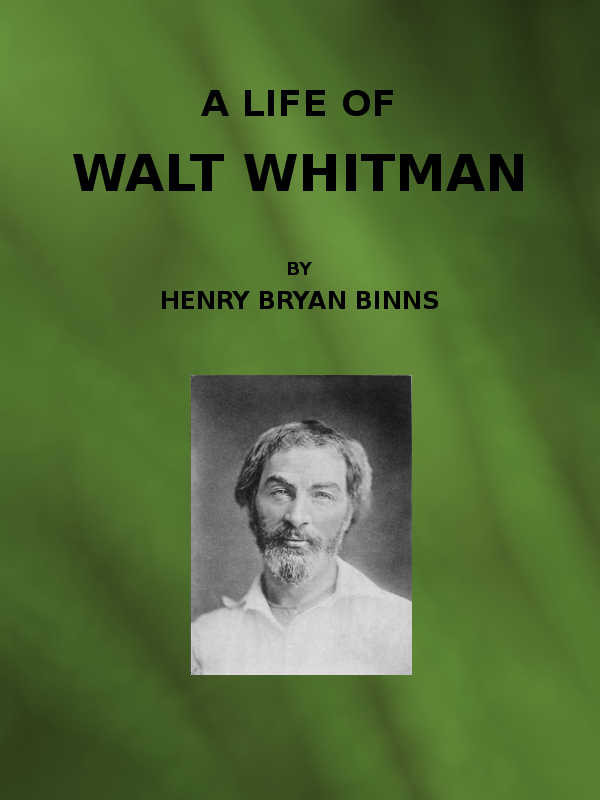
The man’s kindliness and benignity are admirably suggested in the portraits taken in his thirty-sixth year, the earliest that we have. One in particular—that chosen for the frontispiece of this book—is almost articulate with candour and goodwill. In many respects it is the most interesting of the hundred or more portraits extant. Whitman was an excellent sitter, especially to the camera. His photographs give you a glance of recognition, and rarely wear the abstracted look, the stolidity, which is noticeable in several easel pictures.
The daguerrotype of 1854 is the most speaking of the whole series. It is an absolutely frank face, by no means the mask which, according to the sitter himself, one of the later portraits shows. It is frank, and it is kindly, but how much more! The longer one gazes at it the more complex its suggestions become. The eyes are not only kind, they are the eyes of a mystic, a seer; they are a thought wistful, but they are very clear. Like William Blake’s, they are eyes that are good for the two visions; they see and they are seen through. If, as I suppose is probable, something of the expression is due to the fact that the photograph was taken on a brilliant summer’s day, we can only congratulate ourselves that the elements co-operated with the sitter’s soul.
In striking contrast with the eyes is the good-natured but loose mouth, a faun-like expression upon its thick lips, which dismisses at once any fancy of the ascetic saint. The nose, too, is thick, strong and straight, with large nostrils. Even in the photograph you can feel that rich and open texture of the skin which radiates the joy of living from every pore.
It is the face, above all, of a man, and the face of a man you would choose for a comrade; there would be no fear of his failing or misunderstanding you. But, withal, it is the face of a spirit wholly untamed, a wood-creature if you will, perhaps the face of Adam himself, looking out upon Eden with divine eyes of immortality.
Remember, as you meet his gaze, that he knows the life of cities, and that the Fall lies behind him, not before. Perhaps that is why some who have looked at it describe it as the “Christ portrait”—for Jesus was the second Adam—but this is not the ascetic Christ of the Churches, the smile about the lips is too full for that. No, it is the face of a man responsive to all the appeals of the senses, a man who drives the full team of those wild horses of passion which tear in pieces less harmonious souls.
This is a man who saw life whole, and had joy of it. He knew the life of the body on every side, save that of sickness, and of the mind on every side, save that of fear. His large, friendly, attractive personality was always feeding him with the materials of experience, and there was nothing in it all which he did not relish. The responses of his nature to each object and incident were joyous; for the responses of a harmonious nature are musical, whatever be the touch that rouses them.
A shrewd estimate of Whitman’s character had been made five years before by a New York phrenologist, and its general accuracy seems to have vanquished the incredulity of its subject.[132] Mr. Fowler described him—I will translate the jargon of his pseudo-science into plain English—as capable of deep friendship and sympathy, with tendencies to stubbornness and self-esteem, and a strong feeling for the sublime. He thought that Whitman’s danger lay in the direction of indolence and sensuality, “and a certain reckless swing of animal will”. At the same time he recognised in him the quality of caution largely developed.
As this estimate was subsequently quoted by Whitman with approval, and referred to as an authority, it evidently tallied with his reading of himself, and while it is by no means remarkable or particularly significant, it bears out other testimony. That “reckless swing of animal will” always distinguished him from the colourless peripatetic brains and cold-blooded collectors of copy so numerous in the hosts of journalism. Walt came of a race of slow but passionate men, and when he was deeply moved he could be terrible. At such times his wrath blazed up and overwhelmed him in its sudden access, but it was as short-lived as it was swift.
It is related[133] that once in a Brooklyn church he failed to remove his soft broad-brimmed hat, and entered the building with his head thus covered, looking for all the world like some Quaker of the olden time. The offending article was roughly knocked off by the verger. Walt picked it up, twisted it into a sort of scourge, seized the astonished official by the collar—he always detested officials—trounced him with it, clapped it on his head again, and so, abruptly and coolly, left the church. He was a tall, muscular fellow, stood six feet two, and was broad in proportion, and could deal effectually with an offensive person when he felt that action was called for. Such actions naturally added to his popularity among the “boys”—the stage-drivers, firemen and others—with whom he was always a favourite. But, as a rule, he had no occasion to use his strength in this manner. He never gave, and rarely recognised, provocation. There are times, however, when persuasion has to give place to more summary demonstrations of purpose.
Of his strength, but especially of his health, he was not a little proud. As a lad, the praise that delighted him most was that of his well-developed body as he bathed.[134] He did not care to be thought handsome; he knew that wholesomeness and health were really more attractive, and he was content with his own perfect soundness. He was never ailing, even when, in his ’teens, he outgrew for a time his natural vigour. In middle life it was his boast that he could not remember what it was to be sick. Vanity is so natural in the young that when properly based it is probably a virtue, and there can be no question that Walt’s was well-founded.
There is something more, however, in the portrait I have been describing than the perfection of physical health. It is health raised to its highest possibility, which radiates outward from the innermost seat of life, potent with the magnetism of personality, through every pore and particle of flesh. His health, hitherto unbroken, had been deepened into that sense of spiritual well-being which, in its fulness, only accompanies the realisation of harmony or wholeness.[135] He had undergone some fusing process which ended in unity and illumination.
It is difficult to say anything at all adequate about such an experience, because it appears to belong to the highest of the stages of consciousness which the race has yet attained; and because there are many men and women of the finest intellectual training and the widest culture to whom it remains foreign.
The petals of consciousness unfold as it were from within, and every stage of unfolding, being symmetrical, appears to be perfect. A further evolution is almost inconceivable, but the flower still unfolds. The healthy and vigorous personality of the man whose story we are trying to read, continued its development a stage further than the general, and at an age of from thirty to thirty-five established an exceptional relation with the universe.
That exceptional relation is best described as mystical, though the word has unhappy and unwholesome associations, which cannot attach to the character revealed in the portrait. Whitman was almost aggressively cheerful and rudely healthy. But he was not the less a mystic. One of the most essentially religious of men, his religion was based upon profound personal experience.
The character of mystical experience seems to vary as widely as does that of individual mystics, but it has certain common features. It is essentially an irruption of some profounder self into the field of consciousness; an irruption which is accompanied by a mysterious but most authoritative sense of the fulness, power and permanence of this new life. Consequent upon this life-enhancement, come joy and ecstasy.
The whole story of the development of consciousness is, as I have said, a process of unfoldings; but there is one critical moment of that process which occurs sometimes after the attainment of maturity, of such infinite significance to the individual that it seems like a revolution rather than a mere development in consciousness. It is often described as conversion. Whitman’s experience was fully as significant and wonder-compelling as any; but momentous as it was, its nature compelled him to regard it as a further and crowning step in a long succession of stairs—a culmination, not a change of direction. With it he came to the top of the slope and looked over, on to the summit, and beheld the outstretched world. It was no turning round and going the other way; it was the rewarding achievement of a long and patient climb.
But the simile of the mountain-side hardly suffices, for this was a bursting of constraint—a breaking, as well as a surmounting of barriers; as though the accumulating waters in some dark and hidden reservoir should so increase in volume that they burst at last through their confining walls of rubble and of rock, forcing their way upwards in a rush of ecstasy to the universal life and the outer sunshine. This outlet of the pent-up floods of emotional experience into another and a vaster sphere of consciousness—this outpouring of the soul from its confinement in the darkness to the freedom of the light—results from the slow accumulation of the stores of life, but it has at last its supreme hour, its divine instant of liberation.
In this it has its parallel with the passion of Love. For the inner mysteries of religion and of sex are hardly to be separated. They are different phases of the one supreme passion of immanent, expanding and uniting life; mysterious breakings of barriers, and burstings forth; expressions of a power which seems to augment continually with the store of the soul’s experience in this world of sense; experience received and hidden beneath the ground of our consciousness. To feel the passion of Love is to discover something of that mystery breaking, in its orgasm, through the narrow completeness and separate finality of that complacent commonplace, which in our ignorance we build so confidently over it, and creating a new life of communion. To feel the passion of religion is to discover more.
The relation of the two passions was so evident to Whitman that we may believe it was suggested to his mind by his own experience. In some lives it would appear that the one passion takes the place of the other, so that the ascetics imagine them to be mutually exclusive; but this was certainly not Whitman’s case. Whitman’s mysticism was well-rooted in the life of the senses, and hence its indubitable reality. We have seen that he had had experience of sex-love, and we have found reasons to aver that it was of a noble and honourable order; we have seen this experience followed by an acute crisis and its determination, or at least its suspension, and change of character.
But in the meantime, the sex-experience had revealed to Whitman the dominance in his nature of those profound emotional depths of which he had always been dimly conscious since the hours on Long Island beach. The whole crisis had made him realise more fully than ever the solemnity and mysterious purpose of life. It had not satisfied him: it had roused in him many perplexities, and had entailed what was probably the first great sacrifice of his life. In a word, this obscure and mysterious page in his story prepared him who read it for a further emotional revelation, such as I have been describing.
This actually came to him one memorable midsummer morning[136] as he lay in the fields breathing the lucid air. For suddenly the meaning of his life and of his world shone clear within him, and arising, spread an ineffable peace, joy and knowledge all about him. The long process of integration was at last completed. He was at one with himself, and at peace. It was the new birth of his soul, and properly speaking, the commencement of his manhood.
Co-incident with self-realisation came the realisation of the universe. He saw and felt that it was all of the same divine stuff as the new-born soul within him; that love ran through it purposefully from end to end; that thought could not fathom the suggestions which the least of things was capable of making to its brother the soul; that the very leaves of the grass were inspired with divine spirit as truly as the leaves of any Bible. It was as though something far larger than that which he had hitherto regarded as himself had now become self-conscious in him. He was an enthusiast in the literal sense of that mystic word, possessed by a god, filled with the divine consciousness. The Spirit is One, and he was in the Spirit. It identified him with the things and objects that hitherto had appeared external to him, and infinitely increased his sense of their mysterious beauty. George Fox’s description of his own mystical experience is true, upon the whole, of Whitman’s. He writes: “Now was I come up in spirit through the flaming sword into the Paradise of God. All things were new, and all the creation gave another smell unto me than before, beyond what words can utter.”[137] When one considers the Quaker reputation for veracity and caution, one can hardly doubt that these wonderful words describe a condition of consciousness similar to that of Whitman on the June morning of which we speak.
Fox continues that the nature of things lay so open to him that he was at a stand “whether he should practise physic for the good of mankind”. It was by the subtle sympathy of the Spirit that the first Quaker supposed himself to be familiar with the medicinal virtues of herbs, and the same sympathy made Whitman feel that he understood the purpose of their myriad lives. The wonder of the universal life was revealed to them both. They partook of the consciousness which pervades all matter.
To both men illumination brought a double gift of vision, vision into the nature of the universal purpose—of the spiritual or deeper side of life—and insight into the condition and needs of individuals. But in Fox and Whitman this insight, which seems to predominate rather in observant than in creative types of genius such as theirs, was less prominent than the other vision. They were more largely occupied with the universal than with the individual; and while their words carry the extraordinarily intimate message of an appeal to the profoundest element in each soul, their very universality may have rendered them often indifferent to the secondary consciousness or individual self of their hearers. And it is observable that neither of them evinced anything of that dramatic gift which seems to require the predominance of this insight into the secondary self-consciousness. The impersonality with which as preacher or poet they made their public appeal, must have made them at times somewhat inaccessible in their private lives.
Consciousness, it would seem, is of a double nature, being, as it were, both personal and impersonal—if we may use these terms of something that seems after all to be so wholly personal. And hence it appears contradictory to itself, and we are forever trying to harmonise it by the sacrifice of one portion to the other. But in reality it is one consciousness with two functions: the first for fellowship and communion, the second for definition and for concrete achievement.
Whitman developed these two functions harmoniously; he never sacrificed his individual self-consciousness to the cosmic. He was just as positively Walt Whitman the man, as he was Walt Whitman the organ of inspiration. I think we may say that in the midst of that mysterious wonder, that extension of himself which took place at the touch of God, Whitman’s own identity, so far from being lost, was deepened and intensified, so that he knew instinctively and beyond a doubt that it was in some sense of the word absolute and imperishable.
Earlier in this chapter we viewed philosophy as the attempt of the Self to apprehend the Not-self as a Whole; Whitman’s revelation was, it seems to me, the discovery in himself of the sense which does so apprehend the universe; not as a hypothetical Whole, but as an incarnate purpose, a life with which he was able to hold some kind of communion. It was a realisation, not a theory. Whatever this communion may have been, it related him to the universe on its spiritual side by a bond of actual experience. It related him to the ants and the weeds, and it related him more closely still to all men and women the world over. The warmth of family affection was extended to all things, as it had been in the experience of the Nazarene, and of the little poor man of Assisi.
But while his sense of relationship to individuals was thus quickened, the quickening power lay in the realisation of God’s life, and of his own share in it. His realisation of God had come to him through an ardent love of individual and concrete things; but now it was that realisation which so wonderfully deepened and impassioned his relation to individuals. What we mean when we use the word God in public, is necessarily somewhat ambiguous and obscure; but when Whitman used it, as he did but rarely and always with deliberation, he seems to have meant the immanent, conscious Spirit of the Whole.
Theory came second to experience with him, and he was no adept at definition: the interest he grew to feel in the Hegelian philosophy and in metaphysics resulted from his longing, not to convince himself, but to explain himself intelligibly to his fellows, and, in so far as it was possible, make plainer to them the meaning of the world and of themselves.
It seems desirable to define his position a little further, though we find ourselves at once in a dilemma; for at this point it is evident that he was both—or neither—a Christian nor a Pagan. He is difficult to place, as indeed we must often feel our own selves to be, for whom the idea of a suffering God is no more completely satisfying than that of Unconscious Impersonal Cosmic Force. Again, while worship was a purely personal matter for him, yet the need of fellowship was so profound that he strove to create something that may not improperly be described as a Church, a world-wide fellowship of comrades, through whose devotion the salvation of the world should be accomplished.
In a profound sense, though emphatically not that of the creeds, Whitman was Christian, because he believed that the supreme Revelation of God is to be sought, not in the external world, but in the soul of man; because he held, though not in the orthodox form, the doctrine of Incarnation; because he saw in Love, the Divine Law and the Divine Liberty; and because it was his passionate desire to give his life to the world. In all these things he was Christian, though we can hardly call him “a Christian,” for in respect of all of these he might also be claimed by other world-religions.
As to the Churches, he was not only outside them, but he frankly disliked them all, with the exception of the Society of Friends; and even this he probably looked upon principally as a memory of his childhood, a tradition which conventionality and the action of schismatics had gone far to render inoperative in his Nineteenth Century America. We may say that he was Unitarian in his view of Jesus; but we must add that he regarded humanity as being fully as Divine as the orthodox consider Jesus to be; while his full-blooded religion was very far from the Unitarianism with which he was acquainted;[138] and his faith in humanity exalted the passions to a place from which this least emotional of religious bodies is usually the first to exclude them. In fact, he took neither an intellectual nor an ascetic view of religion. He had the supreme sanity of holiness in its best and most wholesome sense; but whenever it seemed to be applied to him in later years he properly disclaimed the cognomen of saint, less from humility, though he also was humble, than because he knew it to be inapplicable. In conventional humility and the other negative virtues, renunciation, remorse and self-denial, he saw more evil than good. His message was one rather of self-assertion, than of self-surrender. One regretfully recognises that, for many critics, this alone will be sufficient to place him outside the pale.
Another test would be applied by some, and though it would exclude many besides Whitman, we may refer to it in passing. He was apparently without the sense of mystical relationship, save that of sympathy, with Jesus as a present Saviour-God.[139] But none the less he had communion with the Deity whose self-revealing nature is not merely Energy but Purpose. And his God was a God not only of perfect and ineffable purpose, but of all-permeating Love.[140]
Whether his relation to God can be described as prayer, it is perhaps unprofitable to ask. It is better worth while to question whether he was conscious of feeding upon “the bread of life,” for this consciousness is a test of communion. Undoubtedly he was; and the nourishment which fed his being came to him as it were through all media. The sacrament of wafer and cup is the symbol of that Immanent Real Presence which is also recognised in the grace before meat. Whitman partook of the sacrament continually, converting all sensation into spiritual substance.
The final test of religions, however, is to be found in their fruits, and the boast of Christianity is its “passion for souls”. Now Whitman is among the great examples of this passion, and his book is one long “personal appeal” addressed, sometimes almost painfully, “to You”.
But, it may be asked, did he aim at “saving souls for Christ”? If I understand this very mystical and obscure question, and its ordinary use, I must answer, No,—but I am not sure of its meaning. Whitman’s own salvation urged him to save men and women by the Love of God for the glory of manhood and of womanhood and for the service of humanity.
Far as this may be from an affirmative reply to the question, the seer who has glimpses of ultimate things will yet recognise Whitman as an evangelical. For he brought good tidings in his very face. He preached Yourself, as God purposed you, and will help and have you to be. Whether this is Paganism or Christianity let us leave the others to decide; sure for ourselves, at least, that it is no cold code of ethical precepts and impersonal injunctions, but the utterance of a personality become radiant, impassioned and procreative by the potency of the divine spirit within.
In stating thus the nature of Whitman’s vision, I do not wish to place it too far out of the field of our common experience. His ordinary consciousness had been touched by it in earlier hours; and some gleam or glimmer of it enters every life as an element of romance. But for most of us, only as a light on the waters that passes and is gone, not as in Whitman’s case, and in the case of many another mystic whether Pagan or Christian—for mysticism is far older and more original than the creeds—as the inward shining and immortal light which henceforward becomes for them synonymous with health and wholeness. For most men, the fairy light of childhood becomes a half-forgotten, wholly foolish memory; Romance also we outgrow, or cling only to its dead corpse as to a pretty sentiment. Thus the wonder of our childhood and our youth, so essentially real in itself, fades into the light of common day; it becomes for our unbelief a light that never was on sea or land.
But in Whitman’s story we find it living on, to become transformed in manhood into the soul of all reality. His wonder at the world grew more. And this wonder, always bringing with it, to the man as to the child, a sense of exhilaration and expansion, was at the heart of his religion, as it is doubtless at the heart of all. No one will ever understand Whitman or his influence upon those who come in contact with him, who does not grasp this fact of his unflagging and delighted wonder at life. It kept him young to the end. The high-arched brows over his eyes are its witness.
FOOTNOTES:
[116] Bucke, 25.
[117] J. T. Trowbridge, My Own Story. Cf. list of articles, etc., in Camden, vol. x.
[118] Later than this, spring, 1859; cf. Camden, ix., 92.
[119] Camden, ix., 188; Comp. Prose, 184, 185.
[120] Camden, ix., 95.
[121] Ib., 98.
[122] Ib., 80, 81.
[123] L. of G., 441.
[124] Camden, ix., 98, 120.
[125] Ib., 123-128; Comp. Prose, 487.
[126] Camden, ix., 160; cf. Trowbridge.
[127] L. of G., 441.
[128] Kennedy, 43.
[129] Fortnightly Review, vi., 538.
[130] Camb. Mod. Hist., 400, 401; C. H. Shinn, Mining Camps (1885), 132, 133.
[131] In re, 33-40.
[132] In re, 25 n.
[133] Johnston, 102.
[134] G. Gilchrist, op. cit.
[135] Comp. Prose, 502.
[136] In re, 342; Camden, iii., 276, 277, 287; Bucke’s Cosmic Consciousness, 33-35; L. of G., 32, 33. Cf.:—
[137] Fox’s Journal (ed. 1901), p. 28.
[138] Comp. Prose, 322; Camden, v., 280, 281.
[139] Cf. however, infra, 167.
[140] Cf. In re, 368; Camden, ix., 166 (on Hegel).