
CHAPTER VI.
Paul sees the Pope.
ALIGHTING from her carriage at the great bronze door of the Vatican, Mrs. Dunton led Paul into the broad corridor and up the wide staircase to the right. The boy's eyes surveyed with delight the Pope's Swiss guard in their picturesque parti-coloured uniform, stationed within the entrance. He began to ask questions eagerly in his high clear tones, to which Mrs. Dunton replied in a voice discreetly lowered, till, as they ascended the stone steps, the solemn, decorous atmosphere of the place affected even Paul, and he, too, became quiet, though nothing escaped his eager eyes.
Mrs. Dunton ascended to the second floor, and, entering a small office on the right, spoke in Italian to the sedate, demure official in suit of glossy broadcloth and white cravat, who advanced with noiseless tread to meet her. She gave him her card, and he ushered her into a small sitting-room to wait while he carried it to Monsignore Nero.
The room was furnished in a plain though substantial style and lighted from above. There was little in it to please Paul's eyes, and he grew weary of sitting still, as many minutes went by and the monsignore did not appear. He got down from his chair, and began to move restlessly about the room. Absorbed in her own thoughts, Mrs. Dunton left him to himself.
At last, the door opened and there entered a tall, large man with handsome features and dark eyes. In a soft, deep voice, with charming kindliness, he welcomed Mrs. Dunton, patted Paul on the head and called him "a fine little fellow;" then sank into a chair beside the lady, who was soon engaged in earnest talk with him.
Paul felt himself out of it, and decidedly bored. The door into the outer room stood open. There was the sound of voices and the stir of life outside. He wanted to see more of the strange, vast building in which he found himself, so, taking advantage of Mrs. Dunton's pre-occupation, he slipped out of the room, and crossing the next, came on to the open court which was at the top of the staircase.
Two Carabineers in their smart uniform stood on guard at the entrance to the court, but it chanced that their attention was at that moment engaged by an official of the Vatican, with whom they were in close consultation. The little boy slipped behind one of them, and ran across the courtyard and out by an exit on the other side, without attracting the attention of any of the three. Delighted with his freedom, he sped on along the passage in which he found himself, turned to the right, crossed another court, and came into a road at the back of St. Peter's, near the entrance to the Sculpture Gallery, where there were several carriages drawn up. A group of students in long black gowns with red sashes stood by the door. They were talking earnestly, and Paul slipped by them without attracting any special attention. He found himself beside a large iron gate which stood a little way open. Beyond he saw a broad gravel terrace, with tall trees and masses of bright flowers in the distance.
In a moment Paul was through the gate and running along the terrace. Instinct told him that he was on forbidden ground. These must be the beautiful old gardens of the Vatican, of which he had heard people speak. Well, here he was, and he would see all he could while he had the chance.
Paul was conscious of a strong and delicious perfume, as he ran along the terrace. It came from the orange and lemon trees planted against the walls, and covered with a wealth of white blossoms, enough to provide wreaths for all the brides of Christendom. Paul sniffed their fragrance with rapture as he hurried on, anxious to see as much as possible ere he was reprimanded and borne away, as he fully expected to be.
The sound of falling water reached his ears. He turned to the right, and saw a tiny cascade falling over stones, fringed with maiden-hair fern. He paused for a few moments to gaze at this, then went on, being now out of sight of the gate, and found fresh wonders and delights at every turn. There were roses in abundance, and of every species, from the tiny Banksia, trained over arbours and trellises, to the large thick cabbage roses and the exquisite pale yellow Maréchal Niel.
But, though he loved flowers, Paul presently came on what interested him more. Within a large fenced enclosure was a collection of curious animals—ostriches with their tall, swift limbs, and long awkward necks; a pelican, with its extraordinary bill; a few goats and deer; and a couple of sheep of a peculiar breed. Paul stood as if glued to the wire fence which enclosed these creatures. He started as a voice addressing him in Italian said:—
"Who is this little gentleman who admires so much the Pope's menagerie?"
Paul looked round, and saw an elderly man, wearing a grey suit of clothes and a broad straw hat, who was regarding him with an amused and benevolent expression.
"I do not know what you say," said Paul, looking up into the stranger's face with his open, fearless expression; "I am an English boy; I cannot speak Italian, except just a word or two, you know."
"Ah! He is an English boy," said the man, speaking Paul's native tongue in a way that the child thought rather funny; "I can speak the English, but it is not much. I have been to England. They know how to make the garden in England."
"Yes; but Janet says the Scotch are the best gardeners," said Paul. "She says a Scotch gardener would be ashamed to let the gardens get so untidy as they do in Italy."
"Ah! It is true; the Scotch does know how to gardener," replied the stranger, "and they does think that they does know better than everybody else. But how comes the little English boy into my garden?"
"Is it your garden?" said Paul in surprise. "I thought it was the Pope's."
"So it is, but I—I am the Pope's head of the gardeners," said the stranger with an air of importance, which was not lost upon Paul.
"Are you angry with me because I am here?" he asked. "I have not touched any of the flowers, indeed. I came with Mrs. Dunton to see Monsignore Nero, you know."
"Ah! It is Monsignore Nero brings you," said the gardener, looking round.
"No, he did not bring me; it was Mrs. Dunton," said Paul.
"It is the same," said his new acquaintance. "Have you seen our parrots?"
"No," said Paul eagerly; "but I should like to see them."
"Come with me, then," said the gardener. And he led Paul to another part of the garden where stood a large cage containing parrots of splendid plumage—green, red, and yellow.
Paul was charmed to watch these, and to hear them say, "'Buon giorno'" in hoarse, inward tones.
So far from being angry, his new friend seemed to take pleasure in showing him everything that was likely to please him, and as they went along, he picked roses and other flowers for Paul. They came to a splendid fountain sparkling in the sunshine, and filling almost to overflowing a large deep basin. A little farther on was an entrance into a lovely miniature wood. Wild flowers grew there in abundance, a fountain gleamed prettily in the distance, and an antique statue was visible amid the trees.
"He may pick as many of those flowers as he likes," said the gardener.
Paul looked wistfully into the wood and longed to explore it; but it had just occurred to him that Mrs. Dunton's talk with the monsignore must be over by now, and she was probably looking for him.
"I should like to pick some of those bluebells," he said; "but I expect I ought to go back to Mrs. Dunton."
"You do better to stay here," said the gardener, thinking that the monsignore and the lady were somewhere in the grounds; "they are sure to come here presently. If you go one way, they may go another, and you miss."
This advice accorded so well with Paul's inclination that he thought it excellent. The little wood was bounded on this side by a tall, thick hedge of box, which gave forth a sweet, subtle fragrance beneath the slanting rays of the sun. On the other side of the hedge was a broad, gravelled path. The gardener glanced down it as he spoke, and saw a little group of persons at the farther end.
"Here they come, I believe," he said.
Paul looked in the direction indicated; but there was no lady amongst the persons advancing, all black-robed, save for a tall, slight form in the centre, which was clad in white.
"Mrs. Dunton is not there," he said.
"No, indeed," said the gardener; "I see now that it is the Holy Father who comes."
"The Holy Father!" exclaimed Paul, in an awe-struck tone. "Oh! Shall I see him? 'May' I see him?"
"I don't know," said the gardener, looking grave. "The Holy Father may not like to see a little English boy in his garden; but stay—I know how. You shall stand in the wood, and the holes in the hedge are many through which you can see. Quick—here."
He led Paul within the wood, and soon found a hole through which the little boy could look upon the path, while keeping himself out of sight.
"You stand there and keep always quiet," he said, "and you will see, and no one see you."
"But the Holy Father will know that I am here," said Paul.
The gardener looked puzzled, but with a gesture, he enjoined Paul to keep silence, and, stepping back into the path, went forward to meet those who were advancing.
Paul's heart was beating fast, and the breath came quickly through his parted lips. "Adam and Eve hid themselves when He walked in the garden in the cool of the day," he said to himself, and he trembled at once with joy and fear.
Five persons were approaching, but Paul saw but one. His eyes were riveted on the slight, gaunt, yet dignified form, clothed in a long white habit, which advanced with slow, feeble steps leaning on a stick. It was that of an old man, with silvery hair showing beneath his small, close-fitting cap. His face, with its strongly-marked features, keen, piercing glance, and complexion of the colour of old ivory, impressed the child deeply, but was not what he had expected to see, if, indeed, he could have given form and colour to his vague anticipation.
He watched as the gardener went forward, and with deep reverence saluted the aged personage. He saw the deeply-lined face break into a broad smile—he heard questions and answers exchanged, but not a word could he understand. He noted that certain words, uttered by the venerable centre of the group, in a voice that was clear and strong, though a trifle tremulous, caused smiles and even a ripple of laughter to pass among his companions. Then the little party moved on, and presently the gardener came back to Paul.
"Well, did you see him?" he asked.
"No," said Paul, in a tone of disappointment; "I saw that old man in white; but he was not the Holy Father."
"But he was," he replied. "Do you mean for to tell me that I know not the Pope?"
"Oh, the Pope!" said Paul. "Was he the Pope? But I thought I should see God—'our Father in heaven,' you know."
"God!" repeated the gardener, in a startled tone. "How could you expect to see God, my dear little boy? No one can see Him."
"But Holy is His Name," said the child; "and He used to walk in the garden where Adam and Eve lived."
"Ah! But that was in Eden, and a long while ago," said the man, with a smile. "No mortal can look upon the face of God. The Pope is His Vicar; that means, you know, that he stands in His place. People look on him instead of on God, and he acts in the name of God—so at least the priests say; but I don't know myself."
"How can he?" said Paul, with a perplexed and even troubled expression on his guileless face. "Why, it was Jesus who came to show us what God is like. I know, for nurse has told me. Ah! And I remember she said that the Roman Catholics put the Pope and the Virgin Mary in the place of Christ."
The gardener looked on him in wonder. "So you are a Protestant, my little gentleman?" he said.
"Yes, certainly I am a Protestant," said Paul, unconsciously straightening his tiny form as he spoke. "Will you tell the Pope, and will he have me burned?"
He asked the question eagerly, and without the least appearance of fear. His imagination had grasped the idea of the glory of martyrdom without taking account of its pains.
The gardener stared at him for a moment, then burst into a hearty laugh.
"No, no," he said, as soon as he could speak. "We do not burn Protestants in Rome to-day. We will not give that baby face and those pretty curls to the flames. But what an innocent it is! And what is Monsignore Nero about, that he lets such a little Protestant run wild in the gardens of the Vatican?"
"I don't think he knows I am here," said Paul. "He and Mrs. Dunton were talking hard in the little parlour, and I slipped away. I expect she thinks me naughty."
"What! You came into these gardens alone? I never heard of such a thing. Come, come, we must go and find this lady."
So saying, the gardener took hold of Paul's hand, and marched him off to the entrance, which was at no great distance. They had not gone many steps from the great gate when they encountered Mrs. Dunton and Monsignore Nero, the lady looking flushed and distressed, but the ecclesiastic serene as usual.
"Ah! Here he is," he said; "here is our little friend!"
"Oh, Paul, where have you been?" cried Mrs. Dunton. "We have been searching for you everywhere."
"I have been in the Pope's gardens," said Paul calmly.
"And he has seen the Holy Father," said the gardener.
"No, I have not," said Paul, "I have only seen the Pope."
"But, my child, he is the Holy Father," said the monsignore.
"No, he is not," said Paul stoutly. "God is the Holy Father, and I thought I should see Him."
For a moment all were silent from astonishment, as they looked into the child's uplifted face, so serious and so sweet.
A change passed over the face of the monsignore. He laid his hand tenderly on the child's golden head, and said, in his full, deep tones, "That vision, too, may be yours some day, little Paul, since it is written that the pure in heart shall see Him."
CHAPTER VII.
A Letter from the Highlands.
JANET could not make it out. A letter had just been given to her, addressed to "Master Paul Bernard, the Hotel Londra, Rome," and she saw to her surprise that it came from Scotland. It bore, indeed, the postmark of a little Highland town which Janet had known in her youth. She could almost fancy that she smelt the heather and felt the strong, keen air of the moorland district from which it had come. Who could have written from thence to her young charge?
"I never knew that they had friends in Scotland," she thought; "perhaps it is from one of those children with whom he got so friendly on the steamer coming over. But how could they know that he was at the Hotel Londra?"
The puzzle increased as she studied the letter. The writing was not that of a child. It was a free, flowing hand with a certain audacity in the way the capitals were formed. She could appease her curiosity only by giving the letter to its owner. Janet hurried along the corridor towards the room where Paul was at play.
"See what the postman has brought for you, Master Paul," she said; "a letter, all your very own."
"Has it my name on it?" asked Paul, turning eagerly from his bricks.
"To be sure—here it is—'Master Paul Bernard,' big enough for you to read," said Janet, "and it comes all the way from Scotland—from the Highlands."
"Then I know who it's from," said Paul, in clear, ringing tones; "it's from Mademoiselle Grand."
"Why, what makes you think that?" asked Janet, and she felt doubtful whether she ought to let him have the letter.
Paul, however, had already seized the letter, and was trying to open it. He would not let Janet help him. It was the first real letter he had ever received, and he was determined to open it himself. At last, he accomplished it, with the help of Janet's scissors; but, though his correspondent had written as plainly as possible, to read it was beyond his power. He had to ask Janet to read it to him.
This was the letter she read:—
"MY DEAR LITTLE FRIEND, PAUL,—I have thought of you so often since I
came home, that I feel that I must write and tell you what a little
God-sent messenger you were when you told me to go to my father. For
I am at home once more, filling the child's place in the house of the
best of fathers, and I should be happy, could I ever forget how little
I deserve such love, and how I have sinned against it.
"'Fathers always forgive,' you said, and truly I found my father ready
to forgive. He was aged, enfeebled, sorrowful, as the result of my sin;
but he was waiting for me with open arms, watching and praying for my
return, 'going to meet me' in his heart.
"I could not believe in such forgiveness; but the Father in heaven
revealed it to you, little Paul. And His love is beyond and above all.
He watches with yearning heart for the return of His prodigal children,
and welcomes them with a love which makes them know and feel their sin
as nothing else can. You taught me that truth, dear Paul, and I hope
and pray that you will live to teach it to many another poor wanderer.
I can think of no better way for a man to spend his life than in
seeking the Father's lost children in the far country, and telling them
of the love that waits to welcome them. May God bless you, dear boy,
and all belonging to you, and make you a blessing to many, as you have
been to—
"Your loving friend,
"ISABEL GRAND.
"P.S.—Fritz is sitting by my side and watching me as I write. If I
could make him understand to whom I am writing, he would bark his good
wishes, I know."
"Fritz barking his good wishes!" cried Paul, with a merry laugh. "I'd like to hear him. I'm glad she got home safe. Of course I knew her father would run to meet her. Is it far to the Highlands, nurse?"
But Janet did not answer. Her voice had grown hoarse and her lips tremulous as she read the letter. She turned aside, that Paul might not see her tears.
He, that little child, had led her to go home—home to her earthly father, home to her God; and she, who for so many years had called herself by the name of Christ, had had no word of love, or pity, no Gospel message for this poor sinner!
"May God forgive me," Janet said to herself, "that I looked on that poor wanderer with the eyes of a Pharisee, and forgot how my Lord welcomed such an one, and sent her away in peace! I, to whom He has forgiven so much, to despise another sinner—and she from bonnie Scotland, too!"
"You must keep this letter, Paul," she said. "It will mean more to you when you are older than it does to-day."
"I can understand it," said Paul.
"I daresay," said his nurse; "but you'll understand it better by-and-by."
"I wish I could write an answer," said Paul. "I should like to send some kisses to Fritz."
"Then you must make haste and get on with your writing," said Janet.
And Paul decided that he would write a copy forthwith.
CHAPTER VIII.
In a Garden with Graves.
"SO this is the Protestant Cemetery," said Paul, as, holding his nurse's hand, and somewhat awed by the solemnity of her manner, he stepped within the great gateway.
The vague fear which had crept into his mind vanished as he looked about him. Masses of red and white and mauve azaleas were blooming in pots on either side the entrance; roses of almost every variety grew amid the tombstones, and though the violets were over, their abundant leaves made green coverings for the graves. The tall, dark green spires of the cypresses rose beautifully against a sky of perfect blue; bees were buzzing and butterflies flitting among the flowers; it was a place to make one in love with death. Yet it was not of death, but of life that everything testified on that lovely afternoon.
"I like this place," said Paul, breaking away from his nurse in his eagerness to explore it. "Shall I be buried here when I die?"
"I hope not," said Janet, with a sudden sense of pain; "but who can say? Only God knows when or where or how any of us will die."
"Why do you hope not?" asked the child. "I think I should like to be buried here. It's so nice and warm in the sun, and the flowers smell so sweet. And how the birds do sing! Does God send them here to sing to the people in their graves?"
"Why, no, Master Paul; there's no hearing or seeing or smelling in the grave. There are no people there, indeed, only their worn-out bodies. Their souls, their real selves, you know, are with Jesus in heaven."
"Oh!" said Paul, wonderingly. "With Jesus in heaven! How do they get there after they are put in the ground?"
But Janet had passed on, intent upon finding Shelley's grave, and paid no heed to his question. Paul slowly wandered after her, his feet finding little irregular paths amid the graves. He looked up at the shafts of light falling on and between the dark cypresses. How high the trees were! Their tops seemed to touch the sky.
"Heaven is up there," the child said to himself; "God lives on high, above the sky. How do they get there? Do they climb up through the trees?"
Then Paul remembered having seen a picture representing two angels supporting a slightly clad female form upon their wings as they sped upwards towards the sky. He had been told that they were carrying the woman to heaven.
"Perhaps," he said to himself, "they climb as high as they can, and then the angels come and carry them the rest of the way."
And the more he mused upon the explanation he had found, the more satisfactory it seemed. Then, moved by the songs of the birds and the sweetness of the flowers and the sunshine, he suddenly began to sing words which accorded ill with the clear, joyous swell of his childish voice:
"'I'm but a stranger here,
Heaven is my home;
Earth is a desert drear,
Heaven is my home.'"
The child's song reached the ear of a gentleman who was standing at a little distance, accompanied by the large and beautiful dog which was his constant companion. He was a man barely forty years of age; but he looked older, for his face had a worn and melancholy expression and showed signs of ill-health.
He had paused to read the inscription on an old tombstone, one of the oldest in the cemetery, which recorded the death, by sudden accident, of a young girl.
"Reader," said the mute warning, "whoe'er thou art, who may pause to
peruse this tale of sorrows, let this awful lesson of the instability
of human happiness sink deep in thy mind. If thou art young and lovely,
build not thereon, for she who sleeps in death under thy feet was the
loveliest flower ever cropt in its bloom."
A sad smile passed over the face of the man as he read the words.
"It is not here alone that one may learn the instability of human happiness," he said to himself. "There are worse calamities than an early death, and worse partings than it effects. Life can separate more utterly than death."
And with the thought, the very sunshine seemed to darken, and earth was to him indeed a desert. At that moment the child's song fell on his ears. He was struck with the inappropriateness of the words which came with such a joyous lilt from the childish lips.
He listened. The sounds came nearer.
Suddenly they ceased. Then—"Oh, what a dear dog!" said the fresh young voice from behind him.
The gentleman turned, smiling with genuine pleasure. The sight he saw was prettier than the sounds which had reached his ear. He had seen that morning Raphael's famous fresco in the church of Santa Maria della Pace, and now, peering over a low gravestone, much in the attitude depicted by the great painter, he seemed to see in the flesh the very angel-boy Raphael has so exquisitely introduced into his sublime group of Sibyls. The soft, golden curls, drooping low on the childish brow, the innocent blue eyes, the purity and sweetness of expression, were indeed such as that painter loved to render, but the picture vanished, as the child bounded to the side of the dog.
"You need not be afraid; he will not hurt you," said the gentleman; but the words were unneeded.
Paul did not know fear where animals were concerned. Already his arms were around the dog's neck, and he was kissing his soft glossy coat.
"What a beautiful great, big dog!" he said. "What is his name?"
"Beppo," answered the dog's master; "and yours—what is your name, my little man?"
"Oh, I'm Paul," said the child. "Beppo! That's a funny name, isn't it?"
"Paul!" repeated the gentleman, and looked at the child with a new and deeper interest. "How old are you, Paul?"
"I'm nearly five," said the boy; "Janet says I shall be five in August, if I'm spared. That's when my birthday is, you know."
The gentleman did not smile at the child's quaint phraseology. He was gazing at Paul with an intentness the boy found embarrassing.
He turned, and rested his cheek against the dog. "Why did you call him Beppo?" he asked.
"I did not give him the name," said the gentleman. "He was named by the monks of St. Bernard, from whom I had him. He belongs to the race of dogs known as St. Bernards."
"Well, now, that is funny!" exclaimed Paul in a clear, ringing voice. "For my name is, Bernard, you know. Mother is Mrs. Bernard."
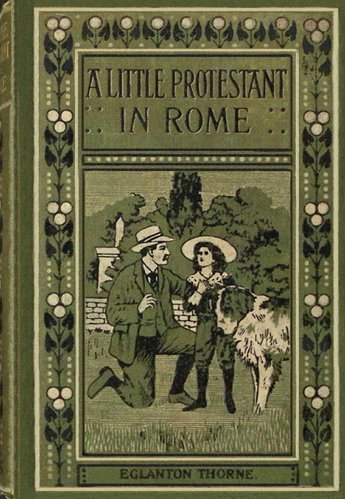
"Really!" the stranger's voice quivered as he spoke. He dropped on one knee beside the child, and put his arm around him.
"And your father, little Paul," he murmured; "you have a father?"
"Yes," said Paul, "I have a father, though I never see him. But I shall soon; oh yes, I shall see him soon!"
"Why do you say that, Paul? What makes you think that you will see him?"
"Why, because I ask God every day to let me see my father very soon," said Paul, in his matter-of-fact way, "so of course I shall."
"Why do you wish to see him?" asked the gentleman.
"Because he is my father," said the child, "and fathers are good and kind. Besides, I think mother would not be so unhappy if father were to come."
"Is she unhappy?" asked the gentleman, quickly and breathlessly; "are you sure she is?"
"I should think so," said the child; "she sighs because she is unhappy; she told me so. Sometimes there are tears in her eyes when she talks to me, and that shows, you know, that she is sorry, or else naughty. I remember that mother said one day that she was naughty; but I could hardly believe it."
"Of course not," said the stranger, and his voice had a strange sound. "You love your mother very much, I am sure, little Paul."
"Yes, I do," said the boy, "and I should love my father, too, if he would only come."
"Would you—would you really?" said the gentleman. "Will you give me a kiss for your father, my dear boy?"
"Give you a kiss for him?" returned the child. "Do you know my father, then?"
"Yes, I know him. Give me a kiss, little Paul."
The child looked for a moment into the grave, pleading eyes that were only a little less blue than his own; then he threw his arms around the stranger's neck and kissed him warmly.
"Be sure you give him the kiss, and tell him it's from Paul," he cried. Then he turned again to hug the dog, which licked his face and gazed on him with great, friendly eyes, and the next minute he heard his nurse's voice calling him.
"That's Janet," he explained, "I must go."
His new friend made no attempt to detain him; but he watched the graceful little form till it passed out of sight. Then he clutched at a head-stone for support, for he was trembling exceedingly, and all his strength seemed gone from him.
CHAPTER IX.
A Moonlight Expedition.
MRS. BERNARD had at last made up her mind to leave Rome. She resolved to travel northward, spending some time at Assisi and Perugia, and other places of interest. She hoped finally to establish herself for the hot summer months in some mountain resort in the neighbourhood of Turin. Having made her plans, she found, as most persons find on the eve of a departure from Rome, that the famous old city had laid its spell upon her, and to leave it was like parting from a friend. There were last visits to be paid and long-talked-of things to be done that would fill almost every hour of the few days that remained.
"You must pay a moonlight visit to the Coliseum before you go," Mrs. Dunton reminded her. "We have talked of it so often, yet left it to the last. Happily, the evenings are lovely now. The moon was brilliant last night. What do you say to going tonight, if we can make up a party?"
"I should like to go," said Mrs. Bernard, with more animation than she often displayed. "I feel as if I had not done my duty by the Coliseum, and now there is so little time."
"Oh, mother, may I go, too?" cried Paul eagerly. "I do so want to see the Coliseum by moonlight."
Mrs. Bernard shook her head. She was sorry the plan had been mentioned in the child's hearing.
"That is impossible, my darling," she said gently. "It would not be good for you to be out so late. Besides, you have a cold already. I can hear that you are hoarse."
"No, I'm not," said the child. "I'm not cold at all. Feel my hands how warm they are."
And indeed the little hands were very hot.
"You certainly have a cold," said his mother, "and I am afraid you are feverish. I must tell Janet to give you some medicine when she puts you to bed."
"I don't want any nasty medicine!" cried Paul impatiently. "I don't want to go to bed. Do take me to the Coliseum."
"No, dear, I cannot do that," said his mother firmly.
Paul began to cry.
"Oh, if you are going to behave like a baby, you must go to Janet," said his mother, rising to ring the bell.
Paul's sobs increased in intensity, till his nurse bore him away in a passion of tears.
"I cannot think what is the matter with him," said Mrs. Bernard, looking troubled. "He is not at all himself to-day. He would not cry like that if he were well."
"Oh, I daresay the heat has upset him," said Mrs. Dunton. "You must expect children to get out of sorts now and then."
She thought privately that Paul's mother had rather spoiled him; but it was excusable, since he was her only child and the one object of her love.
Janet also was of opinion that Paul was not well. She had hardly ever known him so fractious as he showed himself for the rest of the day. He continued to fret because he could not go to the Coliseum, and he resisted strenuously his nurse's desire to put him to bed rather earlier than usual. When at length she got him between the sheets, his perversity continued, and it was long ere he would lie still, or show any inclination to sleep.
Janet was therefore thankful when, coming to peep at him, she at last found that he had fallen asleep. But his face was deeply flushed, his breathing quick, and his appearance made her uneasy.
"I wonder if I have done the best for him," she thought. "I've a good mind to run across the Piazza and ask the English chemist."
It was nine o'clock. The moon was slowly rising above the houses. Mrs. Bernard had just driven off with her friends to the Coliseum. The chemist's shop would probably be closed; but Janet believed that she could speak to him if she rang the bell. She put on her bonnet and hurried off, glad to know that Paul was sleeping.
But Paul was less sound asleep than his nurse supposed. Scarcely had she left him when he woke, and began moving about restlessly again. A streak of bright moonlight fell across his bed. He sat up and laid his hands upon it; he was hot and thirsty. He ran to the washhandstand and drank eagerly from the bottle of water that stood thereon.
He pulled aside the window-blind and looked out. The Piazza was as light as day. Oh, the glorious moonlight! Oh, to see the Coliseum! A fascinating idea took possession of the child's fevered brain. He would go to the Coliseum; he knew the way; he was sure he could find it. He would run all the way, and get back before Janet had time to miss him.
He was in a mood to which nothing seemed impossible. He began to put on his clothes. He had never dressed himself wholly unaided, and the buttons and straps presented some difficulty. No matter; he fastened them as best he could, and the little pilot coat he dragged out of the wardrobe covered all defects. His cap lay to hand; he put it on his head and ran to the door.
No sign of Janet in the corridor. He made his way to the head of the stairs and darted down them. The hall of the hotel was deserted, for a wonder. The waiters were talking together in the dining room, and the porter had been called upstairs. If anyone saw the child, it did not occur to that person that it was strange he should be running out alone.
Paul had a sense of exultation as he ran across the Piazza in a slanting direction. The cool air was delightful and the moonlight most lovely. How surprised his mother would be to see him at the Coliseum! It did not strike him that she would call him naughty for coming. Paul had never walked to the "big wound wooin," but he had a vague idea of the direction in which it lay, though he had not the least notion how far off it was. He ran on through the narrow streets, turning corner after corner till he found himself in the Corso. The streets were full of people, nor were children lacking, for Italian children are often allowed to sit up till unheard-of hours. Paul passed along unnoticed, for no one seeing him could imagine that he was out at that hour unattended. The pavements of the Corso were so crowded on that lovely moonlight night that the child found it difficult to push his way through the people.
It was impossible to run; but he had ceased to feel like running. A terrible weariness oppressed him, and he was conscious of being both hot and cold. He thought that the Coliseum was somewhere at the end of the Corso, but he had not known before that the Corso was so long. In places nearly the whole of the pavement was occupied by people seated at little tables eating ices or drinking coffee. All seemed to be laughing and talking gaily, and the sound of their voices made little Paul feel strangely desolate. He looked into their faces, longing to see someone whom he knew. If only he could sit down for a minute; if only they would give him something to drink!
Still he pushed on, though a faint, sick feeling was beginning to creep over him, and a strange singing sounded in his ears. He came to a place where the Corso widened out into a little piazza in which stood an ancient church. The space in front of the church was bare of people. Instinctively Paul staggered towards it. One side of the steps lay deep in shadow. The child crawled up them, and sank into a dark corner beneath the portico. There he found rest at last, for consciousness forsook him.
CHAPTER X.
What Beppo Found.
MRS. BERNARD and her friends were by no means the only persons who visited the Coliseum on that lovely moonlight night. A considerable number of people were gathered in the arena. Amongst them was the stranger with whom Paul had talked in the Protestant Cemetery. He was feeling impatient of the crowd, and the noise and stir they made, as he walked along one of the deserted corridors with his great dog at his heels. He wanted to feel the poetry and sublimity of the huge historic ruin, and the careless voices and idle laughter jarred on his ear.
He stood in the shadow of one of the arches, and looked across the wide circle. A party of ladies had halted at a little distance from him and were looking up at the tiers of arches. They stood in the bright moonlight, but he had not heeded them, till one of them spoke, and at the sound of her voice his heart seemed to stand still. He turned quickly. There she stood, within a few yards of him—his wife! She was beautifully dressed as usual. The pale blue cloak with silver clasps, the large black hat with drooping plumes, became her exquisitely. For a moment he thought her unchanged; but as he looked more closely, it seemed to him that she had grown thinner, and there was a sad, weary look on the face, the delicate profile of which he could see so clearly as she gazed upwards at the mighty walls.
"Yes, it is beautiful, very beautiful," she admitted; "but all these people destroy the romance of it. One needs stillness and solitude to get properly awed and thrilled by such a scene."
"Well, you've seen it by moonlight, anyway," said a voice, unmistakably American, "and I guess that's the main thing. You can imagine the romance when you get home."
"Is it true, Mrs. Bernard, that you leave Rome this week?" asked another of the party.
"Yes, I am sorry to say that I leave on Saturday," she replied; "but I am going to spend the summer in Italy, and shall perhaps return to Rome in the autumn."
"The summer in Italy!" repeated her friend. "That is unusual, and you will find it rather dull, I should think. But, of course, you will not be alone?"
"No, I shall not be alone," she said; "I shall have my boy with me."
"Yes; but a child is all very well, and we know that you are a devoted mother, yet you ought to have another companion."
"I do not think so," replied Mrs. Bernard; "my boy is a great deal to me. I shall not soon weary of his company."
And the unseen observer, watching her so closely, saw her lips quiver as she spoke, and a shadow, as if of pain, pass over her face. The ladies moved on, and he followed them slowly, keeping in the gloom. They did not linger much longer. He saw them get into the carriages, which awaited them at the entrance. Then they drove off, and he, too, moved away.
He took the road leading to the Arch of Titus, and passing beneath it went on past the old Forum, lying still and beautiful in the moonlight. In the perfect quiet that reigned in that spot, he began talking to his dog, as he was wont to do.
"I could not take the boy from her, could I, Beppo? It would break her heart. Did you see how she looked when she spoke of him? What is her husband to her in comparison? Well, she is happier than I am, for she has him. And she is a devoted mother. Poor little Paul! he is not to be congratulated on his father. Yet he desires to see him; he prays God to send him. Can it be that I have been brought here in answer to his prayer? Yet what can I do to bring about a reconciliation? I dare not approach her. I have no reason to suppose that her feelings towards me have changed. What can I do, Beppo? Can you tell me?"
Beppo was looking up into his master's face with his great wise eyes. When Mr. Bernard ceased speaking, the dog thrust its black muzzle into his hand with a low whine which said—if it said anything—"Wait!"
Turning along one by-lane after another, he came into the Piazza Venezia, and from there made his way into the Corso. He was walking briskly forward, when Beppo suddenly left his side, and bounding across an open space to the right disappeared beneath the portico of an old church. Presently he reappeared, barking vigorously and bounding against his master, seemed anxious to direct his attention to the spot he had quitted. Mr. Bernard was tired, and little disposed to go out of his way.
"Nonsense, Beppo, it's nothing," he said; "or if it is, I really cannot stay to look at either a beggar or a stray cat. Come along."
But Beppo would not come. He rushed back to the church, and his loud, ringing barks began to attract the attention of every one in the street. Much annoyed, Mr. Bernard went after the dog.
"What have you found now?" he asked.
Beppo was crouching over something that lay in the dark corner of the portico. Bending down, Mr. Bernard could dimly see the form of a little child, apparently asleep. He lit a match to enable him to see more clearly, and to his unutterable amazement, the light revealed the face of his own child.
What did it mean? How had he come there? Had there been foul play? A hundred questions presented themselves, as with tremulous tenderness he lifted the child into his arms and examined him carefully.
Paul opened his eyes for a moment as he was moved; but they closed again, and his head fell drowsily on his father's shoulder. But he was sound in body and limb, and with a feeling of relief his father carried him into the street, and hailing the first empty carriage, was driven with the child in his arms to the house where he was staying, which happily was close by.
How thankful he was that he had established himself in quiet rooms, and not at a large hotel! There was no one but his faithful servant, who looked after his comfort as well as any woman could, to receive him as he entered with the child.
"Has he had a fall, sir? No?" With the seriousness of a medical man, James felt the child's pulse and laid his hand on his brow. "It seems to me like a case of fever, sir," he then remarked in the calmest manner, for he was a man who never suffered himself to be perturbed whatever happened.
"I think so, too," said his master. "You must fetch a doctor at once, James; and, stay, you must also carry a note to the child's mother at the Hotel Londra."
"If his mother is at the hotel, sir, wouldn't it be better to take him there?" the servant ventured to suggest.
"No," Mr. Bernard replied sharply; "he shall stay here."
It took him but a minute to write a few words on a piece of paper and direct them to Mrs. Bernard. James went off with it at once; and Paul's father, with awkward yet tender hands, proceeded to undress the child and lay him in his own bed.
CHAPTER XI.
Reconciled.
JANET could hardly believe her own eyes when, on her return from visiting the chemist, she found Paul's little bed empty, and the child nowhere to be seen. She searched for him through the hotel, thinking that he must have wandered from his bed in delirium. Then, with a new sense of horror, she discovered that his clothes had vanished likewise. Even his little overcoat and cap were missing, so he must have gone out of doors. Surely someone had come during her brief absence and carried him away. Like one distracted, she ran to inform the manager of the hotel.
He was startled by her statement that the child had been stolen, but assured her that it was impossible for anyone to enter the hotel and carry off the child unseen.
"He cannot be far off; he must be found directly," he said. And sent his servants hither and thither in search of the wanderer.
Janet herself went to and fro, searching in every likely and unlikely place without result till she was almost beside herself. No light had been thrown on the mystery when Paul's mother drove up to the hotel accompanied by her friends.
How Janet told her mistress she never could remember. The faithful servant was too miserable already to suffer much more, when Mrs. Bernard turned on her with bitter reproaches.
"You had no right to leave him for an instant!" cried the anguish-stricken mother. "I thought I could trust you. My child is lost to me now. I will never forgive you, never."
"Don't say that he is lost," said Mrs. Dunton, "that is impossible. He cannot be far off; he must be found immediately."
Mrs. Bernard shook her head. Her face had grown white and set.
"This is my husband's doing," she said in Mrs. Dunton's ear. "He has taken my boy from me; I knew he would."
"That cannot be," replied her friend. "Why should he do such a thing? It was agreed that you should keep Paul till he was seven years old."
Mrs. Bernard made no reply. The idea that had taken possession of her mind was not to be lightly dislodged. Just then the manager hurried towards her with a note in his hand.
"This has been brought this moment for madame," he said; "perhaps it contains news of the child."
Her hands trembled visibly as she tore open the envelope. It contained but a few words, yet it took her some moments to grasp their meaning, so great was her agitation.
"MY WIFE,—I have found our child lying senseless in a street corner. I
have brought him here. He seems very ill. Will you come?
"Your husband,
"JOHN BERNARD.
"96, Via Nazionale."
In a few minutes, Mrs. Bernard was in a carriage on her way to the Via Nazionale. Mrs. Dunton had offered to accompany her; but she preferred to take Janet, in spite of her indignation with that honest servant.
Mrs. Bernard said scarce a word as they drove along. She was astounded by the facts presented by that brief note. Her husband in Rome! That he should find his child senseless in the street!
"A pretty mother he will think me!" she said to herself with anguish. "He will surely judge me unfit to be longer the guardian of his child."
Yet there was sweetness as well as bitterness in the thoughts suggested by the note. As she held it tight within her hand, she was glad to remember that it began with "my wife" and ended with "your husband." Husband and wife! "What God has joined together." The hot tears sprang to her eyes; then her thoughts turned back to her child in deep anxiety.
She felt like one in a dream when her husband, who was on the look-out for her, helped her to alight from the carriage and led her into the house. She had a dim sense that he looked older and thinner than she remembered him. His voice was so gentle that it made her afraid.
"How is he?" she asked with faltering voice. "Tell me the worst at once, please. He is not—he is not—"
"No, no," said her husband; "he is unconscious and in a high fever, but I have good hope that he will recover! The doctor is with him now; you shall see him in a few minutes, but pray calm yourself first."
"You must think me a most careless mother," she said; "but I left him in good hands, as I thought. Janet was responsible for him; she can perhaps explain how he came into the street."
"That I cannot indeed," said Janet. "I left him fast asleep in bed, and I just ran round to the chemist's to get him some medicine. I was not away more than half an hour; but when I got back, he was gone!"
John Bernard looked keenly at the nurse as she spoke. He recognised her as the woman he had seen with Paul in the cemetery. He felt, too, that she spoke truly, and was worthy of trust.
"It was a pity you left him; but it cannot be helped now," he said kindly; "no doubt he was delirious when he got up and ran out. When I undressed him, I found that his clothes were huddled on in the strangest fashion."
A few minutes later, they were all standing beside the bed on which Paul lay. His stupor had passed. He was talking rapidly and incoherently; but he knew no one who looked on him. Now Janet's name was on his lips, and now his mother's. Now he talked of the Coliseum, and now he was amid the graves in the cemetery, puzzling over their connection with the heaven above. Then he began to speak of his father:
"If only my father would come!" he sighed. "I want him to carry me; I'm so tired. No, that's not my father; that's the Pope. The Pope is only the Pope; but I want my father. Why does he not come?"
"Your father is here, little Paul," said Mr. Bernard, kneeling beside the bed, "here, by your side, holding you."
But the child was conscious of neither voice nor touch. John Bernard glanced at his wife. She had covered her face with her hands.
The medical man found himself at present unable to determine the nature of the fever which had attacked the child. His exposure to the night air and sleep on the hard stones had rendered his condition more serious than it would have been if taken in hand at first. The doctor was anxious but hopeful, since his patient was a sturdy little fellow, who might battle successfully with disease. He spoke encouragingly; but Paul's mother could take no comfort from his words. She looked the image of despair as she sat beside her child. Janet went back to the hotel to fetch various things that were needed; but Mrs. Bernard would not quit the little sufferer for a moment.
Paul grew quieter about midnight. The husband and wife were alone beside him.
John Bernard turned from his child to his wife.
"Clarice," he said gently, "take comfort. He will live. Something within me tells me that he will live."
She sighed heavily.
"The voice within me says otherwise," she said after a moment; "I have been a wicked woman, John, unworthy to be the mother of such a little child, and he will be taken from me. It is my punishment."
"God's punishments are blessings, my dear wife," he replied. "Already there is mercy in this trial, since it has brought us together. The poet tells how husband and wife who had fallen out were reconciled as they stood beside a little grave. Thank God, dearest, you and I may clasp hands over a living child, and join our prayers for his recovery. Shall we do so?"
His wife broke into sobs. He threw his arms about her, drew her to his heart, and they kissed again with tears.
CHAPTER XII.
A Surrender.
JOHN BERNARD entered the room where his wife lay, having at last consented to take a little repose. She was on the couch by the window. There was bright sunshine outside; but the venetians were closed, making a pleasant twilight in the room. She still wore the handsome silken gown in which she had dined and gone forth to view the Coliseum by moonlight. She had lain down, intending only to rest for half an hour; but sleep had stolen upon her, and she had been sleeping for more than two hours. She was still pale, and there were dark circles beneath her eyes; but her look was peaceful, and her husband felt as he gazed down on her that she had lost none of her beauty or her charm. Thankful to find her sleeping, he was about to steal away when she opened her eyes. For a moment they met his in bewilderment; then her colour rose and she sat up.
"Paul," she said quickly, "how is he?"
"He is going on all right," said her husband cheerfully. "A rash has appeared which leaves the doctor no longer any doubt as to his malady. It is scarlet fever."
She shuddered. "Scarlet fever! That is terrible."
"It might be worse, dearest. I think the doctor is relieved to find that it is scarlet fever. There is every reason to hope that the disease will follow a normal course, and the child make a good recovery."
"God grant it!" murmured Mrs. Bernard, as she rose and hastily crossed the room.
Her husband laid his hand on her arm as she was about to open the door. "Stay a moment, Clarice. I have something to say to you."
She looked up at him inquiringly, her hand still on the door.
"Janet is with him now, you know," said Mr. Bernard. "She says she has had the fever, and has not the least fear of infection."
"Nor have I," said Mrs. Bernard quickly. "If that is all—" and she turned the handle.
"It is not all," said her husband. "Of course, I knew you would be fearless; but, dear, I want you to think of our boy's best interests. The doctor and I have agreed that it would be most unwise to suffer you to run any risk of infection."
Mrs. Bernard turned on him with a flash of defiance in her eyes.
"What do you mean?" she asked. "You cannot suppose that I am not going to nurse Paul myself. It is my right as his mother."
"Then, dearest, I will ask you to forego that right for his sake and mine," said Mr. Bernard; "Paul cannot afford to lose his mother, nor can I afford to lose my wife."
Clarice Bernard stood motionless. The word wife thrilled her with the memory of their recent reconciliation, and the joy which had come in the midst of sorrow and dread. Were their wills clashing already?
"I do not see why you need imagine such a thing," she said; "I am not at all likely to take the fever."
"We cannot tell that," said Mr. Bernard, "and I do not think you ought to run the risk. Janet is perfectly able to nurse him, and I shall be at hand to help her."
"If I ought not to run the risk, you ought not," she said.
"It is not an equal risk for me," he said; "I am older, and I shall take every precaution. There is less fear for me, indeed."
"I cannot see that," she said. "You look anything but strong."
"I am stronger than I look," he replied. "Dearest, I am persuaded that all will go well, if you will only do as I wish. The doctor says you may return to your hotel now without any fear of carrying infection. I will arrange to meet you every day and tell you all about Paul, then as soon as it is safe, we will go into the country together."
Mrs. Bernard stood motionless. Her hand had dropped from the door. When at last she spoke, her voice had an unnatural sound.
"You are asking a very hard thing of me," she said.
"I know I am," he replied tenderly. "It seems cruel to ask it, but I believe it will be for Paul's real good, and he and I will both thank you ere long for the sacrifice you have made."
"I can make it upon one condition only," she said after a moment.
"What is that?" he asked.
"That if Paul should be very ill," her voice quivered painfully as she spoke; "if there should be danger, you will let me see him before—" She could not finish, but her husband understood.
"Yes, yes," he said, and his own voice was husky, "I promise you that; you may trust me."
She turned with a sob, and taking up her hat, which lay on a chair, put it on.
"I had better go at once, ere my courage fails," she said.
"God bless you, my darling!" said her husband. "It grieves me to send you away thus, but I am sure it is the best thing for us all."
She looked at him shyly through her tears.
"You have conquered me," she said softly. "It was not—it was not for Paul's sake only that I gave in. Give me another promise—that you will take care of my husband for me, as well as of my child."
The happy smile with which he answered her made her heart glad in spite of all.
CHAPTER XIII.
A Festival.
SO Mrs. Bernard stayed on in Rome after most of the English visitors had departed. Her acquaintances bestowed much pity on her as they made their adieux; but, in truth, the weeks she passed so quietly were by no means unhappy ones, though she would have been loth to admit how much enjoyment she found in them.
The fever followed its usual course, and though Paul suffered a great deal, he was never in danger. Every day his mother found something to send him. Every day, too, she met Paul's father and heard from him the details which had for her such intense interest. They would walk together in the Villa Borghese or the Villa Doria, and the long afternoons they spent thus seemed to pass with marvellous rapidity.
Slowly the child's tedious convalescence advanced, till the infectious stage was over. It was a happy day for Mrs. Bernard when she set out for Frascati to seek rooms there to which she might welcome her husband and child, and still happier that of their arrival.
Frascati was in the perfection of its summer beauty. The country around was green with spreading vines and the deeper verdure of magnificent woods. The greyish hue of the olive-trees contrasted powerfully with the vivid green of the grass which grew about their roots. Even the ancient ilexes had a suggestion of youth in the fresh, yellowish shoots they were putting forth. The brilliant sunshine rendered delightful the deep shade of the bosky villas, while it brought to perfection the roses which flourished so luxuriantly in their gardens. It seemed to Clarice Bernard that she had never seen a more lovely place. Her heart was so full of joy and thankfulness that the inner sunshine enhanced the glory of the outer.
She stood on the top of the flight of steps leading down to the railway station, looking far into the distance, and watching for the snowy streak which should reveal the approach of the train from Rome. It was the most lovely hour of the day. The sun's level rays illumined the vast, broad Campagna, and made the sea-line gleam like silver. But Paul's mother had only one thought at that moment. The train was late; but at last it came into view. She ran quickly down the steps, and was soon clasping her boy to her heart.
Paul looked radiant. Illness had not marred his appearance. It had given a more delicate bloom to his complexion, and made his eyes look larger and more earnest. Evidently it had not rendered his tongue less nimble.
"Oh, mother!" he cried joyously. "Is it not nice that we are all together again, you and father, and Janet and Beppo?"
"So Beppo is one of the family now," said his mother with a smile. "Yes, it is indeed nice, Paul; better for me than for you. I have wanted my little boy so badly."
"And I have wanted you," he said. "But was it not a good thing, mother, that I ran out that night? If I had not, perhaps father would never have found me, or I him."
"It made me very unhappy at the time, Paul," said his mother; "but I think now that everything has turned out for good."
They went slowly up the long flight of steps, looking at the beautiful plantations, the flowering aloes, the roses, the fountains that gradually came into view.
"What a lovely place it is!" said Mr. Bernard. "It looks one great garden."
"It is like the Garden of Eden," said Paul.
His parents looked at each other and smiled. They were so happy that they seemed indeed to have found a Paradise.
The following was a high day at Frascati, the festival of Corpus Christi. From the balcony of the house in which they were lodging, Paul and his parents looked down on the gay scene presented by the crowded piazza. The whole place seemed astir. Peasants wearing blue blouses were seated on the steps of the church; other country folk were arriving on donkeys; women in gay attire with their rich black tresses gracefully coiled, stood knitting and chatting in groups, brown-frocked friars moved amid the crowd, and boyish priestlings sped to and fro on important errands. Paul watched everything with eager eyes, and asked innumerable questions.
About noon a series of mild explosions announced that the procession was about to set forth from the old cathedral. First came the acolytes in their white gowns and pale blue capes with quaint white hoods, then a troop of boys wearing surplices made of coarse black calico with white linen bands hanging beneath their chins, giving them a resemblance to Scottish doctors of divinity. Huge black crosses, crucifixes, and gorgeous banners were borne aloft as they advanced. After these stepped some tiny girls dressed as "angelette," in white frocks veiled with chiffon, from which peeped forth at their shoulders gilded wings. Then came a group of elderly women, who had donned the ancient and beautiful costumes of the country-side. These were followed by a band of young girls in white, wearing their "first communion" veils. Last of all, the archbishop attended by clergy marched forth under a canopy, carrying the Host. As it approached, the people in the piazza fell upon their knees.
"What superstition, what blind materialism it seems!" Mrs. Bernard whispered in her husband's ear. "John, can you believe that I came near joining the Roman Catholic Church?"
"No, that I cannot believe," he said.
"Yet it is true," she replied. "I was so weary, so burdened, so desolate, and they promised me rest and peace. They said that the confessional would ease my conscience, and the priest absolve me from my sin."
"But you did not listen to them?" he said.
"Alas, I did!" she said. "I tried to believe their words. It was our little Paul who kept me from that fatal mistake. His childish words taught me that God is near and ready to forgive, and that we can come to Him in sorrow and penitence without the intervention of any human priest. And now that I have confessed to my God, and know myself forgiven for my Saviour's sake, I marvel that I was ever fascinated by this elaborate and materialistic system of religion, which hides the very truth it professes to set forth."
"Ay, truly," said her husband. "They lift the cross on high and wreathe it with flowers; they exalt the image of the suffering Christ, yet deny the power of His cross, and teach men to trust for salvation to human rites and ceremonies. It is a strange perversity by which they make the very forms and methods of their worship defeat the main purpose of worship and separate the soul from God."
"What is that gilt thing he is carrying, and why do the people kneel?" asked little Paul. "Did Jesus tell them to do that?"
Mrs. Bernard smiled as she laid her hand on her boy's curly head.
"Paul's question points to the mainspring of all true Christian life and service—the word of Christ," she said. "Truly, one must become as a little child to enter the kingdom of heaven."
———————————————————————————————————
LONDON: PRINTED BY WILLIAM CLOWES AND SONS, LIMITED.