
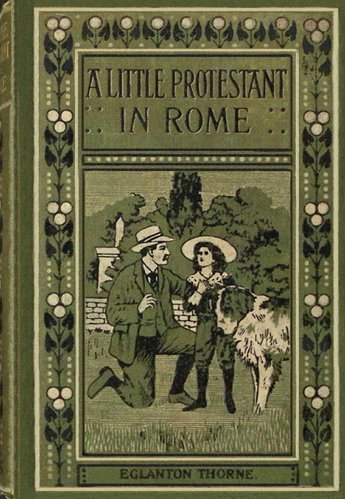
The Project Gutenberg eBook of A little Protestant in Rome
Title: A little Protestant in Rome
Author: Eglanton Thorne
Illustrator: Lancelot Speed
Release date: December 17, 2025 [eBook #77485]
Language: English
Original publication: London: The Religious Tract Society, 1900
Transcriber's note: Unusual and inconsistent spelling is as printed.
HE DROPPED ON ONE KNEE BESIDE THE CHILD.
A Little Protestant
in Rome
BY
EGLANTON THORNE
Author of "Worthy of His Name," "The Elder Brother,"
"Her Own Way"
LONDON
THE RELIGIOUS TRACT SOCIETY
4 BOUVERIE STREET AND 65 ST. PAUL'S CHURCHYARD
CONTENTS.
NOT ASHAMED OF HIS FAITH
A REMARKABLE STRANGER
HIDE AND SEEK
A BURDENED HEART
PAUL ADDS A NEW PETITION TO HIS PRAYERS
PAUL SEES THE POPE
A LETTER FROM THE HIGHLANDS
IN A GARDEN WITH GRAVES
A MOONLIGHT EXPEDITION
WHAT BEPPO FOUND
RECONCILED
A SURRENDER
A FESTIVAL
A Little Protestant
in Rome
CHAPTER I.
Not Ashamed of his Faith.
"I LIKE that big wound wooin," said Paul Bernard, sprawling across his mother's knees in his endeavour to gaze till the last moment in which they could be seen at the mighty sunlit walls rising against the deep, pure blue of the Roman sky.
"Sit up, Paul, directly. You are hurting me. What a rude, rough little boy you are getting! And I wish you would not say wooin. You can sound your r's if you take the trouble."
Paul fell back in his seat as the carriage turned a corner and the famous ruin passed from his sight. He was in no way disturbed by his mother's fretful reproof, for he was accustomed to being alternately snubbed and idolised, and could deport himself with equanimity under either experience. He had not yet seen his fifth summer; but he was already somewhat of a philosopher, able to take things as they came, and to possess his soul in patience when it was impossible to mould circumstances to his will.
Mrs. Bernard sighed as she shook out the folds of her gown, which Paul's impetuous action had disarranged. She was young and pretty and elegantly attired, but her face wore a sad and listless expression. She spoke with a slight drawl and an intonation which betrayed her American birth.
"I suppose it is the correct thing to visit the Coliseum by moonlight," she observed; "at any rate, it is what all my compatriots appear to do."
"Yes, and it is really worth while, although everyone does it," replied her companion, a lady a few years older, whose dress indicated that she was a widow. "I advise you to choose a night when the moon is not too brilliant. One gets finer effects of light and shade, and a deeper sense of mystery pervades the vast arena, when the moon is contending with clouds than when the sky is absolutely clear."
"Indeed!" said Mrs. Bernard indifferently. "Then I must try to go on some such night."
"May I go, mother?" asked Paul eagerly.
"You, my dear child!" said his mother's friend. "You will be snug in bed and fast asleep, long before your mother sets out."
"No, I sha'n't. I don't go to bed so early as you think," he protested; "and I am often awake when Janet comes to bed. I may go, mayn't I, mother?"
"You go! Nonsense! You will be much better in bed," said his mother. "Now, Paul, don't begin to worry me! I will not have it. I should like you to accompany me, Mrs. Dunton, when I go."
"With pleasure," said that lady; "I love to visit the Coliseum. To me it is one of the most sacred places on earth, and I greatly regret that the spot where so many Christian martyrs suffered is no longer marked by a cross. I should like to have known it when there were shrines there at which one could offer prayers."
Paul's blue eyes grew big with wonder as he listened to her words.
"Why can't you pray there now?" he asked.
"Why? Because it is no longer possible," said the lady, a little puzzled how to answer the child's abrupt question. "The Coliseum is no longer a holy place, except for its memories."
"But I thought that God was everywhere," said Paul, looking puzzled in his turn; "and that we could speak to Him in any place? I do, and He hears me too."
"Now, Paul, be quiet," said his mother. "Little boys must not talk about things they do not understand."
"But I do understand," said Paul; "nurse has told me."
"There! There! That will do," said his mother, holding her neatly-gloved hand before his lips. "Not another word!"
Paul was silent for a few moments while he turned things over in his mind.
Then suddenly, he addressed to Mrs. Dunton another question.
"Are you a Catholic?" he asked.
"Yes," she said, smiling. "Most certainly I belong to the Holy Catholic Church."
Paul's brow cleared. He looked as if he had received enlightenment. He regarded the lady with an air of great interest.
"Nurse says the Catholics would burn us all if they could," he remarked cheerfully. "I'm a Protestant, you know," he added, by way of making things clear.
"My dear child!" exclaimed Mrs. Dunton, and she turned towards his mother with a look of amazement.
"Paul, I told you not to speak," said Mrs. Bernard hastily.
"You see what comes of having a Scotch nurse," she added, in an undertone to her companion. "I do wish she would not put such ideas into the child's head; but she is so faithful and good that I could not bear to dismiss her. It is such a comfort to know that he is perfectly safe when out of my sight."
"Yes; but still—" Mrs. Dunton began dubiously; then checked herself, and ended in a lighter tone, as she patted the boy's cheek—"Paul will know better when he is older."
Paul gave no heed to her words, for at that moment his attention was diverted by the appearance of a little boy about his own age, clad in wonderful green velvet knickers and a bright red coat, with a tiny black "wide-awake" perched on the back of his head, who ran beside the carriage and made signs to him, which Paul failed to understand. Mrs. Dunton gave him a "soldo" to fling to the little vagrant; but, after pocketing it, the boy continued to run along the road, apparently finding pleasure in amusing the other boy with his antics.
Meanwhile, the ladies could talk in peace.
"Have you thought over the subject of our last conversation, dear Mrs. Bernard, since we met?" asked Mrs. Dunton, with an air of intense interest.
"Oh yes, I have thought of it," said her companion wearily; "I am always thinking, thinking—if only one could stop thinking!"
"I know exactly how you feel," said Mrs. Dunton, her tones soft with sympathy; "but your thoughts will never cease to trouble you till you find rest, as I found it, in the bosom of our Holy Church."
"Ah! If I thought that!" exclaimed her friend. "If I could believe what you tell me, I would become a Romanist to-morrow. But how is it possible? Can anything undo the past? Many years ago I made a great mistake—nay, it was a sin. Is there any power on earth that can blot out that sin and make my life as if it had not been?"
"Of course the past cannot be undone; that is undeniable," said Mrs. Dunton; "but our Holy Church can absolve from sin the penitent soul. It is for that purpose we have the sacred office of the Confessional. Ah! Dear Mrs. Bernard, if you knew the relief one experiences when one unburdens one's heart in the ears of the priest, and the rest there is in giving oneself up to be taught and guided."
"Oh! But I could not!" cried Mrs. Bernard. "I could not bear to speak of my trouble to anyone!"
"Then it will continue to torment you," said Mrs. Dunton gravely. "Dear Mrs. Bernard, promise me that you will go again to the convent of the Sacré Cœur, and speak with Sister Célestine. You will find her full of sympathy, and she is better able to help you than I am."
"I will go," said Mrs. Bernard, after a moment's pause, while the placid, kindly face of the nun rose before her mental vision; "I like to talk to Sister Célestine. It would be easier to tell 'her' than to tell a priest."
"What is a pwiest, mother?" cried Paul, becoming conscious of his mother's words, as the little "contadino" he had been watching suddenly fell back breathless and was lost from view. "What is a pwiest?"
As often happened, his mother paid no attention to his query, and he repeated it, and was still repeating it when the carriage drew up before the hotel at which they were staying.
"What is a priest?" said a full sonorous voice in amused accent. "Look at me, my boy, and you will see what a priest is."
At the same moment, a pair of strong arms lifted Paul from the carriage and held him for a moment high above the ground. Paul looked down into a merry face, with kindly grey eyes, laughing lips, flashing white teeth, and a massive chin.
"Oh! Father O'Connell, is it you?" cried both the ladies in tones that expressed pleasure.
And Paul was set down on the pavement, while the priest turned to greet his mother.
Paul looked curiously at the tall figure in the long, glossy, black robe and broad hat. Father O'Connell, turning, caught his intent gaze.
"So, my little friend, you see now what a priest is," he said, with a humorous twinkle in his eyes; "tell me, do you like the look of me?"
"You don't look bad," remarked Paul gravely, "but nurse says she does not believe in priests."
Father O'Connell burst into a ringing laugh.
The next moment a middle-aged woman, neatly dressed in black, came to the door of the hotel, and taking Paul's hand, led him quickly away.
CHAPTER II.
A Remarkable Stranger.
CLARICE BERNARD was by nature both artistic and luxurious, and an ample income made it easy for her to indulge her tastes. The only child of wealthy parents, she had been spoiled from her infancy, and, like most spoiled children, she had suffered when the arms which had so softly sheltered her were withdrawn, and she had to face alone the realities of life. That her troubles were of her own making did not render them more easy to bear. Living, to all appearance, a life of ease and pleasure, she was in truth a most unhappy woman.
A fond mother in her way, she yet found little satisfaction in her love for her child. He was a beautiful boy, with large, earnest blue eyes, before whose direct, searching gaze she sometimes shrank, inwardly feeling as if he could read the secrets of her heart.
She loved to buy Paul pretty clothes and costly toys, and to hear people speak of his beauty and charm; yet there were times when she wished that his eyes were not so deeply, purely blue, and that his fleeting expressions and unconscious gestures did not so constantly remind her of another.
"Paul is like you, and yet not like you," a lady said to her one day, as they sat together in the drawing-room at the hotel. "I fancy the difference will be more marked as he grows older. His eyes are not like yours. I suppose his father had blue eyes?"
"Yes, yes, it was so," said Mrs. Bernard hurriedly, and she turned to the piano and began to strike a few loud chords at random, as if anxious to check further speech.
The lady reflected that Mrs. Bernard must have loved her husband very much, since she could not bear even this slight reference to him.
Paul was so admired and petted at the hotel that he ran considerable danger of being spoiled, and doubtless would have suffered, but for the conscientious efforts of his Scotch nurse to counteract the mischief. She never failed to remind him in moments of elation of his natural depravity.
"Yes, the suit's all right," she would say; "it's bran' new velvet and real lace; but I'm thinking the worst part's in the middle. God keep us humble, for we've little cause to be proud, when we think what our hearts are."
"Is my heart so very bad, do you think, nurse?" Paul would ask, with an air of concern.
"It mayn't be the worst or the best," said his nurse; "but what of that? The Bible tells us that the heart is deceitful above all things, and desperately wicked."
"But you said that God would give me a new heart, if I asked Him, and I have asked Him; I am always asking Him," said Paul, with some impatience. "I should think He must have given it to me by now."
"The heart needs to be renewed every day," said his nurse gravely; "but now keep still while I fasten your collar. It is impossible for me to button it while you keep jerking your head about."
In spite of her Scotch birth, Janet found Paul difficult to deal with when he waxed argumentative. She was often both astonished and rebuked by his faith in prayer. When quite a wee boy, he had insisted on saying the Lord's Prayer in a fashion of his own, with the petition, "Give us this day our daily bread and honey and jam."
When Janet reproved him for making this addition, he replied, "But, nurse, you say that we may ask God for whatever we want. Bread alone will not do for me; I must have honey and jam."
And he continued to repeat the prayer in his own way.
Paul and his nurse occupied a large and airy room in the hotel, with a balcony overlooking the Piazza di Spagna. The balcony was a never-failing source of diversion to Paul. From it he could watch all the life of the Piazza—the carriages rolling to and fro, the arrivals at the hotel, the flower-sellers with the beautiful, many-hued flowers massed together on their stalls, the pedlars with the mosaics and tortoise-shells they so seldom seemed to sell, and the artists' models in their picturesque costumes. Sometimes his nurse would bring her needle-work, and sit just within the window, that she might be at hand to answer as best she could Paul's innumerable questions.
One evening about sunset, as Paul, after returning from his walk, was amusing himself in the balcony, a carriage drove up to the door of the hotel bringing a young lady, who had evidently come from a journey, since a quantity of luggage was piled up in the front of the conveyance.
She was quite young—too young, one might have thought, to be travelling alone—and very smartly dressed. Masses of red-golden hair were visible beneath her black velvet hat; her cheeks had a delicate bloom, and her eyes were large and bright, with finely-pencilled brows.
Paul looked at her and admired her with a child's ready appreciation of surface prettiness. Then his eyes were caught by the knowing-looking pug which sat on the seat beside his mistress.
Paul watched as the lady rose, and, taking up her pug, alighted with him in her arms. The wise eyes and little black nose peeped out from beneath her arms as she stood giving directions respecting her luggage.
Paul happened to be eating a biscuit, and it occurred to him to try the effect of dropping a piece down before the dog. The biscuit fell within an inch of the dog's nose, and lay on the ground before him; but he made no attempt to seize it.
The young lady looked up in surprise, but smiled as she saw the little boy.
"How kind you are to my dog!" she said. "I thank you for him. Yes, Fritz, you may take it."
She set down the pug as she spoke, and Paul had the satisfaction of seeing him snap up the biscuit.
"There," she said, looking up at Paul with laughing eyes, "he would not have touched it if I had not told him he might. He is a good dog, is Fritz."
"Is his name Fritz, and does he always do what you tell him?" asked Paul, delighted with this new acquaintance.
"Always," said the girl.
But at that moment Janet, astonished to hear her charge talking with some one below, stepped on to the balcony. She looked down, and the girl's face met her view in the full light of the clear sky. The girl nodded to Paul and went into the hotel, followed by her dog; but Janet had seen enough.
"A painted minx!" she said, with something like a snort. "She's no good."
"What is a minx?" asked Paul. "And why is she painted, and who painted her?"
"Never mind. It's no business of yours," replied nurse, aware that she had been indiscreet in making such a remark in his hearing.
"What makes you think that she is not good?" persisted Paul.
"There! There! It does not matter to you. You are not to talk about her," said his nurse.
"But the dog is good, is he not?" said Paul. "He does whatever he is told, so he must be a very good dog."
"Then you may try to be like him," said nurse. "I know a little boy who does not always do what he is told."
And Paul, aware that he had forgotten more than one injunction of his nurse's that day, became silent.
That evening, at the "table d'hôte," the appearance of the newly-arrived traveller created a sensation. She was richly dressed, and diamonds flashed on her small, white hands. Her beauty was most striking; but the ladies present eyed her with suspicion, and whispered among themselves that her complexion was certainly artificial and her hair too golden to be natural. She bore herself with great self-possession, and looked about her with cool, supercilious eyes, which seemed to defy criticism. Now and then her beautiful lips curled with a somewhat contemptuous smile.
Presently she began to talk to the gentleman on her right, and the people near her grew quiet, that they might hear what she was saying. She talked gaily and brilliantly in good and fluent French; but she had been heard to speak English with equal facility, and people began wondering as to her nationality. Was she English or American, or possibly Canadian? Was she as young as she looked, and what was the meaning of her travelling alone?
But while people observed and conjectured, they held aloof from the young stranger, and made no attempt to obtain information at first hand.
"An actress, I should say," whispered Mrs. Dunton to Mrs. Bernard, as she watched the play of hands and voice and features with which the young beauty talked.
"An adventuress of some kind, no doubt," was the other lady's reply.
So their eyes dwelt on the stranger with cold disapproval, while reluctantly compelled to admire the style and fit of her silk gown.
Meanwhile, the new arrival was being discussed in other regions of the hotel. A courier who chanced to be in the hall when the young lady entered, recognised her as one whom he had seen at Naples, and imparted certain facts concerning her to the porter, who in his turn told them to one of the waiters, who confided them to his wife, who was a chambermaid, and who, being able to speak English, could not resist whispering them to Paul's nurse.
Janet was shocked at this confirmation of her suspicions, yet derived some satisfaction from the thought that she had been right in her first estimate of the young woman's character.
On the following morning, Paul, equipped for a walk on the Pincio, was waiting till his nurse was ready to accompany him, when a sharp little bark reached his ears, and running into the corridor, he saw the clever pug standing at one of the doors, evidently asking that it might be opened to him. Paul was stroking him when his mistress opened the door. She smiled to see the child standing beside the dog. She was a radiant vision in a pink morning gown, and Paul was fully conscious of her charm as he looked up at her.
"Good morning, little man," she said brightly, "I am glad that you like my dog. Now, Fritz, say 'good morning' properly. See, he knows how to shake hands!"
"So he does!" exclaimed Paul, delighted with the dog's accomplishment as he shook the proffered paw. "He is a good dog. Nurse says he is better than I am, because I don't always do as I am told."
"You don't mean to say so!" said the young lady, looking amused. "And you look such a good little boy too!"
"I'm not, though," said Paul seriously. "It's awfully hard to be good, isn't it? Did you always do what you were told when you were a little girl?"
"Oh dear me, no; neither then nor since. I was always one to take my own way," said the girl.
She spoke lightly, and ended with a laugh, yet a shadow fell on her face as she spoke, and Paul was dimly aware that his words had somehow hurt her.
Just then Fritz sprang forward, barking vigorously at the hotel porter, who was coming down the corridor with his hands full of letters. Instantly the lady's face changed. There was an eager, anxious look in her eyes as she advanced to meet the man.
"You have a letter for me—Mademoiselle Grand?"
The man shook his head.
"But there must be!" she insisted.
And she made him turn over all the letters till she was satisfied that not one bore her name. A look of pain and disappointment came to her face. She stood motionless with clasped hands as the porter went on down the corridor.
"Cruel, cruel!" she murmured to herself.
Paul was playing with the dog, and noted nothing.
"Does he know how to beg?" he asked, looking up at the lady.
"Yes, he has learned to beg," she said; "but we must give him something to beg for."
She went into her room, and returned immediately with a pretty box of chocolates, which she gave to Paul. He showed one to Fritz, and at once the dog sat erect with his little paws drooping.
"What a dear dog he is!" said Paul. "How you must love him!"
"I do," said Mademoiselle Grand. "He is the most faithful friend I have in the world."
"Is he? I'll be your friend too, if you like," said Paul.
"Will you? That is very kind," she said, with a smile; "you must tell me your name, my little friend."
"It is Paul," he said.
"Paul!" she repeated. "And what is your father's name?"
"I haven't got a father—except of course the Heavenly Father," he said, "'Our Father which art in heaven,' you know. Have you a father?"
"I?" she looked startled at the question, "I! Yes. No—I mean—I have no father."
Paul looked at her with wondering eyes. It struck him as strange that she should first say "Yes" and then "No."
"That's not quite true, you know," he said.
"Not true! What do you mean?" she asked.
"You have a father, because God is your Father," he replied.
At that moment Janet appeared at the end of the corridor, and called to Paul in severe accents.
"There's your nurse," said the lady; "run away to her at once, like a good, wee boy." And she went into her room.
"Good sakes! If she did not say those words just like a Scotswoman!" murmured Janet. "God forbid that the poor lost soul should be from Scotland!"
"Why couldn't you stay in the room when you were dressed?" she asked of Paul. "Why need you go talking with one we have no concern with?"
"She is a very nice lady," said Paul. "See what she has given me!"
"What's that? Chocolates?" Janet regarded the dainty box with displeasure in her eyes. "Give it to me."
Reluctantly Paul yielded it up. Taking the box, Paul's nurse went swiftly down the corridor and tapped at the lady's door.
"You'll excuse me, miss," she said bluntly, as the girl opened the door; "but I cannot allow my young gentleman to keep this. His mother would not approve of his receiving such a gift from a stranger."
"Oh, very well," said Mademoiselle Grand carelessly; but she coloured, and there was a bitter smile on her face as she closed the door. With a passionate gesture she flung the rejected gift out of the open window.
A number of small urchins were scrambling for the chocolates when Paul reached the Piazza. His temper was not improved by the sight.
"You are horridly cross," he said to his nurse. "Why couldn't I have the chocolates? I am sure mother would have let me keep them."
"Not if she knew who gave them," said Janet. "Now, mind, you are not to go near that lady again."
"Why not?" asked Paul. "I like her, and I am going to be her friend."
"She is a poor creature," said his nurse.
"I am sure she is not poor," said Paul. "She has such pretty frocks, and you should see how her rings sparkle. And such a dear dog. She 'can't' be poor."
"That's all you know about it," said Janet; "I tell you she is a poor, unhappy creature."
"If she is unhappy, I ought to try to make her happy," said Paul.
As usual, Janet found herself worsted in argument.
CHAPTER III.
Hide and Seek.
THE last ringing note had been sounded by the band on the Pincio, and the men were gathering up their music and hurrying down from the stand; but Janet still sat knitting rapidly, and talking with an air of the deepest interest to the old Englishwoman. Marie, the little French girl with whom Paul had been playing, had gone home with her nurse; every one was going. How tiresome it was of Janet to sit there, so absorbed in her talk as to pay no attention to his very plain hints that he wanted to be moving! What stupid things grown-up people talked about! Who cared how many servants the Russian countess kept? Certainly Paul did not. A naughty idea occurred to him, and proved too delightful to be resisted. He would run away and hide. It would serve nurse right if she thought that he was lost.
Slipping behind Janet, and running across to the Moses Fountain, Paul was soon lost to sight amidst the shrubs. Looking about he found a snug hiding-place—a little nook beneath a rockery, screened by a full leafy bush. In the gathering gloom beneath the trees it was impossible that anyone could spy the tiny form ensconced there. Not many minutes had passed ere Paul heard his nurse's voice calling him. It was delightful to think how well he was hidden. He would stay where he was till Janet came quite close, and then catch hold of her gown as she passed.
"Paul! Paul! Come to me at once, Master Paul!" nurse called. "Oh yes, I know you are hiding; but it is too late now for games; we must go home at once."
Paul shook with laughing as he listened. It was such fun to think that nurse could not find him. He stretched out his right hand, ready to grab Janet's skirt as she passed, but she never came near enough for him to do that; the shrubs, growing thickly about his hiding-place, barred the way for a grown-up person. Her voice sounded further away; presently the cry of "Paul! Paul!" seemed to come from a distance; then he heard it no more.
Paul waited, feeling sure that Janet would presently return; but she did not come, and the waiting grew tedious. It is dull work hiding, if no one comes to find you. Besides, it seemed to be getting dark. Paul did not like the idea of being alone on the Pincio in the dark.
He came out of his hiding-place, scrambled through the bushes, and stood looking about him. It was not dark, but the light was failing, and he saw the moon looking down at him from the clear sky. No one was in sight. A feeling of loneliness and fear took possession of Paul's mind.
He began to cry aloud—"Janet! Janet! I'm here. Come to me quick. Janet! Janet!"
But it was now his turn to call in vain. He burst into tears, and ran forward with outstretched hands. Suddenly a sharp little bark fell on his ears, and Mademoiselle Grand's pug came bounding to meet him.
"Oh, Fritz, Fritz! I am glad to see you!" the child cried. "I'm here alone, Fritz, all alone!" And his tears flowed afresh.
Fritz did his best to comfort him. He stood on his hind legs and laid his front paws on the child's shoulders; he licked his cheeks and gave short joyous barks, as if he would say, "Never mind, it's all right now; I'm here, you know."
Then he gave a tug at the boy's tunic and bounded off, looking back, as though to bid him follow. Paul followed willingly.
The dog bounded across the deserted road and made for the furthest angle of the wall. This corner is separated from the path by wooden palings, which guard the spot whence there juts forth a fragment of the oldest Roman wall. At one point the fence had broken down. Fritz sprang through the gap, and Paul followed him.
The next moment the boy uttered a cry of fear, for, standing on the very verge of the wall, overlooking its sheer descent, and leaning forward at an angle that even the child saw to be most perilous, was Mademoiselle Grand. At the sound of the boy's cry, she started, and all but lost her balance.
But Paul seized her hand, and with tremulous haste pulled her back. "You must not stand so near the edge," he said; "it is very naughty. You might fall, and then you would be bwoken to bits, like Marie's doll when she dwopped it over the wall."
Mademoiselle Grand turned towards him a face from which every vestige of colour had fled. She was trembling from head to foot, and when she tried to laugh her voice broke, and she began to sob instead.
"Don't cwy," said Paul, forgetting his own distress in his desire to comfort her; "I daresay you did not know how naughty it was."
"Oh yes; I knew very well," she sobbed. "I knew that I was going to do a very wicked thing. Dear little Paul, I believe God must have sent you to stop me. If you had not come, I should certainly have thrown myself down."
STANDING ON THE VERGE OF THE WALL
WAS MADEMOISELLE GRAND.
"Then you would have been bwoken," said Paul, in the most matter-of-fact way, "your head and your neck, and I suppose your arms and legs too."
The lady shuddered.
"It's horrible to think of," she said; "but, after all, it would not have mattered about my body. No one would have cared."
"God would have cared," said Paul.
"God!" she repeated in a startled tone. "Does He care?"
"Of course," said Paul. "Janet says that it makes Him sad when we do naughty things. Haven't you any father and mother to be sowwhy too?"
"My mother died when I was younger than you, Paul," said Mademoiselle Grand in a low, sad tone. "My father—"
"Your father—" repeated Paul, as she paused.
Still, the young lady did not speak. She was gazing away into the distance, as if she saw something that Paul could not see. Looking up at her pale, sad face, outlined against the clear evening sky, the child was dimly aware that it was very beautiful. Suddenly she seemed to become conscious of his presence again. She turned, and seating herself on a low bank of earth, drew Paul towards her. As she put her arm about him, the child could feel how it trembled.
"My father, Paul," she said, "is a good man; but stern and hard. It is always the good people who find it most hard to forgive evil in others. He loved me in his way, and he did much for me; he was proud of me till—I was a bad daughter, Paul. I ran away from him. I know I have broken his heart. He will never forgive me."
"Oh yes, he will," said Paul, confidently. "If you go home and tell him that you are sorry, he will forgive you; fathers always do. There was the pwodigal son, you know. His father came to meet him with his arms stretched out wide. I've seen the picture of it."
"Oh, the prodigal son!" said Mademoiselle Grand. "That is in the Bible."
"Yes, that's why I know it is true," said Paul.
"Well, I'm a prodigal daughter, so it's a similar case," she said bitterly; "but I don't think I dare go home. Yet, what will become of me?" She broke off abruptly, and her tears gathered afresh.
"I should go home if I were you," said Paul. "Depend upon it, your father will come to meet you. And if he seemed angry, you could tell him you would be one of his servants."
"My father does not keep many servants," said Mademoiselle Grand, with a sad smile. "Ah! How sick I grew of my quiet Highland home, and now I weary to see it again, though I know the sight of it would break my heart! Would to God I had never left it! Well, Fritz, what now?"
For all the time she was speaking, Fritz was nestling close to her, licking her hands and cheek, and striving by every means that dog can employ to show his love for her.
"How fond of you Fritz is!" said Paul. "What would he have done if you had fallen off the wall?"
"He would have sprung after me," said Mademoiselle Grand. "He has too true a heart to live on, if I were dead. Dogs are more faithful than men."
"Poor dear Fritz," said Paul, fondling him. "I'm glad you did not fall. But now, please—" there was a sudden break in his voice—"you take me home? I'm lost, you know, and nurse is looking for me. And I am so dreadfully hungry."
Mademoiselle Grand rose quickly, and taking the little boy's hand led him homewards. Up to this moment she had been too absorbed in herself to wonder at his being there alone. At the gate they met Janet, looking like one distracted. She had been to the hotel, to see if Paul had found his way back alone. Great was her relief on seeing him with Mademoiselle Grand; but she gave but scant thanks to the young lady for her care of him.
"Good-bye," said Paul, as he shook hands with her, "you won't go back to the wall, will you?"
"I? Oh no!" said Mademoiselle Grand, with a nervous laugh. "See, they are closing the gate. Good-bye, my little friend; I shall not forget what you have said."
"What did you say to her?" asked Janet curiously, as they walked away. "And what did you mean about the wall?"
"I thought she might walk too near and fall over, you know," said Paul. "It was a pity you did not go on looking for me, Janet, I was in such a lovely hiding-place."
"It was very naughty of you to go away and hide, when it was time to go home," said his nurse; but she was too thankful to have found him to be hard upon him.
Meanwhile, Mademoiselle Grand had paused outside the gates of the Pincio, and stood beneath the ilexes, gazing across the house-tops to the dome of St. Peter's, looming dark against the grey sky. In all the wide city there was perhaps no more desolate and despairful creature than this young girl, so beautiful and so exquisitely dressed. She had bartered all that a woman holds most dear for what had proved a worthless exchange. She had sinned, and bitter was her repentance.
This evening she had meant to end her life, but God had stayed her by the hand of a little child, and by that child, it seemed to her, that He had spoken to her. She would go home, she who had sinned against her father and her God. It might be that there was forgiveness for her with both; but for that she dared not hope.
CHAPTER IV.
A Burdened Heart.
"MADEMOISELLE GRAND has gone away," said Janet the next morning, as she was brushing Paul's hair.
"Has she? Gone already!" exclaimed Paul. "And Fritz too! Oh, I am sorry! I did want to say good-bye to them before they went."
"She left the hotel at seven o'clock," said his nurse. "Did you know she was going away?"
"Yes, I knew," said Paul, with a nod. "She has gone home to her father."
"Oh, really!" said nurse.
"Yes, and I'm glad she has gone, though I wish I had said good-bye to her," said Paul. "Nurse, how is it that I haven't got a father? All other children have."
"You are mistaken, Master Paul. There are many poor little children whose fathers are dead."
"Is my father dead?" asked Paul.
Janet made no reply, but pursed up her lips as if she never meant to open them again. When Paul persisted in putting his question she told him to be quiet, and not to worry her. But Paul's desire to obtain information was not to be quenched by a single rebuff. When Janet refused to answer him, he said to himself that she did not know. He waited till later in the day, when he was alone with his mother in her room, and then put the question to her.
"Is my father dead?" he asked, looking up into his mother's face with his open, appealing gaze.
She started nervously as he spoke. "What do you mean, Paul? What makes you ask me that?"
"People are always asking me," he said. "That lady in the green frock asked me yesterday, and when I said that I had never had a father, she laughed, and said I 'must' have had one; but if I did not know anything about him, she supposed he was dead. Is he dead, mother?"
Mrs. Bernard opened her lips to speak hastily, but as she met her boy's earnest, innocent eyes, she paused. She could not speak falsely to Paul.
"No, he is not dead, Paul," she said slowly; "but dead to me—dead to me."
"Not dead!" said Paul eagerly. "Then shall I see him some day, mother?"
"Perhaps," she said faintly. He little knew how he pierced her heart by the question. "But I cannot talk about it, Paul, nor must you."
"Why not?" he protested. "I want to hear about my father. I am so glad that I have one. Marie's father gives her chocolates and carries her on his shoulder. When shall I see him, mother?"
"I cannot tell, Paul. Now, you are not to talk any more; you make my head ache. Run away to Janet; I am going out."
Mrs. Bernard's hands trembled as she arranged before her mirror the large velvet picture hat which set off her beauty so admirably. It seemed to her that her face had suddenly grown white and haggard. Paul saw no change in it, however.
"You do look so pretty in that hat, mother," he said. "Where are you going? Do take me with you."
She responded by taking him into her arms and kissing him passionately. There was a tear glistening on Paul's cheek when she released him from her embrace. She was going where the presence of a child might prove inconvenient, but she could not refuse to take him, and it would be a gratification to her motherly pride to show Sister Célestine her lovely boy.
So Paul went with his mother to the convent of the Sacré Cœur. He was greatly impressed by Sister Célestine in her flowing white veil and long robe of turquoise blue. He felt the charm, too, of her sweet, gentle voice and kindly eyes. She understood children, and Paul was perfectly good and happy in her company. When she wished to talk quietly with his mother, she called one of the novices, and bade her take Paul to see the pretty black and white kitten, a true Dominican, which had been sent to the convent from the monastery of St. Sabina. Paul thoroughly enjoyed playing with the kitten, and did not like leaving her, when the summons came for him to rejoin his mother.
Mrs. Bernard had a grave and harassed look as she quitted the convent. She stood in doubt as Paul sprang into the carriage which awaited them at the door of the church.
"Shall we go back to the hotel, Paul?" she asked.
"No, no," cried Paul emphatically, "let us go for a drive, mother!"
"Very well," she said, after a moment's hesitation, "we will go to the Villa Mattei; it is open this afternoon."
Paul chattered eagerly as they went along; but she only half heard what he was saying. She was thinking of the strong, earnest words of the nun. Would she be happier if she joined the Roman Church? Would she find relief in the office of the Confessional? Would the weight of bitter remorse that lay upon her heart be lifted off it? One thing was clear to her. If she became a Roman Catholic, she would raise a last barrier between herself and her husband. He was an Englishman and a Protestant. She knew the light in which he regarded the Roman Catholic Church. If she should join it, her doing so would appear to him a fresh act of defiance. As this thought struck her, Mrs. Bernard looked at her boy and shivered.
"He would certainly take Paul from me if I became a Roman Catholic," she said to herself.
It was a strange destiny which had bound the life of a man like John Bernard, of Huguenot ancestry, serious, earnest, with strong principles, inflexible pride, and a will of iron, to a self-willed, spoiled, frivolous girl, such as Clarice had been when she married him. She had fascinated him so completely in the days of their courtship that she, not unnaturally, expected to dominate him as a wife. She was astounded when, gently but firmly, he made known his intention of having his own way in certain matters pertaining to their mutual life.
She refused to surrender her will, and their life became one of perpetual discord. Clarice had so little understood her husband that it had seemed to her that if she persisted in her defiance, she must conquer in the end. Finally, in passionate resentment of a wish he had thwarted, she had fled from his home, taking with her their infant son, and settled herself with friends at a distance. She had never doubted that John would seek her in haste, and implore her to return to him.
He had acted quite otherwise. He took her flight to signify that she thought it better they should live apart for the future. To her sore mortification, he never even asked her to return to him, but sent his solicitor, to explain to her the terms on which he proposed they should for the future lead separate lives. They were terms to which she could take no exception. Her husband left her free to spend as she would the whole of the handsome fortune she had inherited from her parents, and she was permitted to have the guardianship of her child until he was seven years of age.
Clarke was not the woman to humble herself and ask forgiveness. In her way she was as proud as her husband, and she accepted his terms without a demur. She bade the solicitor tell him that she meant to quit England, where she had known no happiness, and return to America. There she had many friends, and might yet find life worth living.
But in her heart Clarice knew that there was for her no joy in life from henceforth. In spite of her perversity, she loved her husband, and she mourned bitterly over the wreck of the happiness which had seemed so sure on their wedding day. At first she resented passionately what she chose to regard as her husband's harshness; but there came to her the conviction that she had been most to blame.
"Every wise woman buildeth her house," said Solomon; "but the foolish plucketh it down with her own hands." Clarice had committed that supreme act of folly, and now she suffered the anguish of a hopeless remorse. Her very love for her boy became a torture to her. She could not rejoice in his beauty and growth, for sickening dread of the hour when he should be taken from her. "Oh! For power to undo the past!" was the daily cry of her heart.
Mrs. Bernard returned to Boston, her native place, and lived there a life which was outwardly pleasant enough; but the ache of regret, the sore craving for the love she had forsaken, never ceased. Only in constant diversion and change could she find relief. It was this necessity which, after four years passed in America, had brought her again to Europe. In all that time no word or sign from her husband had reached her. He had not even sought to see his child. He might be dead, for aught she knew.
Paul and his mother alighted from the carriage at the entrance to the Villa Mattei. The gardens were delightful on that April afternoon. Beneath the warm sunshine the tall box hedges gave forth their subtle perfume. It was pleasant to walk beneath the shade of the old, gnarled ilexes, and Paul was charmed with the quaint and somewhat mutilated statues and antique bits of carving which lined the way.
Presently they found a seat which commanded a lovely view of the Campagna. Orange and lemon trees, laden with golden fruit, grew near, and bees were buzzing to and fro and rifling the flowers of their honey.
"I like this willa," said Paul. "It is much nicer than the Pincio."
"What will Janet do without you this afternoon, I wonder?" said Mrs. Bernard, as she patted his curly head.
"Oh, she will be all right," said Paul indifferently. "She will be able to talk to that old woman on the Pincio as much as she likes."
"I do not suppose she will go on the Pincio alone," said his mother; "she is most likely sitting in her room sewing for you. I don't know what you would do without Janet."
"No," said Paul gravely. "She is very good; but, mother, I like best to be with you. I should like to be with you always. I would never wun away from you; never!"
"I should hope not, my darling," said his mother, rather tremulously. "Why should you run away from me?"
"Some people do," said Paul, with the old man air of wisdom he sometimes wore. "I have heard of people running away from their fathers and mothers; but I never will, mother, not when I am grown-up ever so tall."
"I am sure you would not," said his mother; "but suppose, Paul—suppose some one should try to take you away from me?"
"I would not let them!" cried Paul. "I would fight them!" And doubling up his tiny fists, he began to strike out at an imaginary foe.
"But if they should tell you, Paul, that your mother was a naughty woman," said Mrs. Bernard slowly; "if they should tell you, you would be better away from her?"
"I should tell them it was a wicked story," said Paul stoutly. "You are not a naughty woman, mother."
"I am afraid I am, Paul," said his mother sadly. "Yes, it is true; I have been very, very naughty."
"Have you, mother?" exclaimed Paul, his blue eyes opening wide in astonishment. "But you are sorry now, aren't you?"
"Sorry!" cried his mother, her voice breaking with a sob. "I am more sorry than I can tell you, Paul!"
"When I have been naughty," said Paul, "I tell Janet that I am sorry, and she forgives me. And when I say my prayers, I tell God that I am sorry, and He forgives me. You will tell God that you are sorry, won't you, mother?"
"Do you think He would forgive me?" she asked.
"Why, yes," said Paul, in a tone of absolute certainty. "God always forgives."
He was silent for a few moments, while his little face wore a look of serious reflection.
"I don't know," he said presently, "whether there is anyone else to whom you ought to say that you are sorry."
His mother thought that she knew; but she said nothing. She bent over Paul and kissed him again and again. "You love me, Paul?" she said; "promise me that you will always love me."
"Of course," he said calmly. Once more his little face was grave with thought for a few seconds ere he said: "I've been thinking, mother, what a good thing it is that God sent me into the world, for I shall always be able to take care of you. When I am a big man, and you are a little, old woman—you will be old then, you know—I shall give you my arm and lead you along, as M. Roget leads his old mother."
Mrs. Bernard laughed at the strange vision of the future presented by her son; but there were tears in her eyes. A lizard darted across the path, and Paul ran off in pursuit of it. She was left to her own thoughts. Was it all as simple as her child had said, she asked herself? Had she but to seek forgiveness and to receive it? Was there no need of the intervention of a priest, no virtue in the priestly absolution of which she had heard so much? Was God indeed so ready to forgive?
Like a swift response to the question, a voice within her mind seemed to utter words, familiar once, yet never heeded before:
"If we confess our sins, He is faithful and just to forgive us our
sins, and to cleanse us from all unrighteousness."
CHAPTER V.
Paul Adds a New Petition to his Prayers.
MRS. BERNARD went no more to the convent of the Sacré Cœur. The spell that drew her thither was broken; the gorgeous Roman rites and ceremonies had lost their fascination for her. She felt that she needed that which was at once greater and simpler. She wanted to know that she was forgiven, and the sin of the past blotted out; but she could no longer believe that any earthly priest had power to pronounce her forgiveness, or to make her peace with God.
She was restless and unhappy, and her friends found her moods unaccountable. She talked of leaving Rome, but could not make up her mind where to go. All places were alike distasteful to her. Even while she listened to the most favourable descriptions of places she had not visited, her heart sickened within her. She knew that she would feel heart-sore and weary wherever she went. It is not in the power of beautiful scenery, or the most perfect climate, or the gayest spectacles, to minister to a mind diseased. She was tired of wandering to and fro; her heart craved rest and home; but these were blessings she could never hope for more.
Then she sought relief in the fulfilment of duty. It struck her that she had not sufficiently realised her responsibility as a mother. She would devote herself to teaching and training her boy. Paul was not yet five; it was early to begin regular lessons, but in two years he might be taken from her, and she would no longer be able to do anything for him. Well, her husband should see that she had done her best for their child. Hitherto Janet alone had instructed Paul. She had taken pains to teach him his alphabet, and he was even beginning to read tiny words and to form his "o's" and "pothooks" in a funny quavering hand.
Paul was delighted when his mother became his teacher. She was astonished at the quickness with which he learned. "He will be a clever man," she said to herself, with a throb of mingled pride and pain. Then followed the thought—
"How proud of him his father will be!"
At that moment Clarice Bernard realised how much her husband was missing, how much he had lost of the joy of watching the development of this beautiful child. She no longer thought of her husband as a hard-hearted tyrant. She knew him capable of loving Paul with a love as deep and strong as her own, and there came to her a new sense of the wrong she had done him when she quitted his home. She breathed a heavy sigh, as she thought of "what might have been."
"Why do you sigh, mother?" asked Paul.
"I sigh because I am unhappy, darling," she replied.
"Why are you unhappy?" he said.
"I cannot tell you, Paul; you would not understand," she said gently.
"I do not like you to be unhappy," Paul said, almost with impatience. Children naturally shrink from those who are sad and melancholy, and there was not a more sensitive little mortal in the world than Paul. His mother's sigh checked for a moment his exuberant gladness, and cast a shadow on his loving little heart.
That evening Mrs. Bernard sent Janet out to make some purchases, and she herself put her boy to bed. As Paul knelt at her knee to say his evening prayer, his upturned face and curly head, emerging from the white-frilled nightgown, had the beauty and sweetness of one of the cherub heads which the old painters loved to depict.
"'Gentle Jesus, meek and mild,
Look upon a little child,—'"
he repeated. At the close of the familiar lines, he offered a few petitions of his own.
"Please God, bless my mother, and make her not to be unhappy any more.
And bless Janet, and please may she not hurt me so much when she combs
my hair. And bless Orlando, and the lame boy who sells matches, and
Marie and M. Roget, and—" There was a pause. Paul had opened his eyes,
and those large blue orbs were looking with their deep earnest gaze
into his mother's.
"Mother," he asked, "may I pray for my father?"
For a moment she could not speak; then she said, with breathless haste, "Yes, yes, surely, Paul; it is right that a little boy should pray for his father."
Paul shut his eyes, and continued his prayer.
"God bless my father," he said, "and make him a good man, and please
let me see him very, very soon."
Mrs. Bernard's bosom heaved with a sigh as she heard him; she could not say "Amen" to her child's prayer.
From that time Paul prayed for his father every day. It was wonderful to him that Janet made no comment on the new petition he had added to his prayers; but his nurse had the wisdom of the Scotch, and knew the things that are best passed over in silence. Janet had travelled far and wide, and it was in America that Mrs. Bernard had met with her. When she entered that lady's service, she learned that Mrs. Bernard's husband was living; but she had never allowed the other servants to gossip with her about the separation, for she considered it beneath her dignity to pry into facts which her mistress chose to conceal from her. Therefore, though she wondered greatly what had led Paul to pray thus, she refrained from questioning him, and he, on his part, maintained a reticence on the subject, which was remarkable in so young a child.
One afternoon Paul was in the drawing-room of the hotel, when his mother and Mrs. Dunton and Father O'Connell were taking tea. Paul, seated on a rug amusing himself with a large piece of cake, and a book full of pictures which he had found on one of the tables, for a while paid no heed to the talk which was going on; but when he had exhausted alike the cake and the pictures, he turned to the ladies for amusement.
Mrs. Dunton was speaking with the utmost seriousness. "I have a black lace mantilla, which will be just the thing," she said; "it is beautiful Spanish lace, and will look well with my black silk gown."
"And will be most becoming," said Father O'Connell; "I love to see ladies with their heads draped in black lace."
"Your new black silk is really too good to wear in such a crowd as there will be," said Mrs. Bernard.
"Oh no!" said Mrs. Dunton, decidedly. "Nothing is too good to wear when one goes to see the Holy Father."
Paul's blue eyes opened wide in astonishment as he looked at her. Was it really true that she was going to see the "Holy Father"?—"Our Father which art in heaven!"
He could not believe that he had heard aright. He crawled to the lady's feet, and asked eagerly, "Who are you going to see, Mrs. Dunton?"
She was so interested in discussing the details of her dress on the occasion that she paid no heed to the child's question. He had to repeat it more than once, and even to tug at her gown, ere he could attract her attention.
"What is it, dear?" she said at last.
"Who are you going to see when you wear your black silk and that lace thing on your head?" he demanded.
"Whom am I going to see?" she said. "The Holy Father, my dear."
She uttered the words as if she expected Paul to be impressed by them, and so indeed he was. "The Holy Father!" he said in an awe-struck tone. "Why, I did not think that anyone 'could' see him."
"It is not easy to do so, my dear boy; it is only possible now and then," said Mrs. Dunton earnestly. "It has been my desire for years to see him, and now I hope to do so on Sunday. Oh, I cannot tell you how glad I am!"
"I should think so," said Paul. "Are you going to see him too, mother?"
"I believe so, Paul," said his mother. But she spoke almost with indifference.
"Oh, do take me with you!" Paul cried eagerly. "I do want to see the Holy Father so much."
"My dear boy, I could not possibly take you into such a crowd," said his mother. "There will be no room for little boys, I assure you."
Paul looked sorely disappointed.
"You will speak to him, mother, when you see him, won't you?" he said.
"Oh no, I shall not speak to him," replied his mother, with a laugh, which struck curiously on Paul's ear. "It will be honour and glory enough to look upon him."
"I should want to speak to the Holy Father if I saw him," said Paul.
At this both the ladies laughed.
"But I can speak to him without seeing him," the child added, "so I would not so much mind if I did not speak to him when I saw him."
"What does he mean?" exclaimed Mrs. Dunton.
Mrs. Bernard only smiled and shrugged her shoulders.
"Where are you going to see him?" Paul asked, a moment later.
"To St. Peter's," said his mother. "The Holy Father lives close by there—in the Vatican, you know."
"Does he?" exclaimed Paul. "I have been in St. Peter's. Janet took me one day."
And as he recalled his childish vision of the vast basilica, with its shining marbles and huge statues, the gold embossed ceilings so far above his little head, the wonder of the dome, and the glittering lights about the high altar, it was not difficult for him to believe that the Great Father might be seen there.
"Is the 'Watican' beautiful, too?" he asked.
"Beautiful!" cried Father O'Connell. "I should rather say it was. Some of the most beautiful things in the world are to be seen there. You should take him to see the sculptures," he added, with a glance at Mrs. Bernard.
"It's the Holy Father I want to see," said Paul. "Oh, do take me, mother, do take me!"
"My dear Paul, you are asking for what is quite impossible, so it is of no use for you to say another word about it," said his mother.
"I tell you what, Paul," said Mrs. Dunton, touched by the child's strong desire to see the Pope, "I am going to the Vatican directly to see Monsignore Nero, and, if you like, I will take you with me."
"Shall I see the Holy Father?" asked Paul eagerly.
"Well, no, I am afraid I cannot promise you that," said Mrs. Dunton, with a smile; "but at least you will see something of the palace where he lives."
So within half an hour, Paul, looking highly delighted, drove away with Mrs. Dunton to the Vatican.