
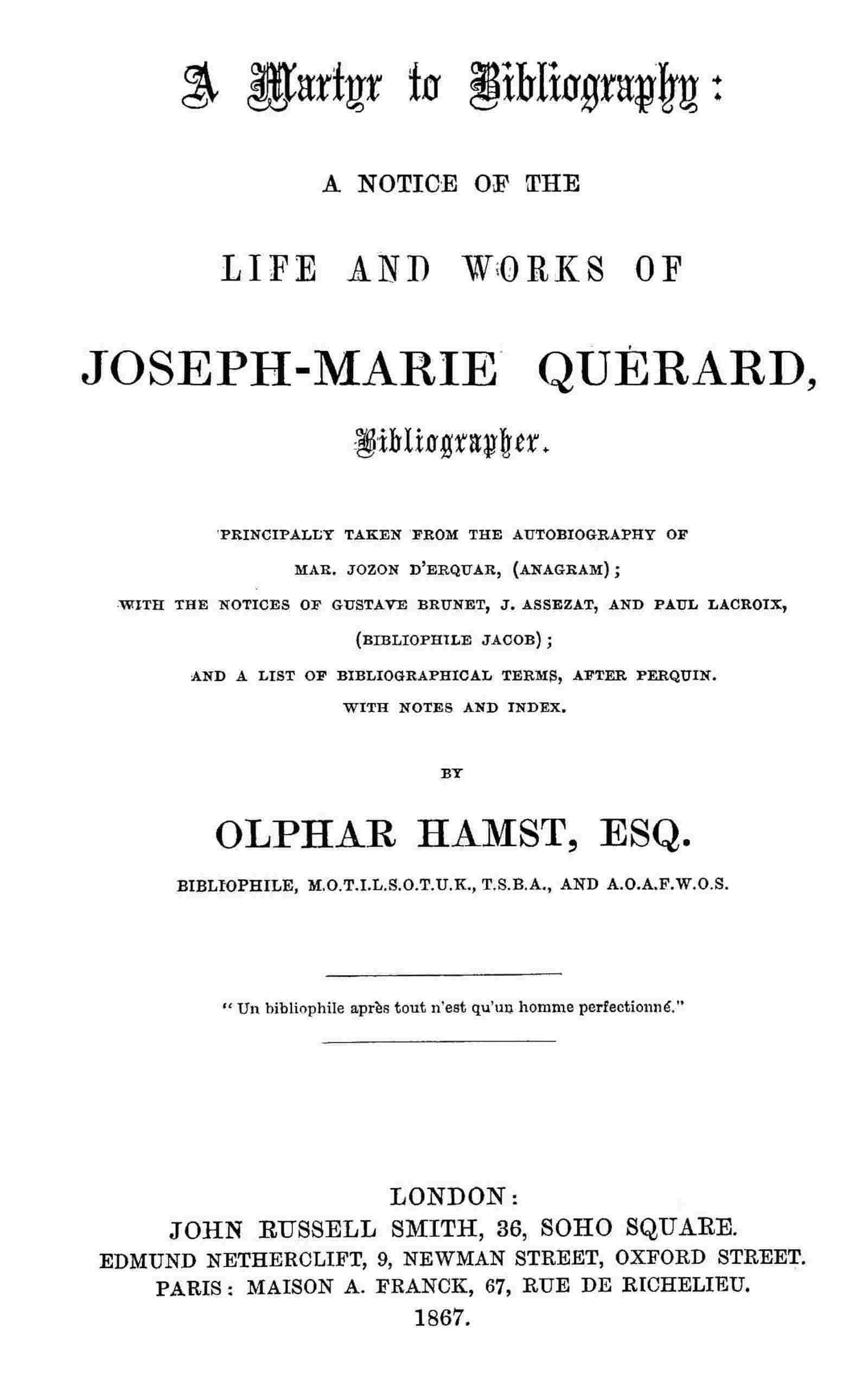
(XXX.)—Quelques mots sur M. Bossange père, doyen des imprimeurs et des libraires de Paris. Paris, 1864. 4ᵗᵒ; 7.
Quérard’s quarrel with M. S. P. is one of the things most to be regretted in his career, but he does not seem to have had that valuable quality of making friends, and such was the obstinacy of his character, that he would have sacrificed his dearest friendship to an idea. In fact it is only from materials such as this that we ever obtain works of the nature of Quérard’s.
He has been called “the chief of French bibliographers,”[51] “the Patriarch and Apostle of men devoted to bibliographical studies,”[52] and many other equally flattering, though not unmerited, epithets. He was the first, and probably the last, person in France who attempted—with what success our readers have seen—to make a profession, and an honourable means of support out of the science of books. He must long have known the madness of the endeavour, yet such was his devotion to his darling art, he was totally unable to deviate from the path which inevitably led to failure, for one which might have brought success. Bibliography is an occupation that no one would follow with a fore-knowledge of the incessant sacrifices, the continuous labour, this introduction to all science claims at the hands of its votaries. But each one who comes fresh to the study, brings with him hopes and aspirations which are sufficient to buoy him up for many years in the struggle for knowledge; though ultimately to be, like all predecessors, disappointed by neglect, ignorance, and want of appreciation,[53]
Quérard was pre-eminently endowed with all the qualities which form a bibliographer, the principal being indefatigable perseverance and the strictest accuracy.[54] Of his character little is said; he was of a retiring disposition, modest and unpretending, with a just idea of the magnitude and importance of his labours, and a full knowledge of the most unmerited neglect and of the cause of that neglect. He was indefatigable in his application and worked unremittingly, a necessity, in fact, for any one who wishes to execute any bibliographical undertaking. For himself, though not for the literature of his country, it is to be deplored that this love of research was not exercised in some other calling in which such constant labour would have ensured an ordinary competency, if not the highest position. The bibliography of his works is, in fact, almost his biography. A most interesting feature of the latter, however, as he himself remarks, would be his relations with authors and publishers, and others with whom his publications brought him in contact; whether he has left such, time will probably show.
FOOTNOTES:
[1] It is curious that this work, like that of Quérard, should have been composed away from the repositories one would have expected the authors to consult. Many parallel circumstances may be traced both in the lives and works of these men, who so much benefited the literature of their country: without any benefit to themselves. Quérard was robbed of his work, as we shall presently see, and so was Watt. The former never recovered his. The Watts had a year’s labour before they recompiled the stolen sheets. Chambers’ Biog. Dict. of Em: Scotch: IV. 439, 1856.
[2] We doubt whether so far as the public are concerned they are not gainers by his not being pensioned off with some such post. If he attended to his duties, would he have been able to go on with his work? In 1856, he himself complained that the Officers in the Imperial Library attended more to their own pursuits than to the Library or the public; although it is only open from 10 till 3, and no books to be asked for after ½ past 2. Le Quérard, II., 564.
We have often thought what an amount of erudition a certain gentleman at the British Museum must possess: it always reminds us of the sphinx, it never speaks, nor does it impart its knowledge concealed behind that expansive forehead. Even if some of the knowledge were imparted, should we not then complain that our library was ill-attended to?
Upon this point we would refer the reader to Mr. Panizzi’s characteristic evidence taken before the “Select Committee on the British Museum 1836,” commencing at 4919.
[3] We cannot resist the temptation of giving this letter entire:—
“Mon cher ami, je suis toujours votre abonné naturel, ordinaire, et extraordinaire pour toutes vos publications. Je lis votre journal avec un vif intérêt, et je vois que vous gagnez du terrain dans ce grand désert de la bibliographie, où le sol aride produit à peine des pommes de terre. La note que vous avez mise à l’occasion de la mort du ministre m’a serré le cœur en me rappelant une des plus grosses injustices de ce temps-ci; mais que voulez-vous? il est arrêté en principe ministériel que les bibliothécaires ne sont pas des bibliographes; les choses allaient de même sans doute avant la Révolution puisque comme le dit Beaumarchais, il fallait un calculateur et ce fut un danseur qu’on choisit. Vous protestez contre cette énormité en publiant de bons travaux: le meilleur serait encore une seconde édition revue, et augmentée de votre ‘France Littéraire.’ Quant à ‘l’Encyclopédie du bibliothécaire,’ c’est tout du monde et le jour des créations n’appartient qu’au bon Dieu.
Croyez à mes sentiments bien dévouée,
“PAUL LACROIX, bibliophile JACOB.”
(Le Quérard, II., 462, 1856.)
[4] Indépendance Belge, 3 August, 1856.
[5] The Bibliothèque Impériale at present possesses a keeper of the same calibre. Being asked one day by Quérard if he had works on “La Gaellique” and “Le Demotique.” What are those two things?—They are two languages.—Oh, then we have nothing. Note by Q. in 1854. He does not give the date of the above book?
[6] To show how hollow was the pretext for this legal robbery, the book though edited by four persons was not completed till 1857, and then in VII. vols. the last two subjects promised on the title-page have never been carried out.
[7] It is amusing for instance to find a translation of Gulliver’s Travels catalogued under the Christian name, as if “Lemuel (Gulliver)” were the author. See La Littérature Contemp. V. 80.
[8] For the criticisms on the part by Quérard, see Revue de Bib. Ana. 1840, p. 1094; and 1842, p. 994; and Nos. XVII. and XXIV.
[9] L’organe des chartistes, l’Athenæum français a cessé de paraître. Plan et titre étaient empruntés a un journal littéraire anglais qui compte un grand nombre d’années d’existence. Le Quérard, II. 530. That is the Athenæum, and which contains a mass of authentic and useful matter next to perfectly useless for want of a general index.
[10] One critic, who rejoiced in the name of Hippolyte Babou, fortunately gives us some guide to the value of his criticisms. The following is the order in which M. Hippolyte Babou would give biographical particulars:—1st, The names, Christian names or pseudonyms of the author. 2nd, A succinct biography, if any: the dates of his death, and birth; the principal events of his life. L’Athenæum Français, 1854; 666.
[11] The insane prejudice against Mr. Panizzi, because he was of Italian birth, which was exhibited some years ago by a number of grossly ignorant detractors, will no doubt be recollected. For ourselves, though we have not the honor of knowing him, we consider Mr. Panizzi a patriotic Englishman, and whether he is or not proud of England, England ought to be proud of him.
[12] Bulletin du Bibliophile Belge, I. 142-431. 1845. This article of M. Guichard is reprinted in No. XXIV.
[13] Bulletin du Bibliophile Belge, I. 357. 1845.
[14] In the preface the following observations occur:—The English who have so many special bibliographers, have not one who has occupied himself with anonyms and pseudonyms; we will not say universal, but not even of their own nation. Watt does not cite any in his Bibliotheca Britannica. M. Philarète Chasles, one of those French writers who has been greatly instrumental in introducing foreign literature to us, has recently traced out a most exhaustive plan for English literature, similar to that which other civilized nations already possess. The Revue des deux Mondes, (Series 5, VI. 757, 1844) contains an excellent article from his pen, which begins thus:—“In the whole history of literature, there is not a more fantastical group of whimsicalities than that of the English pseudonyms which abound between 1688 and 1800; nor is there any subject so new and unexplored, and yet so little explained. It was at that time some hundreds of writers, amongst whom I shall only take certain notabilities, deliberately renounced the lustre of their own names, and sacrificed their vanity to their interest or passion. If they concealed their names and disguised their hand it was to carry out their work better: one wishes to destroy an ancient reputation which is in his way; another wants to popularise sentiments which he considers useful; others to glorify the national vanity; the greater part to make their fortunes. There are the innocent and honest, as De Foe; the violent and imprudent, like Chatterton; the foolish, like Ireland; the unskilful and the calumniators, like Landor; and lastly, the expert, the Scotchman Macpherson, who deceived an entire generation of Europe and America.” Burke’s “imitation” of Bolingbroke may amongst numerous others be mentioned. It would perhaps be difficult to find a better example of the necessity there is for a good English bibliographical work, like La France Littéraire, than the information Bohn’s Lowndes gives about Burke’s writings. The “imitation” is not even mentioned, and in the life, by Prior, there is scarcely a scrap of bibliographical information. Generally, we concur in Mr. Hazlett’s very severe condemnation of Lowndes, though it must not be forgotten it is the only one we have. Mr. H. while professing not to be critical, in reality “damns the book.” “It may have been a well-meant scheme.” Hand-book to early English Literature, 1867, p. VI.
A masterly article upon Burke will be found in Allibone’s Critical Dict. of Eng. Lit. 1859. This is without doubt one of the most extensive and boldest literary enterprises of the day, entirely executed by one man. It does not contain much bibliographical matter, as the plan precluded it.
As Dr. Petzholdt remarks:—“Enthält zwar eine grosse Masse litterarischer Materialien, die aber mit allzu grosser Oekonomie zusammengetragen sind, als dass sie für bibliographische Zwecke sonderlichen Nutzen haben.” Bibliotheca Bibliographica, p. 419.
“And the judgment of the learned upon English authors” is no longer a desideratum. Bolton Corney, Curiosities of Lit. Illustrated.
[15] We can assure our readers that this Old Nick is no relation of the Gentleman so often mentioned in England.
[16] Bulletin du Bibliophile Belge, II. 78, 1845.
[17] See La L. F. C. of Bourquelot, IV., 104.
[18] Bulletin du Bibliophile Belge, III. 400, 1846.
[19] B. du B. B. III. 400. 1846.
[20] Years ago we were informed that Mr. Glover, Her Majesty’s Librarian, had a large collection for a work on anonymous and pseudonymous writers of England Quar. Rev. LXXII., 8.
[21] What would the writer in the Athenæum (1849) have said if he had been told at the time, when he was ridiculing the “500” volumes the catalogue was to be in, that it would ultimately be three times that number!
[22] Bulletin du Bibliophile Belge IV; 222; 1846.
[23] B. du B. B. IV. 444. 1847.
[24] B. du B. B. VI. 149-419. 1849.
[25] L’Indépendance Belge. 3 August 1856.
[26] Bulletin du Bibliophile Belge, III.; 401.
[27] The following is the title of the first part:—
Les Auteurs Apocryphes supposés déguisés plagiaires et les éditeurs infidèles de la littérature française pendant les quatre derniers siècles ensemble les industriels littéraires et les lettrés qui se sont enoblés à notre époque. Par J.-M. Q. auteur de L. F. L., 1ʳᵉ livre Paris l’Éditeur 1846; pp. 80.
[28] Bulletin du Bibliophile Belge, IV., 66. 1847.
[29] This is erroneous, Quérard declares that he alone was the author, and the chief assistance he had was from the catalogues of the dramatic agents.
[30] Bulletin du Bibliophile Belge, IV.; 206.
[31] Ibid, IV.; 352.
[32] Ibid, IV.; 434.
[33] Ibid, VII.; 398. 1850.
[34] Ibid, VII.; 160. 1851.
[35] Supercheries, I. 484, 511.
[36] Bulletin du Bibliophile Belge, XX, 141. 1864.
[37] In Notes and Queries, may it live long and prosperous, some very ridiculous signatures have been from time to time adopted. One gentleman indulges in the following:—“Thinks I to myself,” to the great discomfort of all autonyms. A table of pseudonyms, and the real names of the writers in this useful little journal, would be more than curious and interesting; it would make many notes authoritative. We wish the editor could be encouraged to reveal the pseudonyms, if only of the first and second series.
[38] Preface, Les Écrivains Pseud.
[39] Bulletin du Bibliophile Belge VI.; 354.
[40] Ibid, V.; 132.
[41] B. du B. B. XX.; 198.
[42] Le Quérard in announcing the Memoirs of Libraires, by Edward Edwards, of the British Museum, declares that the author wrote Die Maskirte Literatur der Alteren und neuren. Leipzig; 1856; imp. 8ᵛᵒ; von Emil Weller, and that Emil Weller is Mr. Edward Edwards’ pseudonym. We can scarcely credit this, seeing the number of works Dr. Petzholdt[A] ascribes to the former, and the latter’s constant literary occupations at home. If the above is right, we may compliment Mr. Edwards upon his German, and Herr Weller upon his correct English titles and familiarity with our Institutions. We beg respectfully to suggest to Mr. Edwards, Notes and Queries, as a medium for contradicting this, if it is not a fact. We are glad of an opportunity of thanking him for the information we have derived from many of his works, and particularly his Memoirs of Libraries.
[A] Bibliotheca Bibliographica, Kritisches Verzeichniss der das Gesammtgebiet der Bibliographie Betreffenden Litteratur des in- und auslandes in systematischer ordnung bearbeitet von Dr. Julius Petzholdt. Mit alphabetischem namen- und Sachregister. Leipzig. Verlag von Wilhelm Engelmann. 1866; 8ᵛᵒ; xii. 939.
[43] In announcing the death of this gentleman, Quérard writes:—
“M. Fortoul était très affable et rempli de bienveillance. Nous en citons une preuve entre mille.
Un soir des premiers jours d’Octobre de l’année dernière (1855), un pauvre solliciteur revenait de l’hôtel du ministre de l’instruction publique; il était très satisfait!!! Il sortait d’une audience qui lui avait été accordée, et dans laquelle le ministère avait été pour lui d’une extrême bonté, quoique le personnage très intimidé de se trouver dans un cabinet ministériel fût bien décontenancé, et ait dû paraître passablement gauche au ministre. Mais M. Fortoul connaissait les ouvrages du rude travailleur qui se trouvait en sa présence, et sa franchise lui plut; aussi l’accueillit-il mieux qu’un homme à jactance et à prestance assurées.
Ce solliciteur était l’auteur de La France Littéraire. M. Fortoul lui promit de le dédommager de l’indifférence de ses prédécesseurs, sauf de M. Guizot, en 1830. L’occasion ne s’est pas présentée de tenir la promesse qu’il avait faite au bibliographe; mais il s’en rappellera dans le monde meilleur pour lequel il est parti, et la bibliographie sera relevée un jour en notre personne par une place de bibliothécaire—chez le Père éternel.” Le Quérard, II., 446.
[44] Nothing could be more apposite to his position than Mathias’ remarks:—“The want of discretion and prudence has ruined more men of learning and of genius than the time would allow me to mention. Without this sobriety of intellect, nothing is strong, nothing is great.... The world will but smile at such scholars; and ministers when called upon to promote them, will tell you, not without reason, that “they are not producible.” Those who in confidence of superior capacities or attainments, disregard the common maxims of life, shall be reminded that nothing will supply the want of prudence.” Pursuits of Literature, 1812; 4ᵗᵒ; 366.
The numerous and copious notes in this work remind us that we should apologise for our own. But it seems some cannot write without them, and others, a very small minority indeed, with them. It has been said that notes to a book show want of thought, but surely this could not be a reproach to the one we have just quoted. The young German students we are told rush into print and oceans of notes directly their college life is over. (Rogers. Vanity and Glory of Lit.) Struvinus says that lawyers are especially apt to give too many notes. We do not think this aptitude confined to them. Mr. Bolton Corney, in 30 pages, has 110 notes. (See his excellent critique on The New General Biographical Dict. 1839. 8ᵛᵒ; 35.) Basil Montagu’s notes sometimes rival the size of his work. George Ensor, in the Independent Man, has 1000; and Buckle, in his Introduction, has 10,000. What would become of Dibdin deprived of his notes!
[45] To the honor of America several names of Philadelphians appear. And to America the mother country was content to leave that honor, for not a single English name of note appears but those of Antonio Panizzi, J. Winter Jones and Thomas Watts.
[46] Petzholdt. Bibliotheca Bibliographica, p. 106.
[47] Cherbuliez in the Revue Critique, 1863.
[48] Joel Cherbuliez “Revue Critique,” 1863. B. du B. B., XIX., 213, 417. See also M. de Stacy, “Journal des Débats,” July 12, 1855, p. 3.
[49] The consequence of this criticism was to obtain for Guichard, though a celebrated and talented author, only a single line in the foot notes of the 5th edition of Brunet’s Manuel. For critique see B. du B. B., XIX., 214, 1863.
[50] See also B. du B. B., XX., 141, 1864.
[51] M. Aug. Scheler, bibliothécaire de S. M. le roi des Belges in the Bulletin du Bibliophile Belge, 1856, p. 302.
[52] His Ex. M. Modeste de Korf, letter to Quérard, 1856.
[53] That this should be so is a reproach to the education of Englishmen; and yet so it is, and always has been. Important as is the science of books, there is not a man that can be pointed out who, after having devoted a life-time to its study, has been adequately rewarded. Let us simply take as an instance the last man who has been disappointed, who intended, no doubt, to contribute to English bibliography what should prove a useful literary addition, instead of which it is a useful commercial manual. He complains as each part of his work appears:—
“The labour required to make anything like a perfect Manual of Bibliography, is, both physically and mentally, far beyond what would be conceived by those who have not engaged in such duties, while the requital of even a successful achievement would be below what might be derived from the most ordinary pursuit.”
He then cites Dr. Watt, and “Lowndes, after years of unwearied exertion, died in distress.” (Part II.)
“The book does not pay at its present price.” (Part IV.) “Bibliographical knowledge alone is not sufficient for producing a satisfactory manual—it requires unremitting industry and perseverance.” (Appendix.)
But what would he have said if he had executed his work thoroughly, devoted twenty years to its compilation, aided scarcely by a single hand, instead of by numerous coadjutors? We candidly confess that we are disappointed in the new edition of Lowndes. What unveiling of pseudonyms, what anonymous books ascribed or given authoritatively to their real authors had we not a right to expect from one who had been all his life among books and literary men? And yet we ought to thank Mr. Bohn if only for making Lowndes cheaper.
[54] We believe the old notion that a bibliographer must know everything it is possible to know has long since exploded. It was a very popular thing for the early writers in any science to give a list of the qualifications a man required to follow it. They generally were so numerous that to have attempted to study the science according to their plan would have been madness. Peignot in his Manuel du Bibliophile, Dijon, 1823, p. lii., says that a bibliographer should have a knowledge of all sciences. This may be requisite for any one who is attempting universal bibliography—not for a special bibliograph; if he has a good education combined with the above qualities, though even in a less degree than Quérard, he may justly hope for utility and success.