
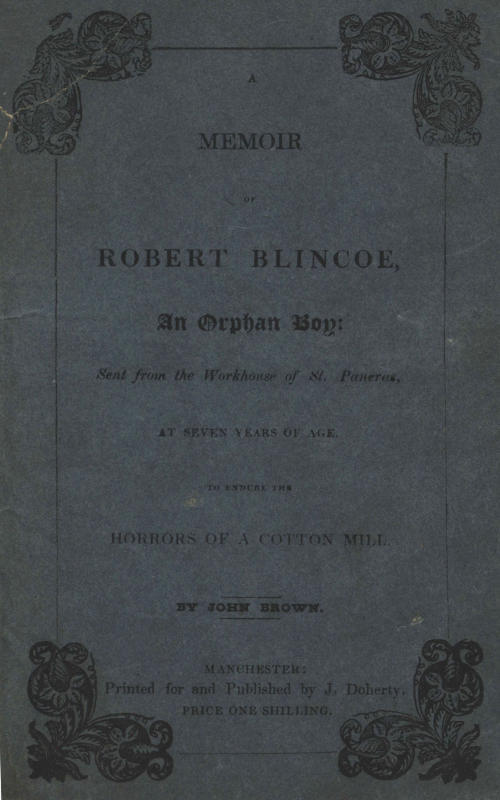
The Project Gutenberg eBook of A Memoir of Robert Blincoe, an Orphan Boy
Title: A Memoir of Robert Blincoe, an Orphan Boy
Author: John Brown
Release date: March 25, 2019 [eBook #59127]
Language: English
Credits: Produced by deaurider and the Online Distributed
Proofreading Team at http://www.pgdp.net (This file was
produced from images generously made available by The
Internet Archive)
Transcriber’s Note: Obvious printing errors have been corrected, but old spelling (e.g. villian, ancles, truely) has not been changed.
A
MEMOIR
OF
ROBERT BLINCOE,
An Orphan Boy;
SENT FROM THE WORKHOUSE OF ST. PANCRAS, LONDON,
AT SEVEN YEARS OF AGE,
TO ENDURE THE
Horrors of a Cotton-Mill,
THROUGH HIS INFANCY AND YOUTH,
WITH A MINUTE DETAIL OF HIS SUFFERINGS,
BEING
THE FIRST MEMOIR OF THE KIND PUBLISHED.
BY JOHN BROWN.
MANCHESTER:
PRINTED FOR AND PUBLISHED BY J. DOHERTY, 37, WITHY-GROVE,
1832.
PUBLISHER’S PREFACE.
The various Acts Of Parliament, which have been passed, to regulate the treatment of children in the Cotton Spinning Manufactories, betoken the previous existence of some treatment, so glaringly wrong, as to force itself upon the attention of the legislature. This Cotton-slave-trade, like the Negro-slave-trade, did not lack its defenders, and it might have afforded a sort of sorry consolation to the Negro slaves of America, had they been informed, that their condition, in having agriculturally to raise the cotton, was not half so bad, as that of the white infant-slaves, who had to assist in the spinning of it, when brought to this country. The religion and the black humanity of Mr. Wilberforce seem to have been entirely of a foreign nature. Pardon is begged, if an error is about to be wrongfully imputed—but the Publisher has no knowledge, that Mr. Wilberforce’s humane advocacy for slaves, was ever of that homely kind, as to embrace the region of the home-cotton-slave-trade. And yet, who shall read the Memoir of Robert Blincoe, and say, that the charity towards slaves should not have begun or ended at home?
The Author of this Memoir is now dead; he fell, about two or three years ago, by his own hand. He united, with a strong feeling for the injuries and sufferings of others, a high sense of injury when it bore on himself, whether real or imaginary; and a despondency when his prospects were not good.—Hence his suicide.—Had he not possessed a fine fellow-feeling with the child of misfortune, he had never taken such pains to compile the Memoir of Robert Blincoe, and to collect all the wrongs on paper, on which he could gain information, about the various sufferers under the cotton-mill systems. Notes to the Memoir of Robert Blincoe were intended by the author, in illustration of his strong personal assertions. The references were marked in the Memoir; but the Notes were not prepared, or if prepared, have not come to the Publisher’s hand. But, on inquiring after Robert Blincoe, in Manchester, and mentioning the Memoir of him written by Mr. Brown, as being in the Publisher’s possession, other papers, by the same Author, which had been left on a loan of money in Manchester, were obtained, and these papers seem to have formed the authorities, from which the Notes to the Memoirs would have been made. So that, though the Publisher does not presume to make notes for the Author, nor for himself, to this Memoir, he is prepared to confirm much of the statement here made, the personalities of Robert Blincoe excepted, should it be generally challenged.
Robert Blincoe, the subject of the Memoir, is now about 35 years of age, and resides at No. 19, Turner-street, Manchester, where he keeps a small grocer’s shop. He is also engaged in manufacturing Sheet Wadding and Cotton Waste-Dealer. The Publisher having no knowledge of Robert Blincoe, but in common with every reader of this Memoir, can have no personal feelings towards him, other than those of pity for his past sufferings. But such a Memoir as this was much wanted, to hand down to posterity, what was the real character of the complaints about the treatment of children in our cotton mills, about which a legislation has taken place, and so much has been said. An amended treatment of children has been made, the apprenticing system having been abandoned by the masters of the mills; but the employment is in itself bad for children—first, as their health—and second, as to their manners and acquirements—the employment being in a bad atmosphere; and the education, from example, being bad; the time that should be devoted to a better education, being devoted to that which is bad. The employment of infant children in the cotton-mills furnishes a bad means to dissolute parents, to live in idleness and all sorts of vice, upon the produce of infant labour. There is much of this in Lancashire, which a little care and looking after, on the part of the masters of cotton-mills, might easily prevent. But what is to be done? Most of the extensive manufacturers profit by human misery and become callous toward it; both from habit and interest. If a remedy be desired, it must be sought by that part of the working people themselves, who are alive to their progressing degradation. It will never be sought fairly out, by those who have no interest in seeking it. And so long as the majority of the working people squanders its already scanty income in those pest-houses, those intoxicating nurseries, for vice, idleness and misery, the public drinking-houses, there is no hope for them of an amended condition.
MEMOIR
OF
Robert Blincoe,
AN ORPHAN BOY.
CHAP. I.
By the time the observant reader has got through the melancholy recital of the sufferings of Blincoe and his associates in cotton-mill bondage, he will probably incline to an opinion, that rather than rear destitute and deserted children, to be thus distorted by excessive toil, and famished and tortured as those have been, it were incomparably less cruel to put them at once to death—less cruel that they had never been born alive; and far more wise that they had never been conceived. In cases of unauthorized pregnancies, our laws are tender of unconscious life, perhaps to a faulty extreme; whilst our parochial institutions, as these pages will prove, after incurring considerable expence to preserve the lives of those forlorn beings, sweep them off by shoals, under the sanction of other legal enactments, and consign them to a fate, far worse than sudden death.
Reared in the most profound ignorance and depravity, these unhappy beings are, from the hour of their birth, to the last of their existence, generally cut off from all that is decent in social life. Their preceptors are the veriest wretches in nature!—their influential examples all of the worst possible kind. The reports of the Cotton Bill Committees abundantly prove, that, by forcing those destitute poor to go into cotton-mills, they have, in very numerous instances, been consigned to a destiny worse than death without torture. Yet appalling as are many of the statements, which, through the reports of the Committees, have found their way before the public, similar acts of delinquencies, of a hue still darker—even repeated acts of murder, have escaped unnoticed. Much of the evidence brought forward by the friends of humanity, was neutralized or frittered away by timidity of their witnesses, or by the base subserviency of venally unprincipled professional men, who, influenced by rich capitalists, basely prostituted their talent and character as physicians, surgeons, and apothecaries, to deceive the government, to perplex and mislead public opinion, and avert the loud cry raised against the insatiate avarice and relentless cruelty of their greedy and unfeeling suborners.
It was in the spring of 1822, after having devoted a considerable time to the investigating of the effect of the manufacturing system, and factory establishments, on the health and morals of the manufacturing populace, that I first heard of the extraordinary sufferings of R. Blincoe. At the same time, I was told of his earnest wish that those sufferings should, for the protection of the rising generation of parish children, be laid before the world. Thus assured, I went to enquire for him, and was much pleased with his conversation. If this young man had not been consigned to a cotton-factory, he would probably have been strong, healthy, and well grown; instead of which, he is diminutive as to stature, and his knees are grievously distorted. In his manners, he appeared remarkably gentle; in his language, temperate; in his statements, cautious and consistent. If, in any part of the ensuing narrative, there are falsehoods and misrepresentations, the fault rests solely with himself; for, repeatedly and earnestly, I admonished him to beware, lest a too keen remembrance of the injustice he had suffered should lead him to transgress the limits of truth. After I had taken down his communications, I tested them, by reading the same to other persons, with whom Blincoe had not had any intercourse on the subject, and who had partaken of the miseries of the same hard servitude, and by whom they were in every point confirmed.
Robert Blincoe commenced his melancholy narrative, by stating, that he was a parish orphan, and knew not either his father or mother. From the age of four years, he says, “till I had completed my seventh, I was supported in Saint Pancras poorhouse, near London.” In very pathetic terms, he frequently censured and regretted the remissness of the parish officers, who, when they received him into the workhouse, had, as he seemed to believe, neglected to make any entry, or, at least, any to which he could obtain access, of his mother’s and father’s name, occupation, age, or residence. Blincoe argued, and plausibly too, that those officers would not have received him, if his mother had not proved her settlement; and he considered it inhuman in the extreme, either to neglect to record the names of his parents, or, if recorded, to refuse to give him that information, which, after his attaining his freedom, he had requested at their hands. His lamentations, on this head, were truely touching, and evinced a far higher degree of susceptibility of heart, than could have been expected from the extreme and long continued wretchedness he had endured in the den of vice and misery, where he was so long immured. Experience often evinces, that, whilst moderate adversity mollifies and expands the human heart, extreme and long continued wretchedness has a direct and powerful contrary tendency, and renders it impenetrably callous.
In one of our early interviews, tears trickling down his pallid cheeks, and his voice tremulous and faltering, Blincoe said, “I am worse off than a child reared in the Foundling Hospital. Those orphans have a name given them by the heads of that institution, at the time of baptism, to which they are legally entitled. But I have no name I can call my own.” He said he perfectly recollected riding in a coach to the workhouse, accompanied by some female, that he did not however think this female was his mother, for he had not the least consciousness of having felt either sorrow or uneasiness at being separated from her, as he very naturally supposed he should have felt, if that person had been his mother. Blincoe also appeared to think he had not been nursed by his mother, but had passed through many hands before he arrived at the workhouse; because he had no recollection of ever having experienced a mother’s caresses. It seems, young as he was, he often enquired of the nurses, when the parents and relations of other children came to see his young associates, why no one came to him, and used to weep, when he was told, that no one had ever owned him, after his being placed in that house. Some of the nurses stated, that a female, who called soon after his arrival, inquired for him by the name of “Saint;” and, when he was produced, gave him a penny-piece, and told him his mother was dead. If this report were well founded, his mother’s illness was the cause of his being removed and sent to the workhouse. According to his own description, he felt with extreme sensibility the loneliness of his condition, and, at each stage of his future sufferings, during his severe cotton-mill servitude, it pressed on his heart the heaviest of all his sorrows—an impassable barrier, “a wall of brass,” cut him off from all mankind. The sad consciousness, that he stood alone “a waif on the world’s wide common;” that he had no acknowledged claim of kindred with any human being, rich or poor—that he stood apparently for ever excluded from every social circle, so constantly occupied his thoughts, that, together with his sufferings, they imprinted a pensive character on his features, which probably neither change of fortune, nor time itself, would ever entirely obliterate. When he was six years old, and, as the workhouse children were saying their Catechism, it was his turn to repeat the Fifth Commandment—“Honour thy father and thy mother, &c.,” he recollects having suddenly burst into tears, and felt greatly agitated and distressed—his voice faltering, and his limbs trembling. According to his statement, and his pathetic eloquence, in reciting his misfortunes, strongly corroborated his assertion, he was a very ready scholar, and the source of this sudden burst of grief being inquired into by some of his superiors, he said, “I cry, because I cannot obey one of God’s commandments, I know not either my father or my mother, I cannot therefore be a good child and honour my parents.”
It was rumoured, in the ward where Robert Blincoe was placed, that he owed his existence to the mutual frailties of his mother and a reverend divine, and was called the young Saint, in allusion to his priestly descent. This name or appellation he did not long retain, for he was afterwards called Parson; often, the young Parson; and he recollected hearing it said in his presence, that he was the son of a parson Blincoe. Whether these allusions were founded in truth, or were but the vile effusions of vulgar malice, was not, and is not, in his power to determine, whose bosom they have so painfully agitated. Another remarkable circumstance in his case, was, that when he was sent in August, 1799, with a large number of other children, from Saint Pancras workhouse, to a cotton-mill near Nottingham, he bore amongst his comrades, the name of Parson, and retained it afterwards till he had served considerably longer than his fourteen years, and then, when his Indentures were at last relinquished, and not till then, the young man found he had been apprenticed by the name of Robert Blincoe. I urged the probability, that his right indenture might, in the change of masters that took place, or the careless indifference of his last master, have been given to another boy, and that to the one given to him, bearing the name of Blincoe, he had no just claim. This reasoning he repelled, by steadily and consistently asserting, he fully recollected having heard it said his real name was Blincoe, whilst he remained at Saint Pancras workhouse. His indentures were dated the 15th August, 1799. If, at this time, he was seven years of age, which is by no means certain, he was born in 1792, and in 1796, was placed in Pancras workhouse. With these remarks I close this preliminary matter, and happy should I be, if the publication of these facts enables the individual to whom they relate, to remove the veil which has hitherto deprived him of a knowledge of his parentage, a privation which he still appears to feel with undiminished intensity of grief.
Two years have elapsed, since I first began to take notes of Blincoe’s extraordinary narrative. At the close of 1822 and beginning of 1823, I was seized with a serious illness, which wholly prevented my publishing this and other important communications. The testimony of a respectable surgeon, who attended me, as any in the country, even ocular demonstration of my enfeebled state, failed to convince some of the cotton spinners, that my inability was not feigned, to answer some sinister end; and such atrocious conduct was pursued towards me, as would have fully justified a prosecution for conspiracy. Animated by the most opposite views, the worst of miscreants united to vilify and oppress me; the one wanting to get my papers, in order, by destroying them, to prevent the enormities of the cotton masters being exposed; and another, traducing my character, and menacing my life, under an impression that I had basely sold the declarations and communications received from oppressed work-people to their masters. By some of those suspicious, misjudging people, Blincoe was led away. He did not, however, at any time, or under any circumstances, retract or deny any part of his communications, and, on the 18th and 19th of March, 1824, of his own free will, he not only confirmed all that he had communicated in the spring of 1822, with many other traits of suffering, not then recollected, but furnished me with them. It has, therefore, stood the test of this hurricane, without its authenticity being in any one part questioned or impaired. The authenticity of this narrative is, therefore, entitled to greater credit, than much of the testimony given by the owners of cotton-factories, or by professional men on their behalf, as will, in the course of this narrative, be fully demonstrated, by evidence wholly incontrovertible. If, therefore, it should be proved, that atrocities to the same extent, exist no longer; still, its publication, as a preventative remedy, is no less essential to the protection of parish paupers and foundlings. If the gentlemen of Manchester and its vicinity, who acted in 1816, &c., in conjunction with the late Mr. Nathaniel Gould, had not made the selection of witnesses too much in the power of incompetent persons, Robert Blincoe would have been selected in 1819, as the most impressive pleader in behalf of destitute and deserted children.
CHAP. II.
Of the few adventures of Robert Blincoe, during his residence in old Saint Pancras workhouse, the principal occurred when he had been there about two years. He acknowledges he was well fed, decently clad, and comfortably lodged, and not at all overdone, as regarded work; yet, with all these blessings in possession, this destitute child grew melancholy. He relished none of the humble comforts he enjoyed. It was liberty he wanted. The busy world lay outside the workhouse gates, and those he was seldom, if ever permitted to pass. He was cooped up in a gloomy, though liberal sort of a prison-house. His buoyant spirits longed to rove at large. He was too young to understand the necessity of the restraint to which he was subjected, and too opinionative to admit it could be intended for his good. Of the world he knew nothing, and the society of a workhouse was not very well calculated to delight the mind of a volatile child. He saw givers, destitute of charity, receivers of insult, instead of gratitude, witnessed little besides sullenness and discontent, and heard little but murmurs or malicious and slanderous whispers. The aged were commonly petulant and miserable—the young demoralized and wholly destitute of gaiety of heart. From the top to the bottom, the whole of this motley mass was tainted with dissimulation, and he saw the most abhorrent hypocrisy in constant operation. Like a bird newly caged, that flutters from side to side, and foolishly beats its wings against its prison walls, in hope of obtaining its liberty, so young Blincoe, weary of confinement and resolved, if possible to be free, often watched the outer gates of the house, in the hope, that some favourable opportunity might facilitate his escape. He wistfully measured the height of the wall, and found it too lofty for him to scale, and too well guarded were the gates to admit of his egress unnoticed. His spirits, he says, which were naturally lively and buoyant, sank under this vehement longing after liberty. His appetite declined, and he wholly forsook his usual sports and comrades. It is hard to say how this disease of the mind might have terminated, if an accident had not occurred, which afforded a chance of emerging from the lifeless monotony of a workhouse, and of launching into the busy world, with which he longed to mingle.
Blincoe declares, he was so weary of confinement, he would gladly have exchanged situations with the poorest of the poor children, whom, from the upper windows of the workhouse, he had seen begging from door to door, or, as a subterfuge, offering matches for sale. Even the melancholy note of the sweep-boy, whom, long before day, and in the depths of winter, in frost, in snow, in rain, in sleet, he heard pacing behind his surly master, had no terrors for him. So far from it, he envied him his fortune, and, in the fulness of discontent, thought his own state incomparably more wretched. The poor child was suffering under a diseased imagination, from which men of mature years and elaborate culture are not always free. It filled his heart with perverted feelings—it rendered the little urchin morose and unthankful, and, as undeserving of as he was insensible to, the important benefits extended to him by a humane institution, when helpless, destitute and forlorn.
From this state of early misanthropy, young Blincoe was suddenly diverted, by a rumour, that filled many a heart among his comrades with terror, viz. that a day was appointed, when the master-sweeps of the metropolis were to come and select such a number of boys as apprentices, till they attained the age of 21 years, as they might deign to take into their sable fraternity. These tidings, that struck damp to the heart of the other boys, sounded like heavenly music to the ears of young Blincoe:—he anxiously inquired of the nurses if the news were true, and if so, what chance there was of his being one of the elect. The ancient matrons, amazed at the boy’s temerity and folly, told him how bitterly he would rue the day that should consign him to that wretched employment, and bade him pray earnestly to God to protect him from such a destiny. The young adventurer heard these opinions with silent contempt. Finding, on farther inquiry, that the rumour was well founded, he applied to several menials in the house, whom he thought likely to promote his suit, entreating them to forward his election with all the interest they could command! Although at this time he was a fine grown boy, being fearful he might be deemed too low in stature, he accustomed himself to walk in an erect posture, and went almost a tip-toe;—by a ludicrous conceit, he used to hang by the hands to the rafters and balustrades, supposing that an exercise, which could only lengthen his arms, would produce the same effect on his legs and body. In this course of training for the contingent honour of being chosen by the master-sweeps, as one fit for their use,—with a perseverance truly admirable, his tender age considered, young Blincoe continued till the important day arrived. The boys were brought forth, many of them in tears, and all except Blincoe, very sorrowful. Amongst them, by an act unauthorised by his guardians, young Blincoe contrived to intrude his person. His deportment formed a striking contrast to that of all his comrades; his seemed unusually high: he smiled as the grim looking fellows approached him; held his head as high as he could, and, by every little artifice in his power, strove to attract their notice, and obtain the honour of their preference. While this fatherless and motherless child, with an intrepid step, and firm countenance, thus courted the smiles of the sooty tribe, the rest of the boys conducted themselves as if they nothing so much dreaded, as to become the objects of their choice, and shrunk back from their touch as if they had been tainted by the most deadly contagion. Boy after boy was taken, in preference to Blincoe, who was often handled, examined, and rejected. At the close of the show, the number required was elected, and Blincoe was not among them! He declared, that his chagrin was inexpressible, when his failure was apparent.
Some of the sweeps complimented him for his spirit, and, to console him, said, if he made a good use of his time, and contrived to grow a head taller, he might do very well for a fag, at the end of a couple of years. This disappointment gave a severe blow to the aspiring ambition of young Blincoe, whose love of liberty was so ardent, that he cared little about the sufferings by which, if attained, it was likely to be alloyed. The boys that were chosen, were not immediately taken away. Mingling with these, some of them said to our hero, the tears standing in their eyes:—“why, Parson, can you endure the thoughts of going to be a chimney-sweep? I wish they would take you instead of me.” “So do I, with all my heart,” said Blincoe, “for I would rather be any where than here.” At night, as Blincoe lay tossing about, unable to sleep, because he had been rejected, his unhappy associates were weeping and wailing, because they had been accepted! Yet, his heart was not so cold as to be unaffected by the wailings of those poor children, who, mournfully anticipating the horrors of their new calling, deplored their misfortune in the most touching terms. They called upon their parents, who, living or dead, were alike unable to hear them, to come and save them! What a difference of feeling amongst children of the same unfortunate class! The confinement that was so wearisome to young Blincoe, must have been equally irksome to some of his young associates; therefore, the love of liberty could not have been its sole cause,—there was another and a stronger reason—all his comrades had friends, parents, or relations: poor Blincoe stood alone! no ties of consanguinity or kindred bound him to any particular portion of society, or to any place—he had no friend to soothe his troubled mind—no domestic circle to which, though excluded for a time, he might hope to be reunited. As he stood thus estranged from the common ties of nature, it is the less to be wondered at, that, propelled by a violent inclination to a rambling life, and loathing the restraint imposed by his then condition, he should indulge so preposterous a notion, as to prefer the wretched state of a sweeping-boy. Speaking on this subject, Blincoe said to me, “If I could penetrate the source of my exemption from the sorrow and consternation so forcibly expressed by my companions, it would probably have been resolved by the peculiarity of my destiny, and the privation of those endearing ties and ligatures which cement family circles. When the friends, relatives, parents of other children came to visit them, the caresses that were sometimes exchanged, the joy that beamed on the faces of those so favoured, went as daggers to my heart; not that I cherished a feeling of envy at their good fortune; but that it taught me more keenly to feel my own forlorn condition. Sensations, thus, excited, clouded every festive hour, and, young as I was, the voice of nature, instinct, if you will, forced me to consider myself as a moral outcast, as a scathed and blighted tree, in the midst of a verdant lawn.”
I dare not aver, that such were the very words Blincoe used, but they faithfully convey the spirit and tendency of his language and sentiments. Blincoe is by no means deficient in understanding: he can be witty, satirical, and pathetic, by turns, and he never showed himself to such advantage, as when expatiating upon the desolate state to which his utter ignorance of his parentage had reduced him.
During Blincoe’s abode at St. Pancras, he was inoculated at the Small Pox Hospital. He retained a vivid remembrance of the copious doses of salts he had to swallow, and that his heart heaved, and his hand shook as the nauseous potion approached his lips. The old nurse seemed to consider such conduct as being wholly unbecoming a pauper child; and chiding young Blincoe, told him, he ought to “lick his lips,” and say thank you, for the good and wholesome medicine provided for him at the public expense; at the same time, very coarsely reminding him of the care that was taken to save him from an untimely death by catching the small-pox in the natural way. In the midst of his subsequent afflictions, in Litton Mill, Blincoe, declared, he often lamented having, by this inoculation, lost a chance of escaping by an early death, the horrible destiny for which he was preserved.
From the period of Blincoe’s disappointment, in being rejected by the sweeps, a sudden calm seems to have succeeded, which lasted till a rumour ran through the house, that a treaty was on foot between the Churchwardens and Overseers of St. Pancras, and the owner of a great cotton factory, in the vicinity of Nottingham, for the disposal of a large number of children, as apprentices, till they become twenty-one years of age. This occurred about a twelvemonth after his chimney-sweep miscarriage. The rumour itself inspired Blincoe with new life and spirits; he was in a manner intoxicated with joy, when he found, it was not only confirmed, but that the number required was so considerable, that it would take off the greater part of the children in the house,—poor infatuated boy! delighted with the hope of obtaining a greater degree of liberty than he was allowed in the workhouse,—he dreamed not of the misery that impended, in the midst of which he could look back to Pancras as to an Elysium, and bitterly reproach himself for his ingratitude and folly.
Prior to the show-day of the pauper children to the purveyor or cotton master, the most illusive and artfully contrived falsehoods were spread, to fill the minds of those poor infants with the most absurd and ridiculous errors, as to the real nature of the servitude, to which they were to be consigned. It was gravely stated to them, according to Blincoe’s statement, made in the most positive and solemn manner, that they were all, when they arrived at the cotton-mill, to be transformed into ladies and gentlemen: that they would be fed on roast beef and plum-pudding—be allowed to ride their masters’ horses, and have silver watches, and plenty of cash in their pockets. Nor was it the nurses, or other inferior persons of the workhouse, with whom this vile deception originated; but with the parish officers themselves. From the statement of the victims of cotton-mill bondage, it seems to have been a constant rule, with those who had the disposal of parish children, prior to sending them off to cotton-mills, to fill their minds with the same delusion. Their hopes being thus excited, and their imaginations inflamed, it was next stated, amongst the innocent victims of fraud and deception, that no one could be compelled to go, nor any but volunteers accepted.
When it was supposed at St. Pancras, that these excitements had operated sufficiently powerful to induce a ready acquiescence in the proposed migration, all the children, male and female, who were seven years old, or considered to be of that age, were assembled in the committee-room, for the purpose of being publicly examined, touching their health, and capacity, and what is almost incredible touching their willingness to go and serve as apprentices, in the way and manner required! There is something so detestable, in this proceeding, that any one might conclude, that Blincoe had been misled in his recollections of the particulars; but so many other sufferers have corroborated his statement, that I can entertain no doubt of the fact. This exhibition took place in August 1799, and eighty boys and girls as parish apprentices, and till they had respectively acquired the age of twenty-one years, were made over by the churchwardens and overseers of Saint Pancras parish, to Messrs. Lamberts’, cotton-spinners, hosiers and lace-men, of St. Mary’s parish, Nottingham, the owners of Lowdam Mill. The boys, during the latter part of their time, were to be instructed in the trade of stocking weaving—the girls in lace-making. There was no specification whatever, as to the time their masters were to be allowed to work these poor children, although, at this period, the most abhorrent cruelties were notoriously known to be exercised, by the owners of cotton-mills, upon parish apprentices. According to Blincoe’s testimony, so powerfully had the illusions, purposely spread to entrap these poor children, operated, and so completely were their feeble minds excited, by the blandishments held out to them, that they almost lost their wits. They thought and talked of nothing but the scenes of luxury and grandeur, in which they were to move. Nor will the reflecting reader feel surprised at this credulity, however gross, when he considers the poor infants imagined there were no greater personages than the superiors, to whom they were, as paupers, subjected, and that, it was those identical persons, by whom their weak and feeble intellects had thus been imposed upon. Blincoe describes his conduct to have been marked by peculiar extravagance. Such was his impatience, he could scarcely eat or sleep, so anxiously did he wait the hour of emancipation. The poor deluded young creatures were so inflated with pride and vanity, that they strutted about like so many dwarfish and silly kings and queens, in a mock tragedy. “We began” said Blincoe “to treat our old nurses with airs of insolence and disdain—refused to associate with children, who, from sickness, or being under age, had not been accepted; they were commanded to keep their distance; told to know their betters; forbidden to mingle in our exalted circle! Our little coterie was a complete epitome of the effects of prosperity in the great world. No sooner were our hearts cheered by a prospect of good fortune, than its influence produced the sad effects recited. The germ of those hateful vices, arrogance, selfishness and ingratitude, began to display themselves even before we had tasted the intoxicating cup. But our illusion soon vanished, and we were suddenly awakened from the flattering dream, which consigned the greater part of us to a fate more severe than that of the West Indian slaves, who have the good fortune to serve humane owners.” Such were Blincoe’s reflections in May 1822.
It appears that the interval was not long, which filled up the space between their examination, acceptance, and departure from St. Pancras workhouse, upon their way to Nottingham; but short as it was, it left room for dissension. The boys could not agree who should have the first ride on their masters’ horses, and violent disputes arose amongst the girls, on subjects equally ludicrous. It was afterwards whispered at Lowdam Mill, that the elder girls, previous to leaving Pancras, began to feel scruples, whether their dignity would allow them to drop the usual bob-curtsey to the master or matron of the house, or to the governess by whom they had been instructed to read, or work by the needle. Supposing all these follies to have been displayed to the very letter, the poor children were still objects of pity; the guilt rests upon those by whom they had been so wickedly deceived!
Happy, no doubt, in the thought of transferring the burthen of the future support of fourscore young paupers to other parishes, the churchwardens and overseers distinguished the departure of this juvenile colony by acts of munificence. The children were completely new clothed, and each had two suits, one for their working, the other for their holiday dress—a shilling in money, was given to each—a new pocket handkerchief—and a large piece of gingerbread. As Blincoe had no relative of whom to take leave, all his anxiety was to get outside the door. According to his own account, he was the first at the gate, one of the foremost who mounted the waggon, and the loudest in his cheering. In how far the parents or relatives of the rest of the children consented to this migration; if they were at all consulted, or even apprised of its being in contemplation, formed no part of Blincoe’s communications. All he stated was, that the whole of the party seemed to start in very high spirits. As to his own personal conduct, Blincoe asserts, he strutted along dressed in party-coloured parish clothing, on his way to the waggon, no less filled with vanity than with delusion: he imagined he was free, when he was in fact legally converted into a slave; he exulted in the imaginary possession of personal liberty, when he was in reality a prisoner. The whole convoy were well guarded by the parish beadles on their way to the waggons; but those officers, bearing their staves, the children were taught to consider as a guard of honour. In addition to the beadles, there was an active young man or two, appointed to look after the passengers of the two large waggons, in their conveyance to Nottingham. Those vehicles, and very properly too, were so secured, that when once the grated doors were locked, no one could escape. Plenty of clean straw was strewed in the beds, and no sooner were the young fry safely lodged within, than they began throwing it over one another and seemed delighted with the commencement of their journey. A few hours progress considerably damped this exultation. The inequality of the road, and the heavy jolts of the waggon, occasioned them many a bruise. Although it was the middle of August, the children felt very uncomfortable. The motion of the heavy clumsey vehicle, and so many children cooped up in so small a space, produced nausea and other results, such as sometimes occur in Margate boys. Of the country they passed through, the young travellers saw very little.—Blincoe thinks the children were suffered to come out of the waggon to walk through St. Alban’s. After having passed one night in the waggon, many of the children began to repent, and express a wish to return. They were told to have patience, till they arrived at Messrs. Lamberts, when, no doubt, those gentlemen would pay every attention to their wishes, and send back to St. Pancras, those who might wish to return. Blincoe, as might have been expected, was not one of those back-sliders—he remained steady to his purpose, exulting in the thought, that every step he advanced brought him nearer to the desired spot, where so many enviable enjoyments awaited him, and conveyed him farther and farther from the detested workhouse! Blincoe being so overjoyed with the fine expectations he was to receive at Lowdam Mill, he spent his shilling at Leicester in apples.
The greater part of the children were much exhausted, and not a few of them seriously indisposed, before they arrived at Nottingham. When the waggons drew up near the dwelling and warehouse of their future master, a crowd collected to see the live stock that was just imported from the metropolis, who were pitied, admired, and compared to lambs, led by butchers to slaughter! Care was taken that they should not hear or understand much of this sort of discourse. The boys and girls were distributed, some in the kitchen, others in a large ware-room, washed, combed and supplied with refreshments; but there were no plum-pudding—no roast beef, no talk of the horses they were to ride, nor of the watches and fine clothing that they had been promised. Many looked very mournful; they had been four days travelling to Nottingham: at a more advanced period of their lives, a travel to the East Indies might not have been estimated as a much more important or hazardous undertaking. After having been well refreshed, the whole of the boys and girls were drawn up in rows, to be reviewed by their masters, their friends and neighbours. In Blincoe’s estimation, their masters, Messrs. Lamberts’, were “stately sort of men.” They looked over the children and finding them all right, according to the invoice, exhorted them to behave with proper humility and decorum. To pay the most prompt and submissive respects to the orders of those who would be appointed to instruct and superintend them at Lowdam Mill, and to be diligent and careful, each one to execute his or her task, and thereby avoid the punishment and disgrace which awaited idleness, insolence, or disobedience. This harangue, which was delivered in a severe and dictatorial tone, increased their apprehensions, but not one durst open a mouth to complain. The masters and their servants talked of the various sorts of labour to which the children were to apply themselves, and to the consternation and dismay of Blincoe and his associates, not the least allusion was made to the many fine things which had so positively been promised them whilst in London. The conversation which Blincoe heard, seemed to look forward to close, if not to unremitting toil, and the poor boy had been filled with expectations, that he was to work only when it pleased him; to have abundance of money and fine clothes—a watch in his pocket, to feast on roast beef and plum-pudding, and to ride his masters horses. His hopes, however were, not wholly extinguished, because Nottingham was not Lowdam Mill, but his confidence was greatly reduced, and his tone of exultation much lowered.
The children rested one night at Nottingham in the warehouses of their new masters—the next day they were led out to see the castle, Mortimer-hole and other local curiosities, in the forest of Sherwood, which are so celebrated by bards of ancient times. Many shoes, bonnets, and many other articles of clothing having been lost upon the journey, others were supplied—but withal Blincoe found himself treated as a parish orphan, and he calculated on being received and treated as if he had been a gentleman’s son sent on a visit to the house of a friend or relative. By the concurring testimony of other persons who had been entrapped by similar artifices, it appears certain, that the purveyors of infant labourers to supply the masters of cotton and silk factories with cheap labourers, adopted this vile, unmanly expedient, in most of their transactions. It will be seen, by the evidence of Sir Robert Peel, Baronet, David Owen, Esq. and other witnesses examined in 1816, that, when children were first wanted to attend machinery in cotton-factories, such was the aversion of parents and guardians to this noxious employment, that scarcely any would submit to consign their offspring to those mills, the owners of which, under the specious pretext of diminishing the burdens occasioned by poor-rates, prevailed on churchwardens and overseers, to put their infant paupers into their hands. Since then, by a gradual progress of poverty and depravity, in the county of Lancashire alone, there are some thousand fathers, mothers, and relatives, who live upon the produce of infant labour, though alloyed by the dreadful certainty, that their gain is acquired by the sacrifice of their children’s health and morals, and too frequently of their lives, whereby the fable of Saturn devouring his children, seems realised in modern times.
CHAP. III.
Lowdham Cotton-Mill, situated near a village of that name, stood ten miles distant from Nottingham, on the Surhill road; thither Robert Blincoe and his associates were conveyed the next day in carts, and it was rather late when they arrived. The mill, a large and lofty edifice, being surmounted by a cupola, Blincoe, at first, mistook for a church, which raised a laugh at his expense, and some jeering remarks, that he would soon know what sort of service was performed there. Another said, he did not doubt but the young cocknies would be very regular in their attendance. When he came in view of the apprentice-house, which was half a mile distant from the mill, and was told that was to be his home for fourteen years to come, he was not greatly delighted, so closely did it resemble a workhouse. There was one source of consolation, however, remaining—it was not surrounded by lofty walls, nor secured by strong gates, as was the case at Pancras. When the first cart, in which was young Blincoe, drove up to the door, a number of villagers flocked round, some of whom exclaimed, “God help the poor wretches.”—“Eh!” said another, “what a fine collection of children, little do they know to what a life of slavery they are doomed.”—“The Lord have mercy upon them,” said a third.—“They’ll find little mercy here,” said a fourth. The speakers were mostly of the female sex, who, shaking their heads, said,—“Ah! what fine clear complexions!”—“The roses will soon be out of bloom in the mill.” Such were a part of the remarks which saluted the ears of these children, as they entered the Lowdham Mill. In common with his comrades, Blincoe was greatly dismayed, by the gloomy prognostications, which their guardians did all they could to check, or prevent the children from hearing, hurrying them, as rapidly as they could, inside the house.
The young strangers were conducted into a spacious room, fitted up in the style of the dinner-room, in Pancras old workhouse, viz: with long, narrow deal tables, and wooden benches. Although the rooms seemed tolerably clean, there was a certain rank, oily, smell, which Blincoe did not very much admire. They were ordered to sit down at these tables—the boys and girls apart. The other apprentices had not left work, when this supply of children arrived. The supper set before them consisted of milk-porridge, of a very blue complexion! The bread was partly made of rye—very black, and so soft, they could scarcely swallow it, as it stuck like bird-lime to their teeth. Poor Blincoe stared, recollecting this was not so good a fare as they had been used to at Saint Pancras. Where is our roast beef and plum-pudding, he said to himself. He contrived, with some difficulty, to eat about one half of his allowance. As the young strangers gazed mournfully at each other, the governor and governess, as the master and mistress of the apprentices were styled, kept walking round them, and making very coarse remarks. Just as they had passed Blincoe, some of the girls began making faces, and one flung a dab of bread against the wall, where it stuck fast, as if it had been plaister. This caught the eye of the governor—a huge raw-boned man, who had served in the army, and had been a drill serjeant, unexpectedly, he produced a large horse-whip, which he clanged in such a sonorous manner, that it made the house re-echo. In a moment, the face-makers and bread throwers were reduced to solemn silence and abject submission. Even young Blincoe was daunted—he had been one of the ring-leaders in these seditious proceedings; but so powerful was the shock to his nerves, sustained from the tremendous clang of the horse-whip, it bereft him of all his gaity, and he sat as demure as a truant-scholar, just previous to his flogging. Yet the master of the house had not uttered a single threat; nor indeed had he occasion; his carbuncled nose—his stern and forbidding aspect and his terrible horse-whip, inspired quite as much terror as was requisite. Knowing that the apprentices from the mill were coming, this formidable being retired, to the great relief of the young strangers, but so deep an impression had he created, they sat erect and formal, scarcely daring to look beyond the nose. Whilst they were in this subdued and neutralised state, their attention was suddenly and powerfully attracted by the loud shouting of many voices, almost instantly the stone-room filled, spacious as it was, with a multitude of young persons of both sexes; from young women down to mere children. Their presence was accompanied by a scent of no very agreeable nature, arising from the grease and dirt acquired in the avocation.
The boys, generally speaking, had nothing on, but a shirt and trousers. Some few, and but a few, had jackets and hats. Their coarse shirts were entirely open at the neck, and their hair looked, as if a comb had seldom, if ever, been applied! The girls, as well as Blincoe could recollect, were, like the boys, destitute of shoes and stockings. Their locks were pinned up, and they were without caps; very few had on, either jacket or gown; but wore, what, in London, are called pinafores; in Lancashire, bishops!—that is, long aprons with sleeves, made of coarse linen, that reached from the neck to the heels. Blincoe was no less terrified at the sight of the pale, lean, sallow-looking multitude, than his nostrils were offended by a dense and heavy smell of rank oil or grease, that arose at their appearance! By comparison, the new comers appeared like so many ladies and gentlemen. On their first entrance, some of the old apprentices took a view of the strangers; but the great bulk first looked after their supper, which consisted of new potatoes, distributed at a hatch door, that opened into the common room from the kitchen. At a signal given, the apprentices rushed to this door, and each, as he made way, received his portion, and withdrew to his place at the table. Blincoe was startled, seeing the boys pull out the fore-part of their shirts, and holding it up with both hands, received the hot boiled potatoes allotted for their supper. The girls, less indecently, if not less filthily, held up their dirty greasy bishops or aprons, that were saturated with grease and dirt, and having received their allowance, scampered off as hard as they could, to their respective places, where, with a keen appetite, each apprentice devoured her allowance, and seemed anxiously to look about for more. Next, the hungry crew ran to the tables of the new comers, and voraciously devoured every crust of bread and every drop of porridge they had left, and put or answered interrogatories as occasion required.
Thus unfavourable were the impressions produced by the scene that presented itself on his first entrance into a cotton-factory. Blincoe was forcibly struck by the absence of that personal cleanliness which had been so rigidly enforced at St. Pancras. The apprentices were required to wash night and morning; but no soap was allowed, and without it, no dirt could be removed. Their tangled locks covered with cotton flue, hung about their persons in long wreaths, floating with every movement. There was no cloth laid on the tables, to which the new comers had been accustomed in the workhouse—no plates, nor knives, nor forks—to be sure the latter utensils were not absolutely necessary with a potatoe-supper. Instead of salt-cellars, as had been allowed at Pancras, a very stingy allowance of salt was laid on the table, and Blincoe saw no other beverage drunk, by the old hands, than pump water.
The supper being devoured, in the midst of the gossiping that ensued, the bell rang, that gave the signal to go to bed. The grim governor entered to take the charge of the newly arrived boys, and his wife, acting the same part by the girls, appeared every way suitable to so rough and unpolished a mate. She was a large grown, robust woman, remarkable for a rough hoarse voice and ferocious aspect. In a surly, heart-chilling tone, she bade the girls follow her. Tremblingly and despondingly the little creatures obeyed, scarcely daring to cast a look at their fellow travellers, or bid them good night. As Blincoe marked the tear to start in their eyes and silently trickle down their cheeks, his heart responsive sank within him. They separated in mournful silence, scarcely a sigh being heard, nor a word of complaint being uttered.
The room in which Blincoe and several of the boys were deposited, was up two pair of stairs. The bed places were a sort of cribs, built in a double tier, all round the chamber. The apprentices slept two in a bed. The beds were of flock. From the quantity of oil imbibed in the apprentices’ clothes, and the impurities that accumulated from the oiled cotton, a most disagreeable odour saluted his nostrils. The governor called the strangers to him and allotted to each his bed-place and bed-fellow, not allowing any two of the newly arrived inmates to sleep together. The boy, with whom Blincoe was to chum, sprang nimbly into his berth, and without saying a prayer, or any thing else, fell asleep before Blincoe could undress himself. So completely was he cowed, he could not restrain his tears. He could not forbear execrating the vile treachery of which he felt himself the victim; but still he declared, it never struck him, at least, not till long afterwards, that the superiors of St. Pancras had deceived him. The fault, he thought, lay with Messrs. Lamberts, their new masters. When he crept into bed, the stench of the oily clothes and greasy hide of his sleeping comrade, almost turned his stomach.—What, between grief and dismay, and this nauseous smell, it was dawn of day before Blincoe dropt asleep. Over and over again, the poor child repeated every prayer he had been taught, and strove, by unfeigned piety, to recommend himself to the friend of the friendless, and the father of the fatherless. At last, sleep sealed his weary eye-lids—but short was the repose he was allowed to enjoy—before five o’clock, he was awakened by his bed-fellow, who springing upright, at the loud tolling of a bell, told Blincoe to dress with all speed, or the governor would flog him and deprive him of his breakfast. Before Blincoe had time to perform this office, the iron door of the chamber, creaking upon its hinges, was opened, and in came the terrific governor, with the horse-whip in his hand, and every boy hastily tumbled out of his crib, and huddled on his clothes with all possible haste! Blincoe and his fellow travellers were the slowest, not being rightly awake. Blincoe said “bless me, have you church-service so soon?” “Church-service, you fool, said one of the larger apprentices, it is to the mill service you are called, and you had better look sharp, or you’ll catch it!” saying this, off he scampered. Blincoe, who was at first amazed at the trepidation, that appeared in the apprentices, soon understood the cause. The grim-looking governor, with the carbuncled nose, bearing the emblem of arbitrary rule, a horse-whip in his hand, made his appearance, and stalking round the chamber, looked in every bed-place; as he passed Blincoe and his young comrades, he bestowed a withering look upon them, which, fully understanding, they hastened below; arrived there, Blincoe saw some of the boys washing themselves at a pump, and was directed to do the same.—The whole mass sat down to breakfast at five o’clock in the morning. The meal consisted of black bread and blue milk-porridge. Blincoe and his fellow strangers took their places, mingled with the rest of the apprentices, who, marking their dislike of the bread, eagerly seized every opportunity of eating it themselves. Blincoe and his comrades looked wistfully at each other. Consternation sat deeply imprinted on their features; but every tongue was silent; young as they were, they had sense enough to perceive the necessity of submission and the prudence of reserve.
They reached the mill about half past five.—The water was on, from the bottom to the top, in all the floors, in full movement. Blincoe heard the burring sound before he reached the portals and smelt the fumes of the oil with which the axles of twenty thousand wheels and spindles were bathed. The moment he entered the doors, the noise appalled him, and the stench seemed intolerable.
He did not recollect that either of the Messrs. Lamberts’ were present at the mill, on his first entrance. The newly arrived were received by Mr. Baker, the head manager, and by the overlookers of the respective rooms. They were mustered in the making-up room; the boys and girls in separate divisions. After being looked at, and laughed at, they were dispersed in the various floors of the mill, and set to various tasks.—Blincoe was assigned to a room, over which a man named Smith presided. The task first allotted to him was, to pick up the loose cotton, that fell upon the floor. Apparently, nothing could be easier, and he set to with diligence, although much terrified by the whirling motion and noise of the machinery, and not a little affected by the dust and flue with which he was half suffocated. They span coarse numbers; unused to the stench, he soon felt sick, and by constantly stooping, his back ached. Blincoe, therefore, took the liberty to sit down; but this attitude, he soon found, was strictly forbidden in cotton mills. His task-master (Smith) gave him to understand, he must keep on his legs. Ho did so, till twelve o’clock, being six hours and a half, without the least intermission.—Blincoe suffered at once by thirst and hunger—the moment the bell rang, to announce dinner, all were in motion to get out as expeditiously as possible. Blincoe ran out amongst the crowd, who were allowed to go—never, in his life, before did he know the value of wholesome air so perfectly. He had been sick almost to fainting, and it revived him instantaneously! The cocknies mingled together, as they made progress towards the apprentice-house! Such as were playsome made to each other! and the melancholy seemed to mingle their tears! When they reached the apprentice-room, each of them had a place assigned at the homely board! Blincoe does not remember of what his dinner consisted; but is perfectly sure, that neither roast beef nor plum-pudding made its appearance—and that the provisions, the cookery, and the mode of serving it out, were all very much below the standard of the ordinary fare of the workhouse in which he had been reared.
During the space of a week or ten days, that Blincoe was kept picking up cotton, he felt at night very great weariness, pains in his back and ancles; and he heard similar complaints from his associates. They might have suffered less had they been taken to the mill at five o’clock, been worked till eight, and then allowed time to eat their breakfast; but six hours’ confinement, to close work, no matter of what kind, in an atmosphere as foul as that which circulated in a cotton-mill, is certainly injurious to the health and growth of children of tender years. Even in mills worked by water, and where the temperature of the air is nearly the same within the mill as without, this is the case; but incomparably more so in mills, such as are found in Manchester, where, in many, the average heat is from 70 to 90 degrees of Fahrenheit's scale. After Blincoe had been employed in the way described, he was promoted to the more important employment of a roving winder. Being too short of stature, to reach his work, standing on the floor, he was placed on a block; but this expedient only remedied a part of the evil; for he was not able by any possible exertion, to keep pace with the machinery. In vain, the poor child declared it was not in his power to move quicker. He was beaten by the overlooker, with great severity, and cursed and reviled from morning till night, till his life become a burthen to him, and his body discoloured by bruises. In common, with his fellow apprentices, Blincoe was wholly dependent upon the mercy of the overlookers, whom he found, generally speaking, a set of brutal, ferocious, illiterate ruffians, alike void of understanding, as of humanity! Blincoe complained to Mr. Baker, the manager, and all he said to him was:—“do your work well, and you’ll not be beaten.”—It was but seldom, either of the masters visited the mill, and when they did, Blincoe found it was useless to complain. The overlooker, who had charge of him, had a certain quantity of work to perform in a given time. If every child did not perform his allotted task, the fault was imputed to his overlooker, and he was discharged.—On the other hand, a premium was given, if the full quantity of work was done, and not otherwise. If, therefore, Messrs. Lamberts had remonstrated, or had reprimanded the task-masters, by whom the children were thus mercilessly treated, those task-masters could, and most probably would have said, that if the owners insisted upon so much work being extracted from the apprentices, and a greater quantity of yarn produced, than it was possible to effect by fair and moderate labour, they must allow them severity of punishment, to keep the children in a state of continual exertion. Blincoe had not, of course, sense to understand this, the principal, if not the sole cause of the ferocity of the overlookers—but such was, and is the inhuman policy prevailing in cotton-mills, and whilst that cause remains unchanged, the effect inevitably must be the same. Each of the task-masters, to acquire favour and emolument, urged the poor children to the very utmost!—Such is the driving system, which still holds its course, and which leads to the exhaustion and destruction of annual myriads, and to the utmost frightful crimes;—and such is the force of avarice, there are plenty of spinners, so depraved, as not only to sacrifice other people’s children, but even their own. Blincoe, was not treated with that sanguinary and murderous ferocity in this mill which these pages will soon delineate; but from morning till night, he was continually being beaten, pulled by the hair of his head, kicked or cursed.
It was the custom, in Lowdham Mills, as it is in most water-mills, to make the apprentices work up lost time, by working over hours! a custom, that might not be deemed unreasonable, or found oppressive, if the regular hours were of moderate duration. Blincoe did not say, that this custom was abused at Lowdham Mill, in an equal degree, to what it was in others; but when children of seven years of age, or, by probability, younger, and to work fourteen hours every day in the week, Sundays excepted, any addition was severely felt, and they had to stop at the mill during dinner time, to clean the frames every other day. Once in ten days, or a fortnight, the whole of the finer machinery used to be taken to pieces and cleaned, and then they had to remain at the mill from morning till night, and frequently have been unable to find time to get any food from this early breakfast till night, after they had left off, a term frequently extended from fifteen to sixteen hours incessant labour.
As an inducement to the children to volunteer to work, the whole dinner-hour, a premium of a halfpenny was allowed! Small as was the bribe, it induced many, and Blincoe amongst the number! On such occasions, the dinner was brought up in tin cans, and often has Blincoe’s allowance stood till night, whilst he was almost famished with hunger, and he has often carried it back, or rather eaten it on the road, cold, nauseous, and covered with flue.
Being half starved, and cruelly treated by his task-masters—being spotted as a leopard with bruises: and still believing his ill-treatment arose from causes beyond the controul of the parish officers, by whom he had been disposed of to Messrs. Lamberts, Blincoe resolved to attempt an escape,—to beg his way to London,—to lay his case before the overseers and churchwardens of Saint Pancras, and not only claim redress of injuries, but the fulfilment of the grand promises that had been made to him. “I cannot deny,” said Blincoe, “that I feel a glow of pride, when I reflect that, at the ago of seven years and a half, I had courage to resent and to resist oppression, and generosity to feel for the sufferings of my helpless associates, not one of whom durst venture to share the peril of the enterprise.—On the other hand,” said he, “I must give them the credit for sincerity; for, if any one had been unguarded or perfidious, who knew of my intended expedition, I should have been put under such restraint, as would have effectually prevented a successful attempt to run away! I considered my situation so deplorable, and my state of thraldom so intolerable, that death appeared as a lesser evil. I was not wholly ignorant of the sufferings I might have had to encounter, nor that I might perish on the way, from want of food or shelter, and yet I persevered in an effort, in which, of forty fellow-sufferers, not one had courage to join, although many had parents or relatives, to whom to flee for succour, and I had none! So far, young as I was, I calculated upon difficulty, danger and sufferings.—In one thing, only, was I deceived; that error consisted in thinking the evils of my situation intolerable! I had no recollection of calamities so severe, and consequently no standard by which to regulate my judgment. I therefore, rashly determined in my own mind, that my condition admitted of no aggravation,—I was indeed, soon undeceived! I lived, within the short space of four years, to look back with regret to the comparative degree of ease, plenty of food, and of all other good things enjoyed at Lowdham Mill! This sort of knowledge, is, I believe, commonly taught” said Blincoe, “to all the children of misery, as they sink deeper and deeper in woe! The first stage appears the most intolerable; but as they descend, like me, they sink so profoundly in the depths of wretchedness, that in their melancholy progress, those stages and degrees, which, at first, appeared as intolerable, lose all their terrors, in accumulated misery, and the desponding heart, when it takes a retrospective glance at past sufferings, often arraigns its want of patience and fortitude, for murmurings measured by present calamities. Their former condition appeared comfortable! Such was my condition, at a later period, when, to be released from the greater and heavier misery, which I endured at Lowdham, with all its evils, and in the very worst shape, I should have esteemed it as a positive state of happiness.” Such was the philosophical reasoning of Robert Blincoe, in 1822. But, to proceed,—steady to his purpose, he embraced the first favourable opportunity of making the projected attempt to escape! He considered his great danger to lie in being retaken on the road between Lowdham and Nottingham; but he knew no other way, and was afraid to make inquiry! When the manager and overlooker of the room he worked in were busy, Blincoe set off, dressed in his working clothes. His progress began in a sort of canter, looking behind him every fifty yards for the first half mile, when, finding he had not been seen or pursued, he continued his rapid flight till he reached Burton, and there, as fate decreed, that flight suddenly terminated; for, as he trotted onwards, a long-shanged, slip-shod tailor, who worked for Lowdham Mill, slid nimbly from his shop-board, which, unfortunately for Blincoe, faced the road, and, placing himself full in the way, with a malicious kind of grin upon his long, lank visage, said “O! young Parson, where art thou running so fast this way?” saying this, he seized him by the hand, and led him very loath into his cottage, and, giving him a seat in the back part of the room, placed himself between his captive and the door.
Blincoe saw, at one glance, by these precautions, that he was caught. His indignation was so great at first, he would not give any answer; noticing which, his false and artful host said to his wife, “Give the young Parson something to eat and drink,—he is weary, and will be better able to pursue his journey, after he has rested and refreshed himself! The Lord commands us to give food to the hungry, and I dare say,” addressing himself to him, “thou art not so full, but thou canst eat a bowl of bread and milk.” “I must own, to my shame,” said Blincoe, “the carnal man, the man of flesh was caught by the bait! I hungered and I ate, and he gave me so much, and I drank so heartily, that my teeth disabled my legs! To be sure, my fare was not very costly:—it consisted of some oaten bread and butter-milk!”
When this sly fox of a tailor found he could eat no more, still blockading the door, to question Blincoe as to the object of his journey, which the latter frankly explained,—“Aye, I thought so,” said the detestable hypocrite, “young parson, I thought so,—I saw Satan behind thee, jobbing his prong into thy ****!—I saw thee running headlong into h—ll, when I stept forth to save thee!” This avowal aroused all Blincoe’s indignation, and he was determined to have a scuffle with his perfidious host; but he had swallowed so large a portion of butter-milk, and eaten so much oaten bread, he felt he had lost half his speed! Disdainful, however, of fraud or denial, he again avowed his intention, and its cause. The tailor then commenced an harangue upon the deadly sin of a breach of covenant,—assured Blincoe he was acting under the influence of Satan! that he was liable to be sent to Bridewell, to be flogged, and, when sent back to his work, to be debarred of all liberty, and led to and from the mill with a halter round his neck! Blincoe was neither convinced by this reasoning, nor intimidated by these denunciations—but, alas! his gluttonous appetite had disabled him for flight, and being thus disabled, and thus doubly a captive, he made a merit of necessity, and agreed to go back, if his host would be his mediator with Mr. Baker, the manager. This was the precise point to which the jesuitical tailor wished to bring him. Without relinquishing his seat, the treacherous knave doffed his paper cap, and skeins of thread that still hung round his long, shaggy neck,—he combed his black, greasy locks, that hung straight as candles round his lanthorn jaws,—tied a yellow cotton handkerchief round his neck,—put on a pair of shoes,—took a crab-tree stick, full of knots, in his right hand, and grasping Blincoe’s very tight in his left, he sallied forth on a work of charity as the loathsome hypocrite called his having entrapped and betrayed a poor oppressed orphan child, fleeing from slavery and oppression. “In my heart,” said Blincoe, “I detested the wretch with greater bitterness than my task-master; but he held me so tight, I could not escape—and the sight of the bit of crab-tree which he brandished, as he chaunted hymns of thanks-giving, had also no small share of influence in overawing me,—in short, into the counting-house this second Judas led me. After an admonition to beware how again I made an attempt of the kind, the manager gave me a severe but not cruel chastisement.” As to the hospitable tailor, when he had delivered him up, he slung away, not waiting to receive Blincoe’s thanks. Whether he took the five shillings, which Blincoe was afterwards told was the standing reward of those who brought back run-away apprentices, or let it stand till he had five pounds to receive for such services, he cannot ascertain; but he was told, this peeping Tom of Burton, had rendered many a poor child the same sort of kindness. “In consequence of this scurvy trick,” said Blincoe, “I have never been able to conquer the aversion it created against Methodists; although I am bound to believe, the wretch was one of the myriads of counterfeits, who flock to their standard from venal and corrupt motives.”
After Blincoe had received his punishment, every weal and bruise with which he had started found a fellow. He was handed back to Smith, his task-master, by whom he was laughed at and jeered unmercifully, and worked with an increase of severity. When Blincoe left work, his old associates flocked around him, condoling his misfortune, and offering him half-pence and bits of bread that they had saved! When they heard how godly had caught him, their indignation swelled to such a height, they declared they would drown him in the mill-dam, if ever they had an opportunity. These condolements were grateful to his wounded pride and disappointed hopes. As he retired to his miserable bed, the governor, grinning horribly, made him a low bow in the military style, and gave him a hearty kick on his seat of honour at the same instant. In this manner, was he ushered to his bed, laughed at by that portion of the elder apprentices, who had made similar attempts, and had undergone a similar or more vindictive punishment. Having abandoned all thoughts of escape, Blincoe submitted sullenly and patiently to his fate;—he worked according to his age and stature, as hard as any one in the mill. When his strength failed, and his limbs refused their office, he endured the strap or the stick, the cuff or the kick, with as much resignation as any of his fellow-sufferers. In the faded complexions, and sallow looks of his associates, he could see, as, in a mirror, his own altered condition! Many of his comrades had, by this time, been more or less injured by the machinery. Some had the skin scraped off the knuckles, clean to the bone, by the fliers; others a finger crushed, a joint or two nipped off in the cogs of the spinning-frame wheels! When his turn to suffer came, the fore-finger of his left hand was caught, and almost before he could cry out, off was the first joint—his lamentations excited no manner of emotion in the spectators, except a coarse joke—he clapped the mangled joint, streaming with blood, to the finger, and ran off to Burton, to the surgeon, who, very composedly put the parts together again, and sent him back to the mill. Though the pain was so intense, he could scarcely help crying out every minute, he was not allowed to leave the frame. He said but little to any one; but was almost continually bemoaning in secret the cruelty of his fate. Before he was eight years old, Blincoe declared, that many a time he had been tempted to throw himself out of one of the upper windows of the factory—but when he came to look at the leap he purposed taking, his courage failed him—a propensity, he mentioned not as thinking it evinced any commendable feeling, but as an illustration of the natural and unavoidable consequences of working children too hard, and subjecting them to so many severe privations.
About the second year of his servitude, when the whole of the eighty children sent from Pancras Workhouse, had lost their plump and fresh appearance, and acquired the pale and sickly hue which distinguished factory children from all others, a most deplorable accident happened in Lowdham Mill, and in Blincoe’s presence. A girl, named Mary Richards, who was thought remarkably handsome when she left the workhouse, and, who might be nearly or quite ten years of age, attended a drawing frame, below which, and about a foot from the floor, was a horizontal shaft, by which the frames above were turned. It happened, one evening, when most of her comrades had left the mill, and just as she was taking off the weights, her apron was caught by the shaft. In an instant the poor girl was drawn by an irresistible force and dashed on the floor. She uttered the most heart rending shrieks! Blincoe ran towards her, an agonized and helpless beholder of a scene of horror that exceeds the power of my pen to delineate! He saw her whirled round and round with the shaft—he heard the bones of her arms, legs, thighs, &c. successively snap asunder, crushed, seemingly, to atoms, as the machinery whirled her round, and drew tighter and tighter her body within the works, her blood was scattered over the frame and streamed upon the floor, her head appeared dashed to pieces—at last, her mangled body was jammed in so fast, between the shafts and the floor, that the water being low and the wheels off the gear, it stopped the main shaft! When she was extricated, every bone was found broken!—her head dreadfully crushed!—her clothes and mangled flesh were, apparently inextricably mixed together, and she was carried off, as supposed, quite lifeless. “I cannot describe,” said Blincoe, “my sensations at this appalling scene. I shouted out aloud for them to stop the wheels! When I saw her blood thrown about like water from a twirled mop, I fainted.” But neither the spine of her back was broken, nor were her brains injured, and to the amazement of every one, who beheld her mangled and horrible state, by the skill of the surgeon, and the excellence of her constitution, she was saved!—Saved to what end? the philosopher might ask—to be sent back to the same mill, to pursue her labours upon crutches, made a cripple for life, without a shilling indemnity from the parish, or the owners of the mill! Such was the fate of this poor girl, but, dismal as it was, it will be seen by the succeeding parts of this narrative, that a lot still more horrible awaited many of her fellow-sufferers, whom the parish officers of St. Pancras, pursuant to Acts of Parliament authority, had apprenticed for fourteen years to the masters of Lowdham Cotton Mill. The dreadful spectacle Blincoe had witnessed in the racking of Mary Richards, rendered his employment more odious than ever.