
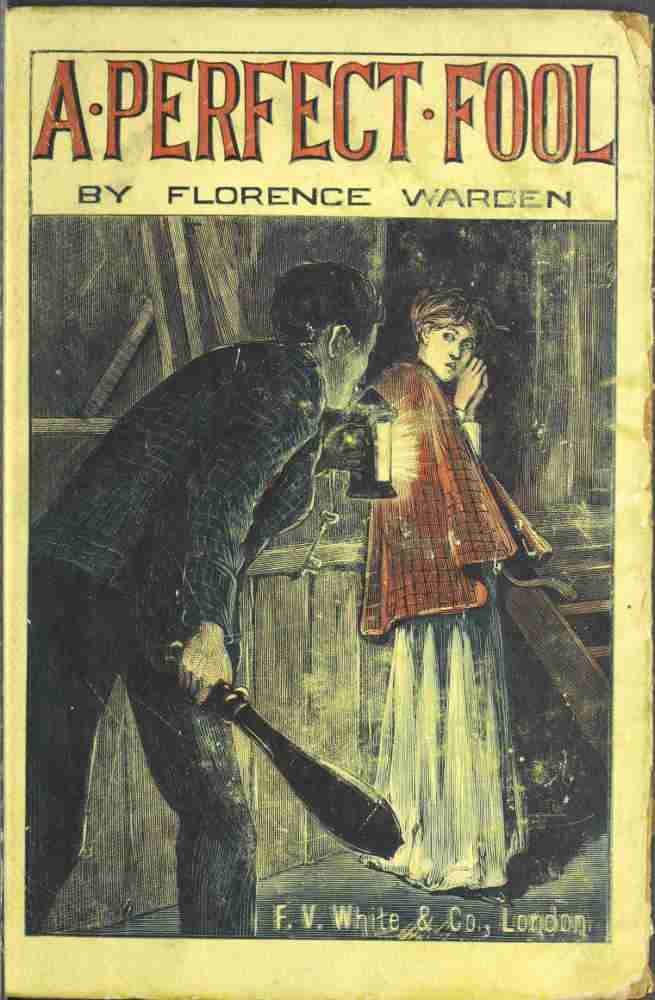
CHAPTER IX. MR. BRADFIELD’S “SMART” RELATIONS.
To have a personal attack made upon her by a lunatic is enough to alarm the most intrepid girl. And Chris, although not a coward, not even given to hysterical attacks over black-beetles, was a good deal frightened by her first experience of Mr. Richard’s violence.
By the time she was safely out of the enclosure, however, she had recovered from her first alarm; and, dropping from a run into a walk, she paused before carrying out her first idea of running indoors to tell her mother what had happened.
Why should she say anything about it to Mrs. Abercarne? Her mother had hardly yet got over her repugnance to staying under the same roof with a lunatic. If her terrors were to be revived by hearing of the adventure that had befallen her daughter, she would make fresh difficulties about staying, and perhaps exhaust Mr. Bradfield’s patience. And Chris, though she could not be blind to the difficulties which Mr. Bradfield’s admiration began to put in the way of their remaining in his house, did not wish to hasten the moment when they must leave it. So she turned away from the house, and sauntered between the bare borders and empty flower-beds, to calm herself a little before returning to her mother’s presence.
“Well, what did I tell you?” said Mr. Bradfield, in an exultant tone. “Are you still as anxious as ever for an interview with our young friend?”
Chris, annoyed with herself, vented her annoyance on him. So she turned to say, snappishly:
“Yes, quite as anxious; and more anxious still that he should be seen by a doctor.”
Mr. Bradfield’s face changed. The sullen frown which, whenever it appeared, made his dark face so very unprepossessing, came over it as he said shortly:
“You presume too much.”
And he turned on his heel abruptly, and went indoors.
Chris felt quite glad she had offended him. From one point of view, as the master of the house where she and her mother lived so comfortably, she liked him very much. From any other she began to feel that she did not like him at all. She felt again the aversion with which he had inspired her on the day of her arrival, an aversion which his kindness had been gradually dispelling. Perhaps it was that he showed too decided an acquiescence in the fact that his ward’s mental malady was incurable. Or it may have been vexation at his exposing her to the danger of the madman’s anger, and at the daring familiarity with which he had put his arm round her shoulder in an alleged attempt to protect her. Or, possibly, her renewed dislike was only the result of that instinct by which women leap to conclusions without reasoning out the facts. It is at any rate certain that the girl felt at that moment considerably more fear of Mr. Bradfield than she did of the madman in the east wing. To be sure, the latter was shut up, and the former was not.
She did not go indoors until she had quite recovered from the effects of the scene she had gone through; so that Mrs. Abercarne noted nothing unusual in her countenance or manner.
It was after luncheon on the same day, that Chris, sitting with her embroidery in the corridor, which was warmed with hot-water pipes, and was her favourite retreat, was surprised to be addressed by Stelfox, who was carrying a couple of large books from one of the upstairs bookcases in the direction of the east wing.
“You were not much frightened, I hope, this morning, miss, by Mr. Richard’s antics?” he asked, in his quiet, stolid manner. Chris had a liking for this man as unreasonable as her dislike of his master. She had seldom spoken to him; when he met her he had usually stood out of her way like an automaton, so that it was not upon discerning acquaintance that her predilection was founded. Still, it was a fact and she smiled as she assured him that if she was frightened she soon got over it.
“But where were you?” she went on in some surprise. “Were you upstairs with Mr. Richard? No,” she continued, answering herself, as she remembered to have seen Stelfox coming in by the front gates as she ran out of the enclosure, “you had gone out into the town. How did you know, then, that I was frightened? Did Mr. Bradfield tell you?”
Stelfox allowed his straight mouth to widen a little in what passed with him for a smile.
“No, miss. Master never talks about Mr. Richard to anyone. I heard it from the young gentleman himself when I took him in his luncheon.”
Chris looked at him in astonishment.
“He told you! He’s sane enough to know what he does, then, and to talk about it afterwards? Do you believe that he is really incurable?”
“Well, he’s pretty bad sometimes,” answered he, not giving a direct answer. “Perhaps you haven’t heard the way he cries out, and the odd noises he makes, miss?”
Chris gave a little shudder.
“Yes; and it’s very dreadful to hear him. But——”
She paused, and looked at the sky, which, now darkening a little towards evening, could be seen between the bare branches of the trees. Stelfox was silent too, but it suddenly flashed through the mind of Chris that his was a discreet silence which had meaning in it. Before either spoke again, Stelfox lifted the lid of the box-ottoman near which he was standing, and rapidly but very quietly slipped inside the two books he had been carrying, and was immediately in the same attitude of respectful attention as before. Then for the first time she heard the creaking of a stair, and, turning her head, she saw Mr. Bradfield approaching.
To her great delight, for she had begun on the instant to dread a tête-à-tête with him, Mr. Bradfield scowled as he caught sight of her, and disappeared into a sort of workshop he had on the first floor, where he often spent the afternoon busy with a turning-lathe.
As soon as his master was out of sight, Stelfox took the two books out of the ottoman. Chris watched him in evident surprise. Then a thought struck her.
“You were going to take those books to Mr. Richard?” she asked, in a low voice.
“Yes, miss.”
“And you were afraid he wouldn’t like you to?”
“Well, miss,” said Stelfox, again with the contortion he meant for a smile, “Mr. Bradfield don’t understand his ways as well as I do, and he thinks books wouldn’t be safe with him. But I know when to trust him with ’em, and he’s as quiet as a lamb this afternoon.”
He was going on towards Mr. Richard’s room, when the young lady detained him, saying, in a low voice:
“Did he say, Stelfox, that he really meant to hurt me, this morning?”
Stelfox looked down at the carpet, and, for a moment, made no answer. Then he looked up, and caught a look of suspense and impatience on her face. Looking down again at once, he said, drily:
“No, miss; I don’t recollect as he told me that.”
Then he withdrew, leaving the young lady in a state of curiosity and strange excitement.
Why should she care whether this poor lunatic wanted to hurt her or not? Surely the only thing that concerned her was that it should be out of his power to do so. This was what Chris told herself. But her girlish sense of romance was tickled by the whole story—by the knowledge of the solitary and sad life this man was leading, close to his fellow-creatures, and yet shut out from them; by a remembrance of the incident of the miniature, which would have passed for his portrait, and yet which surely could not be his; above all by the man himself, with his handsome face and weary eyes.
For the next few days, neither Chris nor her mother saw much of Mr. Bradfield. But he soon forgot or forgave her indiscreet interference on Mr. Richard’s behalf, for when he did see her, he bantered her, good-humouredly, about the approaching ball, for which the invitations were being sent out. With this work, however, the ladies had little to do, except to help Mr. Bradfield’s secretary—a pale, fair, weak-eyed young man named Manners—in directing the envelopes.
While this work of sending out the invitations was still in progress, Mrs. Abercarne received a note from Mr. Bradfield, requesting that she and her daughter would do him the pleasure of breakfasting, lunching and dining with him every day, and that they would begin that very evening.
No sooner had they taken their seats at the table for the first time, than Mr. Bradfield took an open letter from his pocket, and gave it to the elder lady to read.
“I have asked you to keep me company,” said he, grimly, “to save me from that!”
Mrs. Abercarne read the letter, which was in a large and modern lady’s hand. The paper was perfumed, and in colour a very pale rose-pink—the latest Bayswater fashion in notepaper.
“Cambridge Terrace,
“Kensington, W.“My Dear Cousin John—Need I say how utterly delighted we were with your most kind invitation? Lilith and Rose are perfectly charmed, and so is Donald, whom you will not recognise! He has grown into a splendid fellow. What is this I hear, that you have been so dull that you have had to get a housekeeper? Surely you know that you had only to mention it, and we would have done long ago what we propose to do now, namely—migrate from town to the wilds of Wyngham to be near you. Yes, this is absolutely and truly what we are going to do. Retrenchment is the order of the day, now that we have a family growing up around us, and I think we cannot do better than settle ourselves where we shall get the benefit of the shadow of your wing. I suppose there is some society in or about the place, and the fact of our being related to you, besides the value of our own name, would of course give us the entrée. Would it be asking too much of you to look out for a modest house such as you would care for your relations to live in; not too far away from you, I need not say.
“William wishes to be remembered to you most kindly. As for Rose and Lilith, and the boys, they send so many messages that I cannot remember them all.
“Believe me, dear cousin John, you shall not long be left to the hired society of strangers, when your own family are only too anxious to do all they can to cheer you, and to serve you in any way in their power.
“Ever your sincerely affectionate cousin,
“Maude Graham-Shute.”
Mrs. Abercarne read the letter slowly through with the help of her eyeglasses, and then gave it back in a dignified manner.
“A very affectionate letter,” she remarked, having read between the lines of the effusive epistle and conceived for its writer an antagonism quite as violent as that which the writer evidently felt towards her.
“Very affectionate,” he answered, drily. “It will cost me say two hundred pounds. And cheap at the price, perhaps, you’ll say.”
Mrs. Abercarne coughed: comment was dangerous, and, indeed, unnecessary. Chris, who, without having seen the letter, made a judicious guess at the tenor of it, glanced from the one to the other.
“You will think I have brought it on myself,” he went on, as he glanced once more at the letter before putting it in his pocket. “However, the woman is so amusing with her airs and her pretensions that I am doing the neighbourhood a good turn by providing it with a laughing-stock. A good-natured soul, too! I was in love with her once. There was less of her then.”
Every word he uttered concerning the effusive cousin increased the aversion with which Mrs. Abercarne already regarded her.
“I’ve asked them to come for the week,” he went on. “From Monday to Monday. You will give them what rooms you please, Mrs. Abercarne. There’ll be five of ’em—old couple, two grown-up daughters and a grown-up son. And you and Miss Christina will do your best to amuse them, I’m sure.”
Mrs. Abercarne had grave doubts whether the visitors would allow themselves to be amused, but she did not say so. Mr. Bradfield did not like difficulties to be mentioned in the way of his whims, and it was one of his whims to fill his house at Christmas time, and another to play the patron to his poorer relations. She began to fear that the pleasant and independent time she and her daughter had enjoyed at Wyngham House was over.
For Mrs. Graham-Shute—she knew by a fine woman’s instinct—would “interfere.”
CHAPTER X. MRS. GRAHAM-SHUTE MANŒUVRES.
It was ten days later that Mrs. Graham-Shute arrived, according to her promise, at Wyngham House.
Chris, much against her will, was stationed, by Mr. Bradfield’s special request, to receive the visitors. Mrs. Abercarne tried to persuade him that he himself ought to meet such distinguished guests, but he laughed, and said “he couldn’t stand the old woman’s gush; if a reception by Miss Christina wasn’t good enough for them, they might do without one altogether, and be hanged to them.”
So Christina amused herself at the piano until Mrs. Graham-Shute was announced. The girl came forward modestly to receive the new-comers, who were talking loudly as they entered. At the first moment she thought it was an affectation to put her out of countenance, but she soon found out that the Graham-Shutes never did anything without making four times as much noise over it as anybody else would have done.
Thus, Mrs. Graham-Shute came in with rustling skirts and jingling bonnet ornaments, while Donald laughed in a deep bass voice, and entered with a tread as heavy as a dragoon’s.
“My dear John, where are you? It was quite too sweet of you to——”
Suddenly becoming aware that “dear John” was nowhere to be seen, and that there was only a slender and remarkably pretty girl bowing and smiling to her rather timidly, Mrs. Graham-Shute stopped short, drew in her extended hand, and stared at Chris with a face which had in an instant lost its air of expansive good humour.
Chris, who had been reassured by the good-natured expression which she had at first seen on the visitor’s face, felt a chill come over her. She was not afraid of this self-important lady, but she perceived at once that there would be “unpleasantness” between her and “mamma.” With the quickness of budding womanhood, she had taken in at a glance every detail of the new-comer’s appearance, and had had time for a peep at the young people behind.
And what she had seen was a woman of medium height, enormously stout, with a large, many-chinned face, in which were a pair of eyes which ran over her interlocutor for a few moments with frank curiosity, and then grew dull, while her tongue still ran on, and her mind occupied itself with some subject foreign to her words.
So that while her words to Chris were, “Dear me! So very sorry that Mr. Bradfield was too busy to receive us himself! The poor dear man really does work too hard with his collections, and his philanthropical projects!” her thoughts were: “I wonder who on earth you are, and what you’re doing here! And I hope, whoever you are, that we shall be able to turn you out!”
Unfortunately, her thoughts spoke through her looks more eloquently than her words. Between her suspicions of the real state of the case, and the possibility that this young lady might be a relation of Mr. Bradfield’s, the poor lady felt uncertain how to treat her, and alternated between the most distant coldness and bursts of confidential effusiveness. When, however, Chris said: “Would you like to go up to your rooms? My mother thought you would like what we call the lighthouse room at the end,” Mrs. Graham-Shute stared at her with unmistakable hostility.
“Your mother is staying here with you, then?” she said shortly.
“My mother is the housekeeper,” answered Chris, with a blush.
Poor Mrs. Graham-Shute’s extensive person seemed to expand still further under the influence of her just indignation. To be received by this minx of a housekeeper’s daughter! A girl whose very existence, to judge by her face and figure, was a danger and an insult to all Mr. Bradfield’s relations who had any expectations from him. What was dear John thinking about? She called her children much as a hen gathers her chicks under her wings at approaching danger, and they bustled and bounced out of the room.
Chris was mortified, but she had expected something of the sort, so she conquered the feeling easily. She would not go up to her mother, who was dressing for dinner, to delay her and worry her by a description of the new arrivals. Mrs. Abercarne could take her own part whatever happened, and there was no need to let her anticipate evil more than she had already done.
In the meantime, Mrs. Graham-Shute had not dared to make any comment on the situation until she was well past the study door. But upstairs, meeting her husband, who had gone straight to the stables for a cigar after his journey, she poured out her wrath in a ceaseless torrent.
Mr. Graham-Shute was a small, inoffensive man, and he looked smaller and more inoffensive still when in the company of his wife. He was the grandson of a man who had been a great poet, and there is no need to say more about him than that he was a striking example of the fact that genius is not hereditary. Being used to his wife’s harangues, he listened indifferently to this one; and the only point in it which excited him to any attention was her account of the good looks of the interloper.
“Pretty girl, is she?” said he, with interest, when his better half took breath for a moment. “I must make haste and dress and run down and have a look at her!”
The poor lady was hardly more fortunate with her children. Lilith was rather pretty, Rose was rather plain; the former had dark eyes and a loud voice, and the latter had light eyes and no voice at all. They both thought that mamma was making a great fuss about a small matter, and Lilith told her so.
Unable to get any sympathy from this quarter, Mrs. Graham-Shute tried her son. Donald, who was the apple of his mother’s eye, had been coarsely and aptly described by Mr. Bradfield before his arrival as a rough young cub. He was a great, loud-voiced, awkward hobbledehoy, who had remained at this stage much longer than he would otherwise have done through the injudicious management of his mother. He couldn’t be made to see things from his mother’s point of view at all. Chris was an “awfully pretty girl,” and looked like an “awfully jolly one.” In consequence of her presence he looked forward to having a very much pleasanter time at Wyngham House than he had ever had there before.
“I shouldn’t worry myself about it, mother. In fact, I don’t know what you are worrying about,” he said, when she paused for breath. “The girl’s a lady, and——”
“Why, you idiot! don’t you see that’s the danger?” gasped his mother. “She’s a lady, and she’s young and good-looking. And if she gets him to marry her, there’ll be an end of any hope of his doing anything for you, or for any of us!”
“Gets him to marry her!” roared Donald, indignantly. “Why, the old fool might think himself precious lucky if he were to get her to marry him! Why, she’s one of the most charming——”
“Sh—sh!” said his mother, pinching his arm in her terror lest he should be overheard. “For goodness’ sake hold your tongue. I’ve no doubt these people have their spies about, and if we’re not very civil to them, they’ll persuade cousin John to be rude to us, or something dreadful.”
“You needn’t fear that I shall be anything but civil to that girl,” said Donald, as if conscious that his civility was rather a precious thing.
And Mrs. Graham-Shute left her son with a sigh of self-pity at obtaining so little sympathy from her “own people.”
She was an inventive woman, however, where her own little schemes were concerned, and an idea had come into her head. If it should prove, as she feared, that there was any danger of “dear John’s” being enslaved by the housekeeper’s pretty daughter, why should she not put “a drag” across the scent in the shape of her son? He was handsome and fascinating beyond all men, and was twenty-five years younger than John Bradfield. He was already attracted by the girl, who could not fail to be flattered by his admiration, whatever her designs might be upon the master of the house. If Donald would have the sense to make love to her without exciting the jealous suspicions of his cousin, he might draw off the girl’s attention, and give his mother time to “look round” in the interests of herself and her family.
In the meantime, she made up her mind to “be civil.”
This proved a more difficult task than she had expected. At dinner she found Mrs. Abercarne installed in the place of the mistress of the house. She saw “dear John,” who had welcomed her without effusiveness, casting sheep’s eyes in the direction of Miss Abercarne. As she expressed it afterwards to her husband, who was delighted with Chris:
“You couldn’t move for Abercarnes. It was ‘Mrs Abercarne, will you do this?’ and ‘Miss Abercarne can tell you that,’ from morning till night!”
On the whole, dinner was a calamitous function. Mr. Graham-Shute, who was neither a busybody nor a schemer, but simply an easy-going gentleman, without any great measure of tact, made, in spite of frowns of warning from his wife, more than one awkward remark. In the first place, he asked John Bradfield, across the table, whether he still kept his private lunatic on the establishment.
“Because if you do, you know, my dear fellow,” he went on, “I sha’n’t be able to sleep a wink.”
Mr. Bradfield answered, very shortly:
“I don’t see what that can have to do with your sleeping!”
“Don’t you? Why, John, your memory’s going. Have you forgotten the row he kicked up last time we were here, and how we all thought he would bring his door down? And the man who looks after him, or, at least, who did then, man named Stelfox, said he always went on like that when there were visitors in the house. I declare I shouldn’t have dared to come to-day if I thought you’d got him still!”
“Why didn’t you ask me, then?” said John Bradfield, drily. “I didn’t want to have you here against your will.”
“Really, William,” broke in Mrs. Graham-Shute, in an agony, “I don’t know how you can be so absurd. How can it matter to you who is in one part of a large house like this, when you are far away in the other?”
“Oh! of course, it’s all right as long as he’s safely locked up,” said her husband, as he helped himself to an olive, with more attention to that than to the discussion in hand. “But at my time of life a man prefers to die a natural death, and not to run the chance of being tomahawked in his bed.”
Luckily the young people took this as a joke, and laughed; so that difficulty was got over. But when they had got as far as the sweets, the doomed man began again:
“By-the-bye, Bradfield,” he asked casually, as he tried to make up his mind between orange-jelly and ice-pudding, “what’s become of those two fellows who were out in the bush with you?”
“Don’t know what two fellows you mean,” answered Mr. Bradfield, in a tone which would have warned off any person less obtuse. “I met a good many fellows when I was out there.”
By this time Mr. Graham-Shute had caught his wife’s eye, seen her frowns, watched her agonised attempts to kick his foot under the table; but he was as quietly obstinate in his way as she was loudly determined in hers, so he glared at her across the flowers, and persisted in his ill-advised remarks.
“Oh! come, you must know. Two fellows who went out with you, or whom you met soon after you got out there, and chummed up with. Marrable—yes, Alfred Marrable was the name of the one, and——” Here he paused, trying to recollect the second name. “I can’t remember the name of the other. What’s become of them? What’s become of Marrable?”
Mrs. Graham-Shute could hardly have been trusted alone with her husband with a weapon in her hand at that moment. For she saw that the rich cousin from whom so much was expected was looking as much displeased as only a sallow-faced and black-haired man can look. If William were going on like this, they might just as well settle at John-o’-Groat’s as at Wyngham. John Bradfield no longer pretended, however, to have forgotten the existence of his old chums.
“Dead, I believe, both of them,” he answered, curtly. “Did no good, either of them.”
“And what was the name of the other man?”
“Don’t remember.”
William looked at him incredulously, though he could not go so far as to contradict him.
His wife rushed in to the rescue.
“And what are we going to do to pass the time away between this and Friday?” she asked, with a great assumption of buoyancy and good spirits. “We ought to try to ‘get up’ something, ought we not?”
This question almost restored John Bradfield’s good humour. It was so characteristic of his cousin Maude. She was always “getting up” something, always at short notice, and always badly. It was her custom to forget some one or other of the necessary preparations, and to leave the work to be done in the hands of others. But she liked the excitement, the glory of being the prime mover of everything, however small, the feeling that she was making herself talked about; above all, she liked the “fuss.”
Lilith and Rose looked at each other. Their eyes said, “So like mamma!”
“All right, Maude,” said her cousin, with restored gold humour. “What shall it be? A sack race? Or distribution of buns to the oldest inhabitants? It’s all the same to you, I suppose?”
It was her turn to look offended. She raised her head so far that her cousin could scarcely see more than the chins as she answered, in stately tones:
“Oh! of course, if I’m only to be laughed at, I withdraw the suggestion. But I thought, as we are in a beautiful house like this, where there is plenty of room and plenty of people to do everything, it seems a pity not to take advantage of it, and——”
“And get a line in the local paper,” added her husband.
There was a laugh at this, subdued on the part of her daughters, boisterously loud from Donald, who had been enjoying his cousin’s champagne immensely, and bestowing more and more of his attention on the unresponsive Chris.
They all knew that her project, if she could yet be said to have anything so definite, was not nipped in the bud, but would spring up to its full growth at a not remote period. For the moment, however, Mrs. Graham-Shute said no more about it, but rather disdainfully gave to Mrs. Abercarne the signal for the ladies to retire, instead of waiting for that lady to give it to her.
CHAPTER XI. AMATEUR CHARITY.
As soon as the ladies were in the drawing-room, Mrs. Graham-Shute returned to her point. As her daughters, used to mamma’s ways of “getting up” entertainments, were unsympathetic, and as Mrs. Abercarne was on her dignity, she was forced to pour out her proposals into the ear of Chris. Anxious to secure at least this one ally, she became very gracious to the girl.
“I’m sure you would be glad of some gaiety to vary the monotony of your life here,” she said, with condescension. “Now, what do you say to tableaux vivants? I’m sure we might get some up by Thursday. This is only Monday, so we have three clear days.”
“There would be a great deal to do in such a short time,” said Chris. “And where would you have them?”
“Oh! in this room of course. It is beautifully adapted for the purpose. There’s the opening for the curtains between the two rooms, and a door to each, one for the audience, the other for the performers.”
She was so enthusiastic that Chris felt quite sorry that she must destroy this charming arrangement by pointing out that the room was wanted for the ball on Friday night, and that there would be no time to put up a stage on Thursday and to take it down and re-arrange the room for the night after.
“Well, there must be some other room in a big place like this,” said Mrs. Graham-Shute, still buoyantly. “Come, you set your wits to work to help me, like a dear girl, and I’m sure we shall manage something between us.”
Chris began to see that she had better indulge her, as she would want something to keep her occupied during the next few days.
“There’s a great place that was built for a barn, that was used for a school treat in the summer, I believe. It’s down by the new stables, a quarter of a mile away. I don’t know whether that would do. There are some tables and trestles piled up in one corner; perhaps they could be made into a stage.”
“The very thing!” cried Mrs. Graham-Shute, enthusiastically. “I knew we should manage it somehow.”
But Chris saw difficulties where her companion saw none.
“But you will want a lot of people, performers and spectators too,” she objected. “And then, have you considered that there will be dresses to be made, and scenes to be rehearsed? There’s a lot of work to be done to get tableaux up properly.”
But to get a thing up properly was what Mrs. Graham-Shute never troubled to do. To get it up somehow was always the extreme limit of her ambition. She was already perfectly satisfied, and she proceeded at once to settle other details as summarily as the first.
“We will do fairy tales, I think,” she said. “The dresses will be cheap and easily made. We can have the ‘Sleeping Beauty,’ with Lilith as Beauty, and ‘Robinson Crusoe’ and ‘Red Riding Hood,’ and—and any of those things, don’t you know? With all my cousin’s curiosities and things we can make a lovely palace for the ‘Sleeping Beauty.’”
Mrs. Abercarne had raised her double eye-glass, and was looking horror-struck at this suggested desecration.
Chris, with a frightened glance at her mother, hastened to say:
“But, then, the performers? Who would you have for the tableaux?”
“Oh, well, there must be some family in the neighbourhood quite used to such things. There always is, you know. I must ask my cousin John about that. I suppose you wouldn’t know of anybody?”
“Well, there are the Brownes. Mr. Browne is a brewer, the head of the firm of Browne & Browne. It’s a large family, and they can act, I believe.”
“Then they will do beautifully,” said Mrs. Graham-Shute, complacently. “We will have them just to fill up. They can play the pages and court ladies, and one of them can be the Wolf in ‘Red Hiding Hood;’ and another can black himself for Man Friday. Of course, Lilith, and Rose, and Donald will take the principal parts, for they want a little acting, you know. People think it’s only just to stand still, but really you have to be quite clever to do it really well. And now there’s nothing left to decide but what’s it to be for. Of course, it must be in aid of something. I must go and see the vicar’s wife—if he has a wife—to-morrow, and settle that.”
“You don’t mean to charge to see them, do you?” exclaimed Chris, in astonishment. “Done in such a hurry, would they be worth it?”
“Oh, people don’t mind when it’s for a charity,” answered the lady, breezily. “Besides, I’m sure they’ll be very good. You will spare no pains in getting the dresses ready, and all the little etceteras, will you? I don’t mind organizing these things a bit, but I must have a willing lieutenant to carry out the petty details,” she ended, with a smile.
Chris thought that upon the whole the “petty details” would be quite equal in value to the “organisation,” but all she said was:
“Of course, I will do all I can. But I’m afraid you will have to give up the idea of making a charge for admission. Mr. Bradfield would never allow it, I’m sure.”
Mrs. Graham-Shute, losing her good humour in a moment, looked at her with fishy eyes. Who was this girl that she should profess to know more than she did about her “cousin John?”
“Oh, that would take all the sense out of the thing altogether,” she said, coldly. “If any little thing should go wrong, the lights all go out, as happened once, I remember; or the people be obliged to go on in their ordinary dress, as we had to do once for the murder of Rizzio, people can grumble or make fun of you if it’s not for a charity. Young people don’t consider these things. I’m sure, if Mr. Bradfield doesn’t like it much, he’ll give way if I coax him.”
Chris said nothing; and as the gentlemen came in at that moment, Mrs. Graham-Shute proceeded straightway to use her blandishments on her cousin.
“We’re going to give tableaux vivants in the barn by the stables, John,” she said, attacking him at once. “Miss Abercarne says we can make a lovely stage there with some trestles and things that are there already for us. And she says that the Brownes will play the smaller parts beautifully, and I’m going to see them about it to-morrow. And we’re going to do the ‘Sleeping Beauty.’”
“I’ve no objection. But if you must have a ‘Beauty’ picture, have ‘Beauty and the Beast.’ Of course Miss Abercarne will play Beauty, and I’ll play the other chap.”
Mrs. Graham-Shute’s face fell.
“We had thought of making Lilith play Beauty; you see it wants some aptitude, and a little experience in these things to play an important part like Beauty. But, of course, if Miss Abercarne thinks she can do it better——”
“She can look it better, that’s the point,” interrupted Mr. Bradfield, with conviction. “The prettiest girl must play Beauty, and you can’t deny that Miss Abercarne is the prettiest. Ask William.”
Mr. Graham-Shute agreed enthusiastically; and the girls, who were all three gathered round the piano, wondered what was amusing the gentlemen so much, and making mamma so angry. But it was at the suggestion of making a charge for admission that John Bradfield put his foot down the most cruelly on his cousin’s little plans. He would not hear of it. He was quite ready to pay them to come in, he said, if that should be necessary; but he could not think of allowing people who would be his guests on the following night, to pay for what was not worth paying for.
And Mrs. Graham-Shute had to swallow her mortification as best she could.
“Perhaps,” she said, when she had mastered her vexation sufficiently to speak, “we had better give up the idea of having the tableaux, and think of something else. The time is very short, and if we are to have a lot of incompetent people in the principal parts, it will not, as you say, cousin John, be worth paying to see, or even seeing at all.”
“But,” said John Bradfield, who saw through the poor lady’s little manœuvres, and loved to tease her. “I won’t have them given up. They will amuse you at any rate, and I want to see Miss Christina with her hair down. She’ll have to wear it down as Beauty, won’t she?”
Each word was making the poor lady more angry. She saw her husband laughing at her, and at last she could bear it no longer.
“Oh, if the affair is going to be spoilt in this way, I wash my hands of it. I thought it was to be kept in the family.”
“What family? The Brownes?” cried John Bradfield, as he crossed the room and broke up the knot of girls. “Miss Christina, there’s a difficulty about the part of Beauty. I’m sure you won’t mind playing it, if I play the Beast, will you?”
Poor Chris grew crimson, and Lilith looked surprised. It was her mother’s fault that she had been taught to consider herself, not an ordinarily pretty girl, but a peerless beauty, with whom all other good-looking girls were out of the running.
“Mrs. Shute doesn’t think you are clever enough to stand and be looked at, Miss Christina,” he went on mischievously. “But I want you to vindicate your claims to intellect.”
“On the contrary,” interrupted his cousin in a shrill, offended tone, “I thought Miss Abercarne’s talents would be wasted in such a trifling part. I thought she would like better to play the music. We must have a musical accompaniment.”
“Yes, yes; I should like that much better,” said poor Chris, who saw that she had been made the instrument for worrying the stout lady to the verge of apoplexy. “Make me of use in any way you like, as long as you don’t want me to go on the stage.”
And so the incident ended in a discussion of the dresses, and in choosing the subjects to be illustrated.
CHAPTER XII. AN ALARM.
The next two days were days such as Mrs. Graham-Shute loved, full of bustle and confusion, and needless noise. She herself went out early in the morning to call upon the Brownes, and to enlist them in her service as foils to Lilith’s charms. The Brownes saw through her motives, and discussed them among themselves in the frankest manner. But they were ready for any fun that might be going, as people in the country are, and at least they could go and laugh at her, which was the usual reason privately given for the acceptance of one of Mrs. Graham-Shute’s invitations.
In the meantime, as she had shrewdly expected, all the real work was left to Chris, who had to search through old wardrobes, devise costumes, and decide upon all the arrangements necessary for transforming the deserted barn into a comfortable and draught-tight theatre. Here Mrs. Graham-Shute was too modest even to make a suggestion.
“I’m quite sure, my dear Miss Abercarne, that you are quite equal to seeing to all these little matters. Of course, I couldn’t undertake to do everything myself.”
So Mrs. Graham-Shute went to call upon the Brownes, while Chris and her mother worked and tired themselves out at home. As for Lilith and Rose, they simply washed their hands of the whole affair, and contented themselves with begging Chris not to work so hard, and not to worry herself. “Mamma was always doing these things, and people were used to the way in which she did them.” Lilith occupied herself solely with her own costumes, with which she required a great deal of help, and which she thought were the only things that anybody need trouble themselves about. Rose was completely apathetic, and made no offer of assistance; and she was of very little use when persuaded to lend a hand.
All this Chris would not have minded much if the attentions of Donald had not been the last straw. Having received encouragement from his mother, he pursued Chris all day long, getting in her way, and boring her so much, that, on the second afternoon, she was at last fain to get rid of him by sending him into the town to buy tapes and buttons.
Mr. Graham-Shute took refuge in the study, where he bored John Bradfield by talking politics, which his host hated.
It was about three o’clock in the afternoon when a knock at the study door was hailed by Mr. Bradfield as affording a hope of release.
“Come in!” cried he; and Stelfox entered.
Both the gentlemen saw at once, by the disturbed expression of the usually stolid face, that something had happened.
“Well, what is it?” asked his master testily.
The next moment, with a glance at Graham-Shute, Mr. Bradfield jumped up, and, making a step towards an inner door, which led into the library, made a sign to Stelfox to follow him.
But Mr. Graham-Shute’s curiosity was roused.
“Eh—what? What, it’s something about that lunatic of yours, Bradfield, I’m sure!” he cried excitedly. “He has got into some mischief or other! I knew he would while I was here. What—what is it, Stelfox? Has the creature got away, or what?”
Stelfox nodded.
“That’s it, sir,” he said.
John Bradfield, who had reached the library door, reeled abruptly round.
“Got away—again? Good heavens!”
Mr. Graham-Shute was fidgetting nervously about the room. Stelfox stood like a rock.
“Then why—why on earth don’t you go after him?” said Mr. Graham-Shute.
John Bradfield interrupted his querulous questions.
“When did you find it out, and what have you done?”
“I found it out a couple of hours ago, sir, and I’ve been hunting high and low ever since, and I’ve had some of the men helping me. Of course, it all had to be done on the quiet, so as not to frighten the ladies.”
“Yes, for heaven’s sake don’t let my wife hear of it,” moaned Mr. Graham-Shute, “or she’ll give us twice as much trouble as any lunatic. Do you think he’s anywhere about the house?”
Stelfox glanced at his master, who had turned deadly white at the suggestion.
“I don’t think so, sir.”
Mr. Bradfield appeared suddenly to rouse himself from the sort of stupefaction into which Stelfox’s intelligence had thrown him. Crossing the room with quick steps, he picked out from a pile of canes and weapons of various kinds which stood in one corner a heavy, loaded stick.
“We must lose no time,” said he. “Have you any ideas as to which direction he will have taken?”
“No, sir. All I’m sure of is that he can’t have got far. You see, sir, he can’t meet anyone without their finding out that something’s wrong with him, even if he should chance upon someone that doesn’t know where he belongs to. No, sir; what I’m afraid of is, lest he should happen upon Miss Abercarne. After that day, and seeing what he did, he’d frighten her so dreadfully, sir.”
“He mustn’t meet her—he mustn’t meet her on any account!” said John Bradfield with excitement, and he brought the end of his heavy stick down with force upon the ground.
“I hope you don’t mean to brain the poor chap?” exclaimed Mr. Graham-Shute apprehensively.
“No. But unluckily there’s a possibility of his braining the first person he meets. Do you know, Stelfox, whether he took anything which he could use as a weapon away with him?”
Stelfox hesitated a moment, and then answered:
“Well, sir, one leg of the mahogany table that stands in his sitting-room has been forced off. It looks as if he’d been preparing for this job, for it’s clear he’s been hacking away at the leg on the quiet for some time, so that at last he was able to wrench it off.”
While he spoke, Mr. Bradfield was buttoning himself in his ulster. Stelfox went on:
“I can’t quite make out now how he gave me the slip. The door was closed as usual. He must have picked the lock. He’s as cunning as they make ’em, and nobody would have guessed at breakfast time that there was anything up.”
Mr. Bradfield, who was walking towards the front door, stopped suddenly.
“Where is Miss Christina now?” he asked.
Mr. Graham-Shute answered.
“She’s up in the Chinese-room, sewing for this tomfoolery my wife’s getting up.”
“Mr. Donald has just gone up there with some things he’s been buying for her in the town,” added Stelfox.
“That’s all right,” said Mr. Graham-Shute. “He’ll be hanging about there for the rest of the afternoon, so that if this poor fellow should get in there, she’ll have someone to stand by her.”
“Stelfox,” said Mr. Bradfield as he left the house, “let somebody watch the door of the Chinese-room.”
But this order was given too late. Chris had, indeed, been sewing upstairs, as Mr. Graham-Shute said, and Donald had returned from the town with his tapes and buttons. But several things had happened since then.
In the first place, Donald had wanted to make his return an opportunity of making love to Chris.
“Why, six pieces of tape! three reels of number forty! one packet of mixed needles! two boxes of pins! Mr. Shute, you’re a genius! You haven’t made a mistake!”
“I should have done if it had been for anybody but you,” said Donald sentimentally. “But every word you say is engraved upon my heart. And don’t call me Mr. Shute. Call me Donald.”
“I’ll call you anything you like if you won’t tread upon the nun’s veiling, and if you leave off snipping the tape with my scissors,” said Chris prosaically.
“How awfully sharp you are with a fellow. Aren’t you nicer than that to anybody, Miss Christina?”
“Not when they interfere with my work.”
“But you’re always like this to me.”
“Always! I have known you two days.”
“And how long must you know me before you leave off snubbing me?”
“As long as you continue to behave as if I were a very silly girl, and you a very silly—boy, Mr. Shute.”
“You think that’s very cutting, I suppose? Do you happen to know how old I am, Miss Abercarne?”
“Oh, perhaps you’re only extremely juvenile for your years; at any rate I should have thought you were too old to worry a girl at your mother’s instigation.”
Donald started, and grew crimson.
“I—I—I don’t understand you, Miss Abercarne,” he stammered, seating himself on the table, and stabbing the precious nun’s veiling through and through with a bodkin which he had taken from a work-basket.
“Don’t you?” said Chris calmly, as she set his teeth on edge by tearing a piece of calico. “Then, as I am quite sure you’re not dull-witted, I can only suppose that you must think I am. For the past two days,” she went on, as she tore off another strip of calico, “you have followed me about everywhere; and when you have not done it of your own accord, I have seen Mrs. Graham-Shute remind you by a nod or a look that you had to do so. Ah! ha! You didn’t think my eyes were so good as that, did you?”
Donald was redder than before, and furious with his mother, Chris, and himself. But then the boy peeped out in him, and he snatched away the calico just as she was about to tear it again.
“Don’t do that, for goodness’ sake!” said he, wincing. “Call me names, if you like, make me out a cad if you like, but don’t set my teeth on edge!”
“I’m not going to call you names, or to make you out anything,” said Chris, blushing and laughing a little, and looking very pretty in the excitement of the skirmish. “But, of course, I can’t help having my own opinion of your behaviour.”
“I don’t care what your opinion is, you’ve no right to say such things!” cried Donald in a loud and dictatorial tone.
“I haven’t said anything but that you followed me about because your mother told you to,” said Chris, looking up with a daring face.
“It isn’t true! It isn’t true, it’s a—a—well, it isn’t true!” roared Donald.
“Yes, it is true, and I know why she does it, too!” she added in a defiant tone, but with burning cheeks. “And I can tell you that both you and she are wasting your time; for I’m not going to do the thing you’re both so much afraid of. And if I were going to do it,” she added, with spirit, “nothing you and she could do would prevent me.”
For a moment Donald was struck dumb. He was not only astonished, but he was filled with admiration. He liked the girl’s “pluck,” and she looked “jolly pretty.”
“And w-w-what’s that?” he stammered almost meekly.
“Why,” said Chris, becoming redder than ever, and looking at him half-shyly, half-defiantly, “why, marry Mr. Bradfield!”
By this time Donald had given up all thoughts of contradicting her. Where was the use? So he sat down again upon the table, and stared at her stupidly.
“Oh!” said he at last in a feeble manner, and in a tone of reflection—“oh! so that’s what you think, is it?”
“Yes, and what I think further is that you’re both very silly.”
“By Jove!” said Donald softly, “I think we are!”
“And as you agree with me so entirely upon this point,” said Chris, as she skipped over the piles of material which lay on the floor, and made for the door, “you won’t be surprised when I tell you that if you dare to come and worry me any more, I shall tell Mr. Bradfield. And perhaps you know whether you would like that!”
With which tremendous menace, Chris gave him a little curt bow, and ran quickly out of the room, leaving him in a state of stupefaction.
Half-way along the corridor Chris slackened her steps. It began to dawn upon her that she had just managed to put herself in a very uncomfortable position. She had, she thought, probably succeeded in freeing herself from the attentions of the boisterous hobbledehoy who had been pursuing her. But if, as she judged most likely, he should confide to his mother the details of the interview just passed, Mrs. Graham-Shute’s indignation would be so great, that she would certainly vent some of it on the girl who had “insulted” her son. With this unpleasant idea in her mind, Chris went down to the drawing-room very soberly.
The moment she entered she was seized upon by Mrs. Graham-Shute.
“Oh, Miss Abercarne,” began that lady in an injured tone, “you’ve forgotten all about the music. Don’t you know that the performance is to take place to-morrow, and that it doesn’t do to leave everything to the last?”
Chris was not in the humour to be bullied by Mrs. Graham-Shute for that lady’s own neglect.
“I hadn’t forgotten the music, Mrs. Shute,” she said. “But I hadn’t been asked to arrange it, and I should not have taken the matter upon myself, even if, with the costumes to make, I had had time.”
“Oh, well, somebody must see to it. I’m getting this affair up for other people’s pleasure, and I expect to be helped.”
“If you will settle upon the music you want played, I am quite ready to play it,” said Chris rather shortly.
It was certainly not for Miss Abercarne’s pleasure that Mrs. Graham-Shute was getting up the entertainment, but she spoke as if she had no other object in view.
At that moment the door opened, and Donald came in. He did not see Chris, who was standing in the embrasure formed by the big bay-window which looked out to the west. Donald slouched up to his mother with his usual heavy tread.
“Mother,” he said, “I want to speak to you.”
Mrs. Graham-Shute turned towards him, and Chris slipped quickly out of the corner she was in, passed round the two, and crossed the room to the door.
“Wait a minute, Miss Abercarne,” said Mrs. Graham-Shute peremptorily, catching sight of Chris when the girl’s hand was on the door.
But Chris took no notice. She had been running about and tiring herself out for that lady for two days, and now at last she rebelled. She saw Donald start and turn round, and that was another reason why she felt that she must make her escape. She had had enough of Graham-Shutes for the present; and as they could find her as long as she was in the house, she pulled out a cloak from a box-ottoman in the hall, took from a peg in the outer hall a lantern which always hung there, lit the candle in it, and escaped out of the house. She would go and see how the work of erecting the stage in the barn was getting on.
She had to cross the park by a path which led alongside a plantation to the group of new buildings, erected by Mr. Bradfield, which consisted of the stables and some farm-buildings, one of which was the great barn. The key had been left in the lock, so she got in without difficulty. It was quite dark inside, and apparently deserted. Raising her lantern high above her head, Chris saw that the men had finished the work of erecting the stage, and that they had all left the building.
While she still stood by the door, she heard Donald’s voice whistling to one of the dogs. She did not want him to find her here, and to inflict upon her another “scene.” So she shut the great door very softly, first taking the key from the outside, and replacing it on the inside. And when she had shut it, she turned the key softly in the lock.
“Now,” she thought to herself, “if he should think of trying the door, he will find it locked, think the place empty, and pass on.”
With a sigh of relief to think that she had gained half an hour’s peace, Chris crossed the wide barn floor, and examined the stage. It had been very well put up, and was firm to the tread. For she tried it herself, putting her lantern down on one corner of the stage while she did so.
She tried a step or two, but stopped suddenly, hearing something behind her which was not the creaking of a board. She looked round quickly, but saw nothing except the bare brick walls, and the forms still piled in one corner. So she turned round again to face the imaginary audience.
To her horror, she found that she had a real one.
A man, evidently from his stealthy walk a man with some purpose which was not honest, was sliding rapidly along the walls towards the door. Chris dropped her skirt, and held her breath. Was he going out, afraid of being discovered? In this case she made up her mind to pretend not to see him.
To her horror he gained the door by a last step, which was like the bound of a wild beast, and took the key out of the lock.
Chris sprang from the stage to the floor, uncertain what to do until she knew who this was, and what his purpose might be. But with a sudden notion that this was a thief, who meant to assault and rob her, she turned towards the lantern, thinking she could elude him better in the dark.
But the man divined her attention, and sprang across the floor with leaps and bounds, uttering discordant and frantic cries.
For one moment Chris was paralysed with horror, and could not move; and of that one moment the man took advantage to snatch up the lantern, and turn its full light upon her.
Then she stood transfixed, looking at his great wild eyes in the obscurity, and clasping her hands.
For it was the lunatic from the east wing!
CHAPTER XIII. MR. RICHARD SURPRISES CHRIS.
At the first moment of finding herself alone with the madman, Chris gave herself up for lost; for he carried in his hand a formidable weapon—the table leg with which he had provided himself before leaving his rooms. He did not, however, brandish it in the air, and then bring it down upon her head, as, in the first impulse of terror, she had fully expected.
So paralysed with fright was she, indeed, that she shut her eyes, flinching under the expected blow. For she was standing with her back against the little stage, with him in front of her, so that escape seemed out of the question.
As the blow did not come, she opened her eyes and looked up; and involuntarily, at the sight of Mr. Richard’s face, she uttered an exclamation.
For he did not look ferocious or frenzied. He was regarding her with just the expression of surprise and shy admiration which she might have seen on the face of any other man of her acquaintance in the circumstances. The only difference was that he did not, as another man would have done, make any apologies. He stood looking at Chris as if she had been a divinity; and she began to hope that she would be able to persuade him, with very little trouble, to let her out. Indeed, if it had not been for her vivid remembrance of the paroxysm of rage into which she had seen him fall, on the occasion when he had flung a missile at her through the window, she would have been absolutely without any fear of him at all, so greatly did his melancholy face and gentle manners outweigh with her the reports of his violence. He was so quiet, that for her to assume a conciliatory manner was easy.
“May I have my lantern, please?” she asked, holding out her hand, and still keeping her eyes rather watchfully fixed upon his face.
Bus he did not understand her, although he looked eagerly into her face, as if trying to do so. Chris began to feel more nervous. She looked towards the door and tried again.
“Won’t you, please, unlock the door, and let me go out?” she said, emphasising her request by shyly touching the great key which was swinging from his hand by the piece of rough string attached to its handle.
To her great relief, his face lighted up, and he nodded. She began instantly to move in the direction of the great barn door, and he followed her very quietly. She had just fear enough left, on hearing his footsteps behind her, to turn and wait for him, so that he might walk by her side. This, however, rendered their progress very slow, for he moved with such languid or unwilling steps, that it seemed to her half an hour before they reached the end of the barn.
The attempts at conversation which she made to relieve the awkwardness of the situation were, however, not very successful.
The first remark she made, which was upon the weather, elicited no reply whatever from Mr. Richard. Then she turned towards him, and asked in very distinct and deliberate tones whether he had ever been in the barn before. She thought he seemed to understand the question, and that the shake of the head he gave was his answer. But still he uttered no word.
When they had come near the door, Mr. Richard stumbled, his feet having been caught in a tangle of old rope and sacking which lay upon the floor. The key fell from his hand. He did not appear to notice this, however, although Chris heard the loud clang with which it touched the brick floor.
“You have dropped the key,” she said, as he walked on.
As he took no notice still, she went down on her knees, groping among the rubbish with which the place was strewn. He turned, and seemed to look at her with surprise. But he did not ask her what she was looking for.
“It’s the key. Don’t you see you have dropped the key?” she cried, her alarm again roused by this apparently wilful obtuseness. “Please let me have the lantern one moment.”
To her horror, he began to utter the strange sounds which she had sometimes heard issuing from the east wing, and she was so much shocked, that she instinctively put up her hands to her ears, while her face assumed an expression of the utmost terror. Then Mr. Richard fell into sudden silence. For a few seconds he stood looking at her as she knelt on the ground; then he seated himself on an empty wine-case which was among the lumber, put his head in his hands, and heaved a deep sigh.
At that moment, Chris caught sight of the key, which had fallen behind a little heap of tins which had once contained tobacco. In snatching it up she knocked it against one of the tins, making a great clatter. But the noise appeared not to disturb the madman, who did not even look up when Chris rose to her feet, although she trod on some ends of board and set them rattling. She feared he was only pretending to be unobservant, and that she should not be able to get to the door before he made the attack upon her which his mysterious conduct led her to expect.
She must, however, make the attempt and trust to her luck. She began by taking two or three cautious steps; and then, when she was close to him, she set off at a run. But she had hardly done so when he started up and, uttering another of the weird cries which so much alarmed her, came in pursuit, and reached the door as soon as she did.
Not all her self-command could help poor Chris to stifle the scream which she had suppressed before. And then, remembering that after all her screams were her best chance of escape, as the stable was so near that one of the men might hear them, she put her mouth to the keyhole of the door, and called loudly for help.
At once Mr. Richard put his hand over her mouth. For a moment she could not move, she could not even try to cry out again. Remembering his savage fury on the day when he had thrown the goblet out of the window, she gave herself up for lost, believing that he would dash her down senseless upon the hard floor. For a long time, as it seemed to her, though it was really the work of a few seconds, he kept one hand upon her mouth, and held both her hands with the other. He uttered from time to time a curious sound, which was more like a low moan of distress than a cry of fury, and though he held her so that it was impossible for her to escape, she could not even fancy that he hurt her.
Her first impulse had been to shut her eyes; but when she found that she had so far come to no harm in the hands of the lunatic, she ventured to open them, and was instantly struck by the expression of his face, which was infinitely sad, infinitely wistful, but absolutely mild and kind.
In the position in which they stood, he could see the door of the barn, while she could not. She had had only just time to realise that Mr. Richard had no present intention of harming her, when she saw his eyes glance quickly from her face to the door, while at the same time she heard a slight noise behind her.
The next instant she found herself free, and looking round quickly to find out the reason of this, she saw Mr. Bradfield’s face just as he, after looking in at the door, withdrew his head quickly.
With another of the ear-piercing cries which could only proceed from a madman, Mr. Richard rushed to the door, which was locked on the other side before he could reach it. He hurled himself against the door, then turned quickly to Chris, and took the key from her hand. He did not do it roughly, however, even in his excitement, but gave her a deprecatory look, as if asking her permission.
Then it came into the girl’s mind, by an extraordinary flash of inspiration, born of intense excitement, that she had some power over this wild and dangerous man, and that this was a time to use it. She seemed to see in the same moment, first that he wanted to do some harm to Mr. Bradfield, and secondly, that her influence might be able to dissuade him from his purpose. So she put out her hand again for the key, as she ran after him to the door. He was already trying to put it into the lock.
“No, no!” she said eagerly, looking up into his face with eyes which looked sweet in their pleading even by the weak light of the lantern which he had snatched up again from the floor. “No. You are not to try to hurt Mr. Bradfield. Now promise me you won’t. Please, please promise!”
The effect of her entreaty was instantaneous. Mr. Richard’s hand fell down by his side; the expression of his face changed from one of fierce excitement to one of pleasure, and even of tenderness. Still he said no word; and Chris, perplexed and rendered shy by his abrupt change of manner, drew back a step, and looked down. With the key in the door, she was no longer afraid. Besides, had not Mr. Bradfield seen her? And although he had most unaccountably refrained from at once releasing her from her perilous tête-à-tête with the madman, he would surely send some one else to do so, if he was too much afraid of Mr. Richard to do it himself.
Not that she was in any hurry to be released. She could not help taking a strong interest in this unhappy man, who, even in his mad frenzy, stopped short of harming her, nay, even became gentle, in the midst of his fury, at a word from her. Believing as she did, that more might be done for him than had been done, in the way of lifting the cloud which hung over his mind, she began to ask herself, as she stood there, whether it would not be possible for her to help him to escape from the confinement in which he was kept, to some place where he would have the medical supervision which she was sure that his case demanded. As this thought crossed her mind, she glanced up again at Mr. Richard, who was leaning against the wall, and looking at her with eyes in which it seemed to her that there was every moment less of madness and more of an emotion which it touched while it alarmed her to see there. She instantly made up her mind to try and help him.
Approaching him with some shyness, and taking care, without appearing to do so, to keep the door well in sight, she asked, in a gentle and persuasive voice, speaking in a very slow and deliberate manner, so that he might understand her: