
The Project Gutenberg eBook of A Short Discourse Concerning Pestilential Contagion, and the Methods to Be Used to Prevent It
Title: A Short Discourse Concerning Pestilential Contagion, and the Methods to Be Used to Prevent It
Author: Richard Mead
Release date: June 4, 2017 [eBook #54843]
Most recently updated: October 23, 2024
Language: English
Credits: Produced by readbueno and the Online Distributed
Proofreading Team at http://www.pgdp.net (This file was
produced from images generously made available by The
Internet Archive)
This cover was produced by the Transcriber
and is in the public domain.
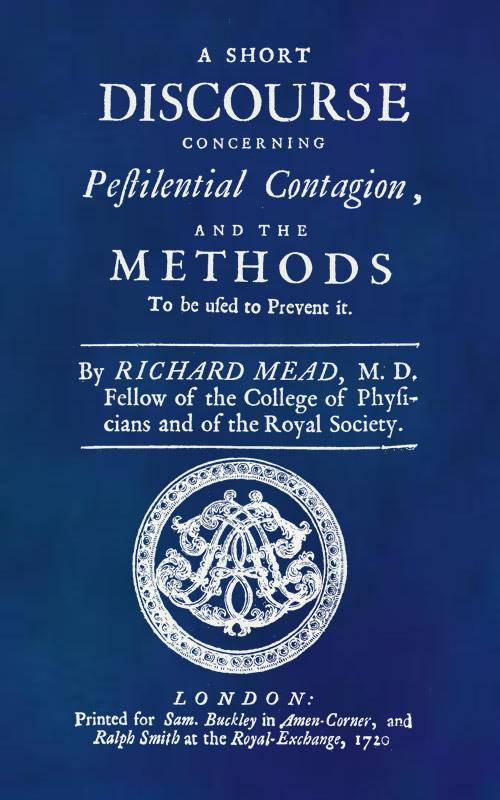
A SHORT
DISCOURSE
CONCERNING
Pestilential Contagion,
AND THE
METHODS
To be used to Prevent it.
SIR,
I Most humbly offer to You my Thoughts concerning the Prevention of the Plague, which I have put together by your Command. As soon as you was pleased to signify to me, in his Majestie's Absence; that their Excellencies the Lords Justices thought it necessary for the Publick Safety, upon the Account of the Sickness now in France, that proper Directions should be drawn up to defend our selves from such a Calamity; I most readily undertook the Task, though upon short Warning, and with little Leisure: I have therefore rather put down the principal Heads of Caution, than a Set of Directions in Form.
The first, which relate to the performing Quarentines, &c. You, who are perfectly versed in the History of Europe, will see are agreable to what is practised in other Countries, with some new Regulations. The next, concerning the suppressing Infection here, are very different from the Methods taken in former Times among Us, and from what they commonly Do Abroad: But, I persuade my self, will be found agreable to Reason.
I most heartily wish, that the wise Measures, the Government has already taken, and will continue to take, with Regard to the former of these, may make the Rules about the latter unnecessary: However it is fit, we should be always provided with proper Means of Defence against so terrible an Enemy.
May this short Essay be received as one Instance, among many others, of the Care, you always shew for Your Country; and as a Testimony of the great Esteem and Respect, with which I have the Honour to be,
Novemb. 25. 1720.