
CHAPTER VII.
The Coming of Duke William.
1. Duke William’s Claims.—Every one who knew what had happened between William and Harold must have known that after that Duke William would certainly claim the English crown whenever King Edward died. He would most likely have done so, even if Harold had never sworn anything to him; but now that Harold had sworn something, whatever it was, he was yet more sure to press his claims than before. It is worth while to stop and think what William’s claim really was. The truth is that he had no real claim whatever; but he was able in a cunning way to put several things together, each of which sounded like a claim. And so, by using one argument to one set of people and another to another, he was able to persuade most men out of England that he was the lawful heir to the English crown, kept out of his right by the wrong-doing of Harold. Each of his claims was really very easy to answer; but each was of a kind which was likely to persuade somebody, and the whole list together sounded like a very strong claim indeed. The real case was this. The people of England had a right to choose whom they would for their King, and they had not chosen William. It was indeed usual to choose out of the one kingly house, and Harold did not belong to that house. But then neither did William. William indeed said that he was Edward’s near kinsman and ought to succeed him. And no doubt in lands where the notion of electing kings was going out of memory, where hereditary succession was coming in, but where the rules of hereditary succession were not yet fully fixed, this claim would have an effect on men’s minds. But in truth William had no more claim by inheritance than he had by election. He was indeed Edward’s kinsman through Edward’s mother Emma; but he was not of the house of the Old-English kings, which alone could give him any preference for the crown above other men. And meanwhile there was young Edgar, a nearer kinsman than William, and who was of the old kingly house. And it is worth noticing that, about a hundred years after, when the notion of hereditary succession had taken root, men began to speak, very often of Harold, and sometimes of William too, as wrong-doers against Edgar. But at the time no one thought of this. And according to modern law King Edward himself would also have been a wrong-doer against Edgar; for by modern law Edgar, the grandson of the elder brother, would come before Edward the younger brother. But most surely no one at the time thought of that either. Then William said that Edward had left him the crown. Now there can be little doubt that Edward had once made him some kind of promise; but a king of the English could not leave his crown to any one; he could at most recommend to the Wise Men, and Edward had recommended Harold. William in short had no kind of right to the crown, whether by birth, bequest, or election. But it was easy for him to talk as if he had; and it was still easier to bring in all manner of other things, which had nothing to do with the matter, but which all helped to make a fair show. Harold was his man who had forsworn himself against him. Harold had done despite to the bones of the Norman saints. These might be Harold’s own personal sins, but the English people had nothing to do with them. But William found something to say against the English people also. They had, with Harold’s father at their head, murdered the Ætheling Alfred, William’s cousin, and his Norman companions. They had, Harold among them, driven out many Normans, among them Archbishop Robert, and had set up a schismatic archbishop in his place. They were an ungodly people, who did not show respect enough to the Pope; he, Duke William, would go and teach them better ways. And, if all other arguments should fail, he could offer lands and honours in England to all who would come and help him to conquer England. William in short could show himself all things to all men, from a pious missionary to a mere robber. But mark that all this care to put himself right in men’s eyes shows that we have got out of the days of mere violence. When the English entered Britain, when the Danes entered England, when the Northmen settled in what was to be Normandy, they did not think of putting forth so many good reasons for what they did as Duke William put forth now.
2. Duke William’s Challenge.—All these arguments sounded very well on the mainland; but no one listened to them in England. Yet it was not for want of hearing them. Duke William heard of Edward’s death and of Harold’s election and coronation in one message; and before long he sent a challenge to the new King. As we have no exact dates, we cannot tell for certain whether this was before or after Harold’s journey to Northumberland; but anyhow it was early in his reign. Nor can we say exactly what were the terms of the message. William of course called on Harold to do whatever he had sworn to do. But, as there are many stories as to what it was that Harold had sworn to do, so there are as many stories, and indeed more, as to what it was that William now called on him to do. Let him give up the kingdom; let him hold it of William as his lord; let him be earl of half of it under William; let him in any case marry William’s daughter; he had at all events promised to do that. Now, if the message came after Harold had married Ealdgyth, this last part must have been mockery. Indeed the whole message must have been sent, not with any hope or thought that Harold would do anything because of it, but simply that William might say that he had given his enemy every chance, and might thus seem to put himself yet more in the right and Harold yet more in the wrong. For it is needless to say that whatever William asked Harold refused. As there are different stories about William’s challenge, so there are different stories about Harold’s answer. In some accounts he is made to give an answer which covers everything. His oath was not binding, because it was not taken freely. He could not give up his kingdom or hold it of William, for the English people had given him the crown, and none but they could take it from him. And as for marrying William’s daughter, he says in one account that the daughter whom he had promised to marry was dead, in another that an English king could not marry a foreign wife without the consent of the Wise Men. He is not made to say that he is married already. So the message may have come before he married Ealdgyth, or it may be that that answer would have seemed to the Normans to be only making bad worse.
3. Duke William’s Councils.—Nothing was now left to William, if he wished for the English crown, but to try and take it by force. His first business then was to see what help he could get in his own duchy. He first got together a small council of his immediate friends and kinsfolk; they said that they would help him themselves, but that they could not answer for anybody else. Then he gathered a larger council of all the barons of Normandy at Lillebonne. Here there was great opposition. Many men said that it was no part of their duty to their duke to follow him beyond sea; many also said that the undertaking was rash, and that Normandy was not able to conquer England. And in the end the assembly did not come to any general vote; but William talked over the barons one by one, till they all promised to help him; each would give so many ships and so many men. And when the thing was once blazed abroad, men began to take it up eagerly, and all Normandy was full of zeal for the undertaking. The first thing to be done was to make a fleet; so trees were cut down and ships were built, and all the havens of Normandy were busy with the shipbuilding all the summer. In the course of August the fleet was ready. All the great men of Normandy had made presents of ships. And by that time men enough to fill them had flocked in both from Normandy and from other lands.
4. Duke William’s Negotiations.—Everything at this time was as lucky for William as it was unlucky for Harold. Harold had two enemies coming against him at once, and he could not bear up against both. So a few years before, if William had set out on such an undertaking as the conquest of England, he would have left his duchy open to several enemies at once. Just now he had no one to fear. All his old enemies were dead; King Henry of France, Duke William of Aquitaine, and Count Geoffrey of Anjou. We have seen that it is not unlikely that Harold had once thought of alliances with some of these princes, in case William had any designs on England. There was no such chance now. The young King Philip of France was under the guardianship of William’s father-in-law Baldwin of Flanders. In Anjou there was a civil war. The only neighbour likely to be dangerous was Conan of Britanny. He died about this time in the Angevin war, and there is a tale that William contrived to poison his bridle, his gloves, and his hunting-horn. The strange thing is that it is a Norman writer who mentions this, and that the Bretons say nothing about it. But it was not like William to poison any one, and it is certain that, next to his own subjects, no people followed him so readily as the Bretons. To the King of the French William sent an embassy; some even say that he offered to hold England of him. At any rate he made things safe on the side of France. And he sent to the young King Henry of Germany, the son of the Emperor Henry. Here England had, by the death of the Emperor, really lost a friend, and not merely the enemy of an enemy. Neither of these kings gave William any help; but they did all that he wanted; they did nothing against him, and they did not hinder their subjects from joining his army. But William’s greatest negotiation of all was with the Pope, Alexander the Second. He tried to show, not only that Harold was a perjurer and a sinner against the saints, whom the Pope ought to punish, but also that his enterprise against England would tend greatly to the advantage of the Roman Church. Discipline should be better enforced in England, and the money which was paid to the Pope, called Romescot or Peterpence, should be more carefully paid. And besides all this, there were men at Rome who could see how much the authority of the Pope would gain, if it were once allowed that he had the right to dispose of crowns or to judge between one claimant of a crown and another. Some of the cardinals said that the Church ought not to meddle in matters of blood or to set Christians to fight against one another. But the voice of these just men was overruled, chiefly by the arguments of Hildebrand the Pope’s chief counsellor, who was then Archdeacon of Rome, and who was afterwards himself the great Pope Gregory the Seventh. So Pope Alexander, seemingly without hearing any one on the English side, ruled that Harold was a perjured man, and that the cause of Duke William was righteous. So he gave the Duke a hallowed banner and a ring with a hair of Saint Peter. William was thus able to attack England, her king, and her freedom, as if he had been going forth on a holy war against the enemies of the faith.
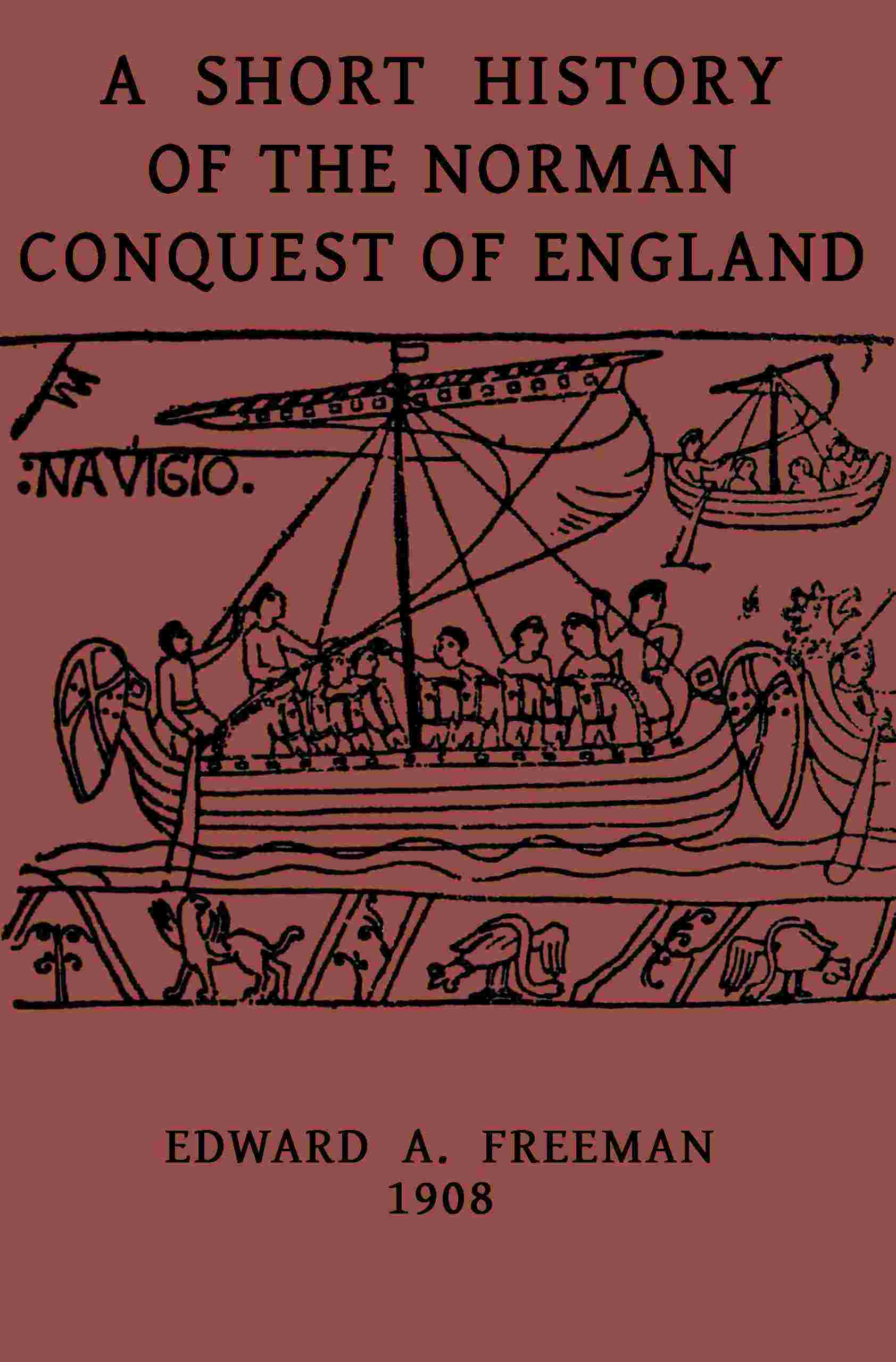
5. The Voyage of Duke William.—In the course of August all was ready. The fleet was built and manned, and the army was ready to cross into England. The place of meeting was at the mouth of the Dive. The number of ships and of men is very differently told us; but the Norman poet Wace, whose father was there, says that the number of ships was 696. They were only large boats for transport, with a single mast and sail. When they were come together at the Dive, they were kept a whole month waiting for a south wind to carry them to England. It would have been better for England if the south wind had blown at once; for in August King Harold and his army were still ready to meet them; but, as it was, the Normans did not come till the first army was disbanded, and till Harold was busy with the war in the north. At last, though a south wind did not come, a west wind did, and the fleet sailed to Saint Valery at the mouth of the Somme, in Count Guy’s land of Ponthieu. They were now much nearer to England than they had been at the Dive; but they still could not cross till Wednesday, September 27, two days after the fight of Stamfordbridge. Then at last the south wind blew, and the fleet crossed in the night. The Duke’s own ship, the Mora, the gift of the Duchess Matilda, sailed first with a huge lantern at its mast to guide them. On Thursday morning the Duke of the Normans and his host landed at Pevensey in Sussex. They landed under the walls of the Roman city of Anderida, which had stood forsaken and empty, ever since it had been stormed by the South-Saxons nearly six hundred years before. There was just now no force in those parts able to hinder the Norman landing. There is a story that, as William landed, his foot slipped, and he fell. But, as he arose with his hands full of English earth, he turned and said that he had taken seizin or possession of his kingdom, for that the earth of England was in his hands. Anyhow he took his first possession of English ground at Pevensey, where he left a force. He then, on Friday, September 29th, marched to Hastings, which he made his head-quarters. He there threw up a mound and made a wooden castle. And from this centre he began to harry the land far and wide, in order to make King Harold come the sooner and fight.
6. The March of King Harold.—The news of Duke William’s landing was, as we have seen, brought to King Harold at York as fast as it could be brought. And King Harold set out on his march southwards as fast as man could set out. With his housecarls and such men of the northern shires as were ready to follow him at once, he set forth for London. Edwin and Morkere were bidden to follow with all speed at the head of the whole force of their earldoms, while the King sent forth to gather the men of his own Wessex and of the earldoms of his brothers Gyrth and Leofwine, to come to the muster at London. Thus the men of all southern and eastern England came in at the King’s word; but the main strength of the north never came. Edwin and Morkere kept their men back, most likely hoping to be able to hold their own earldoms against either Harold or William. Thus King Harold got little help in his second struggle from the land which he had saved in the first. While the troops were coming in, the King went to the church which he had himself built at Waltham, and prayed there. And men said that signs and wonders were wrought at his coming; for that the image on the Holy Cross bowed its head, as if to say, ‘It is finished.’ So the canons of Waltham feared that harm would come to their King and founder. And two of them followed King Harold’s host to the place of battle, that they might in anywise see the end.
7. Duke William’s New Message.—The host was now ready to set forth for Sussex, all but the men of those shires whose force never came at all. And now another messenger came from Duke William to the King in London. A monk of Fécamp, a great abbey in Normandy near the sea-coast, came and stood before the King of the English on his throne. He bade him come down from it and abide a trial at law between himself and the Duke who claimed the crown by the bequest of Edward, and whose man he had himself become. The King—so the Norman writers say—answered that his oath to William, as being unwilling, was of no force, and that any bequest to William was made of no strength by Edward’s later recommendation of himself. This answer, it will be seen, did not go to the root of the matter; but it was answer enough to this particular message. The King then sent his message to Duke William to offer his friendship and rich gifts, if he would go quietly out of the land; but that, if he was bent on fighting, he would meet him in battle on the next Saturday. Then Earl Gyrth gave his brother wise but cruel counsel. He said that, as Harold had anyhow sworn to William, it was not good that he should meet him in fight. Let him, Gyrth, go against Duke William with the host which had already come together; let the King meanwhile wait for fresh troops, and lay waste all the land between London and the sea, so that, even if the Normans won the fight against Gyrth, they would have nothing to eat, and their duke would be driven to go away. But King Harold said that he would never let his brothers and his people go forth to the fight while he himself shrank from it, and that he would never burn a house or lay waste a field in the land over which he was set to be king. So the King marched from London with his host, and on Friday, October 13th, he reached the hill of Senlac, seven miles inland from the Duke’s camp at Hastings, and there waited for the attack of the Normans.
8. King Harold’s Camp.—The English, as has been already said, were used to fighting on foot. They were stout men to hurl their javelins and to meet the enemy hand to hand with their axes; but they had no horsemen and very few archers. The Normans, on the other hand, were the best horsemen and archers in the world. It was therefore King Harold’s plan not to attack the enemy, but to let them attack him; not to meet them in a broad plain fit for horsemen, but to hold a strong place in attacking which the Norman horses would be of less use. So he pitched his camp on a hill which stands out from the main line of hills, and the sides of which are in parts very steep; he fenced it in with a palisade, and with a ditch on the south side where the ground was less steep. The land between Hastings and Senlac was woody, broken, and rolling ground, and the ground at the foot of the hill must then have been a mere marsh. The Normans would therefore have much ado to get to the hill and ride up it, and, if they got to the top, they would find the English standing there ready to cut them down. So wisely had King Harold chosen his place of fighting; for he knew the land of Sussex well.
9. The Last Challenge.—Both King Harold and Duke William sent spies to see what the other was doing. It is said that an English spy came back and said that in the Norman camp were more priests than soldiers. In an earlier time both Normans and English had worn their beards; but now the Normans shaved the whole face like priests, while the English wore only their whiskers on the upper lip. So the spy took the shaven Normans for priests. Then King Harold laughed, and said that they would find these priests right valiant fighting men. One tale tells that King Harold and Earl Gyrth rode out together to spy out the Norman camp, and came back unhurt. And it is also said that now, after the camp was pitched on Senlac, Duke William sent yet a last message and challenge to King Harold. Once more, would Harold give up the kingdom to William, according to his oath? Would he and his brother Gyrth hold the kingdom of William as his men? Lastly, if he declined either of these offers, would he meet William in single combat? The crown should be the prize of the victor, and the blood of their followers on both sides would be spared. But King Harold refused all these offers; for to have accepted any of them, even the single combat, would have been to acknowledge that the war was his personal quarrel with William, and not the quarrel of the people of England whose land William had unjustly invaded. It is plain that Harold had no right to stake the crown on the issue of a single combat. If William killed Harold, that would give William no right to the crown, which it was for the people of England to give to whom they would. And if Harold killed William, the Norman army was not the least likely to go away quietly; there would have been a battle to fight after all. So King Harold assuredly was right in refusing to stake the fate of England on his own single person. All these stories, it must be remembered, come from the Norman writers; our English Chronicles cut the tale very short. But we may be pretty sure that there is some truth in them, and this story of the challenge seems very likely. Anyhow by Friday evening, every man in each army knew that the great fight for the crown and the freedom of England was to be fought on the morrow.