
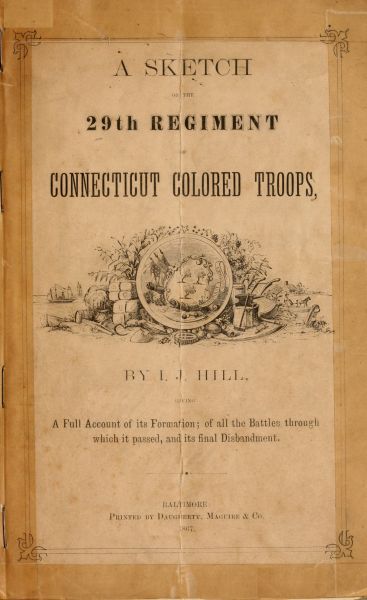
The Project Gutenberg eBook of A Sketch of the 29th Regiment of Connecticut Colored Troops
Title: A Sketch of the 29th Regiment of Connecticut Colored Troops
Author: Isaac J. Hill
Release date: November 16, 2019 [eBook #60700]
Most recently updated: October 17, 2024
Language: English
Credits: Produced by Graeme Mackreth and The Online Distributed
Proofreading Team at http://www.pgdp.net (This file was
produced from images generously made available by The
Internet Archive)
A SKETCH
OF THE
29th REGIMENT
OF
CONNECTICUT COLORED TROOPS.
BY I. J. Hill,
GIVING
A Full Account of its Formation; of all the Battles through
which it passed, and its final Disbandment.
BALTIMORE:
Printed by Daugherty, Maguire & Co.
1867.
PREFACE.
The author of this has for a long time been greatly concerned for this land and nation, and for the human family in general, but more particularly for the unfortunate African, both in this and every other part of the world. I was born in Selings Grove, Union County, Pa., in the year 1826, the 2nd day of June, and was the youngest son of four brothers. My father's name was Isaac, and my mother's, Rachel. The family consisted of thirteen in number. My father being a poor man, I was put out to a gentleman of Louisville, Kentucky, at the age of six years; I was brought up with a limited education, not being permitted to go to school, for it was against the laws of the State for a white person to teach a colored child; but having kind friends to live with and being beloved by white boys, I gained some information in spelling, and with diligent study I learned to read and write. I never had the opportunity of going to school a day in my life, when it became known to the citizens that I could not write, I was sent home to Pennsylvania in the year 1840, then 17 years of age. I embraced religion in the year 1846.
I was called to the ministry in the year 1852, in which position I studied; when the war broke out in 1861, I went out with the 3rd Pennsylvania Cavalry, under Col. Emory, I was in the charge at Falls Church, Va., and Fairfax Court House. When the rumor reached me that the Government was enlisting colored men, I then left the Regiment and went home, and in 1863 enlisted in the 29th Connecticut Regiment, January the 7th, 1863.
The author's desire and prayer is, that tranquility, peace and happiness may cover the earth, as the waters cover the great deep. Forasmuch as there has been a great deal of confusion in relation to my afflicted nation, and different parties holding opposite opinions have come forward with a desire to alleviate their condition; their good intentions have taught us: First, that it is necessary to become christians, to love and fear God and keep his commandments, to have patience and faith in our Lord and Savior Jesus Christ, then we shall be delivered in due time. Secondly, the reader is referred to the pages of this work; please read it impartially and carefully, and you will see plainly that the author's sole aim is to promote the happiness of the human family, here and hereafter; therefore, I pray that those who will read this book may be forever blessed in this world, and receive endless happiness in the world to come.
I. J. HILL.
Woodbury, New Jersey, 1866.
THE
PRINCIPAL BATTLES
OF THE
TWENTY-NINTH REGIMENT,
U. STATES COLORED TROOPS
| 1st. | DEEP BOTTOM, VA. |
| 2d. | STRAUSBURG PLAIN, VA. |
| 3rd. | PETERSBURG, VA. |
| 4th. | NEW MARKET ROAD, VA. |
| 5th. | FORT GILMOR, VA. |
| 6th. | CHAFFIN'S FARMS, VA. |
| 7th. | DARBYTOWN ROAD, VA. |
| 8th. | RICHMOND, VA. |
| 9th. | TEXAS EXPEDITION. |
Col. W.B. Wooster led us on, he had no right to fear, there was not a faint heart in the 29th Volunteers.
A SKETCH
OF THE
29th Connecticut Colored Regiment.
The 29th Connecticut Colored Regiment was gotten up by Colonel Pardee, and encampted at Grape Vine Point, New Haven, Connecticut. The recruiting was commenced in August, 1863. The inducements held out to men to join this Regiment were these: they were to receive a bounty of $310 from the State, $75 from the County from which they enlisted, and $300 from the United States. The $310 from the State we received, the other bounties we did not receive.
There were several men who took an active part in recruiting for this Regiment, among them Lieutenant Brown of New York, to whom great credit is due. There were others, both colored and white, who did very much towards filling up the Regiment. Sergeant Archie Howard, Orderly of Company C, recruited more men than any other excepting Lieut. Brown, but I am sorry to say, that after all he did the parties failed to pay him according to promise, and he was ordered to his Regiment without receiving a just compensation for his labors.
The first of January, 1864, the 29th Regiment was filled up. The writer of this narrative was in the last squad of men that enlisted for this Regiment, and out of the forty men I was the only one that was admitted into the 29th, the balance of the recruits being put into the 30th Regiment, that was then recruiting in the same camp. We remained at New Haven until the 8th of March, and nothing of interest happened up to that date, when we received orders from Colonel Pardee's Headquarters, stating that the 29th Regiment was to move to Annapolis, Maryland.
March 8, 1864. We broke camp to leave New Haven for Annapolis, Md. At 10 o'clock the whole Regiment was drawn up on the old parade ground, with their knapsacks, to receive the flag, Col. W.B. Wooster in command. The flag was presented by the Rev. Dr. Mott. On account of the Regiment not receiving the $75 which was promised them at their enlistment, they made no response to the presentation, and the Colonel gave them no command to do so. The order was given to "forward, march," and the Regiment paraded through the principal street of New Haven; at 2 o'clock it halted in the public square, where we were visited by our friends, also by some of the first families in the city. After resting two hours, the word was given "attention," and every Company was brought into line, and at the command "forward, march," the Regiment moved down Chapel street to State st., and then to the long wharf, where it halted and awaited the near approach of the transport, that was still out in the stream. At 5 o'clock the troops commenced embarking, Company A taking the lead, and at half past 6 o'clock all were on board, excepting a few, with the writer of this journal, who were detailed for duty at the Regiment's previous headquarters. On my way from the long wharf I met the crowd of citizens that was not permitted to go to the wharf with the Regiment. Never did my ears hear, or my eyes perceive, or my heart feel the strong yearnings of nature as they did at that moment; mothers weeping for their sons, and wives for their husbands, and sisters for their brothers, and friends for their friends, that were then on their way to the scene of conflict. White and colored ladies and gentlemen grasped me by the hand, with tears streaming down their cheeks, and bid me good bye, expressing the hope that we might have a safe return. My heart felt the sobbing impulse for the first time, and although I had no mother, no wife, and no sisters there to greet me, yet strangers ministered unto me, and never shall I forget their kind attentions to me. At 8 o'clock in the evening I went on board the transport, and received an introduction to Col. Wooster as Regimental Orderly Hill. The Colonel met me very kindly, and put his state-room, which was letter K, into my care.
At 10 o'clock I learnt the transport would not move anchor until next morning at 6 o'clock; after gaining this information, I had a desire to go ashore, but could form no excuse for doing so. While I was in doubt what to do about it, one of the officers, Lieut. Leonard, came to me and said. "Orderly Hill, can't you go to the post office for me, as I can't go ashore?" My answer was, "I will try and go for you." I had never spoken to the Colonel, and felt somewhat delicate about approaching him, but as I had never been refused a favor by a commanding officer, I took heart, adopting for my motto, "Without a trial, there can be no denial," and started for the Colonel, and found him in his berth. I said, "Colonel, can I go ashore?" He remarked, "If I grant you permission, except on business, others will expect the same favour." I said, "I have letters to carry to the post office." He said, "Well, you can go." I left him, and went to Lieut. Leonard, of company D, and asked for Dr. Bigbee, whose family was living in New Haven. The lieutenant passed him outside the guards with me, and we felt it to be a great favor, for which we were very grateful. When my errand was done, we proceeded to the residence of Dr. Bigbee, and found his wife had retired, but on learning who had arrived she arose, and a friend who was stopping with her, and they prepared us a good supper. We enjoyed it—still we were saddened with the thought that we might not meet again for three long years. We remained there until 2 o'clock, and then bid the last farewell to our friends in New Haven, and went on board the transport again, and laid down to sleep, but sleep had fled from me entirely, and daylight found me as I laid down, wide awake. Sabbath morning at 6 o'clock, we weighed anchor, and the stream bore us down its rapid tide until New Haven was lost in the distance. The day was spent very pleasantly, and at 3 o'clock we passed New York; and as we passed the city, our drummers assembled on deck and played, at which flags were displayed by the citizens, and cheers given in response. At 12 o'clock, the same night, we passed Cape May.
I fared the same as the officers. The great anxiety now was to see Annapolis, Maryland, which place we reached on Tuesday at 10 o'clock. As we approached the place all became disheartened at the appearance of things. Officers and men were much disappointed when we learned that we should have to camp three miles from the town. Now, for the first time, we had to pitch tents—the clouds threatened a storm, and the boys went eagerly to work and most of them had their tents up before night.
I spent the night in the Colonel's tent, and the next morning we found the earth covered with snow to the depth of eight inches. We found the people very inferior at this point; and a great many of the colored people had caught the distemper from the whites, their so-called masters. It was hard to find a pleasant family of colored people in the place; they appeared to be afraid to speak to us. The first Sabbath I spent in camp, and had the pleasure of listening to a very interesting sermon from a reverend gentleman that paid us a visit for that purpose. The text was, "And on him they laid the cross." He handled the subject with great credit to himself, and great applause was given by the soldiers. On the next Sabbath, which was the 27th of March, I visited the Methodist church at Annapolis. At 11 o'clock I preached to a crowded house, from Joshua, 3d chap. 11th verse. I preached at Zion's church in the afternoon, from Revelations, 3d chap. 4th verse, and truly the good Lord was with us. At 5 P.M. I returned to camp, and accompanied the Colonel to dress parade, and after it was over, I was informed that an appointment was made for me to preach in the camp at 7 P.M. Feeling much exhausted from the severe labors of the day, yet at the time appointed I was there, and endeavored to preach from the text, "The wages of sin is death." It was listened to by the officers and men with the utmost attention. The week following the Colonel was absent on business at Washington, D.C.; and according to frequent rumors in camp, our regiment was to spend the summer at this point. I had cherished the hope of greeting my dear family, whom I had left quite unwell at home; but on Friday my hopes were blasted by a general order, stating that the 29th Regiment should break camp at 7 o'clock on Saturday morning, and embark on the transport then lying in the stream opposite the navy yard, bound for Hilton Head, South Carolina.
Saturday morning found me up at 4 o'clock, and in the best of spirits, and as usual in a pleasant mood, but still I thought of home, sweet home—it was lost to my sight, but not to my memory—and although I was very busy, I did not forget the dear ones there; and while I was waiting for the cars to come and take the officers' baggage, as a soldier, the rail track was my chair and the cross-beam was my writing desk, I wrote to my wife at this last moment. I went by rail to Annapolis, and when I arrived there, I joined those who had gone by boat. My lot was cast to the steamer Swallow. I went on board and put the Colonel's things in his state-room and mine also, and then went on shore and spent the day until 5 o'clock in the afternoon, when the transport was launched out into the stream, and I was left ashore with the Colonel, Adjutant and Lieut. Colonel. All kinds of rumors prevailed on board. Some said I had deserted—others, that I was taken up for carrying arms, but 5 o'clock found me in a life-boat with the Colonel and his staff, bound for the Swallow, that was waiting our arrival. When the boys saw me, they gave three hearty cheers for Orderly Hill. We remained all night, and the next morning at 6 o'clock the Swallow started down the stream, and Annapolis was soon lost to view. The Swallow took the lead, and we soon lost sight of the other boats. Monday morning at 9 o'clock we arrived at Fortress Monroe and the pilot went ashore, and after remaining a few moments we set sail again for Hilton Head, South Carolina.
The wind was tolerably high, and the officers and men felt somewhat concerned in reference to passing Cape Hatteras that night, but God was in the wind, and when we passed the cape at midnight it was quite calm; and Tuesday morning found us on the blue sea, out of the sight of land. This was the first time in my life that I was ever out to sea, and it seemed very strange. All this time I had not been sea-sick, and began to think I should entirely escape, as I had been on the water two days. But at 3 P.M. I was very sick, and in company with many of the old seamen I had to cast up accounts for relief. It was very rough, and poor me! I thought I could not live, but the utmost attention was given me by the Colonel and officers. The same night the boat took fire, and being too sick to sleep, I was enabled to give timely warning of the accident, or we should have perished by the flames or a watery grave; but God was with me, and I got up in the midst of smoke and called the first mate, and then went to the Colonel's state-room and told him what had happened, and we put out the flames without arousing the other officers and men.
Wednesday morning I felt better. The first sail we had seen for two days was that of a brig, which passed us this morning on our right. The sea was quite calm, but as the day wore away the wind began to rise, and 3 P.M. found me sick in the Colonel's berth. At 6 P.M. we were in sight of land, and this, the last night we spent at sea, was the hardest time we had, but joy came in the morning as we neared Hilton Head. When we came to the landing, the Colonel and Adjutant went on shore, and we waited their return. When they came aboard, the Colonel told the Captain of the Swallow that he was ordered to Beaufort, where we arrived at 10 A.M. and were received on the wharf by a large crowd of people. We disembarked the same day, which was April 16th, and marched through the main street, and went up to the camp of the New York 26th U.S.V., and encamped on the right of Beaufort. We found Beaufort a pleasant place of about five thousand inhabitants.
May 20th, 1864. Nothing of importance had occurred up to this date. I passed up the line of tents, and saw the Major in a wagon—he informed me that the Paymaster had arrived. When I made this known to the 29th Regiment the boys were much pleased, for they had not received any money since their enlistment, but soon their spirits fell when they learned they would receive only $7 per month. Company A took the lead in the dissatisfaction, it being the first company, and company B next, company K next, company C next, and so on till company D, it being the last company and the one to which I belonged. After the companies all expressed their indignation at the small sum of $7 per month, the officers called them in line and told them they would receive $16 the next pay day, and they had better take this—at the same time promising them, that in the future they should receive full pay. They did as he wished. This has been the failing with the colored race—they are always ready to comply with wrong teachings of strange gods, especially when they come from white men, and that is the reason we cannot be a united nation. I would not and did not accept of the $7 per month, and I stood entirely alone. All in my company took that sum but myself, and when I was called up my response was, if the government could not afford to pay me a soldier's wages I would peril my life and die for my country without it. When I consider the sacrifice I have made of my beloved family, and think that the general government does nothing for them, and then to insult me with the sum of $7 per month! No, as I have given my life I will become a martyr and die before I will accept that sum. But I am happy to relate that when they found there were some that felt the dignity of their manhood, the Paymaster Major endeavored to make apology to me in reference to the affair, but there was no compromise in me. I would accept nothing but $16 per month. "Well," said he, "you will get the balance next pay day." My answer was, "Whether I do or not, I will not accept of less than $16 this time." I was brought to think of the psalmist David, when he said "Many are the afflictions of the righteous, but the Lord will deliver them out of them all." Notwithstanding our troubles, on Sabbath morning, the 22d inst., my mind was very much relieved at 6 P.M. While at dress parade, the General rode along the line, and the Colonel brought the companies up in broken columns in front of the flag. At the command of the Colonel, the regiment came to "order, arms"—and at this point General Saxton dismounted, and gave me his horse. Taking off his hat he commenced some brief remarks by saying, "Boys, I have come to greet you with an order I have received that you are to be considered soldiers of the United States and receive your pay as white soldiers, and I hope you will consider yourselves men. Although your skins are dark, you have the same muscle as white men, and the same courage to fight. It is for you to get the same skill by strictly attending to your duty, not from fear of punishment, but because you are soldiers. Two years ago I came here to Beaufort and raised the first colored regiment. They were all slaves, and their masters were in the rebel army. One day a flag of truce came in from the rebel line, and the colored troops were out on picket. Before these colored men became soldiers they could not look a white man in the face, but at this time they began to feel like men. One of the so-called masters came over, and seeing his so-called slave, he exclaimed, using his own language, 'There is my negro in arms,' but the colored soldier looked him square in the face, and as I never make use of the word negro, I said to him, if he was once a slave he is free now, and God has made him so, and there is not a regiment in the department I would sooner go into the field with than the first Southern, now called the 33d United States troops." He concluded by saying, "Boys, if you ever want to make good soldiers you must look a white man straight in the face, and let him know that you are a man."
I spent the morning at the first colored church, and at 3 P.M. preached from the 14th chapter of Job and the 14th verse. My theme was "Death—an important change, not annihilation. It does not reduce us to nothing, but alters our frame of being."
At 7 P.M. the elder spoke from the text "Strive to enter in at the straight gate," and I closed the meeting.
The next Sabbath we had service in the camp in which I took part. The Rev. Edward Scott preached. At 7 P.M. I preached from Revelations the 7th chapter and 9th verse. My theme was "The society and happiness of the heavenly state. Life is a journey. Christians are but travellers to the unseen world. The world to which we are going is unknown to us." Truly we had a good time.
May 25th. A general order, stating that a part of the 29th regiment was ordered out on picket duty. Company D was asked for, but owing to one of the officers being sick, and the Captain on detached service, it could not go, so Co. E was substituted, and for the first time they commenced packing to face the enemy in the field. When they were all ready to move the boys started off cheerfully. As the officers looked dejected, my prayer was, may God go with you and give you strength to face the enemy. The camp was unusually quiet at this time. The Colonel and Adjutant had orders to go to the front, and it left the camp without a line officer, excepting the Major, and he looked quite lonesome. The rumors were that the rebels intended to attack Beaufort the 25th instant, but the day passed of all quiet along the line.
August 9th—we broke camp at Beaufort and embarked on board the transport Trade Wind bound for Hilton Head, where we arrived at 10 A.M. The Colonel went ashore and received orders to go to Fortress Monroe.
At 6 P.M. we weighed anchor and soon found our bark stemming the rapid tide, and when night came on I was soon in the arms of sleep and forgot all earthly care. The morning of the 10th instant I rose at 5 o'clock and gazed upon the glorious sun as he rose out of the sea; truly it was a grand sight to one as ignorant of such things as myself. The day passed pleasantly, and the transports stemmed the rapid tide three in number. When I stood on deck and took an observation of the surrounding scenery, I was lost in wonder at the profound immensity of the great waters, and I came to the conclusion that the hand of God had formed all these things; in this profound thought the morning passed gently. After dinner, I had some talk with the boys on board in reference to their fare, and they informed me they would be glad to boil their coffee with the coals that the fire-man raked from the furnace, but even that was denied.
The night of the 10th came, and all retired to their sleeping places, (and you may imagine they were not feather beds,) officers and men, with the exception of Col. W.B. Wooster and a few Captains, who had state-rooms, and they were the most miserable I ever saw, and dirty accordingly, but they were the best they could have, therefore they were contented. The night passed rapidly, and the morning of the 11th inst. found all on board well and ready for breakfast. We found hard tack and raw pork were not as agreeable as the fare we had been used to, but hunger made it very palatable. After breakfast I went on deck and amused myself by talking with the boys generally. I met the Sergeant Major, and after inquiring of his health, he informed me that he was on board with nothing to eat. I went to the Colonel's state-room and brought my haversack with some cheese, cakes and pies, that my friends in Beaufort put up for me, and I said, "Here is enough for you; help yourself;" he looked up and said, "Mr. Hill, I never shall forget your act of kindness to me in this hour of suffering."
In the evening at 6 o'clock we came in sight of the light house off Fortress Monroe. I went to the Captain and asked him when we should get to the Fort, he said "In the morning about 8 o'clock." I retired and went to sleep. The morning of the 12th found me up at 5 o'clock, and looking around me I saw the land on my left. We arrived at Fortress Monroe at 10 A.M. and dropped anchor, and the Colonel went ashore and remained until 1 P.M. When he came on board he informed the officers that he must proceed to Bermuda Hundred, Va. At 4 P.M. we weighed anchor and left for our destined place. I was much pleased with the scenery up the James river. The first thing that attracted my attention was Jamestown in its desolation—nothing but a shattered wreck—the only building is that of a brick church that stands in the midst of green trees lifting their heads high and lofty, looking down on a city doomed as Sodom was for sin. When we reached City Point within five miles it was night, and the captain of the Trade Wind stated that he did not think it safe to run up that night, as the rebels had guns planted on the shore. We dropped anchor and waited the approach of day. The boys slept soundly, but sleep had fled from my eyes. The morning of the 13th came, and we weighed anchor, and at 6 A.M. we found our little transport safe at the wharf at Bermuda Hundred. We passed City Point, and the troops went ashore and took up the line of march for the General's headquarters. The day was intensely warm, and the regiment marched five miles into Virginia, and not being accustomed to marching they became weary, and most of the men threw away their blankets. Being Regimental Orderly, I was detailed at Bermuda Hundred till four o'clock, and then started for the regiment, which I reached at 6 P.M. and found it encamped in the woods close to General Birney's headquarters. The boys cheered me as I passed along the line on my way to the Colonel's quarters. We remained there until 11 P.M. and received an order to proceed to Deep Hollow. We marched until 2 A.M. and crossed the pontoon bridge, and proceeding two miles farther passed ——; halted in a corn field in the rear of the advanced pickets, and for the first time laid on our arms in the open field. I lay near the Colonel, with the reins of my horse tied to my wrist, my gun in my arms half cocked, and in this position rested the night—the rebels being quite close to us—within a stone's throw.
The morning of the 14th inst. the Colonel sprang to his feet at 4 o'clock and gave the order "Attention." The boys all arose from their dusty beds, waiting for the order to load, expecting to take the advance pickets, but at this juncture the General sent an order for him to fall back to the fort at Malvern Hill. We got breakfast and the men were stationary. All was quiet until one P.M., when the rebels attacked the pickets that were stationed on the outposts. The Colonel gave the order "Fall in." For the first time the boys put on their equipments and fell in; and when the order was given "Forward," they rushed to the battle in good order. Quite a battle took place, at which time a number were killed and wounded on both sides, and we took a number of prisoners.
On the 15th inst. we remained quiet, with the exception of some skirmishing. The 16th, we received orders to move the regiment and join the 3d division 10th army corps, General Birney's brigade having at this time fallen in with the 22d, 7th, 8th and 9th U.S. C. Troops, and with the 29th they numbered 5,000. At 2 P.M. we took up our line of march for Jones' landing. We crossed the pontoon bridge and marched up the valley in a drenching rain, and in the midst of the deep mud the boys were cheerful. We arrived at our place of destination at 7 P.M. and rested in an open field in the rear of the advance pickets. The boys stacked their arms and commenced putting up their shelter tents. I took my tin cup and coffee, and prepared supper for the Colonel, Lieut. Colonel, Major and Adjutant. After this I was at my wits end to find a place for them to sleep; at last I formed this plan: I got nine rails and laid three abreast and spread the blankets on them, and the Colonel and Major laid down. The Lieut. Colonel laid on the ground. I slept on the third tier, and being tired rested comfortably. The night passed swiftly, and the morning of the 17th we rose early and got breakfast, and awaited the order to advance to the front. At 10 A.M. we halted in the woods, and the boys commenced clearing up to pitch their tents, and while they were at work the General rode up at one P.M. and told the Colonel to draw the division back to its former position, which they did in good order. We got dinner and remained but a short time, when the rebels commenced driving in our pickets, and the order was given to "fall in," and the men fell in in good order, and rushed to the battle; the 29th had the right centre, the 22d formed next to the 29th on the right of the centre, the 7th on the left of the centre, and the 9th in the centre. At the command "left flank," the whole column marched at double quick. They halted at the woods, and quite a battle took place, at which time our Lieut. Colonel was wounded in the leg and his horse was shot from under him; he has since recovered. We remained in line of battle till 12 o'clock, and to the surprise of officers and men not a soldier of the 29th was killed or wounded, I being the only one that a ball struck. While standing on an elevated spot a rebel ball struck my hat and caused me to look around.
On the 17th inst. the whole column moved back and remained all day where Gen'l McClellan retreated from in the fall of 1861, twelve miles from Richmond. We remained there until the 18th instant, and at 8 P.M. the whole corps and 3d division moved down the valley. We halted in an open field for two hours opposite the pontoon bridge crossing the Chickahomney, at which time the order was given "Attention." The whole regiment came in line, and when the order was given "Forward," the column marched towards the bridge and halted on the bridge, on account of a broken plank. The bridge being repaired, which detained us an hour, we again took up the line of march and passed the general headquarters, almost to our original position, and halted for the day in an open field.
The 19th instant we remained quiet. The 20th we started for the front of Petersburg, and marched in a drenching rain to the forts on the right of the Point of Rocks hospital. The 21st—came near being flanked by the rebels, and marched back to Malvern Hill and repaired breastworks. The 22d had quite a skirmish with the rebels, when we were quite successful, killing and taking 75 prisoners, and had as yet lost none of the 29th regiment in killed or wounded. We left on the day of the 23d for the front of Petersburg again, and at 10 A.M. crossed the James river on the pontoon bridge, and passed the heights where the first New Jersey battery was stationed. We arrived in front of Petersburg at 2 P.M. and were amused looking at the doomed city. The rebels sent a shell, which passed over the regiment, and fell close to the Colonel, who was sitting on his horse at the right of the brigade; he gave the order "Attention," and countermarched the regiment and fell back to the woods, and waited the order from the General, which he received at 5 P.M. to fall back to the fort four miles distant, to protect the pontoon bridge opposite the Point of Rocks, where we arrived at 6 P.M. coming at almost double quick. On our return the roadside was strewn with stragglers from different regiments, and when the column met them they inquired the cause of our return, and the reply of the boys was "the rebels are after us." It was a source of laughter to us to find the stragglers falling in, and many of them could out walk the well soldiers when they heard the rebels were coming. We remained the night of the 23d at the fort in a drenching rain, and the Johnnies did not come.
On the morning of the 24th I found quite a number of my white friends from home—Dr. Clark from Woodbury, N.J., and others. We were glad to meet again alive, and talked of beloved friends at home, and the morning passed rapidly and pleasantly to all. At one P.M. the order came for the regiment to return to the front of Petersburg, when the white soldiers seemed to regret that the 29th were going to leave the fort. We took up our line of march and at 3 P.M. were again in front of the land of Destruction, which was Petersburg. We halted in the rear of Gen. Birney's headquarters and got supper, after which the regiment moved to the rifle pits, with the exception of a few detailed men, of which I was one. I was attracted by the remarks of a white soldier as we left the fort. He looked at the colored troops and said, "Well, they are taking those colored men to their slaughter pen in front of Petersburg." Truly his saying was correct, for on the first night Co. H felt the first stroke, having the first man killed out of the 29th regiment. It was private Henry Mings, a native of Africa, who emigrated to this country in 1862, and joined the 29th Connecticut Volunteers Jan'y, 1864. He was very broken in speech, being a regular African, and was, as is too often the case among soldiers, a very wicked man. He died as he lived, a rebel to his God but true to this country.
On the 25th, Co. K felt the horrors of war. Private Samuel Burton was killed, being shot through the head while moving the company; he was a resident of Hartford, Conn. On the 26th Co. D felt the blow. Private George Porter was shot in the shoulder, and died at the hospital four days after. On the 27th Col. Wooster was brought in from the rifle pits quite sick. The 28th we lost our first officer, a worthy man, who was captured while out strengthening the pickets on the outpost. On the 29th we had two men killed, I could not ascertain their names, but they belonged to Co. A. On the 30th we had two killed, one out of Co. B, and one out of another company. The 31st we lost two men out of Co. E, and one out of Co. K, private Chester Phillox.
Sept. 1st, we struck tents in front of Petersburg, and took up our line of march for our place of destination, unknown to all but the Generals. When the line was drawn up, the colored troops of the 3d division, 10th army corps, numbered 75,000, the 29th forming the centre. At 3 P.M. we started on the main road leading direct to City Point, thinking we were going by transport to some place of rest, but about 12 o'clock the same night our hopes were blasted, when we took the left hand road leading to Broadway Landing, and we soon found ourselves crossing the pontoon bridge that brought us in the rear of Petersburg. Daylight found us on the Old Market road leading direct to the front of Richmond. We marched all night.
Eight o'clock, on the morning of the 2d inst. found the whole brigade engaged in front of the enemy; we drove them five miles, and at 1 P.M. were inside the rebels' first line of works surrounding Richmond. We had a hard battle, commencing at 2 P M., and had been engaged three hours when a charge was made on two of the rebel forts. The left of the line was charged by the 8th U.S.C. troops, supported by the 29th. The centre was charged by the 9th Maryland, supported by the 7th U.S.C. troops. The day was one long to be remembered; the rebels fought hard, but the colored troops carried the day, and night found us in the rebels' line of works. We lost quite a number of brave men and among the wounded of the 29th was Capt. Thorpe and Lieut. McDonald; we greatly regretted their loss, but to the surprise of all not one of the 29th was killed; they all came out of the fight well. When I looked upon the dead and wounded, it was awful to see the piles of legs and arms that the surgeons cut off and threw in heaps on the ground. We lay in front of the works all night, and the morning of the 3d we had quite a warm reception. The bombarding was heavy on both sides, and we could frequently see rebels carrying their dead and wounded out of their trenches and forts. We had several wounded but none killed. The Colonel being unable for duty, Major D. was in command, who was a worthy and careful commander, and gained high praise from both officers and men. The Colonel, officers and men generally, regretted the absence of Lieut. Col. J.C. Ward, who was at that time sick at Fortress Monroe.
The morning of the 4th inst. we moved on the left of the line, and planted our flag under the rebel fire of grape and canister, bombshell and musketry. When the rear guards came over the field the dead lay strewed on the ground, but to my surprise we could find none of the 29th killed. The 5th inst. we rested in the rifle pits, with the advance pickets thrown out in front of the third fort of the rebels; nothing went on of importance, except the artillery fought a duel with the rebel fort at long range. On the 6th instant, we remained still in the breastworks. On the 7th we received orders to fall back to the general headquarters to rest. The 29th had just reached their resting place when a fight broke out in the centre, and they were ordered back to the breastworks on double quick. On the 8th we remained at the breastworks until 3 P.M. and then received orders to move on the right to support the 45th at the fort on Lookout mountain. We arrived at Lookout at 6 P.M., tired and weary, and hoped to encamp for the night, but at 10 o'clock our hopes were blasted by an order, stating that the 29th must return to the front to support the 8th U.S. C. troops, then laying in the breastworks. We remained at this post six days, when the General ordered a scout to explore the woods in front of the rebels. We left camp in front of the breastworks at two P.M. on the 14th inst. and as we were accustomed to have it rain, the rain fell in torrents, but General Birney gallantly led his band of the 3d division, 10th army corps, numbering 75,000 colored troops. We arrived at our destination, and the General ordered out the skirmishers, but whether he saw any rebels, or saw too many of them to engage in a fight is yet a profound secret, but the night of the 14th inst. found us back in camp in the rear of the breastworks. The rain kept falling. The men were ordered to have two days' rations and be ready to fall in at one A.M. in light marching order, without knapsacks. Col. Ward, then in command of the 29th, said to me, "Hill, I would like you to be close to me, as I shall want you early in the morning." At this I spread my blanket on the wet ground and lay down to rest; sleep had fled from me, and as I looked at the Colonel I could see a change in his countenance. Adjutant Spalding, who had but lately rejoined the regiment, was also with us. There seemed to be an uneasiness among the field officers. The morning of the 15th inst. rolled round, and at 3 o'clock the line was formed and gradually moved off to the right, and as we marched along the Captain of Co. D commenced singing "Are there no foes for me to face? Must I not stem the flood? Is this vain world a friend to grace, to help me on to God?" These sublime words oftentimes cheered the moving column as it marched through the dreary roads of Virginia. When the glorious sun arose it found us on the extreme right of the front, three miles from Richmond, where the white troops were repulsed on the 6th inst. The column was halted and drawn up in line of battle in front of the woods, the white troops on the right, and the colored troops on the left, the 8th and 29th forming in the centre, the 29th supporting the 8th. They entered the woods, and immediately attacked the enemy, and at 8 A.M. the battle became general along the whole line, and many a brave soldier fell, killed or wounded. Among them were thirteen of the 29th. The Adjutant fell wounded early in the engagement; Corporal George Burr, Co. L, Corporal Sidney of Co. H, private Joseph Halstead of Co. D, killed instantly. George E. Peters wounded in the side, Sergeant James Evans wounded in the foot by a piece of shell. To my regret, George Halstead was left on the field dead.
A very striking instance came to my notice through the course of the day of the 16th. A private of the 8th U.S.C. troops was wounded in the head early in the engagement and brought to the rear. I found him lying in his blood, and he would have died in this condition but I lifted him up and raised his head. I went to my post, and at 1 P.M. returned, and found him still alive, and when making some inquiries I learned that no doctor had given him any attention, and inquired to know the cause of this neglect. I made some stir about the case, and corn fodder and had him laid on it and put by the fire. When the wounded were moved back he was taken along and was soon in a condition to be sent to the hospital, with hopes of his recovery. Many of like cases could be saved by a little care and attention after the battle, but the complexion and rank of a man has a great bearing. There was a great distinction made among the wounded, so much so that it would make the heart of any christian ache to see men treated so like brutes.
On the evening of the 15th, at 5 o'clock, the cannon was sounded for the army to fall back while the artillery spoke destruction and slaughter to the rebels; we fell back, the cavalry covering our retreat. The colored troops wore the first to go into the fight and the last to come off the field. With what eagerness I looked for the flag of the 29th, and at last I saw it floating among the pines; and truly my heart leaped with joy when I once more saw the colors of our Regiment. The-night found us back in camp, in the rear of our former position.
All was quiet in front of Richmond, from the 15th until the evening of the 28th inst., when we received the information that the 10th Army Corps had light marching orders, and as it was in our former marches, different rumors prevailed. The Companies left their knapsacks at their company quarters, and the morning of the 29th, at 4 o'clock, we were on the march for the field of battle, which we reached at 6 o'clock; the 8th formed in line in front of the enemy, the 18th formed on the right, the 10th Corps, to which my Regiment belonged, was in the centre. The 29th Regiment was put out on a skirmish in the advance to charge the rifle pits. At the time of this battle, the highest officer in the 29th was a Captain; the Colonel was home on a sick leave; the Lieut. Colonel, W.C. Ward, was promoted Colonel of the 41st U.S., and the Major was sick in camp. We mourned the loss of our field officers, but Captain Camp, of Co. D, took the position of Major and formed the line, and said to us, "Boys, we have got to fight to-day; do the best you can; do your duty and I will stand by you till the last; will you stand by me?" The boys replied, "we will stand by you till the last." The Captain said: "Be careful and keep in line and obey the orders," "Forward, double quick;" and the regiment charged the rebel rifle pits and carried the works, and held them twenty-four hours. This was one of the most desperate battles of the campaign. We lost in the fight one hundred men killed and wounded. The 29th Colored Regiment covered themselves with great praise given them from all the officers. General Birney greatly complimented it for bravery in the battle. One of our first Orderly Sergeants of Co. D, named Spencer, captured three rebel prisoners. The fight lasted from 6 in the morning until 7 P.M.
The morning of the 30th, while the regiment lay on the rebel works, they shot away a 50 pounder. They received forty rounds of cartridge and rose up and stormed the rebels' main works, and then received orders to fall back, which they did in good order, and the evening of the 30th found us safe back again in front of Richmond. We were called to mourn the loss of Mr. Charles Bentley of Co. A, who fell in the early part of the engagement with a ball in his breast, a champion of liberty and a noble christian; also James Spriggs of Co. F, and 13 others who fell asleep on the field of battle.
Oct. 16, 1864. All was quiet up to this date. 3d division 10th army corps, 29th regiment, Gen. Birney's brigade. To the surprise of the regiment we were presented with the United States national colors, which greatly pleased the boys. The flag was presented by the Major of the 45th U.S.C. troops to Lieut. Col. W.C. Ward in a pleasing manner, and in his statement he spoke of the bravery of the 29th in the battle of the 15th inst., to which Lieut. Col. Ward replied, "I am no speech-maker, but I have 672 guns that will speak for me when occasion requires better than I can, and they are ready whenever called for." Notwithstanding this pleasant incident, quite a mourning sensation occurred in the regiment on the 19th inst. While on dress parade Lieut. Col. Ward made a very feeling and parting address to the 29th regiment, and told them he was promoted to Colonel of the 41st U.S.C. troops. He said, "I intend to leave you in 24 hours. I would rather stay with the 29th, but duty demands it and I must obey." Truly, these remarks fell upon the ears of the boys with tremendous weight.
Col. W.C. Ward was generally beloved by the 29th regiment for his gentlemanly and good discipline, and his careful protection of his men. He was careful never to order the private to go where he was not willing to go himself, and for these traits the men loved him. He was in command of the regiment at the absence of Col. Wooster, and he led it in and out of two battles with the loss of few men, and this made us regard him as a leader we could look up to. While we were quartered in the breastworks in front of Richmond, Col. Ward was mounted on his horse, and I rode in the rear of him, and when we halted a rebel sharpshooter shot at him just as he dismounted, and the ball went through his hat. Col. Ward never flinched, but came to "attention," and said "Well, Hill, I believe that was meant for me, but he did not get me this time." This was during the first day's fight, and he had not had his boots off for five days, and slept on the ground with his men, faring as they did. Sometimes I would get him to take my blanket to keep him warm, as I would rather do without it myself than see my officers uncared for. But he left us, and no one felt his loss more than I, for I was his first Orderly. When he came to the 29th regiment as Captain of Co. E, I was promoted by him to Regimental Orderly, and I was the last to escort him to his regiment, and with reluctance I left him Colonel of the 41st U.S. regiment, encamped in the rear of the 29th in front of Richmond.
On the 5th of November I left camp in front of Richmond and went on business to Bermuda Hundred, and to my surprise I received the intelligence at 10 A.M. that the 29th regiment had moved to Malvern Heights, one mile from Spring Hill, Virginia. After attending to the business entrusted to my care I mounted my horse and started for regiment, then laying at the fort, this being the first time the regiment ever moved without my being with it. At 9 P.M. I found the regiment in the forts on Malvern Hill in good spirits. The regiment was divided in four different forts in the immediate front of the rebels. All was quiet up to Nov. 8th, at which date we ranked in the second division, 10th army corps, the 29th yet in the forts at Malvern Hill. Nothing of importance occurred up to the 3d of December, when we received moving orders at 4 P.M. and at that time the tents were struck. This was on the Sabbath, and the relief did not arrive until Monday. The 5th inst. at 10 A.M. we took up our line of march for a destination unknown to us. All kinds of rumors prevailed among the boys. Leaving comfortable quarters they had constructed, they did not feel pleasant about going, but 2 P.M. found us on the left of Fort Harrison in the centre of the line, the latter place being quite inferior to our old company ground. When halted the boys went busily to work at fixing up as usual, carrying timber and putting up their cabins. They all worked busily until Tuesday evening at nine o'clock, when there came an order stating that the 29th should pack up with two days' rations. The hearts of the boys were sad enough before, but when they heard of having marching orders they felt worse. We packed up but did not start; and Wednesday, the 7th inst., found us still in camp, in front of the rebs in a drenching rain. The same day found us somewhat changed—the colored regiments all being consolidated in the 2d division, 3d brigade, 25th army corps. A number of detached men were taken from the regiments. I was detailed at headquarters as Brigade Postmaster. I felt somewhat strange in the new office, but I entered upon my duties with a willing heart. All was quiet along the line, with the exception of the Johnnies cheering. The evening of the 8th inst. the advance pickets were fired on.
January 1st, 1865.—Fort Burmen, in front of Richmond. The closing of 1864 passed off up to this date with frequent picket firing, our boys taking their regular turn. On the 8th of January the rebels fired on the pickets on the left of the line; the 29th at the sound fell in line in their entrenchments waiting to receive the Johnnies, but they failed to make an attack. We lay under marching orders up to the 13th inst. when Col. W.B. Wooster received orders to move his headquarters in the rear of the 29th regiment.
All remained quiet up to the 23d, when at 8 P.M. the rebel fleet moved down the James river towards the Dutch Gap, and commenced firing on fort Bradley, which was kept up all night. On the 24th inst., at 2 P.M., the clerk came to me and stated that there was an order to go out to the picket line, but neither of the Orderlies whose duty it was, wished to go, and seeing their dissatisfaction, I volunteered and went out to the advance picket line. 8 A.M. found the whole line drawn up in their entrenchments, under cannonading at long range, with the reinforcement in the rear in line of battle. The shelling was terrific all day; I went into the basement of the house used for general quarters at 2 P.M., where I formerly stayed. There was five of us in the basement, and a stray shell from the rebel gunboat came through the window and burst, passing over me and tearing out everything in the basement, but to the surprise of all, none of us were killed or wounded. This was a wonderful deliverance from God. The provost guard in front of general quarters, having knowledge of my being in the house at the time of the explosion, all exclaimed, "Hill is killed." A very intimate friend of mine, Mr. Jordan Jones, said "Boys, Hill is in the basement, and who will go in with me to bring out his remains." A little boy by the name of Thomas Watson was with me, and when I heard the shell coming I took him in my arms. After the explosion I shook him to see if he were yet alive, when Tommy commenced kicking. I said, "Boys, follow me;" and the next moment I made my appearance on the back stoop facing the breastworks, just as they were coming in to see if we were dead. As I came out the boys all cheered. I felt much stunned, and found my hearing dull.
There was a duel fought at long range on the 28th, at which time a shell sent from the rebel ram came through my quarters tearing out everything in the room, but my life was spared through the mercy of God. On the 7th of Feb'y my heart gladdened, for I received a furlough of twenty days to return home to see my beloved family and many precious friends. I started the same day on board the transport Weldon for City Point. I went from there to Fortress Monroe, from Fortress Monroe to Annapolis, and from there to Washington city by cars, where I arrived on Friday the 10th inst. at 9 A.M. I remained there until 6 P.M. and then left in the cars for home; reaching Philadelphia at 12 o'clock: I put up with Mr. Samuel Williams until Saturday morning the 11th inst. At 3 P.M. I hit Philadelphia in a boat at Walnut street wharf for Camden, and there took the cars for Woodbury, N.J., where I arrived and had the pleasure of embracing my beloved family. Truly the meeting was one long to be remembered, I remained at home four days, and then visited Trenton, N.J., where I had many kind friends. On Monday I returned home again and remained with my family and friends; everything was delightful, and truly a great change from camp life, where I had spent one year and one month in the service. On the 24th instant at 8 o'clock I bid my beloved wife and two children adieu; one of my children was three years and six months old, and the other six months. When the last moment came never in my life did I experience such emotions, and no one but a husband and father can imagine what they were, as I looked upon my family as I supposed for the last time in life. Never shall I forget that last farewell. The wagon that bore me away began to move and my eyes were fastened on my home until it was lost in the distance. I landed in Philadelphia at 10 o'clock, and there bid my father-in-law good bye, with the intention of going to Baltimore, but when I arrived in the city I was detained by my friends. Mr. Brown, in South street, made a reception for me at 8 P.M. I went there at the specified time, and found a great many of my devoted friends to pay, as they supposed, the last tribute to one they loved, and a defender of the country. I remained in the city until Tuesday the 25th, and at one P.M. I left the residence of Mrs. Young for Broad and Prime sts., where I took the cars for Baltimore, and arrived there at 5 P.M. I was escorted to the soldiers' refreshment saloon, where I partook of the hospitality of kind friends, after which I inquired of the friends if any of them could take me to the residence of Rev'd W.D. Schureman. One of the ladies kindly took me there, and I found he had gone to a fair then going on in his church. I went there and found him and his lady; they received me as a brother and introduced me to a great many of his congregation. I spent the evening pleasantly, but in the midst of the great throng I thought of my home and dear family that I had left behind. After the fair closed I went home with Mr. Schureman and his wife, and stayed all night. I spent the next morning with Mr. Schureman in his library talking over old times until 9 o'clock, when we went to the Provost Marshal's and got my transportation for Fortress Monroe, where I arrived on Thursday the 27th, after a lonesome ride with a burdened heart. I arrived in camp at the expiration of my furlough.
At 10 A.M. on the 29th inst. we moved from the breastworks on the left of Fort Harrison to the hill in the centre, where we built a tower overlooking the rebel works into Richmond. We remained there four weeks, and on the 27th of March we moved again. Part of the 29th rested in Fort Harrison and the 2d Brigade in the white house, known as General Birney's headquarters. All was quiet here until the 1st of April, when all was in readiness, and the order was given to strike tents and move on to Richmond. During Sunday night the brigade was out in line of battle, and at three o'clock in the morning the rebels blew up three gun boats and commenced vacating their works in our front. At 5 A.M. the troops commenced to advance on the rebel works—the 29th taking the advance, the 9th U.S.C. troops next. Soon refugees from the rebels came in by hundreds. Col. W.B. Wooster passed them about, and made them go before the regiment and dig up the torpedoes that were left in the ground to prevent the progress of the Union army. They were very numerous, but to the surprise of officers and men, none of the army were injured by them. On our march to Richmond we captured 500 pieces of artillery, some of the largest kind, 6,000 stand of small arms, and the prisoners I was not able to number. The road was strewed with all kinds of obstacles, and men were lying all along the distance of seven miles. The main body of the army went up the New Market road. The 29th skirmished all the way, and arrived in the city at 7 A.M., and were the first infantry that entered the city; they went at double quick most of the way. When Col. Wooster came to Main st. he pointed his sword at the capitol, and said "Double quick, march," and the company charged through the main street to the capitol and halted in the square until the rest of the regiment came up. Very soon after the arrival of the white troops the colored troops were moved on the out-skirts of the city, and as fast as the white troops came in the colored troops were ordered out, until we occupied the advance. The white troops remained in the city as guards. We remained on the outpost.
The 3d instant President Lincoln visited the city. No triumphal march of a conqueror could have equalled in moral sublimity the humble manner in which he entered Richmond. I was standing on the bank of the James river viewing the scene of desolation when a boat, pulled by twelve sailors, came up the stream. It contained President Lincoln and his son, Admiral Porter, Captain ——, of the Army, Captain ——, of the Navy, Lieut. W.W. ——, of the Signal Corps. In some way the colored people on the bank of the river ascertained that the tall man wearing the black hat was President Lincoln. There was a sudden shout and clapping of hands. I was very much amused at the plight of one officer who had in charge fifty colored men to put to work on the ruined buildings; he found himself alone, for they left work and crowded to see the President. As he approached I said to a woman, "Madam, there is the man that made you free." She exclaimed, "Is that President Lincoln?" My reply was in the affirmative. She gazed at him with clasped hands and said, "Glory to God. Give Him the praise for his goodness," and she shouted till her voice failed her.
When the President landed there was no carriage near, neither did he wait for one, but leading his son, they walked over a mile to Gen'l Weitzel's headquarters at Jeff. Davis' mansion, a colored man acting as guide. Six soldiers dressed in blue, with their carbines, were the advanced guards. Next to them came President Lincoln and son, and Admiral Porter, flanked by the other officer right and left. Then came a correspondent, and in the rear were six sailors with carbines. Then followed thousands of people, colored and white. What a spectacle! I never witnessed such rejoicing in all my life. As the President passed along the street the colored people waved their handkerchiefs, hats and bonnets, and expressed their gratitude by shouting repeatedly, "Thank God for his goodness; we have seen his salvation." The white soldiers caught the sound and swelled the numbers, cheering as they marched along. All could see the President, he was so tall. One woman standing in a doorway as he passed along shouted, "Thank you, dear Jesus, for this sight of the great conqueror." Another one standing by her side clasped her hands and shouted, "Bless the Lamb—Bless the Lamb." Another one threw her bonnet in the air, screaming with all her might, "Thank you, Master Lincoln." A white woman came to a window but turned away, as if it were a disgusting sight. A few white women looking out of an elegant mansion waved their handkerchiefs. President Lincoln walked in silence, acknowledging the salute of officers and soldiers, and of the citizens, colored and white. It was a man of the people among the people. It was a great deliverer among the delivered. No wonder tears came to his eyes when he looked on the poor colored people who were once slaves, and heard the blessings uttered from thankful hearts and thanksgiving to God and Jesus. They were earnest and heartfelt expressions of gratitude to Almighty God, and thousands of colored men in Richmond would have laid down their lives for President Lincoln. After visiting Jeff. Davis' mansion he proceeded to the rebel capitol and from the steps delivered a short speech, and spoke to the colored people as follows:
"In reference to you, colored people, let me say God has made you free. Although you have been deprived of your God-given rights by your so-called masters, you are now as free as I am, and if those that claim to be your superiors do not know that you are free, take the sword and bayonet and teach them that you are—for God created all men free, giving to each the same rights of life, liberty and the pursuit of happiness."
The gratitude and admiration amounting almost to worship, with which the colored people of Richmond received the President must have deeply touched his heart. He came among the poor unheralded, without pomp or pride, and walked through the streets, as if he were a private citizen more than a great conqueror. He came not with bitterness in his heart, but with the olive leaf of kindness, a friend to elevate sorrow and suffering, and to rebuild what had been destroyed. The 6th inst. General Weitzel's headquarters were moved to a large mansion on the north corner of Franklin and 4th streets. Here the hearts of the detached men were made glad with the expectation of remaining sometime, but our hopes were soon blasted when the General told me that on Tuesday the 11th, we should move to Petersburg. On Tuesday morning the 25th corps moved by regiments to the regret of all, both white and colored. As we moved down Main street to Broad, I could hear what the rebels said as they stood on the corners in the drenching rain. They expressed their feelings freely, saying "We never were protected until the colored troops came here. They treat us better than our own troops did." We moved in the drenching rain and marched on the Petersburg turnpike within two miles of Petersburg. Nothing of interest occurred up to the 16th of April, when we received the terrible news that President Lincoln was dead. He was stricken down by the hand of the assassin on Friday evening, April 14th, 1865, while in company with his family at Ford's Theatre, in Washington, D.C. The fatal shot was fired by John Wilkes Booth. This was four years after the opening shot was fired upon Fort Sumter, and on the very day when the same old union flag that was then taken down again floated over the Fort. This good and God-fearing President died on the morning of the 15th of April at half-past seven o'clock, and he bore to heaven the fetters of four millions of slaves, and I think I can hear him say to the Father of all good spirits, "These are they that came up through great tribulation." He was meek, like the Lord and Savior, and forgave his enemies to the last. I fancy I can almost hear him say in his dying moments, "Father, forgive them, for they know not what they do." No class of people feel his death as the colored people do, for we have lost the best friend we had on earth, our great deliverer. He has done all a President could do for the poor colored race, and in speaking of him let me, in conclusion, adopt the language of the poet:
"Sleep brave warrior, sleep:
Thy toils and fears are o'er;
Around the living stream of bliss,
May we meet where parting is no more."
About the 25th instant we left camp near Petersburg for Camp Lincoln near City Point, when we lead a sort of idle camp life until the 6th of June, when the 25th corps, 1st division, 2d brigade, received orders to march to the City Point wharf, and there we halted and laid down until the morning of the 7th inst. and at 9 o'clock embarked on board the De Molay, bound for Norfolk. General Russell and staff came on board and bid our officers good bye. Col. W.B. Wooster also came and saw us off. We left many kind and weeping friends standing on the wharf bidding us God speed, and wishing us a safe return. As these friends stood on the wharf they waved their handkerchiefs and cheered us until their voices were lost in the distance, and we were gliding swiftly down the James. We reached Fortress Monroe at 5 P.M., and then proceeded to Norfolk. We spent the day quite pleasantly. Col. Sadrick and the officers generally were in the best of spirits. The only lady on board was the wife of Captain Smith. The 9th U.S. regiment was the regiment selected by the commanding Colonel to accompany the 1st division, 2d brigade, 25th corps, but they greatly violated their trust in the harbor at Norfolk, and endeavored to commit a mutiny. Some of the leaders of this mutiny were arrested, and among than were Sergeant Daniel Elsley, and six others. The men generally were unruly, and repeatedly threatened my life, saying that I favored the officers taking them to Texas. The general life of the men was swearing, gambling and dancing. We arrived at Norfolk at 8 P.M. and anchored for the night. With a burdened heart I laid down in the hinder part of the ship, while the starry decked heavens formed my covering. While I lay thinking of my beloved family and many kind friends I fell asleep, and had pleasant dreams of home and loved ones there, which were very soon disturbed by a row among the men in the forward hatch, who had been put under guard because they refused to obey orders.
The morning of the 8th the sun rose beautifully. Everything was quiet on board and the day past off pleasantly. The 9th found us still in harbor, and the men again endeavored to be unruly. The cause of their uneasiness and all the disturbance was this: they thought the officers were going to take them to Cuba and sell them, and the reason they continually threatened me was because they thought I knew all about it. But I held my passion and allowed them to think as they pleased. I give great praise to Col. Gennett of the 9th U.S. regiment for the manner in which he endeavored to find out the leaders of the mutiny. I kept a strict lookout and put my trust in God.
On the 10th instant I visited Norfolk, and found the colored people generally doing well. I met with Rev. J.M. Brown, of the A.M. E. Church, one of my old friends. He treated me very kindly, and we spent a pleasant time together. He introduced me to some of the brethren of the church. On the 11th, by general order, I went to Fortress Monroe and got the mail and remained there all night at a boarding house. The morning of the 12th inst. I returned to Norfolk and went on board the transport De Molay in the evening, and found all glad to see me, both officers and men. Sabbath I visited the churches in Norfolk, and was much pleased to hear Elder J.M. Brown in the morning. I was also greatly pleased to see the Sabbath School, numbering 800; they sang beautifully. At 4 P.M. I preached on board the transport to the officers and men of the 9th U.S. regiment; my text was "For the wages of sin is death," and good attention was given by all. I had an appointment to preach to Rev. J.M. Brown's people, but I gave the appointment to Rev. Dr. Garnet of Washington. The officers and Chaplain of the 9th Colored regiment went to hear him; he spoke most delightfully from the passage "Run and speak to that young man." On Monday, the 13th inst., I visited Portsmouth and found the colored people there doing well and engaged in many ways to procure a living. I found some of the 29th boys in the hospital. On Tuesday I again went to Portsmouth and spent a part of the day, and then went over to Norfolk and back to Fortress Monroe, where I met many of my old officers of the 29th, and as usual, all were glad to see me. The 29th was then on the transport Blackstone, then laying in the harbor opposite the fort. When I passed in the mail steamer the men gave me three cheers. At 7 P.M. I returned to Norfolk and went on board the De Molay. On Wednesday, the 14th inst., we weighed anchor and soon the De Molay was stemming the tide; we went to Fortress Monroe and joined the rest of the transports of the fleet, five in number. We remained there two hours for me to get the mail, and 2 P.M. found us bound for Texas, where we expected to arrive in fifteen days. We passed Cape Hatteras light house at 5 P.M., and the ocean was calm and beautiful. We passed Cape Henry light house at 4 P.M. Thursday morning, the 15th inst., found us out of sight of land, and we were much amused at seeing the sun come up out of the great waters. We had a pleasant sail, the sea was calm and beautiful and the officers amused themselves by fishing, and caught some six feet in length.
Friday morning, the 16th, all well on board, we were greatly impressed with the wonderful power of God, as it was manifested on every hand. We were sailing due east with a fresh breeze. The only thing that had been visible for two day was a small schooner off to the right. The 17th inst. was quite hot on board the transport as the sea was calm. In the evening we had a shower. Saturday, the 18th, we were still out at sea and out of sight of land. The day passed off nicely; the sea continued calm, and as yet I had not been sea-sick, which was quite remarkable for me. The night of the 18th was cool and clear, and we discovered a light off to the right. After taps I soon lay me down on the deck.
Sabbath morning, the 19th inst., was beautiful and clear with a good breeze, and the sailors put out all sail, and to the joy of both officers and men, we were able to see the land of Newfoundland coast. We passed Gibraltar light house at the inlet, at 9 o'clock on the morning of the 19th inst. Amidst the pleasant scenery of the voyage, my thoughts ofttimes turned to my beloved family and friends at home, separated from me by the great waters rolling between. The 20th inst., it was still clear and calm, and found us sailing off the coast of Florida Reefs.
We passed the 29th regiment, which was on board the transport Blackstone that had been disabled and was laying at anchor, but when we came alongside, they got up steam and followed us, and on the morning of the 21st, she was close in sight. We saw a great many small sail boats. The 22d found us off the coast of Alabama, and in the evening we were out of sight of land. Notwithstanding we had been at sea only seven days, we began to be anxious to get on land, which we expected to gain in two days more. On the 23d the men began to get restless, and complained bitterly when the water gave out and we had to drink condensed water. Those being accustomed to sea-sickness were generally well up to this date; there were only 10 sick out of 750 men and 25 officers.
The officers generally amused themselves by fishing, and they caught some of the largest kind. The 25th found us still on the De Molay, out of sight of land. The officers spent quite a time on board the De Molay, the night of the 25th. Thinking it to be the last night they gave vent to their feelings, and kept up until 3 A.M. They would not sleep, and would not let any one on board sleep. The chaplain of the 9th U.S. endeavored to get them to stop, but they went on more vigorous, seeming to be gratified that they found some one they could annoy. They went on until they finally fell asleep. The morning of the 26th found us in Mobile Bay in sight of Fort Warren. There were a great many transports laying in the harbor.
We were glad to see land. Fort Gaines lay at our right and Fort Morgan at our left. After we passed these forts we turned and anchored at 10 A.M. The scenery around the Fortress was beautiful. The gun boats lay in the stream in great numbers. We hoped to gain camp here at Mobile, but at 12 M. our hopes were blasted by an order from Colonel Sadrick to go to New Orleans. We hoped to gain that place in two days sail. We passed the light-house on the right and the scenery was most delightful; we frequently saw groups of small trees growing by the edge of the water. We glided down the stream and soon found ourselves wrapt in the shades of night, which was beautiful to behold, and like nature we were soon wrapt in the arms of sleep, and all cares of the world were over.
The morning of the 27th found us generally well and in good spirits. We were out of sight of land. The day was beautiful. Nothing of interest occurred, but the usual sport of fishing by the officers. At 6 P.M. we hove in sight of land and entered the channel leading up to New Orleans. At 8 P.M. we anchored for the night. The morning of the 28th was beautiful and clear. We passed a great many small vessels and at 9 A.M. came in sight of Fort Jackson and Fort Phillips. When a signal was fired from the fort we had to come to until we were boarded by an officer from the fort, who informed Col. Sadrick that the 2d division could not go to New Orleans, neither could any of the officers or men be permitted to go without a general order from General Grant. This was quite a shock, as the officers and men had greatly anticipated spending some time in New Orleans. The officers permitted us to go up to the fort, but not to disembark without orders. There we were compelled to lay on board until the Colonel could telegraph to Washington to General Grant. We had run out of coal, wood and oil, and the transport Blackstone was disabled, on which was the 29th colored regiment, and could not go any farther.