
The Project Gutenberg eBook of A summer journey in the west
Title: A summer journey in the west
Author: Eliza R. Steele
Release date: September 25, 2023 [eBook #71725]
Most recently updated: January 19, 2025
Language: English
Original publication: New York: John. S. Taylor, and Co, 1841
Credits: Chuck Greif and the Online Distributed Proofreading Team at https://www.pgdp.net (This file was produced from images generously made available by The Internet Archive)
LETTER I.,
II.,
III.,
IV.,
V.,
VI.,
VII.,
VIII.,
IX.,
X.,
XI.
Numerous typographical errors
have been corrected.—Etext transcriber.
A SUMMER JOURNEY IN THE WEST.
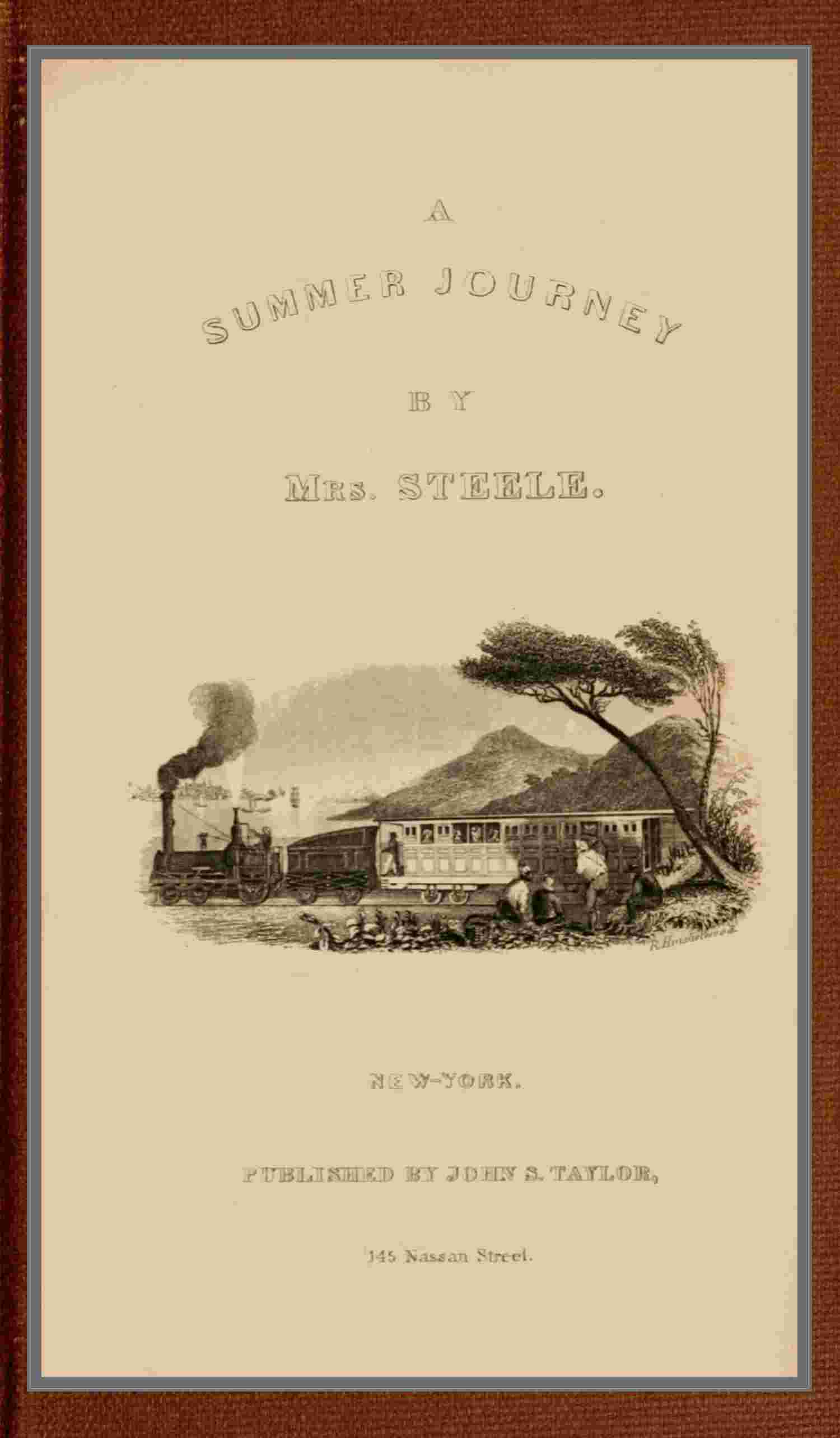
A
SUMMER JOURNEY
BY
Mrs. STEELE.
NEW-YORK.
PUBLISHED BY JOHN S. TAYLOR,
145 Nassau Street.
SUMMER JOURNEY IN THE WEST.
BY MRS. STEELE,
AUTHOR OF HEROINES OF SACRED HISTORY.
NEW YORK:
JOHN S. TAYLOR, AND CO.
(Brick Church Chapel, 145 Nassau-St.)
1841.
Entered according to the Act of Congress, in the year 1841, by
JOHN S.
TAYLOR & CO.
in the Clerk’s Office of the District Court for the
Southern District of New York.
PREFACE.
This little book assumes to be nothing more than a note book of all that passed before the observation of the author, during a summer tour of four thousand miles, through the great lakes; the prairies of Illinois; the rivers Illinois, Mississippi, and Ohio; and over the Alleghany mountains to New York. Since she has been ‘urged by friends to print,’ the author has added to her notes and letters, some little information regarding the western States, in hopes her book may be of use to future tourists and emigrants, who will here find an account of the distances, prices, and conveyances, throughout the author’s route. Anxious to guard against errors, information acquired upon the road, has been compared with the best Gazeteers. Accuracy, in a newly settled country, is difficult, and accounts differ much; still the author trusts the traveller who may honor her by taking her book for his guide, will not be far mis-led.
New York, May, 1841.
A SUMMER JOURNEY.
LETTER I.
June 14th, 1840.
My dear E.—The variety of scenes which have passed before my eyes since I last beheld you, and the crowd of new ideas acquired thereby, have not obliterated your Shaksperian adieu from my mind:
Some rare note-worthy object in thy travels,”
were your last words—in consequence of this desire, I hereby send you all I deem note-worthy. With what delight did I find myself once more upon the Hudson! Although so often seen, to me it is still lovely, for custom cannot stale its beauties. I pass along this river as through a gallery of cabinet pictures. The sunny vista and romantic glen of Gainsborough—the frowning cliff and murderous dell of Rosa—the Dutch cottage of Teniers—the Italian villa and graceful trees of classic Weir—cattle, as if just sprung from out a Berghman and grouped upon the shore, or standing ‘in the cool translucent wave,’ their ‘loose train of amber-dropping hair,’ not being ‘braided with lilies,’ but occupied in flapping the flies away!—all these, and many more are placed side by side before me as I float along.
You have never seen this famed stream, and I will therefore describe it to you minutely. Mine will not be ‘notes by the way,’ nor ‘crayoning,’ nor ‘pencil sketches,’ but perfect Daguerrotype likenesses of all I see.
With a bold rush our steamboat was free of the wharf and out into the stream. Ascend now to the upper deck with me and you will obtain a fine view of the city of New York and its noble bay. Upon one side lies the city with its mass of houses, churches, and vessels; beyond is Long Island. Observe what a pretty back ground is Staten Island: its numerous white buildings show well against the green elevated ridge behind them; then turn your eye to the opposite side and you will behold New Jersey, with its pretty city, and villages, and churches; and in the center of all this is the glassy water covered with steamboats, brigs, ships of war, and vessels of all sizes, and dotted with pretty fortress islets. Hoboken with its neat church and romantic colonade are passed, and the rugged cliffs of Weehawken rise upon our left as we ascend the river. These cliffs are the commencement of the Palisade rocks, which soon retreat into the interior to arise again above. Bull’s Ferry (worthy of a better name,) next appears, with Fort Lee, pretty rural retreats, whose white houses, churches, and fences, are pencilled as with white chalk upon the river’s green and sloping bank.
From the east side, turret and spire have passed away, and villages and country seats adorn the shores until we arrive at Spuyten Duyvel creek, rendered famous by the redoubtable Van Corlear, who swore he would pass it in spigt den Duyvel; and also as being the boundary line of Manhattan Island. To a hasty observer, the shores beyond this are as lonely and wild as if we were hundreds of miles from any city; but if you will fix your eyes steadily upon the woodlands which line the river banks, you will catch glimpses, between the trees, of Grecian portico, Yankee piazza, or Dutch gable, telling of many a summer haunt of the city’s ‘tired denizen.’
Upon the west side the Palisade commences, a perpendicular wall, or to speak more scientifically, ‘a columnar escarpement,’ from three to eight hundred feet high, and two miles broad, thus continuing for twenty miles along the New Jersey side of the river. As you dabble in geology, I must not forget to tell you these rocks are of the trap formation, passing into green stone. Under it are layers of slate, sandstone, and grey limestone, much of which is used in the city and its neighborhood. Sloops were lying at the foot of the rocks, as we passed, taking in their load of sandstone flagging, or roofing slate for the use of the citizens. These sloops, which carry masts sixty or seventy feet high, show the height of these cliffs, as when seen anchored below them they appear like skiffs. A few stone-cutters have erected cottages upon the rocks, which might be taken for children’s houses. Shrubbery is seen in some spots, while a green fringe of trees is waving from the summit. These rocks have stood the brunt of that mighty torrent which wise men tell us once rushed over the country from the north-west, as if some lake had burst its barrier—for bowlders washed from the Palisades are seen in various parts of Manhattan Island and Long Island. To the alluvium brought down by this flood, we are indebted for Manhattan Island and Staten Island. What a pity ‘wise saws’ are out of fashion, or I could lengthen my epistle by telling what ‘modern instances’ these islands are, of the ‘good’ brought down by ‘ill winds.’
As we are both now tired of these Palisades, it is very pretty of them to retire as they do, into the country, making a fine back ground to the rich land lying upon the river’s bank, adorned with several picturesque townlets. These are Nyack, reclining upon a verdant slope; Haverstraw, nestled under a high, green promontory; and Tappan, which ought to have been first mentioned. This is, however, but the ‘landing’ of the town of that name, lying a few miles in the interior, and whose ‘heavens’ ought to be ‘hung with black,’ for the sake of the talented and unfortunate Andre, whose silver cord was here untimely loosed.
The river swells out into a broad lake, called Tappan sea, which ought to be spelled Tap-pann Zee. The west side I have described, except that from these towns the ground rises into an elevated green ridge of Haverstraw, and then descends gracefully to the water, ending in a low level spot, covered with a rich velvet sward, dotted with groups of oaks, and evergreens, among which a silver rivulet winds its happy way. This is very prettily called Grassy Point.
Upon our right hand we have smooth, lawn-like slopes, over which the buildings of Yonkers, Tarrytown, and Dobbs’ Ferry (harmonious sounds,) are straggling, or reposing in graceful groups upon every gentle swell. Sing Sing, with its long range of prisons, is before us; so called, I suppose, that the inhabitants of those abodes may have something cheerful about them. It is a lovely spot commanding a beautiful view of the river scenery—so lovely that I am almost tempted to be wicked, that I may be ordered to reside there, and sit like a Naiad sing singing upon a
Sleeking her soft alluring lock.”
That is all very well, you will say, when the rock is already cut out for you to sit upon; but where one is obliged to hew out one’s own rock, as do these woful sing-singers, it would be as well to abandon the place to the heroes who there do congregate. They quarry a white granular limestone which is used as building material. The antique Dutch church looks very well, seated upon an eminence; and Wolfert’s Roost, with its Dutch points and gables, the residence of the celebrated Irving, is another interesting object upon this shore.
Look behind you quickly, if you would take a last farewell of Staten Island, whose dark outline has, until now, filled up the back ground, although we are thirty miles from it. As we turn towards the narrow outlet between Stoney and Verplanck’s Points, the Palisades are sweeping around to the east, and rapidly shoving in their side scene between us and the Island. Now it is gone, and the Narrows are fast being covered, through which you might, if your eyes could see so far, descry the green ocean and its gallant barks. The river now seems a lake behind us, upon whose bright bosom a fleet of vessels, like a flock of birds, are skimming, and ducking, or reposing upon the water. Two Points defend the entrance to the Highlands: Stony Point on the west, a bold rocky promontory, formed of fine horneblend granite rock, and surmounted by a light-house; Verplanck’s on the east presents a small village, containing a pretty fanciful hotel, and some lordly dwellings upon the elevated ground above. These are now behind us, and we find ourselves in the Grand Pass of the Highlands. Beautiful creations they are—high, green cones, sweeping gradually down to the water’s edge, where they sometimes appear a verdant precipice nearly two thousand feet high; or projecting their spurs into the river, and crossing each other so that the Hudson must wind hither and thither to follow the tortuous path between them. Various lights give new beauties to these hills. It is pleasant when the sun shines broad and bright upon them, to penetrate with your eye their green recesses, or endeavor to distinguish whether those bushes on the summit are indeed trees or no; and again when a cloud passes, running rapidly over the surface, the effect is very beautiful. As we were near the centre of the Pass, the sun was obscured, and a heavy shower clothed every thing with gloom.—Through the sombre light they seemed like giant mastadon or mammoth of olden times, couching down upon each side, musing upon the changes which have taken place upon this diluvial earth. The rain has ceased, and the mist has all retired into the mountain caves, save on one spot near the summit, where it lowering stands, like one of Ossian’s ghosts, whose wont it is, he tells us, to ‘fly on clouds, and ride on winds.’ Or, it may be the wandering spirit of some red warrior who has perished on these shores, and now haunts the scene of his former triumphs.
Upon a promontory jutting out from the river, are situated the Military Schools of West Point. It is a summer’s day well spent to ramble over that pretty spot. If you care not for the Schools, nor to see the orderly young cadets, you may admire the monument dedicated to Kosciusco, or walk in his garden as they call the spot where he used to ‘sit on rocks’ and muse upon the sweets of Liberty—or you may climb up to that ruined fortress crowning the summit of the mountain which overhangs the Point. From thence you have a fine view of all the rugged, cultivated, wild, adorned and varied country for miles around—and of that broad silver stream bearing upon its waters many a graceful vessel. The dusky peaks and dells, and undulations of the several mountains around are here distinctly seen.
The Dunderberg, where is the thunder’s home, raises its frowning head at the right, followed by Bare Mountain, Sugar Loaf, Bull’s Hill, Crow’s Nest, Butter Hill, Breakneck Hill, and many others bearing designations equally euphonius. Among these hills, beside West Point, are many spots famous in the history of our country. Do not be afraid, I am not going to begin ‘In the year 17—’ nor tell of the iron chain which bound Anthony by the nose to the Fort opposite; nor arouse your indignation by pointing to the chimneys of Arnold’s house; nor make you sad by speaking again of Andre; nor arouse your patriotism by relating the deeds here done in times of old. Let the past be by-gones; and turn to the present whose sun is shining down upon the pretty village of Cold Spring opposite to us, and upon that romantic white chapel dedicated to ‘Our Lady of Cold Spring,’ which is so tastefully perched upon a rock washed by the Hudson’s waters. At West Point is a depot of fossil enfusoria, and sulphur has also been found. Shooting out of the Highland Pass, we find ourselves in a broad expanse of water, presenting some of the prettiest views to be seen upon the river. Seated upon the elevations of the left bank are many towns; Newburgh being the most conspicuous as it is the largest: and it is built upon a high cliff of argillaceous slate, thus displaying its numerous houses and churches to advantage. The opposite shore presents a beautiful green mountain wall, the highest peak of which is 1689 feet above the river. At its foot reposes the smiling town of Fishkill.
I must not linger thus by the way. Remember I have four thousand miles to travel and the summer is passing. Imagine then to yourself a broad and beautiful river, skirted with cultivated country with often a mountainous back ground, and rich with ‘summer’s green emblazoned field’—and wafting upon its waters river-craft of all forms, from the lazy whaler returning after a four year’s cruise, to the little pleasure yacht. There are many towns on this river, one of which, Poughkeepsie, is rendered famous as being the place where Washington, Hamilton, Jay and Chancellor Livingston met, to compose the Constitution of the United States. The city of Hudson is agreeably situated upon the summit of a slaty cliff commanding a view of the Catskill mountains, and the town of Athens on the opposite bank of the river. Imagine, scattered like gems upon the borders of the stream, pretty villas of Grecian, Gothic and nondescript styles, the homes of the Livingstons, Dewitts, Ellisons, Verplancks, Van Renselears, Schuylers, and other gentlemen of taste and wealth. I saw nothing of those Dutch elves and fays which the genius of Irving has conjured up, among the dells and rocks of the Hudson—those creatures are unfortunately out of fashion; and one might as well look for them as for high heeled shoes. Perhaps they will come in with the ancient modes. If I thought so, I would immediately order hoop, train, cushion, buckle, high heel, and all the odious costume which rendered my ancestresses so hideous. Alas I fear the ‘mincing dryades’ with high crowned hats, are all departed—and no more—
Trip the pert fairies, and the dapper elves.”
Albany appears at great advantage seated upon a side hill, presenting a mass of imposing buildings surmounted by many a tall steeple, and crowned by the Capitol and City Hall, from whose gilded dome the evening sunbeams are brightly streaming.
I have said nothing about my gallant bark, nor my company—the first a large and rapid steamboat, arranged with satin cushioned and canopied saloons—the latter a mixture of all countries and sexes.
But we are at the wharf and I must put up my papers. Adieu.
LETTER II.
June 15th, 1840.
My dear E.—We shall of course remain in Albany during the Sabbath for the pleasure of worshipping that kind Friend, who has showered upon us the blessings we are now enjoying. In the morning we walked to the church of a Baptist clergyman, Mr. W——h, who has been long celebrated as a very interesting preacher. This church is a handsome marble structure, surmounted by a dome, and adorned by a colonade of pillars in front. The lecture room is below, and we ascended to the chapel, a neat apartment with a good pulpit and commodious seats. Mr. W. sprang from an obscure station, being a mechanic, and therefore could only obtain a common education. What he is, he has made himself, or rather was made by the Holy Spirit; for we all know how religion refines and elevates the intellect of man, as well as his affections. After his conversion he rapidly improved, and now one is astonished at the beauty and purity of his language. He is not an animated preacher, nor does his forte lie in arousing a sinner; but he shows forth the truth and beauty of religion, and expounds the Gospel doctrines with a power and grace, and clearness, which fascinate the hearer. This church is always crowded by the elite of Albanian society of all sects, and by the strangers who are in the city.
In the afternoon we attended service in an old Dutch church, one of the oldest in the city. It is built of brick, and boasts two spires which give it a singular appearance. The interior is richly fitted up, with gilded chandeliers and many comforts and elegant conveniences. Here we found ourselves surrounded by the old Dutch families, whose fathers emigrated from Holland and settled themselves here; among them were the family of the Patroon. I looked around with pleasure upon the sober benevolent faces of the congregation, for I have always felt a very kindly sentiment toward our Dutch brethren. The peaceful, even tenor of their lives; their contented spirit, their industry and integrity entitle them to our most ‘golden opinions.’ The Rev. Mr. Y——, who officiates here, is an able, solid, preacher, well versed in the fundamental truths of christianity.
I am happy to say, the people of this city, are a very moral and religious people. This applies also to the ‘first society’—which is a singularity in city history. Beneath their influence theatres, dissipation, and extravagance cannot thrive. Already I seem to breathe freer, although so little distant from New York; whose atmosphere, rank with foreign luxuries, is like a hot house over-crowded by fragrant exotics; stifling us with perfume.
We admire this city, which however we have only been able to see in our odds and ends of time. Its situation is very fine, it contains many handsome buildings, and it is generally kept very neat. A broad street through the centre leads up to a pretty square, surrounded by several imposing buildings—the Capitol occupies a fine position here; it is of dark stone, with a neat marble portico supported by four ionic columns. The City Hall on the opposite side of the square, is a noble edifice, built of white marble from the quarries of Sing Sing, surmounted by a gilded dome. The view from this dome is beautiful; embracing the city at your feet—green hilly country, dotted with country seats and towns, among which is the city of Troy—the noble Hudson, winding among this country and a back ground of mountains. The new State Hall is a pretty building—the Exchange, is a huge mass of granite, giving one a great idea of the extent of business which requires so large a structure for its merchants.
What a different place is this to the town which stood upon this two hundred years since. Then the only public building was a quaint old Dutch church, with painted glass windows; adorned with the coat of arms of those ancient worthies, who, clad in trunk hose and steeple crowned hats, sat demurely below. There are but few of the ancient Dutch houses left, and these are daily falling before the yankee spirit of improvement—which improvement by the bye sometimes merely amounts to alteration. At this city is the southern termination of the great Erie Canal.
LETTER III.
June 17th, 1840.
My dear E.—We arose at an early hour, and after looking into some of the public buildings we returned to breakfast, This dispatched, we drove to the rail road depot, an ugly building at the head of State Street where we alighted and stood in a large barn-like apartment, among men and trunks and boys—the latter screaming, Albany Argus’—‘Evening Journal!’—and among all sorts of confusion, until we were seated in the cars. Soon however, two fine horses, to whom I render my thanks, dragged us out of the barn into open day—up through the square, over the hill, to the Locomotive Depot, giving us on the way many sweet little back views of Albany and its pretty country and river, and the round tops of the Catskills in the blue distance beyond. The snort of a steampipe, and perfume of grease and smoke, announced the vicinity of our locomotive; and, as if to show off its paces, the engineer whirled the hideous thing back and forth before our—at least my—nil admirari eyes. Our horses were unhitched—the engine attached, and away we rushed, leaving our fine steeds gazing after us with tears in their eyes, to see themselves outdone by a great tea-kettle.
There are many pretty villas along the road; breathing places for the heated citizens below, which I would describe to you; but dashing along at sixteen miles an hour speed I can only catch a glimpse of white pillar and portico when the next minute we are three miles away. You must expect no description of the country when I am on a rail road, for the scenery is all blurred, like a bad lithograph. I only saw groups of pine trees rushing past and several bright dots which I suppose meant wild flowers when we came in sight of Schenectady, an antique dutch town. Before entering it I was struck by the vision of two immense tarred ropes walking deliberately beside our car, and discovered we were upon an inclined plain, descending which, cars of stone were brought up at the other end of our ropes. Our steam horse was once more exchanged for one of flesh and we set off upon a jog trot. Near the city we passed a canal basin in which lay several canal boats, for the Erie Canal passes through here. We entered the city, crossed the end of a long street filled with bright looking shops, where people and horses were frisking about in the morning air,—when another large depot received us in its barn-like expanse. The Ballston and Saratoga train entered at the other end, and you may imagine the charming confusion as the people of both trains jumped in and out the carriages, marched and counter marched until they had settled down into their several seats.
We were not suffered long to look upon this pleasant picture, for at 9 o’clock we were on our way to Utica. We could see but little of Schenectady while passing through it, but it looked well at a distance. Upon an eminence above the town stands Union College a fine building of grey stone.
Schenectady is an Indian name spelt by them Schan-naugh-ta-da; meaning ‘the Pine Plains,’ a fitting name, for the pine is universal here. This town has been the property of many different nations—the Mohawk, the French, the Dutch, and the English having each in succession ruled its destinies.
After leaving the town, we entered at once the glorious valley of the Mohawk which runs nearly westerly, and whose course we followed eighty miles to Utica. There may be lovelier vallies in the world, but certainly not another like this, for it is unique in its kind. Imagine a long green valley covered with rich farms—through its centre a bright transparent river, having a rail road on one bank and a canal on the other; while a range of hills frame in the picture on each side. So straight is this valley, that canal, river, and rail road run parallel, and within sight of each other nearly all the way.
It was one of June’s sweetest mornings when we passed the shores of the pretty Mohawk, and I was never weary of gazing down into its smiling face, as we glided along; or of watching the lazy canal boat dragging its rich freight at the foot of those soft green hills opposite; or, of peeping out the coach at the rugged cliffs, which reared their bare heads far above our road.
There are many little villages on this route, where we stopped to refresh ourselves, or to fill the engine. The first was Amsterdam a small Dutch settlement. Near this place stands a handsome stone edifice which is renowned in the annals of New York as the residence of Grey Johnson and his brother Sir William, the dreamer. At these towns there are hotels, and at other spots refreshment houses, built at the road side, where you are allowed a few minutes to rest. You are shown into large rooms set out with long narrow tables, bearing loads of coffee, oysters, cakes, pies, fruit lemonade, etc.,—you pile your plate with good things, stir around your coffee or tea, when tingle! goes the bell ‘all aboard!’ rings in your ears, and you have just time to put your 25 cents into the attendants hands and yourself in a car when puff! and away you go. Some of these towns are pretty, as St Johns, Fonda, Canajoharie, Herkimer, and many others.—What hungry people these travellers are! at every refreshment station the tables were crowded and at the signal they rushed into the cars each with a cake or pie, or apple, to finish at his leisure. We may say with Horace,
One would imagine he was speaking of our little Fonda, which is here pronounced as Horace spells it. It was named after the celebrated Col. Fonda.
Fort Plain is a pretty place on the other bank of the river; here I longed to ‘stay one turn’ to hammer a specimen from the encrinal lime-rock which is found there. The little falls of the Mohawk is a delightful place. The river here forces its way through a rocky country and falls over successive ledges of rock in pretty cascades. The beauty of the scene does not consist in altitude, but in number and variety of these saults; and the foaming river rushing over its rocky bottom or winding around its tiney islets, and in the towering cliffs around it. The village is seated upon each side of the river, connected by a handsome marble aqueduct leading to the canal basin, and by a neat bridge for carriages. The scene as we approached was very pretty. You see a frame work of rugged cliffs, enclosing a noisy rushing river with numerous cascades, its shores crowned with white buildings, and spanned by a noble bridge; the canal boat is seen creeping at the foot of the hills opposite, while the steeples, court house and hotels, are peeping from the trees which cover the sloping bank at our right. Perched upon every jutting point and grouped around the shores were many shanties occupied by the children of Erin who have kindly volunteered to make our rail roads and canals.
When the train stopped before the hotel, instead of the usual sound of ‘Newspapers,’ or ‘Nuts,’ or ‘Apples to sell,’ I heard young voices asking if we wanted some diamonds! Surprised, I looked out and beheld several little girls holding up small boxes containing Quartz Crystals. We of course became purchasers, and found among them some very perfect and pure. ‘Where do you find these?’ I asked. ‘Oh, all among the cliffs ma’am,’ she answered in the Hibernian tongue—‘and if its stop ye wud, I’d show ye to the diamond holes where I often dig up the ful of my pocket.’ We observed this was a large town, having several churches, dwellings, a handsome court house, and many large manufacturers. Geologists tell us this was one shore of that lake of which the highlands were the southern boundary. How it came to wear through these hills and run away to the sea no one can ever know. The rocks here are limestone, principally; but I observed there was with it some fine granite. There was an old man among our passengers, who had lived here ‘when all this was a wilderness.’ He amused us with some stories of past times; one of which I think interesting enough to tell you. Here it is to fill up the page.
During the War of Independence there were two brothers, who, although they were brothers, could not think alike; they joined opposite sides in the war. It happened while the Division under Gen. Herkimer was destitute of arms, ammunition and clothing, he heard of the approach of the English troops. Fight he could not; fly he would not; and he was seeking some stratagem to better his situation, when fortunately, for him, the English brother having strayed too near his camp was taken up as a spy. The brothers, who had been long separated met once more; but it was a bitter meeting, for one was a prisoner and condemned to die. In spite of their different sentiments they loved each other. The prisoner earnestly entreated his brother, who was the General’s Aid, to use all the influence in his power to save his life. The Aid was conscious he could not succeed unless he made the ‘worse appear the better reason;’ for his brother had been fairly captured as a spy, and in consequence of some bloody deeds of the enemy, his life was to be forfeited. With a heavy heart and darkened brow he entered the General’s tent.
‘I know what you would ask ere you speak’ said his commander. ‘I have expected you and have determined upon my course. You come to ask your brother’s life—it is your’s upon one condition.’ ‘Name it! I am not afraid to agree to any thing my General may propose!’ ‘I require you to go over to the enemy as a deserter—tell them exactly of our numbers; for I have learnt they do not imagine we are so strong; conceal the state of our arms and provisions; and if I am not much mistaken, they will immediately withdraw when they know how large is our force. You are then to find your way back again as you can. When you return your brother shall be free.’
For one moment the Aid hesitated. To appear as a deserter—to act the spy—to deceive even an enemy, was adverse to his open noble nature—there was also danger of discovery when returning, which would lead to disgrace and death.
‘Well young man! what is your determination?’ asked the General. ‘I will go, and trust in heaven and in you.’ He sought the enemy’s camp, was imprisoned as a spy—but his feigned tale procured his liberation. The enemy retreated before so large a force, which they could have conquered if they had known their distressed condition. It was many months ere the Aid rejoined his General. His brother was released, and after a parting full of sorrow they separated never to meet again.
We arrived at Utica at three o’clock, and repaired immediately to Baggs’s hotel. Here we found an excellent dinner, just ready, which to hungry travellers is a cheering sight. As I promised to put down our expenses, we pay $3,75 each, from Albany to Utica, eighty miles. We here concluded to leave the train, and spend a few days at the celebrated Trenton falls. After partaking a very nice dinner at Bagg’s hotel, we entered a neat carriage for Trenton falls, 14 miles north of Utica. The drive is a pretty one, and up hill all the way. We arrived at dark at a small inn in a forest, and were obliged to defer our visit to the cascade until the next morning.
After breakfast we walked out to visit the falls. Our way was through a deep forest breathing forth sweet fragrance in the early morning air. Suddenly, in the midst of the woods, we found ourselves upon the brink of a precipice, one side of a narrow chasm two hundred feet deep, while, too far below to be heard, a mountain torrent was rushing and foaming over the rock. A range of five ladder stairways led down the steep,—and as we thus hung over the water, we felt very much like some of Shakespear’s samphire gatherers, and thought what a ‘dreadful trade’ was hunting waterfalls. Safely down, we found a narrow ravine, so filled with the roaring torrent, that there was scarcely room for a pathway beside it. Part of the way a chain was inserted into the rock that we might, by holding upon it, pass the boiling whirlpool, if our nerves are strong enough to command our hands and feet—so scrambling, climbing, swinging, we contrived to reach the uppermost cascade, which is two miles from the last one. This stream, called the West Canada Creek, falls down a deep ravine over successive ledges of rock, in six small cascades of great beauty. The highest is only fifty feet high. The sides of the ravine are precipitous, and covered with the beautiful foliage of numerous trees. Among them are many evergreen trees—of these I remarked the stately white pine, which grows over one hundred feet high and perfectly straight; the red pine, with its dark green leaves, and yellow cones; the black spruce and the lofty birch. The rocks are slate and transition lime stone of the silurian series, abounding with petrifaction, of which many are perfect trilobites. Quartz crystals are also found here in great beauty and profusion. This place has been the scene of some tragic events—one of them most pitiable. A young girl sat out upon a pleasure tour, accompanied by her mother, father, and affianced husband. They came to this place, no warning spirit pressing them back, no drear omen warning them away, and no dream or presentment checking their steps. Gaily they descended the stairs, and clambered the rocks—the lover with the hand of his betrothed in his; the father and mother behind. Being thus led along, did not accord with her playful spirit, and telling him she could take care of herself, she in an evil moment withdrew her hand. His charge to be careful was answered by smiling asseverations of her sure-footedness; he turned with another admonition and she was gone! Where is she? He looks in every direction. She has hid herself in play; he calls; no answer but the torrents roar; she has rejoined her parents; he turns towards them and sees them quietly reposing together upon a rock. His pallid look—his wildness, as rooted to the spot, he gazes upon them, tells them the tale of woe, soon bitterly confirmed by her pretty bonnet of straw, which was at that moment whirled past their feet. Oh, the agony of those hearts as they stood beside that dark torrent, away from all help, and powerless to save their beloved one. The guide was despatched to the village for help, but not until three days after was she found a mile below; her tender form having been thus far carried over rocks and whirlpools.
Another family party came to view these scenes. A tender girl of eleven years was for security consigned to the valet’s arms. One false step plunged him into the torrent—he struggled to the shore, but the parent’s pretty fondling was lost to them in life. The body was the next day found.
As I stood upon the slippery rock, while these events were floating through my memory, their scenes pointed out to me by the guide; the place lost all its beauty, and the dashing torrent seemed some huge monster, seeking whom he might suck beneath his horrid depths. I grew nervous, and much to my companions surprise, begged him to return. He, rejoicing in the fresh country air, and released from the city’s dust, ran over the rocks with, to me, an alarming quickness, and I turned to depart. Why these beloved ones should be thus snatched away from their fond relatives; taken from their homes to find their death in this wild spot, is to us unknown. He who commanded this, has purposes, to us unscrutable; perhaps it was to read a lesson to those who hear the tale, to teach them the uncertain hold they have upon life, and all its pleasures, and to fear that power which can in an unlooked for moment, bear them from life to eternity. There are hundreds every season who stand upon this spot, and hear this story, and the heart which is not affected by it must be as the hearts of the petrified animals around them.
We spent several days here, riding and walking among the romantic scenery.
The village of Trenton Falls is a small one, containing a few shops, and cottages and two churches, one of which is quite pretty. The ride towards Utica is very beautiful. The ground descends on each side to the Mohawk valley, and while our road wound down this side, we had the whole slope of the other side before our eyes, covered with orchards and fields, and dotted with villages. The town of Clinton with Hamilton college, stands upon elevated ground, while, below, at the river’s brink is spread the city of Utica. Here we spent a day looking about its streets and shops. The ground slopes down to the river, near which are the business streets, while most of the dwelling houses are upon the more airy and elevated portion of the city. Genessee street is a fine wide avenue leading up the hill, lined upon each side with shops, hotels, churches, libraries, museums, &c. The canal is here crossed by a pretty bridge. The houses were substantially built, surrounded, many of them, by gardens, and appeared very comfortable residences. The business part of the city show rows of well built ware-houses, and were filled with people and carts passing to and fro, as if their trade was an active one and their city thriving. The Erie canal has brought much trade to this place, which now is one of the most flourishing inland towns in the State. The canal boats, stages, and rail trains which are constantly arriving and departing give a stirring appearance to the place. Religion, education, and literature, engage the attention of the inhabitants who support sixteen churches, and many seminaries and literary institutions. The population in 1835, was 10,183, to which now of course, several thousands must be added. It is situated in Oneida County, which was selected by the celebrated Baron Steuben as his retreat, and here he was buried.
June 21st.—We left Utica to-day in the three o’clock train for Auburn. About four miles from the city we passed a small town called Whitesborough, a pretty place, with two churches, an academy, and a building called the Oneida Institute. There is also here a manual labor school. A large unfinished building just outside of Utica, we learned was to be a lunatic asylum, calculated to accommodate one thousand patients—God pity them.
Several pretty towns lay upon our route: as Rome, Manlius, Canastola, etc. Sweet retreats from the confusion of a city without the solitude of the country. The canal and railroad which run through or near these towns present facilities for trade or travelling. Rome is a place of considerable importance, containing five churches, a court house, academy, several shops and dwellings. The population, five years since, amounted to 4,800. When arrived at Syracuse we drove up to a large good looking stone building bearing the name of Syracuse House. There we stopped to take tea. This place is sixty miles from Utica: enjoys considerable trade, but is still in its teens, having arisen since the canal passed through that part of the country. The Oswego canal joins the Erie here, which, with the salt works near, brings them much business. The population is 7,000. We observed in passing through it, several good churches, a pretty court house, substantial ware houses, numerous shops and dwellings, with a lyceum and high school, so that it would seem the inhabitants ought to be wealthy, refined, and well educated. The salt springs are at Salina, one mile and a half from Syracuse, where there are eighty manufactories of this material. These salt springs flow from beds of slate, in some places two hundred feet thick. Among the layers are masses of vermicular rock, whose interstices are supposed once to have been filled with salt. In this region of country are extensive gypsum beds; water lime is also found in profusion. Sandstone, generally old red, and lime-stones, are the prevailing formations of the county.
It was a beautiful evening when we left Syracuse. The sky, every where of a clear deep blue, paled gradually as it approached the west, where it was lost in a rich golden glow. The spires of the town behind us, reflected this brilliant hue, and the country as we passed, looked like one of Turner’s one colored pictures. Onondaga lake with the pretty village reposing upon its shore, and the rich fields around it, were all touched with this golden pencil. The fields were strewn with salt vats, where the salt was undergoing evaporation, which were covered with low sheds, probably taken off in the morning, as it was now late Saturday afternoon, and this might have been to protect them from the weather. It was quite dark when we reached Auburn. We left the cars at the railroad depot, and were provided with carriages to the American Hotel. Here, large commodious bed rooms, and luxurious mattresses, received your weary friends. I lingered a while to write you the events of the day, but must now hasten to bid you—adieu.
Sunday, June 22d.—This morning we visited the first presbyterian church, a large handsome edifice of brick. The pulpit was neat, and the seats and backs of the pews comfortably lined with horse hair. From Mr. Lathrop, the clergyman, we heard a very good discourse. The baptist and several other churches struck us as very neat and tasteful. The episcopal is in the gothic style, the interior lined with oak, and containing a handsome monument of Bishop Hobart, who died in this place. The hotels are showy handsome buildings, particularly the Auburn House, and the American, where we have taken up our quarters. This last is built of grey limestone from that neighborhood, and is surrounded by two rows of piazzas supported by handsome pillars. Opposite to it is the court house, quite a little palace in appearance. It is in the Parthenon form with a portico and high pillars, with the questionable addition of a large dome. From the cupola of an hotel, we obtained a charming view of this beautiful town and its environs. ‘A palace and a prison on each hand,’ I exclaimed as I glanced around, for behind was the grand court house, and in front arose the gloomy walls and towers of our famous State Prison. We saw from here the Theological Seminary, several handsome churches, hotels, elegant private dwellings, and streets of shops; while the outside of the circle presented a charming and varied range of fields, and hills, and groves and streams. It seemed indeed the loveliest village of the plain around, and I expressed my surprise at seeing so large and well built a town ‘so far off.’ My companion told me it was too near the commencement of our journey to be astonished yet, I had Rochester, and Buffalo, and Cincinnati to see. This town has a population of nearly 7,000, I do not know exactly, but refer you to the Gazetteers. Those of our friends whom we visited gave the place a fine character for good society, and told us they enjoyed all the conveniences and elegances of life, with good pastors and good books. In twenty-four hours any thing can reach them from New York. The prison presents an imposing appearance. It is built of dark stone with gothic ornaments, and consist of first, a high wall enclosing a large square, in the centre of which, rises a massive pile of building surmounted by a cupola. This building is arranged on three sides of a square, the centre 276, the other 242 feet long. In this are the eating rooms, hospital, chapel, and cells. The work shops are erected against the wall leaving a space for the keeper to walk around and gaze upon them through holes for the purpose, himself unseen. It is a dismal life these poor creatures lead, not only encarcerated from the world, but confined alone, and forbidden even to speak to a fellow prisoner when they meet at table or in the shops. They pass the life of La Trappe monks, except that it is against their will. At table they sit in rows with their faces one way, so that they cannot even see each other. However, this solitary and silent existence is said to be the best and most successful method of restraining and reforming the unhappy convict. In solitude they have time for reflection, and silence prevents corruption from their fellow criminals. They have religious instruction, which has converted several. I cannot but think it a very efficient arrangement. The guilty man is stopped in his mad career, and solitude, silence, and time for reflection, and religious counsel, are blessings placed in his path. In the mean while his bodily wants are attended to, he is supplied with nutritious food, well ventillated rooms, with nurses and physicians. He is obliged to work, and the fruits of his labor go to defray the prison expenses. We saw carriages, shoes, cabinet-ware, and various other articles made by them, offered for sale in the shops of the village.[1]
LETTER IV.
June 23d, 1840.
Dear E.—At ten o’clock, we entered the stage coach for Rochester, 70 miles distant. Among our passengers were two whom we had found extremely interesting, while journeying from Utica here—a clergyman of Massachusetts and his daughter. The Rev. N. T——r, was about seventy, but extremely active, and very cheerful. His conversation was instructive and agreeable and of course in a pious vein, for he had occupied the pulpit 47 years, as had his ancestors for 230 years back. There was such simplicity of heart about him, such piety, and kindness of manner, joined with elevated thought and deep learning that we lent a charmed ear to his discourse, during the whole day.
Our route lay through an exquisitely beautiful country, covered with cultivated farms and varied with pretty lakes and towns. The first lake we saw was Cayuga lake. It is from one to four miles broad, and thirty-eight long. It is a bright sheet of water, lying in a deep valley and from its surface its shores gently rise, covered with a fine farming country. We crossed the end of the lake over a bridge more than a mile long. So pure was the water that as we looked down upon it, we plainly beheld the trout swiming beneath.
Leaving the lake we passed through the pretty villages of Waterloo and Seneca Falls. Here the dark green Seneca river rushes foaming over a bed of rock, in a fall of forty seven feet. There are several mills and manufactories upon its borders, and we observed several churches, an academy, and many shops. Seneca! fair Seneca Lake, how can I describe the gentle beauties of thy varied shores, and of that pretty town which so adorns thy banks. This lake and its surrounding country, present a very lovely scene. There is nothing grand about the lakelet; you must not imagine it enclosed in the moutains of lakes George or Champlain; the style is petite and delicate. Its Indian name was Jensequa, which has been modernised into its present appellation. It is a placid, transparent sheet of water, of very great depth, 4 miles by 35 long, and is said never to be frozen over in the coldest winter. The road lay around the end of the lake, from whence the eye wound over its fair pellucid waters to its cultivated shores, adorned with handsome farm-houses, and country seats, and the massive buldings of the college which occupies a commanding elevation near the town—and the towers and steeples of the village peeping through the trees, as if to catch a glimpse of the waters below. We stopped at a small stage house in the lower and business end of the town, where we all descended from the stage while the operation of changing horses and stages was going on. A good sized parlor furnished with gay landscape paper received the female part of the passengers, while the restless mankind part, repaired to the shops, to inspect the manufactures of the town, or to refresh themselves at the soda-water, and ice-cream shops. Once more seated in our stage coach we ascended the hill, to the better portion of the town, where we passed through the principal avenue of the place, upon each side of which were arranged those pretty villas and gardens for which Geneva is so justly celebrated. There were several churches in view, and a new presbyterian half built. This, to us, was an interesting object, a token God was not forgotten by the busy people below, or the wealthy ones around us.
Canandaigua with its lake and street of villas received our commendations. There we dined at a very pretty and commodious Hotel, having a fine view of the lake from its windows. Some of the lake trout which appeared upon the table we found very fine. This lake is smaller than those we have passed being 14 miles long. The main street is nearly two miles long, and we drove through a mile of tasteful ‘garden-houses,’ surrounded by grounds laid out in a pleasing manner, adorned with flowers and fine shade trees. The country from thence to Rochester is very beautiful. Spotted with farms and villages, and woodlands covered with groves of maple, hickory, bass-wood, elm, and evergreen trees. It was nearly dark around us, when we were told the city was in view, and against the bright evening sky we beheld in the distance the towers and spires of Rochester. When we arrived we drove to the Rochester House. After some refreshment we bade our companions adieu; promising to meet at an early hour the next morning and drive over the town before we left it for Lockport—and then were glad to rest, for we had come a long day’s journey and in spite of good roads and commodious coaches, fine spirited horses, and good drivers, we were very much fatigued.
Well do the inspired writers compare man and his brief existence to a flower that early withereth—to a shadow—a cloud that quickly vanisheth—one day here, and the next gone. Truly saith Job, ‘thine eyes are upon me and and I am not,’ a just figure of man’s fleeting life. Never have I found the truth of these comparisons more striking than at the present moment. I told you of the amiable intellectual clergyman, who with his daughter agreed to meet us early this morning—when that morning came he was in eternity! At two o’clock last night we were aroused by a messenger from Miss T. saying her father was very ill. We followed the servant through the dark and lonely halls into the chamber where ‘the good man met his fate.’ Yes, all was over. Around the room in attitudes of mournful musing sat the keeper of the Hotel, some servants, and several ladies who had arisen to do all in their power to soothe the sufferer’s pains. All had been done that was possible, but in vain. Upon the bed, lay a silent corpse, whose countenance bespoke a death of agony—it was all that now remained of that good and kind old man, that tender father, whose refined manners and intellectual conversation, had charmed us so much the day before. But his high intellect, his talents, his agreeable converse, of what avail were they all to him now, had they not been joined to deep heart-felt piety, and been devoted to the interests of religion. He had died far from his home, with no friends near him except his daughter—his last hour passed away in a hotel among strangers—yet spare your sympathy, for he died happy. The everlasting arms were supporting him, a tender father was waiting to receive him in those heavenly mansions where death and sorrow can never come. He was going to no unknown region, he was to meet no stranger face, for his mind and his heart had ever been familiar with that celestial home, now to be his eternally—he knew a welcome awaited him from that Savior and that God, with whose spirit he had ever held communion through a long life spent in devotion and in acts of beneficence. It was the wish of the celebrated Archbishop Leighton that he might die at an inn, thus to be more forcibly reminded he was a pilgrim upon the earth—his wish was fulfilled, for he died at the Bell Inn, London.
With what terms of praise high enough shall I speak of the people of Rochester. When the news of this sad event spread, they surrounded the bereaved daughter with sympathizing hearts, and offers of service. The persons belonging to the house, and the boarders, with many physicians and clergymen with ther families, were anxious to cheer the heart of the sad survivor, and to lighten her mournful duties. The services of the Episcopal church were read over the body by the Rev. Mr. W. a young English clegyman of great talent and piety. The persons assembled near, seemed much affected with this solemn event. May God bless this sudden providence to them and to us. Uniting in a procession we accompanied the corpse to the canal boat, where bidding adieu to Miss T. we left her to pursue her dreary journey of five hundred miles, accompanied only with hired attendants. With what comfort did we see in her the power of religion elevating the soul above the trials and sorrows of life. Nothing else could have supported this bereaved daughter through so heart-rending a dispensation. But she knew in whom she believed. She saw from whom the blow came, and her faith told her it was done in mercy. As we were to leave Rochester the next morning, some of our kind friends called that afternoon and insisted upon driving us through the town. It being our only chance of seeing this celebrated city, we accepted their kindness, although the scenes of the morning had unfitted us for anything but retirement.
As we drove along we were astonished at the extent and beauty of this city. It was you know founded in 1812, and now contains 22,000 inhabitants. We had heard of its rapid rise, but supposed it must consist mostly of wooden buildings as is often the case in new settlements, and our surprise was the greater to find it built in the most solid manner. Churches, houses, hotels and banks, court house and arcade, markets were all of marble or stone. There are here fourteen churches[2] some of them quite handsome. The Episcopal Church of St. Paul’s, is a fine gothic edifice of grey stone—the church which enjoys the ministration of the Rev. Mr. W. mentioned above, is also handsome, of gothic form, neatly edged with brown free stone—the presbyterian is of grey plaster supported by substantial abutments—the baptist, where Mr. C. officiates, one of our active friends of the morning; a neat brick edifice—also catholic, methodist and bethel for the canal men. The streets are many of them McAdamized. There is a fine park here surrounded by neat railings where the children of the neighborhood are brought to take exercise. But what most elicited our admiration were the private dwellings, which in number and beauty are seldom equalled in our cities. They are spacious, built of marble or stone, in gothic or grecian form surrounded by wings and piazzas, and out-buildings and grounds handsomely laid out, adorned with shade trees, shrubbery and flowers. They are delightful retreats from the city’s dust and noise; make fine playgrounds for the children, and altogether evince much taste and wealth. How much better is it for men of fortune, to secure for themselves and families, pure air and room for exercise, instead of squeezing, as they do in our city, into houses only 30 by 100 feet, as is too much the custom in our cities. The wealth lavished upon gay entertainments would procure space where their children might gain health and strength. A frolic upon the green sward is much more conducive to health, than a sober city walk beside a nurse. I often see these palid pitiable little creatures in our streets walking as gravely and demurely as some old octogenarian. A child without gaiety is as cheerless as a landscape without sun.
The Genesee river divides the city into two parts, and is crossed by three bridges and the two aqueducts of the Erie canal. The oldest of these is a very fine piece of hewn stone work 804 feet long supported by eleven raches. They were building another aqueduct, which is 858 feet long and 28 in height[3], and the music of the rushing river was almost drowned by the mason’s hammer.
Beside this canal there is another called the Genesee valley canal from Rochester to Olean, 119 miles. The Genesee falls are very pretty, consisting of rapids through the city, and in the suburbs it plunges over a circular rock into a deep dell. The whole fall through the city is 268 feet; 97 at the cascade. There is another cataract farther down the river, which falls 106 feet. This is at Carthage, two miles below, and here is the port at which the lake steamboats stop. A rail road runs to this place. There was not much water in the river, and we did not see the falls in their greatest perfection, but still there was great beauty in the feathery foam which fell in snowy masses over the dark rock. These cliffs are old red stone and limestones—with feruginous sand rock, and argillaceous iron ore; supposed by geologists to be equivalent to the Caradoc series. Upon the summit of the cliff opposite to us was a range of solid stone mills, from whence we obtain that fine Genessee flour, ground from the wheat in the fertile region around. Five hundred thousand barrels of flour are turned out in a year. There are twenty-two of these mills. The little streams which trickle down the rocks, are stolen from the river to turn the wheels. Our kind friends were anxious to drive us to Mount Hope, a celebrated cemetery a few miles from the city, but time was wanting for this and many other proposed pleasures. A distant view of Lake Ontario is said to be obtained from this hill. We returned home through some of the business streets, which, particularly Maine and Buffalo, were filled with busy people, waggons of home or foreign produce, while the long ranges of shops were gay with dry goods hanging from the doors, and piled with every comfort and luxury. Stages were landing or taking up passengers, canal boats were arriving and departing and every thing we saw denoted a striving and thriving population.
LETTER V.
June 25th, 1840.
Dear E.—We left Rochester this morning at eight o’clock, in a fine stage and four horses, for Lockport, 64 miles distant, for which we were to pay two dollars and fifty cents each, dinner on the road, included. It was with much regret that we parted from this interesting city, for, although we had been there but a short time, we had seen enough to be able to appreciate its beauties, and the sterling qualities of its beneficent and refined inhabitants. We passed through several pretty villages, and observed with pleasure the farm houses and even the meanest cabins were decorated with roses, geraniums, honey-suckles and other flowers; a pleasing custom which I wish was more followed among us. In one of the villages, I think its name was Greece, I observed a neat grave yard enclosed in a handsome stone fence and iron railing, where ‘the rude forefathers of the hamlet sleep,’ while around the tombs the kind hand of surviving friends had planted roses and drooping willows. A great part of our way lay over the famous ridge road, an elevation of ground about as wide as a common road formed of sand and shells, and which is supposed once to have been the shore of Lake Ontario, now about ten miles distant. The ground has very much this appearance as the land between us and the lake is much lower, and level, with marshy spots. It is in some places covered with a dense forest. There is one thing however, which struck me as singular, the land declines the other side of the road also, in some places leaving a narrow ridge to ride upon, which is not the ordinary form of a lake shore. Why may it not have been a public road, formed by that indefatigable race of diggers, the mound builders, as a thoroughfare between two of their cities. It might still have been the border of the lake, but swampy and marshy ground. If we are to believe Mr. Delafield[4] these people were the descendants of the builders of Babel, and when dispersed by the confusion of tongues wandered about the world and at last found themselves in America. Here they have thrown up pyramidial mounds in imitation of their ruined tower on the plains of Shinar. The Arabs have a tradition that Nimrod, disappointed in his purpose of reaching heaven by building a tower, constructed a chariot, to which he placed a pair of wings, and thus hoped to enter the celestial regions. Alas! since the days of Nimrod how many like him, have sought to attain the courts above, by their own strenuous exertions.
Dear me, how I have wandered from the ridge road. The celebrated traveller, McKenney, believes this to have been the border of the lake, which broke away and ran over the State of New York, thus scooping out the earth at the other side of the ridge. The lakes Geneva, Canandaigua, Cayuga, etc., he believes to have been left by this flood. This agrees with Dr. Mitchell’s theory of a vast lake having been once in this part of the state, which burst through its southern shore at the Little Falls of the Mohawk, and through the Highlands, flooding the coasts of New York with alluvion. De Witt Clinton also, in his Canal report, remarks: ‘The general position of the Little Falls, indicate the former existence of a great lake above connected with the Oneida lake; as the waters forced a passage here and receded, the flats were formed above, composed of several acres of alluvion.’ In this alluvion trees are often found twelve feet under ground. Darby observed marks upon the rocks at Little Falls fifty feet above the river, showing the water had once stood so high.
At a distance we saw Brockport upon the canal, and soon after, at Gainesville, we dined. We reached Lockport at five o’clock in the afternoon and were shown into a neat comfortable hotel where we awaited the time of starting in the cars. Lockport is a town of the mushroom order, having arisen around the locks of the canal within a few years. The churches, houses, and hotels, looked very respectable, and the rail-roads and canals gave it quite a stirring appearance. The locks at the canal here are a great curiosity. There are five double combined locks which carry the canal over the ridge. There is also a deep cutting through the solid rock for some miles which is very interesting. Many specimens of minerals have been discovered here, as carbonate of lime, selenite, dogtooth spar, petrifactions, etc. I promised to give you an account of all our expenses, so I will mention now, we are to pay ninety-four cents each to Niagara, twenty miles, as I shall not think of such mundane affairs while there. Our expenses at the hotels have been two dollars a day each, and meals fifty cents each at all our stopping places. Seated in the rail car we were soon on our road, and fast dashing through a tolerably cultivated country, with several neat mansions peeping through the trees. I trembled lest the land should remain thus until we arrived at Niagara, for I could not bear to approach it through petty villages and farms, but we soon left all cultivation behind and found ourselves in a deep forest. While gliding rapidly along, the engineer’s bell rang to scare some cow or other animal, as we thought, from the rail track. Several of the passengers looked out, one pronouncing it a man, another a cow, until, as we approached, we discovered it was an Indian female. She was enveloped in a dark mantle from beneath which could be seen her scarlet leggins richly embroidered with beads. With a slow and stately step she paced the rail-track, the engineer’s bell and shrill whistle unheeded. That she heard them was evident, for another Indian woman, her companion, who walked outside the rail, stretched forth her hand as if in earnest appeal, but the haughty young princess scorned to fly before her country’s foe. The engine with slackened speed came near her and stopped; then, and not until it had quite stopped, she condescended to walk off the rail-way. As we passed I saw she was young and pretty, and her dark eye flashed with a triumphant expression which said, ‘You dared not drive over me! I scorned to be forced from the road by your bell, like an animal!’
‘Look out for the Falls! Prepare for Niagara!’ is the cry of all in the coach. My heart began to beat—does not yours? Do be a little romantic, and feel some emotion, while about to behold one of Nature’s greatest wonders. I looked out; we were on the river’s bank, a high precipice of about two hundred feet Far below rushed the river, of a green copper hue, or verdigris; far up through the defile I caught a view of a mountain of mist, but I resolutely turned away, for such snatches of views I have been told to avoid, as bringing disappointment with them. The road swerved from the river, and in a few minutes we found ourselves in the midst of the little village of Niagara. When the train stopped we were surrounded by a host of porters, struggling to secure us for their several favorite hotels. We chose the Cataract house, from a friend’s recommendation, and from its appropriate name. We had no cause to repent our decision as its accommodation and attendance were every thing we could wish. We were shown into a neat chamber, which to my delight looked out upon the rushing rapids. The tea bell rang as we entered, and much to the annoyance of my impatient spirit, my companion made it plain to me I should refresh myself before visiting the Falls. Tea over, I had leave to go, and we were soon upon the pathway. Shall I take you at once into the presence chamber of the divinity, or shall I describe the halls and corridors as I pass through them to her throne? I think a minute description will best please you. Niagara river, just before it reaches the fall is divided into two parts; one rushing past the Canada shore, plunges over the rocks making the crescent, or horse-shoe fall—this fall is about one hundred and sixty feet high. The other half of the river passes around an island, called Goat, or Iris island, and falls from the American side. This island has been sacred from the foot of man until a few years since, when a bridge was thrown across the rapids with much dexterity and daring. Upon this bridge we will walk if you please, stopping one moment to view the rapids. These constitute a very beautiful feature of the scene, and, were it not for the falls, would be well worth a visit on their own account. The river is a mile wide, and comes rushing and foaming over rocks some ten or twelve feet high, looking, sea-faring men tell us, very much like breakers, or a sea in a storm—the green waves heightening the illusion. One is glad to be safely over this tumultuous water, especially as the former bridge has been carried away. From the bridge you land upon Bath island, containing about two acres of land, upon which is erected a toll-house, and shop for the sale of Indian curiosities and canes. There are also bathing houses here. A short bridge brings us to Goat Island, one-half a mile long and a quarter wide. It is also called Iris, and as such I shall designate it. The increased roar, the mist rising above the trees, urge you on, and you pass the ‘curiosity shop’ and refreshments here offered, and hasten on through many a winding forest path, until you gain the opposite side of the island, where you find yourself upon the brink of a deep gulf into which an ocean broken loose from its bounds is precipitated with astounding noise and violence!.... This is the crescent fall on the Canadian shore. But linger not here. Descend the island to the brink of the river, and cross the rapids over a tottering, frail bridge, to the tower, which stands upon the precipice at the edge of the falls. Ascend to the top, and lean over the railing, look calmly down if you can, into the fathomless abyss of ocean, where the waves are dashing; the foam whirling, and the winds rushing, amid the roar of a thousand thunders eternally ascending. Deafened, confounded, bewildered, you retreat in haste, fearful every moment the breakers which are dashing against the tower, will tear it away from its foundation, and plunge you into the fearful ocean depths below. At this place, and upon table rock opposite, you see Niagara in all its power and terror. But if you would behold it in all its ravishing beauty, you must go as we did, the next morning before sunrise, and view it from the ferry house. To reach this spot, you do not cross to Iris island, but follow the river bank to the American fall, near which is the ferryman’s cottage, and at a little distance the ladder which leads you down to the boat. Seated upon a rock, in front of the cottage, we feasted our eyes with unearthly beauty. Beside you is the American fall, tinged with a delicate apple or beryl green hue. One delights to follow with the eye this fair translucent arch, as it plunges far down into the water nearly two hundred feet below us. You have but a sideling view of this fall here. Looking past it you see the dark foliage of Iris island, and beyond, the Canadian fall. This immense mass of water falls over rocks in the form of a crescent, and is tinted with an elysian loveliness which you have never beheld, and never can conceive, let me write pages upon it. Earth has never produced water of the like hue: something of the emerald, but more rich, more vivid. This green, spotted, and embroidered as it is, with wreaths of snow white foam, presents the most charming and unique effect imaginable. In some places the water pitches over perfectly smooth, as if an emerald arch; and so pellucid, that you may distinctly see through it the white foam that is churned from the rocks over which it flows. As we reached the spot from whence this is seen, the sun arose above the trees, and immediately two glorious rainbows spanned the river from shore to shore! and the mist which was rising high in the air, took the tint of the rose, which faded, only to be replaced by the most gorgeous prismatic hues. Never had imagination pictured any thing so glorious as that scene: a tremendous fall of green and white water; a gay colored rainbow; rosy mist; azure sky, and shores of various shades. It was a creation which belonged not to earth. It seemed as if the celestial city was before us, with its gates and walls of sapphire, of emerald, of ruby, and of gold. The waters of life that flow through the city of God, seemed rushing past us, for the scene was altogether unearthly, and our feelings were elevated to that sublime architect, who could create such surpassing beauty. Earth and its cares, home and its joys are all forgotten, and we feel as if we could ever recline before the throne of that mysterious presence, and watch untiring those clouds of incense which are rising before it forever. When we left the scene, we trod in solemn silence, as if on holy ground. The violence with which the water pours over the rocks has worn them away, and the river has broken its way up from Lake Ontario at the rate of a rood in three years. It is supposed, when first discovered, to have been near the Clifton House on the Canadian shore, and the ferry house at the American.