
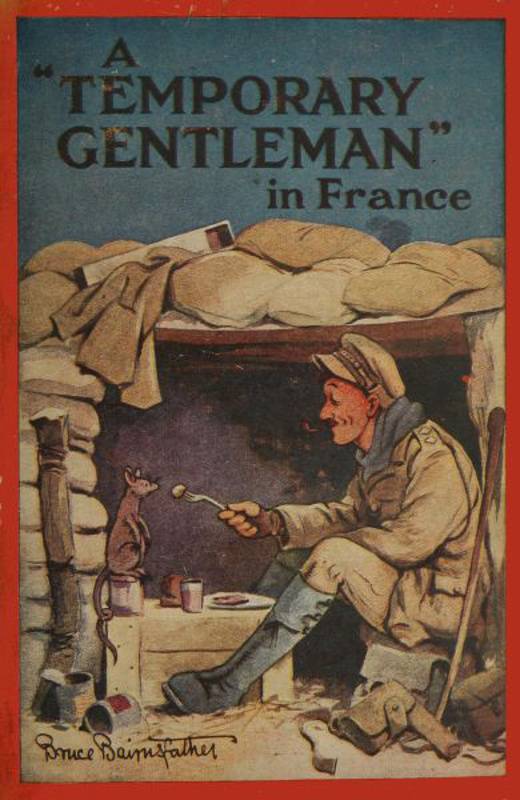
In the case of the Service Battalion officer of Britain's New Army who, with humorous modesty, signs himself "Your 'Temporary Gentleman,'" what is there behind that enigmatic signature that his letters do not tell us? The first of these homely epistles shows their writer arriving with his Battalion in France; and the visit is evidently his first to that fair land, since he writes: "I wonder if I should ever have seen it had there been no war!" That exclamation tells a good deal.
But of the man and his antecedents prior to that moment of landing with his unit in France, the letters tell us nothing; and if it be true that the war has meant being "born again" for very many Englishmen, that frequently quoted statement at all events points to the enjoyment of some definite status before the war.
Inquiry in this particular case speedily brings home to one the fact that one is investigating the antecedents of a well-recognised New Army type, a thoroughly representative type, as well as those of an individual. In his antecedents, as in the revolutionary development which the war has brought to him, this "Temporary Gentleman" is clearly one among very many thousands who have, so to say, passed through the same crucibles, been submitted to the same standard tests, and emerged in the trenches of France and Flanders, in Gallipoli and in Mesopotamia, in Africa, and in other places in which the common enemy has endeavoured to uphold his proposed substitution of Kultur for civilisation, as we understand it.
In the year 1896 there died, in a south-western suburb of London, a builder and contractor in a small, suburban way of business. An industrious, striving, kindly, and honourable man, he had had a number of different irons in the fire, as the saying goes, and some of them, it may be, would have provided a good reward for his industry if he had lived. As the event proved, however, the winding-up of his affairs produced for his widow a sum representing no more than maintenance upon a very modest scale of a period of perhaps three years. The widow was not alone in the world. She had a little daughter, aged five, and a sturdy son, aged eight years. Nineteen years later that boy, into whose youth and early training not even the mention of anything military ever crept, was writing letters home from fire trenches in France, and signing them "Your 'Temporary Gentleman.'"
For seven years after his father's death the boy attended a day school in Brixton. The tuition he there received was probably inferior in many ways to that which would have fallen to his lot in one of the big establishments presided over by the County Council. But his mother's severely straitened circumstances had rather strengthened than lowered her natural pride; and she preferred to enlarge the sphere of her necessary sacrifices, and by the practice of the extremest thrift and industry to provide for the teaching of her two children at private schools. The life of the fatherless little family was necessarily a narrow one; its horizon was severely restricted, but its respectability was unimpeachable; and within the close-set walls of the little Brixton home there never was seen any trace of baseness, of coarseness, or of what is called vulgarity. The boy grew up in an atmosphere of reticence and modesty, in which the dominant factors were thrift, duty, conscientiousness, and deep-rooted family affection.
The first epoch of his fatherless life closed when our "Temporary Gentleman" left school, at the age of fifteen, and mounted a stool in the office of a local auctioneer and estate agent, who, in the previous decade, had had satisfactory business dealings with the youth's father. This notable event introduced some change into the quiet little mother-ruled ménage; for, in a sense, it had to be recognised that, with the bringing home of his first week's pay, the boy threatened to become a man. The patient mother was at once proud and a little disconcerted. But, upon the whole, pride ruled. The boy's mannishness, brought up as he had been, did not take on any very disconcerting shapes, though the first cigarette he produced in the house, not very long after the conclusion of the South African War, did prove something of a disturbing element just at first.
The South African War affected this little household, perhaps, as much as it would have been affected by a disastrous famine in China. It came before the period at which the son of the house started bringing home an evening newspaper, and while the only periodicals to enter the home were still The Boy's Own Paper and a weekly journal concerned with dressmaking and patterns. As a topic of conversation it was not mentioned half a dozen times in that household from first to last.
The next really great event in the life of the auctioneer's clerk was his purchase of a bicycle, which, whilst catastrophic in its effect upon his Post Office Savings Bank account, was in other respects a source of great happiness to him. And if it meant something of a wrench to his mother, as a thing calculated to remove her boy a little farther beyond the narrow confines of the sphere of her exclusive domination, she never allowed a hint of this to appear. Her son's admirable physique had long been a source of considerable pride to her; and she had wisely encouraged his assiduity in the Polytechnic gymnasium of which he was a valued supporter.
For the youth himself, his bicycle gave him the key of a new world, whilst robbing the cricket and football clubs to which he belonged of a distinctly useful member. He became an amateur of rural topography, learned in all the highways and by-ways of the southern Home Counties. His radius may not have exceeded fifty miles, but yet his bicycle interpreted England to him in a new light, as something infinitely greater and more beautiful than Brixton.
Quietly, evenly, the years slid by. The boy became a youth and the youth a man; and, in a modest way, the man prospered, becoming the most important person, next to its proprietor, in the estate agent's business. The mother's life became easier, and the sister (who had become a school-teacher) owed many little comforts and pleasures to the consistent kindliness of one who now was admittedly the head of the little household and its chief provider. He never gave a thought to the State or felt the smallest kind of interest in politics; yet his life was in no way self-centred or selfish, but, on the contrary, one in which the chief motive was the service of those nearest and dearest to him. Whilst rarely looking inward, his outward vision was bounded by the horizon of his well-ordered little home, of the Home Counties he had learned to love, and of the south-coast seaside village in which the family spent a happy fortnight every summer.
They were in that little seaside village when the Huns decreed war and desolation for Europe in August, 1914, and the three were a good deal upset about the whole business, for it interfered with the railway service, and broke in very unpleasantly upon the holiday atmosphere, which, coming as it did for but one fortnight in each year, was exceedingly precious to the little family. However, with the Englishman's instinct for clinging to the established order, with all the national hatred of disturbance, they clung as far as possible to the measured pleasantness of their holiday routine, and, after a week, returned to the workaday round of life in Brixton.
Then began a time of peculiar stress and anxiety for the little household, the dominating factor in which was the growing strangeness, as it seemed to them, of its actual head and ruler; of the man in the house. At first he talked a great deal of the war, the overpowering news of the day, and he passed many scathing criticisms upon the conduct of the authorities in their handling of the first stages of the monstrous work of preparation. He had much to say of their blunders and oversights; and somewhat, too, of what he called their criminal unpreparedness. He stopped talking rather abruptly at breakfast one morning; and one of the headlines which subsequently caught the eyes of his sister, in the newspaper her brother had propped against the coffee-pot, put this inquiry, in bold black type:
"WHOSE FAULT IS IT, MR. CITIZEN, THAT THE COUNTRY IS UTTERLY UNPREPARED FOR WAR?"
Those nightmarish early days of the great war slowly succeeded one another, and the mother and daughter grew perturbed over the change they saw creeping over their man. He talked hardly at all now. All the old cheery, kindly good humour which had provided half the sunshine of their lives seemed to be disappearing and giving place to a queer, nervous, morose sort of depression. It was as if their man lived a double life. Clearly he was much affected, even absorbed, by some mental process which he never so much as mentioned to them. Morning and evening they saw him, and yet it was as though he was not there, as though he lived and had his being in some other world, aloof from the old cosy, familiar, shared world in which they had always been together. The house-wifely eye of his mother noted with something like alarm that his bedroom candlestick required a fresh candle every day. One had been wont to serve him for a fortnight. Always, she thought he would unburden himself when he kissed her good-night. But he said never a word; and the nerve strain in the little household, which had been so quietly happy and bright, became almost unendurable.
Then the end came, with the beginning of the third week in September. The evening was extraordinarily peaceful and fine. The sister and a girl friend were at the little cottage piano. The visitor had a rather rich contralto voice, and sang with considerable feeling. In the middle of her third song the master of the house rose abruptly and walked out of the room, closing the door sharply behind him. The song was one of those called a "recruiting song." Late that night, when the visitor had departed, the brother apologised to his mother and sister for leaving them so abruptly, and spoke of a sudden headache. And the next evening he brought home the devastating news that he had enlisted, and would be leaving them next day for a military depot.
The news was received in dead silence. In some mysterious way neither of the women had contemplated this as possible. For others, yes. For their man—the thing was too wildly, remotely strange to be possible. There was his business; and, besides—It was merely impossible. And now he was an enlisted soldier, he told them. But, though they hardly suspected it, not being given to the practice of introspection, their man was not the only member of the little household in whom a fundamental and revolutionary change had been wrought by the world-shaking news of the past six weeks. In the end the women kissed their man, and the central fact of his astounding intelligence was not discussed at all. They proceeded direct to practical, material arrangements. But when the time came for her good-night kiss, the mother said, very quietly, "God bless you, dear!"; and the sister smiled and showed a new pride through the wet gleam of her eyes.
And then the auctioneer's clerk disappeared from the peaceful purlieus of Brixton and went out alone into an entirely new world, the like of which had never presented itself to his fancy, even in dreams. He became one of fifteen men whose home was a bell tent designed to give easy shelter to perhaps half that number. He began to spend his days in a routine of drill which, even to him with his gymnasium training, seemed most singularly tiresome and meaningless—at first.
At the end of four weeks he returned home for a Saturday night and Sunday in the Brixton house; and he wore one stripe on the sleeve of his service jacket. To his intelligence there now was nothing in the whole intricate round of section, platoon, and company drill which was meaningless, however wearing it might sometimes seem. There was a tan on his cheeks, a clear brightness in his eyes, an alert swing in his carriage, and a surprisingly crisp ring in his voice which at once bewildered and delighted his womenfolk. He seemed not so much a new man as the man whom they had always loved and respected, in some subtle way magnified, developed, tuned up, brought to concert pitch.
In November he was advised by his Company Commander to apply for a Commission. The officer badly wanted him for a Sergeant, but this officer had long since learned to place duty first and inclination a long way behind; and it was apparent to him that in this tall, alert Lance-Corporal of his, as in so many hundreds of other men in the ranks, there was the making of a good officer.
Shortly before Christmas, 1914, he was gazetted a Second Lieutenant, and on New Year's Day he found himself walking across a parade ground to take his place in front of the platoon he subsequently led in France, after long months of arduous training in several different English camps.
Three-quarters of a year passed between the day of this "Temporary Gentleman's" enlistment and his writing of the first of the letters now published over his pseudonym; and it may well be that all the previous years of his life put together produced no greater modification and development in the man than came to him in those nine months of training for the New Army. The training had its bookish side, for he was very thorough; but it was in the open air from dawn till dark, and ninety per cent. of it came to him in the process of training others.
The keynotes of the training were noblesse oblige, sportsmanship and responsibility, that form of "playing the game" which is at the root of the discipline of the British Army. While he taught the men of his platoon they taught him, in every hour of the day and many hours of the night. They learned to call him "A pretty good sort," which is very high praise indeed. And he learned to be as jealous of his men as any mother can be of her children. He learned to know them, in fair weather and in foul, for the splendid fellows they are; and in the intensely proud depths of his own inner consciousness to regard them as the finest platoon in the New Army.
And then came the longed-for day of the departure for France, for the land he was to learn to love, despite all the horrors of its long fighting line, just as he learned most affectionately to admire the men and reverence the women of brave, beautiful France. In the letters that he wrote from France he had, of course, no faintest thought of the ultimate test of publication. That is one reason why his name is not now attached to documents so intimate, even apart from the sufficiently obvious military reasons.
A. J. D.