
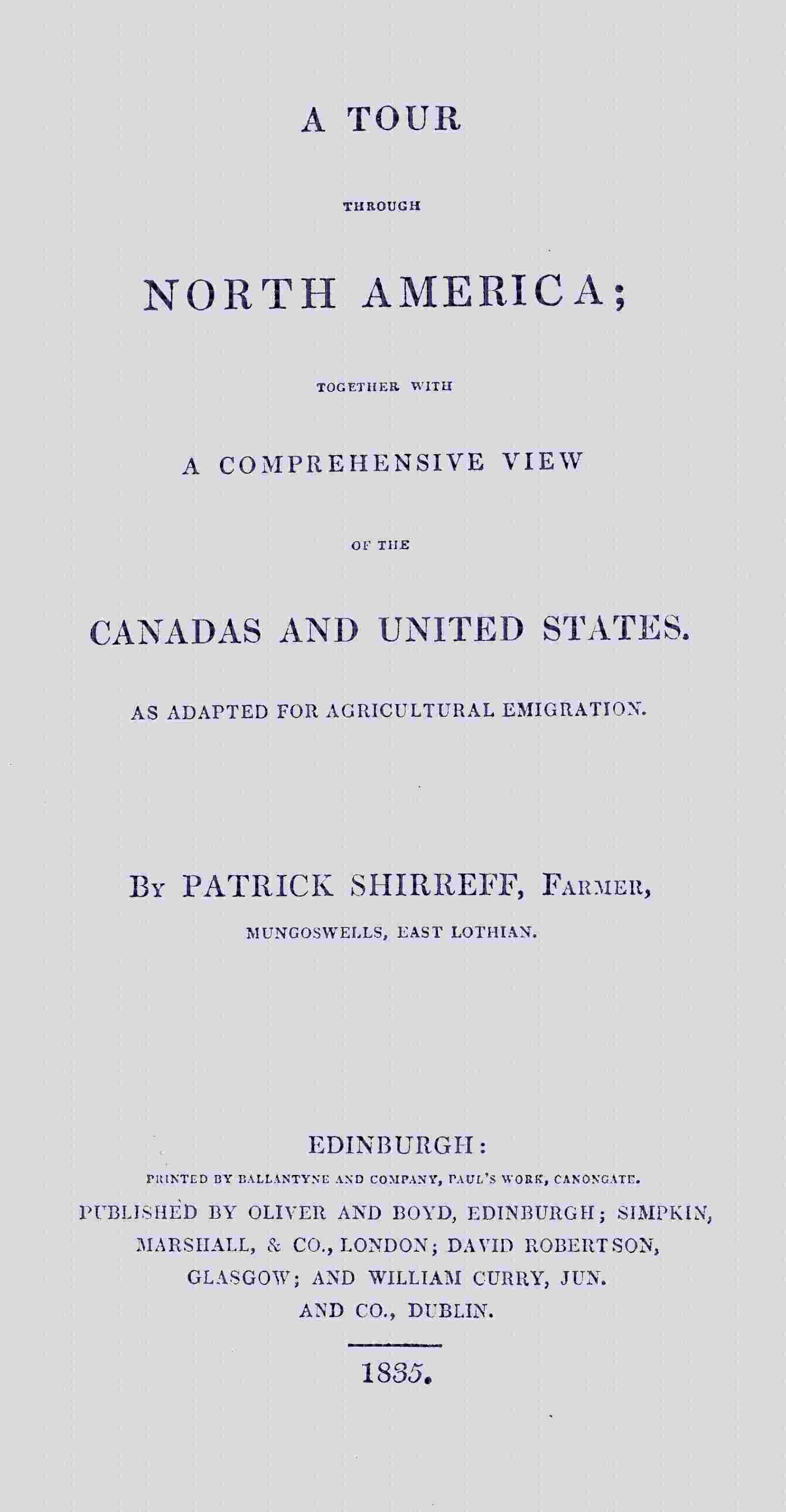
TO
MR JOHN DEANS,
I dedicate the following tour to you, who had an opportunity of judging of many of the scenes and occurrences which I have described. Your candour and honesty have long been known to me, and I hope the sentiments and the feelings expressed in the succeeding pages, will be found to accord with your own character.
It has been said that I was appointed by a party of East Lothian farmers to visit and report on the Canadas and the United States; but nothing could be more unfounded. A younger brother having expressed a wish to try his fortune as an American farmer, I resolved to explore the country for the purpose of enabling me to give an opinion on the step which he contemplated. With this single object in view, my Transatlantic excursion was originally planned, and afterwards performed, unfettered and unassisted by any party whatever.
Having been led to travel from a sense of fraternal duty, I would have willingly remained satisfied with simply accomplishing the object of my journey, being aware how recently some individuals of the highest attainments had published works on America, and how ill qualified I am, in some respects, to convey an accurate impression of a country and people so interesting. But the solicitations of friends induced me to give my opinions to the public, and the result will, perhaps, prove their partiality to have been greater than their discernment.
Having passed much of my time apart from fashion and politics, the position which I occupied in the world may not have been favourable to an impartial view of all which came under my notice. My acquaintance with agriculture enabled me, however, to judge of American farming without relying on the opinions of others, and, while listening patiently to much which was told me, I drew conclusions only from what I saw.
In measuring the advantages of the different parts of the country by the standards of nature, and the reward of agricultural industry by produce, I hope to have departed from custom without having been led into error. Nature is the most general and invariable of agricultural tests.
Want of information is a complaint which has been brought against treatises on emigration, and the charge in all probability arises from diversity of human character; one mind being incapable of furnishing all requisite information to another, without previously knowing what is required. The first part of this publication is intended to show the opportunities which I had of seeing the country, and the second part to aid in forming an opinion of the different places of settlement. I have aimed only to impress the understanding of the reader, and should any of my representations and conclusions be found to differ from reality, I shall regret having written a word on the subject.
The common currency of the United States and the Canadas consists of dollars, expressed by the character $, and worth about four shillings and threepence sterling. The dollar is divided into one hundred cents, of about the value of a British halfpenny each. In the State of New York and Upper Canada the dollar is divided into eight shillings, or sixteen sixpences currency. In Lower Canada the dollar consists of five shillings currency. The dollar of Illinois is divided as in the State of New York, but the shilling is often called a “bit” and the sixpence a “piccayune.”
I was not aware of any circumstance which could possibly influence my judgment in favour of one portion of America more than another, until I heard that my brother Charles had fixed on Illinois as his place of residence. Like myself, he had seen Upper Canada before visiting Illinois, and his preference of the latter district may be regarded by some individuals as corroborative of the opinions which I have expressed, and by others as the cause of my partiality. But since an inducement to praise Illinois may exist, my statements regarding it ought to be carefully examined.
Being a farmer in the strictest sense of the word, and having written the volume at intervals snatched from professional duties, I make no pretensions to correctness, much less to elegance of composition. My only aim has been to state plainly and freely what appeared to be truth, and I trust this will be received as an apology for any inaccuracies of style which may be discovered, and for such dogmatical and homespun expressions as may be considered inconsistent with good taste.