
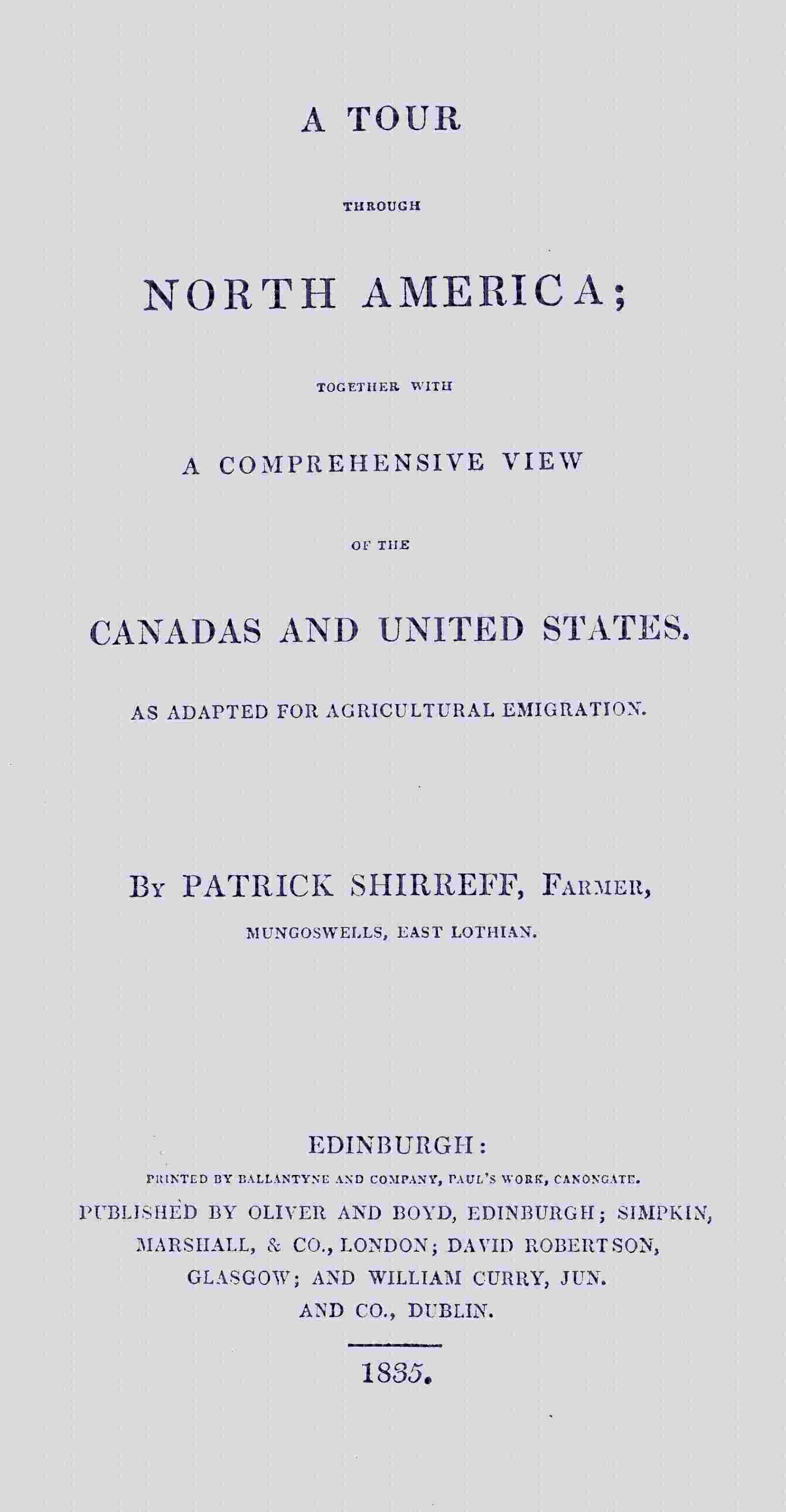
A VIEW
OF THE
CANADAS AND UNITED STATES,
AS
ADAPTED FOR AGRICULTURAL EMIGRATION.
CHAPTER I.
System of Nature Reproductive and Progressive, when aided by Man—Soil is a Workshop—Nature and Man manufacturing Produce—East Lothian Agriculture—Corn Laws—Leases—Competition for Land—Situation of Tenants—Situation of Hinds—Prospects of the People connected with Land.
From whatever sources arise the materials which compose and sustain organized bodies, no symptoms of decline can be discovered in them. Nature seems to be a system of continued reproduction, and, when aided by man, of progressive increase.
The quantity of matter which has been organized since the beginning of time must be immense. But whether the world is viewed in whole or in portions, nature has no appearance of decay, but seems a manufactory producing new fabrics, which are again reduced to their elements, in endless succession. Generation succeeds generation, and year after year furnishes sustenance. In the operations of nature there is no loss of materials—and when they are aided by human industry, she generously rewards man with an increase of her returns, and continues to reproduce the increase. The bounties of nature seem inexhaustible, and, in some measure, proportioned to man’s industry.
The system of nature, such as I have ventured to describe, may be illustrated by the details of the farm. Pastures which have continued under the influence of nature, annually yield herbage without decrease. When they are stocked with sheep, man is rewarded with the increase of the animals, and the herbage is reproduced as before. If the pasturage is improved by draining and top-dressing, there will be an increase in the returns from sheep, and the improvement in the pasturage continues from year to year. When an improvement in the sheep is effected, there will be an additional return from them, which, by continued attention, becomes permanent.
When pasturage is superseded by grains and roots, their increased returns above pasturage is the reward of cultivation; and drainage, manures, and labours greatly increase the returns. In such a system of farming man acts a prominent part with nature, and skilful industry is required to continue the increase. Without skill and industry the returns from cultivation yearly diminish, and ultimately fall short of those from pasturage or undisturbed nature. In this case it is not nature but man which fails to do his part, and the decrease may be considered a just retribution.
A reflecting mind will discover much evidence of nature’s economy throughout the universe—and the farm supplies familiar illustrations. Cows and sheep by consuming grass, yield butcher meat, milk, butter, cheese, and leather. These varied fabrics emanate from the same source, and when reduced to their elements, may again enter into the composition of grass. The straw of grain crops and other vegetable matter, after being eaten by or trampled under the feet of animals, decomposes and enters into wheat, barley, and turnip, or any other plant. In this manner the vegetable and animal kingdoms assist each other, and so perfect is the economy of nature, that none of her materials are lost in the intercourse.
By judicious management the fertility of a farm may be maintained, or its productions reproduced year after year; the produce usually disposed of being the reward of cultivation. If such produce was to be consumed on the farm, its fertility would be augmented, and the reproductive and progressive increase of nature, when assisted by man, exemplified. But the progression in fertility is checked by excessive luxuriance, which diminishes the returns. Thus lavish and niggardly cultivation are both punished, and illustrative of the maxim, to use the things of this life without abusing them.
Man seems to have been endowed with rational powers for supplying himself with the means of subsistence, which he accomplishes chiefly through the vegetable and animal kingdoms. Vegetables directly minister to his wants in various ways, and indirectly through domestic animals, which are altogether dependent on them. The farm illustrates the direct supply in the production of wheat, potatoes, and flax, the indirect supply, in butcher meat and wool. In farm economy, vegetables and animals may be viewed as manufacturing machines, assisting man and each other, and the united results of which are necessary to the formation of certain fabrics, such as milk. From this source man is supplied with many of the luxuries as well as the necessaries of life. The results of the mulberry-tree, silk-worm, and cochineal insect, are united in some of the lustrous clothing of the fair sex.
The materials entering into organized life may be varied, and partly unknown to man. The most important elements of them, however, are to be found in air and water, and may, therefore, be said to pervade the universe. Should a difference of opinion exist regarding them, it is encouraging for the farmer to know that they abound every where within the sphere of his operations.
The localities for manufacturing sustenance are almost as varied as the machinery or plants. The sea, air, and exterior of every organized body are stations, but the surface of the earth or soil is the chief. The localities may be considered workshops, differing in merit, without generally contributing materials towards the manufactures. Sustenance manufactured in the sea and on the surface of the earth, equally sustain human life, and contain the same elements.
Soil is not often regarded simply as a workshop, although no other view of it accords with the operations of nature and of man. It does not in any case appear to contribute materially to the formation of plants, and is only useful to them by affording support to their roots, and holding their sustenance, being a receptacle of air, water, decomposing organized bodies, and mineral substances. Soil may be rendered fertile or unfertile by imparting or withdrawing whatever promotes vegetation.
In the preparation of human sustenance, then, soil is a workshop; air, moisture, light, heat, and decomposing organized bodies, raw materials; plants and animals, machinery; certain minerals and labours, oil for the machinery. In manufacturing produce, nature supplies air, light, heat, and moisture; man furnishes organized bodies, machinery, and oil, which may generally all be obtained by capital. The parts performed by nature and man vary according to the fabric produced. In the case of pasturage, nature contributes the greatest share; in cultivation the capital skill and industry of man is conspicuous. The neglected farm, incapable of producing turnip with a visible bulb, yields a full crop with a judicious application of labour and manure. The united exertions of nature and man ensure success. She accomplishes much when unaided by man, but he cannot obtain any thing without the assistance of nature. When she withholds heat or moisture, the manufacture is suspended, and she possesses the power of arresting or altogether destroying the machinery. Farmers combine nature’s agency under the term climate, and they are familiar with the general effects of heat, frost, drought, and moisture. If given quantities of manure and labour were bestowed on equal portions of soil, similar in quality, situated in Scotland, on a level with the ocean, and the top of a mountain, the difference of produce would be the effect of climate.
Man has been doomed to earn his bread by the sweat of his brow. Experience confirms that the industry of an individual, closely applied to the cultivation of the soil in the temperate climes of the world, is more than adequate to supply sustenance to himself. It is a beautiful feature in farming, that agricultural improvements furnish additional food, increase almost every comfort, and ameliorate climate. The goodness of God to man is thus manifested, in providing him with the means of subsistence, and a reward according to his industry.
A person who intends emigrating ought to consider well what his prospects are likely to be in the country of his birth, and in the district to which he is to move, and be guided by a balance of their advantages and disadvantages. You have chosen the profession of farmer, and I shall, in connexion with America, direct your attention to a few particulars affecting East Lothian agriculture, the district in which you reside, and its state is perhaps not widely different from the agriculture of other parts of Britain.
The results of nature, capital, and labour, forming farm produce, it becomes desirable to ascertain the proportions which they contribute. It is impossible, perhaps, to fix on them with accuracy in any particular case, and their combinations are variable. Endeavour, however, to obtain a clear comprehension of the separate parts they perform in the manufacture of human sustenance. They deeply affect the question of emigration from Britain, the choice of locality elsewhere, and the employment of capital and cultivation generally. Farm economy is altogether depending on them, and the success or failure of operations intimately connected with their combinations.
The soil of East Lothian is owned in large masses by landholders, who seldom contribute much towards farming except building accommodation. The properties being secured to them and their heirs by laws of entail, their own imprudence cannot deprive them of the land, and not possessing the power of disposing of it, they have little inducement to improve it. Being, many of them, unacquainted with agriculture, they are incapable of managing their properties, which are, consequently, placed under the charge of agents, who are generally lawyers, residing in towns, without knowledge of farming. Landholders too often only interest themselves in land as shelter for game, and agents as the source of rent; the interests of both parties being temporary, they pursue their hobby, regardless of ultimate consequences, and occasionally without sympathy for their fellow-creatures residing on the soil. There is sometimes a person under the agent, called Factor, who, from being the medium of communicating with the tenantry, possesses much influence, which is generally used, for good or evil, to please his employer.
Land is generally occupied on a lease, which endures nineteen years; and it is by the skill and capital of tenant-farmers that the soil is cultivated, and that almost all agricultural improvements have been introduced. The farmers employ yearly servants called hinds, a highly deserving class of operatives.
As the population and wealth of Britain increase, there is employment for a proportionate number of individuals in most professions—such, for example, as bakers and shoemakers. It is otherwise with farmers, because the soil has long been entirely occupied, and it does not expand with an increase of population. Indeed an opposite rule seems to apply to this profession, skill and capital enabling an individual to manage a greater extent of land. These circumstances, joined to the natural desire mankind have to till the soil, have created much competition for renting land.
The corn-laws have been denominated a bread-tax, but they ought to be named rent laws, as their practical effect has been to raise the rent of land without benefiting any one engaged in agriculture, except a few farmers during an existing lease. They are a tax on the community for the benefit of landholders, so admirably devised, that it is levied without expense, farmers acting as gratis collectors, and paying the proceeds in the name of rent. Corn-laws have long given a fictitious value to farm produce, and created delusive hopes in farmers which led to their own ruin. At present they are injurious to the agricultural labourer and farmer, because while they continue and are subject to change, rational data for renting land and investing capital in its cultivation cannot exist, and their abrogation will sooner or later be effected by public opinion.
The present defective leases of farms continuing fixed for nineteen years, are injurious, by giving rise to an improving mode of agriculture at the commencement, a stationary mode in the middle, and a deteriorating system at the termination of the lease. Thus, the fertility of a farm fluctuates, instead of progressing unchecked till the end of time. A nineteen years’ lease is often hurtful to a farmer, by binding him to a bad bargain for such a length of time, and involving his heirs in the difficulty which, in case of a young family, is a more serious step than binding himself. Leases have also tended to lessen the landlord’s interest in his property, and estrange him from the tenantry. So much is this the case, that at the present time many landlords are altogether unacquainted with their tenantry, and a good feeling does not always exist between them. Were land occupied on proper terms, with a proper lease, the case would be different. The landlord would then have a direct interest in the cultivation of his property, in the management of his tenant, and in the welfare of every being residing on the soil. A worthless character, or bad farmer, would be got rid of, and the farm of a tyrannical or illiberal landlord soon abandoned. In short it would be in the option of the parties to separate at short periods, which would prevent jarring, and a community of interests would ensure the progressive productiveness of the farm. The idea of a copartnership of every individual engaged in cultivating the soil, would, in some measure, be realized, and good feeling maintained amongst them. In some parts of England where annual leases prevail, I have witnessed as good farming as I ever saw in Scotland, and perfect harmony existed between landlords and tenants, and the latter seemed to enjoy more of the comforts and luxuries of life than Scottish farmers. However advantageous leases may have proved in former times, when the tenantry were bowed down by oppression and poverty, their effects, of late years, when competition for renting land has been so great, and the value of farm produce retrograding, have been injurious to the tenantry and the advancement of agriculture. The terms of lease seem only calculated for progressive prices of farm produce, and have proved ruinous during declining ones. It would be easy to remedy the defects of the present lease, but, under existing circumstances, visionary to expect their removal.
On the termination of a lease the farm is generally advertised to be let by receiving written offers on a mentioned day. The landlord and his agent knowing little about its value, a tenant is accepted after every attempt has been made to obtain rent above the written offers, by operating on the feelings and local attachments of the former tenant, which seldom fail to ripen during a lease. From all parts of the country candidates of different descriptions appear. Men of sanguine temperament, without calculation, unacquainted with the peculiarities of the district, and looking forward to the prices of produce returning to what they were upwards of twenty years ago. Adventurers, trusting to get a reduction of rent after obtaining possession, and reckless of the consequence of the step they have taken, having perhaps little capital to lose, and content to live, year after year, dependents on the property, and with arrears of rent accumulating. People merely wishing a place of residence, and not calculating on profit from the farm, having the means of living from other sources.
Such is the state of East Lothian farmers, that during the last twenty years perhaps three-fourths of them have not fulfilled their original contracts, and the funds that have been lost in cultivating the soil is incalculable. I have known a tenant rent a farm with a capital of seven thousand pounds sterling, consisting of about 400 acres, and remove from it before the expiry of his lease, with only five hundred pounds in his pocket, and in arrears of rent to his landlord the sum of three thousand pounds. Mr ——, of our acquaintance, on a farm under 100 acres, incurred twelve hundred pounds of arrears, and got off by paying only two hundred of them. With such competitors, a young man who must live by his profession, can hardly wish to be successful. The obtaining of a lease at the present time may often be considered little better than the first chance of being ruined, and many tenants, after leading anxious lives, and exposed to the insults of rent exactors, may think themselves fortunate if they escape with a remnant of their fortunes.
The feeling that landholders, agents, and factors sometimes evince towards the tenantry is so hostile, that a small portion of the farmers originally connected with East Lothian obtain leases of late years, the new tenants generally coming from other countries. So much is this the case, that I have sometimes regarded such tenants as a proscribed race, and thought that the sooner most of them put their house in order for removal the better for themselves. It is of no consequence how respectable the old tenant may be in private life, or high in his profession. A promise of rent, although not likely to be fulfilled, is a never-failing recommendation to a stranger, when joined to subserviency, without which it is very difficult to obtain a farm on any terms. If a tenant has opinions, they must agree with those of agents or factors on the estate, or warfare ensues; and if he is an individual of talent or independent feeling, he is hunted with more zeal as a dangerous person, and every species of annoyance and persecution is hurled against him. A tenant of great enterprise, who had obtained a conventional reduction of rent some years ago, in consequence of a fall in prices, was lately called before an agent and questioned about his management. The tenant maintained his innovation on the common system to be an improvement, but was told by the agent that if it was found he had injured the land, damages must be paid, and if, as was alleged, a discovery had been made, it was fair the landholder should participate in the discovery, and no reduction of rent would be made in future, although prices had fallen thirty per cent since the conventional reduction was granted. About fifteen years ago, eleven tenants resided on a certain estate, and since then the effects of ten of them have been sequestrated and sold at the instance of the landholder, and in all probability the remaining tenant will remove elsewhere in a few months. On a division of another estate, the tenants have all been twice changed in twelve years, and one of the farms in the same time has had four tenants, three of whom became bankrupts. With such examples before their eyes, tenants eagerly seek after farms at rents which cannot be realized from its disposable produce. Their case soon becomes hopeless, but, being bound for nineteen years, they are generally held until their funds are exhausted, when they are sacrificed, according to the partial laws of the country, to make room for a new victim. The original tenants of East Lothian have been accounted fine gentlemen—extravagant fellows, devouring so much of the produce of the soil that they scarcely leave any of it for the landholder—an allegation which is unfounded, and which has hitherto served as a pretext for harshness. It has been suggested that the managers of great estates are fond of power and adulation, and cannot brook the idea of farmers approaching themselves in the refinements of life; hence the harsh treatment of the tenantry and the success of subserviency.
There is a prevalent idea that small farms occupied by hard working men afford more rent than possessions of larger size, and on some estates small farms are forming. The effects of a division of labour, skill, and capital must be nearly the same in farming as in most other manufactories, and a very short trial of tenants without capital, however they may live, will prove this position by the altered fertility of the soil, which is illustrated by the state of Irish agriculture. In Ireland farm produce is the result of nature and imperfect labour; but in East Lothian the results of capital, skill, and improved labour enter into the combination; and in the latter the produce of land is much greater than in the former. But the landholders of Ireland are perhaps more wealthy than those of East Lothian, compared with the people of the respective countries. A crowded and agricultural population will pay rent in proportion to its degradation, or, at least, afford in such a ratio influence and rank to landholders. This rule is not, however, applicable to Britain, where commerce and manufactures flourish, whose profits of stock and wages of labour ultimately affect those of agriculture, and the selfish attempts at degrading the farmers of East Lothian will recoil on their authors. For a time tenants without capital can pay high rents, by extracting from the soil the means of fertility imparted to it by others; but the deteriorated condition of the farm is ultimately a loss to the landholder and the community.
The capital which is required to put the operations of an East Lothian farm in full motion, the tenant maintaining himself and reaping a crop without the aid of credit, may be stated at seven pounds sterling, or nearly thirty-five dollars per imperial acre. The rent which is stipulated to be paid, and the capital expended in fertilizing the soil, renders the step which he takes a serious speculation. If a bad crop or two occurs at the commencement of the lease, the tenant will be unable to pay the rent, and he is then deprived of the lease, or allowed to continue a dependent on the estate. Being bound for nineteen years, he has not the option of removing from the farm, and is very seldom permitted to do so while a tangible farthing of his funds remain. At all times he leads an anxious life without bodily toil, and is seldom remunerated for his exertions and risk of capital. Industry and enterprise may enable him to struggle to the end of his lease. Should he die and leave a wife and young family, the unexpired years of the lease would in all probability ruin them, his funds being liable for the rent, and they would be incapable of managing the farm without incurring great loss. Two thousand pounds may be stated as an ordinary capital to commence farming with; and it is hopeless for a person without considerable funds to think of farming at all.
The hinds, or farm-servants of East Lothian, are, perhaps, the steadiest and most praiseworthy race of men in the world, and indifferently rewarded for the important part which they act in farm economy, living on poor fare, and in bad cottages. Up to the present time, the best feeling has existed between them and the tenantry; and there are thousands of instances of men having died of old age in the service of their first employers, without an abatement of income having been made during sickness or infirmity. But a change is taking place in their condition, by the pressure on the tenantry weakening attachments, and forbidding an indulgence of generosity towards their faithful and proficient operatives. Mutual confidence and assistance, in the different classes engaged in farming, forms the strength of the East Lothian system of agriculture, and the true source of happiness of all interested in it. Kindness and attention, on the part of landholders towards the tenantry, commonly radiates to farm-servants, from them to the animals under their charge, and the happiness of all is thereby promoted. On the other hand, harshness and neglect shown by landholders to the tenantry, descends to servants and animals, and general uneasiness is the result. Some of the recently introduced tenantry bring all their operatives from other districts, and have commenced the Bothie system, which is highly demoralizing in its effects on the men who are subjected to it, although it is somewhat cheaper than the customary mode of treating the ploughmen. The prospect of this class bettering their condition is hopeless, and there is reason to apprehend their comforts will be curtailed.
The rural population of East Lothian appears to be undergoing an unhappy change. The management of landed property is almost entirely intrusted to agents, who, like the middlemen of Ireland, have no permanent interest in the soil, nor sympathy with its cultivators; and, like that country, East Lothian now suffers from the effects of absenteeism, so far as the interests and feelings of the rural inhabitants are concerned. The landholders and tenantry are unknown to each other, and dislike may sometimes be traced in both parties. The tie of farmer and ploughman is waxing weak, and instead of the quietness of conduct which now pervades all classes, a very few years may develope the troubles of Ireland, and the south of England.
It has already been stated, that nature contributes much towards the manufacture of farm produce; but the fruits of her exertion do not benefit the tenant nor operative. The landholders receive as rent all that results from nature, and also a considerable portion flowing from the tenant’s capital and the operative’s labour. The tax which the corn-laws impose on the unagricultural portion of the population, for the benefit of landholders, is collected free of expense by the tenantry. The ragged and half-starved peasant of Ireland labours amongst, and begs from, the people of Britain, and, on reaching home, gives his earnings to the owner of the soil, that he may be permitted to exist only on the potato he himself cultivates. The East Lothian tenant of the present day is often not more happily situated, gradually paying the landholder the earnings of early life, or inherited wealth, for the privilege of occupying the soil, and returning its produce. It is fortunate landholders do not possess the power of preventing the population removing to other countries, and there growing produce for themselves.
There seems but little in the present constitution and state of agricultural relations to brighten futurity. An abrogation of the corn-laws would ensure an extended application of capital to the soil, and create employment for operatives. Annulling the law of entail would produce landholders interested in agriculture and the people who follow it. But however beneficial might be the effects of such measures, the evil of a limited surface with a numerous population would remain. The landholder would perhaps be reduced to the necessity of superintending the cultivation of a part of his own soil, and generally interest himself in his estate. The situation of tenants and operatives would only be improved for a short while, as they would soon compete with each other as before. Neither of them are at present adequately remunerated for their exertions. To expect much improvement in their condition while population is so numerous, seems hopeless; and individuals will require to exert themselves to maintain their present position.
I have treated generally of East Lothian agriculture, and the classes immediately connected with it, without noticing examples of wisdom and generosity on the part of landholders, or of folly and worthlessness amongst tenants and operatives. My object has been to bring the unsound parts of the system under notice, in order that an estimate of future prospects might be formed. But all classes may be regarded as the victims of circumstances which have not perhaps been of their own creating, and they are more deserving of sympathy than censure. While what appeared to me to be the true state of things has been freely described, I disclaim feelings of bitterness or reproach towards man or things.
CHAPTER II.
Persons engaged in American Agriculture—American and British Agriculture—Application of Capital and Labour to Cultivation—Rent—Price of Land—Proportions of Nature—Capital and Labour in the Production of Farm Produce, and their distribution in Britain and America—Capital required to stock a Farm in both Countries—Unhealthiness of America—Climate—State of Society—Situation of young Men without Capital—Choosing America or Britain.
In North America, extensive landholders are not common in any of the districts which I visited; and where they do exist, a great part of their possessions are unproductive. The soil is chiefly cultivated by its owners, who, in sundry respects, resemble the tenants of Scotland; and they often perform a great portion of the manual labour of the farm. In many parts of the country, which has been long settled, the farmers are opulent, participating in all the conveniences of life; and, without passing their time in absolute idleness, hire a good deal of labour. In the more recently settled parts, farmers have few of the elegancies and conveniences of life, with an ample share of its necessaries. They do not labour hard after the first three or four years of settlement, and seem to live without much care. Land does not invest its owner with any privilege or status in society.
Renters of land, or tenants, are common in many parts, and in all respects rank as landholders. The terms of rent are variable. Near towns, and in thickly-peopled districts, a small rent is paid in money, and a lease of several years taken. In remote situations, land is commonly let on shares from year to year. If the owner of the soil furnishes seed and labouring animals, he gets two-thirds of the produce, when on the field, and removed from the earth. If the tenant supplies animals and seed, the landowner gets one-third. But terms may vary according to situation, soil, and crop.
Farm-hired men, or by whatever other name they may be distinguished, are to be had in all old settled districts, and also in many of the new ones. In most cases their reward is ample, and their treatment good, living on the same kind of fare and often associating with their employers. A great deal of farm labour is performed by piece-work.
The agriculture of a country is affected by local circumstances, and farming in Britain and in the remote parts of America may be considered the extremes of the art. In the one country the farmer aims to assist, and in the other to rob nature. When the results of capital and labour are low, compared with the hire of them, they are sparingly applied to the cultivation of the soil, in which case nature is oppressed and neglected, if I may be allowed to use such terms; and when they are high, compared with their hire, she is aided and caressed. Both systems are proper in the respective countries; and, by assuming a fixed result for nature, they admit of arithmetical demonstration. Along the eastern shores of America, manures and a considerable portion of hired labour are applied to the cultivation of the soil; but in remote districts manures are not used, and the smallest indispensable quantity of labour bestowed. In the eastern parts, the results of capital and labour enter into the productions of the soil; in remote districts the aid of capital can scarcely be said to have been called into action, and in both situations nature is the chief agent.
The circumstances affecting the application of capital and labour to the cultivation of the soil in Britain and America are as opposite as their systems of farming. In Britain, with her limited surface and dense population, nature’s contribution towards the production of farm produce is given to the landholder as rent, and the rural inhabitants living near the starvation point, the price of provisions regulates in a great measure the hire of labour. Accordingly, the wages of agricultural labour in the different parts of the country are proportionate to the value of their produce; being lowest in the remote and inclement situations, and highest in the most favoured districts. In America, the extent of soil and thin population has not distorted effects, and nature’s portion of farm produce is not absorbed by rent. The results of capital and labour being represented in quantities of produce, and their hire paid in money, it follows, that the cash-value of the former must generally exceed the latter, and that an additional application of capital and labour to cultivation is a consequence of produce being high priced compared with their hire. Accordingly, in all parts of the country where produce is high, labour is low, and where produce is low, labour is high.
In Britain, the hire of agricultural labour has been affected, and in all probability will continue to be regulated, by the wages of the unagricultural part of the population. Without manufactures and commerce, the condition of her rural inhabitants would have approached the present state of the Irish people. In America, the returns of the agriculturist appear to regulate the wages of other classes. When they are high, other classes are attracted to farming; when low, farmers change their profession;—Americans generally being able to exercise two or three professions.
The origin and progress of rent seem to admit of easy solution. In the western prairies of America, where cheap and good cleared land is almost as abundant as air, rent is unknown, except in the neighbourhood of towns. In the eastern districts, where good cleared land is of limited extent, compared with the inhabitants, rent is paid. Thus, population is the origin of rent, which is the value of produce above what it hath cost in raising and carrying to market. At first, it consists of a small portion of the produce furnished by nature; with an increase of population the whole is absorbed, and ultimately also, parts of the results of capital and labour. Rent is also affected by the condition as well as by the number of the people; and, under a parity of circumstances, will be found to augment in the ratio of the number and misery of the agricultural inhabitants.
Until land yields rent, it is not worth purchase-money, and in proportion to a rise of rent its price will increase. Lands, therefore, sell at a considerable sum on the eastern side of America, and diminish in price to the westward, unless enhanced by localities of situation. As population increases in the west, and labour falls, land will rise in value, cheap land and cheap labour being incompatible with each other. But the investment of capital in the purchase and cultivation of land depends also on the profits of stock, or rate of interest in the country, the tangibility of the investment, and many other things.
From the high price of produce, and comparatively cheap labour and manure in the eastern parts, capital, judiciously employed in cultivation, yields an ample return. But the low produce and high labour in the west renders it unprofitable to employ much capital in cultivation at present in that situation. From the great advantages which the western districts possess over the eastern ones in cheapness and fertility of soil, and consequent reward of labour, population will flow into them, and render a rise in the value of land more probable there than in the eastern parts.
Having frequently alluded to the results of nature, capital, and labour, in the production of farm produce and their distribution, I shall endeavour to illustrate the subject hypothetically, for the purpose of assisting in forming an opinion of their general bearings. The results of capital and labour employed in cultivation cannot always be separated, and perhaps they ought to be classed together. The assumed data does not include capital invested in the purchase of land, and I do not wish the accuracy of the statement to be relied on, although I think it approaches to correctness.
| In | East Lothian produce, let nature be represented by | 3 |
| Capital, | 1 | |
| Labour, | 3 | |
| Total, | 7 | |
Nature’s share being given as rent, and also part of the results of capital and labour, the landholder perhaps gets a portion, expressed by 3½, leaving 3½ for the tenant, labourers, and all other expenses of cultivation. But the expenses of cultivation and rent must be paid under all circumstances, and frequently nothing remains for the tenant. This is particularly obvious in unproductive seasons when the diminished crop may be represented by 4, leaving the tenant, after discharging taxes and some other things, without a farthing to pay rent. I myself have been so situated, and human means cannot prevent such visitations. Hence the speculative nature of farming, and the results which have flowed from it.
| In | American produce, let nature be represented by | 3 |
| Capital, | 0¼ | |
| Labour, | 1¼ | |
| Total, | 4½ | |
In the eastern parts where rent is paid, the landholder’s portion may be 1, leaving 3½ for the tenant and expenses of cultivation. In remote districts where capital is scarcely employed, the whole produce falls to be divided between the landholder and labourers, and the landholder enjoys it without division, when the labour is performed by his own hands. Although the divisible portion appears the same in both countries, the labour and capital employed in cultivation is perhaps five times greater in Britain than in western America. On a given surface the produce is greater in Britain, but in America the produce is greater in proportion to the labour employed in cultivation.
In East Lothian the farmer gives the fruits of nature and part of the results of capital and labour to the landholder as rent. In western America the farmer shares nature’s bounty with the labourer, or enjoys it himself by labouring with his own hands. In East Lothian the farmer of the present time is in some degree the servant of the landholder. In western America the farmer has nature for his servant, or at least enjoys her labours. With such an assistant what industrious man can be poor?
In the event of death or old age, nature still continues her services to the American farmer, by furnishing grass and other commodities. A widow or young family, almost under any circumstances, could milk cows and plant potatoes. Bountiful nature would provide grass for the animals and mature the potatoes, on the produce of which the family might live. In East Lothian a widow or young family, after being ruined, would be turned adrift on the world.
In the eastern parts of America land may be purchased and stocked for nearly the sum an East Lothian farmer expends in stocking and improving a farm, namely L.7 per acre. But if the land has great local advantages, the price will be considerably higher. In the western parts of the United States, prairie land of the best quality, without the least obstacle to cultivation, and to any extent, may be had. For the sum of three hundred pounds sterling a farm of 200 acres could be bought and stocked in the prairies of western America. In East Lothian farming is a hazardous calling; in America there is no risk attending it. In East Lothian L.2000 is required to stock a farm; in the Western States L.300 will purchase and stock one nearly of equal size. In East Lothian a farmer has mental annoyance with bodily ease; in America he has mental ease with personal labour. In East Lothian a young farmer commences his career in affluence, and at middle age finds himself in poverty; in America he begins with toil, and is in easy circumstances by middle age.
But however favourable American farming may appear when simply viewing the quantity of produce, the country has many disadvantages deserving of consideration, and one of the most important is its unhealthiness. The whole of North America is liable to ague and fevers of various kinds, and the chief difference of situation in these respects seems to be owing to cultivation. The more cultivation is extended, the healthier the climate becomes, but occasionally ague and fever prevails in all situations. I found fever and ague at Hyde Park, on the banks of the Hudson, at Niagara, Whitby, and Chatham, in Upper Canada. The inhabitants on the prairies of Michigan, Indiana, Illinois, and Missouri, were suffering much from fever when I was amongst them. Almost every person you meet with in America tells you of the healthiness of his situation, and the unhealthiness of other parts of the country. The cause of fever and ague in America does not appear connected with marshes or stagnant waters, as the inhabitants residing on the dry open prairie of 100 miles in extent are not exempt from its attacks, but is thought to arise from the miasms of decaying vegetation; and the rich bottoms, covered with rank vegetation, on the banks of rivers are the most unhealthy situations. While journeying over the prairies of Illinois after nightfall in autumn, when vegetation was decaying, the smell of fermenting grasses was unpleasantly strong, and reminded me of the odour of a sweating hay-stack in Scotland. In almost every part of the world where the earth’s surface is uncultivated and well clothed with vegetation, fever and ague prevails, and is found to abate as cultivation is introduced. Thus bountiful nature at once rewards the enterprising farmer with her fruits and a more salubrious atmosphere. What incentives to industry!
The climate of North America is remarkable for variations of temperature, and most situations seem alike in this respect. But the duration of winter increases, and length of summer decreases, with the latitude of the situation. The region of North America is not so congenial to human life as Britain, but far more so than the East and West Indies and many other parts of the world. In such a vast continent cultivation is alone wanting to render it healthy.
The state of society in America is very different from what it is in Britain, there being less refinement and fewer of the elegancies of life enjoyed. I am satisfied, however, from experience, that much of what is known by, and appreciated as, the comforts of life, arises from fashion and force of habit, and that a few weeks’ residence will reconcile a reasonable person to the change. Throughout the greater part of the country, fashion has not established her empire, and there is little vieing amongst the inhabitants. The handsome bound volumes which adorn the drawingrooms of Britain, are not more instructive or amusing in consequence of their showy exterior; and the meagre furnishings of American log-houses, in the remote districts, meet the wishes of the inhabitants, and are found as useful as the most gaudy. Plain furniture is not despised where fine is never met with. In taverns, luxuries and refinements are common, and wealth may obtain them almost any where. Of the state of domestic society I am not qualified to speak from personal observation, farther than that the manners and customs of the people differ from those of Britain. In the eastern parts the distinctions of classes in society and elegancies of life approximate those of Britain, and both gradually diminish on proceeding to the westward. But in any part of America, where an emigrant may settle himself, he must lay his account with a change in the social intercourse of life. Some people are, however, incapable of altering their manners and customs, and such characters may live without society.
In the eastern parts of America the luxuries and conveniences of life are cheaper, and the necessaries dearer, than in remote districts. The east should therefore be the abode of the wealthy, refined, and luxurious; the west, of the persons who value the necessaries of life, and such as are not of fastidious habits. But in no part of the country will the fastidious find themselves happy.
The want of good assistants, servants, or helps, is ranked amongst American privations. In the east assistance can at all times be had, which is not the case in the west; but in most situations high wages and good treatment will obtain assistance. Female servants are very scarce, and said not to be good. To the wealthy and refined, who have resided in Britain, this state of things at first appears insupportable. They soon, however, learn to assist themselves in many things, and find their happiness increased by doing so.
The difficulty of obtaining servants arises from the ease with which individuals obtain a livelihood, every industrious and sober character having the means of purchasing a good estate in the west with the accumulated savings of three years’ service. However much certain classes may feel and regret the want of servants, the extraordinary reward which they receive ought in fairness to be accounted the country’s greatest blessing. In no other part of the world is industry, sobriety, and worth, so richly rewarded.
The influence which wealth has attained in Britain merits the consideration of all young men without capital. Personal exertion is often considered degrading, and visited with the contumely of former associates. To lose rank in society must be particularly galling to young men of spirit, and few in the middle walks of life can keep their place without capital. This is one of the many inconveniences attending a refined state of society, and is more likely to increase than diminish in Britain. In the remote parts of America wealth is not idolized. The industrious youth may there follow any occupation without being looked down upon or sustain loss of rank, and may rationally anticipate raising himself. The plain style of buildings and household furnishings of such places are favourable to young people, and in almost every particular their situation may be said to be the reverse of what it is in Britain. A young man without capital and of good character, is almost sure to gain but cannot lose rank by emigrating to America, and will rarely maintain his rank by remaining in Britain.
In judging then of the step of becoming an American agriculturist, all may lay their account to undergo considerable privations at first settlement, and lead a different life from the farmers of East Lothian. The bountiful reward which industry receives soon enables good men to purchase land; and it is therefore often the unsteady and idle which hire themselves to farmers. On this account, it will be necessary to work personally, by way of example and active superintendence. Right thinking people consider it no disgrace to labour in any part of the world, and it is thought quite disreputable to be idle in America. East Lothian farmers often toil mentally without remuneration; and the assurance that, while in America, all the fruits of a person’s own labour, assisted by generous nature, accrues to himself, will nerve his arm and sweeten his toil. The division of labour so beautifully effected in some of the operations of East Lothian agriculture, and which I may be permitted to call professional luxuries, cannot be practised at present in America. The wooden dwelling-house and barns will at first perhaps appear revolting, and may induce some people to think, that, with the same privations and sacrifices, they would have been enabled to have lived in East Lothian. Such is not, however, the case; because the pressure on farmers arises from a competition of numbers, which would be increased by lowering the standard of living; and the only result of such policy would be to raise the rent of land, and degrade all engaged in farming. Let no one, however, from my representations of American farming, entertain too sanguine hopes of success. Farming, in most parts of the world, ranks low in the scale of professional remuneration; and without virtue, persevering industry, and sobriety of character, people will not likely either become wealthy or happy. In nine cases out of ten, a man’s success in life depends on his own exertions. America presents a fertile and extensive field, and whoever does not reap an abundant harvest, will, in all probability, find the cause of failure in his own character. I cannot hold out an immediate or ultimate prospect of great wealth, as the low price of produce and high labour renders this improbable. Every person may, however, obtain all the necessaries and most of the true comforts of life in the fullest abundance, unharassed by the cares of the present, or apprehensions of the future. The pleasures of society are not likely to be so much enjoyed in America as in Britain; but, on the other hand, its mortifications are escaped. In every part of the world, man ought to look to his family and himself, and not to society, for true happiness. If abundance of the necessaries of life do not ensure society in America, the want of abundance is almost sure to lose society in Britain.