
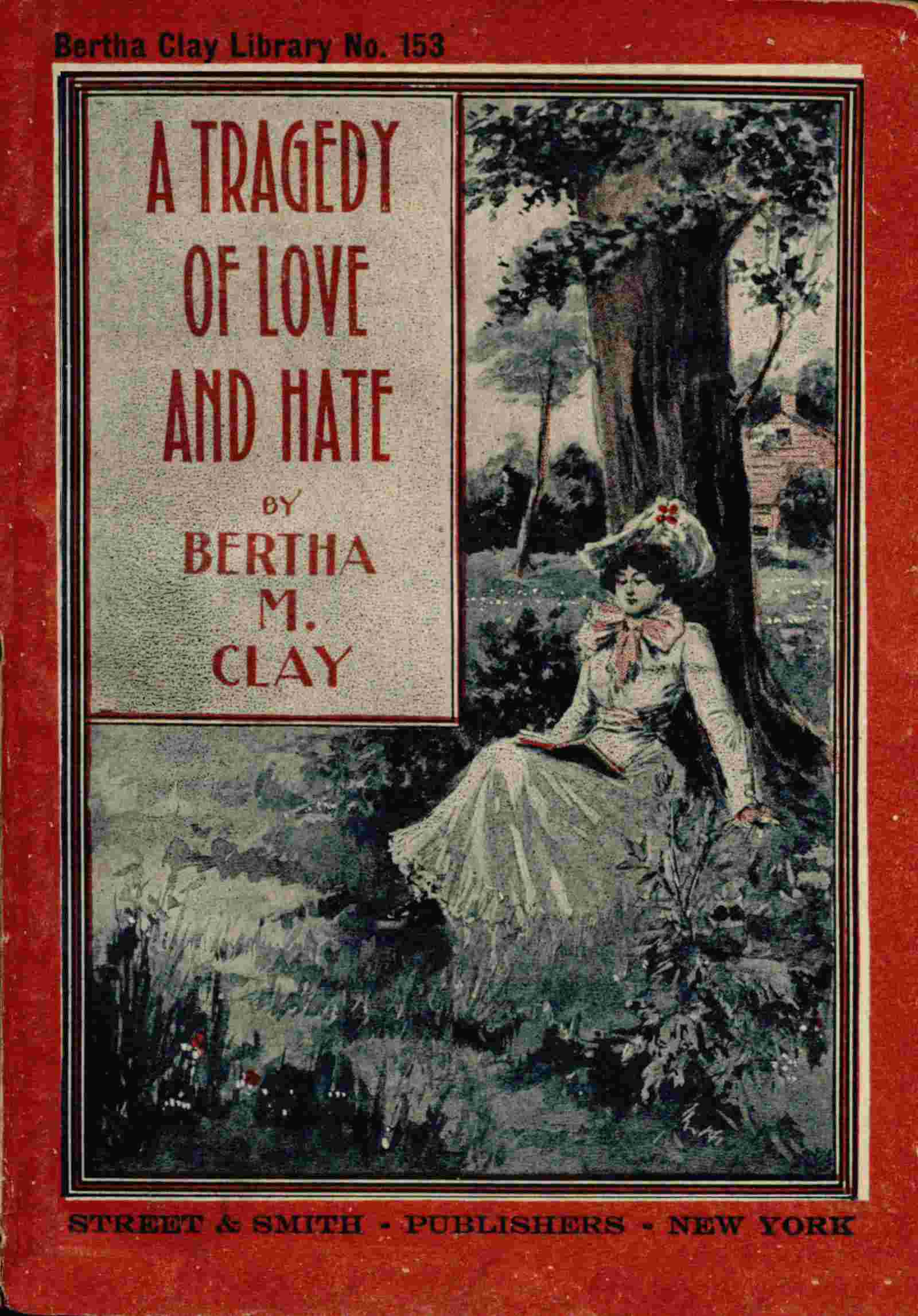
CHAPTER XIX.
AS A DROWNING MAN.
Sir Ronald went gently to her and called her by name. Whatever her dream might be, it was so deep that she had not heard the sound of his footsteps or the rustling of the boughs.
“Clarice,” he said, and when she raised her head and saw him, the change that came over her face was so sudden and so great it dazzled him.
“You, Sir Ronald!” she said, and then he knew that she had been dreaming of him.
He went nearer to her, and they strode side by side under the shade of the old tree.
“Clarice,” he repeated, “there are tears in your eyes and on your lashes. You have been alone in this quiet place, weeping. What is wrong?”
“Nothing,” she replied; “but my thoughts were very sad ones, and tears are a luxury at times.”
“They should not be for you, for whom all things bright and beautiful must have been made. Tell me what those sad thoughts were.”
A mound of dead and dying leaves lay at her feet. Every vigorous breath of wind brought fresh leaves down, yellow and red. She pointed to them.
“Every autumn for the last four years I have watched the leaves of this tree fall,” she said, “and the same thoughts have always pursued me.”
“You will not tell me what they are?” he said.
“I cannot. Do you not know how impossible it is to put those thoughts into words that we hardly understand ourselves?”
“Clarice,” he said, gently, “do you know what I have sought you for?”
“No,” she replied, and he noticed something of dreaminess in her voice and look.
“I came over to Mount Severn this evening especially to ask you to be my wife.”
Something like a half-hysterical sob came from her lips.
“Your wife! But you say nothing of loving me.”
“Should I ask you to be my wife if I did not love you, Clarice?” he asked, carried away, despite himself, by the passion of her words and the love in her face. He never forgot her half-tearful joy.
“You love me, Ronald! Do not deceive me; do not tell me that unless it is quite true.”
He could not have said what he intended to say had his life been the forfeit. He had meant to own to her that his love lay in ashes; but he could not hold those trembling hands in his, and look at those quivering lips, yet speak such words as must stab that tender heart.
“I do love you, Clarice. Why, how many years is it since we were children together, since we played at love and jealousy?”
“But,” she interrupted, “you have had another love since then.”
Yes, Heaven help him! he had; and as he stood there, holding another woman’s hand in his, all the memory of that lost love came over him, and, looking up at the green trees, he half wished they might fall and crush him. Then he recovered himself with a violent effort and turned to her.
“I do not attempt to deceive you, Clarice—I had another love. I will tell you all the truth, and you must reject me or take me, as you will. I loved Lady Hermione when we were children. She has been the one love, the one passion, the one loadstar of my life. I had no wish, no thought, that did not begin and end with her, and I believed she loved me. God grant that I may not speak too harshly of her! She deceived me with the most cruel words and looks; she drove me half mad, for when I offered my love to her, she threw it back at me. There were some false, scoffing words about being my friend for life—my friend! when she knew she had slain all that was best in me.”
“Hush!” she said, with dignity; “you must not tell this to me.”
“But I must tell you, Clarice, if we are to understand each other. Why are you so pale—why do you tremble—am I cruel to you?”
“No; speak on; it is better, perhaps, I should hear.”
“The letter she sent me, refusing me, slew in me all that was honest and best. It made me a coward, it unfitted me to battle with life, it destroyed every hope that makes manhood sweet and life precious.”
“Was it so very hard to bear, Ronald?” she asked, pityingly; and he could not be deaf to the pain in her voice.
“It was. I hide nothing from you. I do not know what madmen suffer, but it seems to me, on looking back, that for many long months afterward I was mad. There was nothing that I left undone to drive even the memory of her fair face from me; I could not do it. Clarice, a drowning man clings to a straw—I cling to you. Will you save me from the total wreck of life, reason and happiness? Can you be more generous than woman ever was before? Can you marry me, knowing that another woman has had the best of my life? Can you marry me, to save me and restore me to the world of men?”
She clasped her hands round his arm.
“You have said not one word of loving me, Ronald—not one word.”
“But I will, God helping me. If you will trust your life and your happiness to me, I will—I will make you happy.”
“Say you will love me, Ronald,” she whispered, raising her lovely face to his. He would have been more than mortal not to have been touched by the wistful sadness there.
“I will love you,” he cried. “Help me to love you, Clarice; help me to forget this black, brooding shadow that darkens my life; help me to be a braver, better, nobler man by becoming my wife.”
“I will, if you will love me. Ah, Ronald! why is she fairer to you than I am? Why should you give her more than me? You say she has been cruel to you. Listen! I have loved you as long as you have loved her. I have never given one thought to any other than yourself. You talk about love—oh, Ronald! could you count the leaves on the trees you might, perhaps, be able to tell how dearly I love you.”
She clasped her white hands and laid them folded on his breast.
“Do you know that if at any time my life could have saved you, I would have laid it down for you? Do not think I am speaking as women should not speak. There is no pain you have suffered that has not been doubled for me. I have asked but one boon from Heaven, one grace, one blessing—and that was your love, Ronald.”
“Alas, that I have not more to give!”
“Never say that; I am content. You did not choose me first, but perhaps in the years to come you may love me best. You have chosen me as your comforter, and I would rather be that to you than the worshiped queen of any man.”
Her golden head drooped on his breast, and her voice died away, in a passionate murmur that was but a sigh.
“I do not deserve it,” he said, regretfully.
“Ah, yes, you do. Because she has slighted you, Ronald, it does not follow that her estimate of you must be right. Oh, my love, my king among men! I know how to honor you. I say among all living men, you have not your peer. Because she has been cold and false, I will love you doubly; because she has made you unhappy, I will spend my whole life in trying to make you happy; and if she came to us now, in all the fatal lure of her beauty, and tried to take you from me, she should not. I would keep you by the force of my own mighty love.”
It was very pleasant; even the sweet south wind seemed to listen to the pleading, passionate voice.
“Why, Ronald, when you found me here,” she continued, “I was weeping over you—weeping that my love was so unhappy—that the bright young years of my life were passing in bitterest gloom; for I came to the old tree last year, and watched the leaves fall, and, Ronald, it seemed to me that, even as they fell one by one and died so slowly, that thus my hopes faded, and every year saw you further from loving me. That was why I wept. I shall never shed such tears again.”
He could do nothing but bend down and kiss the beautiful face, praying God in his heart that he might love her as she deserved, and that he might make the life bright whose brightness depended so entirely on him.