
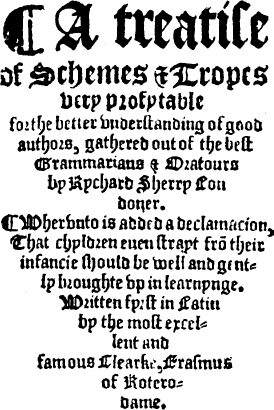
Dedication
To the ryght worshyp
ful Master Thomas Brooke
Esquire, Rychard Shyrrey
wysheth health euer-
lastynge.
Figures and Tropes
¶ A briefe note of eloquciõ, the third
parte of Rhetoricke, wherunto
all Figures and Tropes be
referred.
Notes on the Text
Paragraphs
Some paragraph breaks in this e-text are conjectural. The printed book had the following kinds of breaks:
conventional paragraph with indented first line
unambiguous paragraph with non-indented first line
ambiguous paragraph: previous line ends with blank space, but the space is not large enough to contain the first syllable of the following line
sentence break corresponds to line break: this happens randomly in any printed book, and only becomes ambiguous when the book also has non-indented paragraphs
In this e-text, the second type of paragraph is marked with a simple line break (no extra space) and pilcrow ¶. The third type has a pilcrow ¶ but no line break. The fourth type is not marked.
Transcriber’s Footnote
*
homotelento, -teleto:
In the facsimile edition, the body text has homoteleto but
the Index has homotelento. In the other available text, the body
text has homotelẽto with clear overline. The correct form is
“homeoteleuton” (in this book’s spelling, probably “homioteleuton”).
Spelling
The pattern of initial v, non-initial u is followed consistently.
The spelling “they” is more common than “thei”.
The form “then” is normally used for both “then” and “than”; “than” is rare.
The most common spelling is “wyll”, but “wyl”, “wil” and “will” also occur.
Word Division
Line-end hyphens were completely arbitrary; words split at line break were hyphenated about two-thirds of the time. The presence or absence of a hyphen has not been noted. Hyphenless words at line-end were joined or separated depending on behavior elsewhere in the text:
Always one word (re-joined at line break): som(e)what, without, afterward(e)s
Usually one word: often( )times, what( )so( )euer
One or two words: an( )other
Usually two words: it/him/my...( )self/selues; shal( )be; straight( )way
Always two words: here to
Roman Numerals
Numbers were printed with leading and following .period. When the number came at the beginning or end of a line, the “outer” period was sometimes omitted. These have been supplied for consistency.