
The Project Gutenberg eBook of A treatise on the esculent funguses of England
Title: A treatise on the esculent funguses of England
Author: David Badham
Editor: Frederick Currey
Release date: February 9, 2019 [eBook #58853]
Language: English
Credits: Produced by WebRover, Peter Vachuska, Chuck Greif and the
Online Distributed Proofreading Team at http://www.pgdp.net
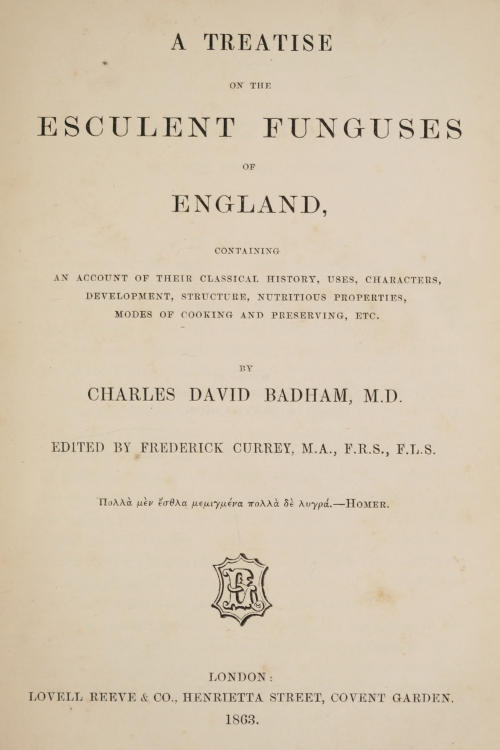
THE
ESCULENT FUNGUSES
OF
ENGLAND.
A TREATISE
ON THE
ESCULENT FUNGUSES
OF
ENGLAND,
CONTAINING
AN ACCOUNT OF THEIR CLASSICAL HISTORY, USES, CHARACTERS,
DEVELOPMENT, STRUCTURE, NUTRITIOUS PROPERTIES,
MODES OF COOKING AND PRESERVING, ETC.
BY
CHARLES DAVID BADHAM, M.D.
EDITED BY FREDERICK CURREY, M.A., F.R.S., F.L.S.
Πολλὰ μὲν ἔσθλά μεμιγμένα πολλὰ δὲ λυγρά.—Homer.
LONDON:
LOVELL REEVE & CO., HENRIETTA STREET, COVENT GARDEN.
1863.
PRINTED BY
JOHN EDWARD TAYLOR, LITTLE QUEEN STREET,
LINCOLN’S INN FIELDS.
PREFACE TO THE SECOND EDITION.
My lamented friend Dr. Badham having died since the first publication of this work, my advice was asked upon the subject of the preparation of a new edition. It was wished that the text of the work should be altered as little as possible, and that the price of the book should be materially lessened. The latter object could not be effected without reducing the number of the Plates; but it appeared to me that some plates relating to details of structure might very well be omitted, as well as the figures of a few Italian species which, although interesting in themselves, are quite unnecessary in a book on British Esculent Fungi. With the exception of the omission of the description of these latter species, and the addition of the description of two other species hereafter referred to, the alterations in the text are too trifling to require notice. With regard to the Figures in this edition, most of them are those of the former plates, somewhat reduced; a few have been taken from the plates of Mr. Berkeley’s ‘Outlines of British Fungology,’ and a few from original and other sources.
By a re-arrangement of the whole, the reduction in the number of the Plates has been effected, and, at the same time, figures of all the Fungi represented in the first edition have been given, as well as of two other species not there noticed. I should observe, however, that by a mistake of the artist an extra figure of the Horse Mushroom has been inserted in Plate IV. instead of one of the Common Mushroom.
The two species above alluded to which were not figured in the first edition, are Tuber æstivum and Helvella esculenta. The former must have been inadvertently omitted by Dr. Badham, as it has long been known as abundant in certain parts of England. Helvella esculenta, although alluded to by Dr. Badham, was not at that time known to be a British species. It has since been observed near Weybridge in Surrey, where it occurs almost every spring. The plant figured in Pl. XV. fig. 6 of the first edition under the name of Lycoperdon plumbeum, is not that species, but Lycoperdon pyriforme; it will be found at Pl. VIII. fig. 5. Dr. Badham states that all puff-balls are esculent, but, judging from the smell of Lycoperdon pyriforme, I should much doubt whether it would make an agreeable dish. Lycoperdon plumbeum is now better known as Bovista plumbea, and Lycoperdon Bovista as Lycoperdon giganteum.
There is some confusion about the synonymy of the plants described by Dr. Badham as Agaricus prunulus and Ag. exquisitus. It is unnecessary to discuss the matter here, and I have thought it not desirable under the circumstances to alter Dr. Badham’s nomenclature. They appear to be described in Mr. Berkeley’s work as Ag. gambosus, Fr., and Ag. arvensis, Schœff.
Dr. Badham’s observations on the spores of Fungi must be read in connection with the note added by him at the conclusion of the work; and to those who are interested in that part of the subject I should recommend the perusal of the seventh chapter of Mr. Berkeley’s ‘Outlines of British Fungology,’ and Tulasne’s recent work, ‘Selecta Fungorum Carpologia.’
Mr. Cooke, in his ‘Plain and Easy Account of British Fungi,’ recently published, mentions some species as esculent which are not noticed in this work. I have however no experience of their qualities, and must refer the reader to Mr. Cooke’s book for further information. He mentions Mr. Berkeley as an authority for considering Agaricus rubescens as suspicious; but, from long experience, I can vouch for its being not only wholesome, but, as Dr. Badham says, “a very delicate fungus.”
F. C.
PREFACE TO THE FIRST EDITION.
TO THE RIGHT REVEREND THE LORD BISHOP OF NORWICH.
My Lord,
I had two reasons for desiring that this humble performance should appear under the sanction of your Lordship’s name. Nothing could be more favourable to a Treatise on any department of Natural History, than the approval of one who has been so eminently successful in his cultivation of the same field.
But it is with much greater confidence that I dedicate a work, whose chief object it is to furnish the labouring classes with wholesome nourishment and profitable occupation, to a high functionary of that kingdom, which is distinguished from all others by recognizing the claims and furthering the interests of the poor.
I have the honour to be, my Lord,
With great respect, your Lordship’s
Obliged and humble Servant,
C. D. Badham.
CONTENTS.
| Page | |
| ETYMOLOGIES | 1 |
| THE RANGE OF FUNGUS GROWTHS | 7 |
| OF THEIR GENERAL FORMS, COLOURS, AND TEXTURE | 10 |
| ODOURS AND TASTES | 13 |
| EXPANSIVE POWER OF GROWTH | 14 |
| REPRODUCTIVE POWER | 16 |
| MOTION | 16 |
| PHOSPHORESCENCE | 18 |
| DIMENSIONS | 18 |
| CHEMICAL COMPOSITION | 20 |
| USES | 21 |
| MEDICAL USES | 25 |
| FUNGUSES CONSIDERED AS AN ARTICLE OF DIET | 27 |
| MODES OF DISTINGUISHING | 40 |
| CONDITIONS NECESSARY TO THEIR PRODUCTION | 47 |
| FAIRY RINGS | 52 |
| ON THE GROWTH OF FUNGUSES | 53 |
| ON THE DEVELOPMENT OF THE SPORES, OR QUASI-SEEDS[1] | 58 |
| OF THE ANNULUS, THE VELUM, AND THE VOLVA | 66 |
| OF THE STALK, AND OF THE PILEUS | 68 |
| OF THE GILLS, TUBES, PLAITS, AND SPINES | 69 |
| METHODICAL DISTRIBUTION OF BRITISH ESCULENT FUNGUSES | 72 |
| DESCRIPTION OF SPECIES:— | |
| Agaricus acris minor | 120 |
| Agaricus alutaceus | 117 |
| Agaricus atramentarius | 111 |
| Agaricus campestris | 94 |
| Agaricus castaneus | 143 |
| Agaricus comatus | 112 |
| Agaricus deliciosus | 102 |
| Agaricus Dryophilus | 107 |
| Agaricus emeticus | 118 |
| Agaricus exquisitus | 100 |
| Agaricus fusipes | 141 |
| Agaricus heterophyllus | 113 |
| Agaricus melleus | 139 |
| Agaricus nebularis | 108 |
| Agaricus Orcella | 129 |
| Agaricus oreades | 106 |
| Agaricus ostreatus | 121 |
| Agaricus personatus | 105 |
| Agaricus piperatus | 144 |
| Agaricus procerus | 88 |
| Agaricus prunulus | 85 |
| Agaricus ruber | 115 |
| Agaricus rubescens | 123 |
| Agaricus sanguineus | 120 |
| Agaricus semiglobatus | 108 |
| Agaricus ulmarius | 140 |
| Agaricus vaginatus | 142 |
| Agaricus violaceus | 143 |
| Agaricus virescens | 116 |
| Agaricus virgineus | 145 |
| Boletus edulis | 90 |
| Boletus luridus | 104 |
| Boletus scaber | 103 |
| Cantharellus cibarius | 110 |
| Clavaria coralloides | 135 |
| Fistulina hepatica | 127 |
| Helvella crispa | 130 |
| Helvella lacunosa | 131 |
| Helvella esculenta | 131 |
| Hydnum repandum | 126 |
| Lycoperdon Bovista | 138 |
| Lycoperdon plumbeum | 136 |
| Morchella esculenta | 123 |
| Morchella semilibera | 124 |
| Peziza acetabulum | 133 |
| Polyporus frondosus | 133 |
| Tuber æstivum | 145 |
| Verpa digitaliformis | 132 |
| CONCLUSION | 146 |
DESCRIPTION OF PLATES.
| Plate I. | |
| Fig. 1. | Agaricus prunulus. |
| ” 2. | Agaricus personatus. |
| Plate II. | |
| Agaricus procerus. | |
| Plate III. | |
| Fig. 1, 2. | Boletus edulis. |
| ” 3, 4. | Agaricus heterophyllus. |
| Plate IV. | |
| Fig. 1. | Polyporus frondosus. |
| ” 2. | Agaricus nebularis. |
| ” 3, 4, 5. | Agaricus exquisitus. |
| Plate V. | |
| Fig. 1. | Helvella lacunosa. |
| ” 2. | Clavaria amethystina. |
| ” 3. | Clavaria coralloides. |
| ” 4. | Agaricus deliciosus. |
| ” 5. | Clavaria cinerea. |
| ” 6. | Clavaria rugosa. |
| Plate VI. | |
| Fig. 1, 2. | Boletus scaber. |
| ” 3, 4, 5. | Boletus luridus. |
| Plate VII. | |
| Fig. 1, 2, 3. | Agaricus comatus. |
| ” 4. | Agaricus oreades. |
| ” 5. | Agaricus Dryophilus. |
| Plate VIII. | |
| Fig. 1. | Cantharellus cibarius. |
| ” 2. | Tuber æstivum. |
| ” 3, 4. | Hydnum repandum. |
| ” 5. | Lycoperdon pyriforme. |
| Plate IX. | |
| Fig. 1, 2. | Agaricus atramentarius. |
| ” 3. | Agaricus melleus. |
| Plate X. | |
| Agaricus ostreatus. | |
| Plate XI. | |
| Fig. 1, 2. | Agaricus Orcella. |
| ” 3, 4, 5. | Agaricus rubescens. |
| Plate XII. | |
| Fig. 1, 2. | Fistulina hepatica. |
| ” 3, 4, 5. | Helvella esculenta. |
| ” 6. | Morchella esculenta. |
INTRODUCTORY NOTICE.
No country is perhaps richer in esculent Funguses than our own; we have upwards of thirty species abounding in our woods. No markets might therefore be better supplied than the English, and yet England is the only country in Europe where this important and savoury food is, from ignorance or prejudice, left to perish ungathered.
In France, Germany, and Italy, Funguses not only constitute for weeks together the sole diet of thousands, but the residue, either fresh, dried, or variously preserved in oil, vinegar, or brine, is sold by the poor, and forms a valuable source of income to many who have no other produce to bring into the market. Well, then, may we style them, with M. Roques, “the manna of the poor.” To call attention to an article of commerce elsewhere so lucrative, with us so wholly neglected, is the object of the present work, to which the best possible introduction will be a brief reference to the state of the fungus market abroad.
The following brief summary was drawn up by Professor Sanguinetti, the Official Inspector (“Ispettore dei Funghi”) at Rome; let it speak for itself:—“For forty days during the autumn, and for about half that period every spring, large quantities of Funguses, picked in the immediate vicinity of Rome, from Frascati, Rocca di Papa, Albano, beyond Monte Mario towards Ostia and the neighbourhood of the sites of Veii and Gabii, are brought in at the different gates. In the year 1837, the Government instituted the so-called Congregazione Speciale di Sanità, which, among other duties, was more particularly required to take into serious consideration the commerce of Funguses, from the unrestricted sale of which during some years past, cases of poisoning had not unfrequently occurred. The following decisions were arrived at by this body:—
“1st. That for the future an ‘Inspector of Funguses,’ versed in botany, should be appointed to attend the market in place of the peasant, whose supposed practical knowledge had been hitherto held as sufficient guarantee for the public safety.
“2nd. That all the Funguses brought into Rome by the different gates should be registered, under the surveillance of the principal officer, in whose presence also the baskets were to be sealed up, and the whole for that day’s consumption sent under escort to a central depôt.
“3rd. That a certain spot should be fixed upon for the Fungus market, and that nobody, under penalty of fine and imprisonment, should hawk them about the streets.
“4th. That at seven o’clock A.M. precisely, the Inspector should pay his daily visit and examine the whole, the contents of the baskets being previously emptied on the ground by the proprietors, who were then to receive, if the Funguses were approved of, a printed permission of sale from the police, and to pay for it an impost of one baioccho (a halfpenny) on every ten pounds.
“5th. That quantities under ten pounds should not be taxed.
“6th. That the stale funguses of the preceding day, as well as those that were mouldy, bruised, filled with maggots, or dangerous (muffi, guasti, verminosi, velenosi), together with any specimen of the common mushroom (Ag. campestris) detected in any of the baskets, should be sent under escort and thrown into the Tiber.
“7th. That the Inspector should be empowered to fine or imprison all those refractory to the above regulations; and, finally, that he should furnish a weekly report to the Tribunal of Provisions (Il Tribunale delle Grascie) of the proceeds of the sale.
“As all fresh Funguses for sale in quantities exceeding ten pounds are weighed, in order to be taxed, we are enabled to arrive at an exact estimate of the number of pounds thus disposed of. The return of taxed Mushrooms in the city of Rome during the last ten years, gives a yearly average of between sixty and eighty thousand pounds weight; and if we double this amount, as we may safely do, in order to include such smaller untaxed supplies as are disposed of as bribes, fees, and presents, and reckon the whole at the rate of six baiocchi, or threepence per pound (a fair average), this will make the commercial value of fresh Funguses very apparent, showing it here to be little less than £2000 a year.”
But the fresh Funguses form only a small part of the whole consumption, to which must be added the dried, the pickled, and the preserved; which sell at a much higher price than the first.[2] Supposing, however, that with these additions the supply of all kinds only reached a sum the double of that given above, even this would furnish us with an annual average of nearly four thousand pounds sterling; and this in a single city, and that, too, by no means the most populous one in Italy![3] What, then, must be the net receipts of all the market-places of all the Italian States? For as in these the proportion of the price of esculent Funguses to butchers’ meat is as two to three, it is plain that prejudice has deprived the poor of this country, not only of many thousand pounds of the former but also of as much of the latter, as might have been purchased by exchange, and of the countless sums which might have been earned in gathering them.[4]
ON THE ESCULENT FUNGUSES OF ENGLAND.
ETYMOLOGIES.
By the word μύκης, ητος or ου, ὁ, whereof the usually received root, μῦκος (mucus), is probably factitious, the Greeks used familiarly to designate certain, but indefinite species of funguses, which they were in the habit of employing at table. This term, in its origin at once trivial and restricted to at most a few varieties, has become in our days classical and generic; Mycology, its direct derivative, including, in the language of modern botany, several great sections of plants (many amongst the number of microscopic minuteness), which have apparently as little to do with the original import of μύκης as smut, bunt, mould, or dry-rot, have to do with our table mushrooms. A like indefiniteness formerly characterized the Latin word fungus, though it be now used in as catholic a sense as that of μύκης; this, in the classic times of Rome, seems to have been confined (without any precise limitation, however) to certain sorts which might be eaten, and to others which it was not safe to eat. The
which occurs in Ovid’s ‘Fasti,’ alludes to the former; the
of Martial, points to an inferior kind, but still esculent; whilst the word not unfrequently designated, if not actual toadstools, at least very equivocal mushrooms; of which character were those “ancipites fungi” presented by Veiento to his poor clients. Some melancholy etymologists, upon whom good mushrooms are really thrown away, would beget fungus out of funus, but Voss[6] judiciously rejects so harsh and forced a derivation, mentioning together with it others that are still more so.
The word Boletus, which now stands for a large genus of the section Pileati, was used in ancient Rome to designate that particular mushroom which had the honour, under Agrippina’s orders and Locusta’s cookery, of poisoning Claudius; in memory of which event it is now called Amanita Cæsarea, the Cæsar’s mushroom. It occurs frequently both in the poets and prose writers of those days, and was in high esteem, as we collect from Pliny, who, though no mushroom-fancier himself, calls this “Boletus optimi cibi.” Nero, in playful allusion to his uncle’s death, of which it was the occasion, designates it the ‘food of gods,’ βρῶμα θεῶν; and Martial celebrates it in many a convivial epigram; in one, for instance, where he asks his hard-hearted patron, “what possible pleasure it can be for his guests to sit at his table, and see him devour boletuses;” in another, “gold and silver and dresses may be trusted to a messenger, but not a boletus, (subaudi) because he will eat it on the way.” This is the only ancient mushroom which we at once recognize by the description of it; “it originates,” says Pliny, “in a volva, or purse, in which it lies at first concealed as in an egg; breaking through this, it rises upwards on its stalk; the colour of its cap is red; it takes a week to pass through the various stages of its growth and declension.” The suillus—probably the same as the modern porcino (a word of analogous import), which was, and is, eaten by men as well as pigs, and not always by these[7]—was, according to Pliny, the fungus which most readily lent itself to poisoning by mistake; a remark so far consonant to modern experience, that it is liable, without some attention, to be confounded with the Boletus luridus, B. cyanescens, and others, which in their general shape and external hue resemble it, though it is not by any means certain that any of these species, with which it may be confounded, are themselves poisonous.[8] The word tuber, though it occasionally (as in Juvenal) meant the truffle, seems to have been used with considerable latitude. Thus the tubers said to spring up after those optatos imbres, those “long-wished-for showers of spring,” were, probably, not truffles, but puff-balls, which, at the season of warm rains grow with incredible rapidity, forming an esteemed article of luxury, not only in Italy, but also in India; whereas the truffle never makes its appearance in the markets at such times, nor comes up so immediately after rain. Tuber, like our ancient “fusseball,” seems a common appellation both for truffles and puff-balls. What the ancients understood by hydnum is as little precise or discriminate as the last word; for Theophrastus declares it to have a light bark, λειόφλοιον εἶναι, in which case it is a puff-ball, while the plant called ὑδνοφίλον, which is said to indicate the whereabouts of hydna in its neighbourhood, can only refer to the truffle. The truffle, however, which is now so much prized throughout Europe, seems not to have been known to the ancients, at least it is not described by them.[9] That which the Greeks called misy, and the Romans the Libyan truffle,[10] was white and of very delicious flavour, whilst by hydnum (when this word really meant truffle) they usually designated a particular kind bearing a smooth red rind, and abounding in certain districts of Italy; but having no chance against the black, nodulated tuber tuberum, the truffle par excellence, found in such abundance in the vicinities of Rome, Florence, Siena, etc., and, above all, amongst the Nursian hills of Umbria, over against Spoleto, whence it is largely exported throughout and beyond Italy. Under the name Peziza, the ancients appear at times to describe, unconsciously, a Scleroderma or species of puff-ball after it has evacuated its seed, when it presents a flattened surface, and so far looks like a Peziza, with which, in fact, it has no connection. By Amanita, Galen intended some kind of esculent fungus, but we know not which; this word has now come to have a more extensive import, and to designate, besides one or two species that are good, many of the most dangerous character. Whatever the ancient Amanita may have been, it was formerly in high repute; Galen declares that, next to the Boletus, it is ἀβλαβέστατον to eat—in which good report of it he is abundantly borne out by the concurrent testimony of Nicander. What Dioscorides meant by ἀγαρικὸν is another uncertainty, to resolve which we have not sufficient data; one thing seems plain, that it could not have been our officinal Agaric, for that grows upon the Larch, whereas his Agaricon grew upon the Cedar. Julius Scaliger amuses himself at the expense of Athenæus for saying that Agaricus is so called from the country of Agaria, whence he would make out that it originally came; whereas there never was such a country, his Agaria being, like our Poiatia, only another synonym for Fancy’s fairyland.[11]
The words champignon and mushroom have both a French origin, though, like the corresponding derivatives from the Greek and Latin, they too have come to signify things different from what they originally designated; champignon, for example, of which champ would seem to be the root, is generic in France. The ‘Traités sur les Champignons’ of Bulliard, Persoon, Paulet, Cordier, and Roques, are treatises of funguses in genere; whilst in England we restrict the word champignon to one small Agaric, which, as it grows in the so-called “fairy-rings,” is hence named Ag. oreades. Again, there can be no doubt that our word mushroom (which, as contradistinguished from toadstool, is so far generic) comes from the French mouceron (originally spelt mousseron), and belongs of right to that most dainty of funguses, the A. prunulus, which grows amidst tender herbage and moss (whence its name), and which is justly considered, over almost the whole continent of Europe, as the ne plus ultra of culinary friandise. It abounds in various parts of England, being everywhere trodden underfoot, or reaped down, or dug up as a nuisance, while the rings which it so sedulously forms are as sedulously destroyed. The very odour which it exhales under these injuries, which the French call “un parfum exquis aromatisé,”[12] and the Italians, “un odore gratissimo,”[13] is in England occasionally cited to its disadvantage in confirmation of its supposed noxious qualities. Thus, while we use the word mushroom, which is the proper appellation of this species, for another (very good, no doubt, but wholly unlike it in its botanical characters, flavour, and appearance), this neglected, and ignorantly neglected, species, finds itself deprived of its rightful name, and proscribed as a toadstool. The origin of this last word, toadstool, which makes them seats or thrones for toads, does not quite satisfy me, I confess, though there be doughty authorities for it in Johnson’s Dictionary and in Spenser’s ‘Faery Queen’!
and, though an anonymous Italian authority declares that, in Germany, they have actually been seen sitting on their stools,[14] still, even in Germany, it must be admitted that they do not use them as frequently as we might expect, had they been created for this end. In that most grisly and ghastly waxwork exhibition at Florence, representing a charnel-house filled with the recent victims to a raging plague, in every stage of decomposition, the toad and his stool are not forgotten; but the artist, who had here to deal with matter, and to consult what it would bear, has not put his toads upon these brittle stools, lest, giving way, both should come to the ground; he has been content to convert them into toad-umbrellas, and to spread them as an awning over their heads.[15]
THE RANGE OF FUNGUS GROWTHS.
The family of Funguses, in the comprehensive sense in which we now employ the term, is immense. Merely catalogued and described, there are sufficient to fill an octavo volume of nearly 400 pages of close print, of British species alone; altogether, there cannot be less than 5000 recognized species at present known, and each year adds new ones to the list. The reader’s surprise at this will somewhat diminish, when he considers, that not only the toadstools which beset his walks, whether growing upon the ground or at the roots of trees, belong to this class, but that the immense hordes of parasites which feed at his expense, and foul, like the Harpies, whatever they may not actually consume, belong to it also.
For the single mushroom that we eat, how many hundreds there be that retaliate and prey upon us in return! To enumerate but a few, and these of the microscopic kinds (on the other side are some which the arms can scarcely embrace): the Mucor mucedo, that spawns upon our dried preserves; the Ascophora mucedo, that makes our bread mouldy (“mucidæ frustra farinæ”[16]); the Uredo segetum, that burns Ceres out of her own cornfields; the Uredo rubigo, whose rust is still more destructive; and the Puccinia graminis, whose voracity sets corn-laws and farmers at defiance, are all funguses! So is the grey Monilia, that rots, and then fattens upon, our fruits; and the Mucor herbariorum, that destroys the careful gleanings of the painstaking botanist. When our beer becomes mothery, the mother of that mischief is a fungus. If pickles acquire a bad taste, if ketchup turns ropy and putrifies, funguses have a finger in it all! Their reign stops not here; they prey upon each other; they even select their victims! There is the Myrothecium viride, which will only grow upon dry Agarics, preferring chiefly, for this purpose, the Agaricus adustus; the Mucor[17] chrysospermus, which attacks the flesh of a particular Boletus; the Sclerotium cornutum, which visits some other moist mushrooms in decay. There are some Xylomas that will spot the leaves of the Maple, and some those of the Willow, exclusively. The naked seeds of some are found burrowing between the opposite surface of leaves; some love the neighbourhood of burnt stubble and charred wood; some visit the sculptor in his studio, growing up amidst the heaps of moistened marble dust that have caked and consolidated under his saw. The Racodium of the low cellar[18] festoons its ceiling, shags its walls, and wraps its thick coat round our wine-casks,[19] keeping our oldest wine in closest bond; while the Geastrum, aspiring occasionally to leave this earth, has been found suspended, like Mahomet’s coffin, between it and the stars, on the very highest pinnacle of St. Paul’s.[20] The close cavities of nuts occasionally afford concealment to some species; others, like leeches, stick to the bulbs of plants, and suck them dry; these (the architect’s and ship-builder’s bane) pick timber to pieces, as men pick oakum; nor do they confine their selective ravages to plants alone, they attach themselves to animal structures, and destroy animal life; the Onygena equina has a particular fancy for the hoofs of horses and for the horns of cattle, sticking to these alone; the belly of a tropical fly[21] is liable, in autumn, to break out into vegetable tufts of fungous growth, and the caterpillar to carry about on his body a Cordyceps larger than himself. The disease called Muscadine, which destroys so many silkworms, is also a fungus (Botrytis Bassiana), which in a very short time completely fills the worm with filaments very unlike those it is in the habit of secreting.[22] The vegetating wasp,[23] too, of which everybody has heard, is only another mysterious blending of vegetable with insect life. Lastly, and to take breath, funguses visit the wards of our hospitals, and grow out of the products of surgical disease.[24] Where, then, are they not to be found? do they not abound, like Pharaoh’s plagues, everywhere? is not their name legion, and their province ubiquity?[25]
OF THEIR GENERAL FORMS, COLOURS, TEXTURE, TASTES, SMELLS, ETC.
What geometry shall define their ever-varying shapes? who but a Venetian painter do justice to their colours?[26] or what modifications of ‘soft’ and ‘hard’ convey an adequate knowledge of all their various crases and consistencies? As to shapes, some are simple threads, like the Byssus, and never get beyond this; some shoot out into branches, like seaweed; some puff themselves out into puff-balls; some thrust their heads into mitres;[27] these assume the shape of a cup,[28] and those of a wine-funnel;[29] some, like A. mammosus, have a teat; others, like the A. clypeolarius, are umbonated at their centre; these are stilted upon a high leg,[30] and those have not a leg to stand on; some are shell-shaped, many bell-shaped, and some hang upon their stalks like a lawyer’s wig;[31] some assume the form of the horse’s hoof, others of a goat’s beard: in Clathrus cancellatus you look into the fungus through a thick red trellis which surrounds it. Some exhibit a nest in which they rear their young,[32] and, not to speak of those vague shapes,