
The Project Gutenberg eBook of A View of Society and Manners in Italy, Volume 1 (of 2)
Title: A View of Society and Manners in Italy, Volume 1 (of 2)
Author: John Moore
Release date: February 17, 2019 [eBook #58901]
Language: English
Credits: Produced by The Online Distributed Proofreading Team at
http://www.pgdp.net (This file was produced from images
generously made available by The Internet Archive)
Transcriber’s Note: Evident printing errors have been changed, but otherwise the original (and antiquated) spelling has been preserved, in both English and other languages. The errata have been corrected.
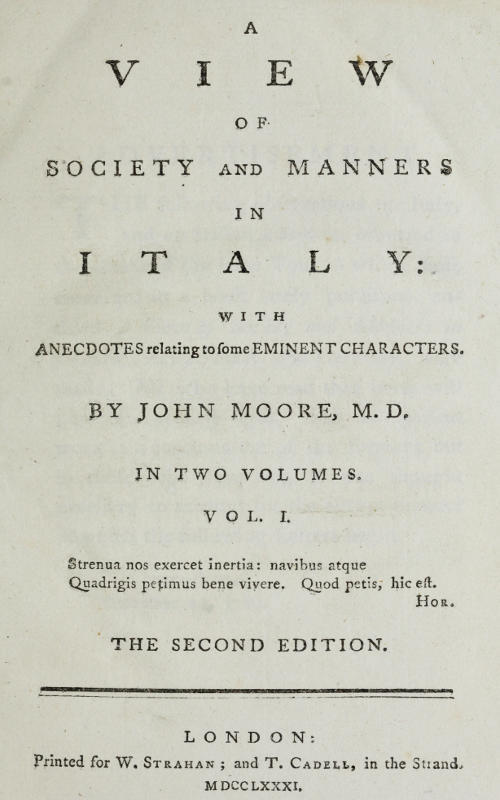
A
VIEW
OF
SOCIETY and MANNERS
IN
ITALY:
WITH
ANECDOTES relating to some EMINENT CHARACTERS.
BY JOHN MOORE, M. D.
IN TWO VOLUMES.
VOL. I.
THE SECOND EDITION.
LONDON:
Printed for W. Strahan; and T. Cadell, in the Strand.
MDCCLXXXI.
ADVERTISEMENT.
The following observations on Italy, and on Italian manners, occurred in the course of the same Tour in which those contained in a book lately published, entitled A View of Society and Manners in France, Switzerland, and Germany, were made. All who have read that book will perceive, at first sight, that the present work is a continuation of the former; but to those who have not, it was thought necessary to account for the abrupt manner in which the following Letters begin.
Clarges-street,
December 14, 1780.
Just Published,
A NEW EDITION OF
A VIEW of SOCIETY and MANNERS in FRANCE, SWITZERLAND, and GERMANY; with Anecdotes relating to some Eminent Characters. In Two Volumes. Price 10s. in Boards.
CONTENTS
OF THE
FIRST VOLUME.
| LETTER I. p. 1. |
| Journey from Vienna to Venice. |
| LETTER II. p. 20. |
| The arsenal.—The Bucentaur.—Doge’s marriage. |
| LETTER III. p. 27. |
| The island of Murano.—Glass manufactory.—Mr. Montague. |
| LETTER IV. p. 39. |
| Situation of Venice.—Lagune.—Canals.—Bridges. |
| LETTER V. p. 46. |
| Piazza di St. Marco.—Patriarchal church.—Ducal palace.—Broglio. |
| LETTER VI. p. 56. |
| Reflections excited by the various objects around St. Mark’s square.—On painting.—A connoisseur. |
| LETTER VII. p. 69. |
| Origin of Venice. |
| LETTER VIII. p. 77. |
| Various changes in the form of government.—Tyrannical conduct of a Doge.—Savage behaviour of the people.—Commerce of Venice. |
| LETTER IX. p. 89. |
| New regulations.—Foundation of the aristocracy.—Origin of the ceremony of espousing the Sea.—New forms of magistracy. |
| LETTER X. p. 104. |
| Henry Dandolo. |
| LETTER XI. p. 114. |
| New courts.—New magistrates.—Reformation of the Venetian code.—The form of electing the Doge. |
| LETTER XII. p. 129. |
| Aristocracy established.—Conspiracies.—Insurrections.—Ecclesiastical Inquisition.—The College, or Seigniory. |
| LETTER XIII. p. 144. |
| Conspiracy against the State, by a Doge.—Singular instance of weakness and vanity in a noble Venetian.—New magistrates to prevent luxury.—Courtesans. |
| LETTER XIV. p. 157. |
| Rigour of Venetian laws exemplified in the cases of Antonio Venier, Carlo Zeno, and young Foscari. |
| LETTER XV. p. 171. |
| The Council of Ten, and the State Inquisitors.—Reflections on these institutions. |
| LETTER XVI. p. 187. |
| League of Cambray.—War with Turks.—Antonio Bragadino.—Battle of Lapanta.—Disputes with the Pope. |
| LETTER XVII. p. 201. |
| Marquis of Bedamar’s conspiracy.—False accusations.—The siege of Candia.—The impatience of a Turkish Emperor.—Conclusion of the review of the Venetian Government. |
| LETTER XVIII. p. 215. |
| Venetian manners.—Opera.—Affectation.—A Duo.—Dancers. |
| LETTER XIX. p. 227. |
| No military establishment at Venice.—What supplies its place. |
| LETTER XX. p. 232. |
| Reflections on the nature of Venetian Government.—Gondoleers.—Citizens.—The Venetian subjects on the Terra Firma. |
| LETTER XXI. p. 240. |
| Gallantry.—Cassinos. |
| LETTER XXII. p. 249. |
| Character of Venetians.—Customs and usages.—Influence of fashion in matters of taste.—Prejudice.—The excellence of Italian comic actors. |
| LETTER XXIII. p. 262. |
| Departure from Venice.—Padua.—St. Anthony, his tomb and miracles. |
| LETTER XXIV. p. 270. |
| Church of St. Justina.—The bodies of St. Matthew and St. Luke.—The university.—Beggars. |
| LETTER XXV. p. 275. |
| The antiquity of Padua.—The Brenta.—The Po.—The Thames. |
| LETTER XXVI. p. 285. |
| Ferrara.—The Family of Este.—Ariosto, the Emperor, and his brothers, lodge at an inn, which oversets the understanding of the landlord. An inscription. |
| LETTER XXVII. p. 292. |
| Bologna. Its government, commerce, palaces. |
| LETTER XXVIII. p. 301. |
| The academy of arts and sciences.—Church of St. Petronius.—Dominican convent.—Palaces.—Raphael.—Guido. |
| LETTER XXIX. p. 313. |
| Journey from Bologna to Ancona.—The Rubicon.—Julius Cæsar.—Pesaro.—Fano.—Claudius Nero.—Asdrubal.—Senegalia. |
| LETTER XXX. p. 323. |
| Ancona.—The influence of commerce on the characters of mankind.—The Mole.—The triumphal arch of the Emperor Trajan. |
| LETTER XXXI. p. 333. |
| Loretto.—History of the Casa Santa. |
| LETTER XXXII. p. 340. |
| Description of the sacred chapel.—The treasury. |
| LETTER XXXIII. p. 351. |
| Pilgrimages to Loretto.—Manufactures.—Confessionals.—Basso relievos.—Zeal of pilgrims.—Iron grates before the chapels.—Reflections. |
| LETTER XXXIV. p. 362. |
| Tolentino.—The Apennines.—A hermit.—Umbria.—Spoletto. |
| LETTER XXXV. p. 371. |
| Terni.—Narni.—Otricoli.—Civita Castellana.—Campania of Rome. |
| LETTER XXXVI. p. 380. |
| Rome.—Conversazionis.—Cardinal Bernis.—The distress of an Italian lady. |
| LETTER XXXVII. p. 389. |
| Remarks on ancient and modern Rome.—The church of St. Peter’s. |
| LETTER XXXVIII. p. 404. |
| The ceremony of the Possesso. |
| LETTER XXXIX. p. 413. |
| Pantheon.—Coliseum.—Gladiators. |
| LETTER XL. p. 432. |
| The Campidoglio.—Forum Romanum.—Jews. |
| LETTER XLI. p. 442. |
| Ruins.—Via Sacra.—Tarpeian Rock.—Campus Martius.—Various Forums.—Trajan’s Column. |
| LETTER XLII. p. 452. |
| The beatification of a Saint. |
| LETTER XLIII. p. 459. |
| Character of modern Italians.—Observations on human nature in general.—An English Officer.—Cause of the frequency of the crime of murder. |
| LETTER XLIV. p. 474. |
| Different kinds of punishment.—Account of an execution.—Souls in purgatory. |
| LETTER XLV. p. 487. |
| The usual course with an antiquarian.—An expeditious course, by a young Englishman.—The Villa Borghese. |
| LETTER XLVI. p. 506. |
| The morning study of an artist.—Conversation with him on that subject.—An Italian lady and her Confessor.—The Lady’s religious scruples and precaution. |
A
VIEW
OF
SOCIETY and MANNERS
IN
ITALY.
LETTER I.
Venice.
DEAR SIR,
Having left Vienna, we proceeded through the Duchies of Stiria, Carinthia, and Carniola, to Venice. Notwithstanding the mountainous nature of those countries, the roads are remarkably good. They were formed originally at a vast expence of labour to the inhabitants, but in such a durable manner, that it requires no great trouble to keep them in repair, to which all necessary attention seems to be paid. Some of the mountains are covered with wood, but more generally they are quite bare. Among them are many fields and vallies, fit for pasturage and the cultivation of grain; a few of these vallies are remarkably fertile, particularly in the Duchy of Carniola. The bowels of the earth abound in lead, copper, and iron. Stirian steel is reckoned excellent; and the little town of Idra, in Carniola, is famous for the quicksilver mines in its neighbourhood.
It has been a matter of controversy among the learned (for the learned dispute about many things which the ignorant think of little importance), by what road the original inhabitants came, who first peopled Italy? And it has been decided by some, that they must have entered by this very country of Carniola. These gentlemen lay it down as an axiom, that the first inhabitants of every country in the world, that is not an island, must have come by land, and not by sea, on account of the ignorance of the early inhabitants of the earth in the art of navigation; but Italy being a peninsula, the only way to enter it by land, is at some part of the isthmus by which it is joined to the rest of Europe. The Alps form great part of that isthmus, and, in the early ages, would exclude strangers as effectually as the sea. The easiest, shortest, and only possible way of avoiding seas and mountains, in entering Italy, is by the Duchy of Carniola and Friuli. Ergo, they came that way. Q.E.D.
In contradiction to the preceding demonstration, others assert, that the first inhabitants came in ships from Greece; and others have had the boldness to affirm, that Italy had as good a right as any other country to have inhabitants of its own original production, without being obliged to any vagrants whatever.
I thought it right to give you the opinion of the learned on this country, because it is not in my power to describe it from my own observation; for we passed through those Duchies with a rapidity which baffles all description.
The inns are as bad as the roads are good; for which reason we chose to sleep on the latter rather than in the former, and actually travelled five days and nights, without stopping any longer than was necessary to change horses.
This method of travelling, however agreeable and improving it may be in other respects, is by no means calculated to give one the most perfect and lasting idea of the face of a country, or of the manners and characters of the inhabitants; and therefore I hope you will not insist upon an exact account of either.
Among other curiosities which our uninterrupted and expeditious movement prevented us from observing with due attention, was the town of Gratz, the capital of Stiria, through which we unfortunately passed in the middle of the night.
I did not regret this on account of the regularity of the streets, the venerable aspect of the churches, the sublime site of the castle, and other things which we had heard extolled; but solely because we had not an opportunity of visiting the shrine of St. Allan, a native of England, who formerly was a Dominican Monk of a convent in this town, and in high favour with the Virgin Mary, of which she gave him some proofs as strong as they were extraordinary. Amongst other marks of her regard, she used to comfort him with milk from her breasts. This, to be sure, is a mark of affection seldom bestowed upon favourites above a year old, and will, I dare say, surprise you a good deal. There is no great danger, however, that an example of this kind should spread among virgins. Of the fact in the present instance there can be no doubt; for it is recorded in an inscription underneath a portrait of the Saint, which is carefully preserved in the Dominican convent of this city. We continued our journey, in the full resolution of reaching Venice before we indulged in any other bed than the post-chaise; but were obliged to stop short on a sudden for want of horses, at a small town called Wipach, bordering on the county of Goritia, in Carniola.
Before setting out from Vienna, we had been informed, that the Archduke and his Princess were about to return to Milan; for which reason we thought it adviseable to remain at Vienna eight days after their departure, to avoid the inconveniencies which might arise from a deficiency of post-horses on such an unfrequented road.
Having taken our measures with so much foresight, we little expected, when we actually did set out, to meet with any delay in our progress.
The Archduke and his Duchess, however, had thought proper to go out of the direct road as far as Trieste, to view the late improvements of that town, whose commerce is greatly encouraged and protected by the Emperor; and remaining there a few days, all the post-horses which had been assembled to carry them to Trieste, were kept in the post-houses for their use; consequently we found none at Wipach. It began to grow dark when we arrived; the Post-master was smoking his pipe at the door. As soon as the chaise stopped, we called to him to get ready the horses without loss of time; for, I added, with a tone of importance, that we could not possibly stay a moment. To this he replied coolly, that since we were in so very great a hurry, he should not attempt to detain us, but that he had no horses to carry us on. I asked, how soon they could be got. He answered, when they returned from attending the Archduke; but whether that would be the next day, the following, or a day or two after, he could not tell.
It appeared a great hardship to be stopped short, so unexpectedly, at a little paultry inn, and we agreed that nothing could have happened more unfortunately. After a few hasty ejaculations, which regarded the posting establishment, and the Lords of Police of this country, we resolved to make a virtue of necessity, and bear our misfortunes with firmness and equanimity.
As we stepped out of the chaise, I ordered the Post-master, therefore, to get ready beds, a good supper, and some of his best wine. Instead of receiving these injunctions with marks of satisfaction, as I expected, he answered without emotion, that he had no wine but for his own drinking; that he never gave suppers to any but his own family; and that he had no bed, except that which he himself, his wife, and his child occupied, which could not easily hold any more than them three at a time.
I had not hitherto perceived that this man’s house was not an inn: as soon as I was undeceived, I begged he would inform us where the inn was. He pointed with his pipe to a small house on the opposite side of the street.
There we were told, that all the victuals in the house were already devoured—three or four guests were in every spare room—the family going to bed—and they could not possibly receive any more company. We had nearly the same account at another little inn, and an absolute refusal at every house where we sued for admittance.
The town of Wipach is so near Goritia, that no travellers, except those of the meanest kind, ever think of stopping at the former; and therefore the inhabitants have no idea of making preparations for other guests.
In this dilemma I returned to our Post-master, who was still smoking his pipe before the door. I informed him of our bad success, and, in a more soothing tone of voice than that in which I had formerly addressed him, begged to know how we were to dispose of ourselves that night. He replied, with admirable composure, that was more than he could tell; but as the horses were expected in a few days, if I should send him word where we were to be found, he would take care to let us know the moment they should be ready: in the mean time, as it began to rain, and the evening was exceedingly cold, he wished us a very good night. So saying, he went into the house, shutting and bolting the door very carefully after him.
No philosopher, ancient or modern, ever supported the distresses of others with more equanimity than this man.
We were now fully convinced, that to be under the necessity of remaining all night at an inn, when they incline to proceed on their journey, is not the most unfortunate thing that can befal travellers, and would have now been happy in that situation which we had considered with horror an hour or two before.
In this forlorn condition I turned to an Italian servant of the Duke of H——’s, a shrewd fellow, who seldom wanted a resource in times of difficulty. He seemed, however, a little nonplussed on the present emergency; he stood shrugging his shoulders, with his eyes fixed on the ground. At length, starting as if he had that instant awaked, he muttered, “Cent ore di maniconia non pangano un quattrino di debito,” and then walked away with an air not totally devoid of hope.
I attended him, without knowing upon what his expectations were founded. We came to a convent of Monks, and got admittance; the Italian called for the Superior, and told him, in a few words, our condition. The venerable old man heard him with an air of benevolence; he expressed sorrow at the treatment we had received, and, desiring me to accompany him, said he would endeavour to find us lodgings. He conducted us to a poor looking house, occupied by a widow and her children. As soon as the good Monk had mentioned our case, she said we should be most welcome to such entertainment as she could afford. We had an excellent supper of sour krout, and sallad. I shall never forget it. I found her wine excellent, and her beds delightful; the good Monk seemed to enjoy the satisfaction we expressed, and positively refused to accept of any other recompence for his trouble.
Had we found the most elegant inn, and the most luxurious supper at our arrival, we might possibly have spent the evening in repining at being disappointed in post-horses; but the dread of so small a misfortune as passing the night supperless in the streets, reconciled us at once to the widow’s hovel, and made us happy with her homely fare; so necessary is a certain portion of hardships or difficulties for giving a zest to enjoyment. Without them, the comforts of life are apt to become insipid; and we see that the people who, independent of any effort of their own, have every enjoyment at their command, are, perhaps, of all mankind, those who have the least enjoyment.
The widow, as we understood in the morning, had sat up all night with her family, that we might be accommodated with beds. She had no reason to repent her hospitality. The poor woman’s gratitude made her talk loudly of the D—— of H——’s generosity; which coming to the ears of the Post-master, induced him to make an effort to get the chaises dragged on to Goritia, without waiting the return of the post-horses.
This was performed by three cart-horses and two oxen, which were relieved in the most mountainous part of the road by buffalos. There is a breed of these animals in this country; they are strong, hardy, and docile, and found preferable to either horses or oxen, for ploughing in a rough and hilly country.
When we arrived at Goritia, we found the inhabitants in their holiday dresses, at the windows, and in the streets, waiting with impatience for a sight of the Grand Duke and Duchess. Having applied at the post-house for horses, we were informed that none could be granted, all being retained for the accommodation of his Highness. I could not help remarking to the D—— of H——, that Dukes seemed to be in a very different predicament from prophets in their own countries.
Things turned out better than we had reason to expect. Their Highnesses arrived in the evening; and as they did not propose to leave Goritia till next morning, the Archduke had the politeness to give orders that the D—— of H—— should have what horses he wanted from the post-houses.
We set out immediately, and arrived at the next stage between one and two in the morning. In that part of the world, raising the people at midnight, and harnessing the horses for two carriages, takes up, at least, as much time as driving two stages in some parts of England. Just as we were going out of the post-house court, the Archduke’s butler and cook arrived; they were going forward, as usual, to prepare supper, &c. at the inn where their Highnesses intended to lie. They knew that the horses were all retained for their master, but had not heard of the particular order in favour of the D—— of H——. Seeing ten horses going to set out, they exclaimed against the Post-master, and threatened him with the vengeance of the whole house of Austria through all its branches, if he should permit a single horse to leave the post-house till the Archduke and his suite had passed.
The man, terrified with these threats, ordered the postilions to dismount, and put up the horses. This mandate was by no means agreeable to the D—— of H——; and the Post-master’s fear of the indignation of the Imperial family, was that instant lost in a danger which was presented to his face, and more immediately threatened his person—he ordered the postilions to drive on.
The next post was at a small town in the Venetian State, where we found that orders had come from Venice to the same effect with those received at the different stages we had already past. The D—— of H——’s Italian servant thought it would save time to make us pass for part of the company to which these orders related—he ordered horses in the name of the Grand Duke, and was instantly obeyed—but the butler and cook arriving soon after, told a different tale. Couriers were dispatched, one of whom overtook us, and, in the name of the magistrates, ordered the postilions to drive back, for we were a gang of impostures, who had no connection with the Grand Duke. The same arguments, however, which had so good an effect on the German Post-master, prevailed also on the courier to be silent, and the postilions to proceed.
It was midnight before we arrived at Mestre, a small town on the banks of the Lagune, five miles from Venice, where we remained all night. Next morning we hired a boat, and in two hours were landed in the middle of this city.
We have taken very delightful apartments at an inn, on the side of the great canal. They had been just quitted by his Royal Highness the Duke of Gloucester, who is at present at Padua. Thus at length we are arrived in Italy—
LETTER II.
Venice.
A few days after our arrival at Venice, we met the Archduke and Duchess, at the house of the Imperial Ambassador. They were highly entertained with the history of their cook and butler, which I gave them at full length.
The company consisted entirely of foreigners, the Venetian nobility never visiting in the houses of foreign ministers.
Among other strangers was the son of the Duke of Berwick. This young gentleman has lately allied himself to the family from which he is descended, by marrying the sister of the Countess of Albany. I suppose you have heard that the Pretender, now at Florence, has assumed the title of Count Albany.
Next day the D—— of H—— accompanied the Archduke and Duchess to the arsenal. They were attended by a deputation from the senate.
Some Venetian ladies of the first distinction, in compliment to the Archduchess, were of the party.
The arsenal at Venice is a fortification of between two and three miles in compass. On the ramparts are many little watch-towers, where centinels are stationed. Like the arsenal at Toulon, it is at once a dockyard, and repository for naval and military stores. Here the Venetians build their ships, cast their cannon, make their cables, sails, anchors, &c. The arms are arranged here as in other places of the same kind, in large rooms divided into narrow walks by long walls of muskets, pikes, and halberts. Every thing having been prepared before the Archduke and Duchess arrived, a cannon was cast in their presence. After this the company were conducted on board the Bucentaur, or vessel in which the Doge is carried to espouse the Adriatic. Here they were regaled with wine and sweetmeats, the Venetian nobles doing the honours of the entertainment.
The Bucentaur is kept under cover, and never taken out but for the espousals. It is formed for containing a very numerous company, is finely gilt and ornamented within, and loaded on the outside with emblematical figures in sculpture. This vessel may possibly be admired by landsmen, but will not much charm a seaman’s eye, being a heavy broad-bottomed machine, which draws little water, and consequently may be easily overset in a gale of wind. Of this, however, there is no great danger, as two precautions are taken to prevent such an accident; one of which seems calculated to quiet the minds of believers, and the other to give confidence to the most incredulous. The first is used by the Patriarch, who, as soon as the vessel is afloat, takes care to pour into the sea some holy water, which is believed to have the virtue of preventing or allaying storms. The second is entrusted to the Admiral, who has the discretionary power of postponing the marriage ceremony, when the bride seems in the smallest degree boisterous. One of the virtues of the holy water, that of allaying storms, is by this means rendered superfluous.
But when the weather is quite favourable, the ceremony is performed every Ascension Day. The solemnity is announced in the morning by the ringing of bells and firing of cannon. About mid-day the Doge, attended by a numerous party of the senate and clergy, goes on board the Bucentaur; the vessel is rowed a little way into the sea, accompanied by the splendid yachts of the foreign Ambassadors, the gondolas of the Venetian nobility, and an incredible number of barks and gallies of every kind. Hymns are sung, and a band of music performs, while the Bucentaur and her attendants slowly move towards St. Lido, a small island, two miles from Venice. Prayers are then said; after which the Doge drops a ring, of no great value, into the sea, pronouncing these words—Desponsamus te, Mare, in signum veri perpetuique dominii. The sea, like a modest bride, assents by her silence, and the marriage is deemed valid and secure to all intents and purposes.
Certain it is, the time has been, when the Doge had entire possession of, and dominion over, his spouse; but, for a considerable time past, her favours have been shared by several other lovers; or, according to that violent metaphor of Otway’s,
After viewing every thing in the arsenal, the Archduke and Duchess, with all the company, were invited on board some boats which had been prepared for their reception. They were directly rowed to that part of the lake from whence there was the most advantageous view of Venice, a band of music performing all the time; while the sailors, in two or three small boats, were employed in fishing oysters, which they opened and presented to the company.
The amusements of this day had all the advantage of novelty to render them agreeable to strangers, and every additional pleasure which the attentive and polite behaviour of the Venetian nobility could give.
LETTER III.
Venice.
As this is not the time of any of the public solemnities which draw strangers to Venice, it is fortunate that we happen to be here with the Archduke and Duchess. The great respect which this state is anxious of shewing the Imperial family, has brought many of the nobility to Venice, who would otherwise have been at their country seats on the continent, and has also given us opportunities of seeing some things to more advantage than we could otherwise have done.
I had the honour of attending their Highnesses when they went to visit the island of Murano. This is about a mile from Venice, was formerly a very flourishing place, and still boasts some palaces which bear the marks of former magnificence, though now in a state of decay. The island is said to contain 20,000 inhabitants. The great manufactories of looking-glasses are the only inducements which strangers have to visit this place. I saw one very fine plate, for a mirror, made in the presence of the Archduke in a few minutes: though not so large as some I have seen of the Paris manufactory, yet it was much larger than I could have thought it in the power of human lungs to blow. Instead of being cast, as in France and England, the Murano mirrors are all blown in the manner of bottles. It is astonishing to see with what dexterity the workman wields a long hollow cylinder of melted glass, at the end of an iron tube, which, when he has extended as much as possible, by blowing, and every other means his art suggests, he slits with a sharp instrument, removing the two extremities from each other, and folding back the sides: the cylinder now appears a large sheet of glass, which being once more introduced into the furnace, is brought out a clear, finished plate.
This manufactory formerly served all Europe with looking-glasses; the quantity made here is still considerable; for although France and England, and some other countries, make their own mirrors, yet, by the natural progress of luxury, those countries which still get their mirrors and other things from Murano, use a much greater quantity now than formerly; so that on the supposition that the Murano manufacturers have lost three-fourths of their customers, they may still retain half as much trade as they ever had. It is surprising that, instead of blowing, they do not adopt the method of casting, which I should think a much easier process, and by which larger plates may be made. Besides mirrors, an infinite quantity of glass trinkets (margaritini as they are called) of all shapes and colours are made here. Women of the inferior ranks wear them as ornaments, and as rosaries; they also mould this substance into many various whimsical forms, by way of ornamental furniture to houses and churches. In short, there are glass baubles enough made here to bribe into slavery half the inhabitants of the coast of Guinea.
Since the departure of the Archduke and Duchess, the D—— of H—— has passed his time mostly in the houses of the foreign Ambassadors, the best resource here, next to the theatres, for strangers.
We were lately at a conversazione at the Spanish Ambassador’s; it might have passed for a pantomime entertainment. The Ambassador, his lady, and daughters, speak no language but Spanish; and unfortunately this was understood by none of the company but the Duke of Berwick’s son. Hearing that Mr. Montague resided at Venice, the D—— of H—— has had the curiosity to wait on that extraordinary man. He met his Grace at the stair-head, and led us through some apartments, furnished in the Venetian manner, into an inner room in quite a different style. There were no chairs, but he desired us to seat ourselves on a sopha, whilst he placed himself on a cushion on the floor, with his legs crossed in the Turkish fashion. A young black slave sat by him, and a venerable old man, with a long beard, served us with coffee.
After this collation some aromatic gums were brought, and burnt in a little silver vessel. Mr. Montague held his nose over the steam for some minutes, and snuffed up the perfume with peculiar satisfaction; he afterwards endeavoured to collect the smoke with his hands, spreading and rubbing it carefully along his beard, which hung in hoary ringlets to his girdle. This manner of perfuming the beard seems more cleanly, and rather an improvement upon that used by the Jews in ancient times, as described in the psalms translated by Sternhold and Hopkins.