
But it almost seems as though I was meant to give it up. The rice-planting, which for years gave me the exhilaration of making a good income myself, is a thing of the past now—the banks and trunks have been washed away, and there is no money to replace them. The experiment of planting cotton has not been a success with me. The cotton grew luxuriantly and bore well, but others gathered it, and I got but little. I cannot sit idle in the midst of all this fertile soil. But I must wait, and watch, and listen, in silence, for the still, small voice, which comes after the storm and the earthquake, and brings the message from above.
Some Gullah words and their meanings:—
| unna | you all |
| een | in |
| ne | in the |
| fremale | female |
| tissic | asthma |
| tetta | potatoes |
| fai' | fairly, actually |
| bittle | food, victuals |
| castle | coffin, casket |
From an Editorial in the "New York Sun"
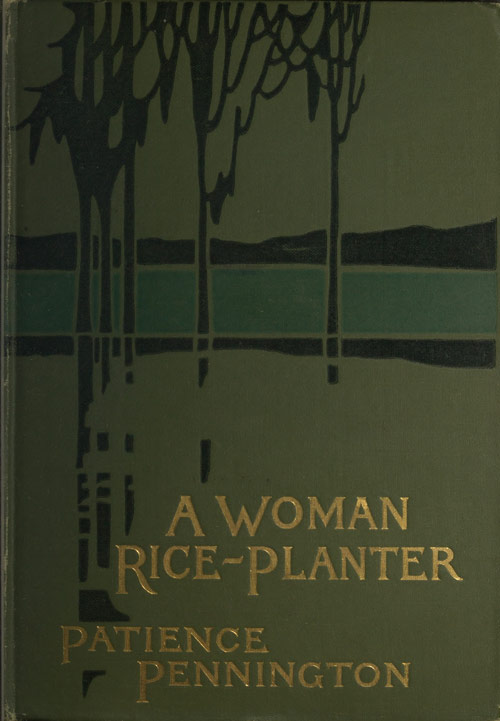
We print to-day a South Carolina lady's story of her experiences as a rice planter on her own account, as the actual manager of two large plantations in that State. It is a story which is all the more interesting and instructive because it is told in a manner of charming simplicity and without a trace of self-consciousness or self-assertion. Independently of the information it conveys it has attraction for every reader by reason of that manner and as a revelation of a feminine character in which are manifested tender susceptibility and womanly sympathy no less than rugged courage in assuming an arduous task and persistency in overcoming heavy practical obstacles.
Mrs. Pennington is of the type of Southern womanhood which reflected so great honor on that part of this country during the period of slavery and may be said to have been a generation peculiar to the social system at the base of which slavery lay. The executive and administrative experience acquired by Southern ladies at the head of households on the great plantations gave them a distinction among American ladies which since the overthrow of slavery has been demonstrated by many of them in the practical management of large estates like that presided over by Mrs. Pennington and in other fields of enterprise usually believed to be beyond the sphere of feminine ability. The mistress of a plantation, with many negro slaves, usually so far removed from considerable social centres that in its superintendence individual resource was taxed to the utmost, was loaded with a multiplicity of practical details and duties of administration, and in the discharge of these she received an education as an executive officer which distinguished her among her American sisters.
Accordingly, when the Civil War, with its incident of negro emancipation, left the South impoverished and its social system upturned, some of the most efficient and most important agents in developing the new prosperity now so abundant were Southern women who had passed through that severe school of training, had been reared under its influences or been moulded by its traditions—resourceful, courageous, well-poised women, accustomed to command, tactful and self-reliant, yet at the same time endowed with the gentlest feminine graces and the most engaging feminine qualities of character and disposition.
The readiness with which Mrs. Pennington assumed the heavy practical responsibilities, the risks, the vexations, and the cares involved in her rice-planting ventures, and the sagacity, practical skill, and indomitable persistence with which she has pursued them, are not less impressive than the beautiful spirit of womanly humanity and religious devotion to duty which is exhibited so unconsciously, so spontaneously, in her simple narrative. No trace of resentment against the negroes from whose shortcomings she has suffered so grievously appears in the story. The feeling she manifests is rather sympathetic in its tender consideration of moral defects apparently inseparable from their inheritance as a race and from the conditions produced by the sudden revolution in their relations to those employing them. It is to such a spirit as Mrs. Pennington's that the welfare of the negro race of the South can best be trusted.
Mrs. Pennington closes her story with the expression of a fear that "this is a dull letter"; but she may be sure that every one of the thousands of people who will read her story will find in it a human document of touching interest, and will see in it a revelation of a character in which are illustrated the best and highest virtues and graces of womanhood.
FOOTNOTES:
[1] He planted at this time one thousand acres of rice successfully.
[2] Marcus has since died. He was found one morning in his stable, where he had gone to harness his horse, leaning against the manger, stiff in death. He bore a high character, and his death was regretted by white and black.
[3] "Yedde" means to hear in real gullah, which some of the old darkies still use.
[4] "ne" is a contraction of "in the."
The following pages contain advertisements of a few of the Macmillan books on kindred subjects
Mothering on Perilous
By LUCY FURMAN
With Illustrations by Mary Lane McMillan
Decorated cloth, 12mo; preparing
The scene, a settlement school in Kentucky; the characters, the unformed children of the mountaineers and a young woman, their teacher, who has come to them that she may forget in her work a great sorrow that has entered into her life. How her grief is not only assuaged, but how she finds a new life, rich in possibilities, in the mothering of the homesick lads and in the molding of their careers, is told by Miss Furman with a wealth of feeling. The book is at times as genuinely humorous as it is touching and all through it there is evidenced the hand of one who knows whereof she speaks. Miss Furman is a teacher in a school in Kentucky. "Mothering on Perilous" may, therefore, be taken not as a story, but as a picture of what is actually being done by earnest-minded people in a line of endeavor of which too little is known.
A Kingdom of Two
By HELEN R. ALBEE
Decorated cloth, illustrated, 12mo; preparing
"The Kingdom" is a country place of about two hundred acres and the "two" are the writer's husband and herself. Practical information for the home-maker and the gardener are happily blended in this book with sentiment and a pleasing vein of philosophical reflection. While the work is primarily one for lovers of the great outdoors, for Nature in its various moods is perhaps the central theme, it is much more than what is ordinarily termed a "nature volume." The story form, only half assumed, the charming personalities which are presented, their day to day lives, these all lend to it an added interest.
The "Highways and Byways" Series
Highways and Byways from the St. Lawrence to Virginia
By CLIFTON JOHNSON
With many illustrations made from photographs taken by the author
Tourist edition, decorated cloth, 12mo, $1.50 net
As in the case of the other volumes in this series Mr. Johnson deals here primarily with country life—especially that which is typical and picturesque. The author's trips have taken him to many characteristic and famous regions; but always both in text and pictures he has tried to show nature as it is and to convey some of the pleasure he experienced in his intimate acquaintances with the people. There are notes giving valuable information concerning automobile routes and other facts of interest to tourists in general.
Tourist Editions of the "South" and the "Pacific Coast"
Highways and Byways of the South
By CLIFTON JOHNSON
Tourist edition, illustrated, decorated cloth, 12mo, $1.50 net
Highways and Byways of the Pacific Coast
By CLIFTON JOHNSON
Tourist edition, illustrated, decorated cloth, 12mo, $1.50 net
New Illustrated Books of Travel, Adventure, and Description
My Life with the Eskimos
By VILHJALMUR STEFANSSON.
Illustrated with half tone reproductions of photographs taken by the author and others.
Decorated cloth, 8vo. Preparing
A fascinating book of description and adventure has been written by the famous traveler and explorer, who has passed years of his life within the Arctic Circle. Mr. Stefansson has had a vast amount of material upon which to draw and he has made his selection wisely. He has lived with the Eskimos for long periods; he knows their language; he has subsisted on their food; he has heard their legends; he has seen them in their daily lives as have few explorers. Consequently his remarks about this primitive and matter-of-fact people are shrewd, true and frequently amusing. The experiences and tales which he recounts, mirroring the hardships and the inspirations of life in a fearful but wonderful country, compose a work quite the most absorbing on it that has ever been published.
Hunting the Elephant in Africa
By C. H. STIGAND.
With illustrations made from photographs taken by the author.
With an Introduction by Col. Theodore Roosevelt.
Decorated cloth, 8vo. Preparing
For a period of more than thirteen years the author of this work has hunted big game in the jungles of East Africa. Here are told simply and with an attractive modesty, yet dramatically, some of his most remarkable experiences. It is an old-fashioned animal hunting book with real thrills in it and revealing many new points on the habits of the beasts of a wild country. Captain Stigand is no nature fakir; his work is consequently a robust one in which is embodied the spirit of the real hunter. Colonel Roosevelt has written an introduction for the volume, which is illustrated by a number of very interesting pictures made from photographs taken by the author.
The Barbary Coast
By ALBERT EDWARDS
Author of "Panama," "Comrade Yetta," etc.
With many illustrations; decorated cloth, 12mo; preparing
Albert Edwards's "Panama: The Canal, the Country, and the People" has gone into many editions and received wide and favorable comment. Much may, therefore, be expected of this new descriptive volume, in which Mr. Edwards relates some of his remarkable and always interesting experiences in the states of northern Africa. Mr. Edwards does not write with a history or a book at his elbow; what he says does not come to the reader from a second-hand knowledge. He has been in Africa himself and he writes out of his own life.
America As I Saw It
By E. ALEC TWEEDIE
With illustrations; decorated cloth, 8vo; preparing
Many books have been written by people who have visited this country and have then returned to their native heath, but it is doubtful whether any one has gone at the task with such an abundance of good humor as has the author of this sprightly volume. Mrs. Tweedie says things, to be sure, about America and Americans that will not be wholly acceptable, but she says them in such a way that even the most sensitive cannot take offence. In fact, it is quite likely that her criticisms will provoke laughter as good humored in itself as the remarks which cause it. There is hardly a spot on the broad continent that does not pass under Mrs. Tweedie's examination, and scarcely a person of importance. She finds much to praise openly, but amusing as it may seem, these praiseworthy factors are not those upon which we expect commendation. Our dinners, our clubs, our educational systems, our transportation facilities, our home life, our theatres, our books, our art, all are analyzed and "Tweedie verdicts" passed. Of course the book is to be taken seriously, but not too seriously; Mrs. Tweedie would be offended if we did not laugh at her cajolery; that is what she wrote for.
THE MACMILLAN COMPANY
Publishers 64-66 Fifth Avenue New York