
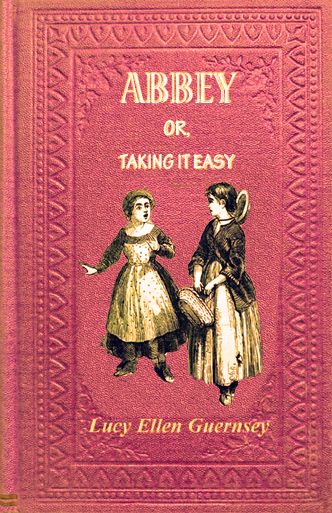
The Project Gutenberg eBook of Abbey
Title: Abbey
or, Taking it easy
Author: Lucy Ellen Guernsey
Release date: June 6, 2025 [eBook #76232]
Language: English
Original publication: Philadelphia: American Sunday-School Union, 1867
Transcriber's notes: Unusual and inconsistent spelling is as printed.
New original cover art included with this eBook is granted to the public domain.
Abbey; or, Taking it Easy.
Abbey finds Elvie weeding in the garden.
ABBEY;
OR,
TAKING IT EASY.
[BY]
[LUCY ELLEN GUERNSEY.]
——————————————
PHILADELPHIA:
AMERICAN SUNDAY-SCHOOL UNION,
NO. 1122 CHESTNUT STREET.
——————————————
NEW YORK: 599 BROADWAY.
————————————————————————————————————————————————————————————————
Entered according to Act of Congress, in the year 1867, by the
AMERICAN SUNDAY-SCHOOL UNION,
in the Clerk's Office of the District Court of the United States
for the Eastern District of Pennsylvania.
————————————————————————————————————————————————————————————————
CONTENTS.
—————
CHAPTER
ABBEY;
OR,
"TAKING IT EASY."
———————
CHAPTER I.
THE GREEN PAIL.
"TAKE the green pail to carry the water up-stairs, and set the smaller one on the stove, with water in it, that I may have it hot presently," said Mrs. Ward. "Do you understand me?"
"Oh, yes, I know," answered Abbey, confidently.
Mrs. Ward closed the kitchen-door, and sat down in the shade on the back steps for a few minutes, to read the paper before going on with her day's work.
She had certainly earned a little rest. For she had been up since five o'clock, had prepared her husband's breakfast and sent him off to his work at seven o'clock, had swept and dusted her pretty little parlour and dining-room, and was presently to make bread and cakes, and a meat-pie to be eaten cold for next day's dinner. For, while she made it a rule never to do unnecessary cooking on Sunday, she "calculated," as she would have said, to provide something rather better than common for her husband's dinner on that day.
She was the wife of a hard-working, painstaking printer,—a man who never missed a day's work from idleness or a spree, but who yet had hard work enough to maintain his family at home, help support his old mother, keep his house and life insured, and make both ends of the year meet. Mrs. Ward had never kept a girl till quite lately. She had always been able to do all her own work, with the help of her daughter, who had been trained to usefulness from the time she could run alone. But Comfort Ward, though a strong and healthy girl up to the age of fourteen, had then begun to pine away and fade like a plant. The spring after her fifteenth birthday, she was laid to rest under the trees of Mount Faith Cemetery, in the sure and certain hope of a glorious immortality. Her illness was long and trying, and Mrs. Ward found herself so worn out after it was over, that her husband insisted on her having some one to help her in her household work.
So she hired Abbey Jenkins, a stout girl of fourteen, who had already lived in two or three different places, but for some reason (which no one seemed exactly to understand) had never stayed long in any one of them. Every one told Mrs. Jenkins that her Abbey could not possibly have a better place: Mrs. Ward was an excellent Christian woman, a capital housekeeper, understanding all sorts of work, and one who would do her duty by any girl who lived with her. Old Aunt Phœbe Ray added to her congratulations the remark that Mrs. Ward had a heap of patience, and could get on with Abbey if any one could; from which we may gather that Abbey was no particular favourite with the old lady.
Mrs. Ward was tired, and the shaded back steps made a very pleasant resting-place. She looked through the paper, and then sat for a few moments surveying her little garden-ground and considering how she could put in a row of Martinias and some new annual flower-seeds where every inch of room seemed already occupied,— when she perceived a smell as of burning paint.
"Somebody has got a hot fire," was her first thought. "It comes from the kitchen!" was her second.
She jumped up hastily and opened the door. There on the stove was her new, neatly-painted green water-pail, all blackened and blistered with the heat, the paint upon the bottom burned off, and filling the whole house with a most unsavory odour! She hastened to snatch it off, but the mischief was done. The pail was utterly spoiled.
Mrs. Ward was a woman who understood pretty well how to rule her own spirit. She did not utter a single hasty exclamation, but there was some sharpness in the tone with which she called "Abbey!" at the foot of the back stairs.
Abbey did not answer.
And Mrs. Ward, listening, heard a sort of rubbing and scrubbing sound, as of some one violently rubbing a carpet.
"What has she been about?" thought Mrs. Ward.
She stepped into the parlour, to lay down the paper. The first thing which caught her eye was a large and rapidly-spreading stain upon the newly whitened ceiling, from which water was falling drop by drop upon the matting below. She hurried up-stairs, and beheld a scene which explained the whole matter. The pail which Abbey had been told to set upon the stove lay on the floor, with the handle out, and Abbey was busily swabbing up the water with some large white cloth done up into a wad.
"What 'have' you been about, Abbey?" asked Mrs. Ward.
"The handle came out of the pail, and spilt the water," replied Abbey, with rather an air of injured innocence. "I didn't know it was loose."
"Didn't I tell you to set that pail on the stove and take the green one to carry up the water?" asked Mrs. Ward.
"I didn't understand," said Abbey.
"If you did not understand, it was because you did not pay attention," returned Mrs. Ward. "I told you, in perfectly plain English, to set this pail on the stove and carry the other up-stairs. And you have done exactly the contrary, and accomplished more mischief in one half-hour than your wages will be worth for a month to come. I think you had better go home to your mother. I cannot afford to keep a girl who cannot turn round without doing mischief, just because she will not attend to what is said to her. What are you rubbing the floor with? Let me see."
She took the cloth out of her hands and unfolded it, but the sight it presented did not tend to comfort her. It was an old but fine damask table-cloth, bearing the marks of careful preservation and mending, but now worn into two or three great holes by Abbey's rubbing. As Mrs. Ward looked at it, her colour rose, and the tears came into her eyes.
"My dear mother's cloth!—And the very last I had!" said she. "You had better go to bed, and stay there the rest of the day. There, at least, you will be out of mischief."
"I'm sure I didn't mean any thing—" and Abbey began her defence.
But Mrs. Ward interrupted her.
"Yes: there is exactly the trouble. You never do mean any thing, either good or bad. You don't mean any harm, perhaps, but you don't mean any good, either. You don't put your mind upon your work in the least degree, nor do you attend to any thing that is said to you. Half the mischief in the world is done by people who don't mean any thing. Another trouble is that you think you know every thing already,—instead of which you are a very ignorant little girl, deficient in almost every thing that should be known even by a girl of your age. And if you are ever going to be any thing but a real torment to every one about you, you will have to take a great deal of pains for it. Just because you would not attend to perfectly plain directions, you have done more mischief since you came into this house, only a month ago, than your work will be worth in six months if you do your very best. I don't think I can afford to keep you any longer. If I saw you improving, or taking pains to improve, I should feel differently; but you don't."
Mrs. Ward may be excused for feeling irritated. The parlour-ceiling had just been whitened, at considerable expense; the pail was a new one, and the table-cloth an heirloom which had been in her family for two or three generations. It was not Abbey's first piece of mischief, either. She had broken more cups, loosened more knife-handles and spotted more floors than Mrs. Ward had done in all her housekeeping. She had killed two or three valuable plants by throwing her dish-water upon them,—though she was expressly told what to do with it,—and broken down a Diana grape-vine, which Mr. Ward was nursing with great care, by throwing the coal-ashes upon it, instead of putting them in their proper place. In every one of these cases her excuse was that she didn't mean any thing; she didn't understand.
"What shall I do next?" asked Abbey, after Mrs. Ward had washed and hung up the unlucky table-cloth.
"You can take those towels and sit down to hem them in the kitchen, where I can see you while I am mixing my bread," replied Mrs. Ward.
"Can't I sit up in my room?" asked Abbey.
"No! Unless you are under my eye, you will hem half of them one way and half the other. And I cannot trust you to finish the work up-stairs by yourself."
"Well," said Abbey to herself, as she hunted up her thimble (which was never in its place), "I'm glad I don't worry so about every little thing. I believe in taking things easy, for my part."
It is worthy of notice that for every person who prides himself or herself on taking things easy, there is always some one else who has to take them hard in proportion. This was the case with Abbey and her friends. She had always taken things easy, ever since she was born.
As a little child, her mother had been proud of her daughter's placid disposition and had boasted that nothing ever put Abbey out. But as the child grew older, and became of an age to be helpful to her mother, Mrs. Miles did not find that Abbey lightened her cares at all. Somehow, she had a remarkable knack of "shirking,"—of slipping out of and away from every thing that she did not like to do,—of breaking and spoiling every thing she took in hand,—of being so long over her breakfast dishes that it was less trouble to her mother to wash them herself,—of getting the baby into scrapes whenever she was set to tend him,—of buying exactly the wrong thing whenever she was sent to market or to the grocer's, and never coming back till the last minute.
All this time, Abbey was as placid as possible. No scolding disturbed her temper or did her any good. She was always singing over her work. And as she had a sweet voice and sung with a good deal of taste, visitors were apt to remark how pleasant it was to have a child of such a happy disposition!
When Abbey was thirteen years old, her mother married again. Abbey's stepfather was a hard-working, energetic, well-principled man, who fully intended to do the part of a father by his wife's children. But he was what is called "short-tempered," and being, as I said, very hard-working and painstaking himself, he had not very much patience with the opposite qualities. Abbey found herself driven about and stirred up more than she had ever been before in her life.
Mrs. Jenkins felt sorry for her, but she had lately become awake to the fact that Abbey would have to earn her own living. And that, if she were ever to be good for any thing, it was quite time she began. Abbey, however, was more than a match for her stepfather. Her placidity of temper gave her a great advantage over his fretful position,—as cotton-bags are said to oppose the best resistance to cannon-balls.
But Mr. Jenkins had the advantage in one way, and at last he used it. He possessed "the power of the purse;" and he declared that he would no longer support Abbey in idleness: she should go out to work, and earn her own living in some one else's house, if not in her own home.
Abbey had been living out for four months, and she had been in three different places already. As I said, her mother was very glad when Mrs. Ward took her in hand. And Aunt Phœbe Ray, who had interested herself very much in finding places for Abbey, declared that Mrs. Ward could get on with the girl if any one could.
CHAPTER II.
TRYING AGAIN.
ABBEY took her work and went down into the kitchen, where Mrs. Ward was mixing her bread. She was not in the least ruffled by the events of the morning, and thought it very strange that any one else should be. What was the use? She made various remarks by way of beginning a conversation, to which she got very short answers, or none at all. Presently she began to sing.
"Don't sing, Abbey: attend to your work," said Mrs. Ward, shortly. "I do think one reason why you never have your mind upon what you are about is that you are always singing. The sound serves you instead of thought."
This was quite true in Abbey's case, and I have no doubt it is true of many others. The poet says of some one that,—
"He whistled as he went, for want of thought."
Abbey sung for want of thought. Being now, however, reduced to silence, she was obliged to think a little, and her reflections were not remarkably pleasant. She could not but confess to herself that it would not be very convenient to lose her place again and have to go home in disgrace for the fourth time in as many months, while her next youngest sister, who was only twelve, had been living with one lady for nearly a year, and had lately had her wages raised. She had spoiled her best frock by washing dishes in it at her last place. Her second-best was rapidly becoming shabby; and Mr. Jenkins declared that he would not buy her another,—she should earn it herself, and then she would know the value of it; nor would he allow Elvira to divide her wages with her sister.
"You think I am hard upon the girl," he said to his wife, "and I dare say other people have plenty to say about the matter. But I tell you that she will never be good for any thing till she finds out that she is dependent on her own exertions for her living."
"I believe you are right," said Mrs. Jenkins, sighing, "but I begin to be afraid she will never learn any thing. The trouble is, that she does not care. No fault-finding disturbs her in the least."
"Exactly so. But she likes to dress well and to have plenty to eat, and she 'will' care when she finds that she is to have neither food nor clothes unless she provides them for herself."
Abbey could not but admit to herself as she sat at work that if she left Mrs. Ward in disgrace, the chances of her finding another place were very small. Aunt Phœbe Ray, who got situations for half the girls in Milby, declared positively that she would never recommend her again if she failed this time. It was, no doubt, unreasonable in Mrs. Ward to be so angry at an accident (so Abbey said to herself), but it was clear that she was very much put out. Indeed, she had as good as told her that she might go home. Certainly, the prospect was not a pleasant one.
"But there is no use in worrying," said Abbey. "I dare say something will happen."
Meantime, Mrs. Ward had in some degree recovered her composure. She did not regret the scolding she had given Abbey,—she knew very well that hardly any thing would rouse her from her indifference. But she began to think whether she had not better try her a little longer. She knew how poor the family really were, and how hard both father and mother worked to keep themselves out of debt and their children comfortable and respectable, and to provide comforts and luxuries for the oldest boy,—a poor little humpbacked cripple of ten years, who had never been able to walk, and probably never would be. She remembered how glad Mrs. Jenkins had been to procure the place for Abbey. And she finally made up her mind to try the girl a little longer.
"After all, I suppose I may as well have patience with her as any one else," said she to herself. "If Comfort had been obliged to live out, I should have wanted people to have patience with her."
"Now, Abbey, I want you to attend, what I say," said Mrs. Ward, as she finally took her sewing and sat down. "Don't let your mind wander to the ends of the earth,—nor out of the window, either," she added, with some sharpness, as she saw Abbey beginning in a dreamy manner to contemplate some cows upon the common. "Listen to me."
Abbey had a habit, whenever any one began to reprove her,—or "lecture her," as she said,—of at once beginning to think of something else. Just at this time she had a perception that such a course would not be very wise: so she brought in her eyes from the common, and her mind from the day-dream she was just beginning, and prepared to give some attention to what was said to her.
"Do you want to keep your place, Abbey?" asked Mrs. Ward.
"If I can suit you," said Abbey.
"Suppose you go away from here: what do you expect to do?"
"Go home, I suppose, and stay till I get another place," replied Abbey.
"It may not be so easy for you to find another place," said Mrs. Ward. "Which of the ladies you have lived with during the last few months, do you think, would recommend you?"
Abbey was silent.
"And, meantime, you will be at home, where you are not wanted, and be a burden upon hands which are already more than full."
"I don't see how I can help it," said Abbey. "And I don't think it is fair to twit me with it. I am sure you could tell any one that I was neat and honest, and—"
"Look under that table, Abbey, and see the dust upon the legs," interrupted Mrs. Ward. "Look out of the window, and see those coal-ashes. As for honesty, there are more ways of being dishonest than merely stealing."
"I don't know what you mean, Mrs. Ward," said Abbey, now really colouring and showing some signs of feeling.
"Well, Abbey, I will tell you what I mean. I give you good wages,—very good for a girl of your age,—which I pay you every Saturday out of my own and my husband's hard earnings. Do you take pains to earn those wages? When I go to a store and lay out five dollars, I expect to get the worth of my money. And if the tradesman gives me short measure or an inferior article, I call him a dishonest man. If I pay a girl good wages for doing my work, and she neglects it, or does it badly and in such a manner as to bring loss upon me, I call her a dishonest girl, whether she steals the value of a penny from me or not."
"I don't think I have done any thing so very bad," said Abbey. "Every one makes mistakes sometimes."
"Listen, Abbey," replied Mrs. Ward, taking a paper from her work-basket. "I have been making a little calculation as to what you have cost me since you came here, a little more than four weeks ago. I will read it to you:—
Tin basin forgotten and left on the stove to burn up.... .30
Diana grape-vine spoiled................................1.00
Fine rose-bushes spoiled................................1.00
Towel burned up......................................... .25
New water-pail spoiled..................................1.50
Parlour-ceiling spoiled.................................2.00
—————
$6.55
"There are six dollars and fifty-five cents, at the lowest calculation, a dead loss; and all from the sheerest carelessness and indifference on your part. Not one of these accidents was necessary. I say nothing of the table-cloth, for no money will pay for that. And I have put down the rose-bushes at just what I gave for them,—though I would not have taken ten dollars apiece for them. The very last thing my daughter did in the garden was to set out those two rose-bushes, which you destroyed just because you would not pay attention and did not care whether you did right or wrong."
For once, Abbey did not seem to have any thing to say for herself. She was not used to be treated in this way. She had often been scolded and fretted at, and she had intrenched herself in indifference and inattention. But it was something new to have somebody sit down and calmly compel her attention to a straightforward, business-like account of her misdeeds.
She did not know how to meet it. And, for once in her life, she felt ashamed and irritated. The feelings were not pleasant to her. Abbey began to cry,—a very unusual thing with her.
"I am sure, Mrs. Ward, I did not mean any harm!" she sobbed. "I think it is very hard to lay it all to me."
"Who shall we lay it to?—To me?" asked Mrs. Ward. "I don't suppose you did mean to do wrong; but neither did you mean to do right. If you had, you would have done right; for there was nothing to hinder you, but, on the contrary, every thing to help you. You knew better than to do any one of these things,—some of them because you were expressly told at the time, and others because any person of common sense would know better. You have caused me all this loss and discomfort in a perfectly needless manner; you have slipped yourself out of every bit of work that you could get rid of; and yet you expect me to pay you as much as if you had done your work faithfully. Is that honest?"
For once, Abbey's conscience was touched. She could not get out of the corner in which Mrs. Ward had placed her, and she dared not say "yes" to the question.
"But there is another and a still more serious view of the matter," continued Mrs. Ward, after a little silence. "Abbey, do you ever reflect that you are accountable to God for the way in which you spend your time and your strength?"
Abbey did not answer aloud. But she said to herself, "Oh, dear! I do wish she would not begin on that. A lecture is bad enough, without a sermon."
"Do you remember the twenty-fifth chapter of the Gospel by Matthew?" asked Mrs. Ward.
Abbey did not remember it particularly, though it had been read at family worship only the day before.
"It contains very interesting and important instructions about the last judgment," continued Mrs. Ward. "We have, first, the parable of the ten virgins. How did the five foolish virgins come to be shut out from the marriage supper? Was it because they broke their lamps, or made any bad use of them?"
"It was because they took no oil," replied Abbey.
"And in the case of the unfaithful servant who was cast into outer darkness, for what was he condemned? Did he spend his lord's money, or waste it?"
"He hid it in the ground," replied Abbey.
"And what ought he to have done?"
"He ought to have traded with it, as the others did, I suppose," said Abbey.
"Now we come to the account of the last judgment," said Mrs. Ward. "Does our Lord say to those on his left hand that they had robbed, or murdered, or done any thing of that sort, for which they were to be condemned?"
Abbey was silent. She began to see the drift of the sermon, as she called it.
"In every one of these instances," continued Mrs. Ward, "we find people condemned for things which they had omitted. I do not suppose the foolish virgins 'meant any harm,'—as you are so fond of saying. They merely forgot to provide themselves with oil.
"The slothful servant, as I said, did not make any bad use of the money committed to his charge. He was merely too lazy to use it at all. Doubtless he might have doubled his talent, as well as his fellow-servants; but that would have required thought and exertion and watchfulness. He would have been obliged to get up early, and go into the market, and keep himself informed as to the state of trade,—all of which he thought too much trouble. It was easier to put the talent out of sight and indulge his indolence, excusing himself to his own conscience with the thought that his master was a hard man and would not be pleased whatever he did, and that, after all, he was not so bad as some other people, for he did not spend his talent for fine clothes or strong drink.
"You see, Abbey, what I mean. God has given you more than one talent, and of these talents, he will one day demand a strict account. He has given you health and strength, and people who are willing to teach you. And if you misuse all these things, or if you do not use them at all, it will not excuse you, when he calls you to account, that you did not mean any thing in particular, any more than the five foolish virgins were excused."
"I am not a professor of religion," said Abbey.
"So much the worse for you, my child. If you were ten times a professor of religion, you would be under no more obligation to serve God than you are now. And you cannot get rid of your obligation by not acknowledging it. You are only adding one more sin to all the others."
"I don't see how that is," said Abbey. "I think Christians ought to be a great deal better than other people, for my part though I don't see that they are. I am sure my father isn't. He is always reading the Bible, and all that. And I don't see that he is any better-tempered for that. And there is Elvie! She joined the church last fall. And what good has it done her?"
"Why do you think your father is not a good man?" asked Mrs. Ward.
"He is always finding fault with me," said Abbey. "I have not had one bit of comfort at home since he came there. Mother never said one word about my living out, till he began to talk about it."
"But, Abbey, you must have known that you would have your own living to earn some time. Who did you think was going to support you?"
Abbey did not know: only, she didn't see why she should have to work for a living, more than other people. She didn't see why some one shouldn't leave her a fortune. "Mrs. Frost's uncle had left one to her."
"Do you reflect, Abbey, that if such an event had taken place, it would only have increased your responsibility? It would be another talent, for the use of which you would have to answer to God. And if you hide away and neglect the talents you have already, what reason have you to think that you would do better with ten than with one?"
"I don't believe rich people trouble themselves about such things as that," said Abbey. "They just have the money and spend it and take the comfort of it."
"Many rich people do trouble themselves about such things," said Mrs. Ward. "They consider themselves only as stewards of the wealth God has given them, and use it for his service. You have heard of Miss Nancy Wigglesworth, who founded the Old Ladies' Home and the Coloured Orphan Asylum?"
"Folks say she was an old miser," said Abbey, "and that she used to go looking like a fright, and would not give a beggar a bit of money for any thing. I wouldn't be like that. I would take the comfort of my money as I went along."
"People were very unjust to call Miss Wigglesworth a miser," said Mrs. Ward. "She never spent one-quarter of her income upon herself. All the rest went for religious and charitable uses. She used to help poor people by lending them money as they needed it. Sometimes they would neglect to pay her, when they were perfectly well able to do so; and then, when they were compelled to pay, they railed at their benefactor as a hard-hearted miser. Another way in which she got the name of being stingy was that she never would give to an object of which she did not approve. People used to go to her for all sorts of things, and when she refused them, they abused her."
"That's just what I say," persisted Abbey. "What was the use, after all? She might just as well have taken the comfort of her money as she went along, instead of giving it away and getting no thanks for it."
"Miss Wigglesworth has been dead eighteen or twenty years," said Mrs. Ward; "that is to say, she has been all that time in heaven. Do you suppose she regrets now that she gave away her money and did not spend it upon her own pleasures? I remember well going with my mother to see her when she was ill with her last sickness. She suffered a long while, and very terribly at times; but I shall never forget the peace and joy in her face as she spoke of her own death, nor the tone in which she repeated the words,—
"'I have fought a good fight, I have finished my course, I have kept
the faith: Henceforth there is laid up for me a crown of righteousness.'
"Do you think the rich man in the parable felt like that when God said to him, 'Thou fool, this night thy soul shall be required of thee'?
"Yet all he meant to do was to have a good time as he went along."
Abbey writhed impatiently in her chair. She never could bear to think of dying.
"Well, I am not rich, and I never shall be," said she: "so that is nothing to me."
"You are mistaken, Abbey. It is every thing to you. You are not rich in money,—that is true; but you are rich in what is worth far more, in what money cannot buy,—in health, and strength, and chances of usefulness. You may put aside all these gifts in a napkin; you may employ them for your own selfish ends,—in merely 'having a good time,' as you say. You may let them rust in idleness, or wear them out in the service of self and the devil; but rest assured of this, that for every one of them God will as surely bring you into judgment as you sit there."
"Do you wish to stay here, Abbey?" asked Mrs. Ward, once more.
Abbey did not answer. She did "not" wish to stay, if she could help it; but she did not see what else she was to do.
"You can take till to-night to think over the matter," continued Mrs. Ward, "but I tell you plainly that, if you 'do' stay, it must be on very different terms than heretofore. You must conduct very differently. I shall charge you for every article that you break or spoil, and I shall make you do over again every thing you leave undone or half done. I am willing, for your mother's sake, to try you a while longer on these terms; that is, if Mr. Ward will give his consent,—for he will be very much vexed when he sees the condition of the parlour-ceiling. As I said, you can take till night to consider the matter. Now put away your sewing, take the dust-pan and brush, and brush under every table in the room, and then rub all the chair-rounds and table-legs with the cloth."
Abbey obeyed, feeling very ill used indeed. Her conscience, which she had heretofore managed to keep pretty quiet, was at last awakened, and it pricked her severely. Abbey did not like the feeling at all. It irritated her, as any discomfort of body or mind always did. And she felt provoked at Mrs. Ward for having given her this new and very disagreeable sensation. She would have liked very much to throw up her place and go home; but home was not likely to be any more agreeable to her than her present situation, and she must earn something, or go in rags.
"Dear me!" she said to herself, impatiently, "it does seem as if when all we wanted was to live in peace and have a good time, one might be let alone and allowed to have it; but it appears as though every thing was dead set against me."
Even so, Abbey. The whole course of nature is "dead set" against any one who will not work either with it or against it.
"I believe I will go and talk it over with Elvie this afternoon," said Abbey. "She will think I am to blame, of course; but, then, she won't scold and fume, like father, or sigh and look as if I had half-killed her, as mother does every time I come home."
"Can I go over to Mrs. Frost's and see my sister?" asked Abbey, after dinner.
"I have no objection; but you must be at home by five o'clock. And I want you to stop at the butcher's and bring home a veal cutlet for Mr. Ward's supper. Now remember! What do you mean to buy?"
"A quarter—I mean a cutlet of veal," said Abbey, recollecting herself.
"Well, now, mind what you are about. Don't make a mistake, and don't forget the time."
"Oh, dear!" sighed Abbey, as she walked away,—for once remembering to latch the gate after her. "I do wish folks would not be so cross! I am not 'that,' anyhow, whatever else I am."
This was always Abbey's last refuge when found fault with. She did not reflect that her naturally placid temper was only another talent committed to her charge, which would prove a curse or a blessing according as she used it.
CHAPTER III.
CONSULTATIONS.
ABBEY found Elvie busily engaged, not in the kitchen or in sewing, but in the garden, squatting down on her feet and weeding a flower-bed.
"Well, I declare! I did not know you were hired to work out-of-doors," said Abbey.
"Nor I," returned Elvie, smiling, as she laid down her trowel and rose up to greet Abbey.
"I am working 'on my own hook,' as father says. Mrs. Frost has given me all this long border for my own garden, and I am to have all I can raise from it. I have bought fifty cents' worth of seeds with my own money, and Mrs. Frost has given me as many more, and some plants besides.
"Won't it be nice to have some flowers for poor Harry,—and some fruit, too? For those two gooseberry-bushes, and that double row of strawberry plants, are all mine. Won't it be nice?"
"Very nice," said Abbey, rather languidly; "but I should think Mrs. Frost might give you all you wanted,—such a large garden as she has."
"But they wouldn't be the same at all," said Elvie. "They would be her presents then, and not mine. And it is so much pleasanter to give away something which you have earned or made yourself."
"I don't see why," returned Abbey. "A present is a present."
"And, besides," said Elvie,—who knew by experience that there was no use in trying to make Abbey understand her,—"I love to work in the garden. The ground smells so good and fresh, and it is so curious and interesting to see things grow. Look at all these little green rings of plants. They did not show the least bit yesterday afternoon; but the shower has brought them up nicely. I am going to put some of the sweet alyssum, and Tweedia, and some other things, in a cocoanut basket I have been making for Harry to hang up in his window. Won't it be nice for him? I bought the cocoanut myself, for the children, and Miss Priscilla Frost showed me how to make a basket of the shell."
"Well, never mind that now," said Abbey, upon whose ears all these things rather grated than otherwise,—she never added a single penny's-worth to poor Harry's comforts and pleasures,—"never mind that now. I want you to listen to me, and tell me whether I shall stay at Mrs. Ward's or not."
"Stay at Mrs. Ward's!" exclaimed Elvie, dropping her trowel, and forgetting all about seeds, cocoanut basket, and strawberries. "Oh, Abbey, you are not thinking of leaving her? Surely you have not gone and lost your place again? Oh, what will mother say?"
"Well, well, you need not talk so loud, or make such a fuss, as though one had committed murder. I was only thinking about it,—that's all. If any one treated you as I was treated this morning, I don't believe you would want to stay; but because I don't make a fuss about every little thing, as you and mother do, you think I have no feeling."
"Tell me all about it," said Elvie, wisely putting aside the reproach. "Let us sit down on the steps here,—so I can see if any one comes in at the gate—and tell me the whole story, from first to last."
Abbey told the story according to own idea of the matter, ending with, "And she says if I stay, she shall charge me with every thing that I break or spoil, and take it out of my wages. I don't see how I am ever to earn any thing, at that rate."
"You must take care and not break things, then," said Elvie. "I don't wonder ladies get out of patience sometimes, girls are so careless. And you know, Abbey, you were always unlucky about dishes. But what about the water-pail? How can you to make such a mistake?"
"I didn't think," replied Abbey. "But I don't see why she need make such a fuss about that."
"Well, I don't know," said Elvie. "Do you remember what you said when Totty broke your china cup? That was nobody's fault but your own,—leaving it on the stairs, of all places in the world; and the poor child got a sad fall and scratch beside: yet you scolded her smartly. You didn't think that was nothing, did you?"
"That was different."
"I don't see the difference, except that one was yours and the other was somebody's else. And, you see, it really is a great loss, for I don't think the Wards are at all rich."
"I hate to live with poor folks!" said Abbey, pettishly. "If I could have such a place as yours, I wouldn't mind living out."
"I don't think that rich folks like to have their things spoiled, any more than poor folks," replied Elvira. "I am sure Mrs. Frost does not. She will not let the least thing be wasted. But, Abbey, I do hope you won't think of leaving your place, if you can possibly keep it. There is a particular reason just now for our all exerting ourselves, you know, for Harry's sake, because mother is so anxious to take him out in the country this summer."
"Oh, yes! Harry,—always Harry!"
"Well, and so it ought to be always Harry," said Elvie, with a little flash of her eyes. "Who should it be, if not Harry,—when you know how good and patient he is, sitting there in his chair week in and week out, suffering so much, yet never complaining, nor troubling any one more than he can possibly help? I think we might all of us take pattern by him, for my part, and be willing to work for him,—dear little fellow!"
"Now, don't get in a passion, Elvie; because, if you do, you will be sorry," said Abbey. "Just as if I did not think as much of Harry as you do; only I am not always talking about it. Some people like to talk about their feelings and what they do for others, and some don't: that's all."
"And some people like to act out their feelings, and some don't," returned Elvie. "If people neither talk about their feelings nor act upon them, I don't see, for my part, how any one is to know whether they have them or not."
"Well, there is no particular use in talking about that," said Abbey. "I suppose I had better stay at Mrs. Ward's and bear it the best way I can. She may as well fret at me as at any one else. I don't mind it much: that is one good thing."
"Perhaps if you minded more, she would have less cause to fret," remarked Elvira. "That is one trouble. When any one begins to tell you any thing, you never begin to listen till they are half done, and so you don't more than half understand. I don't believe that you cannot please Mrs. Ward well enough, if you only try. Do try, Abbey,—please do," she added, earnestly. "I can't bear to think how bad mother will feel if you lose this place, and she has so much to trouble her already. Do try, to mind Mrs. Ward, and attend to what she says to you. You will learn after a while, and then it will come easier.
"Come, now; I am sure you ought to be able to do as well as I, when you were always so much smarter to learn, and you are more than a year older than I am. And every one says Mrs. Ward is such a good woman. Mrs. Campion was here yesterday, and I heard her say she did not know a better woman than Mrs. Ward. It will be such an advantage to you to learn the best way of doing all sorts of work."
"Well, well, you needn't say any thing more, Elvira," said Abbey, rising. "I'm sure I am willing to stay; though I don't know, after all, whether she will want me. And—there! She told me to stop somewhere, and where was it?"
"Do try to remember," said Elvira, anxiously. "Was it the baker's?"
"No: she never sends to the baker's, except for yeast; and I am pretty sure it wasn't yeast. Oh, I know now. It was a veal cutlet: so she must have meant the butcher's."
"Of course," said Elvira, laughing, but much relieved. "Well, you have no time to lose; for it is almost five o'clock."
"I must hurry, then, for she told me to be home by five. And if I don't, there will be another fuss. Come walk a little way with me."
"I can't," said Elvie; "the other girl has gone out, and I must get tea ready. I will come and see you as soon as I can. I am going to run home this evening and carry Harry's basket to him. Won't he be pleased when he sees it?"
"Don't say any thing about this fuss at home, or mother will be coming over to see Mrs. Ward, and there will be no end of a time," said Abbey. "Promise now, Elvie, that you won't."
"I will promise, if you will promise me to take pains and try to keep your place," said Elvie.
"Of course I mean to do that. I must, or I sha'n't have any thing to wear pretty soon. My brown dress is almost worn out."
"Well, good-by. Don't be long on the road, now. It is almost five."
Thus urged, Abbey did contrive to accomplish her errand and get home only ten minutes after the time specified.
Elvira went back to her work with a deep sigh. She had long ago given up trying to make Abbey understand or sympathize with her, and since she had taken a decidedly religious stand, they were farther apart than ever. Elvira was sensible of her own faults. She knew that she had a hasty temper, and that she was apt to fret if things went wrong or did not go on as fast as she desired. She had latterly striven hard against this fault, and corrected it in a great degree; but sometimes she was overcome by Abbey's easy indifference, and allowed a little of the old fire to appear. She knew very well that such outbreaks did harm instead of good, by affording food to Abbey's self-complacency: yet she found it impossible to repress her indignation, as she thought of her sister's selfishness and indifference to the necessities of the rest of the family.
"There is no use in fretting, however," said Elvie to herself. "She will never be influenced by me. And the only thing I can do is to work all the harder myself, and try to keep my temper with Abbey. There is one comfort," she added, as she took up her trowel once more. "One can always pray."
CHAPTER IV.
A CHANGE.
FOR three or four weeks, moved by Elvira's energetic remonstrances, and stimulated also by the necessity of earning the means of paying for a new frock and hat, Abbey did a good deal better. Mrs. Ward began to have hopes of making something of her, after all, and was able with a clear conscience to tell Aunt Phœbe Ray (when she called to inquire about the matter) that she thought Abbey was improving.
Mrs. Jenkins began to feel her heart in some degree relieved from one of its many burdens. And her husband was so gratified with the report from Abbey, that he made her a present of a very pretty summer hat,—"to encourage her," as he said.
Unluckily Abbey was not a person to be benefited by this sort of encouragement. As Elvira said, "the more you did for her, the more you might." The same present made to Elvie herself caused her to work all the harder and take all the more pains to please.
In Abbey's case, she had lost one spur to exertion. Moreover, she at once began to think that, as her father had given her a hat, perhaps he would give her a frock also, or, if he did not, perhaps somebody else would. Mrs. Frost had two or three times given Elvie outgrown or worn dresses of Miss Priscilla's, which she—being a little creature, and as handy as she was little—had made over and remodelled into nice dresses, as good as new. Abbey knew Mrs. Ward had a whole trunkful of Comfort's old things, and "perhaps" she would give her some of them. Abbey could not for her life see why such "pieces of good luck," as she called them, should not happen to her as well as to Elvira.
It was not long before Mrs. Ward began to find things more out of joint about the kitchen than ever. She happened to be ill and confined to her room for a few days. And dreadful were the sights and the smells which met her disgusted senses when she could be about the house once more. Kettles and spiders set away unwashed, and rusted in consequence; the tea-kettle with the handle blackened and loosened; the nice thick metal teapot with part of its nose melted off against the hot stove; and the sink in a very offensive state.
Poor Mrs. Ward! She had never seen so much dirt in her house since she had one to take care of. She went to work with energy to clear up and clean out, and she tried to make Abbey help her; but this was harder than to do the work herself. Abbey was serenely unconscious that any thing was wrong, and looked on with calm wonder, not unmixed with amusement, as Mrs. Ward pulled out pans and basins, scraped dishes, and put dish-towels to soak. Presently came an inquiry, "Where is my dish-cloth?"
"I don't know what you mean," sail Abbey. "Here is 'mine,'" (producing a dripping wad, of most questionable appearance, from one corner of the sink.)
"'That' a dish-cloth!" said Mrs. Ward, surveying it with unspeakable disgust. "You don't mean to say you wash dishes with that thing! Where is the cloth I gave you just before I was sick?"
"This is it."