
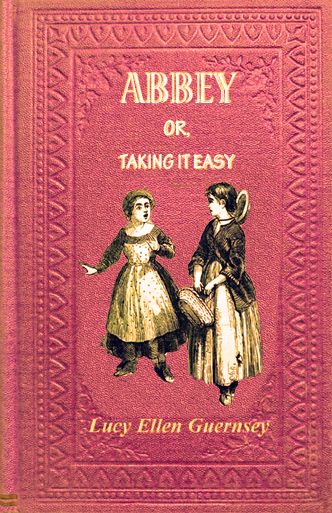
Abbey; or, Taking it Easy.
"'That' a dish-cloth!"
Mrs. Ward folded her hands, sat down on the nearest chair, and looked round her in despair.
"What has happened to that table, that the leaf is turned round to the wall?"
"Oh, the leaf is broken. It has been loose ever since I came here to live."
"I have never known it, if it was. How did you break it?"
But Abbey declared that she did not break it. It had always been so, she repeated, ever since she came into the house. She had never seen any cork to the kerosene-can, either. She was quite sure there never had been any.
"And what has become of the kerosene? Surely all that kerosene has not been used up in the course of a week. The can was filled only last Saturday."
Abbey at first did not know any thing about that, either. But she presently acknowledged that she had "spilt" some of it. This was not true. She had used the kerosene, but she dared not tell how.
At this moment the door-bell rang, and Mrs. Ward went to attend to it.
"Dear me! What a fuss!" said Abbey to herself, as she began slowly to wash up the dishes Mrs. Ward had piled upon the table. "And now I have got all these dishes to wash, and I shall not get through till noon. How I do hate to live with such fussy people, who will never let one have a minute's peace of one's life!"
That she herself was to blame for any part of the "fuss" she complained of, never entered Abbey's head. For all she cared, dirty dishes might have gone on accumulating till there was not a clean one left in the house. If she had wanted one to use at the moment, she would have washed it, or used it without washing, just as it happened. The condition of the sink never disturbed "her" senses, so long as space remained to pour away any thing else.
How people could make themselves uncomfortable about such things was something she could not understand. It appeared to her a very oppressive act in Mrs. Ward to give her so much additional work to do in cleaning the things she had left dirty; but Mrs. Ward was "particular" and "fussy," and there was no help for it.
Mrs. Ward's visitor proved to be her sister-in-law, Mrs. Powell, who lived a long way off, quite on the other side of the city, and had come to spend the day. Mrs. Powell was a small, wiry little woman, with (as they say) not an inch to spare about her, with sharp blue eyes which looked as if they had been made on purpose to spy out dust in corners and under tables, and there was a general air of business and despatch about her.
Mrs. Powell was a born housekeeper. Even Mrs. Ward was hardly neat enough to suit her ideas. Not a speck of dirt, not a particle of grease, could repose in peace under her vigilant eyes; no "catch-alls" or "shut-holes" could enjoy existence anywhere in her domains. Nevertheless, Mrs. Powell had the name of being a very pleasant person to live with, among the girls whom she and her neighbours employed. True, she got a good deal of work out of them, and she would have every thing done exactly right; but she did not fret or find fault unjustly, and she never kept her girls waiting for their wages.
"Well, Maggie, and how do you do?" said Mrs. Powell, as she settled herself in a very straight-backed, low chair, which Mr. Ward always called "Dorcas," after his favourite sister. "Seems to me you look rather tired and worn out. You don't get fairly rested yet, I see. You ought to have a good, responsible girl,—one who can take some charge of things and give you a chance to be mistress of your time a little while,—to look after the garden, or perhaps take a little journey. That's what you want. Some one like my Rebecca, now!"
"A girl!" said Mrs. Ward, with a deep sigh. "Don't say any thing about it, Dorcas. I have had a girl six weeks, and she has nearly been the death of me. I have never worked so hard in all the time I have kept house as during the time Abbey has been here. I have not been down-stairs before for two days, and you ought to see the kitchen."
"Who is she?" asked Mrs. Powell.
"Why, Abbey Jenkins. Her sister, a year younger, has been with Mrs. Frost for a year, and she likes her very much. And Mrs. Jenkins herself is a very neat, capable woman; but Abbey is a trial."
"Perhaps she will improve," observed Mrs. Powell. "I suppose she is quite young and has never lived out before. I often pity young girls going to a strange place. Every thing is new to them, and they are found fault with,—which confuses them all the more."
"That's not the case with Abbey, I can assure you. She cares no more about being found fault with than that stove. Nothing ever puts her out in the least degree. If I could once see her roused to be vexed or ashamed, I should have some hope of her. She has spoiled more things since she came into the house than her board and wages are worth twice over, but she thinks it is very strange I can make any fuss about it, or be disturbed because she has killed both my poor Comfort's rose-bushes by throwing the slops on them." And poor Mrs. Ward—worn out and discouraged, and more than half sick—put down her head on the arm of the couch, and fairly cried.
"Poor dear! You are no more fit to be at work than a baby," said Mrs. Powell, compassionately. "There! Don't cry. I don't wonder, though, I am sure. If there is any thing that does vex me, it is these indifferent people, who will burn your house down by accident and then wonder how you can care any thing about it. I wish I had her a little while! I'd teach her!" added Mrs. Powell, energetically.
"I am sure I wish you had, if you can do any thing with her," said Mrs. Ward, sitting up and wiping her eyes. "I should have sent her home three weeks ago and more, if I had not felt so sorry for her mother. They are poor, hard-working people, with a crippled son who has never walked a step and is a great sufferer, and two or three younger children. Mrs. Jenkins begged me to do just what I liked with Abbey, and to teach her to work; but I don't think I am a good hand to teach girls."
"Well, really, Maggie, I must say, candidly, that I don't think you are," said Mrs. Powell, frankly. "You have not patience with their mistakes, and you are apt to take hold and do things yourself, rather than wait upon them. And, besides, you are not enough of a driver. Well, don't trouble yourself any more just now, my dear. After all, it is part of the discipline of life, you know. I think a way may be contrived to give you rather easier times: in short, a way 'must' be contrived," said the little woman, striking her needles into her ball with great energy, and winding up her work in a decided way. "You must have a rest; and that is all about it."
"I am sure I should be glad to have one. I don't know how it is, but I believe I am losing my energy, or something. I never felt so before. Every thing is a burden to me."
"Why, child, you are tired out. Such a year as the last is enough to use up anybody. It is not only the actual work of taking care of a sick person, but the strain upon one's nerves and feelings, that tells. I'm sure it was a wonder to me and everybody, the way you kept up all through; but there is a limit to every one's strength finally, and now you have reached the limit of yours. Let us go out and look at the garden. My early peas are up two inches high."
"I will go up-stairs and find my hood," said Mrs. Ward. "I want to consult you about making a new verbena-bed."
"She must have rest, and that is all about it, or she will go after poor Comfort in less than a year," said Mrs. Powell, looking after her sister-in-law. "Well, well," she added, nodding at her reflection in the glass as she tied on her bonnet, "we will see. I have a notion in my head; but I won't say any thing till I have talked to Rebecca."
About a week after this visit, Mrs. Powell made her appearance once more. She found Mrs. Ward scrubbing a tin basin, and Abbey looking on with an air of calm observation.
"So that's the way you show your girl, is it?" said Mrs. Powell. "Clean the pan yourself, and let her stand and look on. But never mind. Let her finish it now, and you come into the parlour. I want to talk to you. How do you do? How hot your hands are!—A great deal too hot to be scrubbing pans."
"I know it; but I can't help it, Dorcas."
"Well, I am going to help it, right off," said Dorcas, energetically,—"if you are willing to consent to my proposition. You must stop working. And you never will stop unless you have some one who can work for you: that is clear."
"Well?" said Mrs. Ward. "What then?"
"Just this. I propose to take your Abbey for three or four months, and let you have my Rebecca for the same time. I believe I can teach the girl, if any one can; it won't be by letting her stand and look on while I scour tins, I promise you. And as for Rebecca, if you can find any thing to do while she is in the house, you will be smart, that's all I can say."
"But, Dorcas, I can't let you make such a sacrifice. Rebecca is a perfect treasure. I hardly ever saw her equal. And you don't know what an incapable creature Abbey is."
"Yes, I do: I can see it all over her," interrupted Mrs. Powell. "As for sacrifices, we won't talk of them between sisters. I have not forgotten my own long fever, when my poor baby died, four years ago." And the tears glistened in the little woman's eyes for a moment. "Besides, I want more exercise. I am growing too fat."
"Yes: you look like it. But I hardly feel as though it would be fair,—though I confess it would be a great relief; for my strength seems to go every day. What does Rebecca say?"
"Oh, she is willing. You know you are a great favourite of hers. The question is, what the other girl will say. Call her in, and let's have a talk with her."
Abbey came in, calm as a summer's morning.
Mrs. Powell explained the arrangement to her in few words, ending with, "I shall expect you to do more work than you do here, so I shall give you two shillings a week more. So you can choose between going with me at that rate, or going home. You can ask your mother about it, and let me know directly."
"You had better run home now, Abbey," said Mrs. Ward. "Your father will have come to his dinner by this time."
Abbey departed, and at the end of an hour came back, accompanied by her mother. Mrs. Jenkins talked the matter over with the two ladies, and it was finally concluded that the exchange should be made the next Monday.
"I feel as though I had a thousand pounds' weight taken off my shoulders," said Mrs. Ward, when they were once alone. "But I am afraid you have not the least idea of what you are undertaking. I believe I have—or had—a tolerable temper; but, really, Abbey tries me beyond endurance."
"I am stronger than you,—in health, I mean," said Mrs. Powell. "Your present irritability is more a matter of nerves than any thing else. And, besides, I presume Abbey's misdeeds trouble you more that they will me. You have always had your house to yourself, to manage just as you pleased, and with no one to interfere with your plans and calculations. I have always been obliged to keep help, such as I could get, and I have learned that it does not answer to be too set in my own ways. But, anyhow, I have no choice in the matter, that I see. I should not feel it right to deprive the child of one place without providing her with another, and it is easier to try her myself than to find any one else willing to undertake her. Besides, I have, perhaps, rather a conceit of my ability in the way of teaching."
"Don't you find it very hard to get people to obey directions?" asked Mrs. Ward.
"Almost impossible. I set a man to digging in the garden, tell him exactly where to begin and where to leave off, and, having something else to attend to, go and leave him. Ten to one that, when I come back, I shall find he has begun in the wrong place and dug up the very thing I told him to leave untouched. It is the same with girls. When I once get one so trained that she can do as she is told, I feel as though I had won the day."
"And yet people say that a housekeeper ought to be able to direct a girl in getting dinner, without looking into the kitchen!" said Mrs. Ward.
"People are very fond of laying down the law to others, and talking about what they don't understand," said Mrs. Powell. "It is so much easier than finding out the truth by experiment. But I am heartily glad I have carried my point this time. I shall not grudge my trouble in the least, if I can only see you getting rested, and like yourself once more."
Mrs. Powell spoke sincerely; but she had little notion of what her sacrifice was to cost.
CHAPTER V.
MRS. POWELL.
ABBEY soon found she had fallen into very different hands from Mrs. Ward's or her mother's. Mrs. Powell was not only skilful at all sorts of work herself, but she possessed the rather uncommon talent of making other people work. And Abbey soon discovered that she could no more stand still in that lady's kitchen than she could upon the steps of a treadmill.
Breakfast was on the table every morning exactly at seven o'clock. Abbey's business was to get up and make the fire, sweep out and dust the kitchen and sitting-room, set the table, and have every thing ready for Mrs. Powell to cook the breakfast. Mrs. Powell attended to the cooking. Miss Maria dusted the parlours, and Miss Margaret attended to the plants and birds,—of which Mrs. Powell had a great many. One of the young ladies taught in a public-school, and the other acted as clerk in a large fancy-store down town; and both must be early at their posts.
Breakfast on the table, Abbey must go up-stairs, empty the slops and take the clothes off the beds. So it was all day. Every hour had its appropriate duty, as exactly as every pan and plate had its place in the pantry. There was no chance of shirking. If Abbey left her dishes half washed, she must wash them over, even if she had to make up the fire again on purpose. If she did not sweep clean, she had to sweep over again. Mrs. Powell never did her work after her, even when it would have saved herself a great deal of time and inconvenience.
"It would be a good deal easier for me to do this than to call you away from your dishes," said she, one day when Abbey had left various accumulations of dust in the corners of the stairs. "But I want you to learn to work well while you are about it. I did just so by my own girls, and you see now how nicely and easily they do every thing. It will be worth every thing to you to learn the best way of doing house-work while you are young."
But Abbey did not care any thing about learning the best way of doing things. All she cared for was to get on with the least possible trouble at the time. She might have seen that the true way to save herself trouble was to do her work well in the beginning. But this cost her a little present pains, and the smallest inconvenience at hand was enough to overbalance any profit in the future. She persisted in trying to shirk, till Mrs. Powell began to lose patience, and to think more decided measures necessary to overcome Abbey's laziness.
She had called Abbey every morning at half-past five. And every morning Abbey had answered, "Yes, ma'am," and turned over for another nap, so that she must be called a second time.
"Now, I will tell you once for all, Abbey," said Mrs. Powell, one morning when she had the fire to kindle herself (Abbey not making her appearance till half-past six), "the next time you serve me in this way, you will not find the consequences very agreeable to yourself."
Mrs. Powell spoke with considerable decision, with a "snap" of her blue eyes, and a movement of her head which looked a little dangerous.
The next morning Abbey was up in good season, and also the next, but the third morning was dark and rainy. Abbey had lain awake a long time the night before, reading an old magazine which she found in the garret, and she was very sleepy: so she turned over and went to sleep again. This time she slept a good deal longer than she meant to, and awoke with something of a start.
She sat up in bed, and listened. There was no rattling at the stove, as she would have heard had Mrs. Powell been making the fire herself. The house was all quiet. She could hear nothing but the singing of the birds in the parlour.
"I believe I am awake the first of any one, after all," thought Abbey, as she hurried to dress herself. She found her mistake when she went down-stairs into the kitchen. The fire was out, the stove brushed up, every thing was put away, and Mrs. Powell was out weeding in the garden. She looked at the clock. It wanted a quarter to eight.
"Just like her,—the hateful thing!" said Abbey to herself. "She wouldn't call me, and of course she wouldn't save any thing for me."
Abbey explored the safe and the pantry. There was nothing to be had except dry bread. Even the butter was put away in the lock-up cupboard, and the key was not to be found. She gave up the search, and went out to Mrs. Powell in the garden.
"I don't see what I am to do for my breakfast," said she, in an aggrieved tone.
"I don't know, I am sure," answered Mrs. Powell, who was busy with her strawberries.
"I can't find any thing but bread, and there is no coffee nor any thing," continued Abbey, just ready to cry.
"Isn't there? Then I don't see but you will have to go without," replied Mrs. Powell, carefully pulling out a long bindweed from her raspberries. "There was plenty of every thing at breakfast time, I assure you. And the coffee was remarkably good, as well as the fish-balls."
"You might have called me," said Abbey, sullenly.
"I did call you; but, Abbey, I can tell you one thing," said Mrs. Powell, rising up and collecting her tools: "I shall never call you again. You can get up in the morning just as well as I can, if you only make up your mind to it. If I were to offer you a dollar every morning that you were up in time, you would be ready to rise with the sun. I have been willing to call you so far, that you might form the habit; but you have had plenty of time for that, and you must not expect me to do so any more. It is just as easy for you to get up as for Maria or Margaret. It ought to be easier; for you have nothing to keep you up after nine o'clock. Now remember, this is the last time."
"I want my breakfast," said Abbey, beginning to cry.
"Well, go and get it, then. There is plenty of nice bread, and I will give you some butter for once; but as for any thing else, you must wait till dinner-time. Come, now, let us have no crying over it. Do you hear?"
Poor Abbey! She thought no one was ever so badly used before. She was by no means so good-natured as she had been at Mrs. Ward's. There is a species of sloth in the South American forests, which, even when first taken, will travel with the greatest docility in any required direction, so long as it is allowed to take its own time; but the moment it is hurried, it turns fiercely upon its captors and fights with tooth and claw.
It was somewhat so with Abbey. She could not stand being driven. Allowed to take her own pace,—to be as lazy as she pleased, to shirk whatever she did not like to do, and slight all she pretended to do,—and no one could be more amiable. But this precise regularity and punctuality, this neatness and order, was in the last degree irksome. She could not say that she had too much to do. She had several hours to herself every day, when she could employ herself as she pleased; and she generally chose to lie on the bed and dream of what she would do if she were only rich and had a carriage and servants, and a maid to wait upon her, and several fine young men in love with her, to take her to the theatre and to balls.
But when she worked, she was obliged to work and, above all, fast. The greatest and most ingenious dawdler in the world could not have dawdled under the vigilant eye of Mrs. Powell. Abbey began to find her life intolerable, and to consider in her own mind whether there was any means of escaping from it.
"Come! Hurry, Abbey," said Mrs. Powell, coming into the pantry, where Abbey was slowly munching her bread-and-butter. "I want you to go over to Mrs. Ward's on an errand for me, and, if you are smart, you will have time to run home and see how your sister is. Here: you may take her this bowl of jelly. It will be good to mix in water for her to drink. Get on your hat, and be ready when the car comes along. There will be one in just twelve minutes."
Of course Abbey was not ready at the end of the twelve minutes, missed her car, and had to wait for another.
"What is the matter? Why don't you put your hat on?" asked Mrs. Powell.
"I can't find it anywhere."
"Where did you put it when you wore it last?"
"I put it away," said Abbey.
"If you had put it in its place, it would no doubt have been in its place," said Mrs. Powell. "You have a closet and shelves, which no one meddles with but yourself. But I cannot have you spend all the morning hunting for it. Put on that old black one of Maria's. Now take this note, and the basket which stands in the press, over to Mrs. Ward's, and bring back what she gives you. You will have plenty of time."
Abbey did her errand at Mrs. Ward's, and, with her basket full of strawberry plants, she turned towards home. She was overtaken at the gate by Elvira.
"Why, what brings you home at this time of day?" asked Elvira, in some alarm as the thought presented itself that Abbey, had left her place again. "You have not come home for good, have you?"
"No such luck," said Abbey, peevishly. "I only wish I had a home to come to, so that I need not be made a slave of all my days!"
"I was in hopes you would like Mrs. Powell," said Elvie. "Every one gives her such a good name. And Mrs. Rebecca says no one need wish for a better place."
"No one need wish for a better place!—To be driven like a slave from morning till night!" said Abbey. "I hate living out. I don't see why I should have to work for a living, any more than Mrs. Campion, or Mrs. Frost, or Miss Priscilla."
"Because they are well off and we are poor; that is all," said Elvira. "Besides, they 'do' work. Miss Priscilla practises hours every day, and sews and knits a great deal. She has just finished a whole suit of clothes, all through, for a little girl at the Coloured Asylum,—cutting and fitting and all. Moreover, Abbey, I don't see why it is any worse for you to work than it is for father and mother and me."
"Oh, well, you don't mind it. I believe you really love to dust and sweep and poke over sewing."
"I like to do what I do, 'well,'" said Elvira. "I don't deny that. But I like to do a great many things much better than to sweep and dust, though. I like to work in the garden, and to do the embroidery Mrs. Frost is teaching me, and I should dearly love to go to school again. But, Abbey, you did not like going to school any better than working out. You used to complain of Miss Morse all the time."
"Because she was so partial. She liked every one in the school better than she did me. But I suppose there is no help for it, I must just go on slaving and slaving to the end of my days. And now Tot must go and get sick, to mend the matter; as if Harry was not enough for one house!"
"Abbey, for shame!" exclaimed Elvira, with flashing eyes. "As if the poor child could help being sick! You are the last one who ought to find fault with her; for the doctor says it is very likely she hurt her head when she fell down-stairs that time. And that was all your carelessness, too,—leaving a cup on the stairs, of all places."
"Nonsense!" said Abbey,—turning pale, however. "That was almost two months ago."
"She has never been well since," said Elvira. "She has always complained of her head, and been dull and heavy, ever since it happened. I think you ought to be ashamed."
"I don't care. I don't think you ought to talk so to me, Elvie. I am the oldest. But I did not come home to quarrel, or be scolded at, either. As for the cup, I just put it on the stairs for a minute, while I went for the broom. And then I went up the other way, and forgot it. I don't see that I was to blame about that. Tot ought to have seen what she was about."
"There is no use in talking," said Elvira, struggling to regain the command of her temper. "You and I never do see things alike. Where did you get your new hat?"
"It isn't mine. It is Maria's old one," replied Abbey. "I couldn't find mine. But I mustn't stay any longer now. Just take this bowl in, will you? There is some jelly in it for the young one."
"Oh, Abbey, you won't go away without coming in to see Totty?" exclaimed Elvira. "What will mother say?"
"If there is time," said Abbey, rather reluctantly.
She could not help feeling uncomfortable at the idea that she had any thing to do with Totty's sickness. And this feeling made her unwilling to meet her mother or see the child.
But at that instant, Mrs. Jenkins appeared at the door and called her, and Abbey had no choice but to go in.
She was almost startled out of her indifference when she saw how thin and wan her mother looked, and observed the change in Totty since she had seen her last. No one could be kinder than Abbey when it cost her no trouble. She was very willing now to sit down on the bedside and tell Totty her favourite tales over and over, till the child fell asleep.
"You must not stay any longer now, Abbey; but come again as soon as you can," said her mother. "How well you look! I am so glad you have a good place! It is a comfort to me, in the midst of all my other troubles, that you and Elvie are so well provided for."
"Yes, wonderfully well provided for," thought Abbey; but even she was ashamed to make any complaint of her place, under present circumstances. She turned to the window, where Harry, bolstered up in his arm-chair, was busily employed over some fine work.
"What in the world are you doing, Harry? Making tatting, of all things in the world! What funny work for a boy!"
"If you had to sit still and do nothing as much as I do, you would be glad of any thing in the shape of work," said Harry. "Mrs. Campion brought me this work, and showed me how to do it. I have made one already, and Mrs. R. paid me four dollars for it. It is a trimming for a baby's petticoat. Mrs. Campion said the one I made was as handsome as her Sister's Irish lace."
"Margaret Powell is in Mrs. R.'s store," said Abbey. "She works splendidly. You ought to see the rug she is making. She says it will be worth fifty dollars when it is done."
"What stitch is she doing it in?" asked Elvira, very much interested.
"I don't know. I never noticed the stitch."
"If I were you, I would watch her, and learn all her stitches," said Elvira. "I have learned ever so many of Mrs. Frost."
"Yes: that would be a very good thing for you," added Mrs. Jenkins. "Every such thing comes into use sooner or later. And now so much embroidery is in fashion, you might make it very profitable."
"If you knew how much I have to do, you would not say any thing about my learning embroidery stitches," said Abbey, with a weary air. "I am driven to death as it is."
"Yes, you look like it," said Harry, laughing. And even his mother could not help joining, as she looked at Abbey's fat cheeks. "You are going into a consumption directly: that is plain to be seen."
"Of course 'you' don't think there is any thing the matter, Harry," said Abbey. "Nobody in the family must presume to have any thing to complain of in your presence. I suppose sickness always does make people selfish."
"Abbey!" said her mother, reprovingly.
"Oh, never mind her," said Harry, though his pale face flushed a little. "It is only Abbey, and we know her ways. There! Isn't that pretty?" he added, spreading out his work on his knee.
"Beautiful!" said his mother. "But don't work too long, my dear."
"Oh, I am not tired," said Harry. "I can work longer at it than at any thing I ever tried to do."
Abbey would fain have lingered a little, but her mother would not allow it, and she went on her way, not much comforted but somewhat aroused, by her visit at home. Could it really be possible that she was accountable for Totty's illness? Her mother had said nothing about it, and she would fain have dismissed the matter as one of Elvie's notions; but she could not resist the conviction which forced itself upon her own mind that Totty really had been ailing more or less ever since the accident, and she could not but remember the sound with which the back of the child's head came in contact with the door at the foot of the stairs.
It was not a pleasant thought, certainly, and, to get rid of it, Abbey began to look in at the shop-windows as she passed along. There was nothing very particular to see, till she came to a jeweller's window, in which was a great display of watches and ornaments, and at which she lingered, choosing which of all these fine things she would buy if she only had money enough, till she heard the clock strike twelve.
"There, now! I shall be late, and be scolded again. Every thing is against me today; but, luckily, there is the car."
Abbey congratulated herself on her good luck. She had pulled out two or three more of the old magazines over which she had already lost so much time, from a heap of such things in Mrs. Ward's garret: and she directly became so absorbed in her study that she did not notice which way she was going, till the conductor called out, "Union Street!" and she found she had come half a mile and more out of her way. There was no help for it but to sit still. The car would take her home in time, though by the longest route, and she would gain nothing by going back. It was nearly one when she arrived at Mrs. Powell's door, and became, for the first time, aware that she had left her basket behind her.
"There! Now there will be another fuss!" said Abbey, in an injured tone. "Oh, dear! I do wish I could ever have any peace or comfort!"
CHAPTER VI.
KINDLING A FIRE.
"WELL, Abbey, better late than never," was Mrs. Powell's greeting. "What kept you so long? And where are your strawberries? Didn't Mrs. Ward have them ready? Now, I do hope you haven't lost them on the road!" she exclaimed, seeing Abbey hesitate. "I shall hardly know how to forgive you, if you have."
"I left them at mother's," answered Abbey, beginning to cry. "Totty was so sick, I could not think of any thing else. And she could not bear to have me come away, so I stayed till the last minute. The doctor thinks there is something the matter with her head."
"Poor child!" said Mrs. Powell softened at once. "I am very sorry to hear such an account of her. Mrs. Ward told me she was sick; but I did not suppose there was any thing serious the matter. How long has she been ill?"
"She has been out of sorts a good while," replied Abbey; "but we did not think there was very much the matter till lately. She had a fall and hurt her head, and the doctor thinks that may have had something to do with her sickness."
"Indeed! How did she fall?"
"She tripped with her foot and fell down-stairs," replied Abbey, crying still more as she saw Mrs. Powell's sympathies were moved. "She would hardly let me come away. And mother wants me to go home as often as I can."
"I will go and see your mother this afternoon," said Mrs. Powell, busily dishing up her dinner. "I was going out, at any rate; and I may as well call and get the basket. The strawberry plants ought to be set out this evening. Come, put away your things, and change your dress so as to be ready to wash up your dishes. And, by the way, I have found your hat,—not in a very nice place, either. Where do you think you left it?"
Abbey was quite sure she had left it in the closet.
"You left it upon the shelf in the cellar where I put the soap-grease, and there I found it. One of the strings is spoiled, but it is not hurt otherwise. It is lucky the rats did not carry it off. What could have induced you to leave it there?"
"I don't believe I did leave it there," said Abbey, sullenly.
"Who do you suppose put it there? Did I, or Miss Margaret?"
"I don't know who put it there, I'm sure. I know I didn't."
And just at that minute, the whole story flashed upon Abbey's mind. She had come home from an errand, late, as usual, and, being sent into the cellar for coal, and finding her hat in the way, she had laid it on the shelf "just for a minute," and forgotten all about it.
"Now get ready to wash your dishes when you have had your dinner, and take the brushes and dust under the press and down the kitchen-stairs."
Sullenly enough Abbey obeyed. She had hoped to induce Mrs. Powell to send her back for the basket, and she was not at all pleased at the thought of that lady's having a talk with her mother.
There was no help for it, however, and Mrs. Powell went out about two o'clock, enjoining it upon Abbey to have the kettle boiling and the table set by half-past five, at which time Margaret came home for her tea.
"Now, don't forget," said Mrs. Powell. "There is nothing particular for you to do; but you can dust those books up in the end of the hall, if you choose."
"I don't choose,—thank you," said Abbey, when Mrs. Powell had shut the door. "If I have a chance for a little peace and quiet, I mean to enjoy it."
The way she took to enjoy her peace and quiet was to throw herself down on the sofa in the cool, shady parlour, and read her magazines till she fell asleep over them. Two or three visitors rang the bell in vain, and went away without getting in; but at last, the grocer's man succeeded in making her hear. Rubbing her eyes, she went to the door.
"What! You have been taking a nap have you?" said the man, as he handed her various parcels, and, among others, a can of kerosene. "I guess Mrs. Powell a'n't at home, or you wouldn't take it quite so easy. I thought every one must be dead."
"If you knew how I was driven round, you wouldn't wonder that I liked to take a nap now and then," said Abbey. "It is just drive,—drive, from morning till night—no peace, so long as she is in the house."
"I always heard she was a stormer," said the man. "But hurry up your basket, for I must be at the station at half-past five, and I must drive smart to get there."
Abbey, startled, glanced at the clock. It was ten minutes after five. She hurried to make her fire; but her kindling-wood was rather damp, and would not catch easily. She took up the can and poured some kerosene on it. It flamed up directly.
"That's the way to start a fire!" said she, exultingly. "Wouldn't Mother Powell scold, though, if she knew it?"
She set the can down—"just for a minute," as she was fond of saying—on the hearth, while she searched for the stove-handle, which was never in its place. It was nowhere to be seen.
"Oh, I know," said Abbey. "I took it to drive up that nail in the shed."
As she stepped into the shed to look for it, there was a loud explosion, and a sudden rush of flames and hot air. In a moment (she did not know how) she found herself in the garden, her dress on fire, and the kitchen all in a blaze behind her, with the flames rushing from the windows and doors.
There was a large, shallow tub standing under the pump, which in this dry season was kept full of water for the purpose of watering the garden.
More from instinct than from any exercise of sense, Abbey threw herself head foremost into this tub, and thus extinguished the fire on her clothes, with no other damage to herself than a slight scorching of her arms and face; but, meantime, the back part of the house was all in a blaze.
There was a fire-engine station near by, and the steamer was soon on the ground, pouring its great stream of water upon the flames, which were thus subdued before they could spread to the brick part of the building. But what a sight met the eyes of Mrs. Powell and Margaret as they arrived at home! The flames were out, but the ruins were still smoking. Every thing was drenched with water, within and without. The poor birds lay dead in their cages, smothered by the smoke. All the pretty things—the photographs and engravings, the books and music and dainty bits of embroidery, and such things, which Mrs. Powell and her daughters had got together by their taste and industry—were ruined. And the garden, which had been years in coming to its late state of perfection, was trampled and destroyed. Such was the result of Abbey's "taking things easy."
Of course there was an inquiry into the origin of the fire, and Abbey was closely questioned. At first she declared she knew nothing about it: she found herself in the garden, with her clothes on fire, and that was all she could tell about the matter.
"What were you doing when the fire broke out?" asked the engineer of the fire-department.
"Filling the tea-kettle," answered she.
"Oh! And you had just made the fire a minute before, I presume?"
"Yes," said Abbey. "I had just got it started."
"Oh, indeed! And perhaps you poured kerosene on your kindlings to make them light?" said the experienced engineer, eyeing her closely.
Abbey coloured deeply.
"Yes, I thought as much. I have seen that trick played before. And I dare say you set the can right down by the stove. You couldn't have had it in your hands, or you would not have got off so easily. Well, my girl, you have done a pretty good stroke of work for one day. The next time you want to light a fire in a hurry, I advise you to take gunpowder. It is about as convenient, and rather safer."
"I didn't mean any thing," sobbed Abbey.
"Then you had better mean something next time, and see if you can't do it," said the engineer. "You may be thankful that you were not burned to death. It was a wonderful escape."
"How could you do so, Abbey?" said Mrs. Powell. "You have often been told not to bring a candle near the can of kerosene, or even to fill the lamps after dark. You had abundance of kindlings of all sorts, and plenty of shavings, if you had wanted them, in the shed at the end of the garden."
"I was in a hurry," said Abbey, "and the fire wouldn't burn, and—and—I am sure I didn't mean any thing. I am sure you told me to have the fire going and the kettle boiling by half-past five," she added, in her usual injured tone, as if that fact were a sufficient excuse for all she had done. "You said so the last thing before you went out. I knew you would scold if it wasn't ready when you came home, and so I hurried all I could."
"Where was the need of hurry? You had all the afternoon."
"Well, I didn't know what time it was, till it struck five; and then—"
"There! That will do," said Mrs. Powell. "I don't want to hear any more, Abbey. You may take your things, if any of them are left, and go home. I am sorry for your poor mother, who has enough on her hands without you; but I cannot have any one in my house whom I cannot trust for a single minute. If you showed any sense of your faults, I could have more patience with you; but you seem inclined to lay all the blame upon me. I have done my best to teach you; but it is labour and time thrown away. If you were only stupid, I could have patience with you; but you are utterly unfaithful. Your laziness and carelessness have caused me losses which can never be repaired."
And Mrs. Powell's eyes filled with tears, as she thought of the precious portraits, and of the birds the dear deceased daughter had fed and tended with so much care.
"You have destroyed my garden, that I have taken so much pains with, and all-but destroyed my house,—and all because you were too idle to set about your work in season, and too lazy to seek proper materials for making your fire. You can go home at once, as soon as you have changed your dress. I do not mean to be harsh to you, but I never wish to see your face again."
Mrs. Powell turned away, and, wiping the tears from her eyes, went into the house, where Margaret and Maria were mourning over their treasures and trying to rescue some of them from the general ruin. She was a Christian woman, and strove to forgive as she would be forgiven; but she may be pardoned if she found it hard to put her principles at once in practice on the present occasion.
It would have been easy for her to get a capable girl in the place of Rebecca, whom she had lent (as it were) to her sister-in-law,—for she had a good reputation among working people; but she felt that it would be unjust to deprive Abbey of her place at Mrs. Ward's without finding her another; and after she learned something of Abbey's family, she became interested in the girl on her own account. She knew very well that a young woman who thoroughly understands house-work can always command a good home and good wages in every change of times, and she determined in her own mind that it should not be her fault if Abbey were not well educated in this respect.
Her conscience acquitted her of ever having been hard upon Abbey. She had been exact and particular with her, but not more so than she was with her own daughter, and not half so exacting as she was with herself. She had indulged her in all proper ways, given her a sufficient amount of rest and leisure, and taken all due care of her health and her moral and mental advancement, and here was the result! It was no wonder she felt as though she never wished to see Abbey again.
"Well, what are you waiting for?" she asked, with some sharpness, as Abbey presented herself in the parlour, where she was helping Margaret to select and dry such of the books and pictures as were not utterly destroyed.
"I want my wages," said Abbey,—as calmly as if nothing had happened. "You didn't pay me last week, nor the week before, and you owe me three dollars."
"'Owe' you!" was all Mrs. Powell could say. She looked at Abbey a moment in silence, and returned to her work.
"You had better go, Abbey," said Margaret. "Mother will settle with your father about your wages."
"I wonder if she don't mean to pay me?" thought Abbey, as she went out to wait for the car. "It will be real mean if she don't. Just as if I set the house on fire on purpose!"
"Well, I must say, Abbey's coolness is rather beyond any thing I ever saw!" remarked Margaret. "She does not seem to have the least notion that she has been to blame."
"Oh, no. It was all my fault, you see, for telling her to have supper at half-past five," replied Mrs. Powell.
"Well, I only hope it will be a lesson to her, and rouse her up a little."
"It won't," said Mrs. Powell. "Her laziness is too far ingrained ever to be driven out of her. She will go on to the end of her days, shirking and slipping out of work, depending upon any one and every one to take care of her, accepting every thing as her right, and thinking it terribly hard and oppressive if she is obliged to do any thing towards her own living. There is nothing which can make people more meanly and dishonestly selfish, nothing which can more entirely and hopelessly degrade them, than that dislike to honest hard work which makes them submit to any inconvenience for themselves or others, rather than labour with their own hands."
I am sorry to say that Mrs. Powell's prophecy about Abbey has thus far proved true. While Elvira has gone on earning higher and higher wages, and more and more respect and confidence from her employers,—while poor Harry in his arm-chair gains no inconsiderable sum from his wood-carving and other fine work, and even poor little half-idiot Totty (made so by Abbey's "just a minute's" neglect) earns her mite by weeding in the neighbours' gardens,—Abbey is perfectly contented to be a burden upon her hard-working father and mother.
She has been in several places since the catastrophe at Mrs. Powell's; but no lady will keep her any longer than till she can find somebody else. She has tried to learn two or three trades, but always finds out directly that the sewing-machine makes her head ache, and standing behind the counter makes her side ache, and bottoming chairs makes her shoulders ache,—and so on, to the end of the chapter. She thinks there is no use in her trying to help her mother, because no one is ever satisfied with any thing "she" does.
When Mrs. R., at the fancy-shop (for whom Harry does a great deal of work), will not buy her tatting, it is not because some of the loops are large and others small, and all dirty, but because Mrs. R. has been set against her by Margaret Powell. When Elvira remonstrates (which she seldom does, knowing its utter uselessness), Abbey says Elvira always had a natural taste for work, and of course it is easy for her.
When Mr. Jenkins frets, she reminds him that he would not let Mrs. Powell pay her any wages after the fire, and asks what is the use of working if she is not to be paid for it. She sits by the window or the fire all day, sometimes pretending to sew, sometimes reading any trash she can pick up, sometimes dreaming of somebody who is to fall in love with her and marry her and turn out a rich nobleman in disguise. She is very generous at these times, and plans how she will take Harry to the Springs, and buy cashmere shawls and silk dresses for her mother, and heap coals of fire upon the heads of her stepfather and Margaret Powell by setting the one up in business and ordering of the other an indefinite amount of embroidery.
It does not at all detract from her self-complacency at these times that she lets the fire go out or the dinner spoil: that is merely a piece of the bad luck which, by some strange fatality, always attends her. The probability seems to be that she will go dreaming through life in the same way, and that when she goes to meet the Judge who condemned the slothful servant not for what he did, but for what he left undone, not one creature in the world will have been the better for her having lived in it.
THE END.