
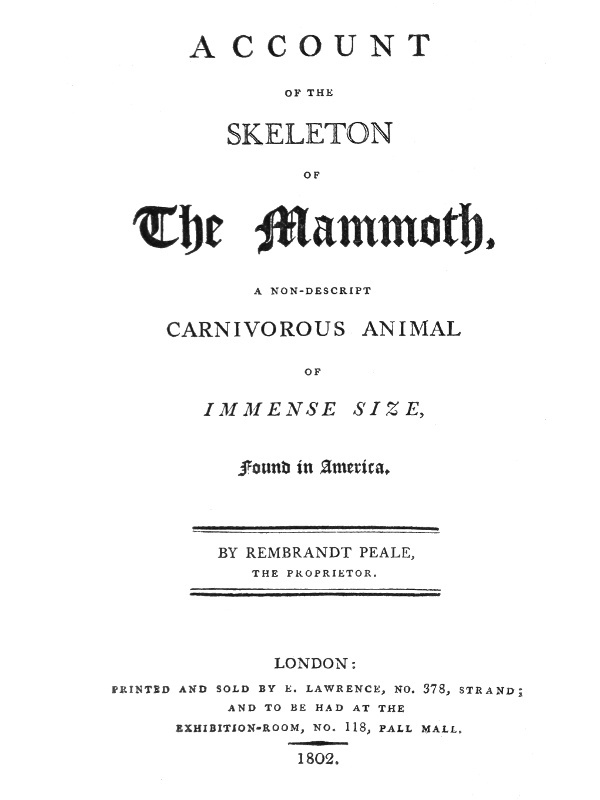
Account of the Skeleton of the Mammoth / A non-descript carnivorous animal of immense size, found in America
Explore more books like this:
About This Book
The narrative traces early discoveries of enormous fossil bones in North America and Siberia, summarizing reports, measurements, and local accounts while scrutinizing mistaken attributions to human giants or to modern elephants. It compares anatomical features—flattened femora, curved tusks, and hippopotamus-like grinders—notes confusion caused by scattered and hastily collected specimens, and reviews contemporary naturalists' opinions. The author evaluates the evidence, describes the collection and dispersal of remains across Europe, and argues for careful anatomical comparison and accurate documentation to reconstruct the animal's size and affinities from fragmentary fossils.
About the Author

You May Also Like
6 picks
 "Five-Head" Creek; and Fish Drugging in the Pacific / 1901
by Louis Becke
"Five-Head" Creek; and Fish Drugging in the Pacific / 1901
by Louis Becke
 "Pennsylvania Dutch," and other essays
by Phebe Earle Gibbons
"Pennsylvania Dutch," and other essays
by Phebe Earle Gibbons
 "Sterminator Vesevo" (Vesuvius the great exterminator) / Diary of the Eruption of April 1906
by Matilde Serao
"Sterminator Vesevo" (Vesuvius the great exterminator) / Diary of the Eruption of April 1906
by Matilde Serao
 21 Jahre in Indien. Dritter Theil: Sumatra.
by Heinrich Breitenstein
21 Jahre in Indien. Dritter Theil: Sumatra.
by Heinrich Breitenstein
 21 Jahre in Indien. Erster Theil: Borneo.
by Heinrich Breitenstein
21 Jahre in Indien. Erster Theil: Borneo.
by Heinrich Breitenstein
 A Bakony (1. kötet)
by Károly Eötvös
A Bakony (1. kötet)
by Károly Eötvös