
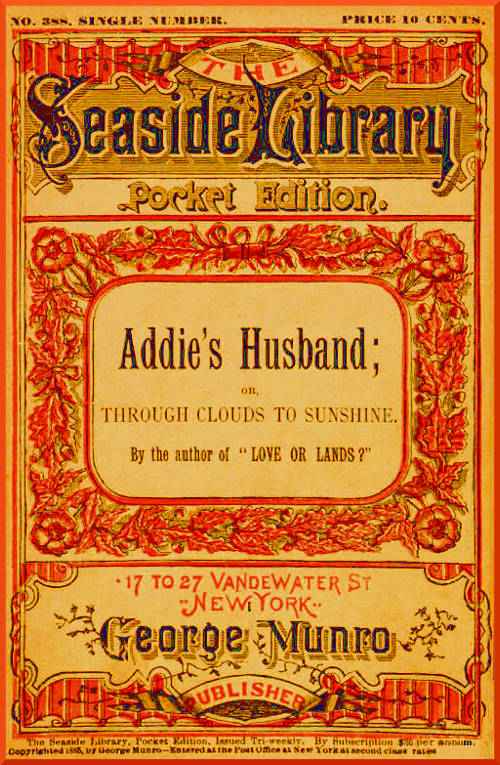
The Project Gutenberg eBook of Addie's Husband; or, Through clouds to sunshine
Title: Addie's Husband; or, Through clouds to sunshine
Author: Mrs. Gordon Smythies
Release date: August 28, 2015 [eBook #49806]
Most recently updated: October 24, 2024
Language: English
Credits: Produced by Chris Whitehead, Demian Katz and the Online
Distributed Proofreading Team at http://www.pgdp.net (Images
courtesy of the Digital Library@Villanova University
(http://digital.library.villanova.edu/))
The cover image was restored by the transcriber and is placed in the public domain.
MUNRO'S PUBLICATIONS.
THE SEASIDE LIBRARY.—POCKET EDITION.
| NO. | PRICE. | NO. | PRICE. | ||
| 1 | Yolande. By William Black | 20 | 58 | By the Gate of the Sea. D. C. Murray | 10 |
| 2 | Molly Bawn. By "The Duchess" | 20 | 59 | Vice Versâ. By F. Anstey | 20 |
| 3 | The Mill on the Floss. By George Eliot | 20 | 60 | The Last of the Mohicans. Cooper | 20 |
| 4 | Under Two Flags. By "Ouida" | 20 | 61 | Charlotte Temple. By Mrs. Rowson | 10 |
| 5 | Admiral's Ward. By Mrs. Alexander | 20 | 62 | The Executor. By Mrs. Alexander | 20 |
| 6 | Portia. By "The Duchess" | 20 | 63 | The Spy. By J. Fenimore Cooper | 20 |
| 7 | File No. 113. By Emile Gaboriau | 20 | 64 | A Maiden Fair. By Charles Gibbon | 10 |
| 8 | East Lynne. By Mrs. Henry Wood | 20 | 65 | Back to the Old Home. By M. C. Hay | 10 |
| 9 | Wanda. By "Ouida" | 20 | 66 | The Romance of a Poor Young Man. By Octave Feuillet | 10 |
| 10 | The Old Curiosity Shop. By Dickens | 20 | 67 | Lorna Doone. By R. D. Blackmore | 30 |
| 11 | John Halifax, Gentleman. Miss Mulock | 20 | 68 | A Queen Amongst Women. By the Author of "Dora Thorne" | 10 |
| 12 | Other People's Money. By Gaboriau | 20 | 69 | Madolin's Lover. By the Author of "Dora Thorne" | 20 |
| 13 | Eyre's Acquittal. By Helen B. Mathers | 10 | 70 | White Wings. By William Black | 10 |
| 14 | Airy Fairy Lilian. By "The Duchess" | 10 | 71 | A Struggle for Fame. Mrs. Riddell | 20 |
| 15 | Jane Eyre. By Charlotte Brontë | 20 | 72 | Old Myddelton's Money. By M. C. Hay | 20 |
| 16 | Phyllis. By "The Duchess" | 20 | 73 | Redeemed by Love. By the Author of "Dora Thorne" | 20 |
| 17 | The Wooing O't. By Mrs. Alexander | 15 | 74 | Aurora Floyd. By Miss M. E. Braddon | 20 |
| 18 | Shandon Bells. By William Black | 20 | 75 | Twenty Years After. By Dumas | 20 |
| 19 | Her Mother's Sin. By the Author of "Dora Thorne" | 10 | 76 | Wife in Name Only. By the Author of "Dora Thorne" | 20 |
| 20 | Within an Inch of His Life. By Emile Gaboriau | 20 | 77 | A Tale of Two Cities. By Dickens | 15 |
| 21 | Sunrise. By William Black | 20 | 78 | Madcap Violet. By William Black | 20 |
| 22 | David Copperfield. Dickens. Vol. I. | 20 | 79 | Wedded and Parted. By the Author of "Dora Thorne" | 10 |
| 22 | David Copperfield. Dickens. Vol. II. | 20 | 80 | June. By Mrs. Forrester | 20 |
| 23 | A Princess of Thule. By William Black | 20 | 81 | A Daughter of Heth. By Wm. Black | 20 |
| 24 | Pickwick Papers. Dickens. Vol. I. | 20 | 82 | Sealed Lips. By F. Du Boisgobey | 20 |
| 24 | Pickwick Papers. Dickens. Vol. II. | 20 | 83 | A Strange Story. Bulwer Lytton | 20 |
| 25 | Mrs. Geoffrey. By "The Duchess" | 20 | 84 | Hard Times. By Charles Dickens | 10 |
| 26 | Monsieur Lecoq. By Gaboriau. Vol. I. | 20 | 85 | A Sea Queen. By W. Clark Russell | 20 |
| 26 | Monsieur Lecoq. By Gaboriau. Vol. II. | 20 | 86 | Belinda. By Rhoda Broughton | 20 |
| 27 | Vanity Fair. By William M. Thackeray | 20 | 87 | Dick Sand; or, A Captain at Fifteen. By Jules Verne | 20 |
| 28 | Ivanhoe. By Sir Walter Scott | 20 | 88 | The Privateersman. Captain Marryat | 20 |
| 29 | Beauty's Daughters. "The Duchess" | 10 | 89 | The Red Eric. By R. M. Ballantyne | 10 |
| 30 | Faith and Unfaith. By "The Duchess" | 20 | 90 | Ernest Maltravers. Bulwer Lytton | 20 |
| 31 | Middlemarch. By George Eliot | 20 | 91 | Barnaby Rudge. By Charles Dickens | 20 |
| 32 | The Land Leaguers. Anthony Trollope | 20 | 92 | Lord Lynne's Choice. By the Author of "Dora Thorne" | 10 |
| 33 | The Clique of Gold. By Emile Gaboriau | 10 | 93 | Anthony Trollope's Autobiography | 20 |
| 34 | Daniel Deronda. By George Eliot | 30 | 94 | Little Dorrit. By Charles Dickens | 30 |
| 35 | Lady Audrey's Secret. Miss Braddon | 20 | 95 | The Fire Brigade. R. M. Ballantyne | 10 |
| 36 | Adam Bede. By George Eliot | 20 | 96 | Erling the Bold. By R. M. Ballantyne | 10 |
| 37 | Nicholas Nickleby. By Charles Dickens | 30 | 97 | All in a Garden Fair. Walter Besant | 20 |
| 38 | The Widow Lerouge. By Gaboriau | 20 | 98 | A Woman-Hater. By Charles Reade | 15 |
| 39 | In Silk Attire. By William Black | 20 | 99 | Barbara's History. A. B. Edwards | 20 |
| 40 | The Last Days of Pompeii. By Sir E. Bulwer Lytton | 20 | 100 | 20,000 Leagues Under the Seas. By Jules Verne | 20 |
| 41 | Oliver Twist. By Charles Dickens | 15 | 101 | Second Thoughts. Rhoda Broughton | 20 |
| 42 | Romola. By George Eliot | 20 | 102 | The Moonstone. By Wilkie Collins | 15 |
| 43 | The Mystery of Orcival. Gaboriau | 20 | 103 | Rose Fleming. By Dora Russell | 10 |
| 44 | Macleod of Dare. By William Black | 20 | 104 | The Coral Pin. By F. Du Boisgobey | 30 |
| 45 | A Little Pilgrim. By Mrs. Oliphant | 10 | 105 | A Noble Wife. By John Saunders | 20 |
| 46 | Very Hard Cash. By Charles Reade | 20 | 106 | Bleak House. By Charles Dickens | 40 |
| 47 | Altiora Peto. By Laurence Oliphant | 20 | 107 | Dombey and Son. Charles Dickens | 40 |
| 48 | Thicker Than Water. By James Payn | 20 | 108 | The Cricket on the Hearth, and Doctor Marigold. By Charles Dickens | 10 |
| 49 | That Beautiful Wretch. By Black | 20 | 109 | Little Loo. By W. Clark Russell | 20 |
| 50 | The Strange Adventures of a Phaeton. By William Black | 20 | 110 | Under the Red Flag. By Miss Braddon | 10 |
| 51 | Dora Thorne. By the Author of "Her Mother's Sin" | 20 | 111 | The Little School-Master Mark. By J. H. Shorthouse | 10 |
| 52 | The New Magdalen. By Wilkie Collins | 10 | 112 | The Waters of Marah. By John Hill | 20 |
| 53 | The Story of Ida. By Francesca | 10 | 113 | Mrs. Carr's Companion. By M. G. Wightwick | 10 |
| 54 | A Broken Wedding-Ring. By the Author of "Dora Thorne" | 20 | 114 | Some of Our Girls. By Mrs. C. J. Eiloart | 20 |
| 55 | The Three Guardsmen. By Dumas | 20 | 115 | Diamond Cut Diamond. By T. Adolphus Trollope | 10 |
| 56 | Phantom Fortune. Miss Braddon | 20 | 116 | Moths. By "Ouida" | 20 |
| 57 | Shirley. By Charlotte Brontë | 20 | 117 | A Tale of the Shore and Ocean. By W. H. G. Kingston | 20 |
| 118 | Loys, Lord Berresford, and Eric Dering. By "The Duchess" | 10 | 154 | Annan Water. By Robert Buchanan | 20 |
| 119 | Monica, and A Rose Distill'd. By "The Duchess" | 10 | 155 | Lady Muriel's Secret. By Jean Middlemas | 20 |
| 120 | Tom Brown's School Days at Rugby. By Thomas Hughes | 20 | 156 | "For a Dream's Sake." By Mrs. Herbert Martin | 20 |
| 121 | Maid of Athens. By Justin McCarthy | 20 | 157 | Milly's Hero. By F. W. Robinson | 20 |
| 122 | Ione Stewart. By Mrs. E. Lynn Linton | 20 | 158 | The Starling. By Norman Macleod, D.D. | 10 |
| 123 | Sweet is True Love. By "The Duchess" | 10 | 159 | A Moment of Madness, and Other Stories. By Florence Marryat | 10 |
| 124 | Three Feathers. By William Black | 20 | 160 | Her Gentle Deeds. By Sarah Tytler | 10 |
| 125 | The Monarch of Mincing Lane. By William Black | 20 | 161 | The Lady of Lyons. Founded on the Play of that title by Lord Lytton | 10 |
| 126 | Kilmeny. By William Black | 20 | 162 | Eugene Aram. By Sir E. Bulwer Lytton | 20 |
| 127 | Adrian Bright. By Mrs. Caddy | 20 | 163 | Winifred Power. By Joyce Darrell | 20 |
| 128 | Afternoon, and Other Sketches. By "Ouida" | 10 | 164 | Leila; or, The Siege of Grenada. By Sir E. Bulwer Lytton | 10 |
| 129 | Rossmoyne. By "The Duchess" | 10 | 165 | The History of Henry Esmond. By William Makepeace Thackeray | 20 |
| 130 | The Last of the Barons. By Sir E. Bulwer Lytton | 40 | 166 | Moonshine and Marguerites. By "The Duchess" | 10 |
| 131 | Our Mutual Friend. By Charles Dickens | 40 | 167 | Heart and Science. By Wilkie Collins | 20 |
| 132 | Master Humphrey's Clock. By Charles Dickens | 10 | 168 | No Thoroughfare. By Charles Dickens and Wilkie Collins | 10 |
| 133 | Peter the Whaler. By W. H. G. Kingston | 10 | 169 | The Haunted Man. By Charles Dickens | 10 |
| 134 | The Witching Hour. By "The Duchess" | 10 | 170 | A Great Treason. By Mary Hoppus | 30 |
| 135 | A Great Heiress. By R. E. Francillon | 10 | 171 | Fortune's Wheel, and Other Stories. By "The Duchess" | 10 |
| 136 | "That Last Rehearsal." By "The Duchess" | 10 | 172 | "Golden Girls." By Alan Muir | 20 |
| 137 | Uncle Jack. By Walter Besant | 10 | 173 | The Foreigners. By Eleanor C. Price | 20 |
| 138 | Green Pastures and Piccadilly. By William Black | 20 | 174 | Under a Ban. By Mrs. Lodge | 20 |
| 139 | The Romantic Adventures of a Milkmaid. By Thomas Hardy | 10 | 175 | Love's Random Shot, and Other Stories. By Wilkie Collins | 10 |
| 140 | A Glorious Fortune. By Walter Besant | 10 | 176 | An April Day. By Philippa P. Jephson | 10 |
| 141 | She Loved Him! By Annie Thomas | 10 | 177 | Salem Chapel. By Mrs. Oliphant | 20 |
| 142 | Jenifer. By Annie Thomas | 20 | 178 | More Leaves from the Journal of a Life in the Highlands. By Queen Victoria | 10 |
| 143 | One False, Both Fair. J. B. Harwood | 20 | 179 | Little Make-Believe. By B. L. Farjeon | 10 |
| 144 | Promises of Marriage. By Emile Gaboriau | 10 | 180 | Round the Galley Fire. By W. Clark Russell | 10 |
| 145 | "Storm-Beaten:" God and The Man. By Robert Buchanan | 20 | 181 | The New Abelard. By Robert Buchanan | 10 |
| 146 | Love Finds the Way. By Walter Besant and James Rice | 10 | 182 | The Millionaire. A Novel | 20 |
| 147 | Rachel Ray. By Anthony Trollope | 20 | 183 | Old Contrairy, and Other Stories. By Florence Marryat | 10 |
| 148 | Thorns and Orange-Blossoms. By the author of "Dora Thorne" | 10 | 184 | Thirlby Hall. By W. E. Norris | 20 |
| 149 | The Captain's Daughter. From the Russian of Pushkin | 10 | 185 | Dita. By Lady Margaret Majendie | 10 |
| 150 | For Himself Alone. By T. W. Speight | 10 | 186 | The Canon's Ward. By James Payn | 20 |
| 151 | The Ducie Diamonds. By C. Blatherwick | 10 | 187 | The Midnight Sun. By Fredrika Bremer | 10 |
| 152 | The Uncommercial Traveler. By Charles Dickens | 20 | 188 | Idonea. By Anne Beale | 20 |
| 153 | The Golden Calf. By Miss M. E. Braddon | 20 | 189 | Valerie's Fate. By Mrs. Alexander | 5 |
| 190 | Romance of a Black Veil. By the author of "Dora Thorne" | 10 | 226 | Friendship. By "Ouida" | 20 |
| 191 | Harry Lorrequer. By Charles Lever | 15 | 227 | Nancy. By Rhoda Broughton | 15 |
| 192 | At the World's Mercy. By F. Warden | 10 | 228 | Princess Napraxine. By "Ouida" | 20 |
| 193 | The Rosary Folk. By G. Manville Fenn | 10 | 229 | Maid, Wife, or Widow? By Mrs. Alexander | 10 |
| 194 | "So Near and Yet So Far!" By Alison | 10 | 230 | Dorothy Forster. By Walter Besant | 15 |
| 195 | "The Way of the World." By David Christie Murray | 15 | 231 | Griffith Gaunt. By Charles Reade | 15 |
| 196 | Hidden Perils. By Mary Cecil Hay | 10 | 232 | Love and Money; or, A Perilous Secret. By Charles Reade | 10 |
| 197 | For Her Dear Sake. By Mary Cecil Hay | 20 | 233 | "I Say No;" or, the Love-Letter Answered. Wilkie Collins | 15 |
| 198 | A Husband's Story | 10 | 234 | Barbara; or, Splendid Misery. Miss M. E. Braddon | 15 |
| 199 | The Fisher Village. By Anne Beale | 10 | 235 | "It is Never Too Late to Mend." By Charles Reade | 20 |
| 200 | An Old Man's Love. By Anthony Trollope | 10 | 236 | Which Shall It Be? Mrs. Alexander | 20 |
| 201 | The Monastery. By Sir Walter Scott | 20 | 237 | Repented at Leisure. By the author of "Dora Thorne" | 15 |
| 202 | The Abbot. By Sir Walter Scott | 20 | 238 | Pascarel. By "Ouida" | 20 |
| 203 | John Bull and His Island. By Max O'Rell | 10 | 239 | Signa. By "Ouida" | 20 |
| 204 | Vixen. By Miss M. E. Braddon | 15 | 240 | Called Back. By Hugh Conway | 10 |
| 205 | The Minister's Wife. By Mrs. Oliphant | 30 | 241 | The Baby's Grandmother. By L. B. Walford | 10 |
| 206 | The Picture, and Jack of All Trades. By Charles Reade | 10 | 242 | The Two Orphans. By D'Ennery | 10 |
| 207 | Pretty Miss Neville. By B. M. Croker | 15 | 243 | Tom Burke of "Ours." First half. By Charles Lever | 20 |
| 208 | The Ghost of Charlotte Cray, and Other Stories. By Florence Marryat | 10 | 243 | Tom Burke of "Ours." Second half. By Charles Lever | 20 |
| 209 | John Holdsworth, Chief Mate. By W. Clark Russell | 10 | 244 | A Great Mistake. By the author of "His Wedded Wife" | 20 |
| 210 | Readiana: Comments on Current Events. By Chas. Reade | 10 | 245 | Miss Tommy, and In a House-Boat. By Miss Mulock | 10 |
| 211 | The Octoroon. By Miss M. E. Braddon | 10 | 246 | A Fatal Dower. By the author of "His Wedded Wife" | 10 |
| 212 | Charles O'Malley, the Irish Dragoon. By Chas. Lever (Complete in one volume) | 30 | 247 | The Armourer's Prentices. By Charlotte M. Yonge | 10 |
| 213 | A Terrible Temptation. Chas. Reade | 15 | 248 | The House on the Marsh. F. Warden | 10 |
| 214 | Put Yourself in His Place. By Charles Reade | 15 | 249 | "Prince Charlie's Daughter." By author of "Dora Thorne" | 10 |
| 215 | Not Like Other Girls. By Rosa Nouchette Carey | 15 | 250 | Sunshine and Roses; or, Diana's Discipline. By the author of "Dora Thorne" | 10 |
| 216 | Foul Play. By Charles Reade | 15 | 251 | The Daughter of the Stars, and Other Tales. By Hugh Conway, author of "Called Back" | 10 |
| 217 | The Man She Cared For. By F. W. Robinson | 15 | 252 | A Sinless Secret. By "Rita" | 10 |
| 218 | Agnes Sorel. By G. P. R. James | 15 | 253 | The Amazon. By Carl Vosmaer | 10 |
| 219 | Lady Clare; or, The Master of the Forges. By Georges Ohnet | 10 | 254 | The Wife's Secret, and Fair but False. By the author of "Dora Thorne" | 10 |
| 220 | Which Loved Him Best? By the author of "Dora Thorne" | 10 | |||
| 221 | Comin' Thro' the Rye. By Helen B. Mathers | 15 | |||
| 222 | The Sun-Maid. By Miss Grant | 15 | |||
| 223 | A Sailor's Sweetheart. By W. Clark Russell | 15 | |||
| 224 | The Arundel Motto. Mary Cecil Hay | 15 | |||
| 225 | The Giant's Robe. By F. Anstey | 15 |
[CONTINUED ON THIRD PAGE OF COVER.]
ADDIE'S HUSBAND.
CHAPTER I.
"'Soldier, sailor, tinker, tailor, policeman, plowboy, gentleman—' Adelaide Lefroy, lift your lovely head, my dear; you're to marry a gentleman."
Miss Adelaide, who is absorbed in the enjoyment of a ruddy ribstone pippin, turns her blooming freckled face to the speaker, and answers pleasantly, though a little indistinctly—
"I'm to marry a gentleman, brother Hal? Well, I guess I've no particular objection! Whenever he comes, he will find me ready to do him homage, and no mistake! Can't you tell me more about him? 'A gentleman' is rather vague. Is he to be rich, poor, or something between? Am I to share his gentility in a Belgravian mansion or a suburban villa?"
"The oracle does not say. I can't tell you any more, Addie. I've come nearer the point with the others, though. Pauline is to be a soldier's bride, Goggles a policeman's!"
"Don't you believe him, Addie!" burst in Goggles, a pale delicate-looking child of twelve, with large protruding eyes and a painfully inquiring turn of mind. "He cheated horribly; he ran the policeman in before the tailor the second time, and left out the sailor."
"I didn't, miss—I did it quite fairly. You had four chances; you got the tinker once and the policeman three times. You're to marry a bobby—there's no hope for you!"
"I won't, I won't, I won't!" she retorts passionately, angry tears welling into her big, foolish eyes. "I won't marry a policeman, Hal! I'd rather die an old maid ten times over."
"First catch your policeman, my dear," chimes in Pauline, languidly waving aside a swarm of gnats dancing round her beautiful dusky head. "You'll not find many of that ilk sneaking round our larder, I can tell you!"
"I don't care whether I do or not. I won't marry a—"
"That will do, Lottie; we have had quite enough of this nonsense," interposes Addie, suddenly and unexpectedly assuming the tones of a reproving elder sister. "You came out here to study, and I don't think either you or Pauline has read that French exercise once, though you promised Aunt Jo you would have it off by heart for her this afternoon. Give me the book; I'll hear you. Translate 'I am hungry; give me some cheese.'"
"Je suis faim; donnez-moi du—du—"
"No; wrong to begin with. It is J'ai faim, 'I have hunger.'"
"'I have hunger!'" grumbles Lottie. "That just shows what a useless humbugging language French is! Fancy any one but an idiot saying, 'I have hunger,' instead of—"
"Don't talk so much. 'Have you my brother's penknife?'"
"Avez-vous mon frère's plume-couteau?"
Miss Lefroy tosses back the tattered Ahn in speechless disgust.
"Never mind, Goggles; I'll give you a sentence to translate," whispers Hal teasingly. "Listen! Esker le policeman est en amour—eh? That's better than anything in an old Ahn or Ollendorff, isn't it? Esker le poli—"
"Hal, do leave your sister alone, and attend to your own task. I don't believe you have got that wretched sum right yet, though you have been at it all the morning."
"And such a toothsome sum too!" says Pauline, leaning forward and reading aloud the problem inscribed on the top of the cracked greasy slate in Aunt Jo's straggling old fashioned writing—
"'Uncle Dick gave little Jemmy five shillings as a Christmas-box. He went to a pastry-cook's, and bought seven mince-pies at twopence halfpenny each, a box of chocolate, nine oranges at one shilling and sixpence per dozen; he gave tenpence to a poor boy, and had four-pence left. What was the price of the chocolate?'"
"It's a rotten old sum—that's what it is!" says Hal trenchantly. "What's the sense of annoying a fellow with mince-pies and things when he hasn't the faintest chance of getting outside one for—"
"Hal, don't be vulgar!"
"Besides, you can change the pies into potatoes or rhubarb-powders if you like," puts in Goggles spitefully, "and work the sum all the same. I'll tell auntie you did nothing but draw the dogs all the morning."
"Yah! Tell-tale tit, your tongue shall be split!"
"Why did you say I'd marry a—"
"Charlotte, hold your tongue at once!"
There is a ring of authority in Miss Lefroy's fresh voice that insures silence.
Pauline throws herself back upon the mossy sward, yawning heavily; Addie weaves herself a wreath of feathery grasses and tinted autumn-leaves, then picks a milky-petaled flower, which she stealthily and cautiously begins to fray.
"'Soldier, sailor, tinker, tailor, policeman, plowboy, gentleman—' Again! How very strange! There seems a fate in it! I wish I could find out more, though. I can't bring it to 'soldier'—heigh-ho!"
It is a still slumberous noon in early October: a mellow sun trickles through "th' umbrageous multitude of leaves," which still linger, vivid-hued, on the stately timber that shelters Nutsgrove, the family residence of the pauper Lefroys.
Nutsgrove is a low rambling brick manor-house, built in the time of the Tudors, surrounded by a stone terrace leading to a vast parterre, which, in the days of their opulence, the Lefroys were wont to maintain, vied in beauty and architectural display with the famous gardens of Nonsuch, in the reign of Henry VIII., sung by Spenser, but which now, alas, was a ragged wilderness, covered with overgrown distorted shrubs, giant weeds, ruinous summer-houses, timeworn statues, and slimy pools, in which once splashed fairy-mouthed fountains.
Through every channel one might running see"
to the bottom,
Beyond this acreage of desolation is the orchard, protected by crumbling walls, creeping into the famous nut-grove, the uncultured beauty of which the noisome hands of neglect and decay have not touched.
As the nut-grove was in the days of Tristran le Froi, when he established himself on Saxon soil, so it is now—a green-canopied retreat, carpeted with moss and fringed with fern; it is the chosen home of every woodlark, blackbird, thrush, and squirrel of taste in the shire—the nursery, school-room, El Dorado of the five young Lefroys, children of Colonel Robert Lefroy, commonly known as "Robert the Devil" in the days of his reckless youth and unhonored prime, a gentleman who bade his family and his native land goodnight in rather hurried fashion about three years before.
"There goes Bob! I wonder did he get the ferret out of old Rogers?" exclaims Hal, breaking a drowsy silence. "I wish he'd come and tell us."
But the heir of the house of Lefroy, heedless of appealing cry and inviting whistle, stalks homeward steadily, a rank cigarette hanging from his beardless lips, a pair of bull-pups clinging to his heels. He is a tall shapely lad of eighteen, with a handsome gypsy face and eyes like his sister Pauline's—large, dark, full of haughty fire.
"How nasty of him not to come!" grumbles the younger brother. "I wonder what has put his back up? Perhaps old Rogers turned crusty, and wouldn't lend the ferret. Shouldn't wonder, because—"
"The gong, the gong at last!" cries Pauline, springing to her feet. "I didn't know I was so hungry until its welcome music smote my ears. Come along, family."
They need no second bidding. In two minutes the grove is free from their boisterous presence, and they are flying across the lawn, their mongrel but beloved kennel barking, yelping, and scampering enthusiastically around, making the autumn noon hideous.
"What's for dinner?"
"Rabbits!"
"Rabbits! Ye gods—again! Why, this is the fourth day this week that we've fared on their delectable flesh!" cries Robert, striding into the dining-room in grim disgust.
"At this rate we'll soon clear Higgins's warren for him!" chimes in Hal.
"Aunt Jo, let me say grace to-day, will you?"
"Certainly, my dear," Aunt Jo responds, somewhat surprised at the request. She is a mild, sheep faced old gentlewoman, with weary eyes that within the last two years have rained tears almost daily.
Pauline folds her slim sunburnt hands, bows her head, and murmurs reverently—
Of rabbits hot, of rabbits cold,
Of rabbits tender, rabbits tough,
We thank thee, Lord, we've had enough!"
"Amen!" respond the family, in full lugubrious choir.
"I wonder if I shall know the flavor of butcher's meat if I ever taste it again?" says Robert presently, with exaggerated exertion hacking a cumbrous limb that covers his cracked plate—a plate which a china-collector would have treasured in a cabinet.
"You certainly won't taste butcher's meat again until the butcher's bill is paid," answers Aunt Jo sharply. "Thirteen pounds eleven and sixpence—so he sent me word when Sarah tried to get a mutton-chop for Lottie the day she was so ill. Until his bill is paid, he won't trust us with another pound of flesh; that was the message he sent to me—to me—Josephine Darcy! Oh that I should live to receive such a message from a tradesman! What would my dear uncle the bishop have felt if he could have heard it?"
"But he can't hear it, auntie dear," says Lottie, consolingly. "He's dead, you know."
"Not dead, but gone before," reproves Miss Darcy, burying her face in her handkerchief.
"Water-works again!" groans Robert, sotto voce. "Use the plug, some one."
Addie obeys the elegant order by slipping her arm round the old lady's neck.
"There, there, dear; don't take on so. You fret too much about us; you'll make yourself ill in the end. Cheer up, auntie dear, cheer—"
"Cheer up!" she interrupts, in a wailing voice. "Oh, child, it is easy for you to talk in that light way! Cheer up, when poverty is at the door, starvation staring us in the face! Cheer up, when I look at you five neglected, deserted children, growing up half fed, wholly uneducated, clothed as badly as the poorest laborer on the vast estates your grandfather owned—you my poor dead sister's children! Oh, Addie, Addie, you talk and feel like a child—a child of the summer, who has not the sense, the power to feel the chill breath of coming winter! How can you know? How can you understand? You heard your brothers and your sisters here grumbling and railing at me not five minutes ago because I had not legs of mutton and ribs of beef to feed you with, grumbling because this is the fourth time in one week you have had to dine off rabbit. Well"—with a sudden burst of anguish—"do you know, if Steve Higgins, devoted retainer that he is, had not the kindness, the forethought to supply us, as he has been doing for the last month, with the surplus of his warren, you'd have had to dine off bread and vegetables altogether? For not a scrap of solid food will they supply us with in Nutsford until my wretched dividends are due, and that is four months off yet. Oh, Addie dear, don't try to talk to me; I can bear up no longer! Sorrows have come to me too late in life. I—I can bear up no longer!"
Her voice dies away in hysterical sobs. By this time the family are grouped round the afflicted lady; even Robert's hard young arm encircles her heaving shoulder. He joins as vehemently as any in the sympathizing chorus.
"There, there; don't, auntie dear. Heaven will help us, you'll see!"
"Every cloud has a silver lining, every thorn-bush a blossom."
"Something is sure to turn up, never fear."
"And we shouldn't mind a bit if you wouldn't take on so and fret so dreadfully."
"Don't heed our grumblings; they're only noise. We'd just as soon have rabbit as anything else—wouldn't you, boys, wouldn't you? There, auntie, you hear them. Boys must grumble at something; it wouldn't be natural if they didn't."
"Oh, auntie, auntie, can't you believe us? We're quite, quite happy as we are. As long as we are all together, as long as we have the dear old place to live in, what does anything else matter? We're quite happy. We never want to change or go away, or wear grand clothes, talk French, or thump the piano like other common people. We don't—we don't indeed! If you would only leave off fretting, we'd leave off grumbling, and be all as happy as the day is long."
Somewhat cheered by this unanimous appeal, Miss Darcy wipes her eyes, though still protesting.
"I know that, I know that; as long as you're allowed to wander at your own sweet will, lie on haystacks, rifle birds' nests, strip the apple and cherry trees, hunt rats and rabbits, and, above all, do no lessons, and make no attempt to improve your minds in any way, you will be happy. But the question is, How long will these doubtful means of happiness be left to you? Acre after acre, farm after farm, has slipped from the family within the last thirty years. You have now but nominal possession of the house, garden, orchard, and part of the grove—only nominal possession, remember, for the place is mortgaged to the last farthing; the very pictures on the wall, the chairs you sit on, the china in the pantry, are all security for borrowed money. And—and, children"—impressively—"it is best for you to know the worst. If—if your—your father should cease to pay the interest on this money, why, his creditors could seize on this place and turn you out homeless on the roadside at an hour's notice!"
There is a deep silence; then comes a protesting outburst. Robert's dark face flushes wrathfully as he exclaims—
"But—but, Aunt Jo, he—he will—he must pay the interest, and give me a chance of reclaiming my birthright. He—he couldn't be so—so bad as to let that lapse under the circumstances."
"Circumstances may be too strong for him."
"In any case," says Pauline hopefully, "the creditors couldn't be so heartless, so devoid of all feelings of humanity as to turn us out like that; they must wait until some of us are dead, or married, or something. Where could we go?"
"Your father's creditors are Jews, Pauline; they are not famed for humanity or forbearance. However, as you say, children, it is best to look at the bright side of things, and trust in the mercy of Heaven."
"And in the mercy of a Jew too!" chimes in Addie.
"'Hath not a Jew eyes? Hath not a Jew hands, organs, dimensions, senses, affections, passions—fed with the same food, hurt with the same weapons, subject to the same diseases, healed by the same means, warmed and cooled by the same summer and winter, as a Christian is? If you prick him, does he not bleed? If you tickle him, does he not laugh? If you poison him, does he not—'"
"Bravo, Addie—bravo; well done!"
"That was tall spouting, and no mistake! Where did you pick it all up?"
"That's Shakespeare," Addie answers, lifting her rosy pale face proudly—"it is from the 'Merchant of Venice;' I read the whole play through yesterday, and enjoyed it greatly."
"You imagined you did, my dear."
"Nothing of the kind, Robert; I found it most interesting."
"Don't tell me, Addie," says Pauline, with a tantalizing laugh, "that you found it as interesting as 'The Children of the Abbey,' 'The Castle of Otranto,' or 'The Heir of Redcliffe,' for I won't believe you."
"The styles are quite distinct; you could not possibly compare them," Addie retorts more grandly still. "I am going up to the grove now to read 'A Midsummer Night's Dream.' I believe it's beautiful."
"Don't you think, my dear niece, you had better mend that hole in your stocking, just above the heel, first?" interposes Miss Darcy gently. "It has been in that yawning condition for the last two days; and, to say the least of it, it scarcely looks ladylike."
"I noticed it when I was dressing," assents Addie, placidly, "but quite forgot about it afterward. Who'll lend me a thimble and a needle and some cotton?"
CHAPTER II.
"Three hundred years, isn't it, Addie, since the Lefroys first settled at Nutsgrove?"
"Three hundred years," repeats Addie automatically. "Since the year of the Massacre of St. Bartholomew, A.D., 1572, when Tristran le Froi, Sieur de Beaulieu, fled from his patrimonial estates in Anjou to England, where he settled at Nutsgrove, and married, in 1574, Adelaide Marion, daughter and heiress of Sir Robert Tisdale of Flockton, by whom he had issue, three sons and two daughters—Stephen, Robert, Tristran, who—"
"Three hundred years!" repeats Robert, with fierce bitterness, a lurid light gleaming in his eyes. "What right had he to treat me like that? He got it from his father, who got it from his, and so on backward from son to father for generations. Why should I be made to suffer for his iniquity? Why should I lose what he inherited in solemn trust for his son or next of kin? It is infamous, it is monstrous! I suppose it would be wrong to wish that one's own father—"
"Oh, hush, Robert—hush!"
Addie's hand is placed over the boy's quivering mouth; he is silenced.
Eight months have gone by, and the great evil foreseen by poor Aunt Jo has come to pass.
Colonel Lefroy, out of reach of remonstrance or appeal, has let the old home of his forefathers pass out of his hands and his son's forever. The Jews have seized on the estate, evicted its nominal possessors, sold by public auction the goods and chattels, the pictures, china, plate, moldy tapestries, tattered carpets, curtains, scratched and time stained Chippendale; even the worthless relics of their nursery-days the homeless wretched children have not been allowed to take with them. The house and immediately surrounding land, after some brisk competition, has been purchased by Tom Armstrong, the great manufacturer, owner of some half-dozen of the most unsavory chimneys in Kelvick, which at times, when the wind is blowing due south, carry their noxious effluvia over the dewy acres of Nutsgrove and the surrounding estates, and most unpleasantly tickle the noses of aristocratic county proprietors, who have nothing in common with the busy plebeian heart of commerce and inventive industry throbbing in the very center of their pastures.
And now Tom Armstrong of Kelvick, a man of the people, who has risen from the lowest rung of the social ladder, is master of Nutsgrove. And the dark-eyed, blue-blooded Lefroys stand, some two months after his installation, leaning against a five-barred gate in an upland meadow, gazing mournfully, and, oh! how bitterly down on the beloved home they have lost forever!
"Three hundred years," repeats Robert, with a dreary laugh. "Well, at any rate, it will take some time to wash the stains of our tenancy out of the old house, to remove all traces of our footsteps from the well-worn paths! By Jove, the wretched snob is at work already! Yes, look at his people hacking away at the flower-beds, ripping up the avenue, hammering away at the venerable walls! It's—it's enough to make one's blood boil in one's veins! He might at least have had the decency to wait until we had gone. I'd like to kick him from here to Kelvick."
"I don't think he'd let you, Bob," says matter-of-fact Hal. "He's a bigger man than you."
"Yes, but a plowman can't fight a gentleman; they're out of it in the first round. Look at the way I polished off the butcher's boy the day he insulted you—and he's twice my weight. I shouldn't be afraid to tackle Armstrong if I only had the chance, and souse him in one of his vile vitriol-tanks, too. That would stop his hacking and hammering until I was at least out of hearing."
"But, Bob," interposed Lottie, awed by her brother's lordly threats, "you're mistaken. That man on the ladder by the west wall is not hammering or hacking anything; he's only trying to clean the big lobby window outside the housekeeper's room, which, I heard Aunt Jo say one day, hasn't been cleaned since the year poor mamma died, when I was a wee baby. It's so hard to reach, and doesn't open; and—and, Bob, you can hardly blame Mr. Armstrong for weeding those beds, for there were more dandelions and nettles in them last year than stocks or mignonette."
"You mark my words," continues Robert, with lowering impressiveness, heedless of his sister's explanation; "should any of us Lefroys stand in this meadow, say, this time five years, we shall not recognize the face of our old home. All its beloved landmarks will be swept away; the flickering foliage of the grove will have disappeared to make way for stunted shrubs, starveling pines, and prim Portuguese laurels: the ivied walls, the mossy stonework, the straggling wealth of creeper, will have been carted away to display the gaudy rawness of modern landscape-gardening; the little river gurgling through the tangled fern and scented thorn-bushes will be treated like the canal of a people's park; the whole place will reek of vitriol, of chemical manures and commercial improvements. So say good-by to Nutsgrove while you may, for you will never see it again—never again!"
"Oh, Robert, Robert, do you think it will be as bad as that?" cries Addie, turning her soft gray eyes to his wrathful face in wistful appeal.
"Of course I do! What chance has it of escaping moneyed Vandalism? If even a gentleman had bought it, no matter how poor—But what quarter can one expect from the hands of an illiterate vitriol-monger, a low-bred upstart, like that Armstrong?"
"Do you know, I think you are exaggerating his defects a little, Bob?" says Addie, languidly. "He's a plain kind of man certainly, both in manner and appearance; but—but he would not give me the idea of being exactly ill-bred. He does not talk very loud or drop his 'h's,' for instance."
"No, that's just it. I'd respect him far more if he did; it's the painful veneer, the vague, nameless vulgarity of the man that repels me so, that gives me the idea of his being perpetually on the watch in case an 'h' might slip from him unawares. If he were an honest horny-handed son of toil, not ashamed of his shop or his origin, not ashamed to talk of his 'orse and 'is 'ouse like Higgins and Joe Smith, I should not dislike him so much; but he's not that style of man—he belongs to the breed of the pompous upstart, the sort of man stocked with long caddish words that no gentleman uses, the man to call a house a domicile, a horse a quadruped, a trench an excavation, and so on. Talk of the—There goes the beggar, quadruped and all! I dare say he fancies himself a type of the genuine country squire. Ugh! Down, Hal—down, Goggles; he'd spot you in a moment! I wouldn't give him the satisfaction of thinking we'd look at him."
They descend from the gate and stand together, the five abreast, taking their farewell look, with swelling hearts, at the home where they have spent their happy careless youth in sheltered union. They are not a demonstrative family, the Lefroys—not given to moments of "gushing" or caressing; they quarrel frequently among themselves, coming of a hot-blooded race; yet, they are deeply attached to one another, having shared all the joys and sorrows of each others' lives, having no interests, no sympathies outside their immediate circle; and the thought of coming separation weighs heavily on their young hearts, as heavily as the pall of death.
"Well, we'd best make tracks," says Robert, turning away, his hands shading his eyes, "we'll not forget the 29th of May—your birthday, Hal, old chap. Last year, you remember we had tea in the grove, and old Sarah baked us a stunning cake; this year we have made our last pilgrimage together. Next year I wonder where we shall be? Scattered as far and as wide as the graves of a household, I fear."
At this point Addie, the most hot tempered but the most tender-hearted member of the family, breaks down, and flinging her arms round her brother's neck, sobs out piteously—
"O, Bob, Bob, my own darling boy, I—I can't bear it—I can't bear to have you go away over that cruel cold sea! I shall never sleep at night thinking of you. Don't go away, don't go away; let's all stick together and—and—go—die—somewhere—together! Oh, Bob, Bob, my darling, my darling!"
There is another general break-down; they all cling one to another, Hal and Lottie howling dismally, Robert's haughty eyes swimming too in tears, until the sound of voices in a neighboring field forces them to compose themselves, and they walk slowly across the upland meadow, at the furthest corner of which they separate, the boys, at the urgent invitation of their terriers, making for a rat-haunted ditch in the neighborhood, the girls strolling toward Nutsford through the northern end of the grove.
Miss Lefroy stalks on moodily in front, Lottie, still battling with her emotion, clinging to her firm young arm. Pauline walks behind alone, full of bitter thought, her straight brows painfully puckered. On the morrow a new, strange life is to begin for her, one that she knows will be eminently distasteful; her free young spirit is to be "cribbed, cabined, confined," in the narrow path of conventionality at last, and the prospect dismays her. Look as far ahead as she can, she can see no break in the gathering gloom—can see only that at seventeen the summer of her life is over and the long winter about to begin. Hope tells her no flattering tale; she does not know that in herself she holds the key of a triumphant liberty, of a future of sunlight, of glory, of all that is sweet too, and coveted by womanhood. Pauline does not know that she is beautiful, does not feel the shadow of her coming power, or guess that the lithe willowy grace of her straight young form, the glorious black of her eyes, the pure glow of her brunette skin, the chiseled outline of her small features, will purchase for her goods and pleasures of which her careless innocent girlhood has never dreamed. No lover has whispered in her ear "the music of his honey vows," and the cracked, fly-stained mirrors at Nutsgrove have told her nothing; and so she is sad and sorrow-laden, and the burden of dependence and uncongenial companionship looming before her seems to her almost more than she can bear.
In silence they pass out of the green gloom of the grove, where "fair enjeweled May" has touched with balmy breath each tiny bud, each tender leaf,